OSMAN KARATAY.MareMagnum
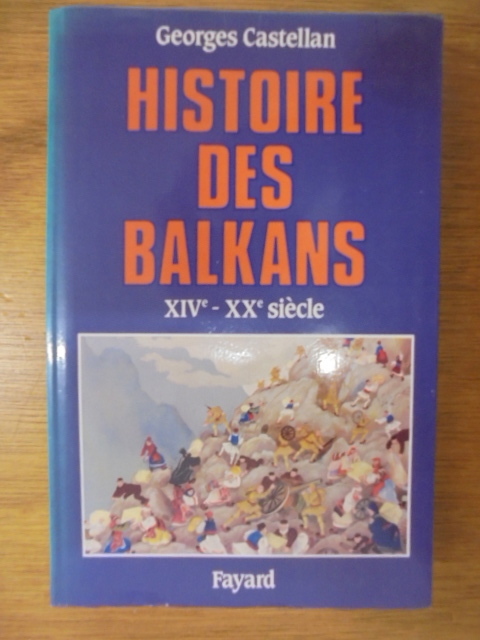
Georges CastellanLivre Rare Book
HISTOIRE DES BALKANS. XIVe - XXe siècle.
HIS976M1993 / 532 pages. Broché. Editions Fayard.

Librairie du Levant · Bayonne, France12,00 €
589 résultats
Fine English Paperback. Pbo. Cr. 8vo. (19 x 13 cm). In English. [iii], 155 p. In search of lost tribe. The origins and making of the Croatian nation. The Croats are a Balkanic nation with a Slavic language. The issue of their origin has been subject to hard debates, but their roots are still "officially" not known. This book offers a new theory, well established in contrary to the others, about who the first Croats were, by explaining how a Turkic tribe disappeared in the north of the Caucasus and appeared in the south of Poland. This study includes also many new ideas about Proto-Hungarian, Proto-Bulgarian, Proto-Serbian, as well as Bosnian and Khazar histories.
As New English Paperback. Pbo. Mint. Roy. 8vo. (24 x 17 cm). In English. 204 p. Ills. One of most recent initiatives of the History Foundation in the field of history education, namely "Improvement of the Balkan History Textbooks Project", was completed in September 2002. This eight-month pilot project was supported by UNESCO, the Heinrich Böll Foundation and the Consulate General of the Netherlands in Turkey. The planning meeting in Istanbul (June 17th-18th,2001) was followed by a workshop in Pamporovo (September 8th-9th, 2001) and a conference in Istanbul (November 30th-December 2nd,2001), with the participation of teams from Bulgaria, Croatia, Greece, Romania and Turkey. The project aimed to bring together academics and history teachers from the Balkan countries; to review primary and -particulary- secondary level history textbooks currently in use; and to propose alternative ways of reflecting the political, social and cultural history of these countries. The main objective of the project was to prepare a final report on the history textbooks and the teaching of history in the five Balkan countries. Sine history education is in a 'transition period' in each of the five Balkan countries, this book at hand, which is the final report of the project should be considered as a 'snap shot' of the current state of the history education in the Balkans.
New English Paperback. Pbo. 4to. (29 x 24 cm). In English and Turkish. 195 p., color ills. Images of our time: Works from the Academy of Fine Arts in Sarajevo.= Günümüz imgeleri: Saraybosna Güzel Sanatlar Akademisi'nden yapitlar. [Exhibition catalogue]. The Academy of Fine Arts at the University of Sarajevo was founded in 1972 as the first Academy of Fine Arts in Bosnia and Herzegovina and became one of the forerunners in Bosnian contemporary art. An openness for diverse artistic poetics, a departure from strict academism, flexibility of curricula in interaction with the wider social community, synergy between traditional design knowledge and skills and new media challenges have all led the numerous graduates from the Academy of Fine Arts in Sarajevo to become recognised artists, designers and professors throughout the world. The exhibition catalogue presents an essay by curator Aida Abadzic Hodzic discussing the contemporary interpretations of Bosnian young artists and works in various media created by undergraduate and graduate students, as well as graduates of the six faculties of the academy, including painting, sculpture, art education, printmaking, graphic and product design. The works survey contemporary art in Bosnia Herzegovina and offers comments and reflections by its young artists on the history, and social, political, economic and cultural issues of the country.
Very Good German Paperback. Demy 8vo. (22 x 15,5 cm). In German. [8], 222, [2] p., 1 folded map, many b/w plates. Im türkischen Kriegslager durch Albanien: Bekenntnisse zur deutsch-türkischen Freundschaft. Ernst Jaeckh was a German author. He was born in Urach Germany. During the First World War, Jaeckh was one of the main propagandists of the German-Turkish alliance and worked for Eugen Mittwoch and his Nachrichtenstelle für den Orient. In 1920, he founded the Deutsche Hochschule für Politik, a key liberal think tank of the Weimar Republic. Being a staunch Anti-Nazi, he emigrated to Britain in the 1930s. In 1932, he became international director of the newly founded New Commonwealth Society. In 1940, he migrated further to the United States where he became professor at Columbia University and founded the Columbia Middle East Institute in 1948. In the 1940s he headed the Middle Eastern Department of the British Ministry of Information, a close associate was Eugen Mittwoch. He is remembered to be an author and academic. He promoted the German-Turkish Alliance (1908-1914) and founded the German Turkish Association in 1912. He became professor of Turkish history at the University of Berlin in 1914. Ernst Jäckh was a member of the diplomatic service during World War I and with Friedrich Naumann, he organized the liberal movement in Germany (1902-1912). Jäckh emigrated to Britain and held the position of international director of the New Commonwealth Institute until 1940 when he became Professor of Public Law and Government at Columbia University specializing in the politics of Germany the Balkans and the Middle East. He wrote books that include Albanian War, Der Austeigende Halbmonde, Background of the Middle East, Deutschland im Orient. First Edition.
New English Paperback. Pbo. Roy. 8vo. (24 x 17 cm). In Turkish and French. 47 p. Ikili Rapor. Rapport des Deux. Türkiye ile Yunanistan Arasinda Muallakta Bulunan Meseleler Hakkinda Hal Sureti Teklif Etmekle Mukellef Türk-Yunan Ikili Komitesi Çalismalari. (Mayis - Agustos 1959).
Fine English Paperback. Pbo. Cr. 8vo. (20 x 14 cm). In Turkish. 170 p., b/w ills. Iki vatan yorgunlari: Mübadele acisini yasayanlar anlatiyor. Memoirs of emigrants in Turkish / Greek exchange in 1923.
As New English Paperback. Pbo. Roy. 8vo. (23 x 16 cm). In Turkish. 316 p., ills. Two empires one geography: Traces of transition from Byzantium to Ottoman in the Balkans and Anatolia. Iki imparatorluk tek cografya: Bizans'tan Osmanli'ya geçisin Anadolu ve Balkanlar'daki izleri.
Fine English Paperback. Pbo. Cr. 8vo. (20 x 14 cm). In Turkish. 93 p. Francis II Rákóczi,(1676 in Borsi, Royal Hungary (now Bor¿a, Slovakia) - 8 April 1735 in Tekirdag, Ottoman Empire) was a Hungarian nobleman[1] and leader of the Hungarian uprising against the Habsburgs in 1703-11 as the prince (fejedelem) of the Estates Confederated for Liberty of the Kingdom of Hungary. He was also Prince of Transylvania, an Imperial Prince, and a member of the Order of the Golden Fleece. Today he is considered a national hero in Hungary. Zrínyi Ilona¿s second husband, Imre Thököly took little interest in Rákóczi's education, as he was by then heavily involved in politics. However, the failure of the Turks to capture the Habsburg capital in the Battle of Vienna in 1683 frustrated Thököly's plans to become King of Upper Hungary. When the Turks began to grow suspicious of his intentions, Thököly proposed sending the young Rákóczi to Constantinople as a guarantee of his goodwill. But Rákóczi¿s mother opposed this plan, not wishing to be separated from her son. Exile: Prince Rákóczi, although not recognized officially by France, was much in favour in the French court. But after the death of Louis XIV on 1 September 1715, he decided to accept the invitation of the Ottoman Empire (still at war with the Habsburgs) to move there. He left France in September 1717, with an entourage of 40 people. and landed at Gallipoli on 10 October 1717. He was received with honours, but his desire to head up a separate Christian army to help in the fight against the Habsburgs was not under serious consideration.The Ottoman Empire signed the Peace Treaty of Passarowitz with Austria on 21 July 1718. Among its provisions was the refusal of the Turks to extradite the exiled Hungarians. Two years later, the Austrian envoy requested that the exiles be turned over, but the Sultan refused as a matter of honour. Rákóczi and his entourage were settled in the town of Tekirdag (Rodostó in Hungarian), relatively distant from the Ottoman capital, and a large Hungarian colony grew up around this town on the Sea of Marmara. Bercsényi, Count Simon Forgách, Count Antal Esterházy, Count Mihály Csáky, Miklós Sibrik, Zsigmond Zay, the two Pápays, and Colonel Ádám Jávorka were among many who settled there, sharing the sentiment of the writer Kelemen Mikes, who said, ¿I had no special reason to leave my country, except that I greatly loved the Prince.
Fine Turkish Paperback. Roy. 8vo. (23 x 16 cm). In Turkish. [vi], 57 p. II. Kosova Savasi. The Second Battle of Kosovo (Oct 17, 1448-Oct 20, 1448) was a land battle between a Hungarian-led Crusader army and the Ottoman Empire at Kosovo Polje. It was the culmination of a Hungarian offensive to avenge the defeat at Varna four years earlier.
New English Paperback. Pbo. Roy. 8vo. (24 x 17 cm). In French. 549 p. Contents: Introduction générale Première partie : Structures Famille 1. « Russophilie ou francophilie dans la Renaissance bulgare. A propos d'un "activiste de la renaissance bulgare". L'autobiographie d'Alexandre Exarh, 1810-1891 », Cahiers du monde russe et soviétique, XXII (4), oct.-déc. 1981, pp. 401-415. 2. « Histoire d'un patronyme. Le nom et l'histoire d'une famille bulgare à l'époque ottomane », Revue des Etudes slaves, Paris, LX/2, 1988, pp. 507-512. 3. « Alexandre Exarh, la renaissance bulgare et les débuts de la Bulgarie moderne. Etat des lieux, apports et perspectives », in Alexandre Exarh et les routes bulgares vers l'Europe. Colloque international de Stara Zagora, 8/9 mai 2005. Sous presse. Territoires 4. « Une ville bulgare à l'époque ottomane. Eski Zaara (XVIIIème-XIXème siècle) », Turcica, XX, 1988, pp. 94-112 5. « Le kaza de Stara Zagora (Eski Zaara) selon les descriptions publiées par le Carigradski Vestnik (1858) et le docteur Poyet (1859)», Balkan Studies, 2002, 43.2, pp. 167-225 et 2003, 44.1, pp. 5-80. Réseaux 6. « Structures sociales et Renaissance bulgare », Colloques internationaux du C.N.R.S., 601, Economie et sociétés dans l'empire ottoman (fin XVIIIème-début XXème siècle), Paris 1982, pp. 243-249. 7. « Espace et réseaux chez les Bulgares ottomans au XIXe siècle. L'exemple de Stara Zagora ». Inédit. 8. « L'hellénisme et la renaissance bulgare, Acculturation, modèle ou matrice' », Balkan Studies, 2000, 41,1. Salonique, pp. 139-156. Deuxième partie : France La France et les Bulgares 9. « Un aspect de la rivalité franco-russe au XIXème siècle: les Bulgares. Pénétration française et missions catholiques », Cahiers du monde russe et soviétique, XXI (I), janv.-mars 1980, pp. 31-47. 10. « A propos de l'influence culturelle de la France sur la renaissance bulgare » Studia z dziejow ZSSR i Europy srodkowej, Tom XVIII, Varsovie, 1983, pp. 45-56, en polonais. A. Exarh et la France 11. « La France, l'hôtel Lambert, l'Empire ottoman et les Bulgares. De la Monarchie de Juillet à la guerre de Crimée », Etudes Balkaniques, 2005, 2, pp. 69-86. 12. « Un centre bulgare anti-russe à Paris, 1836-1845 », Cahiers du monde russe et soviétique, XXIII(I), janvier-mars 1982, pp. 33-44. 13. « Le texte original du Rapport sur la Turquie d'Europe de J.A. Blanqui», Münchner Zeitschrift für Balkankunde, 5.Band, 1983-1984, pp. 79-112. Troisième partie : Identité, nationalité Eglise 14. « Le haut clergé phanariote et les Bulgares. Oppresseur, prévaricateur ou bon pasteur ' 1830-1860 », Turcica, 35, 2003, pp. 81-123. 15. « Entre Russie et Bulgarie. Contribution à l'histoire de la première église bulgare de Constantinople (1847-1859). Un texte inédit d'Alexandre Exarh », Cahiers du Monde russe et soviétique, XXVII (3-4), 1986, pp. 417-460. 16. « Identité, nationalité et appartenance religieuse. Les Bulgares de Constantinople et l'uniatisme en 1861 ». Traduction et présentation d'une brochure publiée à Constantinople en 1861 sur le mouvement bulgare uniate. Groupe de travail sur l'Europe centrale et orientale, Bulletin d'information, 3, Paris, Maison des sciences de l'homme, juillet 1980, pp. 105-118. Ecole 17 « Le développement des écoles parmi les populations de l'Empire ottoman au IXe siècle. L'exemple d'Alexandre Exarh, 1847-1853», Turcica, 32, 2000, pp. 59-83 Presse 18. « Contribution à l'histoire de la presse bulgare ottomane. Le premier journal bulgare d'Istanbul. Le Carigradski Vestnik. 1848-1862 », Inédit.Conclusion générale.
New English Paperback. Pbo. Roy. 8vo. (24 x 17 cm). In English. 412 p. I kath'imas Anatoli: Studies in Ottoman Greek history.
Very Good English Paperback. Pbo. Cr. 8vo. (20 x 14 cm). In Turkish. 49, [3] p., b/w ills. Rare. One of publications of Bulgarian Communist Turks. 1700 copies were printed. Hüseyin Mutkof (Biyografik oçerk). Translated by Ziya Yamaç.
New Turkish Paperback. Roy. 8vo. (24 x 17 cm). In Turkish. 165 p., color and b/w ills. Hz. Mevlana, mevlevilik ve Maras mevlevihanesi. Mevlevi lodge and mevlevi culture in Maras city.
Very Good English Paperback. Pbo. Cr. 8vo. (20 x 14 cm). In English. [14] p. Human rights violations in Western Thrace.
New English Paperback. Roy. 8vo. (24 x 17 cm). In English, Turkish, and Greek. [2], [xiv], 314 p., color and b/w ills. Human rights report on Greece 2014.= Insan haklari açisindan Yunanistan'in görünümü 2014.
Very Good English Paperback. Pbo. Cr. 8vo. (20 x 14 cm). In English. 128 p., with numerous documents and plts. Human rights and documents on the minority in the Western Thrace. BALKANS Turkology Turkish and Muslim minority in West Thrace Greek Greece International relations Human rights Social history.
New English Paperback. Pbo. Roy. 8vo. (24 x 17 cm). In English. 240 p. Preface M. Akif Erdogru, The Nahiye of Tuzla at the end of the XVIth Century Vera Costantini, From Greek Village to Levantine City : The Transformation of Larnaca under Ottoman Rule ??????? ??????????, ??????????? ???????? ??? ???????? ??? ????????????? (1571-1878) Anna Pouradier Duteil - Loizidou, La communauté française de Larnaca au cours de la première décennie du XVIIIème siècl ?????? ???????????, ? ?????? ??? ?????? ?????????????? ???????? ??? ??????? (1733) Georges Koutzakiotis, Franc-maçonnerie, sociabilité et politique à Larnaca au début du XIXe siècle Theoharis Stavrides, The Port of Larnaca in the Napoleonic Wars: An Eastern Mediterranean Maritime Hub in the Age of Sail (1810-1814) ????????? ? ?????, ?? ??????????? ?????????????? ??? ??????? ??? ??????????? ????????? ??? ???????? ???????? ???????????? (1817-1839) Evangelia Balta - Filiz Yasar - Elif Bayraktar, Gayr-i Muslims in Tuzla (Larnaca): The Census Register of 1831 Evangelia Balta - Mesut Ayar, Ottoman Larnaca in the Age of Reforms: A Study of the Temettuat Register (1833) Mehmet Demiryürek, Merchants and Artisans in Tuzla in the First Half of the Nineteenth Century Haydar Çoruh, Yüzyilin ikinci Yarisinda Kibris'ta Bir Kent: Tuzla (Larnaka) Mesut Ayar, XIX. Yüzyilin Ikinci Yarisinda Tuzla (Larnaka): Ticaret, Ticaret Mahkemesi ve Konsolosluklar Michalis N. Michael, The Archive of the United States' Consulate in Ottoman Larnaca: A Preliminary Report Raif Ivecan, Tanzimat'in ilanindan Kibris'ta Ingiliz Idaresinin Tesisine Kadar Tuzla Memlehasi Tom Sinclair, The Muslim Monuments of Larnaca Harid Fedai, Larnaka Bir Ta'mir Bir Târih.
Fine English Paperback. Pbo. Roy. 8vo. (24 x 17 cm). Articles in English, French, Greek, and Italian. 280, [1] p., color and b/w ills. Historical goegraphy: Roads and crossroads of the Balkans from Antiquity to the European Union.= Istoriki geografia dromoi kai komboi the Balkaniki.
Very Good English In contemporary cloth bdg. Foolscap 8vo. (18 x 12 cm). In French. [2], [ii], 435, [1] p. Histoire du peuple Bulgare depuis les origines jusqu'a nos jours.
HIS976M1993 / 532 pages. Broché. Editions Fayard.
1993HIS2908M1993 / 526 pages. Broché. Editions Fayard.
Very Good English Modern cloth bdg. Demy 8vo. (19 x 13 cm). In Turkish. 130, [2] p. 1500 copies were printed. Numbered Edition. No: 1159. Rare. One of Balkan (Bulgarian) Turks' publications. Essays against to Russian fascism. Hikâye ve reportajlar.
New English Paperback. Pbo. 4to. (31 x 23 cm). In Turkish. [xxxvi], 158 p., xv b/w plts. (29 facsimile original documents in Ottoman Turkish), 1 folded huge b/w map. Hicrî 835 Tarihli Sûret-i Defter-i Sancak-i Arvanid. Introduction by Halil Inalcik.
Fine English Paperback. Pbo. Roy. 8vo. (24 x 17 cm). In Turkish. [xvi], 94 p., 3 b/w photos. Heyet-i nasîha. Anadolu ve Rumeli nasihat heyetleri.
Very Good English Original bdg. Oblong demy 8vo. (14 x 21 cm). In Turkish. 170, [2] p., b/w ills. Rare. One of Balkan (Bulgarian) Turks' publications. Vintage cover. Turkish folk dances. Halk oyunlari.