[TRENTO (Jean Baptiste)].Livre Rare Book
371 résultats
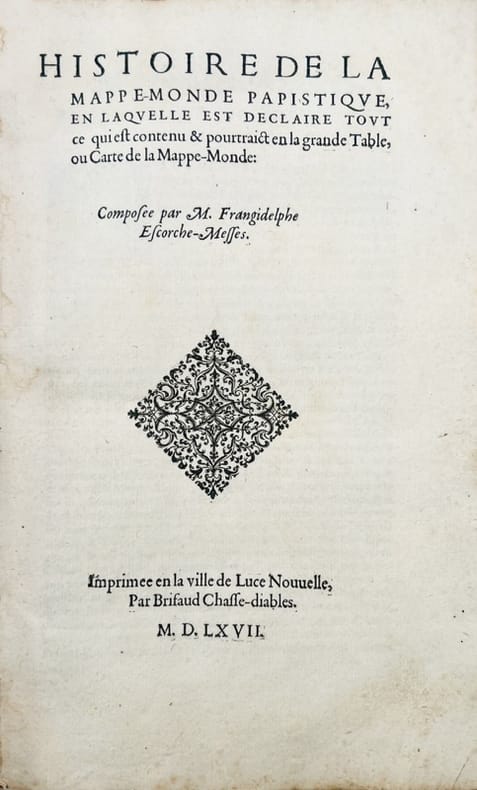
156744337Imprimée en la ville de Luce Nouvelle (Genève), par Brifaud Chassediables (François Perrin), 1567. In-4 (16 x 24,5 cm) de (8)-190 pp. 1 feuillet blanc (sign. a-z4, A4), vélin souple à rabats, lacets (reliure de l'époque).
155452553Rome, ( Viottis parmensem vin aedibus S. Birgittae), 1554. Folio. Bound in 17th century full calf, later rebacked preserving old titlelabel with gilt lettering. Corners a bit bumped. Woodcut on title-page. 2 full-page woodcuts (printer devise Olaus Magnus-Viottii)(58),787,(1 - Errata),(2 - Colophon) pp. and 238 woodcuts in the text and one full-page woodcut map (a smaller copy of Olaus Magnus Carta marina, published 1555). A few minor marginal brownspots at end. printed on good paper. Internally clean and fine.
1505000423bGENOA ITALY. Good with no dust jacket. 1505. Original Vellum. One hundred and eighty four hand numbered pages in this remarkable 500 year old handwritten manuscript ledger journal and diary : " 1505 Gendenze di Saviz - gnano" as stated on the cover. The first page begins: "Libro de tuto _____ quale so tato asan__giano ala venuta mia. To Alexandro salueto schrise e soto schrise de mia gnovia mar." Not written by a scribe this is a working journal and ledger containing hundreds of business entries purchases loans and repayments. There are long lists of foods and prices for what is assuredly shopping lists for parties and feasts. There are also what appears to be observations and business maxims and poetry in a number of entries. Certainly this fascinating book requires more research. The original vellum cover is in somewhat rough shape with tears rubbing and bumping and is barely attached to the text block though still held by the rear binding cords. Interior is in excellent shape save for the odd and to be expected ink blot age-toning and light soiling. Please email for pictures of this rare manuscript.; Italian Spanish Latin; 4to - over 9¾" - 12" tall; KEYWORDS: HISTORY OF ANCIENT ITALIAN GENOA VENICE MANUSCRIPT COMMERCE HANDWRITTEN HAND WRITTEN JOURNAL LEDGER MEMOIR PERSONAL LOG HOLOGRAPH AUTOGRAPH SPAIN SPANISH DIARY DIARIES ANCIENT ANTIQUE MEDIEVEL RENAISSANCE antiquité contrat vélin document manuscrit papier Antike Brief Pergament Dokument Manuskript Papier oggetto d'antiquariato atto velina documento manoscritto carta antigüedad hecho vitela documento manuscrito papel. . hardcover
15604483DBFrankfurt., W. Han., um 1560. 8°. (4) Blatt, 490 S., (9) Blatt. Mit Titelholzschnitt, 79 Textholzschnitten. Geprägter Schweinslederband der Zeit und zwei Messingschliessen. + Wichtig: Für unsere Kunden in der EU erfolgt der Versand alle 14 Tage verzollt ab Deutschland / Postbank-Konto in Deutschland vorhanden +
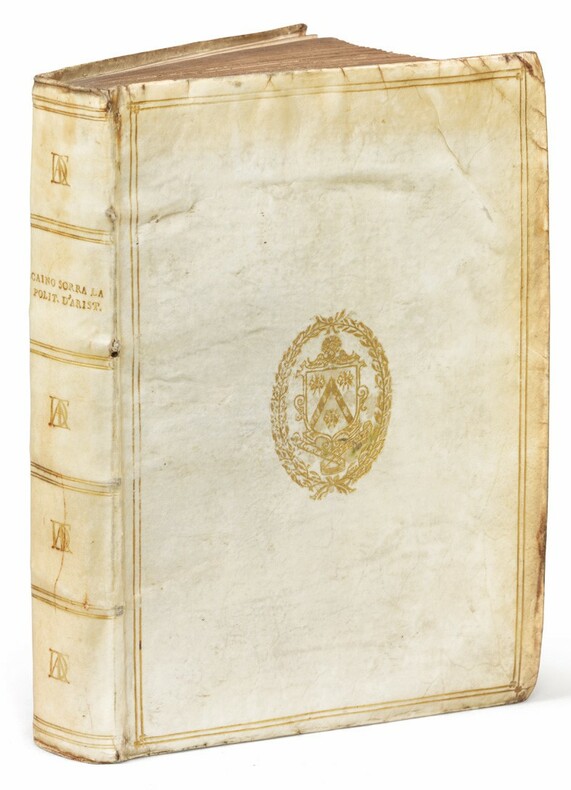
1577YTB-23Roma, Vincentium Accoltum e nelle case del popolo., 1577. Couverture souple. État : Très bon. Roma, Nelle case del Popolo Romano, 1578. Suivi de : SCAINO, Antonio. Sei discorsi sopra diverse materie civili. Roma, Nelle case del Popolo Romano, 1578. Suivi de : SCAINO, Antonio. In octo Artist. Libros qui extant de repub. Quaestiones. Roma, Vincentium Accoltum, 1577. In-4 de (22) ff., 232 ff., 67 ff., (2) ff. bl., (3) ff., 70 pp., (1) f. Plein vélin ivoire, double filet doré encadrant les plats, armoiries frappées or au centre, dos lisse orné de double filets et chiffre dorés, tranches dorées, restes de lacets. Reliure de l’époque. 228 X 165 mm. ÉDITION ORIGINALE DE LA VERSION DE LA POLITIQUE D’ARISTOTE DONNEE EN ITALIEN PAR ANTONIO SCAINO. Adams, A-1926 ; Ascarelli, p. 255 ; BM-STC Italian, p. 53 ; Graesse, I, 218. LE SUPERBE EXEMPLAIRE AYANT APPARTENU AU GRAND BIBLIOPHILE JACQUES-AUGUSTE DE THOU, CONSERVE DANS SON VELIN DORE DU TEMPS, A SES ARMES. « L’ordre actuel des huit livres de la Politique d’Aristote est-il régulier ? Et s’il ne l’est pas, quel autre ordre conviendrait-il de lui substituer ? Il est à peine nécessaire de faire remarquer l’importance de cette recherche. Les questions d’ordre et d’arrangement dans les ouvrages que le passé nous a légués sont les plus graves sanas contredit que la philologie puisse soulever parce qu’elles tendent à modifier les textes d’une manière étendue et complexe. Elles peuvent rétablir ou bouleverser la logique d’une pensée ; elles peuvent refaire ou détruire un système d’idées tout entier. Deux seuls philologues, jusqu’à ce jour, se sont occupés sérieusement de l’ordre des livres de la Politique d’Aristote: c’est Scaino da Salo à la fin du XVIe siècle et Conring d’Hemlstadt, soixante ans après. En 1577, Scaino da Salo tira formellement la conclusion que les septième et huitième livres devaient logiquement âtre placés après le troisième et avant le quatrième. La discussion de Scaino est remplie de bon sens et de clarté. » (J. Barthélemy Saint-Hilaire). Dans le premier livre de la Politique, Aristote examine et décrit les éléments constitutifs de l’Etat : les individus et les choses. C’est là que se trouve sa théorie de l’esclavage naturel et sa théorie de l’acquisition et de la richesse, qui est un des premiers essais d’économie politique que la science puisse citer. Dans le second livre Aristote analyse les différents systèmes politiques ; dans le troisième, il pose qu’il ne peut exister que trois grandes espèces de gouvernement : monarchie, aristocratie et république. Dans le quatrième livre se trouve la théorie des trois pouvoirs, législatif, exécutif et judiciaire. Le cinquième livre est consacré à la théorie des révolutions ; c’est là que se trouve ce portrait fameux du tyran qui est sans contredit le morceau de style le plus brillant et le plus remarquable de la Politique. Dans le sixième livre, Aristote revient aux discussions sur l’oligarchie et la démocratie. Le septième est rempli par l’étude du gouvernement parfait. Le huitième renferme quelques principes sur l’éducation, la gymnastique et la musique. “Aristotle is not only one of the great classical philosophers, the master of every branch of ancient knowledge : his method still underlies all modern thinking.” (PMM) Aristote a fondé la science politique proprement dite sous sa forme, comme il a fondé la science logique, la science métaphysique, la science morale, la science de l’histoire naturelle, la science de la physique, la science de la rhétorique, de la poétique, de la météorologie Aristote a été l’organisateur de la science dans l’antiquité. Il étudie les Etats comme il a étudié les autres êtres. Aristote passa une grande partie de sa vie dans les cours et put voir de très près la pratique des affaires. Pour bien comprendre l’Etat, Aristote étudie d’abord la société et proclame que la société est un fait de nature et que l’homme est un être éminemment sociable. TRES BEL EXEMPLAIRE CONSERVE DANS SON SEDUISANT VELIN.
151562607Jacopo Mazzochi | Rome 15 novembre 1515 | 14 x 20 cm | relié
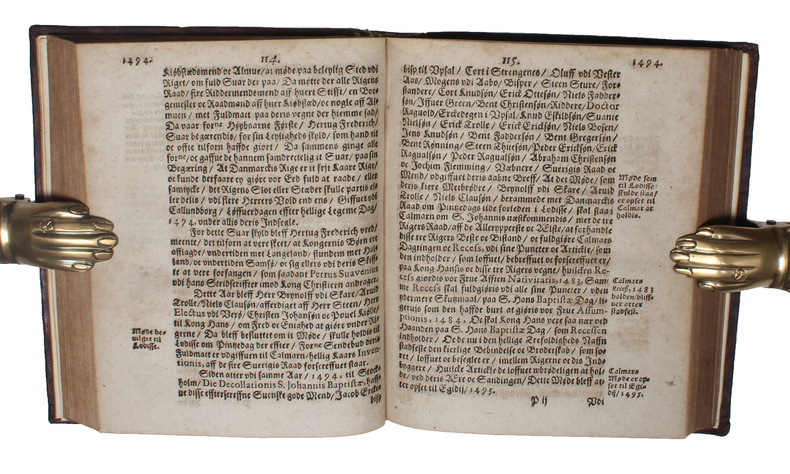
157553247Kiøbenhaffn, Hans Støckelman oc Andreas Gutterwitz, 1575. Folio. Bound in a very nice mid 19th century brown half calf with five raised bands and gilt ornamentations to spine. Title-page printed in red and black and with large woodcut, verso with full-page woodcut portrait of King Frederik II. Small repaired cut-out to top of title-page and an old owner's annotation. Neat marginal annotations to some leaves and early annotations to back fly-leaf. Occasional light brownspotting, but overall an unusually well kept and fresh copy, printed on good paper. (36), 547, (33) pp.
157664840Antwerpen, Christophe Plantin, 1576. 4°. Titelblätter m. breiten Holzschn.-Bordüren. Mit einer Holzschn.-Druckermarke u. über 1700 (1 ganzs.) Textholzschnitten. 671 S.; 2 Bll., 471, 15, 24 S., 6 Bll., 2 Bll., Etw. späterer Ldr.-Bd. a. 4 Bünden.
157963961Frankfort & Wechelus: Francofurti Ad Moenum Apud and Wechelum 1579. Around 1961 a previous owner writes "According to the recent national archives survey this is the second oldest book in the State of Florida." Ask for scanned images of this rare volume and the laid-in notes of early researcher. "THIS CONSISTS OF ORATIONS AND COMMENTS OF FAZELLUS or FAZELUS WHO WAS PROFESSOR OF THE CUSTOMS OF THE SICILIAR AND SACRED HERITAGE OF THE PREACHER.". First Edition 1st Edition. Hardback LEATHERBOUND. Good Used Antique Condition. 13 3/4 Inches X 8 1/5 Inches X 2 1/4 Inches. Francofurti Ad Moenum Apud and Wechelum Paperback
155655452Paris, Iean Roigny, 1556. Folio. In contemporary linp vellum, with three (of four) of the original vellum ties. Binding with wear and inner hinge weak, but in completely original state, with no restorations. Only some light scattered brownspotting and a worm-tract to inner margin, just occasionally touching a few letters. Book-plate to pasted-down front end-paper. A lovely copy. (4), CCXLIII ff.
155841789Lyon, Macé Bonhomme, 1558. 2 parties en 1 vol. in-4 de (20)-240 et 135 pp. (erreur pour 134 pp.), maroquin rouge, dos orné à nerfs, triple filet doré sur les plats, dentelle intérieure, tranches dorées (reliure du XVIIIe siècle).
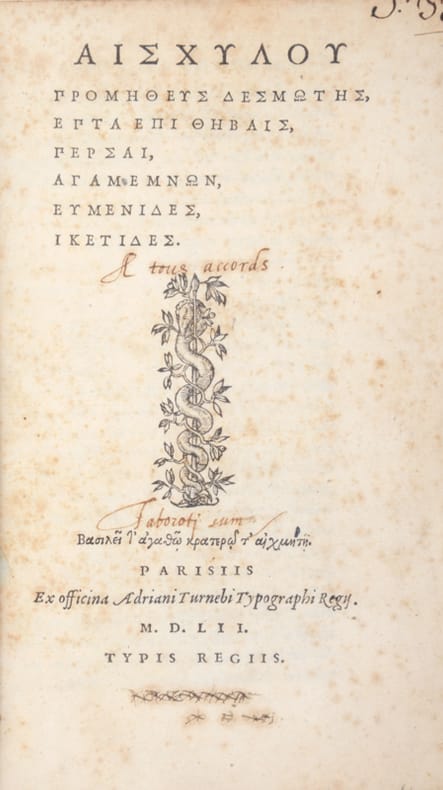
155242167Paris, Adrien Turnèbe, 1552. In-12 de (8)-211-(1) pp. (sign. a4, A-N8, O2), caractères grecs, basane fauve granitée, dos lisse orné, pièce de titre en maroquin rouge, tranches jaspées (reliure du XVIIIe siècle).
159554267Kiøbenhaffn, Mads Vingaard, Henrich Waldkirch, Hans Stockelmann, Niels Michelsen, 1595-1604. 4to. Indbundet i 10 - lidt senere - ensartede helldrbind med ophøjede bind på rygge. Rig rygforgyldning og forgyldte skindtitler. Enkelte bind med reparationer på kapitæler og false. Spredt bruning og brunpletter, specielt sidste bind ""Den Geistlige Historie... 1604). Eksemplaret har interessante provenienser, i alle bind er inklæbet på forpermens inderside et kobberstukket våbenskjold ""E:A:v.B"" (von Bertouch, amtmand i Tønder og genealog (1745-1815)), senere til Jens Paludan Müller (biskop i Århus (1771-1845)) og siden som gave til sønnen, i 1830, Casper Paludan Müller (dansk historiker og professor (1805-82)).
158862780Colophon: Pisauri (Pesaro), Hieronymum Concordiam, 1588. (Having the reprinted title-page: Venetiis, Franciscum de Franciscis Senemsem, 1589). Folio. Contemporary limp vellum. Repairs to upper part of spine and small nicks to back repaired. Edges of covers with tiny loss of vellum. Covers slightly soiled. Calligraphed title on back. Title-page with and old, partly erased stamp. Woodcut printer's device on title-page. Ff (3), 334 (332) (= 664 pp). Numerous woodcut diagrams and illustrations in the text. Printed on good paper. Ff. 2-3 with an old repair to inner margin (no loss). F2 browned, but otherwise remarkably clean with only a few brownspots. A few small worm-tracts to some margins. In spite of its flaws, a very good copy of this monumental work.
159556666Kiøbenhaffn, Mads Vingaard, Henrich Waldkirch, Hans Stockelmann, Niels Michelsen, 1595-1604. 4to. Indbundet i 10 - nær samtidige - ensartede marmorerede hellæderbind med ophøjede bind på rygge. Rig rygforgyldning og forgyldte titel- og tomefelter. Alle bind med helt guldsnit. Nogle kapitæler fint udbedrede. Varierende bruning afhængig af papirkvaliteten. Sidste bind ""Den Geistlige Historie... 1604) som altid med kraftigere bruning. Dette meget velbevarede eksemplar har tilhørt Henning Valkendorf (1560-1626) til Glorup og Søbogaard og senere søofficeren Frederik Hoppe (1690-1776). På alle forpermer er i guld trykt en lille blomsterkrans hvori et bundet neg (Valkendorfs bogmærke ?).
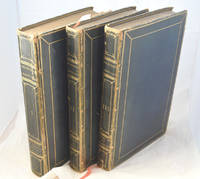
1587033342<p>At London printed in Aldergate Street at the signe of the Starre: John Harrison George Bishop Rafe Newberie Henrie Denham and Thomas Woodcocke 1587 A good copy of the 2nd edition of Holinshed's Chronicles bound in 3 volumes. This edition is particularly known for its association with William Shakespeare who used it for historical background for example in Macbeth. It lacks the extensive woodcuts found in the 1st but has ornate initial capitals and head and tailpieces. This set was rebound in full morocco leather in the 1800's. The bindings have flat spines with gilt titles and volume numbers and gilt lining. The boards have gilt lining around the edges and gilt dentelles on the inner edges. Endpapers are marbled and all volumes have silk bookmarks. The leather is worn on the edges spine joints spine ends and corners but the bindings are currently sound. Vol I has a small closed tear at the top spine end. Vol II has a scuff across the front board. All page edges are gilted. The 2nd edition brings the history up to the date of publication and as such attracted the displeasure of Queen Elizabeth I who had clear views on how her reign and actions should be recorded. The Archbishop of Canterbury was required by the Privy Council in February 1587 to recall the work and reform it. The process of printing large works was very different to that of our digital world and the censorshjp and revision process must have caused chaos at the printers. Sections of the work on Scotland in Vol I and parts of the Chronicles of England are affected and all copies reflect the censorship mess to some extent with odd pagination cancels substitution and gaps in some copies. This set is largely complete lacks title to Chronicles of England and the colophon. Very different thicknesses and colour of the paper suggest where sections have been substituted and there are several instances of mispagination. Contents - Vol I: title and prelims viii; text 250 pp; Historie of England in 8 books; iv; 202 pp; title The Second Volume of Chronicles containing Ireland and Scotland viii; Ireland pp 9-61 blank verso; title Irish Historie xii; 183 pp with blank verso; title - Description of Scotland 2; text pp 3-23 blank verso; title Historie of Scotland blank verso; preface 2pp; text 29-404; Annals of Scotland pp 405-464 ; table alphabeticall First to Fourth 53 pp; Colophon January 1597 1p. Vol II: lacks title - text covers William I to Henry VII- vi; text 1-798. Vol III: text from Henry VIII pp 799 - 1267; Continuation - preface 1268-9 text 1270-1592; third table 58pp; lacks colophon. The contents generally bright clean and sound. There are some minor areas of staining or marking some paper repairs and some mispagination. Please enquire if you would like to see the details on each volume and/or further images.</p> John Harrison, George Bishop, Rafe Newberie, Henrie Denham and Thomas Woodcocke hardcover
158053493Paris, J. du Puys, 1580. 4to. Contemporary full vellum wih contemporary handwritten title to spine. Binding somewhat warped, but unrestored and tight. A (mostly very faint) damp stain to upper blak margin of some leaves (not affecting text), but otherwise internally very nice clean and fresh. Old owner's name to title-page (Dufault) and old acquisition note to front free end-paper. Woodcut title-vignette, woodcut headpieces, woodcut end-vignette, and a few woodcut initials. A large copy with good margins. (14), 252 (recte: 256) ff.
159942935, , 1599-1790. Collection de 492 pièces brochées ou déreliées sous 4 chemises, pièces de titre manuscrites.
155547735Romae, (Colophon: Apud Ioannem Mariam de Viottis Parmensem, in aedibus Birgitttae), 1555. Folio. Bound to style in later (around 1950) full vellum with 4 raised bands to spine. Endpapers renewed. Old owners name on foot of titlepage. 42 unnumb. leaves + 815 pp. (p. 815 is the full page woodengraved printers device, verso blank). With 472 fine woodcuts in the text, the greatest part measuring 59x93 mm, a few half-page and some 1/3-page, among these the full-page map over Scandinavia (the smaller sized ""Carta Marina""). Only few scattered brownspots, probably lightly washed by the rebinding. From ab. p. 500 the upper margins have some faint dampspots, which on ab. 25 leaves has left some small loss of paper, and on a few places the loss of a letter in the caption title, but everywhere professionally repaired with paperpulp where needed.
1549YTB-17Paris, Rosset, 1549. [ENTREE DU ROY HENRI II]. C'est l'ordre qui a este tenu a la nouvelle et joyeuse entrée, que le Roy treschretien Henry deuzieme de ce nom. Suivi de : C'est l'ordre et forme qui a este tenu au Sacre & Couronnement de treshaulte & tresillustre Dame Catharine de Medicis, Royne de France. Deux ouvrages en 1 volume in-4 de (38) ff. et 11 gravures, (12) ff., le dernier blanc. Maroquin aubergine, riche décor aux armes et chiffre du roi Henri II frappées or sur les plats avec fleurs de lys et chiffre H couronné, dos à nerfs orné de filets or et à froid, filet or sur les coupes, triple filet or intérieur, tranches dorées. Reliure du XIXè siècle. 227 X 160 mm. EDITION ORIGINALE RARE ET PRECIEUSE DU « plus beau livre d'Entrée des rois de France qui ait été publié » (Ruggieri, 245). EDITION ORIGINALE DU SACRE ET COURONNEMENT DE LA REINE CATHERINE DE MEDICIS. Fairfax Murray French, 150 ; Du Colombier, Jean Goujon, p. 67-71, planche LVI-LVII ; Vinet, 471 ; Picot Rothschild, IV, 3114 ; Mortimer French, 202l ; Watanabe,1602. RELATION DE L'ENTREE SOLENNELLE A PARIS D'HENRI II EN ET DE CATHERINE DE MEDICIS EN 1549, deux ans après l'avènement du roi qui succédait à son père François Ier, mort en 1547. LE PREMIER OUVRAGE DECRIT LA CEREMONIE DE L'ENTREE, LE SECOND RELATE LE SACRE DE LA REINE, SIX JOURS AUPARAVANT, A SAINT-DENIS. En marquant la liquidation de la succession de François Ier, l'événement revêtait une importance politique considérable. LA VILLE DE PARIS LUI DONNA UNE SOLENNITE PARTICULIERE, N'EPARGNANT AUCUN EFFORT POUR EN SOULIGNER LE CARACTERE MAJESTUEUX : LES DECORS ET LES EDIFICES FURENT DESSINES ET CONSTRUITS SOUS LA DIRECTION DES PLUS GRANDS ARTISTES, SANS DOUTE Jean Cousin, Jean Goujon et Philibert de l'Orme. La coutume des entrées solennelles de souverains dans une ville, et principalement dans une capitale, remonte à la plus haute Antiquité et s'est poursuivie pratiquement à toutes les époques. Sauf quelques exceptions, ce n'est qu'à partir de 1515, lors de l'Entrée de Charles-Quint à Bruges, que celles-ci auraient donné lieu à des relations imprimées illustrées (von Arnim, Fünf Jahrhunderte Buchillustration, p. 91). CE BEAU ET RARE LIVRE ILLUSTRE CONSERVE LE SOUVENIR DES PLUS BELLES DECORATIONS ARCHITECTURALES DU SEIZIEME SIECLE ET DECRIT LA MAGNIFICENCE DE CETTE ENTREE ROYALE. Le texte, attribué à Hardouyn Chauveau par une inscription ancienne dans l'exemplaire Soleinne, serait dû, selon V.L. Saulnier, Les Fêtes de la Renaissance, I, pp. 31-59, au traducteur de Serlio, de Vitruve et de l'Hypnerotomachia Poliphili, l'écrivain Jean Martin, assisté, pour les inscriptions sur les monuments, du poète Thomas Sebillet. LES ONZE PLANCHES SUR BOIS, HORS ET DANS LE TEXTE, QUI DECORENT L'OUVRAGE, EN PARTIE SIGNEES D'UNE CROIX DE LORRAINE, ONT ETE ATTRIBUEES AUX PLUS GRANDS ARTISTES. PAR LA PERFECTION DE LEUR GRAVURE ET L'ELEGANCE DE LEUR DESSIN, EXEMPLES PARFAITS DU STYLE HENRI II DANS SON EXPRESSION PARISIENNE LA PLUS RAFFINEE, ELLES PASSENT POUR L'UN DES CHEFS-D’ŒUVRE DE L'ILLUSTRATION FRANÇAISE DU SEIZIEME SIECLE. La question reste évidemment ouverte de savoir si ces gravures traduisent les dessins ayant servi à élever les monuments de la réception ou si elles en restituent seulement l'aspect. La décoration de ces planches comporte à deux endroits au moins, au pont de Notre-Dame et à la construction flanquant le Beautreillis, le monogramme de Diane de Poitiers ; son emblème, le croissant, qui pourrait passer pour un motif décoratif, figure à plusieurs autres endroits, mais sur ces deux constructions son chiffre s'étale complaisamment à côté, voire à la place, de celui du roi ; le texte mentionne les monogrammes au H du roi mais reste muet sur ceux de sa maîtresse, âgée de cinquante ans, qui figurait dans le cortège de la reine sous son nouveau titre de duchesse de Vale.
1595YTB-7Paris, Abel L'Angelier, 1595. LA PRECIEUSE EDITION ORIGINALE COMPLETE DES ESSAIS DE MONTAIGNE EDITEE PAR MARIE DE GOURNAY, « FILLE SPIRITUELLE » DE L’AUTEUR. ELLE FIXE LE TEXTE DEFINITIF DE CE MONUMENT DE LA LITTERATURE DE LA RENAISSANCE. L’édition originale, parue en 1580, possédait les deux premiers Livres ; le troisième Livre parut en 1588. Tchemerzine, IV, 876 et III, 460 ; Sayce, 7a ; Philippe Desan, Bibliotheca Desaniana, 21 ; Le Petit, 102-105 ; Picot, Catalogue du Baron J. de Rothschild, I, 141 ; Bulletin Morgand et Fatout, 8961 ; En Français dans le texte, n°73. PRECIEUX EXEMPLAIRE AVANT LES CARTONS POSSEDANT LE FEUILLET D’ERRATA ET BIEN COMPLET DE LA CELEBRE PREFACE DE MONTAIGNE « C’est icy un livre de bonne foi » que l’on ne rencontre que dans les exemplaires édités par Abel L’Angelier.