2 263 résultats
1960106061<p>Program format 9x12 illustrated. Slight aging overall in excellent condition. In the 1960 series the Pirates would beat the Yankees in seven games thanks to a homer by Bill Mazeroski in the nine inning of game seven. Featured players include Mickey Mantle Roger Maris Whitey Ford Yogi Berra Bobby Richardson Bill Mazeroski and Roberto Clemente.</p> books
1952105019<p>Program 4to pictorial covers illustrated 48 pp. Normal aging otherwise bright and clean; near fine. This program is the Dodger edition. After beating the Giants a year earlier the Yanks were faced with a fired up Dodger team and had to go the full seven games to win the series. It was an exciting series that went back and forth and while there was some good pitching and many home runs it was Billy Martin's inches from the ground catch that ended the Dodger's hopes for a series win. baseball-almanac website. </p> books
1953105020<p> Program 4to pictorial covers illustrated 48 pp. Normal aging slight corner creasing otherwise bright and clean; near fine. This program is the Yankee edition. After beating the Dodgers a year earlier the Yanks were faced with Dodger team that was looking for revenge. Unfortunately they didn't get it and lost to the Yanks in six games. Yankee power and hitting made the difference especially from the 'red hot' Billy Martin who hit .500 for the series. Both lines were impressive including Jackie Robinson Pee Wee Reese Roy Campanella Dick Snider and Carl Erskine for the Dodgers and Mickey Mantle Billy Martin Yogi Berra Phil Rizzuto and Whitey Ford for the Yanks. baseball-almanac website. </p> books
1954105017<p>Program 4to pictorial covers illustrated 64 pp. Normal aging otherwise bright and clean; near fine. This program is the Cleveland Indian edition and represents a disappointing trip to the series for the Indians as the they lost in four straight to the New York Giants. Despite what was considered a great pitching staff the Indians couldn't compete with the hitting power of the Giants. In this series key Giant players included Willie Mays Monty Irwin Don Liddle and Alvin Dark. Key Indian players included Bob Lemon Dave Hoskins Al Smith Bob Avila and Hank Majeski baseball-almanac website.</p> books
1962106054<p>Small black and white folio program 8 1/2" x 11" pictorial front page 4 pp. Other than some normal aging this is in very nice condition. Scarce and unusual complimentary type program that were handed out to fans at Yankee Stadium. Since the second page refers to games 34 and 5 it appears the first two games had already been completed. The first page includes a black and white photo of Yankee Stadium illustrating an actual game. The front page gives historical series results and attendance numbers. The two inside pages were meant to help the fan keep score. This copy is unmarked. The back page gives player stats for both teams. An unusual and somewhat scare bit of World Series history. The Yanks took this series in seven games despite a poor performance from Mantle and Maris.</p> books
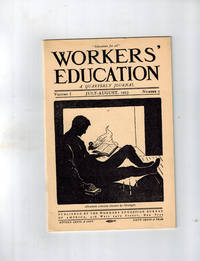
1923001659New York: Workers Education Bureau of America 1923. Fine. 16 page stapled in pictorial wrappers. Articles by A.J. Muste George S. Lackland Hilda Smith and Algernon Lee. Scarce. First Edition. Pamphlet. Fine in Wraps as Issued/No Jacket As Issued. 12mo - over 6¾" - 7¾" tall. Workers Education Bureau of America Paperback books
195345293Worcester 1953. 1st Edition. Commercial metal snap-ring binder of black pebbled vinyl with gilt title lettering to front cover. Binder & photographs: Nr Fine. Text: age-toning Very Good. 14 single sheets with type-written double-space text to recto of each staple upper left. Text contains 4 different "pitches": "A Wind That Kindled A Spirit" 3 pp Untitled 2 pp "Our Lady Of The Tornado noted at top: 'For a Catholic Audience' 4 pp "A Revisit To Assumption College" 5 pp. Illustrated with 4 "before" images of the unharmed campus followed by 10 "after" views of the heavily damaged builidings. All photographs b/w 8" x 10". 4to. 11-5/8" x 9-7/8" <br/><br/>"Assumption College was founded in 1904 by the Augustinians of the Assumption a Catholic order under the Augustinian Rule dedicated to service through teaching and the hastening of the Kingdom of God as reflected in their motto "Thy Kingdom Come." The original campus was in the Greendale section of Worcester on a tract of hillside land. . In June 1953 a tornado cut a path of destruction through several western and central Massachusetts communities including the city of Worcester. Several campus buildings were destroyed or severely damaged." This portfolio binder of original photography undoubtedly assembled as a fundraising document to aid in the rebuilding of the campus following this devastating tornado assualt documents a significant mid-20th Century western Massachusetts disaster from which "the college relocated to a new campus off Salisbury Street on the west side of the city officially opening in 1956." Wiki. unknown books
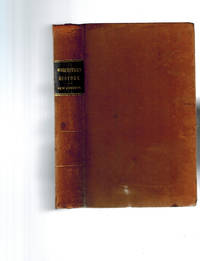
1853006389Boston: William J. Reynolds & Co. 1853. With color map frontispiece the map Near fine small tear. Very Good in contemporary full calf black leather spine label with gilt lettering. Contemporary prior owner name dated 1854 front end page later small ook plate front paste down. Leather lightly rubbed and a bit worn at the corners toning at edges of end pages. A handsome copy. . Revised Edition. Full Calf. Very Good. 8vo - over 7¾" - 9¾" tall. William J. Reynolds & Co. Hardcover books
199530391Portsmouth: Peter E. Randall Publisher. Near Fine in Near Fine dust jacket. 1995. Hardcover. 0914339532 . Illustrated. Introduction by Louise Heermance Tallman. First edition. About fine in like dust jacket. Typed letter signed to a reviewer by Louise H. Tallman laid in. . Peter E. Randall Publisher hardcover books
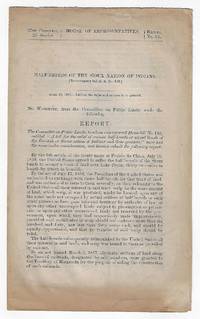
186221258Washington: GPO 1862. Softcover. Very good. 4 pp. Report No. 83 of the 37th Congress 2d session. Lower corners creased some dust soiling; very good. House Bill 143 was entitled "A bill for the relief of certain half-breeds of mixed bloods of the Dacotah or Sioux nation of Indians and their grantees." It related to the provisions of an act passed in 1854 granting the "half-breeds" scrip in exchange for land previously assigned to them under an 1830 treaty. This report from the Committee on Public Lands recommends against passage of the bill which would have presented obstacles to railroad construction in Minnesota. The committee argues that "Congress ought not to interfere by special legislation but should leave the parties to their legal rights." A scarce report with only digitial copies located in OCLC. [GPO] unknown books
200020625NY: Abrams. As New in As New dust jacket. 2000. Hardcover. 0810966913 . 111 color illustrations 100 line drawings. First edition. As new in like dust jacket. Still in original shrinkwrap. . Abrams hardcover books
19662222024<p>First edition. 4to. 65 tipped-in color plates over 30 line drawings including a folding map. Bibliography. Dust jacket unclipped. Very good. 154 pages. No signatures or bookplates.</p> Akademische Druck und Verlagsanstalt hardcover books
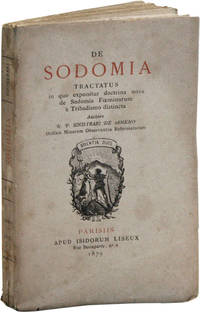
187947623Parisiis: Apud Isidorum Liseux 1879. First Thus. 12mo 15cm.; publisher's cream pictorial wrappers printed in red and black; xii89pp. Some light shelf wear and a few small soil spots tiny chips at spine ends else Very Good or better. Scarce extract from Sinistrari's larger work "De Delictis et Poenis" 1654 text entirely in Latin save for the publisher's tongue-in-cheek introduction in French. Liseux gained some notoriety a few years earlier when he published "De Daemonialitate et Incubus et Succubis" claiming to have discovered this heretofore unknown manuscript written in 1680 by the Franciscan priest Ludovico Maria Sinistrari 1622-1701. The work described the qualities of such beasts as vampires succubi and incubi though it has since been proposed that Liseux himself wrote the piece see J. Gordon Melton "The Vampire Book" 2010 p. 380. "De Daemonialitate" was eventually translated into English in 1879 and found its way into the hands of W.B. Yeats who borrowed Ezra Pound's copy and from it was inspired to compose the poem "The Black Centaur" first published in "The Tower" in 1928 Catherine E. Paul and Warwick Gould "W.B. Yeats and the Problem of Belief" "Yeats Annual" no. 21 p. 313. <br/><br/>The present work is indeed authored by Sinistrari and remains here in its unalter ed Latin form presumably to avoid censure Liseux noting in his introduction that there's a reason he decided to publish this work sans illustration. Though the publisher's advertisement on the final leaf of text and rear cover only mention "De Daemonialitate" Liseux's catalog would go on to include the Kama Sutra and Ernest Dowson's "White Stains: Containing Also the Contemporary and Most Exhaustive Love's Cyclopaedia with Five Illustrations by Aubrey Beardsley in His Most Erotic Vein. Apud Isidorum Liseux unknown books
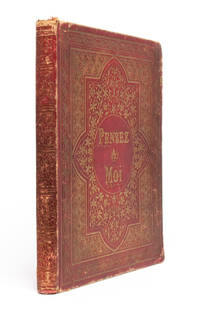
19243357Kentucky Wisconsin Illinois Kansas Minnesota Ohio Wyoming Michigan South Dakota Colorado 1924. Red leather sheep over card ornately stamped in gilt. Album measures 8 x 9.75 inches and is comprised of 108 manuscript pages in a variety of hands with multiple entries per page. Also includes two pasted-in newspaper clippings and a series of loosely inserted ephemera two obituary clippings for the book's owner five calling cards a church bulletin a gown ad an envelope with a death notice of a friend and a car rental flyer from Oklahoma. Tracing the life of Laura Nethers nee Earl from her girlhood and marriage to her old age. Obituaries and census records show that Laura was a resident of Colorado Springs for 56 years following her family's move from the South through the Western US.<br/><br/>The inscription to the first page of the album reveals it to be a gift: "1860. A Christmas gift from father. Covington KY." Above this is the ownership stamp of Laura L. Earl. Little did Laura know the album would follow her across 64 years and to a variety of states documenting her relationships and major moments in her life. For researchers it is an opportunity to trace a woman's development from one century to the next across multiple states in the South and West as she grew into a teacher wife and woman's club activist. Growing up in Kentucky Laura's family moved West. Entries show that she and her father lived awhile in Minnesota and she became a teacher in Wisconsin before marrying and settling in Colorado Springs. Entries come from family pastors students neighbors and friends. Many entries show women's bonds across large stretches of space and together they show what a mobile lifestyle women were increasingly living. No longer confined so a small radius or single homestead they were maintaining relationships and making friends across the miles. <br/><br/>Some early entries like that of Celia E. Hay Illinois 1878 are traditional in nature: "Over our hearts and into our lives shadows may sometimes fall But the sunshine is never wholly dead And heaven is shadowless overhead And God is over all." Students politely thank her for her work and hope they made an impact too: "I ever remain your true friend James U. Cobb. To Miss Laura Earl much Respected Teacher Ellensboro Wisconsin Feb 25 1872." People write poetic verses on friendship or her new marriage throughout.<br/><br/>Yet more often entries are personal. In 1879 Laura's father leaves her a humorous message that "It is ten o'clock and your sixty-one year old father expects a long trip to the Injun Reservation two hundred miles north in the morning.So you see I cannot write any tonight." Elva Walker writes from Colorado in 1885 "We will ever remember our camping trip.and going in a cave" and John Dietrich writes of the same trip "Did it rain while we were camping! I hope we will meet again soon." In August 1919 a friend Emma Eggleston writes an original piece about their recent travel titled Pike's Peak by Auto which begins "19 and 19 was a year to remember from the last of July to the last of September" and which documents in 36 verses the landscapes they passed and the friendship they strengthened while driving. Moments like these are a reminder of changing times -- of early attitudes toward indigenous tribes or of women's freedom as suffrage approached. <br/><br/>A charter member of the Colorado Women's Club and a participant in Frances Willard's Women's Christian Temperance Union according to her obituary Laura's friendship album is a rich space for researchers to trace her movements through communities in the West for genealogists to study the families and lives of contributors and for historians to track which entries come from other educated women and activists. The present is one of the best we've seen. unknown books
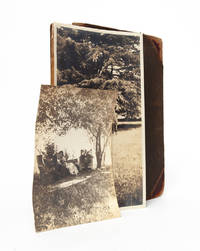
19133478Michigan 1913. Pebbled cloth ledger measuring 8 x 10 inches with boards rubbed and spine largely perished. Two contemporary black and white photos loosely inserted at rear with subjects unidentified. Comprised of a total of 200 manuscript pages in two hands -- 11 pages in the hand of Elijah W. Middaugh and the remaining 189 pages in the hand of his daughter Julia Edmunds Middaugh. Both leave their ownership inscriptions on the front endpaper with the latter notating that her writing picks up in 1913. A candid poetic and at times heartbreaking family history the present manuscript reveals a young woman grappling with her place in the world and seeking to create a sense of order in her own life by understanding and exerting narrative control over the unstable relationship of her parents. <br/><br/>Elijah affectionately called "Lege" by Julia later in the notebook was born into privilege as the son of a prominent Gross Pointe family. Educated at the University of Michigan and Harvard he also was under the tutelage of private instructors during a stretch in Europe. Disappointing the hopes of his own father a businessman he did not take to the workforce with aplomb. He struggled to maintain himself by selling travel stories and reports to the Detroit Free Press and was fiscally irresponsible. Initially his marriage to the working class widow Juddie Palmer Kelso seemed promising. The owner of a shop in Paw Paw Lake she seemed to provide the industriousness Elijah lacked. According to Julia "the first years of their lives were the happiest." She and her brother were born and her parents "bought a King 8 car and went traveling." Indeed this King 8 features prominently in Elijah's opening narrative wherein he records "My trip in a King Auto from Michigan to San Francisco." From its opening one gleans that Julia's later story is a mixture of fact and father worship. He writes "It was said by that great & good man Emerson that travel is the fool's paradise. Without desiring to offer my own experience in proof of this I may state that I have always found pleasure in traveling." And he scorns those travelers who do not get swept up in the romance of the road focusing instead on practicalities; "greenhorns" he calls them "who would ask how fast we could travel how much it cost per mile." Of course the trip in the end did cost the family greatly. He reports multiple breakdowns and flat tires as he tour goes on; and when his radiator fails he opts to buy a new car rather than wait for a replacement part. What's more Julia's version of the story includes a jarring fact: "It was while we were away on a trip to California that the house burned down. When my parents drove up to the lake that night cold and hungry and eager for home Lege turned the car up the lane and there in the blaze of the headlights stood the gray chimney the only remains of the life that had been."<br/><br/>Julia's longer narrative contains multiple such harrowing incidents. And while she at times praises her mother at one point she says Juddie has "more enterprise and natural courage commonly called guts than any woman I know" she frankly sees Juddie's lower class background as the root of her parents' problems and the ultimate reason for their divorce. Her father meanwhile she glorifies. Rather than focus on his failings as such she creates a hero's arc for him. He failed in business because "he was cut out to be a poet" rather than a captain of industry -- and it was a mark of his own superiority. Indeed she writes "he had a better education and his branch of the human race was a little more cultural." After her parents' split and her mother gaining custody Julia remarks "without father things just weren't the same."<br/><br/>Notably it is the women and the female communities Julia encounters in life that provide support and stability. She recounts that after the house fire her father's sister Clara takes the family into her Gross Pointe home. After the divorce when she discovers "mother and two dirty little kids with a forlorn story she said at once Juddie you'll have to come out with me." It is Clara and later the sisters in a convent where Julia goes to be educated that give the young woman space to process her family pains and reflect on how they shape her selfhood. <br/><br/>It is a unique densely written and research rich piece deserving of study. In addition to providing opportunities for genealogical research including Julia's forebears Emilie Eugene Maynard and Judge A.B. Maynard it has extensive details on early automobile road travel from the Midwest to the West Coast information on early divorce and custody including the impact on children and women's finances female communities and women-run businesses class conflict in marriage courtship and historical narrative studies both fiction and non-fiction performances. It poses a valuable opportunity to study how young women in an age of increased attention towards inequality and rights were affected. The extent to which Julia is independent and mobile links both to the women around her and to a larger movement; at the same time Julia is affected by traditional patriarchal narratives including popular novels that position gender family wealth and class as markers of superior morality. unknown books
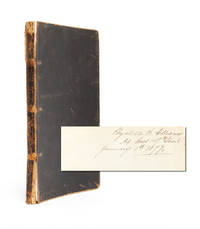
18992984New York 1899. Soft-bound sheep over card with rubbing to extremities and some loss to spine. Ownership signature to third blank: "Elizabeth B. Williams. 34 West 17th Street. January 1st 1877." Comprised of 32 handwritten pages providing a glimpse into the bohemian life of an educated woman living in New York at the turn of the century. <br/><br/>By the time of this notebook's use New York's Greenwich Village had gained a reputation as a haven for artists writers and musicians to live and gather. Boarding houses and bachelor flats like the well-known Benedick Building made the Village an affordable place even for single people to find housing that was safe and affordable. The brownstone building that Elizabeth lists as hers in the ownership signature in fact still exists allowing us to image the space in which this manuscript was used. While we've been unable to locate information on Elizabeth's history the pages here reveal her to be a woman interested in history reading and music. 13 pages focus on a range of historical facts -- including historical timelines of the Hebrews lists of British monarchs and American presidents notes on the genres of authors from the Renaissance to Romantic period and the history of landmarks in London. 4 pages with her hand notably sloppier as if writing while working make notes on musical scales and techniques for effective fingering while playing. And 9 pages reveal that for a number of years Elizabeth was involved in a Book Club as she keeps track of her reading lists for meetings by month and year including Harriet Beecher Stowe Annie Fields and Edna Lyall as well as books on Victorian Literature Social Life in Old Virginia and histories of England and Korea -- 64 titles in all.<br/><br/>Elizabeth's life was not confined to New York however. She dedicates 2 pages for example to a packing list for a voyage detailing the clothes she'll need in her trunk. Another 3 pages list addresses for friends in New York New Jersey Ohio and Illinois to whom she'll send letters while away.<br/><br/>Within these pages exist opportunities for researchers to explore genealogy practices of self-education through reading book clubs and reading habits lifestyles of women living in New York at the turn of the century musical practice and paleography. unknown books
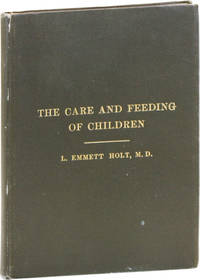
189444281New York: D. Appleton and Company 1894. First Edition. First Printing. Octavo 17.5cm; flexible dark brown cloth boards with titles stamped in gilt on spine; ii45-666pp ads. Light wear to extremities hint of softening to corners with a faint diagonal tear to rear pastedown; contemporary owners ink signature to front endpaper Gertrude H. Souther / March 1895 with holograph pencil notes relative to the weight of two babies on rear endpaper; Very Good. Influential manual for mothers and nurses by Holt 1855-1924 an American author physician and pioneer in the field of pediatrics who helped shape the New York Babies Hospital into the leading pediatric facility of its time. The book was expanded from Holt's Catechism for Nurses 1893 a pamphlet prepared for nursery-maids during their four months training at the Babies Hospital. "The nurses studied the catechism and when they graduated took it with them. There followed requests for copies from their employers and the supply was soon exhausted. It was apparent there was a popular demand for something of the kind. The catechism was expanded and in 1894 The Care and Feeding of Children made its appearance.Probably no one would have been more surprised than Dr. Holt or his publishers had they been told that they were launching a volume that was to go through seventy-five printings and which was to be translated into Spanish Russian and Chinese.The book became the mainstay of many a worried mother and exerted no inconsiderable influence on the profession as well for the practitioners had to keep abreast of the pediatric knowledge which the mothers possessed" DUFFUS R.L. L. Emmett Holt. NY 1940 pp.116-117. <br/><br/>Prior to the publication of The Care and Feeding of Children there was no standard text for pediatric care in print for laymen or medical professionals. A revolutionary volume written in clear simple language providing an orderly presentation of pediatric knowledge which empowered women to care for their children. A cornerstone work responsible for "lifting child sickness and care out of the neglect of the past" Dunn Peter M. "Dr. Emmett Holt 1855-1924 and the foundation of North American paediatrics." Archives of Disease in Childhood - Fetal and Neonatal Edition 2000. Rare in the first edition; we find no copies for sale in trade May 2019 with the last copy at auction sold at the Streeter Sale. ATWATER 1743 citing the 1895 edition; STREETER 4159; Grolier American 100 97. D. Appleton and Company unknown books
189544165New York December 8th 1895. Autograph letter signed on recto and verso of single cream laid sheet 22x14.5cm.; approx. 85 words; dated 26 West 61st N.Y. Dec 8th and simply addressed to "Parker" presumably Stanton's friend and fellow-suffragist Parker Pillsbury 1809-1898 who with Stanton had co-edited the women's rights newsletter "The Revolution" twenty years earlier. Faint mail folds small unobtrusive archival paper remnants to two corners from having been previously mounted else Near Fine and still quite fresh. Brief contemporary 1897 pencil note at bottom edge "Mrs. Stanton - born Nov. 12 1815 Now past 82 - C.E.R." though based on contents we would place this letter as having been written around 1895. Brief but significant missive addressed to Parker Pillsbury the American minister and women's suffrage advocate regarding a copy of Stanton's "Woman's Bible" she had just sent him. "I wonder if I could interest them a "Mrs. White" and one other sufficiently in the Woman's Bible to sell ten or twenty copies in there sic respective woman's clubs It is published at my expense hence I am trying to push its circulation." The controversial "Woman's Bible" a series of commentaries pertaining to the portions of the Bible relating to women was published in two parts in 1895 and 1898 and composed almost entirely by Stanton alone her committee of Bible revisors finding the project too controversial and harmful to the cause of women's suffrage. Clearly at the time of writing this letter the book was still meeting with resistance thus our placing the date at around 1895 Stanton turning to Pillsbury as a potential source of influential and wealthy patrons she inquires "Is Mrs. White still living & working Is that rich woman that Mr. illegible used to visit in Maine living". But by 1897 the book had become a best seller though many of the members of the women's suffrage movement would continue to distance themselves from it. This letter quite significant as a testimony to the aging Stanton organizer of the historical 1848 Seneca Falls Convention and her continuing indefatigable efforts and initial lack of support in getting this work circulated. See Tracy A. Thomas "Elizabeth Cady Stanton and the Feminist Foundation of Family Law" 2016 pp. 15 & 223. unknown books
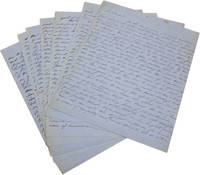
187043875N.p. n.d. but ca. 1870s. Autograph letter on seven leaves of blue laid sheets 25x20.5cm. rectos only "Kent" blind-stamped at top left-hand corner of each leaf; occasional faint soil spots minor shallow creases and faint fold lines else Very Good or better. Extensive and rather rambling unsigned letter or lyceum address draft "To the President" though which President and of what is not stated in which the author quite possibly a public figure based on references to his "detractors" strongly argues against women's suffrage: "would we have our females eschewing their more gentle nature hardening the finer sensibilities of her mind by rushing to the ballot box And mingling in the excitement of an election thereby throwing off the garb of female modesty and timidity I think not." Though the first leaf has the appearance of a clean copy the author's hand begins to turn sloppy with a number of manuscript corrections in the later leaves. Due to a lack of contemporary references Mary Wollstonecraft is the only person explicitly mentioned we cannot place with certainty a date or author for the item though the hand ink and paper and reference to women tending to wounded soldiers during wartime indicate this was penned within a few years of the Civil War as the women's suffrage movement was beginning to gather steam in the 1870s. unknown books
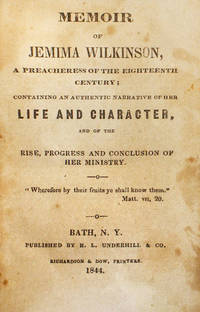
184444191Bath NY: R. L. Underwood & Co 1844. Second Edition. 18mo 15.5cm.; publisher's full sheep red gilt morocco spine label; viii9-288pp.; portrait frontispiece. Boards rather worn and joints cracked but holding old dampstain to rear cover very slightly bleeding into textblock some soil to early leaves else a Good or better copy overall. Account of the life of Jemima Wilkinson 1752-1819 the Rhode Island-born Quaker and Evangelist who claimed after a long illness to have died and been risen from the dead. Through her preaching she became known as the "Universal Friend" creating a Shaker-like sect that practiced celibacy and poverty on a massive property she named "Jerusalem." Some have argued that Wilkinson was an imposter who accrued vast wealth from her followers Howes describes her as "the first religious charlatan of her sex in America". Indeed the sect would not survive after her death. This work first published in 1821 attributed to David Hudson SABIN 33485 and HOWES H-761. See also "Appleton's Cyclopaedia of American Biography" Vol. 6 p. 512. R. L. Underwood & Co unknown books
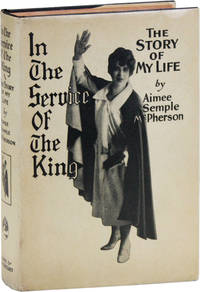
192744064New York: Boni and Liveright 1927. First Edition. Octavo 19.5cm.; publisher's cloth in tan photo-illustrated dust jacket red topstain; 316pp.; photographic portrait frontispiece. Cloth gilt a bit dulled topstain a shade darkened contemporary ownership signature to front free endpaper tiny closed tear at top edge of rear jacket panel not approaching text else Near Fine in a superlative copy of the jacket. Autobiography of Aimee Semple McPherson 1890-1944 the evangelical speaker and founder of the Foursquare Church best known for pioneering the use of mass media specifically radio to broadcast her sermons. The present memoir includes McPherson's supposed kidnapping in Mexico an event heavily called into question by contemporary media who conjectured that McPherson and her lover had cooked up the story to cover up their liaison. Boni and Liveright unknown books
16270Small broadside comparing women's suffrage in different U.S. states before the passage of the Nineteenth Amendment. 7 x 5 in. Excellent condition. Expected toning. This broadside compares the status and voting rights of women in different states specifically comparing the status of women in Western states where they were granted the vote earlier. The broadside states that "Women now vote on equal terms with men" in twelve listed states; it especially emphasizes Nevada and Montana which adopted equal suffrage in 1914. The broadside was originally printed to call for the vote for women from New Jersey although handwritten modifications have altered it to specifically reference New York. An interesting document that emphasizes the greater voting progress afforded to women in Western states before universal suffrage in the U.S. unknown books
16390An early turn of the century Wellesley College student"s hand decorated fan with over 150 photographic or printed image pasted on including her Ivy league friends and many other university logos. One side of fan has 66 small black and white cutout photographs that show her college friends and other images during her Wellesley years. The reverse of the fan has another 84 small color print and gild paper logos and badges these 84 small ephemera are mostly from colleges and social clubs in New England and the US Northeast but includes some from across America. Among many others it includes logos from Wellesley College Worcester Polytechnic Institute Stanford University and Cark University. The fan when open measures about 10.5 in x 19 in. Fan is in very good condition with fabric lightly soiled at edges. Scarce item since woman college education was just taking off at the turn of the century. Minor wear on wooden handle and fan. Very unique and enchanting Wellesley memorabilia Good.<br/> . unknown books
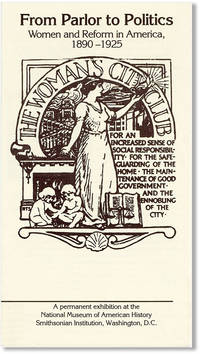
199242638Washington DC: National Museum of American History Smithsonian Institution ca 1992. Single sheet 8-1/2" x 14" folded to make six panels. Fine. Brochure announcing the establishment of the permanent women's history exhibition at the National Museum of American History. The exhibit stood from 1990 to 2004. National Museum of American History, Smithsonian Institution unknown books
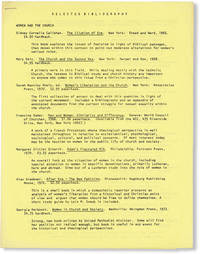
197248260N.p. ca. 1972. Quarto ca. 28cm.; side-stapled self-wrappers; 5pp. printed mimeograph on yellow stock. Light wear from handling else Very Good. Annotated bibliography of recent publications the latest published in 1972 divided by subject including "Women and the Church" and "the Woman Issue." Concludes with a list of resources among these the Women's Bureau and Know Inc. Though not attributed most likely issued by women members of the General Assembly of the National Council of Churches. Not separately catalogued in OCLC as of April 2020. unknown books