42 résultats
Fine original 19th century tinted lithograph. Image size ca. 160 mm X 220 mm. Paper size ca. 240 mm X 315 mm. Artists' and Publisher's names printed below image. In overall very good condition. (Some foxing; traces of pencil marks on verso.) - - We offer more prints from this series. Write for a full list. - - Several of the finest bronze cannon and mortar barrels which were captured in the East Indies by the soldiers of the First-, Second-, and Third Dutch Expedition Force (1846, 1847, and 1849 respectively) were brought to the Netherlands as a gift to the King. In 1880, the artists father and son van Looy made an elaborately detailed and delicately executed set of lithographs, drawn on stone, of practically the entire booty. The prints were pulled by the famous stone-lithographers firm of S. Lankhout & Co., of The Hague, and published in 1881 by Publisher Gouda Quint, of Arnhem. Beautifully decorative. Scarce.
Fine original 19th century tinted lithograph. Image size ca. 160 mm X 220 mm. Paper size ca. 240 mm X 315 mm. Artists' and Publisher's names printed below image. In overall very good condition. (Some foxing; very light pencil mark.) - - Several of the finest bronze cannon and mortar barrels which were captured in the East Indies by the soldiers of the First-, Second-, and Third Dutch Expedition Force (1846, 1847, and 1849 respectively) were brought to the Netherlands as a gift to the King. In 1880, the artists father and son van Looy made an elaborately detailed and delicately executed set of lithographs, drawn on stone, of practically the entire booty. The prints were pulled by the famous stone-lithographers firm of S. Lankhout & Co., of The Hague, and published in 1881 by Publisher Gouda Quint, of Arnhem. Beautifully decorative. Scarce.
Fine original 19th century tinted lithograph. Image size ca. 220 mm X 160 mm. Paper size ca. 315 mm X 240 mm. Artists' and Publisher's names printed below image. In overall very good condition. (Spot; miniature triangular stamp just touching image area.) - - Several of the finest bronze cannon and mortar barrels which were captured in the East Indies by the soldiers of the First-, Second-, and Third Dutch Expedition Force (1846, 1847, and 1849 respectively) were brought to the Netherlands as a gift to the King. In 1880, the artists father and son van Looy made an elaborately detailed and delicately executed set of lithographs, drawn on stone, of practically the entire booty. The prints were pulled by the famous stone-lithographers firm of S. Lankhout & Co., of The Hague, and published in 1881 by Publisher Gouda Quint, of Arnhem. Beautifully decorative. Scarce.
Fine original 19th century tinted lithograph. Image size ca. 220 mm X 160 mm. Paper size ca. 315 mm X 240 mm. Artists' and Publisher's names printed below image. In overall very good condition. (Miniature triangular stamp just touching image area.) - - Several of the finest bronze cannon and mortar barrels which were captured in the East Indies by the soldiers of the First-, Second-, and Third Dutch Expedition Force (1846, 1847, and 1849 respectively) were brought to the Netherlands as a gift to the King. In 1880, the artists father and son van Looy made an elaborately detailed and delicately executed set of lithographs, drawn on stone, of practically the entire booty. The prints were pulled by the famous stone-lithographers firm of S. Lankhout & Co., of The Hague, and published in 1881 by Publisher Gouda Quint, of Arnhem. Beautifully decorative. Scarce.
Fine original 19th century tinted lithograph. Image size ca. 220 mm X 160 mm. Paper size ca. 315 mm X 240 mm. Artists' and Publisher's names printed below image. In overall very good condition. (Spot outside image area.) - - Several of the finest bronze cannon and mortar barrels which were captured in the East Indies by the soldiers of the First-, Second-, and Third Dutch Expedition Force (1846, 1847, and 1849 respectively) were brought to the Netherlands as a gift to the King. In 1880, the artists father and son van Looy made an elaborately detailed and delicately executed set of lithographs, drawn on stone, of practically the entire booty. The prints were pulled by the famous stone-lithographers firm of S. Lankhout & Co., of The Hague, and published in 1881 by Publisher Gouda Quint, of Arnhem. Beautifully decorative. Scarce.
Fine original 19th century tinted lithograph. Image size ca. 220 mm X 160 mm. Paper size ca. 315 mm X 240 mm. Artists' and Publisher's names printed below image. In overall very good condition. (Spots; miniature triangular stamp just touching image area.) - - Several of the finest bronze cannon and mortar barrels which were captured in the East Indies by the soldiers of the First-, Second-, and Third Dutch Expedition Force (1846, 1847, and 1849 respectively) were brought to the Netherlands as a gift to the King. In 1880, the artists father and son van Looy made an elaborately detailed and delicately executed set of lithographs, drawn on stone, of practically the entire booty. The prints were pulled by the famous stone-lithographers firm of S. Lankhout & Co., of The Hague, and published in 1881 by Publisher Gouda Quint, of Arnhem. Beautifully decorative. Scarce.
Fine original 19th century tinted lithograph. Image size ca. 220 mm X 160 mm. Paper size ca. 315 mm X 240 mm. Artists' and Publisher's names printed below image. In overall very good condition. (Some pronounced spots; miniature triangular stamp just touching image area.) - - Several of the finest bronze cannon and mortar barrels which were captured in the East Indies by the soldiers of the First-, Second-, and Third Dutch Expedition Force (1846, 1847, and 1849 respectively) were brought to the Netherlands as a gift to the King. In 1880, the artists father and son van Looy made an elaborately detailed and delicately executed set of lithographs, drawn on stone, of practically the entire booty. The prints were pulled by the famous stone-lithographers firm of S. Lankhout & Co., of The Hague, and published in 1881 by Publisher Gouda Quint, of Arnhem. Beautifully decorative. Scarce.
Fine original 19th century tinted lithograph. Image size ca. 220 mm X 160 mm. Paper size ca. 315 mm X 240 mm. Artists' and Publisher's names printed below image. In overall very good condition. (Spots; miniature triangular stamp just touching image area.) - - Several of the finest bronze cannon and mortar barrels which were captured in the East Indies by the soldiers of the First-, Second-, and Third Dutch Expedition Force (1846, 1847, and 1849 respectively) were brought to the Netherlands as a gift to the King. In 1880, the artists father and son van Looy made an elaborately detailed and delicately executed set of lithographs, drawn on stone, of practically the entire booty. The prints were pulled by the famous stone-lithographers firm of S. Lankhout & Co., of The Hague, and published in 1881 by Publisher Gouda Quint, of Arnhem. Beautifully decorative. Scarce.
Fine original 19th century tinted lithograph. Image size ca. 220 mm X 160 mm. Paper size ca. 315 mm X 240 mm. Artists' and Publisher's names printed below image. In overall very good condition. (Miniature triangular stamp just touching image area.) - - Several of the finest bronze cannon and mortar barrels which were captured in the East Indies by the soldiers of the First-, Second-, and Third Dutch Expedition Force (1846, 1847, and 1849 respectively) were brought to the Netherlands as a gift to the King. In 1880, the artists father and son van Looy made an elaborately detailed and delicately executed set of lithographs, drawn on stone, of practically the entire booty. The prints were pulled by the famous stone-lithographers firm of S. Lankhout & Co., of The Hague, and published in 1881 by Publisher Gouda Quint, of Arnhem. Beautifully decorative. Scarce.
Fine original 19th century tinted lithograph. Image size ca. 160 mm X 220 mm. Paper size ca. 240 mm X 315 mm. Artists' and Publisher's names printed below image. In overall good condition. (Very spotted; miniature triangular stamp just touching image area.) - - Several of the finest bronze cannon and mortar barrels which were captured in the East Indies by the soldiers of the First-, Second-, and Third Dutch Expedition Force (1846, 1847, and 1849 respectively) were brought to the Netherlands as a gift to the King. In 1880, the artists father and son van Looy made an elaborately detailed and delicately executed set of lithographs, drawn on stone, of practically the entire booty. The prints were pulled by the famous stone-lithographers firm of S. Lankhout & Co., of The Hague, and published in 1881 by Publisher Gouda Quint, of Arnhem. Beautifully decorative. Scarce.
Fine original 19th century tinted lithograph. Image size ca. 160 mm X 220 mm. Paper size ca. 240 mm X 315 mm. Artists' and Publisher's names printed below image. In overall very good condition. (Miniature triangular stamp just touching image area.) - - Several of the finest bronze cannon and mortar barrels which were captured in the East Indies by the soldiers of the First-, Second-, and Third Dutch Expedition Force (1846, 1847, and 1849 respectively) were brought to the Netherlands as a gift to the King. In 1880, the artists father and son van Looy made an elaborately detailed and delicately executed set of lithographs, drawn on stone, of practically the entire booty. The prints were pulled by the famous stone-lithographers firm of S. Lankhout & Co., of The Hague, and published in 1881 by Publisher Gouda Quint, of Arnhem. Beautifully decorative. Scarce.
Fine original 19th century tinted lithograph. Image size ca. 160 mm X 220 mm. Paper size ca. 240 mm X 315 mm. Artists' and Publisher's names printed below image. In overall very good condition. - - Several of the finest bronze cannon and mortar barrels which were captured in the East Indies by the soldiers of the First-, Second-, and Third Dutch Expedition Force (1846, 1847, and 1849 respectively) were brought to the Netherlands as a gift to the King. In 1880, the artists father and son van Looy made an elaborately detailed and delicately executed set of lithographs, drawn on stone, of practically the entire booty. The prints were pulled by the famous stone-lithographers firm of S. Lankhout & Co., of The Hague, and published in 1881 by Publisher Gouda Quint, of Arnhem. Beautifully decorative. Scarce.
Fine original 19th century tinted lithograph. Image size ca. 160 mm X 220 mm. Paper size ca. 240 mm X 315 mm. Artists' and Publisher's names printed below image. In overall very good condition. (Miniature triangular stamp just touching image area.) - - Several of the finest bronze cannon and mortar barrels which were captured in the East Indies by the soldiers of the First-, Second-, and Third Dutch Expedition Force (1846, 1847, and 1849 respectively) were brought to the Netherlands as a gift to the King. In 1880, the artists father and son van Looy made an elaborately detailed and delicately executed set of lithographs, drawn on stone, of practically the entire booty. The prints were pulled by the famous stone-lithographers firm of S. Lankhout & Co., of The Hague, and published in 1881 by Publisher Gouda Quint, of Arnhem. Beautifully decorative. Scarce.
Fine original 19th century tinted lithograph. Image size ca. 160 mm X 220 mm. Paper size ca. 240 mm X 315 mm. Artists' and Publisher's names printed below image. In overall very good condition. (Spots; miniature triangular stamp just touching image area.) - - Several of the finest bronze cannon and mortar barrels which were captured in the East Indies by the soldiers of the First-, Second-, and Third Dutch Expedition Force (1846, 1847, and 1849 respectively) were brought to the Netherlands as a gift to the King. In 1880, the artists father and son van Looy made an elaborately detailed and delicately executed set of lithographs, drawn on stone, of practically the entire booty. The prints were pulled by the famous stone-lithographers firm of S. Lankhout & Co., of The Hague, and published in 1881 by Publisher Gouda Quint, of Arnhem. Beautifully decorative. Scarce.
Fine original 19th century tinted lithograph. Image size ca. 160 mm X 220 mm. Paper size ca. 240 mm X 315 mm. Artists' and Publisher's names printed below image. In overall good condition. (Very spotted; miniature triangular stamp just touching image area.) - - Several of the finest bronze cannon and mortar barrels which were captured in the East Indies by the soldiers of the First-, Second-, and Third Dutch Expedition Force (1846, 1847, and 1849 respectively) were brought to the Netherlands as a gift to the King. In 1880, the artists father and son van Looy made an elaborately detailed and delicately executed set of lithographs, drawn on stone, of practically the entire booty. The prints were pulled by the famous stone-lithographers firm of S. Lankhout & Co., of The Hague, and published in 1881 by Publisher Gouda Quint, of Arnhem. Beautifully decorative. Scarce.
Fine original 19th century tinted lithograph. Image size ca. 160 mm X 220 mm. Paper size ca. 240 mm X 315 mm. Artists' and Publisher's names printed below image. In overall fine condition. (Few marginal small spots; miniature triangular stamp outside image area.) - - Several of the finest bronze cannon and mortar barrels which were captured in the East Indies by the soldiers of the First-, Second-, and Third Dutch Expedition Force (1846, 1847, and 1849 respectively) were brought to the Netherlands as a gift to the King. In 1880, the artists father and son van Looy made an elaborately detailed and delicately executed set of lithographs, drawn on stone, of practically the entire booty. The prints were pulled by the famous stone-lithographers firm of S. Lankhout & Co., of The Hague, and published in 1881 by Publisher Gouda Quint, of Arnhem. Beautifully decorative. Scarce.
Fine original 19th century tinted lithograph. Image size ca. 160 mm X 220 mm. Paper size ca. 240 mm X 315 mm. Artists' and Publisher's names printed below image. In overall fine condition. (Miniature triangular stamp just touching image area.) - - Several of the finest bronze cannon and mortar barrels which were captured in the East Indies by the soldiers of the First-, Second-, and Third Dutch Expedition Force (1846, 1847, and 1849 respectively) were brought to the Netherlands as a gift to the King. In 1880, the artists father and son van Looy made an elaborately detailed and delicately executed set of lithographs, drawn on stone, of practically the entire booty. The prints were pulled by the famous stone-lithographers firm of S. Lankhout & Co., of The Hague, and published in 1881 by Publisher Gouda Quint, of Arnhem. Beautifully decorative. Scarce.
1999LFA-126741156Une revue de 16 pages, format 220 x 285 mm, illustrée, brochée couverture couleurs, Editions Atlas, bon état
108 pp cartonnage de l'éditeur noir 1991, 1991, in-4, 108 pp, cartonnage de l'éditeur noir, Très nombreuses illustrations en couleur des objets provenant de la Collection Amoudruz au Musée d Ethnographie de Genève. Ouvrage très rare. 1 volume relié sous coffret. Bon état
202188172021, fort in-4 reliure éditeur (344 pages). Entièrement illustré.
6299contenant l’art de calciner la pierre à chaux et à plâtre, cde composer toutes sortes de mortiers ordinaires et hydrauliques,ciments,pouzzolanes artificielles, bétons, mortiers,briques,pierres en stuc ou en marbre factice propres aux constructions.Nouvelle édition revue,corrigée, augmentée par M D.MAGNIER,in 12 demi-toile à la bradel, titre,filets dorés,faux-titre,titre,X,288 pages,69 figures en 4 planches dépliantes,en fin de volume.Roret à la librairie encyclopédique 1850,rousseurs éparses habituelles,une déchirure réparée page 228(table des matières)
Appears unread. No marks or inscriptions. Tiny crease to upper corner of rear cover. A very clean very tight copy with bright unmarked boards, minor traces of storage and no bumping to corners. Eighteen plates showing the various ordnances described. 168pp. The British Army issue manual for handling the 2-pounder antitank gun. This manual, with the plates at the end of the book, covers every detail of the two pounder antitank gun which was the standard antitank weapon of the British Army until 1942. Designed in the 1920s, it could knock out lightly armoured tanks, but had little success against the German Marks III and IV tanks that it took on in the western desert. This manual is the complete version that was issued to troops in 1938 and comes with the original plates Originally restricted and published in 1938. Very scarce.
Pages 593-620. Features: Cover photo of Gen. Cunningham as he leaves Government House, Jerusalem, for the last time as the British mandate in Palestine comes to an end; Samples of ingenious medieval printed works; Two pages of photos of Princess Elizabeth's "New Look" clothes for her first visit to the continent; 5 Dramatic Photos in Palestine and Jerusalem - scenes and factors of the coming struggle for supremacy between Jews and Arabs; Excellent two-page panoramic map of Jerusalem, which has been battered by Arab guns and Jewish mortars and whose future concerns every Christian community; Seven more photos of Palestine illustrate harsh results of the ongoing conflict; Large photo of the horrible wreck of the London-Bradford express train at Wath, which killed six; Article discusses Spain as a factor in European politics; Photo of the Dutch Royal Palace on fire; Photo of the 150th anniversary of the burial of Capt. Vancouver; Photo of Sissinghurst Place, the home of Mr. Lindsay Drummond, the main part of which was destroyed by fire on May 22; Wonderful centrefold illustrations explain how ASDIC locates enemy submarines while they are still submerged; Page of illustrations explain how "Hedgehog", deadliest of the Royal Navy's submarine killers, works; page of illustrations of personalities of the week includes Kathleen Lady Hartington, Lord Fitzwilliam, Alfred Edwards, Petronella Ferguson, Richard Wyndham, George Beurling, Col. J. L. Ralston, Sir Robert Clive, Herbert Morrison, Mr. Bevin, Count Bernadotte, David Ben-Gurion proclaiming the birth of a Jewish state of Israel, Moshe Shertok, and Dr. Chaim Weizmann; Photos of Princess Elizabeth's visit to Coventry; Two pages of photos present some aspects of the present day curriculum at Queen's College, Harley St., which celebrated its Centenary this month; Photo of the US cruiser Salt Lake City, still dangerously radioactive nearly 2 years after test; Photos of Britain's greatest combined naval and air exercise since1939; Two pages of photos of a great treasure of Nelson relics bought by the National Maritime Museum, Greenwich. Unmarked with average wear. A few minor archival tape repairs. A worthy reference copy. Magazine
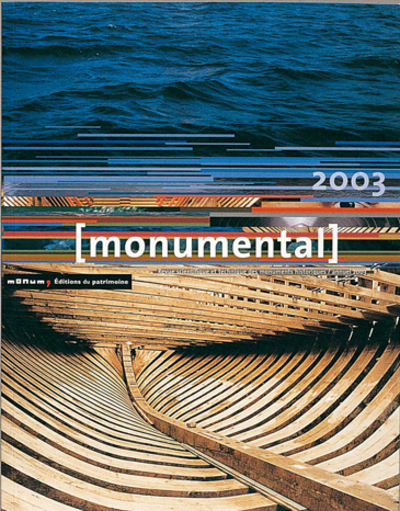
2003N2679Éditions du patrimoine - [monumental] - Revue scientifique et technique des monuments historiques, 2003, 248 p.