Antiquariat.de

250 résultats
170163606CBOhne Ort, ohne Verlag, 1701/1702. 4°. 31,5 x 20 cm. [132] Blatt. Halblederband der Zeit auf vier Bünden, mit floraler Blindprägung und späterem, privat beschriftetem Papierschild auf dem Rücken. [7 Warenabbildungen]
1797bn1577A Paris, de l'imprimerie de la République Relié 1797 In-4 relié pleine basane d'époque, dos à 5 nerfs, xii et 403 pages, 9 magnifiques planches dépliantes dont une très grande montrant un vaisseaux de profile, ouvrage référencé au numéro 1322 dans la bibliographie de Jean Polak, cet ouvrage contient le détail des différents roles selon la situation, essentiel pour comprendre l'organisation d'un navire et le nombre d'hommes essentiels à chaque manoeuvre, les plans de la disposition des hamacs sont impressionants, 363 hamacs dans la première batterie !!! An VI ; coins, coiffes et mors usés. Livraison a domicile (La Poste) ou en Mondial Relay sur simple demande.
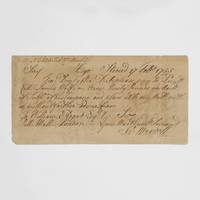
175738668Newtown NJ 1757. 1p. Signed by Henry Simson Joseph Byram John Anderson Thomas Woolverton and Joseph Parry. The French and Indian War on the New Jersey "Front Tears."<br/> <br/>In the wake of Braddock's defeat with tensions with the Delaware Valley Indian tribes rising and with a perceived threat that the tribes of the Delaware Valley would invade into New Jersey at the end of November 1755 Governor Belcher detached hundreds of West New Jersey troops to the New Jersey/Pennsylvania border and into Pennsylvania many under the command of Colonel Abraham van Campen. The present document concerns the death of a resident of Sussex County who evidently travelled with Van Campen and Colonel Jacob Ford to the "front tears" to "parley or hold a treaty with the Indians there" but "hath never returned & by report was near about that time killed." The document advocates for his bereaved wife and suggests that his eldest son be appointed heir and estate administrator. Another copy of this document addressed to "Your Honour" appears in the Documents Relating to the Colonial History of the State of New Jersey first series vol. xxxii p. 326. unknown books
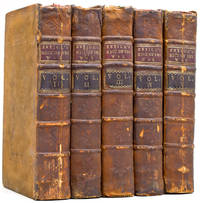
1766237662London: Edward and Charles Dilly 1766. Third edition revised and corrected of vols.I-III; second edition of vols. IV & V. With 41 portraits and 8 folding maps. iv 495; 464; 480; 470 26 Index pp. 5 vols. 8vo. Bound in contemporary panelled reversed calf boards tooled in blind leather title labels. Extremities worn joints rubbed front hinge of volume I detached and front endpaper laid in. Very good. Text clean. Bookplate. Third edition revised and corrected of vols.I-III; second edition of vols. IV & V. With 41 portraits and 8 folding maps. iv 495; 464; 480; 470 26 Index pp. 5 vols. 8vo. History of the French and Indian War drawn largely from primary source material and with much pertaining to the war in North America and the West Indies. Entick 1703-1773 was a prominent lexicographer and historian. Howes E165a; Sabin 22667 Edward and Charles Dilly unknown books
17916424A Paris, Chez F. Buisson, Imprimeur-Libraire, rue Hautefeuille, n°20. (1791). 1791 2 vol. in-8° (200 x 125 mm.) de : I. [2] ff. (titre, f. t.), viii, 466 pp.; II. [2] ff. (titre, f. t.), 486 pp. Initiales manuscrites à l'encre "L R" surles faux titres. Demi-basane dépoque, dos lisses ornés et titrés à l'or, coins de parchemin, plats recouverts de papier à la colle bleu.
179332480London: Printed for J. Debrett 1793. The Second Edition with Considerable Additions. Three-quarter leather. Good. Octavo. 1 xvi 433 pages 1 page blank 19 page index 1 page errata 2 pages advertisements 1. Recased binding with three-quarter brown leather and marbled paper covered boards. Gilt title and five raised bands on the spine. Newer front and rear end papers and one front blank end sheet inserted. The original rear end sheet is present. The folding frontispiece map is toned on the verso with an old repair made also on the verso. Some light edge wear to the map. The folding view of the Rapids of the Ohio and the State Map of Kentucky are in very good condition with light toning. <br /> <br /> Pages 417-433 includes a "Report of the Secretary of State to the President of the United States of the Quantity and Situation of the Lands not Claimed by the Indians Nor Granted to Nor Claimed by Any Citizens Within the Territory of the United States. Read in the House of Representatives Nov. 10 1791" by Thomas Jefferson. <br /> <br /> Howes I 12; Howes Reference Filson - F 129; Sabin 34355; Streeter III 1523; Clark II 41 "An early account of the western country.which was produced by a man who left Kentucky without settling his obligations who seems to have been involved in efforts to organize a French expedition to take the lower Mississippi Valley and who treated Mary Wollstonecraft Shamelessly. This book was written in the form of letters from Kentucky to a friend in England. In all probability they were written in Europe. Printed for J. Debrett unknown
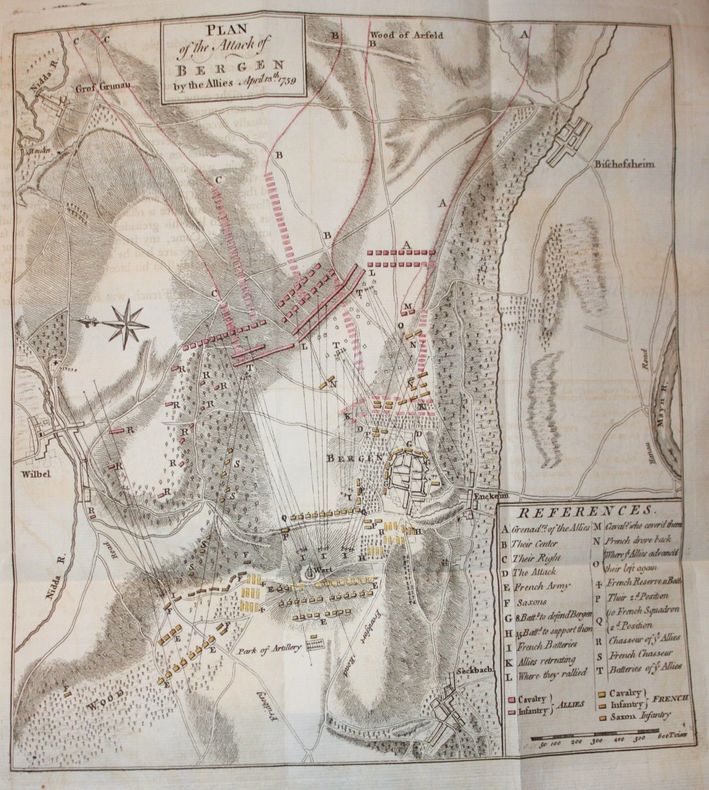
1764AMO-1480THE OPERATIONS OF THE ALLIED ARMY, UNDER THE COMMAND OF HIS SERENE HIGHNESS PRINCE FERDINAND, DUKE OF BRUNSWIC AND LUNEBERG, during the greatest Part of SIX CAMPAIGNS, beginning in the year 1757, and ending in the Year 1762. By an officer, who served in the British Forces. Illustrated with Maps and Plans. London, Printed for T. Jefferys, Geographer to the King, M. DCC.LXIV. [1764] 1 volume in-4 (25,5 x 21 cm) de 2 feuillets non chiffrés (titre et Advertisement by the Publisher placement des cartes et errata), 288 pages chiffrées (erreur de pagination) et 10 feuillets non chiffrés d'index topographique. 12 cartes et plans dépliants (sur 13 - la carte de la bataille de Minden a été arrachée). Une grande carte est déchirée coupée en deux morceaux. Petites déchirures à quelques cartes (plis, bords). La plupart des cartes sont de grande dimension (notamment les 4 cartes reliés à la fin du volume). Reliure de l'époque plein veau brun, dos orné de fleurons dorés (reliure anglaise) usagée. Le premier plat est presque détaché, le deuxième plat se détache, manque aux coiffes et aux coins, l'intérieur du volume est frais avec quelques rousseurs sans gravité. FIRST PRINTING. ÉDITION ORIGINALE. Provenance : George S. Bailey, 1843 et L. George P. Bailey (ex libris manuscrit répété et calligraphié avec note autographe). A noter également 3 petites notes manuscrites en anglais et signées B. H. (écrites par quelqu'un qui a pris part aux batailles). Cet important ouvrage, des plus rares, contient le récit militaire des six campagnes menées par le Duc Ferdinand, de 1758 à 1762. Batailles de Crevelt, Bergen, Minden, Warburg, Vellinghausen, Wilhelmstall, Hesse, etc.
17964831s.l. [Paris], Imprimerie de Patris, M.DCC.XCVI. 1796. 1796 1 vol in-8° (197 x 130 mm.) de: [1] pp. (faux-titre) ; 403 pp. Demi-basane d'époque à coins de parchemin, dos lisse orné, pièce de titre de maroquin rouge, plats recouverts de papier moucheté, tranches jaspées rouges. (Brunissures en marge de quelques ff. in-fine).
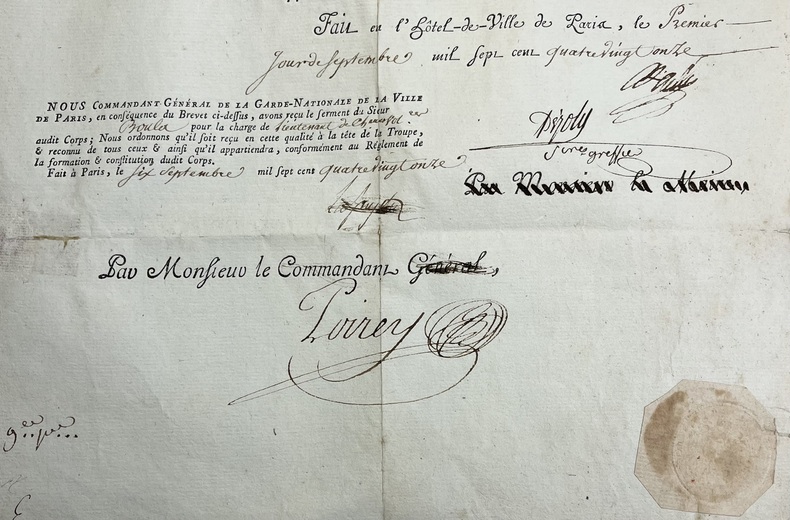
17914503Hotel de ville de Paris, 1er et 6 septembre 1791. 1791 1 feuille in-folio manuscrite à l'encre brune recto-verso (382 X 246 mm.) signée Henry, La Fayette, Bailly, Poirey et Dejoly, cachet en bas à droite (traces de plis avec cassures ancienement restaurées, taches ou traces d'adésif ). Chemise de papier ancien.
1703PHO-2014À La Haye, Chez les Frères L'Honoré, 1703. 2 tomes en un volume in-12, veau, dos à nerfs orné avec pièce de titre (reliure de l'époque) défauts d’usage. Rare édition de l'une des relations de voyage les plus importante pour l'histoire du Canada. - + 279 pp. & -- 220 + 8ff., Un frontispice et 24 planches ou cartes, certaines repliées, dont la « Carte Général de Canada ». Ex-libris manuscrit sur le titre. Première édition, troisième tirage.
1701AUB-4498A Bruxelles, chez Eugène Henry Frick 1701. 5 volumes reliés, reliures pleine peau d'époque, dos ornés avec titres, petits format, 1428 pages avec planches et notes + avertissement, préface de l'auteur, tables des chapitres et table des matières + 913 pages avec notes et planches + avertissement, approbation, extrait du privilège, lavie de Joseph écrite par lui-même (59 p.), préface de Joseph, tables des chapitres et table des matières. Contient: la réponse de Joseph à ce qu'Appion avait écrit contre son histoire des juifs touchant l'antiquité de leur race. Le martyre des Machabées. La relation faite par Philon de l'ambassade dont il était le chef envoyée par les juifs d'Alexandrie vers l'Empereur Caïus Caligula.
178579297Council=Chamber January 19 1785. handsomely matted. Very fine condition. Approx. 3-1/2 x 5-1/2 inches . The printed date 1784 was altered in ms. to 1785. unknown
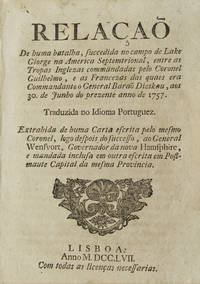
1757303318Lisboa: Domingos Rodrigues 1757. First edition. Woodcut vignette to title-page. 7 blank pp. Small 4to. A very good copy some very faint dampstaining. First edition. Woodcut vignette to title-page. 7 blank pp. Small 4to. A Portuguese translation of General William Johnson's "Letter to the Governours of the Several Colonies who raised Troops on the Present Expedition" signed in the text "Wilhelmo Gonson." <br /> <br /> Not long after the commencement of the Seven Years' War Johnson was appointed British agent to the Iroquois. On 28 August 1755 he renamed Lac Saint Sacrement Lake George in honor of the British monarch and proceeded north as part of a four-pronged attack on the French specifically to capture the French-held Fort St. Frédéric at Crown Point. <br /> <br /> "It was not the greatest battle of the French and Indian War but it came when a victory was needed and the results were momentous. It retrieved both the glory and morale so badly depleted when Braddock fell at the forks of the Ohio the previous July. It blunted a French drive which menaced Albany and the northern frontier set up a new English outpost in that area and the capture of a distinguished French general Dieskau was triumph for the victors and humiliation for the enemy" Hamilton.<br /> <br /> The publication of this letter was of course a remarkable source of propaganda for the English and boosted Johnson's career signficantly. The letter was reprinted in London an engraved plan of the battle was produced as well as portrait. This Lisbon printing is however very rare and little known. It's not in COPAC there wasn't a copy in the Streeter Sale. In fact the last copy on the market we can find was in 1928. Not in Church; Sabin 38661; Maggs "Biblioteca Americana" IV 2998; Milton W. Hamilton "Battle Report: Genreal William Johnson's Letter to the Governors Lake George September 9-10 1755" in Proceedings of the American Antiquarian Society April 1964 pp 19-36 [Domingos Rodrigues] unknown
1757303318Lisboa: Domingos Rodrigues 1757. First edition. Woodcut vignette to title-page. 7 blank pp. Small 4to. A very good copy some very faint dampstaining. First edition. Woodcut vignette to title-page. 7 blank pp. Small 4to. THE BATTLE OF LAKE GEORGE. A Portuguese translation of General William Johnson's "Letter to the Governours of the Several Colonies who raised Troops on the Present Expedition" signed in the text "Wilhelmo Gonson." <br/><br/>Not long after the commencement of the Seven Years' War Johnson was appointed British agent to the Iroquois. On 28 August 1755 he renamed Lac Saint Sacrement Lake George in honor of the British monarch and proceeded north as part of a four-pronged attack on the French specifically to capture the French-held Fort St. Frédéric at Crown Point. <br/><br/>"It was not the greatest battle of the French and Indian War but it came when a victory was needed and the results were momentous. It retrieved both the glory and morale so badly depleted when Braddock fell at the forks of the Ohio the previous July. It blunted a French drive which menaced Albany and the northern frontier set up a new English outpost in that area and the capture of a distinguished French general Dieskau was triumph for the victors and humiliation for the enemy" Hamilton.<br/><br/>The publication of this letter was of course a remarkable source of propaganda for the English and boosted Johnson's career signficantly. The letter was reprinted in London an engraved plan of the battle was produced as well as portrait. This Lisbon printing is however very rare and little known. It's not in COPAC there wasn't a copy in the Streeter Sale. In fact the last copy on the market we can find was in 1928. Not in Church; Sabin 38661; Maggs "Biblioteca Americana" IV 2998; Milton W. Hamilton "Battle Report: Genreal William Johnson's Letter to the Governors Lake George September 9-10 1755" in Proceedings of the American Antiquarian Society April 1964 pp 19-36 [Domingos Rodrigues] unknown books
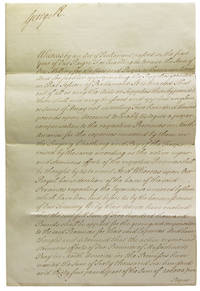
1761319882Great Britain 1761. 2pp. plus integral blank. Docketed on verso "King's Warrant / Province of Massachusetts / Bay £60634 in part / of £200000 Granted for / the North American / Provinces." Signed by George III at the head of the first page countersigned on the second page by William Wildman Barrington James Oswald and Gilbert Elliot. Folio 14 1/4 x 9 1/2 inches. Usual folds. 2pp. plus integral blank. Docketed on verso "King's Warrant / Province of Massachusetts / Bay £60634 in part / of £200000 Granted for / the North American / Provinces." Signed by George III at the head of the first page countersigned on the second page by William Wildman Barrington James Oswald and Gilbert Elliot. Folio 14 1/4 x 9 1/2 inches. Towards the end of the French and Indian War William Pitt started a specie grant program to reward colonies for raising troops thus putting the colonies in competition with each other for a share of an annual 200000 pounds. With specie scarce in the colonies the colonial assemblies were thus incentivized to raise troops to fight against the French. The present document authorizes Henry Fox to make payment to Massachusetts via their colonial agent William Bollan for their share of the annual grant. Although successful the policy was abandoned in favor of direct taxation after 1762 leading to the Sugar Act and most notably the Stamp Act. <br/><br/>This undated document -- the space for the date being left blank suggesting it to possibly be a draft -- is countersigned by William Wildman Barrington Chancellor of the Exchequer 21 March 1761 to 8 May 1762; Sir Gilbert Elliot third Baron Minto Lord of the Treasury 1761-62 and James Oswald Commissioner of the Treasury 1759-63. The date would therefore appear to be 1761 or early in 1762.<br/><br/>George III documents relating to North America from the early years of his reign are particularly scarce. unknown books
1784elala979Paris: Ponce & Godefroy c1784. 1784. 4to. 16 engraved plates incl. title. contemporary bds. rebacked in calf. First Edition. An attractive series of sixteen plates and maps of the American Revolution engraved by Nicolas Ponce and François Godefroy after designs by Fauvel Marillier Le Paon and other notable French artists of the period. Recorded here are some of the major events of the War and of the larger global conflict between Great Britain and France including the tarring and feathering of John Malcom at Boston the battle of Lexington the capitulation of Burgoyne at Saratoga the capture of Dominica Senegal Grenada Pensacola and Tobago the surrender of Cornwallis at Yorktown the battle of St. Eustache the siege of Fort S.Philippe and the attack on Brimstomhill. There is also a general map of the United States and a composite map of the Gulf of Mexico Barbary Minorca and Tobago. Below each view forming part of the engraved surface is brief explanatory text by Niquet. The engraved title contains a précis of the War surmounted by five inset views of military and naval engagements while the final plate decorated with four similar insets gives a précis of the Treaty of Versailles in 1783 and a list of the principal officers killed or wounded in the war. Howes describes this as the first French book with a title-page mentioning the United States. Another issue of the book is also recorded with additional title-page Collection d'estampes. and with several of the plates unnumbered. Cohen-De Ricci 862. Howes C-576. Sabin 68421. Winsor VI p. 185. cfJCB II 2997. 1st Edition. Paris: Ponce & Godefroy, [c1784]. unknown
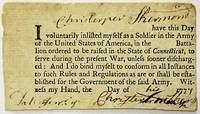
177734560Hartford 1777. Small printed broadside oblong 4" x 2-3/4". "Christopher Sherman" is inserted in manuscript as the name of the volunteer. An "X" for "his mark" is in ink at the end over an attempt to sign his name. For the year "177" is in type and the final "7" in manuscript. "Date" at the bottom is in manuscript along with the month probably "janry". Outer margin closely trimmed but text unaffected. Very Good. <br/><br/> An unrecorded form of Revolutionary War enlistment engagement exceedingly interesting for its reference to "the United States of America." Recorded enlistment engagements from this era-- all of them rare-- refer to the "United Colonies of America" "America" the "Colony of Massachusetts" the "Colony of Massachusetts-Bay". We have handled an unrecorded Massachusetts enlistment engagement from this period which refers to the "United States of America." Enlistment engagements from Connecticut referring to the "United States of America" from this era are unrecorded.<br/> The Continental Congress renamed the Nation "United States of America" on September 9 1776 ordering that "In all continental commissions and other instruments where heretofore the words 'United Colonies' have been used the stile be altered for the future to the 'United States'."<br/> Christopher Sherman was a Private under Captain William Richard's Company in the First Regiment of the State of Connecticut commanded by Lieut. Col. Samuel Prentice Esq. in 1777. A manuscript notation on the payroll sheet for the period January to June 1777 states that he deserted on January 10th or 18th. Revolutionary War Rolls 1775-1783; National Archives Microfilm Publication M246 138 rolls; War Department Collection of Revolutionary War Records Record Group 93; National Archives Washington. D.C. accessed at Ancestry website. <br/>Not located on NAIP ESTC OCLC as of November 2020. unknown books
1755374677Stroud 1755. Other endorsements on verso. Other endorsements on verso. A very rare French and Indian War signature. Wolfe fell famously in battle on the Plains of Abraham during the siege of Quebec in 1759. unknown
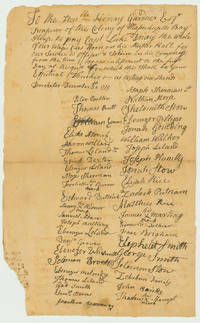
177520781.03<p>A scarce petition for pay listing 44 members of Captain Luke Drury's Company 27 of whom were Grafton Massachusetts-area Minutemen who had marched 36 miles to respond to the Lexington-Concord Alarm on April 19-21 1775. The list includes Fortune Burnee a Minuteman of African American and Native American heritage and his half-brother Joseph Anthony who enlisted on April 29th and died in service. Another of the Minutemen listed is the famous clockmaker Aaron Willard.</p> <b>REVOLUTIONARY WAR.</b>Manuscript Document Dorchester Massachusetts December 30th 1775 addressed to Massachusetts Treasurer Henry Gardner. 1p. 8 x 13 in. Likely Drury's retained copy from the time with the signatures all in one hand though some may be signed with marks & Jonathan Hemenway has signed himself.<p>Petition<i> "to pay Capt Luke Drury the Whole of our Wages as born on his Muster roll for our Services as Officers & Soldiers in his Company from the time of our inlistment to the first Day of August for which this shall be your effectual voucher." </i></p><p>Today the terms <i>minuteman </i>and <i>militiaman</i>are often used interchangeably but there was a distinction in the eighteenth century. Militia were men in arms formed to protect their towns from foreign invasion. They could designate up to one quarter of their force as minutemen a specially trained force required to be highly mobile and able to assemble instantly to a call to arms. It is difficult to categorize specific men into either of the two groups based on the surviving historical record. We apply the term here to all of those militia who responded April 19-21 1775 to the Lexington-Concord Alarm. </p><p>The 27 soldiers and officers listed here who were part of Luke Drury's Grafton Aaron Kimball's Grafton & John Putnam's Sutton April 19-21 Minutemen companies are: 1st Lt. Asaph Sherman Sgt. Nathan Morse Sgt. Shelomith Stow Sgt. Ebenezer Phillips Sgt. Jonah Goulding Cpl. William Walker Cpl. Joseph Leland Drummer Elijah Rice Fifer Zadock Putnam Matthias Rice Isaac Brigham Eliphalet Smith George Smith Peter Butler Thomas Pratt William Evans Elisha Aldrich Aaron Willard Eseck Dexter Moses Sherman Fortinatus Fortune Burnee signed with mark Edward Buttrick Ebenezer Leland Solomon Brooks Ebenezer Melendy Thomas Leland Sr. & Samuel Stearns.</p><p><b>Luke Drury</b>1734-1811 of Grafton Massachusetts joined the militia in 1757 during the French and Indian Wars. As captain of a company of Minutemen and Militamen he responded to the Lexington Alarm and later joined Colonel Jonathan Ward's regiment to fight at Bunker Hill. Drury and his men served in different areas during the war from West Point to Grafton where his company guarded military stores. He also supported the Continentals financially at one point giving £50 fifty pounds to enlist soldiers in Grafton.</p><p>In 1786-1787 Drury became deeply involved in Shays' Rebellion a tax revolt led by farmers in western Massachusetts. The uprising was quashed and Drury imprisoned as "a person dangerous to the state." He was eventually released on good behavior. Drury remained active in state and local politics serving terms as constable deputy sheriff tax collector assessor selectman and state legislator.</p><p><b>Condition</b></p><p>Usual folds small loss at bottom left corner affecting some marginal ciphering else fine condition.</p><p><b>Joseph Anthony</b> and <b>Fortune Burnee Jr.</b> half brothers were both part African-American and Hassanamisco Nipmuc Native American. Compared to records of white New Englanders we know relatively little about them but even so more information exists on these freedmen than is the norm. Several of the Anthonys and Burnees were recorded in the Grafton vital land and probates records the U.S. census neglected to record Native Americans from 1790-1890 and the Burnees have been discussed in recent historical and sociological literature: exploring the relationships both amongst marginalized peoples as well as with their white Yankee neighbors in eighteenth century New England; the definitions of race and identity; social mobility; Indian and black cultures; gender roles; Anglo-Nipmuc land dealings; and the remarkable preservation and history of an 190-acre tract of land in Grafton known as Hassanamesit Woods which is the site of a seventeenth-century "praying Indian" village with Nipmuc habitations that clung on into the mid-nineteenth century.</p><p><b>Joseph Anthony</b>was born in Grafton on December 24 1753 son of Joseph/William Anthony "Negro" and Abigail Printer Abraham "Indian." According to a Nipmuc leader and genealogist Anthony's ancestors include Hassanamisco Nipmuc Chief Anaweakin second in command in King Philip's War in 1675-6; along with Philip/Metacom Anaweakin was killed and his children sold into slavery; his father Noas Sachem of Hassanamesit forced into exile at the same time and died at Deer Island in Boston Harbor; and Nanapashemet Great Sagamore of the Massachuset Federation who was killed in battle in 1619 at Rock Hill Medford the year before Massachusetts was colonized by the English.</p><p>In 1728 seven Indian "Planters" or householders and 33 English re-divided the land at Hassanamesit to incorporate the town of Grafton. In 1739 Abigail Printer married Andrew Abraham Jr. "Indian Planter." Based on Abigail Printer's surname and the very small population left at Hassanamesit in the 1700s it is believed that she is a descendant of Rev. John Eliot's notable contemporary James Printer a Harvard student in 1645-46 who worked for Samuel Green printing Eliot's famous "Indian Bible" in 1663. Abigail and Andrew had three sons before he died in August 1746 after returning from service in the Port Royal Campaign.</p><p>Abigail married second November 14 1752 Joseph/William Anthony. Little is known of him other than his listing in town records as a "Negro." It appears he died circa 1756. Their son the signer of this document <b>Joseph Anthony</b> married Lydia Mercy Johnson. He enlisted in the army April 29 1775 and was reported missing July 6 1777 probably at the Battle of Ticonderoga and dead December 26 1777 possibly a prisoner of war on board an infamous New York City British prison ship. At the time he was a private in Capt. Blanchard's Company of Col. James Wesson's 9th Massachusetts Regiment.</p><p><b>Fortune Burnee Jr.</b> Grafton records spell his name a number of different ways. Dr. David R. Mandell believes there was one man of that name but we find that Electa Kane Tritsch's postulation that there was a father and a son of the same name makes more sense. Abigail again a widow married a third time January 27 1757 to Fortune Burnee Sr. described as "Negro" a veteran of one or more expeditions to Canada during the French and Indian War and widower of another Hassanamisco Sarah Muckamaug Whipple. Mandell writes that Burnee had changed his first name from William to Fortune based on his good luck but does not cite the source or anecdote: Fortune seems more likely a given slave name. He also claims that Burnee abandoned his first wife Sarah before her death but Tritsch has found no evidence for this: that statement may have been compounded with Sarah's first husband Aaron Whipple of Providence Rhode Island. It is thought that Burnee Sr. died about 1771. If so his son <b>Fortune Burnee Jr</b>. is the man who served under Capt. Luke Drury. It is as yet unknown if he is the son of Fortune Burnee Sr.'s second wife Abigail Printer Abraham Anthony Burnee who died in 1776 or his first wife Sarah Muckamaug Whipple Burnee who died in 1751 thus he is either Anthony's younger half-brother or older step-brother. It is interesting to observe that Burnee signs another Drury document with a mark while Anthony was capable of signing in full – whether that hints that Anthony was the younger brother with less responsibilities on the homestead and more opportunity for education is mere speculation. However Tritsch probably by process of elimination finding that Fortune Burnee Jr. does not appear in Sarah's estate papers assigns him as the younger a son of Abigail and half-brother of Joseph Anthony. Fortune Burnee Jr. marched on April 21 1775 in response to the Lexington-Concord Alarm. Marriage records then show that Fortune Burnee Jr. married July 31 1778 "Phylis…negro servant of Rev. Mr. Frost…of Mendon both are listed as "Negroes" and then November 8 1781 Sarah Hector of Sutton again both are listed as "Negroes". He died in 1795.</p><p>Without going into the complex history of Hassanamesit and the Hassanimisco praying Indians Reverend Ezra Stiles's 1761 impressions of the settlement are notable: "At Grafton…I saw the Burying place & Graves of 60 or more Indians. Now not a Male Ind. in Town & perh. 5 Squaws who marry Negroes." By 1770 the town selectmen reported "that there is but one male Indian left" – this man was in fact one of Sarah Muckamaug Whipple's bi-racial children Joseph Aaron. 87 years earlier in 1674 Daniel Gookin had noted that the Indian village had contained twelve families perhaps sixty souls – King Philip's War of 1675-76 and its lingering years of conflict played a major part in this population displacement and decrease.</p><p><b>African Americans & Native Americans in the American Revolution</b></p><p>Of the estimated 100000 men who served in the Continental Army at least 5000 were black. Most black soldiers fought in integrated units as in Massachusetts; some states like Rhode Island had segregated regiments while Connecticut seems to have had both segregated and integrated. Both enslaved and free African-Americans served in the army as soldiers laborers and servants. In some cases slaves were offered freedom for their services as soldiers though others remained enslaved fighting in place of their masters. Many states had been reluctant to arm the black population but had no other countermove to the British Lord Dunmore's offer of freedom to Southern black enlistees. A significant number of colonial blacks at this time were also partly of Native American ancestry – to take once state Massachusetts's eighteenth-century Indian population had two females to one male while the majority of the imported African slave laborers were male. Those figures coupled with their removal to neighboring outskirts of colonial society as well as the enslavement of many Indians in New England after King Philip's War did much to comingle the two ethnic groups.</p> books
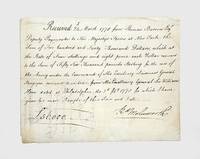
1778155748Rhode Island: 24 March 1778. Sustaining Burgoyne's Wandering Army Revealing a crucial moment in the aftermath of Saratoga this 1778 receipt documents the transfer of £56000 from New York to support General Burgoyne's imprisoned Convention Army in Boston. The receipt was signed at a delicate point for the British Army. In the summer of 1777 General William Howe succeeded in taking Philadelphia but in October a separate force under John Burgoyne was forced to surrender to Horatio Gates following the two battles of Saratoga in the autumn of 1777. Subsequently the Convention Army named for the treaty of surrender was marched to Boston where they were held prisoner. Burgoyne was permitted to leave for England in April 1778 but his army remained in captivity until the end of the war. This immense sum of £56000 perhaps equivalent to £9500000 today was sent to Burgoyne to feed his starving army. The Battles of Saratoga represented the turning point of the Revolutionary War winning the assistance from France "which was the last element needed for victory" Morgan pp. 82-3. The receipt was signed by Richard Molesworth 1737-1799 a longstanding deputy paymaster in the War Office. Molesworth is briefly mentioned in a letter to Howe on 10 April 1778 where the need for money to support General Burgoyne and his army in Boston is discussed. Richard was the brother of the Robert 5th Viscount Molesworth who inherited the title from his cousin Richard Nassau Molesworth 4th Viscount Molesworth who died without heirs. This document was previously folded and kept in an envelope mounted on the front pastedown of a book from the Molesworth family library a first edition of the English translation of Souligné's The Desolation of France Demonstrated. It was gifted by Souligné to Robert Molesworth 1st viscount Molesworth 1656-1725. Molesworth has inscribed the front blank: "Donum Authoris" Gift from the Author and his note on the title-page reads: "Mons. De Souligny sic Grandson to the famous Du Plessis Mornay". The 1st Viscount Molesworth was an experienced political figure and a prominent member of the Privy Council of Ireland who later held a seat for Dublin County in the Irish House of Commons. The book has a later ownership inscription of Samuel Crompton 1753-1827 on the preliminary blank. Crompton was a pioneer of the spinning industry and was married to Harriet Molesworth the daughter of John Edward Nassau Molesworth. John was the great-grandson of Robert Molesworth 1st Viscount Molesworth. A 20th-century bookplate of another viscount Molesworth is pasted over the white envelope which held the subsistence receipt on the front pastedown. Also present is a manuscript bankers' draft dated 1796 signed by the 5th Viscount Molesworth requesting a payment to his son-in-law John Forster Hill. Single leaf 147 x 187 mm hand-written on both sides in black ink; the book: octavo 186 x 117 mm; also with manuscript bankers' draft dated 1796 and signed by Robert 5th Viscount Molesworth. The book: contemporary black crushed morocco raised bands spine gilt in compartments covers ornamentally gilt marbled endpapers. Ink annotations possibly in Crompton's hand. Rubbed minor loss at spine ends a few marks to covers binding open to the cords after free endpapers but sound occasional minor staining. ESTC R8752; Goldsmiths' 3380. 3380. Edmund Sears Morgan The Birth of the Republic 1763-89 1956; Report on the American Manuscripts in the Royal Institution of Great Britain volume 9 No. 180. hardcover
176337559London: Robert Sayer 1763. Engraved map on four joined sheets hand coloured sectioned and linen backed at a contemporary date. Overall sheet size: 42 1/8 x 47 3/8 inches. Housed in a tan cloth box. An early issue of Bowen and Gibson's impressive wall map of North America: the first issue following the end of the French and Indian War.<br/> <br/>Bowen and Gibson's map was first issued in about 1755 under the title An Accurate Map of North America. It was reprinted and served as a template for the enormous political changes of the next forty years attesting to its importance. Aside from its stunning visual impact Bowen and Gibson's map teems with information including numerous Native American placenames in the western areas native tribal regions notes and routes of early roads and the forts along the Mississippi and to the west of the Appalachians. The two insets are of Baffin and Hudson's Bays and the mouth of the Colorado River the latter map based on the explorations of Eusebio Kino. The roccoco cartouche is particularly attractive and features a Native American couple with their small child and a group of indigenous animals: beaver alligator parrot and the skin of a mountain lion. The present issue was the first to the published following the French and Indian War and includes the boundaries as reflected by the Treaty of Paris of 1763.<br/> <br/>Stevens & Tree "Comparative Cartography" 49b in Tooley The Mapping of America; Degrees of Latitude 36; Phillips A List of Maps of America p. 589. Robert Sayer unknown books
175736652Paris: Imprimerie Royale 1757. 4 volumes quarto. 10 x 7 1/2 inches. Woodcut head- and tailpieces. viii lxxv 1 1811 61 1cvii120; xiii 1 646; xvi319 1; 6 xxv 1 654pp. 2 engraved folding maps. Contemporary mottled calf gilt with arms of the duke of Sutherland on upper covers spine gilt in compartments with fleurs-de-lys and crowned L monogram red morocco lettering-pieces red speckled edges<br/> <br/>Provenance: George Granville Leveson-Gower Duke of Sutherland and Marquis of Stafford gilt arms on binding armorial bookplate<br/> <br/>Critical work on the French and Indian War particularly respecting Canada: with the very rare fourth volume seldom found with the set.<br/> <br/>A valuable collection of historical documents and official papers setting forth the opposing claims of France and England to North American territories. This is the most important contemporary source for the origins of the Seven Years' War. The commissioners William Shirley governor of Massachusetts Sir William Mildmay representing Great Britain and the Marquis de la Galissonière and E. de Silhouette acting on behalf of France were appointed after the Treaty of Aix-La-Chapelle in 1748 to reach an agreement regarding the definition of the exact geographical boundaries of Acadia ceded by France to Great Britain by the Treaty of Utrecht in 1713 under the vague definition of "its ancient limits." The documents and papers contained herein provide a significant historical record of Acadia with a discussion of the first permanent settlement in Canada early trading companies and subsequent occupation of the country. Of particular and great importance is the continual discussion of the early maps explorers and geographers of America. Besides the Acadian question the third and fourth volumes contain considerable material on disputes over St. Lucia and Tobago in the West Indies. The fourth volume issued two years after the other three volumes is quite rare and seldom found with the set although is present here.<br/> <br/>Howes M508; TPL 235; Lande 148; Vlach 350; COX II p.120; Sabin 47547 incorrectly calling for 3 maps; JCB I:1074. Imprimerie Royale unknown books
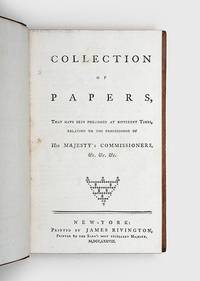
1778161245New York: Printed by James Rivington 1778. Britain seeks peace with revolutionary America First editions of these six tracts recording efforts at British-American reconciliation during the Revolutionary War. This copy has an excellent provenance: although not marked as such it comes from the family collection of William Eden 1744-1814 a key figure in the negotiations and the author of the latter two works. In 1778 Lord North appointed Eden a member of the Board of Trade and Frederick Howard 5th Earl of Carlisle 1748-1825 to a commission charged with reconciling Britain and America after the British defeat at Saratoga. Although the commissioners were authorized to grant every American demand short of independence the mission was not a success. Mostly this was because the Americans had already formed an alliance with France but Carlisle did not help matters by issuing a manifesto which criticized the French and insisted that Britain would fight to the bitter end. This attracted the attention of the Marquis de Lafayette who challenged Carlisle to a duel which was rejected on diplomatic grounds. The Collection of Papers published in New York by the king's printer includes Carlisle's manifesto along with various other letters and proclamations exchanged between the commissioners and Congress. The second third and fourth tracts comprise Congress's four-page response to the Carlisle manifesto a petition and an address to the commissioners from the loyalist merchants of New York City. These papers are often found with the Collection but are not always present and are listed as separate works in ESTC. In Eden's two tracts he defends his record with the commission and demonstrates his continued engagement with British and Irish politics. He had begun to push for Carlisle's promotion and in 1779 he secured for him the presidency of the Board of Trade. In 1780 Carlisle became Lord Lieutenant of Ireland taking Eden with him as his chief secretary. The other tracts comprise: b SECOND CONTINENTAL CONGRESS. The following Paper is reprinted in New-York by Authority with the Remarks subjoined to it. By the Congress of the United States of America. Manifesto. New York: Printed for James Rivington 1778. 4 pp. Not in Howes or Sabin; ESTC W23804; Evans 16133. c The Petition of the Merchants and Traders of the City of New York. New York: Printed for James Rivington 1778. 4 pp. Not in Evans Howes or Sabin; ESTC W18925. d The Address of the Inhabitants of the City of New-York and its Dependencies and others his Majesty's faithful and loyal subjects late Inhabitants of the revolted Colonies. New York: Printed for James Rivington 1778. 3 1 pp. Not in Evans Howes or Sabin; ESTC W19159. e EDEN William. Four Letters to the Earl of Carlisle. On certain perversions of political reasoning. On the Present Circumstances of the War between Great Britain and the combined Powers of France and Spain. On the Public Debts. On the Representations of Ireland respecting a Free-Trade. London: Printed for B. White and T. Cadell 1779. 2 163 1 pp. Bound without half-title. Not in Evans; Adams 79-6a; ESTC T40097; Howes E43; Sabin 21827. A second edition was published later in the same year. f EDEN William. A Fifth Letter to the Earl of Carlisle. On Population; on certain Revenue Laws and Regulations connected with the Interests of Commerce; and on Public Oeconomy. London: Printed for B. White and T. Cadell 1780. 2 71 1 pp. Bound without half-title. Not in Eden or Howes; Adams 80-7a; ESTC T35522; Sabin 21828. Six works bound in a single vol. octavo 208 x 123 mm. Complete with four-leaf appendix and errata leaf. Woodcut ornament to title page woodcut head- and tailpieces. Contemporary sprinkled calf smooth spine panelled and with elaborate decoration in gilt and with red and green morocco labels edges yellow. Housed in a tan cloth flat-back box by the Chelsea Bindery. Light bumping and rubbing front joint cracked but holding firm slight loss to lower spine end minor browning and foxing to endpapers and contents a couple of small ink splashes to contents: a very good copy. ESTC W20046; Evans 15825; Howes C585; Sabin 14380. hardcover
178063128Head Quarters Bergen County NJ 1780. Folio one page approximately 125 words in part: "I perceive . that you had collected about two hundred Cattle more and that a further number might be obtained . I cannot of right command the services of the militia . let the commanding officers know how distressed the Army has been and is likely to be for provisions and that it will be rendering splendid service to us and distressing the enemy to remove the Cattle from those parts of the Coast which furnish the New York Markets." Very good. Browned one small piece detached one word of text easily repaired. After Washington's victory at Monmouth June 1778 during which battle Forman had served as an advisor to Charles Lee the war settled into stalemate with Washington's army in New Jersey and the British forces content to remain in New York both sides keeping an eye on each other while trying to provide for their soldiers the American forces suffering deprivation similar to that of Valley Forge. Meanwhile on the day this letter was written word reached Washington of the complete rout of Horatio Gates and his troops at Camden South Carolina opening Virginia to British invasion from the South. Bolstered by American victories at Kings Mountain Oct. 1780 and Cowpens Jan. 1781 and the depletion of Cornwallis's army at its victory over Nathaniel Green at Guilford Court House Washington in conjunction with his French allies moved south to envelop Yorktown earning the British surrender in October 1781 effectively ending the war. General David Forman 1745-1797 born and raised in Monmouth County New Jersey was appointed colonel of a New Jersey regiment that reinforced Washington at New York in June 1776. After suppressing a loyalist uprising later that year during which time he earned the nickname "Devil David" he was chosen to lead a regiment in the Continental army and in 1777 was commissioned brigadier general to lead the New Jersey militia commanding that force in the battle of Germantown Oct. 1777. Disagreements with the New Jersey legislature led to his resignation from that command and he spent the rest of the war running listening posts especially along the coast of New Jersey providing Washington with intelligence on the movements of the British fleet and army a service he was providing at the time of this letter. see DAB Tench Tilghman 1744-1786 born and raised in Talbot County Maryland graduated from the precursor to the University of Pennsylvania in 1761 taking up a mercantile business until the outbreak of the revolution. After serving briefly as a captain in the army he joined Washington as a volunteer and served continuously as an aide-de-camp to the general for the balance of the war. "The amount of secretarial work in addition to military duties that he performed for Washington was prodigious" DAB and he was granted a regular commission of lieutenant-colonel in 1781. After the victory at Yorktown Tilghman was chosen by Washington to carry the announcement of the surrender of Cornwallis to the Continental Congress. Provenance: When recently purchased the letter was in an old frame and removal revealed an autograph note inside the backing included here as follows: "This letter was bought by me about 1860 of Miss Brown residing at 92 Columbus Street Albany New York. She was a sister of an old minister of St. Peters Church. This Miss Brown was a client of Orlando Meads and myself and found this letter in a barrel in the garret of the home occupied by her sister at Manalapan New Jersey formerly owned by General David Forman. signed Dexter Reynolds / Albany Sept. 7 1902. Presented to my son Marcus T. Reynolds." A newly discovered Washington letter shedding light on the general's relationship to state militias and his concerns for providing for his troops while disrupting the supply lines of the British. Not in Fitzgerald or the Founders Online from the National Archives which lists 57 other Washington letters to Forman 1777-1782 showing a gap from 24 July 1780 to 17 May 1781 and two others post-war. 9836. <br/><br/> unknown books
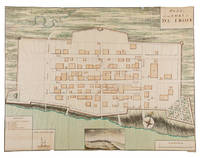
1761WRCAM56427Albany 1761. Manuscript plan in pen and ink with watercolor on four conjoined sheets of paper 21 1/2 x 28 1/2 inches signed at lower right "W.B. Albany Augt. 18th 1761." Old folds minor edge wear light soiling a few unobtrusive minor repairs to verso. Very good. A beautifully-rendered pen ink and watercolor plan of Fort Detroit executed by noted cartographer William Brasier for his commander General Jeffrey Amherst in Albany in 1761. It depicts Fort Detroit just months after it was ceded from New France to Great Britain and very much as it would look for the next four years. This version of Detroit would hold strong against Pontiac and his warriors throughout their barrage in the summer of 1763. <br> <br> William Brasier produced this plan after an original drawn the year before by Lieutenant Diedrich Brehm which was also presented to Amherst some months earlier in February 1761. Brehm had accompanied Robert Rogers from Detroit to New York in late 1760 and early 1761 and arrived at Amherst's command in New York with his plan of Detroit in tow. It is here in Albany where Brasier used Brehm's plan to create the present depiction. <br> <br> Like Brehm's plan Brasier's version presents Fort Detroit as a long roughly rectangular-shaped settlement populated with about seventy mostly-unidentified buildings colored in light red-brown. The names of north and south streets are labeled according to their orientation; this was just the second time the first being on Brehm's map that these streets were identified in print. The fort is shown just off the banks of what is now the Detroit River; a handwritten notation in the water reads "The Streight is about 900 Yards wide here." <br> <br> Brasier includes a "Reference" key at bottom left which identifies six of the buildings and other locations on the plan namely the "King's Powder Magazine" the powder magazine belonging to the inhabitants of the fort the block-houses "The Cavalier" the church and the "Commandant's Garden." This is down from nine locations in a similar key on Brehm's plan. Brasier's plan of Detroit was featured in Brian Leigh Dunnigan's FRONTIER METROPOLIS: PICTURING EARLY DETROIT 1701- 1838 and Dunnigan illuminates the reasoning behind Brasier's elimination of some of these locations: <br> <br> "Brasier's title 'Plan of the Fort at De Troit' does not reveal why it was drawn but the work is not an exact copy of Brehm's original. The differences lie in the west end of the town where all of the buildings shown by Brehm along both sides of the 'Rue neueve St. Germain' have been deleted. These stood within the space gained when Captain Belestre enlarged the stockade during 1758- 59 and it is likely that Brasier's copy relates to the controversy over ownership of those properties. At least twelve grants were made within the town by Captain Belestre during 1758-59 and most were in the area of expansion at the western end of the stockade. Before it had been incorporated into the town however that land was part of the Domain surrounding the fort and was thus the property of the French king. British officers questioned whether Captain Belestre had the authority to grant lots there to individuals. If not the land was rightly the property of King George III." <br> <br> Brasier also followed Brehm by including a "Profil sic of the Stockade" and an elevated depiction of the fort titled "View from the West." The stockade profile is a detailed depiction of the construction of Detroit's main defensive apparatus. The view of the city is considered the "first look at the town of Detroit in other than a ground plan or a map" according to Dunnigan. The perspective of this view was intended to be that of Rogers' troops as they faced the main gate upon arrival at the fort. The tops of many of the buildings including Belestre's own house peek over the tops of the surrounding stockade. The view also makes clear the reality of the uneven ground upon which Fort Detroit was built; the ground swells from left to right to about the middle of the fort then pitches downward again towards the river at right before plunging down to the river banks just outside the stockade walls. <br> <br> William Furness Brasier 1689-1775 was a draftsman in the engineer's office of General Amherst's command post at the time he executed the present plan of Fort Detroit. He was also a prolific and exacting cartographer who produced well-regarded maps of Lake Champlain the upper Hudson River valley and the Mississippi River as well as impressive plans of Fort Ticonderoga Fort Ontario Fort George Mobile and Pensacola and St. Augustine Florida. <br> <br> The whereabouts of this plan were unknown to Dunnigan at the time he published FRONTIER METROPOLIS. The plan remained in the collection of General Jeffrey Amherst and descended through his family until it was bought by Charles Sessler for H. Richard Dietrich at Sotheby's sale of the Earl of Amherst's collection July 4 1967 lot 494. It has been in the Dietrich American Foundation ever since. Brian Leigh Dunnigan FRONTIER METROPOLIS: PICTURING EARLY DETROIT 1701-1838 Detroit: Wayne State University 2001 p.55 figure 4.5. Sotheby's & Co. CATALOGUE OF AMERICANA VOYAGES AND TRAVEL ATLASES AND MAPS London: Sotheby's July 4 1967 pp.102-03. unknown books