COURTILZ DE SANDRAS (Gatien de)Livre Rare Book
84 résultats
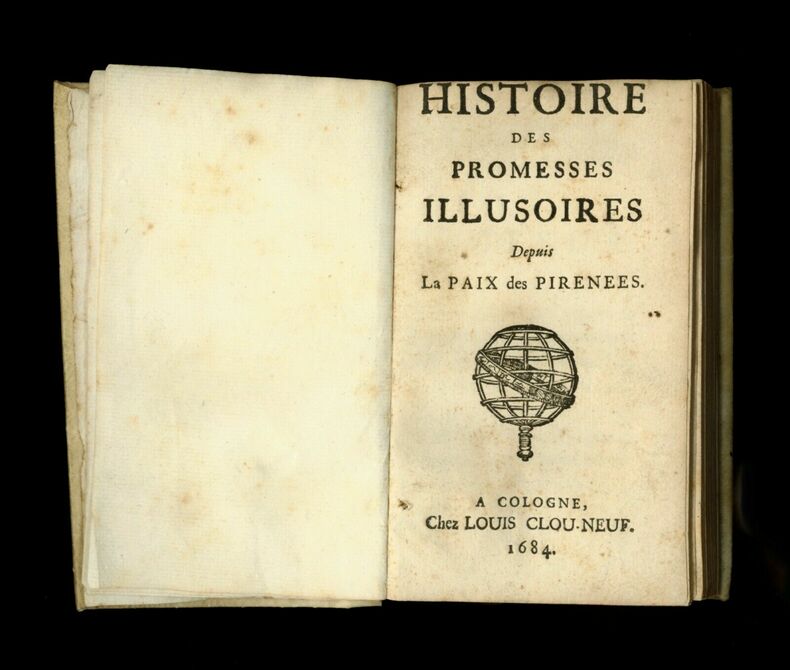
1684AMO-4452A Cologne [La Haye], chez Louis Clou-Neuf, 1684 1 volume in-12 (12,5 x 7,8 cm) de 211 pages. Reliure strictement de l'époque plein parchemin à coutures apparentes (reliure hollandaise), titre calligraphié à l'encre en long au dos (époque). Exemplaire court en marge de tête (atteinte au titre courant sur un feuillet - voir photo ci-dessous). Feuillets parfois légèrement roussis mais très frais dans l'ensemble. La reliure est parfaitement conservée. Edition originale et unique édition. Le traité des Pyrénées formalise une paix conclue entre la couronne d'Espagne et la France à l'issue de la guerre franco-espagnole, commencée en 1635 dans le cadre de la guerre de Trente Ans (1618 – 1648), et ayant continué durant la Fronde. La paix des Pyrénées est signée le 7 novembre 1659 sur l'île des Faisans, au milieu du fleuve côtier Bidassoa qui marque la frontière entre les deux royaumes dans les Pyrénées-Atlantiques. Les rois Louis XIV de France et Philippe IV d'Espagne y sont représentés par leurs Premiers ministres respectifs, le cardinal Mazarin et don Luis de Haro. Ce traité donne à Louis XIV une stabilité ainsi qu'un avantage diplomatique considérable et la cour d'Espagne est affaiblie. La France est désormais la grande puissance de l'Europe, et les Bourbons prennent définitivement le dessus sur les Habsbourg. En 1660, avec la fin de la Première guerre du Nord, l'Europe est entièrement en état de paix. Ce pamphlet est livré au public au cours de l'année 1684 si l'on s'en tient à la page de titre. Publié clandestinement probablement en Hollande, par un français, comme l'indique l'avis au lecteur, et non par un étranger mal intentionné. Courtilz de Sandras aurait acquis le manuscrit pour quelques livres. Au commencement du volume l'auteur dresse un état des puissances de l'Europe avant la paix des Pyrénées. Avec la paix des Pyrénées l'équilibre des puissances se rompt et la France est toute puissante. La France s'engage alors dans de nouveaux conflits armés contre les Provinces unies (Pays-Bas). La guerre de Hollande s'étend de 1672 à 1678. Elle oppose la France et ses alliés (Angleterre, Münster, Liège, Bavière, Suède) à la Quadruple-Alliance comprenant les Provinces-Unies, le Saint-Empire, le Brandebourg et la Monarchie espagnole. Triomphant de ses adversaires, la France, par le traité de Nimègue qui met fin à la guerre, confirme son rang de première puissance européenne en acquérant la Franche-Comté et de nombreuses places-fortes flamandes. Le volume s'achève au moment du siège de Vienne (14 juillet au 12 septembre 1683) par l'empire Ottoman (Turcs). Le volume s'achève sur ces événements, les turcs ayant été repoussés mais la guerre étant loin d'être terminée. L'auteur écrit ces mots pour finir le volume : "Au reste il s'agit d'examiner icy qui sembloit avoir raison des uns ou des autres, mais il me semble qu'il n'est pas bien difficile de conclure, que c'estoit ceux cy car quoy qu'il n'y ait rien a adjoûter à leurs raison, je diray cependant, que les Espagnols, qui eussent esté faciles sur les côditios de la paix, en cas que Vienne eut efté pris, fe roidiront maintenant qu'ils esperent pouvoir estre soutenus de l'Allemagne, laquelle de fon cofté fera bien aise aprés avoir fait la paix avec le Turc, de s'affranchir de la domination Françoise, quoy qu'il en soit, la victoire que vienent de remporter les Chrestiens, ne fauroit produire que de bons effets ; car que nous ayons la paix ou la guerre, nous devons esperer que nous en fortirons heureusement, & que d'un costé ou d'autre en trouvera lieu de mortifier une Couronne, qui commence un peu trop à se méconnoistre." Loin des péripéties de soldats ou des intrigues de cour habituellement racontées (rapportées) le plus souvent par Courtilz de Sandras, cet ouvrage se présente comme une chronologie des événements politiques et militaires. Cette chronologie semble juste et dépourvue des fantaisies habituelles de l'auteur. On doit au même auteur quantité de livres dont les Mémoires de M. d'Artagnan (1700) devenus célèbres dans la littérature depuis qu’Alexandre Dumas en a fait un chef d’œuvre au XIXe siècle. On lui doit aussi plusieurs ouvrages satiriques sur la cour et les amours de Louis XIV (dont plusieurs ont été faussement attribués à Bussy-Rabutin). Références : Anne Sauvy, Livres interdits et saisis à Paris entre 1678 et 1701, n°352. Bourgeois et André, in Les sources de l'histoire de France, n°3025, indiquent que le volume sort des presses de La Haye. "Contre la politique extérieure de la France, que l'auteur accuse de mauvaise foi et de prétention à la domination de l'Europe. L'ouvrage contient quelques tableaux de la guerre de Hollande à laquelle l'auteur dit avoir assisté." (Woodbridge, p. 23). Charmant petit volume très bien conservé dans son parchemin hollandais de l'époque.
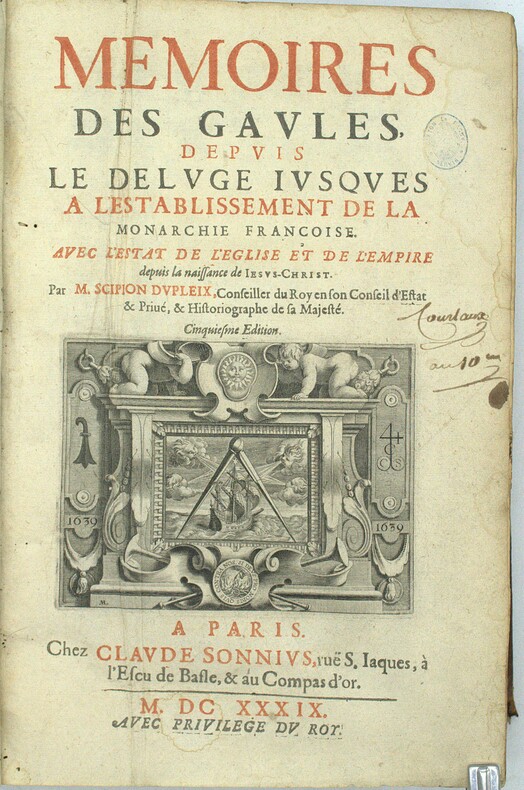
1638PHO-1960Paris, Claude Sonnius, 1638- 1649 ,6 volumes en 4 tomes in-folio, relié plein veau époque, dos à nerfs avec titre et tomaison, supra libris et ex-dono doré aux plats, manque aux dos, griffures et frottements, petits trous de ver aux dos, charnières fendillées, quelques rousseurs et brunissures Tome 1 ; Mémoires des Gaules …., 1639, suivi de Histoire de France …., cinquième édition, 1639, 6ff.-378pp.-12ff.-571pp.-10ff., cachet répété, travail de ver, quelques brunissures, manque le dernier feuillet de la table (en copie) Tome 2 ; Histoire de France…Contenant l’Histoire depuis Hugues Capet iusques à Louis XI, cinquième édition, 1638, 8ff.-852pp.-16ff., cachet, titre détaché et ébarbé, petite mouillure in-fine en marge, quelques brunissures. Tome 3 ; Histoire de France…Contenant l’Histoire depuis Louis XI, iusques à Henry III, quatrième édition, 1644, 8ff.-810pp.-14ff., cachet, travail de ver, mouillure, quelques brunissures, 2 feuillets détachés et ébarbés. Tome 4 ; Histoire de Henry III, Roi de France et de Pologne, 1649, suivi de Histoire de Henry Le Grand IV du nom…, 1639, suivi de Histoire de Louis Le Juste XIII du nom…, 1643, 203pp.-5ff.-4ff.-412pp.-12ff.-6ff.-484pp.-14ff., illustré de 2 frontispices, cachet, manque à la page du 1er titre, travail de ver, mouillure en fin d’ouvrage, quelques brunissures. Provenance ; ex-dono Lud. Bihorel, Carmélites de Rouen, cachet de Gaston le Hardy, maire de Rots, membre de la société de l’histoire de la Normandie.
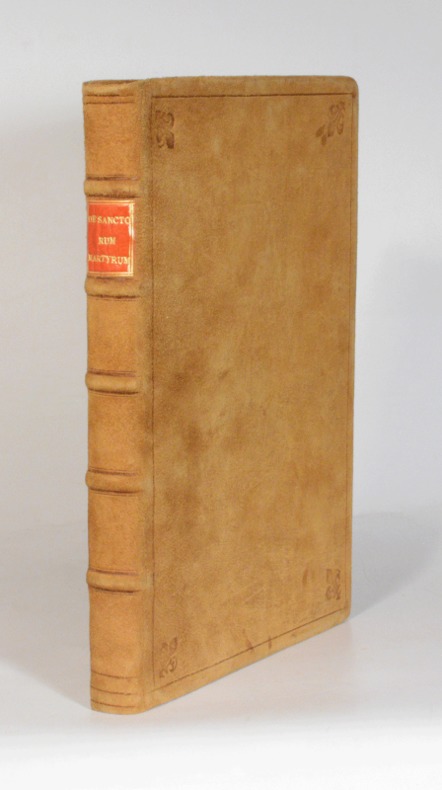
16590049501659 Parisiis [Paris], Fridericum Leonard [Frédéric Léonard], 1659-60. In-quarto (187 X 254 mm) cuir suédé fauve, plats ornés d'un encadrement à froid avec fleur de lys dans les angles, dos cinq nerfs sertis de filets à froid, pièce de titre maroquin rouge vif, tranches mouchetées en rouge (reliure postérieure) ; (1) f. blanc, (5) ff., 322 pages, (5) pages d'index. Cachet héraldique ancien à l'encre bleue en marge du feuillet de titre. MANQUENT QUATRE FEUILLETS : pages 153/154, 155/156, 169/170 et 229/230, mouillures claires angulaires et en marge de plusieurs feuillets.
1649190141Erschienen bei J. Janssonius, 1649. 38 x 49 cm, Papiermaß: 46,3 x 55,6 cm.
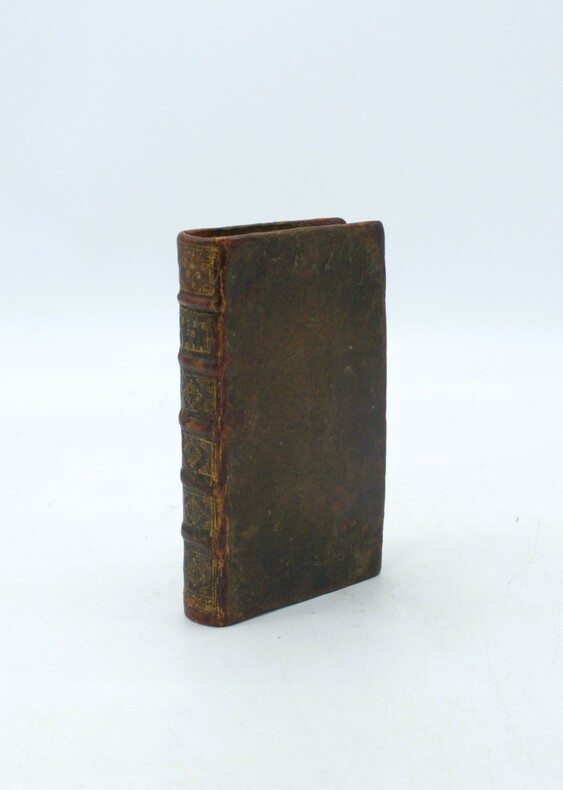
1678PHO-2058Paris, Gervais Clouzier, 1678. In-12 (16,5x9,5cm),6ff.-353pp.-1f, veau époque, dos à nerfs orné avec titre, frottements,, ex-libris manuscrit au titre, rousseurs, manque le premier et dernier feuillet blanc, papier bruni.
1625112711625 3 parties en un volume, reliure d'époque vélin ivoire parcheminé (binding full brown vellum) in-quarto à rabats et lacets (les lacets de cuir manquent), in-quarto à coins, in-quarto à coins oblong, in-dix-huit in-douze (duodecimo) in-seize (sextodecimo), in-24 (24mo - A book that is up to 5 " tall.) in-32 (32mo - A book that is up to 5" tall.) in-48 (48mo - A book that is up to 4" tall.) in-64 (64mo - A book that is up to 3" tall.), dos à nerfs (spine with raised bands) muet (spine without title) - tête lisse (top edge smooth), tranches lisses (edges smoothes), ex-libris à l'encre brune écrit en gros sur loute la largeur du 1er plat :"JOAMNES PERRIERE" et sur la page de garde "JOAMNES PERRIERE GENEVE", orné de 13 gravures sur bois (engraving-wood) in-texte en noir et de fronts-de-chapitre bandeaux (headpiece) + lettrines (dropped initial) + culs-de-lampe (tailpiece) paper), mouillures importantes (scars of waterstains) mais ne gènant à aucun moment la compréhension du texte, 56 (pages de sommaires) 128+341+ 29 (pages de tables) +430+64 (pages de tables) avec Approbation & Privilège du Roi Roy, 1625 Paris Jacques Rebuffé Imprimeur Editeur,
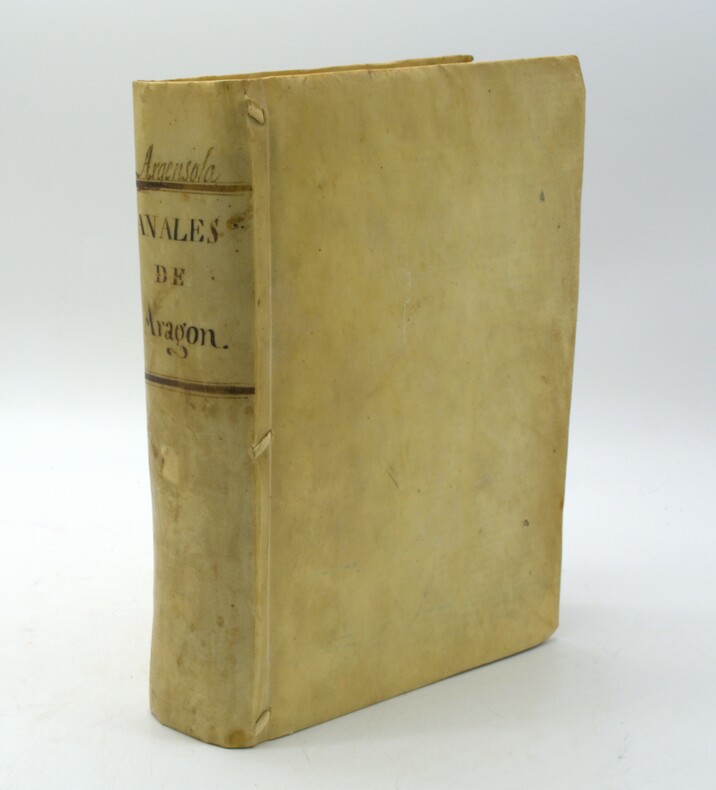
1630PHO-1828En Zaragoza, Por Ivan de Lanaja Impressor, año 1630. In-folio, velin XIX° siècle, titre manuscrit sur le dos. Titre gravé, (13) ff., 1128 pp., (20) ff., mouillures, gardes renouvellées , titre gravé remonté, restaurations marges des trois premiers feuillets, manque un f. préliminaire(errata), restaurations et manques de papier aux trois derniers feuillets.
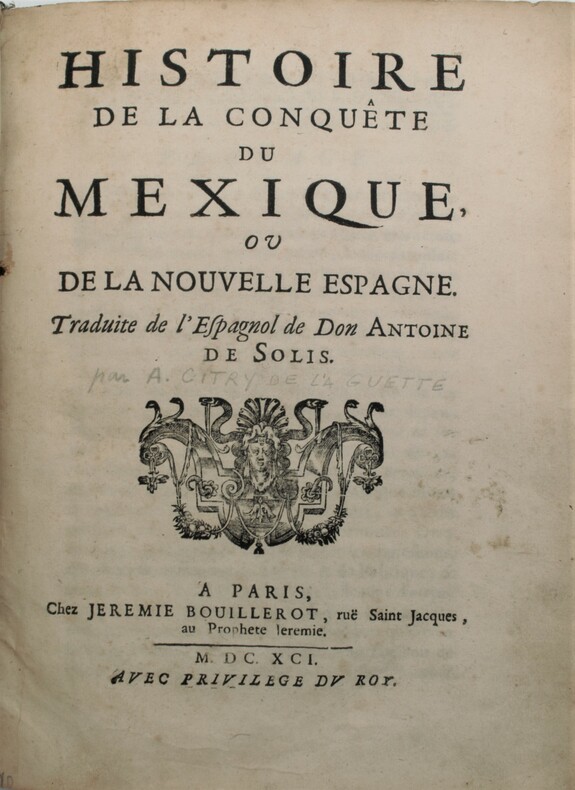
1691PHO-1239Paris, Jean Bouillerot, 1691. Édition originale in-4° (25x19,5cm), 16ff.-630pp.-12ff. , illustré de 2 cartes et 12 planches , la plupart dépliantes , relié plein veau époque , dos à nerfs orné avec titre , restauration au dos , mouillure en fin d’ouvrage.
16609736London: Printed by J. Cottrell for William Roybould at the Unicorn and Henry Fletcher at the Three Gilt Cups in St. Paul's Church-Yard 1660. First edition. 8vo 7 459 I.e. 359pp. Engraved portrait frontis title page in two colors. Bound in half morocco spine lettered in gilt with gilt ruling marbled endpapers t.e.g. Lacks half title. Paper flaw to h4 affecting several words from the ends of about 4 lines on both upper and lower corners but not the sense. Otherwise text clean and complete binding tight and attractive. <br /> <br /> First edition of this important early biography of Cromwell offering a relatively sympathetic account of his military and civil career issued in the year of the Stuart Restoration. This work has been attributed to Henry Fletcher and William Raybould the publishers. There was a second edition in 1680 but the first remains quite scarce in the trade. <br /> <br /> ESTC R18473. Printed by J. Cottrell for William Roybould at the Unicorn, and Henry Fletcher at the Three Gilt Cups in St. Paul's Church-Yard unknown
165164249CBLugduni Batavorum [Leiden], Ex Officina Elseviriorum [Elsevier], 1651. Klein-8°. 16 x 10,5 cm. [5] Blatt, 88, 77 Seiten, [1] Blatt, 251 Seiten. Schlichter Handeinband aus dem 20. Jahrhundert unter Nutzung von Pergament der Zeit. [8 Warenabbildungen]
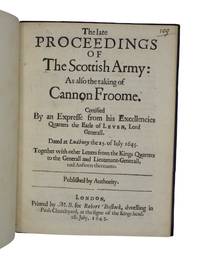
1645AQ22725London: Printed by M. B. for Robert Bostock 1645. 2 6pp. Modern navy morocco lettered in gilt to spine T.E.G. Marbled endpapers early alternate manuscript pagination to upper corners. With a loosely inserted letterpress receipt from bookseller Frank Hammond addressed to Lord Cottesloe acknowledging payment of £12 for the book in 1961. The sole edition of a decidedly uncommon news-book account of the actions of the Army of the Solemn League and Covenant - led by veteran Scottish Army officer Alexander Leslie 1st Earl of Leven c.1580-1661 - in the summer of 1645 reporting most particularly on their taking of a royalist garrison within the moated house at Cannon Froome Herefordshire. Following the defeat of a Royalist rebellion against the Covenanting-led Scottish Government in the Spring of 1645 the Scottish army of the Solemn League and Covenant - named after the 1643 treaty between the reforming parliaments in England and Scotland- led by the Earl of Leven marched south to assist their allies. As this news-book reports a 'party of 4500 Horse Foot and Dragoons' en route to Hereford became aware of a Royalist garrison led by 'Governor Colonell Barnold' in the small Herefordshire village of Castle Froome. After the Royalist commander refused to surrender the moated house which had been reinforced with Irish volunteers after the battle of Newark Leven the 'Lieut. Generall.gave order for storming the place'. The heat of the battle is described thus from a purely Roundhead perspective: 'The Grasses were about nine foot deep and as broad and in most places full of water; The Works above the Grasses were so high that all the Ladders we could get were too short; the Enemy behaved themselves valourously but it pleased the Lord to give our Souldiers to much courage that after a hot dispute they were beate from their works after which they fled to the house where they fought desparately till a great part of them were killed. We lost about 16. and 24. are wounded; of the Enemy were killed about 70. Colonell Barnold deadly wounded Captain Briskoe Capt. Houke & thirty others taken Prisoners.' ESTC records copies at just seven locations in the British Isles Advocates Library BL Hereford Cathedral Newcastle NLS Oxford Trinity College Dublin and just three further elsewhere California State Harvard Texas and Yale. Provenance: Recently dispersed from the Cottlesloe Military Library 'probably the most extensive private collection of early printed books focused on military matters'. ESTC R200176 Thomason E.294 Wing L557. First edition. Quarto. Printed by M. B. for Robert Bostock unknown
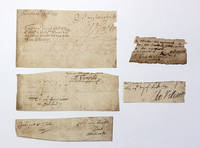
1650031291UK 1650. First Edition . Paper. Very Good. 48mo - over 3" - 4" tall. A group of 5 Ink Signatures of Royalist soldiers who fought in the 1st Civil War. They include 2nd Viscount Molyneux of Maryborough George Monck 1st Duke of Albemarle Sir William Compton General William Legg; Edward Villiers and Guilford Slingsby. Dated between 1640/1680. All removed from various paper documents and comprising signatures of: Richard 2nd Viscount Molyneux of Maryborough c. 1617-1654 'R. Molyneux' signed at the foot of a small piece with text in another hand being a list of supplies and countersigned by Corporal Griffith Standen; George Monck 1st Duke of Albemarle 1608-1670 'Albemarle' on an irregularly trimmed piece dated 4 February 1660; Sir William Compton 1625-1663 'W. Compton' written at the foot of a possible autograph sentiment sent to General William Legg; Edward Villiers 1620-1689 'Edw. Villiers' on a small piece dated 29 April 1680; Guilford Slingsby 1610-1643 'Gylf. Slyngsby' on an irregularly cut piece with autograph sentiment 'your loving friend' Richard Molyneux 2nd Viscount Molyneux of Maryborough about 1617-1654 was a Royalist officer in the English Civil War. Molyneux was present at the siege of Manchester in September 1642 and on 20 April 1643 was defeated by Captain Ashton at Whalley. After the surprise capture of Wakefield on 21 May 1643 the Earl of Derby being then with Queen Henrietta Maria at York Molyneux was ordered to conduct the Lancashire forces thither. He was defeated on 20 August 1644 by Major-general Sir John Meldrum at the battle of Ormskirk and narrowly escaped capture by hiding in a field of corn. He was at Oxford on 24 June 1646 when the city surrendered to the Parliament. George Monck 1st Duke of Albemarle 1608 -1670 was an English military officer and politician who fought on both sides during the Wars of the Three Kingdoms. A prominent military figure under the Commonwealth his support was crucial to the 1660 Stuart Restoration of Charles II. Sir William Compton 1625 - 1663 was an English royalist army officer. He earned the name of the "godly cavalier" in 1648 from Oliver Cromwell for his conduct at the siege of Colchester. William Legge 1608 - 1670 was an English army officer and politician who was a close associate of Prince Rupert of the Rhine. On the outbreak of the First English Civil War Legge joined the king's army and was taken prisoner in a skirmish at Southam Warwickshire on 23 August 1642. Committed by the House of Commons to the Gatehouse Prison he escaped about 4 October 1642 and rejoined King Charles at Oxford. Henceforth he closely attached himself to Prince Rupert and was wounded and again taken prisoner while under his command at the siege of Lichfield in April 1643. At the Battle of Chalgrove Field on 18 June 1643 he was temporarily taken prisoner on the field. After the first Battle of Newbury 20 September 1643 the king presented him with an ornate hanger and wanted to knight him. On 19 May 1644 Prince Rupert appointed him temporary Governor of Chester. Guilford Slingsby 1610-1643 was a member of the Yorkshire gentry who was confidential secretary to Thomas Wentworth 1st Earl of Strafford and present during the trial which ended in his execution in April 1641. Slingsby sat in the Parliament of Ireland as Member of Parliament for Carysfort from 1634 to 1635 and during Strafford's period as Lord Deputy of Ireland was appointed to several administrative posts. When the First English Civil War began in August 1642 he raised a regiment for the Royalist army in Northern England; he was badly wounded in a skirmish near Guisborough on 16 January 1643 and died three days later. Some occasional spotting age toning and paper sizes 11 x 18.5 cm and smaller. Ref19239 <br/> <br/> unknown
1686bn1529A Paris, chez la veuve C. Blageart, Courtneuve du Palais, au Dauphin. Relié 1686 Très rare ouvrage attribué par Barbier à Vanel (Jean de) qui paru de 1686 à 1687. Il paru 5 volumes, nous ne proposons ici que les 4 premiers qui décrivent les évènements de 1656 à 1685 (le volume 4 est paru en 1686), le volume suivant imprimé en 1687 doit contenir la suite des évènements. 4 volumes in-12° reliés plein veau, volume I : titre, 23 feuillets pour la préface et la table, puis 428 pages suivies par le privilège sur 3 pages, volume II : titre, 9 feuillets pour la table, 455 pages, volume III : titre, 428 pages, 9 feuillets pour les tables, volume IV : titre, 9 feuillets pour la préface, la table et le privilège, 352 pages ; petits défauts aux reliures, bon état. Livraison a domicile (La Poste) ou en Mondial Relay sur simple demande.
167563465CBAmsterdam, Verlag von Meurs & von Someren, 1675. 4°. 22 x 18,5 cm. 3 Blatt, 370, 428, 296, 316 Seiten, 10 Blatt. Insgesamt 28 (von 59) Tafeln (inklusive allegorischem Titelblatt). Neuerer Halblederband auf drei Bünden mit blindgeprägtem Rückentitel und erneuerten Vorsätzen. [4 Warenabbildungen]
1670PHO-1560Paris, chez Antoine Bertier, 1670. In-8 (165x110mm), 9ff.-478pp., illustré d’un frontispice, relié demi-chagrin rouge, dos à nerfs orné avec auteur et titre, tranches peignées (reliure 19eme), légers frottements, travail de vers en marge
16946281London: Josiah Bromley 1694. First Edition. Loose Broadside Framed Under Glass. Good. Original one-sheet broadside roughly trimmed 8-1/8 by 12-4/8 inches. Printed on rag paper with old creases now mellowed and two archival tissue repairs on left margin. Mounted on mat board with mat board overlay. Overlay with edge-wear. Framed under glass. First Lord of the Admiralty Edward Russell 1653 -1727 was a key figure in the Nine Years War notably establishing his reputation at the Battles of Barfleur and La Hougue. <p>Following a decisive 1693 victory over the French navy near Cape Barfleur the House of Commons determined that Russell had not done enough in dispatching French ships; he was removed from duty. After disasters that befell the British Navy in summer 1693 Russell was reinstated. In early May 1694 he was appointed First Lord of the Admiralty and sailed for the Mediterranean to thwart French depredations against the Spanish coast near Barcelona and Palamos. The engagement documented here likely occurred enroute to the Mediterranean.</p> <p>With the idiosyncratic spelling and usage common to the era. e.g. "we were buzzed about the ears .". A charming patriotic broadside from reign of William and Mary. Rare. No institutional copies located.</p> . Josiah Bromley unknown
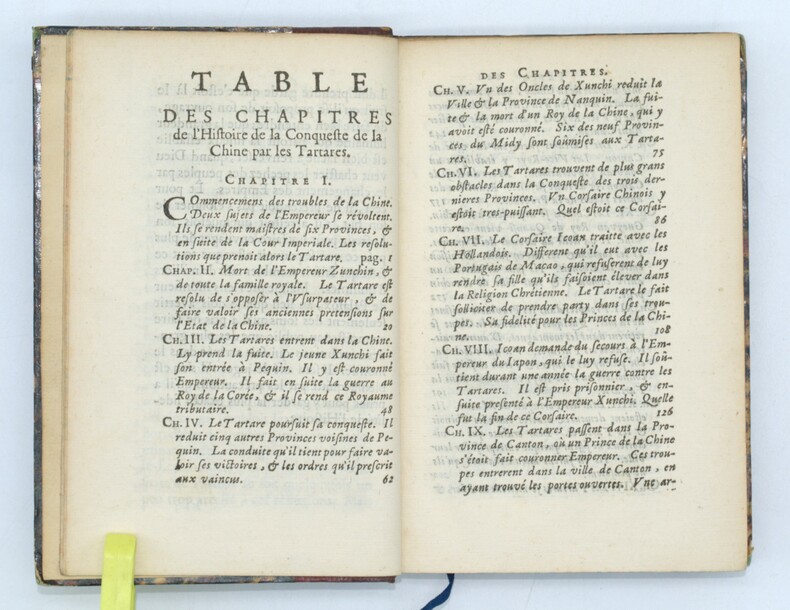
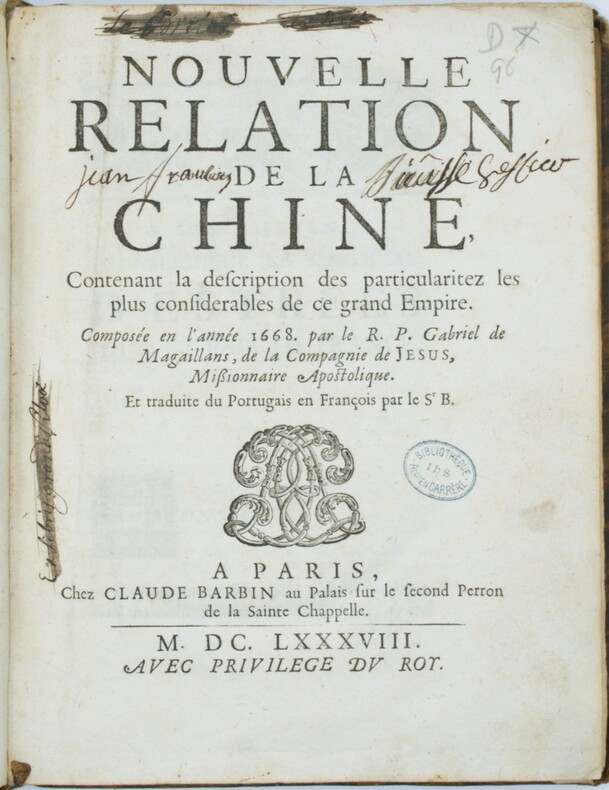
1688PHO-1563Paris, Chez Claude Barbin, 1688, in-4°, 13ff.-385pp.-5ff.,relié plein veau époque, dos à nerfs orné avec pièce de titre, frottements , charnière fendue, manque à la pièce de titre, coins usés, , accrocs au dernier plat, travail de ver en marge, qlqs rousseurs et feuillets brunis, provenance : Adrien Carrère, provincial des Jésuites de Toulouse, XIXe s. (cachet au titre et étiquette au dos) ; textes et ex-libris ms., sans le plan de Pékin.
1611P1-2E-4Lyon, Antoine de Harsy, 1611. In-8 (172x103mm), reliure d’époque, plein velin, titre manuscrit au dos, texte en latin et Grec sur 2 colonnes, 7ff.n.c.-470pp.-36ff. index. Bon état.
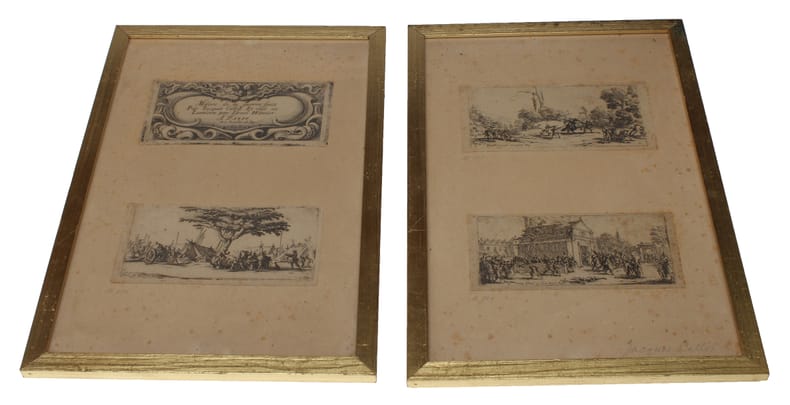
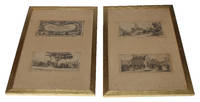
163651722A Paris, Avec Priuilege de Roy, 1636. Four original etchings by Callot, published by Henriet who added a frontispiece (title) etched by Abrahem Bosse. Comprising frontispiece and 3 etchings (ca. 59 x 120 mm.), numbered 1,2 a. 3 in the plate. All 4 mounted and framed in two (29 x 20 cm.). Mildly brownspotted.
163651722A Paris Avec Priuilege de Roy 1636. Four original etchings by Callot published by Henriet who added a frontispiece title etched by Abrahem Bosse. Comprising frontispiece and 3 etchings ca. 59 x 120 mm. numbered 12 a. 3 in the plate. All 4 mounted and framed in two 29 x 20 cm. Mildly brownspotted. <br/><br/><em>The "Small miseries of the War" was unfinished - there was only published 7 etchings the 4 first offered here.Callot was one of the first great artists to practise the graphic art exclusively. His innovative series of prints documenting the horrors of War of which his series "Les Miseres et les Mal-Heurs De la Guerre" Great Miseries of War is the most famous greatly influenced the socially conscious artists of the 19th and 20th centuries. For instance its themes and imagery were used as a source by Goya and he is acknowledged as equal to the three great: Dürer Rembrandt Goya. It is said that no one ever to such an extent possessed the talent of grouping a large number of figures in a small space and of representing with two or three bold strokes the expression action and peculiar features of each individual. Brunet I 1488 17. </em> unknown
1602PHO-1223Bruxelles , Rutger Velpius, 1602 in-8, [3] ff. n. ch. (titre, au lecteur, dédicace), 504 pp., avec un portrait-frontispice, veau brun marbré, dos à nerfs cloisonné et fleuronné, tranches rouges , titre remonté, bon exemplaire. (reliure de l'époque).
1648304145np 1648. Sole edition. 4 ll. Collation: A4. 4to. Green half morocco by Riviere spine gilt some spotting. Sole edition. 4 ll. Collation: A4. 4to. "And would you know what here is meant / By Monster 'Tis our Parliament."<br /> ESTC lists seven other copies of this scathing anti-Cromwellian work though no other parts are traced. Wing S 2321; ESTC R204781. Provenance: Samuel Christie-Miller 1873 purchase note on flyleaf with cost of binding; Britwell Court Sotheby's 4 April 1924 lot 814; Fairfax of Cameron bookplate; Robert S. Pirie bookplate unknown
1648304145np 1648. Sole edition. 4 ll. Collation: A4. 4to. Green half morocco by Riviere spine gilt some spotting. Sole edition. 4 ll. Collation: A4. 4to. "And would you know what here is meant / By Monster 'Tis our Parliament."<br/>ESTC lists seven other copies of this scathing anti-Cromwellian work though no other parts are traced. Wing S 2321; ESTC R204781. Provenance: Samuel Christie-Miller 1873 purchase note on flyleaf with cost of binding; Britwell Court Sotheby's 4 April 1924 lot 814; Fairfax of Cameron bookplate; Robert S. Pirie bookplate unknown books
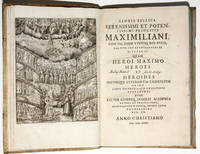
16235340Ingolstadii: Ex officina typographica G. Haenlini 1623. Hardcover. Near Fine. 4to 27 x 17.5 cm. 17 ff. 388 pp. recte 386 7 ff. with misnumbered pages at pp. 203-06 243-46 and 260-71 1 full-page engraving 20 x 15.5 the platemark. Bound in contemporary blind-stamped pigskin raised bands boards beveled somewhat scuffed clasps missing. Blue edges small hole repaired on half title and engraving ownership inscription of Andechs Abbey on title page minor browning in some quires. An excellent and unsophisticated copy. First edition of a rare volume of prose and verse glorifying the military exploits of the Prince-Elector Kurfürst of Bavaria Maximilian I 1572-1651 by members of the University of Ingolstadt as compiled by the Jesuit philosopher-theologian Georg Stengel 1584-1651. The Gloria Bellica is an important witness to the intertwining of princely power university politics and religious sectarianism at the onset of the Thirty Years War 1618-48. Published in the year of Maximilian's elevation to Prince-Elector 1623 the book seems to have been an attempt by faculty at Ingolstadt to secure his favor. The increasingly Jesuitical university would be frequently imperiled during the flux of the war and quickly identified Maximilian himself educated by Jesuits as an important military protector. Maximilian's central role in the German Catholic League had been essential in checking the power of the Protestant Union. The volume is especially notable for its full-page prefatory engraving executed by the Augsburg artist Daniel Manasser a highly detailed and elaborate allegory charting Maximilian's martial rise and the praise conferred on him from various secular and sacred sources. Merchants clerics Liberal Arts herself and a throng of lesser citizens crowd together to salute Maximilian as he rides upward on the back of Pegasus toward the Olympian gods reclining in the empyrean; the demigod Hercules mediates between heaven and earth while battling Nessus and the Lernaean Hydra. Flanking Maximilian's ascent are 8 groups from whom he receives "Gloria": his enemies his commanders and soldiers muses and scientists hometown Bavaria the Catholic League the Holy Roman Emperor Ferdinand I the pope and church and indeed Mary Christ and the saints. The text of the Gloria Bellica is arranged as a fuller version of this scheme with 20 chapters each detailing a source Maximilian's glory. OCLC identifies U.S. copies at Harvard Trinity CT Georgetown and Chicago. VD 17 23:231047E; De Backer/S. and VII 1550 32; Lentner 3774; Pfister I 4297; Mario Praz Studies in Seventeenth-Century Imagery Rome: Edizioni di Storia e Letteratura 1975 pp. 503-04. <br/> <br/> Ex officina typographica G. Haenlini hardcover
16235340Ingolstadii: Ex officina typographica G. Haenlini 1623. Hardcover. Near Fine. 4to 27 x 17.5 cm. 17 ff. 388 pp. recte 386 7 ff. with misnumbered pages at pp. 203-06 243-46 and 260-71 1 full-page engraving 20 x 15.5 the platemark. Bound in contemporary blind-stamped pigskin raised bands boards beveled somewhat scuffed clasps missing. Blue edges small hole repaired on half title and engraving ownership inscription of Andechs Abbey on title page minor browning in some quires. An excellent and unsophisticated copy. First edition of a rare volume of prose and verse glorifying the military exploits of the Prince-Elector Kurfürst of Bavaria Maximilian I 1572-1651 by members of the University of Ingolstadt as compiled by the Jesuit philosopher-theologian Georg Stengel 1584-1651. The Gloria Bellica is an important witness to the intertwining of princely power university politics and religious sectarianism at the onset of the Thirty Years War 1618-48. Published in the year of Maximilian's elevation to Prince-Elector 1623 the book seems to have been an attempt by faculty at Ingolstadt to secure his favor. The increasingly Jesuitical university would be frequently imperiled during the flux of the war and quickly identified Maximilian himself educated by Jesuits as an important military protector. Maximilian's central role in the German Catholic League had been essential in checking the power of the Protestant Union. The volume is especially notable for its full-page prefatory engraving executed by the Augsburg artist Daniel Manasser a highly detailed and elaborate allegory charting Maximilian's martial rise and the praise conferred on him from various secular and sacred sources. Merchants clerics Liberal Arts herself and a throng of lesser citizens crowd together to salute Maximilian as he rides upward on the back of Pegasus toward the Olympian gods reclining in the empyrean; the demigod Hercules mediates between heaven and earth while battling Nessus and the Lernaean Hydra. Flanking Maximilian's ascent are 8 groups from whom he receives "Gloria": his enemies his commanders and soldiers muses and scientists hometown Bavaria the Catholic League the Holy Roman Emperor Ferdinand I the pope and church and indeed Mary Christ and the saints. The text of the Gloria Bellica is arranged as a fuller version of this scheme with 20 chapters each detailing a source Maximilian's glory. OCLC identifies U.S. copies at Harvard Trinity CT Georgetown and Chicago. VD 17 23:231047E; De Backer/S. and VII 1550 32; Lentner 3774; Pfister I 4297; Mario Praz Studies in Seventeenth-Century Imagery Rome: Edizioni di Storia e Letteratura 1975 pp. 503-04. <br/> <br/> Ex officina typographica G. Haenlini hardcover books