dos Santos Guerra, MagdaBiblio.com

11 490 résultats
6205502674.Gpaperback. Good. Access codes and supplements are not guaranteed with used items. May be an ex-library book. paperback
1915996961.Ghardcover. Good. Access codes and supplements are not guaranteed with used items. May be an ex-library book. hardcover
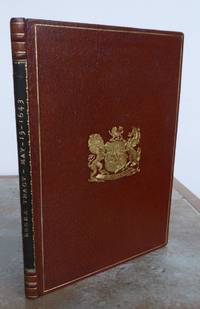
53037<p>London Printed for Ph. Smith 1643. TITLE CONTINUED: As it was presented to the honourable House of Commons on the 15. of May. 1643. PAMPHLET 1643. Small 4to approximately 180 x 130 mm 7 x 5 inches 8 pages padded out with plain paper at front and rear finely bound in full crushed morocco by Mudie their name at foot of first blank page gilt lettered label to spine gilt rule to edges of covers Fairfax coat of arms to upper cover gilt dentelles turn ins marbled endpapers all edges gilt large Fairfax of Cameron bookplate to first pastedown. Pale age-browning to pages with occasional dark spot offset from dentelles to edges of first and final endpapers otherwise a very good copy in fine binding. See: Sotheby's sale catalogue "The Fairfax Library and Archive London 1993" Lot 174 listing this copy; ESTC R42944 listing 5 copies in UK and 1 USA; not listed in George Thomason Civil War Pamphlets 164-1661. MORE IMAGES ATTACHED TO THIS LISTING ALL ZOOMABLE FURTHER IMAGES ON REQUEST. POSTAGE AT COST AND ALL PARCELS SENT FULLY TRACKED AND FULLY INSURED.</p> London, Printed for Ph. Smith, 1643.
1984231Lady Mitchell 1984. Hardcover. Good. No dustjacket as issued. Cover has some wear. One page has an inch-long blue line in ink in lower right corner. Lady Mitchell hardcover
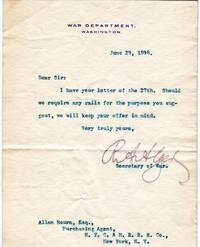
189816967Washington DC 1898. Very good. One page on War Department stationery measuring 5" x 7.75"; To Allen Bourn of the New York Central Railroad referring to rails the Government may purchase. Alger was Secretary of War during the Spanish American War. Russell Alexander Alger February 27 1836 – January 24 1907 was a Governor and U.S. Senator from the state of Michigan and also U.S. Secretary of War during the Presidential administration of William McKinley. He was supposedly a distant relation of Horatio Alger; although Russell Alger lived his own "rags-to-riches" success tale eventually becoming a financier lumber baron railroad owner and government official in several high offices. unknown
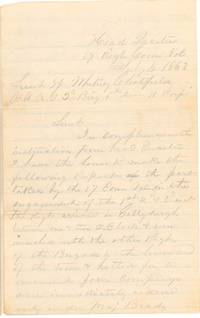
186321808<p>A field report from the Battle of Gettysburg by Major Allen G. Brady commander of the 17th Connecticut Regiment written on the 4th of July 1863 the day after the battle ended in a great victory for the Union.</p><p><i>"We had not more than time to form before the enemy were discovered advancing rapidly upon us on our right & a full Brigade obliquely towards our left….our fire was so destructive it checked their advance the troops on our left giving way the enemy came in behind us but we still remained firmly at the stone wall until the rebels were driven back."</i></p> <b>CIVIL WAR – GETTYSBURG.</b>Allen G. Brady Autograph Manuscript Gettysburg Pennsylvania July 4 1863. 6 pp. in pencil an unsigned draft or retained copy.<p>With: <b>ANDREW JOHNSON.</b> Officer's commission of brevet Lieutenant Colonel to Allen G. Brady <i>"for gallant conduct at the Battle of Chancellorsville Va to date from March 13 1865"</i> March 20 1866 signed with stamp not in ink; and</p><p>With: <b>ALLEN G. BRADY.</b>Autograph Letter Signed to the Adjutant General U.S. Army May 19 1877 seeking a copy of the military record of General Hugh Brady who had fought in the War of 1812; and</p><p>With: <b>WHARTON J. GREEN.</b> Autograph Letter Signed to Allen G. Brady December 13 1885.</p><p><b>Complete Transcript</b></p><p><i>Head Quarters 17 Regt Conn Vol. </i></p><p><i>July 4 1863</i></p><p><i>Lieut. H. Whitney Chatfield </i></p><p><i>A.A.A.G. 2d Brig. 1st Div. 11 Corps</i>.</p><p><i>Lieut.</i></p><p><i> In compliance with instructions from head quarters I have the honor to make the following report the part taken by the 17 Conn Vol in the engagement of the 1st 2d & 3d inst. The Regt. arrived in Gettysburgh between one & two O'Clock & were marched with the other Regt. of the Brigade to the lower end of the town & halted for a moment. Four companies were immediately ordered out under Maj Brady </i>2 <i>two of the four Companys under Maj. Brady were deployed from the bridge to the right as skirmishers the other two held in reserve. The remainder of the Regt under the Command of Lieut Col. Fowler advance with the rest of the Brigade to the front & left of the village. Directly in rear of the 107 Ohio Vol. - who were closed in mass by Division & were ordered to the front Deployed & advanced at Double quick our men held their ground notwithstanding they rushed to the rear of troops directly in advance until ordered by the Brigade Commander to fall back. </i></p><p><i>This order was obeyed the men loading & firing as they were retreating it was <b>about this time Lieut Col. Fowler was killed. Upon reaching the village the four companys</b> </i>3 <b><i>still skirmishing briskley with the enemy </i></b><i>& retiring in good order & ordered by the Comdg Genl to rejoin the Regt. <b>Maj. Brady immediately taking command after deploying & firing in several streets running to the left of the main street of the town on account of the rapid advance of the enemy we were ordered to fall back out of the town & while retreating through the main street the Regt was halted & faced to the rear & poured several destructive vollys into the enemy.</b> We then fell back out of the town & formed in front of the battery <b>pursuant to order from Maj. Genl. </b></i>Oliver Otis <b><i>Howard we then advanced to the stone wall in rear of the village </i></b><i>& remained a few moments there again advanced to a rail fence still further to the front & then remained until </i>4 <i>late in the evening when the whole Regt was sent out on picket & performed that duty <b>until late in the afternoon of 2d when we were relieved & took our old position behind the rail fence w</b></i>h<b><i>ere we remained exposed to fire of the enemy's battery & sharp shooters until about 7 o'clock P.M. were ordered to the extreme right of the Brigade behind a stone wall on each side of the lane below the battery opposite the cemetery entrance one company was advanced to the grain field near the woods we covered the wall on each side of the land by compelling 200 straggling soldiers to fall into our line. We had not more than time to form before the enemy were discovered advancing rapidly upon us on our right & a full Brigade obliquely towards our left. The Regt were ordered to fire obliquely to the left upon the Brigade our fire was so destructive it checked their advance the troops on our left giving way the enemy came in behind us but we still remained firmly at the stone wall until the rebels were driven back.</i></b></p><p><i>It was during this engagement that Maj. Brady was wounded </i>5 <i>by a fragment of shell hitting his right shoulder blade. </i></p><p><i>After the enemy had been driven back & the firing ceased except occasional shots from their sharpshooters. We were relieved by the 4 Ohio Vol. and were ordered to change front to the left behind a wall running at right angles with the fence we had occupied and fronting the town where the rebels entered on our left. During that night & the 3d inst. exposed to a cross fire of the rebel batterys & to the fire of the sharp shooters who were watching our movements. </i></p><p><b><i>When the Regt entered the engagement on the 1st inst it numbered 17 officers & 369 enlisted men. We report at the present time 9 officers & 120 enlisted men. </i></b><i>Capt. Wilson French is the </i>6 <i>only officer known to have been taken prisoner he was wounded in the engagement of the first inst & we are not aware of his being paroled</i>"</p><p><b>Historical Background </b></p><p>The Battle of Gettysburg fought July 1-3 1863 was a major turning point in the Civil War. Over the course of three grueling days Union Major General George G. Meade's Army of the Potomac beat back desperate attacks by Confederate General Robert E. Lee's Army of Northern Virginia including the ill-fated "Pickett's Charge" on July 3. The Union victory ended Lee's short-lived invasion of the North.</p><p>Many soldiers of the 17th Connecticut had been stung by criticisms leveled at their unit after the Battle of Chancellorsville where the corps was surprised and driven from the field with a flank attack by Stonewall Jackson. As Brady reports here events on the first day of the Battle of Gettysburg were eerily similar to Chancellorsville. On July 1 their regiment was again divided outnumbered and outflanked by the same Confederate unit as it had been at Chancellorsville although this time under command of Richard Ewell. As he drove the Connecticut soldiers from the field and through the streets of Gettysburg on the first day of fighting Union Lieutenant Colonel Douglas Fowler was killed. In a disciplined retreat that evening the 17th Connecticut fell back and was posted near the center of the Union line on Cemetery Hill near a stone wall. Their position where the Union lines' "fishhook" curved southeastward toward Culp's Hill exposed them to murderous crossfire from Confederate artillery on three sides. The unit sustained high casualties for the next two days; of the unit's 386 men at Gettysburg 20 were killed 81 wounded and 96 reported missing. Brady himself was wounded by a shell fragment on July 2.</p><p>The regiment performed heroic service on the second day of the battle protecting Cemetery Hill from the attacks of Jubal Early's division specifically Harry Hays's brigade of "Louisiana Tigers." The 17th Connecticut then withstood the Confederate bombardment of July 3 spending much of the day trading shots with sharpshooters in town. Brady's report in slightly revised and expanded form is reprinted in <i>Official Records</i> Series 1 Vol. 27 Chap. 39 Part 1 pp. 716-719. In closing there Brady said "The regiment behaved gallantly. No troops in the world behaved better. Both officers and men are deserving of great credit for their coolness and bravery throughout the entire three days' battle."</p><p><b>Allen G. Brady </b>1822-1905 was from Torrington Connecticut. He enlisted in May 1861 as part of the 3rd Connecticut Infantry Regiment. In August 1862 he was commissioned into the 17thConnecticut Volunteers. Brady was brevetted Lieutenant Colonel for his valor at the Battle of Chancellorsville just two months before Gettysburg. There Brady assumed command after the colonel and lieutenant colonel of his regiment each fell. Brigadier General Charles Devens commended Brady in his official report stating "The Seventeenth Connecticut under command of Major Brady – its colonel having been wounded and lieutenant-colonel killed – was in fact rallied and reformed in their positions." In October 1863 Brady was discharged for disability presumably from his wound suffered at Gettysburg three months previous. He was mustered into the Veteran Reserve Corps and served as Provost-General at the Point Lookout Union Prison Camp in 1864. He was brevetted Colonel in August 1865.</p>
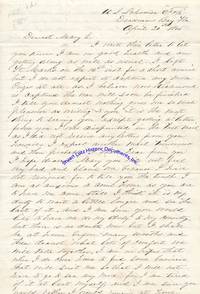
5560END OF THE CIVIL WAR. ALS. 4pgs. April 20 1865. Deadmans Bay Florida. An autograph letter signed Frank. A Union sailor writes home to his wife towards the end of the war just after the fall of Richmond. He tells her how eager he is to come home and start a new life on land while also mentioning the court martial of his former captain and some troubles with getting money hes owed. Dearest Mary I write this letter to let you know I am in good health and am getting along as well as usual. I left St. Marks on the 16th inst for a short cruise but I do not expect to capture any more prizes at all. As I believe now Richmond is captured the war will soon be finished. I tell you dearest nothing gives me so much pleasure as writing to you it is the next thing to seeing you except getting a letter from you I was disappointed in the last mail as I did not receive any letters from you. However I expect another mail tomorrow and then probably I shall hear from you. I hope dearest Mary you will not feel very bad and blame me because I have not resigned for to tell you the truth I am as anxious to come home as you are to have me come. Still I think it is my duty to wait a little longer and see the last of it. And I am sure you would like to have me do my duty to my country but there is no doubt now but I shall be at home before many months and then dearest what lots of comfort we will take together I am in hopes that when I do come home to find some business that will suit me so that I will not have to go to sea any more for I am tired of it at last myself and I am sure you would rather I would remain at home. I do not think I shall be able to go to Key West after all as most probably all these small vessels like the Fox will soon be sold as the Navy will have no use for them after the war is over. So they will not go to any expense to repair them. I have been employed this last few days painting The Fox My old Captain Baxter is being court martialed at Key West all of his officer reported him to the Admiral for drunkenness I think he will be dismissed from the service and he would be no loss. The Fort Henry has been in Key West these last three weeks and I expect she will be there for a month longer repairing but still I am not sorry. I left her for I never was so dissatisfied in my life as I was on board of her but I have enjoyed myself very much since I left herI still have great trouble to get the remainder of my Prize money. My Paymaster has wrote to the Admiral about it but has received no answer yet but expects to by next mail. He is in hopes to get it for me next month so I shall not be able to send any money home by the Union this time. It is in fine condition with very minor staining in a few places. unknown
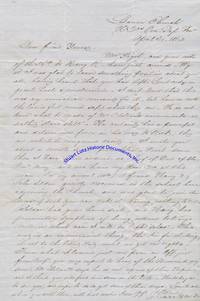
5431CIVIL WAR LETTER. ALS. 1pg. April 30 1862. Lebanon Church Pennsylvania. An autograph letter signed by a Union Army officer stationed in Lebanon Pennsylvania as Chief of Ordnance of the Pennsylvania Army. He mentions General George McClellan and his lack of movement during the Peninsula Campaign taking place at this time. He also mentions the USS Merrimack a Union frigate that the Navy burnt and sank in 1861 to prevent capture by the Confederacy. However the Confederates still raised and rebuilt the Merrimack in early 1862. They hoped that the ship renamed the CSS Virginia could help to end the Union blockade of Southern ports. Mr. Pigot and your note of the 26th to Harry R have just arrived. By it I was glad to learn something positive about you all having heard that you had left Lombardy in great haste & consternation. We do not know what to make of McClellans movements: or rather stand still. He certainly has a powerful and determined force in his way to Richmond; they are not to be conquered easily. I wrote you about a month since from Gloster Point. Since then I have been ordered as Chief of Ord of the Pena Army and now have my Head Qrs at this placeFrom what I learned just now from an Off just from Norrs you may expect to hear of the Merrimack very soon. Geo Tatnall says he is not afraid of their Torpedoes and I think you will find him soon in the York. It is in fine condition. unknown
1307FC080<p>Mestre e Discípulos Notáveis Séc. XVI - Séc. XVIII . Edição - Universidade de Évora - Reitoria. 2005.</p>_x000d_<p>De 33x25 cm. Com 220 iv págs. Encadernação do editor em tela com sobrecapa de proteção do editor forrada com uma película de plástico.</p>_x000d_<p>Profusamente ilustrado com fotografias reproduções de pinturas antigas de documentos folhas de edições de obras do sprofessores e fac-similes das respectivas assinaturas.</p>_x000d_<p>Magnífica edição de grande beleza impressa sobre papel couché que reune grande quantidade de biografias dos professores da Universidade de Évora com bibliografia das respectivas obras. </p> I-36-A-27 unknown
1172056927.Gpaperback. Good. Access codes and supplements are not guaranteed with used items. May be an ex-library book. paperback
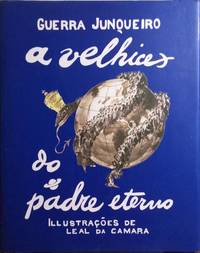
2407MA118<p>Edição ilustrada por Leal da Câmara. Lello Editores. Porto. 2007.</p>_x000d_<p>De 305x24 cm. Com 181 ii págs. Encadernação em tela com sobrecapa de proteção. Profusamente ilustrado a cores. Edição de luxo impressa sobre papel couché muito encorpado. </p>_x000d_<p>Coleção de sátiras contra os dogmas e ritos do catolicismo. Publicada em 1885 esta é a obra mais popular e polémica de Guerra Junqueiro.</p>_x000d_<p>A obra dedicada à memória de Guilherme de Azevedo e a Eça de Queirós é um poema satírico que critica de forma mordaz a Igreja Católica retratando-a como uma instituição obsoleta e hipócrita com forte influência da literatura francesa. O autor censura a deturpação do ideal cristão primitivo o fanatismo religioso o ritualismo oco o jesuitismo as superstições obscurantistas e o Vaticano. Apesar das suas críticas ferozes ao clero e à Igreja Junqueiro não nega a existência de Deus expressando a sua própria «crença robusta» que exalta valores humanistas e propõe uma espiritualidade mais autêntica enquanto denuncia a exploração religiosa e a alienação promovida pela religião. Provocadora e polémica tornou-se um marco da literatura portuguesa. Faz parte de um tríptico planeado pelo autor que incluía A Morte de D. João e que terminaria com Prometeu Libertado. O sucesso alcançado pela obra levou à publicação póstuma do último livro inacabado em 1926 prefaciado pelo seu amigo Luís de Magalhães.</p> SACO MA503-08 hardcover
MN12724HChardron 1912 Porto. 20x13. Tela editorial. 270 pgs. Puntas de oxido en guardas y en las hojas pero no afecta nada al texto. Firma del autor. 628324 Chardron, 1912, Porto. hardcover
1391037766.Gpaperback. Good. Access codes and supplements are not guaranteed with used items. May be an ex-library book. paperback
1391250737.Ghardcover. Good. Access codes and supplements are not guaranteed with used items. May be an ex-library book. hardcover
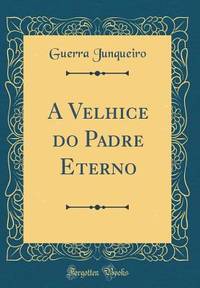
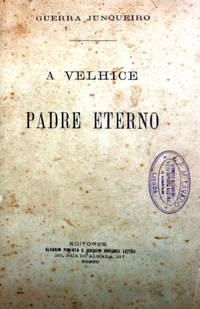
2205JS004<p>Editores Alvarim Pimenta e Joaquim Antunes Leitão. Porto. 1885.</p>_x000d_<p>De 235x15 cm. Com 211 iv págs. Encadernação em percalina verde com ferros a ouro na lombada.</p>_x000d_<p>Exemplar preserva as capas de brochura com carimbo oleográfico de J. P. M. Lavado na capa anterior e assinatura de posse coeva de António Vicente da Silva na folha de anterrosto.</p>_x000d_<p>Primeira edição. </p>_x000d_<p>Coleção de sátiras contra os dogmas e ritos do catolicismo. Publicada em 1885 esta é a obra mais popular e polémica de Guerra Junqueiro.</p>_x000d_<p>A obra dedicada à memória de Guilherme de Azevedo e a Eça de Queirós é um poema satírico que critica de forma mordaz a Igreja Católica retratando-a como uma instituição obsoleta e hipócrita com forte influência da literatura francesa. O autor censura a deturpação do ideal cristão primitivo o fanatismo religioso o ritualismo oco o jesuitismo as superstições obscurantistas e o Vaticano. Apesar das suas críticas ferozes ao clero e à Igreja Junqueiro não nega a existência de Deus expressando a sua própria «crença robusta» que exalta valores humanistas e propõe uma espiritualidade mais autêntica enquanto denuncia a exploração religiosa e a alienação promovida pela religião. Provocadora e polémica tornou-se um marco da literatura portuguesa. Faz parte de um tríptico planeado pelo autor que incluía A Morte de D. João e que terminaria com Prometeu Libertado. O sucesso alcançado pela obra levou à publicação póstuma do último livro inacabado em 1926 prefaciado pelo seu amigo Luís de Magalhães.</p> I-156-D-26 unknown
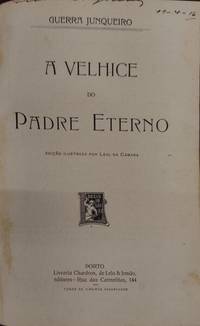
3004LC269<p>Edição ilustrada por Leal da Câmara. Livraria Chardron de Lelo & Irmão Editores. Porto. S.d. 19--.</p>_x000d_<p>De 20x13 cm. Com viii 270 i págs. Encadernação com lombada e cantos em pele com nervos e ferros a ouro. Corte das folhas carminado à cabeça.</p>_x000d_<p>Ilustrado no texto com o retrato do autor e aguarelas de Leal da Câmara que reflectem os sentimentos e impressões de Guerra Junqueiro com padres bonacheirões e imagens como a de Jesus conversando com Voltaire e Deus escarrando.</p>_x000d_<p>Exemplar preserva as capas de brochura com assinatura de posse na folha de rosto.</p>_x000d_<p>Coleção de sátiras contra os dogmas e ritos do catolicismo. Publicada em 1885 esta é a obra mais popular e polémica de Guerra Junqueiro.</p>_x000d_<p>A obra dedicada à memória de Guilherme de Azevedo e a Eça de Queirós é um poema satírico que critica de forma mordaz a Igreja Católica retratando-a como uma instituição obsoleta e hipócrita com forte influência da literatura francesa. O autor censura a deturpação do ideal cristão primitivo o fanatismo religioso o ritualismo oco o jesuitismo as superstições obscurantistas e o Vaticano. Apesar das suas críticas ferozes ao clero e à Igreja Junqueiro não nega a existência de Deus expressando a sua própria «crença robusta» que exalta valores humanistas e propõe uma espiritualidade mais autêntica enquanto denuncia a exploração religiosa e a alienação promovida pela religião.</p>_x000d_<p>Provocadora e polémica tornou-se um marco da literatura portuguesa. Faz parte de um tríptico planeado pelo autor que incluía A Morte de D. João e que terminaria com Prometeu Libertado. O sucesso alcançado pela obra levou à publicação póstuma do último livro inacabado em 1926 prefaciado pelo seu amigo Luís de Magalhães.</p> I-53-H-3 unknown
1019432500.Ghardcover. Good. Access codes and supplements are not guaranteed with used items. May be an ex-library book. hardcover
3563904227.Gpaperback. Good. Access codes and supplements are not guaranteed with used items. May be an ex-library book. paperback
3563913390.Ghardcover. Good. Access codes and supplements are not guaranteed with used items. May be an ex-library book. hardcover
016939Porto: Livraria Chardron. Inteira de Sintético. Bom / Good / Bon. In 8º 207x140. 1 Vol. de 10-206 pp. Retrato do autor. <br/> <br/> Livraria Chardron unknown
18612786np: np 1861. First edition. Original leather covers. Good. A REMARKABLY EXTENSIVE ARCHIVE OF A UNION SOLIDER INCLUDING DIARIES FROM 1861-1865 SPANNING HIS ENTIRE CIVIL WAR CAREER.<br /> <br /> THE SOLDIER CHARLES E. SMITH PARTICIPATED IN SOME OF THE MOST CRITICAL CAMPAIGNS OF THE WAR INCLUDING THE SEIGE OF VICKSBURG THE FALL OF ATLANTA AND SHERMAN'S MARCH TO THE SEA. Background:<br /> <br /> Charles E. Smith 1836-1905 was born in Berlin Township Ohio. He worked as a farmer and country schoolteacher in Alum Creek Delaware County Ohio. He enlisted in the 32nd Ohio Volunteer Infantry at the age of 25 on September 3 1861 and mustered in September 7 1861. He was promoted to the rank of corporal in Company I of the regiment on January 30 1864. He was slightly wounded on July 29 1864 during the Atlanta Campaign. He mustered out of the service on July 20 1865 at Louisville Kentucky.<br /> <br /> The 32nd Ohio Infantry was organized at Mansfield Ohio on August 20-September 7 1861 and mustered in for three years' service under the command of Colonel Thomas H. Ford. The regiment was involved in several important engagements and operations during the Civil War including the Battle of Greenbrier River the Battle of McDowell the Battle of Harpers Ferry the Battle of Champion Hill the Siege of Vicksburg the Atlanta Campaign the Battle of Jonesborough Sherman's March to the Sea the Carolinas Campaign and the Battle of Bentonville. The 32nd Ohio Infantry mustered out of service at Louisville Kentucky on July 20 1865.<br /> <br /> The Collection:<br /> <br /> The collection consists of 26 dairies dating from 1859 to 1866. Except for four volumes covering a period from 1856 to April 1861 and one covering the period September 18 1865 to December 5 1866 the remaining dairies 21 volumes span his entire Civil War career in the 32nd Ohio Volunteer Infantry covering the period September 3 1861 the date of his enlistment to the date of his mustering out of the service on July 20 1865. The diaries of various sizes average approximately 100 pages with few blank pages.<br /> <br /> His daily entries in his Civil War diaries many of which are detailed consist of descriptions of the weather diet geographical locations his devotion to the Union camp activities military news and description of engagements. He also included several drawings in the diaries some in color. He described his day of enlistment of September 3:<br /> <br /> "Enlisted at Lewis Center between 8 and 9 oclock in Captain Dyre's company of 3 years volunteers. I bid good bye to all my folks and started having resolved to assist in sustaining the Government. But the feelings which came over me when I left home friends and all that seemed dear to me I cannot describe."<br /> <br /> The new enlistees moved to Camp Dennison and Smith records the daily activities in camp as his company prepared for their first movement. From Camp Dennison the 32nd Ohio was ordered to western Virginia present-day West Virginia to assist in driving Confederate forces out of the region. On October 3 1861 the 32nd Ohio participated in the inconclusive Battle of Greenbrier River. Smith records in his diary beginning on September 29 through October 3:<br /> <br /> "In the evening we received orders to march to make an attack on Greenbrier about 12 miles distant. Our company numbered 86 men. Our regiment probably numbered 900 men present and able to perform duty. The 32nd. Went in advance and cleared out the road and took one prisoner. Our regiment stopped at the cross roads within four miles of Greenbrier and stopped. We expected there that the battle commenced. but they Confederate troops did not come and we. crept into the thick laurel bushes to lay till morning. When I awoke it was daylight and other regiments were passing. The artillery was hurrying along as fast as possible each gun was drawn by six horses and about nine oclock the canons began to roar. It was kept up till two oclock on both sides when our communication failed and our men withdrew from the field without losing any guns. The canons roared very loud and the sound rolled over the Mountains and valleys and made everything ring once more. Our loss was including those that were killed on the field and those that died of wounds after the battle about 12 men. We took 13 prisoners." <br /> <br /> Smith describes an engagement with Confederate forces around Beverly Virginia on December 18 1861:<br /> <br /> "The rebels came out and met our forces and a bloody fight ensued. The 32nd fought bravely and drove the enemy back. The 25th were in the advance and were cut up dreadfully. They fell back and the 32nd stood their ground and fought them like tigers. Our men made two or three gallant charges and drove them out of their entrenchments and were forced out themselves. Our boys could not drive them out again and after a desperate and bloody struggle our troops retreated. having lost about one hundred men."<br /> <br /> After spending the winter in Beverly Virginia the 32nd Ohio participated in the Shenandoah Campaign of 1862 where they engaged Stonewall Jackson's Confederate force at the Battle of McDowell Virginia on May 8 and were defeated. On that day Smith recorded the following:<br /> <br /> "We formed into line and gave three cheers to the cavalry and were waiting to welcome the infantry when a dispatch came for us to report immediately at headquarters armed and equipped. We went forthwith and formed into line of battle on an open field. The rebels came down on the hills & tried to pick a spot to plant a gun and our boys threw shell amongst and drove them out. The rebels gathered on a mountain at the right of town about 4000 men. Our boys did not find out what they were at or where they were till late in the afternoon. Two regiments went up the mountain and the ball was opened. The battle lasted till after 8 oclock at night when our boys withdrew bringing the wounded and mostly all the dead from the field. The fight lasted about 4 hours."<br /> <br /> The 32nd Ohio retreated to Franklin Virginia where they joined General John C. Fremont's command. Fremont followed the Confederates into the valley and engaged a Confederate force at Cross Keys Virginia on June 8 1862 but Smith's company did not participate in the action. The 32nd Ohio move on to Winchester Virginia where they performed garrison duty for the remainder of the summer.<br /> <br /> In September 1862 the 32nd Ohio was dispatched to Harper's Ferry. The regiment again faced Stonewall Jackson participating in the Battle of Harper's Ferry September 12-15 1862. In this engagement Jackson captured the town and nearly twelve thousand Union soldiers including the 32nd Ohio subsequently paroling them after confiscating their supplies. In his entry for September 15 Smith describes the last day of the battle:<br /> <br /> "At sunrise the ball opened with a heavy cannonade from both sides. Our men were nearly out of ammunition for artillery and the enemy was mowing down our ranks. The shells and shot came down like hail all around and amongst us and many of our officers and soldiers were mortally wounded. Our artillerists run out of ammunition and there was no other way for us to do than surrender or be slaughtered on the field. At about 8 oclock the stripes and stars were hauled down and the white flag waved as a signal for surrender. The rebel cavalry and officers were soon riding through our camp. They hoisted the bars and stars where an hour before our glorious old star spangled banner floated proudly in the breeze. O how my heart beat and my bosom heaved to see that corrupt flag raised in defiance over us."<br /> <br /> The surrender of the 32nd Ohio resulted in a revolt in the ranks of the enlisted men against the regiment's officers which Smith later discusses in a January 15 1863 entry in his diary stating: "we were obliged to surrender 11500 men to the Rebels General A.P. Hill. It was the opinion of nearly all of our men that Colonel Miles of Baltimore betrayed us into the hands of the Rebels. It was said that he got 15 cents per head for us. Our Col Thomas H. Ford was examined by a committee and dismissed from the service for blame that was unjustly laid against him for the evacuation of the Maryland Heights. Since we were paroled a hard feeling was created between the officers of the regiment." Smith and his regiment eventually rejoined General Ulysses Grant's Army of the Tennessee in Memphis on January 25 1863. The regiment was involved in Grant's Siege of Vicksburg beginning in April 1863.<br /> <br /> A pivotal engagement in Grant's Vicksburg Campaign was the Battle of Champion Hill which occurred on May 16 resulting in a Union victory. Smith's entry for that day records the fighting:<br /> <br /> "A battle had begun on the left the firing seemed to be from large guns and the line seemed to be several miles long. We halted to await orders. Soon they came & we went forward & laid behind a ridge where we could see the fighting. The scene was grand but terrible. The heavy fighting was on the left & center at first. Our brigade charged on a rebel battery and took it & hauled it off. The 32nd did a noble part charging on the hills & ravines and out the battery driving the enemy before them killing a large number."<br /> <br /> The siege of Vicksburg ended on July 4 1863 when the Confederate forces surrendered and the Union troops under Grant including the 32nd Ohio entered the city. Smith recorded the events of July 3 and 4 in his diary. On July 3 he wrote: "This is the 46th day of the Siege. The rebels have sustained at this place and nobly and bravely have they defended it but General Grant has been too much for them." The next day's entry detailed the surrender. "At nine oclock it was announced that Vicksburg was surrendered. What a thrill of joy ran through every heart. The boys all seem lively and jubilant over the success which has crowned our arms. At half past ten oclock the rebels march out of their forts and rifle pits. and form in line outside their works and stuck arms."<br /> <br /> After Vicksburg the 32nd Ohio joined an expedition to Monroe Louisiana and then participated in General James McPherson's expedition to Brownsville Mississippi. In addition to his daily entries Smith also drew a number of pencil and ink sketches that reflected what he described in on a particular day such as sketching images that depicted the sleeping arrangements in the soldiers' tents maps of terrains and a two-page spread showing the capture of a Confederate battery in Mississippi. He also wrote down poems whether written by him or others. For example on January 31 1864 he added a six-stanza poem possibly written by him entitled "Evening Thoughts" to that day's entry. A partial transcription reads: "I'm weary and I'm lonely//As I'm sitting in my tent//And I'll take my leaden pencil//And give you my feelings sent// O would this war be over//And these bloody strivings cease//And our country now distracted//Return with lasting peace."<br /> <br /> In February 3 to March 6 1864 the 32nd Ohio was involved in General William T. Sherman's Meridian Expedition which resulted in the capture of Meridian Mississippi. On March 3 Smith recorded a diary entry that detailed the destruction rendered by the campaign:<br /> <br /> "I cannot fully give the amount of damage done to the Southern Confederacy while on this Expedition but the result foots up about as follows. About 200 miles of railroad running east & west was destroyed. About 60 miles of the Mobile and Ohio railroad was destroyed and about 40 miles of the Central Mississippi road destroyed. There were about 25 Locomotives and a considerable number of cars together with Confederate railroad houses machine shops and foundries manufacturing establishments of arms ammunition. A large amount of cotton was burned."<br /> <br /> On June 10 1864 the 32nd Ohio joined Sherman's Atlanta Campaign. In the campaign the 32nd fought in the Battles of Kennesaw Mountain Atlanta Ezra Church and Jonesborough. The campaign ended on September 2 1864 when Union forces occupied Atlanta. Smith's diary entry for June 27 mentions the engagement at Kennesaw Mountain:<br /> <br /> "We were aroused at early dawn. and then ordered to pile our knapsacks and be ready to move. A battery had been brought up and was shelling the Rebels lively for a while. Our division having formed a line of battle came to a right shoulder shift arms and then we advanced in line through the woods toward the enemy. The skirmishers engaged the enemy who replied by volleys of musketry which whizzed overhead and sounded hideous. The rebels brought several batteries down and opened upon us. Moved up a little higher and laid down again and the rebels opened with shot and shell which came whizzing overhead. Some of them sung like an old spinning wheel under the control of a northern farmer's wife. Our loss in this engagement was considerable. We fell back learning that the rebels were massing their force to right and formed a new line of battle in front of our new breastworks and behind the skirmishers. Skirmishing was kept up lively along the lines and many had hair breadth escapes. We made our demonstration to draw as much rebel force away from the right as possible."<br /> <br /> His diary entry for September 3 1864 reported the good news concerning the fall of Atlanta:<br /> <br /> "Atlanta was evacuated yesterday morning at daylight the rebels having blown up large magazines of ammunition destroyed government stores and eighty carloads of ammunition. The Twentieth Corps under General Slocum marched into and took possession of the city of Atlanta an eleven oclock. We have last caused the rebels to evacuate what they called the 'Gate City' or 'Key' to the southern Confederacy and that without a very general battle. The rebels have made many boasting speeches and declared that they would fight for Atlanta till the last man woman and child was sacrificed before they would give it up. Where is their vain boasting where are their prophesies"<br /> <br /> The capture of Atlanta had a major impact on the presidential election of 1864 and helped President Lincoln's chances for reelection enormously. On election day November 8 the 32nd Ohio voted in the field. Smith's diary entry for the day reads "This being election day the polls were opened and we voted for President. Abe Lincoln carried the day."<br /> <br /> In mid-November 1864 the 32nd Ohio participated in General Sherman's "March to the Sea." The command engaged in no noteworthy battles or skirmishes until reaching Savannah Georgia. On December 10 1864 the regiment was among the lead Northern units that drove the Confederate garrison into the confines of city. Upon the Union Army's capture of Savannah on December 21 1864 the 32nd entered and encamped in the city.<br /> <br /> Within a week of the fall of Richmond the capital city of the Confederacy the news of President Lincoln's assassination and death on April 15 spread slowly to the soldiers in the south including the 32nd Ohio. On Monday April 17 Smith recorded in his diary:<br /> <br /> "An order said to have come from Secretary Stanton to General Howard was announced to the soldiers. That President Lincoln Secretary Seward and son were assassinated and that the President was killed. Whether this be true or not it caused sadness in many hearts and was believed to be reliable."<br /> <br /> The next day's entry was in response to the confirmation that Lincoln was dead:<br /> <br /> "News of the death of our President Abraham Lincoln causes a gloom over our minds. We feel that in losing him we have lost one of the best men our nation ever produced. In losing him we lose a wise and intelligent statesman a great and good counsellor a lover of freedom and humanity and the deliverer of our nation from the curse of slavery."<br /> <br /> In addition to the dairies there are several documents and papers relating to Smith and his family including the following: 1 An autograph manuscript entitled "The Vicksburg Campaign from Millikens Bend Louisiana. From March to July 4th 1863" 81 pages one side only in a bound copy book cover missing 8.5" x 11.5" n.p.; n.d.<br /> <br /> 2 An autograph manuscript entitled "The Siege of Vicksburg Continued" 34 pages one side only in a bound copybook 6.75" x 8.25 n.p.; n.d.<br /> <br /> 3 Autograph manuscript signed entitled "Diary of Events Transpiring between the United States and Spain over Cuban affairs." 117 pages in bound copy book 5.75" x 9" n.p.; circa 1901.<br /> <br /> 4 Autograph manuscript signed entitled "Closing Scenes of the Rebellion. An Original Poem" Six pages one side only in bound copybook 8" x 10" n.p.; May 30 1895. Poem was recited on Decoration Day at Cheshire Ohio on May 30 1895.<br /> <br /> 5 An autograph manuscript entitled "The Great Three Days Battle of Gettysburg Fought July 1 2d & 3d 1863. The Greatest and Most Decisive Conflict of the Great Struggle for American Independence" 28 pages one side only in bound copy book missing front cover 8" x 10" n.p.' n.d.<br /> <br /> 6 Autograph manuscript part 2 of number 4 above 27 pages one side only in bound copy book 8" x 10" n.p.; n.d.<br /> <br /> 7 Autograph manuscript entitled "Original Poem Written for the 49th anniversary of the birth of Mrs. Louisa Rolson Smith" Five pages one side only 8" x 10" n.p.; June 22 1895.<br /> <br /> 8 Autograph manuscript signed entitled "Incidents in the war of the rebellion from 1861 to 1865. Poetical Effusions from the pen of Charles E. Smith late of Co. F. 32d Ohio veteran volunteer Infantry" 68 pages one side only in bound copybook missing front and back cover 8.5" x 11.75" n.p.; n.d.<br /> <br /> 9 Photograph of Charles E. Smith 3.5" x 4.75 oval albumin print mounted on board n.p; circa 1894. <br /> <br /> 10 CDV of George Smith brother of Charles E. Smith 2.5' x 4" T.Beach photographer Delaware Ohio; circa 1860s. <br /> <br /> 11 Medal with badge for 32nd National Encampment GAR Cincinnati 1898.<br /> <br /> 12 Photograph of residence of Charles E. Smith West Berlin Ohio an 9.25" x 7.5 albumen print on a 10.25" x 8.5" mount Acme View Company McAlisterville Pennsylvania; 1894. <br /> <br /> 13 A Confederate envelope "captured on the battle field of Raymond Miss. May 12 1863 by C. E. Smith. <br /> <br /> 14 Discharge of Charles E. Smith from the service one page 6" x 8.5" Columbus Ohio; July 28 1865.<br /> <br /> 15 Two pencil sketches by Smith of "A residence near camp of 20th Ohio sketched by C. E. Smith Dec 3d 1863" on front and "A scene in co. D. 20th O.V.I. Thursday evening Nov 26th 1863. A Thanksgiving oyster supper. Sketch by C. E. Smith Nov 27th 1863." <br /> <br /> 16 A pencil sketch of the "View of The Court House at Vicksburg. Drawn by C.E. Smith Nov 4th 1863."<br /> <br /> 17 Pencil sketch of the Rock House inside the Confederate fortifications at Vicksburg "Sketched by C.E. Smith Nov 2d 1863." On verso is sketch by Smith of the city vault in Vicksburg November 2 1863.<br /> <br /> 18 Photocopy of will of Charles E. Smith Two pages West Berlin Ohio; December 18 1901. <br /> <br /> Condition: The 26 diaries all have leather covers over boards which in most cases are worn but intact. The front cover of volume #9 has separated. Most have flaps. Overall the dairies are in good condition. The other items in the collection are overall good; numbers #1 and #7 manuscripts are brittle and fragile. Foxing and toning to letters along with creasing and light tearing at edges. Wear and staining to the exterior of diaries.<br /> <br /> Note: The text of the collection has been published as "A View From the Ranks: The Civil War Diaries of Corporal Charles Smith" in a very limited printing by the Delaware County Historical Society 1999. A copy of the book is included with the collection. <br /> <br /> A REMARKABLE UNBROKEN RUN OF DIARIES OFFERING A HIGHLY LITERATE FIRST-HAND ACCOUNT OF THE CIVIL WAR EXPERIENCE THROUGH THE EYES OF A UNION SOLDIER. np unknown
199835470Dell & Bredon Bredon 1998. 8vo. First Edition with photographs in the text; black cloth gilt back a very good bright clean copy in unclipped dustwrapper. A PRESENTATION COPY FROM THE AUTHOR WITH HIS SIGNED HOLOGRAPH INSCRIPTION ON FRONT FREE ENDPAPER. SCARCE. Smith p.84. Dell & Bredon, Bredon, hardcover
190864038Madison WI: Wisconsin History Commission August 1908. 8vo. xii 104 pp. Frontisp. portrait 1 large folding map. Quarter-cream-coloured cloth over gray-tan boards black lettering on front cover gilt lettering on spine minor toning to spine minor edgewear scuffing still VG copy. First edition of this first-hand memoir of the events up to the siege including the battle of Vicksburg by Vilas 1840-1908 who served as a captain in the 23rd Wisconsin Volunteer Infantry Regiment and later rose to Lieutenant Colonel and served as professor and regent of the University of Wisconsin-Madison. Wisconsin History Commission, hardcover
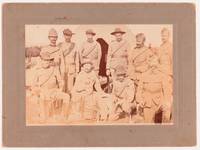
1899100976Melbourne: R. McGeehan 96 Albert St. Windsor 1899. Very Good. Melbourne R. McGeehan 96 Albert St. Windsor circa 1899. A high-gloss gelatin silver photograph 100 × 145 mm on the original blind-decorated mount with the ink stamp of the photographer on the verso. Photograph slightly marked with some uneven discolouration; mount a little marked; in very good condition. The second figure from the right in the front row is wearing a slouch hat with a distinctive hatband and the brim turned up on the right side. We have discovered the same man in one of Rose's Stereoscopic Views #2242 'The Bushmen's Contingent at Camp Langwarrin' illustrated in 'George Rose Australia's Master Stereographer' by Ron Blum 2014 third edition page 32. R. McGeehan, 96 Albert St., Windsor unknown
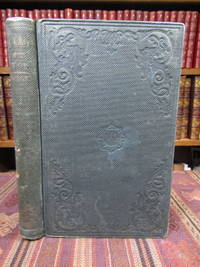
1866055989Chicago: Church and Goodman 1866. 1st Edition . Hardcover. Good/No Jacket. 8vo - over 7¾ - 9¾" tall. Octavo. 241 1 pages. Hardcover in dark green publisher's cloth. The binding is rubbed and worn and bumped at the corners. There are a couple of chips on the spine and a bit of chipping or abrasions at the spine ends. A sound copy with secure inner hinges. Lacks the front and rear flyleaves. The front pastedown has an early signature "E. M. White" and a later ink notation "H 30". Foxing throughout the text. A sound copy. <br/> <br/> Church and Goodman hardcover