437 résultats
40617The eighth wealthiest American of all time was a German-born lumber magnate who began his empire in Rock Island Illinois in 1856 starting as a night fireman at a sawmill and working his way up until he owned this sawmill then began adding more until the "Weyerhauser Syndicate" was enormous; he moved to the Pacific Northwest in 1900 where the firm still operates and is the world's largest timber seller. Partly-Printed Document Signed 1p 8 3/4" X 3 3/4" Rock Island IL 1881 November 15. Very good. Ornate check drawn on the Peoples National Bank printed in black on blue stock and featuring decorative border a variety of ornate typefaces and a steel-engraved vignette at left showing a puffing locomotive at a train station. The check has been made out to Weyerhaeuser in the amount of $25000 and is signed by the bank president Bailey Davenport. Davenport 1823-90 was the son of Davenport Iowa's murdered founding father fur trader/Indian agent/frontiersman Colonel George Davenport 1783-1845 and was himself a wealthy banker real estate entrepreneur and mayor of Davenport during the Civil War. On the check's verso Weyerhaeuser signs boldly adding "pat to the Order / of H C Putnam" above. Below this Putnam then signs. Henry Cleveland Putnam 1832-1912 was a Wisconsin lumber baron and philanthropist one of the founders of Eau Claire. Three more unidentified persons also sign below Putnam. Twenty-five thousand dollars was a huge sum of money in 1881. Real estate developer Davenport and Weyerhaeuser who also served on the board of directors of this bank surely had many and complex business dealings -- as Weyerhaeuser likewise also had with fellow lumber baron Putnam. Weyerhaeuser's syndicate was vast and he had arrangements with a large number of other lumber businesses. It's possible the transaction had to do with the purchase of timber lands but this warrants further research. In any case a unique and intriguing document. unknown books
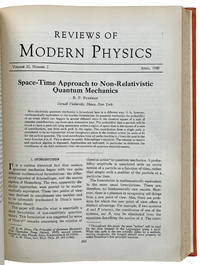
1948S10249Lancaster:: American Physical Society 1948. 1948. Large 8vo. 266 x 205 mm. iv 728 pp. Frontis. port. of Robert Andrews Millikan photos figs. tables. Later orange cloth gilt-stamped spine title; spine faded. Very good. TWO PAPERS FROM THE TWO GIANTS OF 20TH CENTURY PHYSICS AS THEY WERE ORIGINALLY PUBLISHED IN ONE COLLECTED VOLUME. Einstein's "Generalized Theory of Gravitation" is considered the last principal work issued by the 20th Century's premiere scientist. Schilpp-Shields. <br /><br /> Einstein: "A new presentation. . . which constitutes a certain progress in clarity as compared with previous presentations." from the Introduction. Feynman: "At first Feynman's fundamental article RMP 1948 did not arouse much interest among theoretical physicists who were not familiar with Feynman's new approach to doing quantum mechanics. As Feynman recalled: 'At the Shelter Island Conference. . . they asked me if I would explain my path-integral method for doing quantum mechanics so I did. I must have been preparing the manuscript for my paper RMP 1948 so that everything was organized and I explained it. It's hard to pay attention to some new idea and they didn't pay much attention to it.' However nowadays Feynman's RMP 1948 paper is one of the most well-known and widely cited papers; it is one of the cornerstones of modern theoretical physics." Mehra. <br /><br /> "It is a curious historical fact that modern quantum mechanics began with two quite different mathematical formulations: the differential equation of Schroedinger and the matrix algebra of Heisenberg. . . This paper will describe what is essentially a third formulation of non-relativistic quantum theory. This formulation was suggested by some of Paul Dirac's remarks concerning the relation of classical action to quantum mechanics. A probability amplitude is associated with an entire motion of a particle as a function of time rather than simply with a position of the particle at a particular time." from the Introduction. Provenance: David Middleton b. 1920 noted pioneer in the field of statistical communication theory last name gilt-stamped on spine. Einstein: Boni-Russ-Laurence 258; Schilpp-Shields 308 also see p. 758; Wasson Nobel Prize Winners p. 289-294; Weil 222 marked with asterisk by Weil. Feynman: Gleick Genius: The Life and Science of Richard Feynman p. 249; Mehra The Beat of a Different Drum: The Life and Science of Richard Feynman p. 200; Wasson Nobel Prize Winners p. 316-319. American Physical Society, 1948. hardcover books
1952YF1016-003New York:: Museum Books Inc. 1952. Hardcover. Like New. LIMITED EDITION of 2000 copies. Oblong 4to. 9 x 12 inches. iv pp. 25 ff. 10 pp. Printed in brick-red and black inks throughout; text clean unmarked. Vellum spine blind-stamped brown paper over boards added clear mylar jacket; binding square and tight slight bumps to corners else Fine. This is the first English-Language Edition of Feder und Stichel printed on Italian Fabriano paper in the private printing office of D. Stempel AG type foundry Frankfurt am Main. The calligraphic pages were designed by Hermann Zapf between 1939 and 1941. The Historical Appendix in this volume was also contributed by Hermann Zapf and translated by Paul Standard who contributed the Preface to this volume All the metal plates were cut by hand by August Rosenberger punch-cutter to D. Stempel AG. Text set in Palatino. Museum Books Inc., hardcover books
1865319096London: Chapman and Hall 1865. First Edition. Illustrated with 39 full page plates of portraits of famous Aeronauts and their Ascents including Icararus as the Frontispiece and 51 vignettes in the text. xxiii 530 pp. 1 vols. Folio. Bound in modern quarter green morocco and cloth. About fine. First Edition. Illustrated with 39 full page plates of portraits of famous Aeronauts and their Ascents including Icararus as the Frontispiece and 51 vignettes in the text. xxiii 530 pp. 1 vols. Folio. The fullest pictorial account of ballooning containing good reproductions of many rare prints a bibliography and a chronological list of ascents from 1783-1848 and incidently giving an account of meteorological observations during ascents." Brockett 12110; Gamble 373; Liebman-Wahl 676; L'Art Ancien Catalogue Flight #250; Tissandier p. 61; Zeilinger Bibliotheca Chemico-Mathematica 20759 Chapman and Hall unknown books
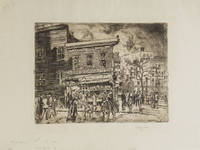
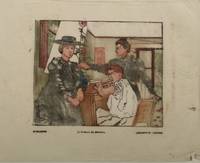
304944Signed dated "05" numbered 4/15 and annotated 'imp" beneath the image in pencil. On wove paper with wide margins. 149 x 200 mm. Matted. Signed dated "05" numbered 4/15 and annotated 'imp" beneath the image in pencil. On wove paper with wide margins. 149 x 200 mm. From the "New York East Side Set 1902" done for Harper's magazine in a series of 8. Wehye Memorial Exhibition Catalogue_ Number 5 unknown books
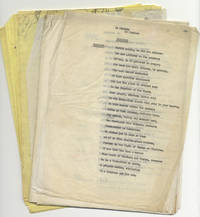
30632Folio. 24 pp. On onionskin. With typed note at conclusion "Translation by Leonard Bernstein August 29th 1962." <br/><br/>Contents: <br/>Prologue: 2 pp. <br/>Act I: First Window: the Court of Lilies 5 pp.<br/>Act II: Second Window: The Magic Chamber 3 pp.<br/>Act III: Third Window: The Council of False Gods 9 pp.<br/>Act IV: Fourth Window: The Wounded Laurel 4 pp. <br/>Act IV: 1 p. <br/><br/>With numerous annotations corrections etc. in ink and lead red and blue pencil throughout by Yuri Krasnapolsky 1934-2018. Somewhat worn and creased; several leaves stapled together at upper inner corners.<br/><br/>Together with: <br/>- An extensively corrected draft of an interesting autograph letter from Krasnapolsky to Leonard Bernstein. 5 pp. Folio. In pencil on 4ff. of yellow lined paper. No date. Addressed "Dear Lenny." Krasnapolsky writes regarding his travels in Europe after seeing Bernstein in Vienna possible conducting engagements having been blacklisted during the McCarthy era etc. The letter is particularly poignant regarding his relationship with and feelings of indebtedness to Bernstein: "The European experience. showed me that my association with you over the past eighteen years has been crucial & pervasive. Your working style in every respect became for me as for many others an object of tremendous admiration and imitation. My own style took longer. to evolve but now that it has I can see & feel more clearly what it owes to yours." Krasnapolsky very much regrets the fact that he has apparently offended Bernstein in some way and is struggling to understand "how & when." He goes on to say that "it is a simple fact of my life that I am deeply indebted to and in a sense derived from you and can no more separate myself from that fact than I can deny my love for music. I literally cannot survive professionally without your help." Krasnapolsky goes on to request various letters of endorsement. <br/><br/>- A corrected draft of an autograph letter from Krasnapolsky to Sir John Barbirolli. 3 pp. Folio. In pencil on 3ff. of yellow lined paper. No date. Addressed "Dear Sir John." Krasnapolsky apologizes for the delay in writing but says that he has been "unexpectedly but unavoidably busy with a series of youth concerts." He thanks Barbirolli for his kindness and hospitality. "It was a great pleasure and a privilege to see you at work again and to have assisted you however briefly." Krasnapolsky has regarded Barbirolli as a "heroic musical figure. for many years." He mentions going to a concert of Barbirolli's at Carnegie Hall "at age 8 and/or 9 quite alone" with Gieseking as soloist. "Furthermore now that I am at the age you were when you took on the N.Y. Phil. I realize more than ever what an enormous task and brilliant achievement that was. Who else could have done that I don't know. But you have remained undeniably a heroic figure of 20th century music. I can only wish that someone. will say the same of me someday. My wife and I are planning to be in London again just after the first of the year. I'll be looking for ways to become a part of the musical life of London and the Continent." <br/><br/>- A corrected draft of a letter to John S. Edwards General Manager of the Chicago Symphony. 1 page. Folio. In pencil on 1f. of yellow lined paper. Thanking him for his time whle in New York mentioning "the Florida affair" etc.<br/><br/>- A corrected draft of a letter to Walter Hendl at the Eastman School of Music. 2 pp. Folio. In pencil on 1f. of yellow lined paper. Recommending a colleague Francois Jarosely for a possible conducting appointment at the school. <br/><br/>- Biographical notes. 5 pp. Folio. In pencil on 5 ff. Le Martyre de Saint Sébastian a "mystère" in five acts to a libretto by Gabriele D'Annunzio composed for the dancer Ida Rubinstein was first performed in Paris at the Châtelet on May 22 1911. Debussy's last stage work it is "a synthesis of orchestra and vocal music dance mime and speech." <br/><br/>Bernstein translated D'Annunzio's text and conducted a recording of the work in 1962 with the Choral Art Society and the New York Philharmonic featuring his wife Felicia Montealegre as Sebastian one of the narrators: ".among its best moments the serenely celestial 'Magic Chamber' in which the NYPO strings bloom and 'The Wounded Laurel' which could have come from La mer. Mr and Mrs. Bernstein were having a good day judging by the passion which comes across." Christopher Fifield BBC Music Magazine. <br/><br/>"The following year 1963 he conducted The Martyrdom of Saint Sebastian to commemorate Debussy's centenary. The sung parts were in German the dialogue in English. Fritz Weaver the actor was the narrator and Felicia appeared as the male saint. Bernstein probably thought of her as at least a saint. If he tested orchestra managements and presidents to see how far he could push them he repeatedly tested Felicia too. She seemed to pass all his tests right up to the end of her life. As for the Debussy critics remarked on the clean articulation of the text." Peyser: Bernstein p. 359. <br/><br/>Krasnapolsky was an assistant conductor of the New York Philharmonic under Leonard Bernstein. unknown books
1890184Lithograph. c. 1890. As published for L'Estampe et L'Affiche. Printed on very thin tissue. Image: 5 x 7. Margins: 9 x 11¼. L'Estampe et L'Affiche. books
12692Used; Like New/Used; Like New. Impressive collection of AMQS and inscriptions addressed to the celebrated soprano Delphine Ugalde on both sides of a large album leaf measuring 31.5 x 23.5 cm 12.5 x 9.5 inches. Fine. <br><br />The recto with: eight measures written and signed by the French composer Charles Lecocq from his wildly successful "La fille de Madame Angot" which when premiered in Paris in 1873 was performed for more than 400 nights consecutively. Inscribed to Ugalde and dated 20 May 1873; an unidentified inscription; a heartfelt inscription from Rossini's friend and biographer Alexis Azevedo dated 17 July 1870. <br><br />The verso with: a three-measure 1869 quotation by Fauré celebrated French baritone and composer creator of important roles by Massé Thomas Meyerbeer Verdi and others who has penned a selection from his own Sacred Song for Voice and Piano "Les Rameaux" with a trimmed albumen photograph of him affixed beneath; a heartfelt 1869 inscription by Capoul the great French tenor creator of Offenbach's Vert-Vert and Masse's Paul et Virginie who writes that he is "so happy of your return to us that I embrace you as strongly as I admire you"; an 1870 inscription from Dejazet important French actress who writes that her "voice remains always charming even when it is speaking it is your great heart which sings" and with a trimmed albumen photograph of her affixed beneath; with one additional unidentifed inscription lower left dated 1873. <br><br />Ugalde "studied in Paris with Cinti-Damoreau and made her début in 1848 at the Opéra-Comique as Angèle in Auber's Le domino noir a role created by her teacher. In 1851 she sang at Her Majesty's Theatre London as Delilah in Auber's L'enfant prodigue. In 1858 she sang Leonora Il trovatore at the Paris Opéra and was then engaged at the Théâtre Lyrique. In 1863 she moved to the Bouffes-Parisiens where in 1867 she sang in her own operetta Halte au moulin. She retired in 1871." Elizabeth Forbes Grove Online unknown books
2431862. Etching and drypoint. Beraldi 175 Cate Japonisme p.35. From the first Cadart and Chevalier issue with their blindstamp in the lower margin. Image: 10¼ x 7¾. Margins: 19¾ x 14 . unknown books
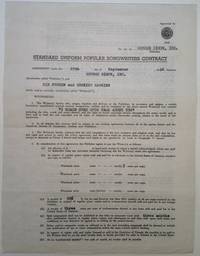
1946102874New York 1946. unbound. 4 pages front and back 11 x 8.5 inches New York September 25 1946. Contract with George Simon Inc. for the song "I Heard Some Good Talk About You" signed by Hawkins and his collaborator Sid Prosen. Natural folds; near fine condition.<br/><br/> unknown books
193640149n. p.: A. G. Spalding & Bros 1936. Original publisher's pebbled blue cloth binding with gilt title stamping to front board. Gilt lettering a bit dull. Age-toning to paper. Overall a VG or better item. Unpaginated though 48 pp. "How to Score a Base Ball Game" p. 48. Paste-downs Spalding adverts. Oblong format: 5-1/2" x 7-3/8" <br/><br/>This scorebook from the mid-30s and was used to record primarily games from the Pacific Coast League. the first scores a game between Sacramento & Hollywood played in Los Angeles July 8 1934. Next comes Sacramento vs Oakland played in Oakland July 15 1934. A total of 23 games are scored including the October 3rd & 4th 1936 World Series games between the New York Giants and the New York Yankees. Gerhig hit a home run in each of these two games and such is herein recorded. Further this the first World Series played by the young phenom Joe DiMaggio. All-in-all a desirable piece of baseball history. A. G. Spalding & Bros hardcover books
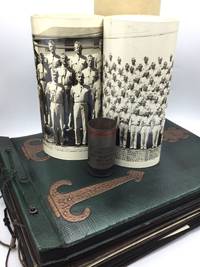
73706A collection of four photo albums three panoramic photographs and other material associated with the service of Warren I. Johnson of Northampton Pennsylvania in the U.S. Army during World War II. Extensively annotated the albums are accompanied by 16 issues of the mimeographed shipboard newspaper - Noah's News Noah News is Good News - published aboard the SS Noah Webster during Johnson's return voyage to the United States.<br/><br/>Johnson was working as an elementary school teacher in Columbia Pennsylvania at the time of his enlistment on May 20 1942. The first album which contains 149 original photographs corresponds to his basic training in Miami Beach Florida; radio school in Scott Field Illinois and in Orlando Florida; assignments at Hammer Field Squaw Valley and Hamilton Field California; and service with the 356th Fighter Group in Tonopah Nevada and Santa Rosa California in the spring of 1943. The second album houses 67 photographs taken at Camp Edwards in Massachusetts and Camp Davis in North Carolina and a color rendering of Flick-Flak a cartoon mascot designed by Walt Disney that was adopted by the 247th AAA SL Battalion.<br/><br/>In September 1944 Johnson attended infantry school at Fort Benning Georgia which is extensively shown in the third album. There are 97 original photographs and several acquired images in this album. It also covers his service in England France Belgium Holland and Germany beginning in December 1944. Of particular interest are the seven photographs from Johnson's assignment guarding political prisoners at the internment camp in Schwarzenborn Germany. The final album which includes 64 original photographs covers the remainder of Johnson's service from October 1945 to February 1946. It opens with images from General Dwight D. Eisenhower's visit to Seventh Army Headquarters in Heidelberg and also shows scenes of the German countryside the SS Noah Webster at the docks in Bremerhaven and the evacuation of a seriously ill solder off Plymouth England.<br/><br/>The albums are accompanied by three panoramic photographs: a printed 42" x 10 ½" image of Camp Davis in North Carolina; a 23" x 8" portrait of Class 73 2nd Platoon - 19th Battery at Camp Davis on September 27 1943; and a 40" x 8" portrait of the Anti-Aircraft Artillery Officer's Candidate School Course No. 73 at Camp Davis on September 30 1943. All the men pictured in the second image are identified on the verso while those in the 19th Battery are identified on the recto of the third. All three photographs were rolled for storage. Also present here is a spent anti-aircraft shell label July 1942 and a Souvenir Edition of Noah's News which corresponds with the aforementioned shipboard newspaper.<br/><br/>The photographs are tipped or pasted to the black paper leaves and labeled by hand in white ink below the image. Many of the earlier photographs are additionally labeled on the verso. They vary in size from 2" x 2 ¾" to 8" x 10" with most measuring 4 ½" x 3 ¼". A very small number of photographs appear to be missing. The bindings of the last three albums are loose particularly the second album which is partially disbound. However the images are clean and neatly organized offering a unique glimpse at the American GI experience during the Second World War. unknown books
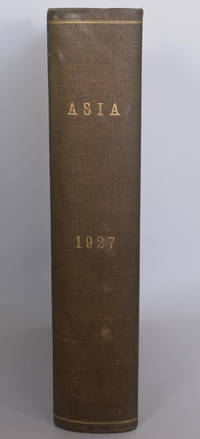
1932239365Concord N.H.: 10 Ferry Street 1932. Illustrated. 16 vols. 4to. Green cloth with original pictorial wrappers bound in by Eggeling Bindery 55 East 11 Street New York. Fine. Illustrated. 16 vols. 4to. Asia was edited by "Izzy" Straight but he died after only one year after the start of publication from influenza and 5 years of marriage to William C. Whitney's daughter Dorothy Payne Whiney . Asia later became "Asia and the Americas. 10 Ferry Street unknown books
1924SBS220-001San Francisco CA: The Book Club of California 1924. First Edition. Hardcover. Very Good. Series: Book Club of California Publication No. 22. 4to. 12 x 8 1/4 inches. Unpaginated. 32 plus the original leaf bound in between pages 6 and 7 pp. Title page printed within an elaborate architectural border 2 headpieces decorative initial and 2 illustrations reproduced without redrawing from originals in the Hypnerotomachia Poliphili printer's device on the colophon; text clean unmarked. Black cloth spine titled in gilt brown paper over boards illustrated paper label on front cover; binding square and tight rubbed with some insect freckling to cloth spine. SBS220-001. Very Good. LIMITED EDITION of 250 copies this is number 154 printed at the Grabhorn Press in handset Poliphilus types on handmade Kelmscott watermarked paper. Only 192 copies with original leaves were distributed in 1924. This is the second use of Poliphilus type a Monotype Studio design by the Grabhorns who were the first in the United States to use it in another book they published earlier in 1924. The first leaf book produced by the Book Club of California. Theodore Low De Vinne was an American printer and author on typography whose scholarship did much to improve the art of printing in the United States. Perhaps the text here is an excerpt from his volume Notable Printers of Italy during the Fifteenth Century 1910. See: Wikipedia. This book was originally issued at 3 or more price points depending on whether the original leaf had ornamentation or woodcuts; this copy contains a leaf with only type foliated 92 in pencil on the upper right corner. One of the Fifty Books of the Year. REFERENCES: De Hamel and Silver Disbound and Dispersed No. 8 checklist No. 22; Heller and Magee Bibliography of the Grabhorn Press 1915-1940 No. 67; Mcgee The Hundredth Book No. 22. The Book Club of California hardcover books
191769840Boston and New York: Houghton Mifflin Company 1917. First Edition. Hardcover. Near fine. Large Paper Edition this is number 129 of 550 copies. This copy comes from the library of Lucretia Thatcher Perry Osborn 1858-1930 with her bookplate to the front pastedown and a holographic note in her hand on the front flyleaf "This narrative is one of John Muir's earliest chiefly written from his diary of the North". Lucretia and her husband American paleontologist Henry Fairfield Osborn 1857-1935 were close friends and benefactors of John Muir. Henry accompanied Muir on his fifth trip to Alaska 1896 and later Muir spent time at the couple's summer house in Garrison New York working on the final proofs of The Yosemite 1912. A fantastic association. In addition to its regular arctic duties as a United States Revenue Service Cutter the Corwin steamed out of San Francisco Bay on May 4 1881 with orders to search for the American polar exploration vessel Jeanette which had not been heard from since 1879. Muir shipped onboard as a naturalist and correspondent for the San Francisco Daily Bulletin and this work consists of the 21 letters that he wrote to the Bulletin during the more than five-month voyage supplemented with notes from his daily diary and the two scientific reports on botany and glaciation that he wrote for the government. Muir was a gifted journalist with a reporter's instinct for the dramatic. Filled with colorful details of the arctic natives and their customs the stark landscape and frequently perilous adventures in an inhospitable and hazardous environment his despatches were eagerly read by a large audience. Edited by William Frederic Bade 1871-1936. Hand-colored photogravure frontispiece with 26 plates consisting of one map eleven halftone reliefs from photographs eight halftone reliefs from sketches by Muir and six line blocks from drawings by Muir. Octavo. Original green laid paper covered boards with a green cloth spine and a brown leather spine label stamped in gold. Partially unopened. An especially crisp and bright example. Later bookplate to a prefatory blank leaf. The spine is lightly faded along the spine with a tiny bit of wear to the spine heel and some very mild rubbing to the rear board. Kimes 347. Houghton Mifflin Company hardcover books
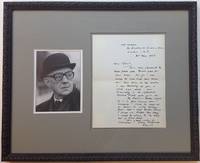
1968260603London 1968. unbound. 1 page 8 x 6.25 inches London December 3 1968. In this friendly letter the British actor mentions the theater and discusses his plans for the new year in full: "Dear Grant How very pleasant to hear from you. Thank you for your letter -- though I was sorry to read that you have not been busy in the theatre. I was thinking of you a week ago when I was browsing in the splendid Robert Frost you gave me. The Cocktail Party seems to be a fair success and I imagine I shall be hard at it until the early spring. After that I don't know what I shall do. Before too long I want to return to the crisp air of New York. All good wishes for Christmas. Yours sincerely Alec G." One horizontal fold but still in near fine condition. Float mounted in gray beside a 5.25 x 4-inch photo of Guinness gazing off to the side. Set in a decorative black frame with burgundy trim measuring 13.25 x 16.25 inches. Accompanied by the original handwritten envelope housed in a plastic sleeve neatly mounted to the back of the frame.<br/><br/> unknown books
190138770Winnipeg 1901. 4to. 10pp. and 43pp. respectively plus 31pp. of additional tables of customs schedules and weight of merchandise through Vladivostock. Early grey cloth upper cover lettered in gilt.<br/> <br/>An interesting contemporary account of the Trans-Siberian Railroad by an important Canadian railroad executive.<br/> <br/>"After a short career with a Scottish railway William Whyte emigrated to the Canadas in 1863 and accepted a job as a brakeman on the Grand Trunk Railway. Rising through the ranks he served as freight and station agent at various locations culminating his career with the company as the assistant superintendent of its central division. In October 1883 he moved to the Ontario and Quebec Railway as its general superintendent and a year later when this company was leased in perpetuity to the Canadian Pacific Railway he became the superintendent of the Ontario division. In 1886 he was transferred to Winnipeg as the superintendent of the CPR's western division . In 1901 Shaughnessy who had succeeded Sir William Cornelius Van Horne as president of the CPR in 1899 appointed Whyte his assistant to advise him on 'all matters connected with colonization proposed extensions of the Companys railway system the development of industries along the Companys lines the establishment of new business connections and the administration of the Companys lands town-sites and other properties of that description.' In 1903 Whyte was elected second vice-president in charge of the western lines. He was promoted vice-president in 1910. Whyte's most pressing problem from 1901 was to solve the recurrent blockages hampering the export of grain from the prairies. Under his direction the company constructed nearly 4000 miles of branch lines within a decade multiplied its rolling stock and experimented with ever-larger locomotives" Dictionary of Canadian Biography. The primary reason for this trip would appear to be to ascertain whether the Trans-Siberian railway would make Siberia a significant competitor to Canada's grain exports. Focusing on Siberia Whyte's epistolary reports goes into great detail on the route from Cheliabinsk to Vladivostock the agricultural prospects and natural resources along the way with a particular emphasis on Irkutsk and the articles imported. Much of his information came from first-hand examination as well as conversations with government officials and local merchants. He also comments on the construction of the railroad itself. unknown books
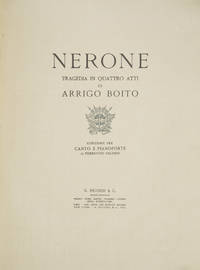
192425776Milano: G. Ricordi & C. PN 119599 1924. Large folio. Full original publisher's stiff vellum boards illustrated in black highlighted in red and gold illustrated endpapers. 1f. blank i half-title i copyright notice 1f. limitation statement 1f. title 1f. table of contents 1f. cast list 1f. part-title within illustrated border by Gisari 1f. scene description 1f. second part-title with illustration of scenery for the first act 415 i blank pp. 1f. decorative device by Gisari. Uncut. <br/><br/>Publisher's blindstamp to lower margin of each leaf. Each act preceded by an unpaginated blank leaf scene description and two part-titles the second with a detailed illustration of the scenery. The second part "Lo spoliarum" is preceded by an unpaginated blank leaf and scene description.<br/><br/>Binding slightly worn soiled and warped. Some leaves slightly browned or soiled. Deluxe Limited Edition this number 19 of 120 copies with "XIX" in careful manuscript to lower margin of limitation statement. On fine Pietro Miliani di Fabriano paper. Illuminated and illustrated by Giulio Cisari after sketches by Lodovico Pogliachi.<br/><br/>Begun in 1877 Nerone an opera in four acts to Boito's own libretto remained incomplete when Boito died in 1924. After its completion by Arturo Toscanini Vincenzo Tommasini and Antonio Smareglia it was posthumously premiered at the Teatro alla Scala on May 24 1924 with Toscanini conducting. Although its premiere was very well received it was not performed in the U.S. until April 12 1982.<br/><br/>An attractive copy. G. Ricordi & C. [PN 119599] unknown books
1951S8653Offprint from: Cold Spring Harbor Symposia vol. XVI. Cold Spring Harbor:: Cold Spring Harbor Symposia 1951. 1951. 4to. 159-174 pp. Photos figs. Self-wraps. Ownership rubber stamp of Norman Horowitz. FINE. Lewis received his PhD from Caltech where he studied under Alfred Sturtevant. He founded the field of developmental genetics with his pioneering work with Drosophila for which he was awarded the 1995 Nobel Prize in Medicine. It was also Lewis who developed the complementation test and he made important contributions to the study of cancer radiation and genetics. In addition to the papers featured is a book review written by James F. Crow of: "Eugenics: Must it be a Dirty Word" by Daniel J. Kevles and INSCRIBED BY LEWIS to Norman Horowitz. All of the papers bear the rubber stamp or signature of pioneer Caltech geneticist Norman Horowitz. WITH: LEWIS. "The Pseudoallelism of White and Apricot in Drosophila Melanogaster." Offprint from: Proc. Nat. Acad. Sci. vol. 38 no. 11 1952. 8vo. 953-961 pp. Self-wraps. Full list available on request. Cold Spring Harbor Symposia, 1951. paperback books
1941C1316xiv573 pages with diagrams. Small Octavo. bound in original publisher's brown cloth with gilt lettering and stamping to spine and cover issued without jacket. Signed and limited to 500 copies of which this is number 26. Limited edition not in Betts First edition.<br /><br />Fine had an exceptionally brief but fruitful international career before changing from grandmaster to psychiatrist. Within three years 1935-8 he developed from an unknown American master into co-winner of AVRO 1938 one of the highest-rated events ever held. Yet when chess revived after the second World War Fine was too busy with his studies to accept an invitation to the World Championship tournament of 1948. After AVRO 1938. Fine concentrated on writing chess books. Altogether he wrote more than a dozen works. Golombek: 116p<br /><br />Condition:<br /><br />Previous owner's name in pencil limitation page else a very good to fine copy. David McKay Co hardcover books
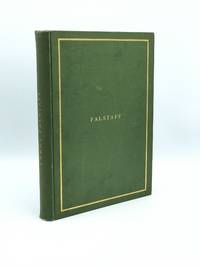
1893402877Milan Rome etc.: G. Ricordi & Co 1893. 4to 267 x 203 mm; 10½ x 8 inches. 471 pages. Full-page portrait of Verdi. Original gilt-lettered and -ruled green cloth. A fine copy with only slightest of wear at the ends of the spine. FIRST EDITION IN ENGLISH. Published the same year as the first edition in Italian. Falstaff is the last of Verdi's operas composed as he neared his eightieth year. The composer wanted to write a comedy and collaborated with Boito for three years from mid-1889. Of his 27 operas this is only his second comedy the first was his second opera Un giorno di regno. The work premiered at La Scala in Milan on 9 February 1893; it was published in its original Italian and in translations later that year. . <br/><br/> G. Ricordi & Co hardcover books
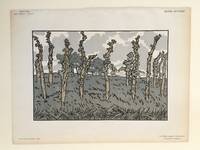
3641907. Woodcut. Curtis 63; BN inv 522. Image: Signed. 12 x 6½. Margins: 11 x 15 . RARE. unknown books
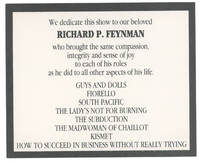
73246A small collection associated with Richard Feynman's involvement with Theatre Arts at the California Institute of Technology TACIT. All the materials are from the estate of Shirley Marneus who founded TACIT and directed stage productions at Caltech for more than 20 years.<br/><br/>Feynman was already regarded as the most brilliant influential and iconoclastic figure in his field when Marneus approached the theoretical physicist who had been a member of the Caltech staff since 1949 about performing in a 1977 production of Guys and Dolls. Feynman recalled this moment in his irreverent memoir Surely You're Joking Mr. Feynman 1985 ".at Caltech there's a group that puts on plays. Some of the actors are Caltech students; others are from outside. When there's a small part such as a policeman who's supposed to arrest somebody they get one of the professors to do it. It's always a big joke - the professor comes on and arrests somebody and goes off again. A few years ago the group was doing Guys and Dolls and there was a scene where the main guy takes the girl to Havana and they're in a nightclub. The director thought it would be a good idea to have the bongo player on the stage in the nightclub be me." Feynman was an enthusiastic amateur player of bongo and conga drums having developed a passion for samba music during his 1951-52 sabbatical in Brazil.<br/><br/>In her remembrance of Feynman for The California Tech a campus weekly Marneus recalled ".immediately he wanted to find out more about the stage about acting how to do it well to really go for the principles of the form. And though his research classes conferences kept him on a rigorous schedule he always made time to come back to TACIT each time fresh yet more skilled each time challenging himself. Finally as the Sewer King in The Madwoman of Chaillot he pulled off a little jewel of characterization - a mix of wry humour weary insight delicious dubiety determined that the 'good guys' in the play should at least have a chance to win. The subtleties and loving details of his performance how he 'saucered 'n blowed' his tea with an elegant lift to his pinkie finger were noticed by a reviewer who praised his work. This worried him: 'Now I gotta be good!' He was. He was just the best. While he suffered no flatterers and few fools his in-home courtesy was incredible. For instance while he was rehearsing for Kismet he was appointed to the President's Commission on the Challenger explosion. He called me the same night to explain and to ask if I'd understand if he quit the show."<br/><br/>Included in this collection is a first edition of the posthumously published Perfectly Reasonable Deviations from the Beaten Track: The Letters of Richard P. Feynman which is inscribed by Feynman's daughter editor Michelle Feynman to Shirley Marneus: "For Shirley I know my father thought the world of you - as do I. All the best Michelle Feynman". Also present here are:<br/><br/>The original cast information sheet for what is perhaps Feynman's most memorable role: the High Priest in TACIT's 1982 production of South Pacific. It includes Feynman's contact information and complete measurements including shoe and hat sizes.<br/><br/>The rehearsal schedule for South Pacific which notes a production meeting with Richard Feynman and fellow Caltech physicist Robert B. Leighton who played the High Priest's assistant<br/><br/>Programs for six of the productions in which Feynman appeared and is credited: Guys and Dolls South Pacific four copies The Lady's Not for Burning The Madwoman of Chaillot Kismet and How to Succeed in Business Without Really Trying<br/><br/>Cast list organized by scene for TACIT's 1978 production of Fiorello! in which Feynman appeared as a gangster<br/><br/>1983 Caltech Faculty Roster in which Feynman is identified as the Richard Chace Tolman Professor of Theoretical Physics alongside his portrait<br/><br/>Memorial program insert 18 copies dedicating an unnamed production to Feynman "who brought the same compassion integrity and sense of joy to each of his roles as he did to all other aspects of his life." It lists all eight TACIT productions in which he appeared.<br/><br/>Some toning and soiling to the programs. Guys and Dolls is hole punched along the left margin and How to Succeed in Business Without Really Trying is folded in half. Overall the material is very good or better condition. unknown books
188261972Cleveland Ohio 1882. Four pages approximately 350 words in part: "Advance sheets of Mr. Blaine's address reached her yesterday morning. Thronging emotions and memories made my heart stand still. It was the anniversary of the last day the Gen'l passed in our Mentor Ohio home . hopes ambitions aspirations pure & high and almost assured all swept away -- nothing left but tears." Garfield took office in March 1881 was shot in July and died a lingering death in September. Mrs. Garfield thanks Mr. Blaine for his wonderful words and his tribute to her husband's life and character. A beautiful poignant letter. Still very good. Folded for mailing some browning at folds. 9782. <br/><br/> unknown books
1947S13280Washington DC:: The American Mathematical Monthly 1947. 1947. 27 offprints. Original printed or self-printed wrappers. From the collection of Abraham Pais. Very good. INVENTORY: 1. KAC Mark; Hurwitz H. Statistical Analysis of Certain Types of Random Functions. Offprint from: The Annals of Mathematical Statistics Vol. XV No. 2 pp. 173-181 June 1944. Signed by Pais. 2. KAC Mark. On the Notion of Recurrence in Discrete Stochastic Processes. Offprint from: The Bulletin of the American Mathematical Society Vol. 53 No. 10 pp. 1002-1010 October 1947. Signed by Pais. 3. KAC Mark; Erdos P. On the Number of Positive Sums of Independent Random Variables. Offprint from: Bulletin of the American Mathematical Society Vol. 53 No. 10 pp. 1011-1020 October 1947. Original grey printed wrappers. Signed by Pais. 4. KAC Mark; Siegert J. F. An Explicit Representation of a Stationary Gaussian Process. Offprint from: The Annals of Mathematical Statistics Vol. XVIII No. 3 pp. 439-442 September 1947. Signed by Pais. 5. KAC Mark. Random Walk and the Theory of Brownian Motion. Errata sheet laid in. Offprint from: The American Mathematical Monthly Vol. LIV No. 7 August-September 1947. Original light blue printed wrappers. Signed by Pais. 6. KAC Mark; Siegert J. F. On the Theory of Noise in Radio Recievers with Square Law Detectors. Offprint from: Journal of Applied Physics Vol. 18 No. 4 pp. 383-397 April 1947. Signed by Pais. 7. KAC Mark. On the Characteristic Functions of the Distributions of Estimates of Various Deviations in Samples from a Normal Population. Offprint from: The Annals of Mathematical Statistics Vol. XIX No. 2 pp. 257-261 June 1948. Signed by Pais. 8. KAC Mark. Probability Methods in some Problems of Analysis and Number Theory. Offprint from: Bulletin of The American Mathematical Society Vol. 55 No. 7 pp. 641-665 July 1949. 9. KAC Mark. On the Distributions of Certain Wiener Functionals. Offprint from: Transactions of The American Mathematical Society Vol. 65 No. 1 pp. 1-13 January 1949. Original light blue printed wrappers. 10. KAC Mark. The Monte Carlo Method and its Applications. Offprint from: Proceedings Computation Seminar pp. 74-81 December 1949. Original grey printed wrappers. Signed by Pais. 11. KAC Mark; Donsker M. D. A Sampling Method for Determining the Lowest Eigenvalue and the Principal Eigenfunction of Schrodinger's Equation. Offprint from: the Journal of Research of the National Bureau of Standards; U.S. Department of Commerce National Bureau of Standards. Research Paper RP2102 Volume 44 pp. 551-557 May 1950. 12. KAC Mark; Berlin T. H. The Spherical Model of a Ferromagnet. Offprint from: The Physical Review Vol. 86 No. 6 pp. 821-835 June 15 1952. 13. KAC Mark; Murdock W. L.; Szego G. On the Eigen-valves of Certain Hermitian Forms. Offprint from: Journal of Rational Mechanics and Analysis Vol. 2 No. 4 pp.767-800 October 1953. 14. KAC Mark. Signal and Noise Problems. Offprint from: The American Mathematical Monthly Vol. LXI No. 7 August-September 1954. Original light blue printed wrappers. 15. KAC Mark. Foundations of Kinetic Theory. Offprint from: Proceedings of the Third Berkley Symposium on Mathematical Statistics and Probability pp. 171-197 December 1954 and June and July 1955. Grey printed wrappers. 16. KAC Mark. Distribution of Eigenvalues of Certain Integral Operators. From: The Michigan Mathematical Journal Vol. 3 pp. 141-148 1955-56. Original printed wrappers. 17. KAC Mark; Darling D. A.; On Occupation Times for Markoff Processes. Offprint from: Transactions of the American Mathematical Society Vol. 84 No. 2 pp. 444-458 March 1957. Original light blue printed wrappers. 18. KAC Mark. A Class of Limit Theorems. Offprint from: Transactions of the American Mathematical Society Vol. 84 No. 2 pp. 459-471 March 1957. Original light blue printed wrappers. 19. KAC Mark; Kesten Harry. On Rapidly Mixing Transformations and an Application to Continued Fractions. Offprint from: Bulletin of the American Mathematical Society Vol. 64 No. 5 pp. 283-287 September 1958. Original green printed wrappers. 20. KAC Mark. On the Partition Function of a One-Dimensional Gas. Offprint from: The Physics of Fluids Volume 2 Number 1 pp. 8-12 January-February 1959. 21. KAC Mark. Mathematics Its Trends and Its Tensions. Occasional Papers of The Rockefeller Institute. New York: Rockefeller Institute 1961. 8 pp. Signed by Pais. 22. KAC Mark. Probability; The real world confronts the mathematician with events that are not strictly predictable. The methods he has developed to deal with such events have opened new domains of pure mathematics. From: Scientific America. September 1964 Vol. 211 No. 3 pp. 91-106. Original printed wrappers. 23. KAC Mark. The Work of T. H. Berlin in Statistical Mechanics—A Personal Reminiscence. Offprint from: Physics Today pp. 39-42 October 1964. 24. KAC Mark. Can One Hear the Shape of a Drum Offprint from: American Mathematical Monthly Vol. 73 No. 4 Part II pp. 1-23 April 1966. Original light blue printed wrappers. "His main interest was probability theory. His question "Can one hear the shape of a drum" set off research into spectral theory with the idea of understanding the extent to which the spectrum allows one to read back the geometry. In the end the answer was "no" in general For the 1966 paper that made the question famous Kac was given the Lester R. Ford Award in 1967 and the Chauvenet Prize in 1968."- Wikip. 25. KAC M.; Luttinger J. M. A Formula for the Pressure in Statistical Mechanics. Offprint from: J. Math. Phys. Vol. 14 No. 5 pp. 583-85 1973. 26. KAC Mark. Marginalia. Dehydrated elephants revisited. Offprint from: American Scientist pp. 633-634 November-December 1982. Original black pictorial wrappers. INSCRIBED BY THE AUTHOR "To Bram pour s'amuse" :: to Abraham Pais. 27. KAC Mark. A Note on Eigenvalues and Eigenfunctions of the Laplace Operator. From: Department of Mathematics Cornell University and the National Bureau of Standards. 6 pp. The Preparation of this paper was sponsored in part by the Office of Naval Research. Occasional handwritten corrections. / Kac completed his Ph.D. in mathematics at the University of Lwów Poland in 1937 under the direction of Hugo Steinhaus. In the year 1951–1952 at Cornell University Kac was on sabbatical at the Institute for Advanced Study. In 1952 Kac with Theodore H. Berlin introduced the spherical model of a ferromagnet a variant of the Ising model and with J. C. Ward found an exact solution of the Ising model using a combinatorial method. The American Mathematical Monthly, 1947. unknown books