371 résultats
18973049601897. Etching. Signed in pencil lower right. 132 x 200 mm. Matted. Etching. Signed in pencil lower right. 132 x 200 mm. Rinder 275. Only State. Rnder Notes that only 5/6 plates were pulled unknown books
1944252118Washington D.C. 1944. unbound. 1 page with a beige paper seal 11.75 x 15.5 inches Washington D.C. August 12 1944. In this document Roosevelt appoints Paul W. Meyer of Colorado as a foreign service officer of class 4. Countersigned by Edward P. Stettinius Jr. as acting secretary of state. Mounted on a matte-board measuring 13.5 x 16 inches. Very good condition.<br/><br/> unknown books
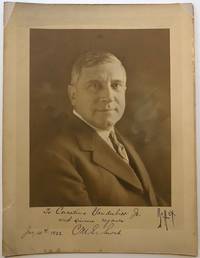
19222815481922. unbound. very good. Exceptional heavy stock sepia matte finish photo measuring 12.5 x 9.5 inches. This shoulder-up image of the famed industrialist photographed at Jollet studios is inscribed: "To Cornelius Vanderbilt Jr. with sincere regards C.M. Schwab July 10th 1922." Mild erosion at the top corners which remain intact due to a previous framing. There is also a one-inch chip at the lower left-hand margin with the piece having been reinserted like a jigsaw puzzle. It is far from the image and inscription. Very good- condition.<br/><br/> Schwab was an American industrialist under whose leadership Bethlehem Steel became the second largest steel manufacturer in the world. Cornelius Vanderbilt IV 1898 - 1975 known as "Cornelius Vanderbilt Jr." and "Neil" by his family and friends was an outcast of high society and was disinherited by his parents when he became a newspaper publisher in 1920. By 1922 the year this photo was inscribed Vanderbilt had lost all his newspapers to bankruptcy and was $6 million dollars in debt.<br/><br/> unknown books
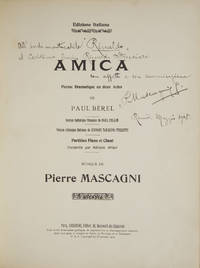
190525676Paris: Choudens PN A.C. 13315 1905. Folio. Half textured maroon cloth with textured maroon cloth boards titling gilt to spine with original publisher's upper wrapper with an illustration after an etching by R. Aguet printed by Ch. Wittmann Paris bound in. 1f. recto title verso blank 1f. recto cast list and table of contents verso blank 183 i blank pp. Music engraved by Baudon and printed in Paris by E. Dupré.<br/><br/>With the composer's autograph inscription signed in black ink to baritone Riccardo Stracciari who performed the part of Rinaldo in the Italian production of the work to upper portion of title: "All' indimenticabile 'Rinaldo' al Carissimo Amico Riccardo Stracciari con affetto e con ammirazione P Mascagni" and dated Rome May 1905.<br/><br/>Price of "15 f. Net" printed to upper wrapper. <br/><br/>Binding slightly worn rubbed and bumped. Upper wrapper slightly worn stained and soiled; occasional light soiling to margins; several leaves partially detached at lower inner margins; pp. 135-136 torn at lower corner slightly affecting notation.<br/><br/>Together with:<br/>An original role portrait photograph of Stracciari and Biancapelli as Rinaldo and Amica ca. 203 x 158 mm. Slightly worn; two minor annotations in blue ink and remnants of former mount to verso. Probable First Edition of the first Italian version. <br/><br/>Amica to a libretto by French publisher Paul de Choudens Bérel was a pseudonym was first performed in Monte Carlo at the Théâtre du Casino on March 16 1905 and was an immediate success. The Italian premiere with an Italian libretto by Mascagni's close collaborator Giovanni Targioni-Tozzetti took place on May 13 1905 with Riccardo Stracciari 1875-1955 as Rinaldo. Mascagni conducted both performances. It was the composer's only opera with a French libretto.<br/><br/>"Stracciari's mellow velvety voice coloured and resonant over its whole range with an extended and penetrating upper register made him between 1905 and 1915 the rival of Titta Ruffo and Pasquale Amato. His repertory included all the great baritone roles and among the dramatic parts he preferred those in Il trovatore Rigoletto and Aida. But thanks to a technique characteristic of the best traditions of the 19th century he excelled in works which allowed him to display his courtly enunciation smooth singing elegant phrasing and musical delicacy." Rodolfo Celletti in Grove Music Online.<br/><br/>A notable association copy. Choudens [PN A.C. 13,315] unknown books
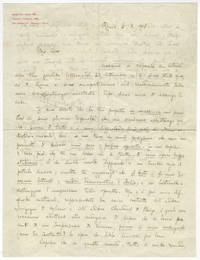
235242 pp. Quarto. Dated Rome October 8 1908. On stationery with "Corso Vitt. Eman. 154. Telefono Interprov. 458. Per telegrammi: Mascagni Roma" printed in red at upper left. In Italian with translation. <br/><br/>Mascagni responds to a proposal to write a "true and authentic" operetta. He likes the idea but would encounter difficulties "of the moral-artistic order" and especially with his publishers Choudens and Sonzogno. As indicated by his use of "tu" Mascagni and his correspondent were on familiar terms.<br/><br/>"But there is still a material difficulty represented in my contracts with the publishers Sonzogno in Milan and Choudens in Paris who will not want to adjust their contracts if they knew I worked for an impresario from Vienna before having delivered as per contract the operas that I must write for them . As you've seen I haven't spoken of monetary interests . but profits have never been a difficulty for the closing of my business deals."<br/><br/>Slightly worn; creased at folds. <br/><br/>Together with: <br/>A postcard photograph of five gentlemen on a street corner dated Paris 1911 on mount: Mascagni the music publisher Edoardo Sonzogno the writer Gabriele d'Annunzio and two unidentified others. Mascagni distinguished as both a composer and conductor is perhaps best-known for his opera Cavalleria rusticana which "was enormously successful from its first performance at the Costanzi in Rome in 1890. From then on Mascagni spent the rest of his long career treating a wide variety of subjects. His next opera L'amico Fritz 1891 consolidated his success with Roman audiences and revealed his lyrical vein. This fluent rustic comedy was successful particularly because melodic vitality - the outstanding merit of Cavalleria - was combined with a more elegant harmonic idiom." By the time this letter was written Mascagni had also garnered considerable acclaim in Vienna Paris and London. Michele Girardi in Grove Music Online. unknown books
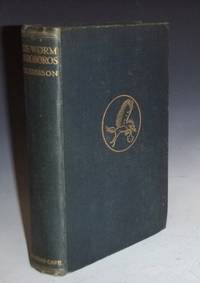
028012London; 1922: Jonathen Cape. First Edition. Octavo. The author's first book of fiction. Frontispiece 446 pages. Illustrated by Keith Henderson. Eddison began writing novels of fantasy while engaged in a career for the civil service. His first novel The Worm Ouroboros published in 1922 established him as a serious writer devoted to a fully imagined world of fantasy. Some have speculated that this work influenced Tolkien. Lewis also thought highly of this book. An occasional member of the Inklings who like his friend Tolkien was devoted to Old Norse which begins to be seen in his Norse sage Styrbiorn the Strong followed by A Fish dinner in Memison which appeared in 1941. He died in 1945 before finishing The Mezentian Gate which was partially issued as a first edition in 1958. A classic fantasy novel set on Mercury. Bound in black cloth centrally stamped in gilt deping a peguses spine lettering gilt endpapers stamped with a black lizard like snake light wear to corners and spine endsBleiler The Guide to Supernatural Fiction 599. Cawthorn and Moorcock Fantasy: The 100 Best Books 32. Jonathen Cape unknown books
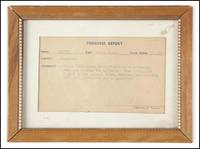
10280Used; Like New/Used; Like New. A school progress report in the subject of Dramatics from May 16 1949 for the then 4-year-old Farrow who has gone on to be a leading American actress singer fashion model and now UNICEF Goodwill Ambassador. The teacher's comments read in full: "Maria still finds it difficult to be attentive when she is only the audience. When acting out as part of the nursery tales however she responds with both initiative and imagination." Together with a school progress report in the subject of dancing from the same date the comments reading in part "Maria has unusual natural ability for dancing. However she has not shown the co-operation and interest in the past few months so outstanding earlier in the term." Both 3.5 x 6 inches and from the collection of Mia Farrow. Please note that these are sold unframed. unknown books
1936BOOKS0057003166 ad pages. Small octavo 7 3/4" x 5 1/2" bound in original publisher's black cloth with silver lettering to spine and cover in original jacket. Has the "A" on the title verso. First edition. Wright wrote as a critic and journalist until 1923 when he became ill from what was given out as overwork but was in reality a secret drug addiction according to John Loughery's biography Alias S.S. Van Dine. His doctor confined him to bed supposedly because of a heart ailment but actually because of a cocaine addiction for more than two years. In frustration and boredom he began collecting and studying thousands of volumes of crime and detection. In 1926 this paid off with the publication of his first S. S. Van Dine novel The Benson Murder Case. Wright took his pseudonym from the abbreviation of "steamship" and from Van Dine which he claimed was an old family name. Wright wrote a series of short stories for Warner Brothers film studio in the early 1930s. These stories were used as the basis for a series of 12 short films each around 20 minutes long that were released in 1930 - 1931. Of these The Skull Murder Mystery 1931 shows Wright's vigorous plot construction. It is also notable for its non-racist treatment of Chinese characters something quite unusual in its day. As far as it is known none of Van Dine's screen treatments have been published in book form and none of the manuscripts survive. Short films were popular then and Hollywood made hundreds of them during the studio era. Except for a handful of comedy silents however most of these films are forgotten and not listed in film reference books. Wright died April 11 1939 in New York City a year after the publication of an unpopular experimental novel that incorporated one of the biggest stars in radio comedy The Gracie Allen Murder Case and leaving a complete novelette-length story that was intended as a film vehicle for Sonja Henie and was published posthumously as The Winter Murder Case. Condition: Unobtrusive book seller's stamp on front gutter of end paper front past down lightly soiled. Jacket professionally repaired with minor edge wear. A very good copy in like jacket. Charles Scribner's Sons hardcover books
190277998London: John Murray 1902. 1st ed. Hardcover. Very Good. frontis photos & illustrations maps 1 folding index xv 481p. Recent quarterbinding marbled boards backed in blue leather. 23cm. Minor soil and wear. Lightly age-toned. No Jacket. Sykes identified on title-page as "H.M. Consul Kerman and Persian Baluchistan." <br/><br/> John Murray hardcover books
191936345East Greenwich R. I.: The Gallaudet Aircraft Corporation 1919. 1st printing. Not in Brockett's Bibliography of Aeronautics though 5 other Gallaudet entries are present; no copies located on OCLC. Brown stiff-stock paper wrappers printed in dark olive green string tie. Minor wear with hint of damp adhesion to 'thumb' area of text fore-edge. Still a VG copy. Unpaginated though 16 pages. 8vo. 8-5/8" x 4-1/8" <br/><br/>A rare trade catalogue from this firm first organized in 1908 by Edson Gallaudet forming the first aircraft engineering office. In 1910 he established Gallaudet Engineering Company to build planes under contract. In 1917 he reorganized as Gallaudet Aircraft Corporation which as its first product in 1918 mass produced Curtis floatplanes. In 1923 the firm was sold to Major Rueben Fleet and became part of Consolidated Aircraft. This promotional booklet describes the Gallaudet Chummy Flyabout Sport Model a two-seater powered by two 18 h.p. pusher-type motors. at the bargain price of $3500. We find no evidence this plane was ever actually produced. The Gallaudet Aircraft Corporation unknown books
14186Used; Like New/Used; Like New. Neatly penned autograph letter one page 5 x 6.5 no date but postmarked April 6 1922. Addressed on the reverse in Dukas's own hand to Henri Prunières and signed "Paul Dukas." The letter apologizes for missing a visit from the addressee and from "Monsieur Béla Bartok whose acquaintance I would have been delighted to make. All the more so since I must respond to your kind invitation for Saturday. I have to be in Valenciennes on Sunday to help with the concert of the Societé du Conservatoire there. And if I don't take the train at 5:10 in the evening on Saturday I will have to get up at 6:30 to leave on Sunday morning! So in this case despite all my regrets I must excuse myself." A scarce and rather charming letter from the French composer critic scholar and teacher best known for his "L'apprenti sorcier "The Sorcerer's Apprentice and his opera "Ariane et Barbe-bleue."<br style="">Bartok's 1922 visit to Paris was part of a larger concert tour of Britain France and Germany ending with the premieres of Bluebeard's Castle and The Wooden Prince on 13 May in Frankfurt. In Paris he met important French composers including Francis Poulenc and Erik Satie. The Saturday soirée to which Dukas refers would have taken place just after an occasion recalled by Poulenc: "I remember a strange lunch on Saturday 8 April 1922 where Bartok and Satie met at my house for the first and last time. Like two birds who do not sing the same tune Bartok and Satie observed each other with suspicion and maintained an overwhelming silence that Auric and I tried in vain to break. For me it is an extraordinary and symbolic memory." Quoted in Entrancing Muse: A Documented Biography of Francis Poulenc p. 113.<br style="">Henri Prunières 1861-1942 was a French musicologist and international propagandist of contemporary art in various forms: music dance painting etc. He occupies especially in music an important place in the art world between the wars. His major contribution was La Revue musicale a monthly musical periodical which he founded in 1920 and left in 1939.<br style=""> unknown books
1986402940Los Angeles: Sun & Moon Press 1986. Oblong folio 8½ x 13 inches. 391 pages on 195 leaves each leaf containing two pages of the text. Xeroxed proof with printer's registration marks and incorporating an earlier editorial reader's occasional notes. Comb binding with drab wrappers. One short tear to front wrapper otherwise fine. UNCORRECTED ADVANCE PROOF with four penciled corrections by Coolidge in the Table of Contents and twenty-seven corrections in the text. 'Solution Passage' Coolidge's largest collection to date brings together 232 of his poems written between 1978-1981 including major works such as "Thin Places: Twelve Interiors" "Of What The Music to Me" "Jerome in His Study" "Peru Eye The Heart of the Lamp" and "After Morandi." <br/><br/> Sun & Moon Press unknown books
1932M11686Baltimore:: Charles C. Thomas 1932. 1932. 8vo. vii 234 pp. 99 figs. 2 color refs. index; water damage to lower margins throughout. Original green blind-stamped cloth gilt-stamped spine title dust jacket; water damage to lower edges of both covers and just jacket. Good. FIRST EDITION LIMITED to 1775 copies. "Cushing advanced the theory that the hypothalamus is responsible for the development of peptic ulcer. This work contains his four principal contributions to pituitary-hypothalamic interrelationships including a reprint of his description of pituitary basphilism." Garrison & Morton. "The four papers in this volume were 'brought together for the convenience of those whom the general theme may interest' Preface. The papers had all been published elsewhere and were the basis for four different lectures Cushing had given in England Canada and America during the years 1930 to 1932." Heirs of Hippocrates. Garrison & Morton 3552; Heirs of Hippocrates 2273. Charles C. Thomas, 1932. hardcover books
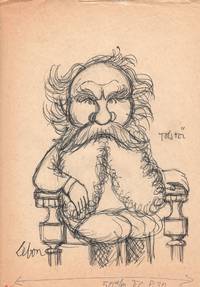
P003399Paris and Wiesbaden: 1921-23. Eight single leaves some folded. Very good with exception of one letter with tear and some loss to text. The son of Lev Tolstoy Lev L'vovich Tolstoy was a firm believer in his father's ideals in his youth but later became increasingly opposed to his philosophical and ethical ideas. He studied sculpture with Rodin and tried without success to become a published writer as well as writing about his childhood and impressions of his father. In 1918 he emigrated living in Paris before eventually settling in Sweden. The letters included here date to a period when he wrote articles on his father and was making a difficult living as a journalist. Among other things they contain his negative reaction to his mother's memoirs discuss his own writing and plans to publish his recollections and detail his financial woes. "Je prends la liberté de vous envoyer pour le Figaro un article littéraire souvenirs personnels sur mon père et deux de ses nouvelles. Vous me rendriez un grand service en les publiant le plus tôt possible car hélas je dois exister du journalisme." - "Je me permets de vous envoyer ci-jointes quelques pages sur la nouvelle posthume de mon père Le Diable. Je parlais de cette Åuvre dans un article sur la Sonate à Kreutzer qui a été publié dans le Journal mais la rédaction n'a pas voulu publier ces pages qui sont pourtant intéressantes. Peut-être pourrez-vous en faire usage en les publiant dans le Figaro ensemble avec le chapitre qui parle des ouvrages de Tolstoï pour le théâtre . Je vous suis très obligé pour l'aide que vous m'avez donnée pour la publication de mes souvenirs ainsi que je remercie Monsieur Robert de Flers pour l'article qu'il a publié dans le Figaro. . Maintenant comme je suis sans argent à ce moment et le change est très déplorable pour notre séjour ici je vous prierais d'avoir l'extrême obligeance de me faire envoyer ici 300-400 francs avec le premier courrier." - "Ma Vie c'est une ignoble escroquerie littéraire et il faut le dire carrément. Le publique est dupé. On achète ce petit livre croyant lire quelque chose de Tolstoï sa vie tandis que cela n'est qu'un récit d'une baba russe un récit d'une langue russe magnifique mais un rien comme intérêt . littéraire.". unknown books
P4450Harbin: Mech Gedeona 1933. Octavo 20 Ã 14 cm. Original printed wrappers; 119 pp. Very good; text evenly toned due to stock; very discrete repairs to spine extremities. Russian translation of this 1933 work by Nakada a Japanese protestant minister and the first bishop of the Japan Holiness Church. Influenced by the Christian Zionist William E. Blackstone and Nicholas McLeod Nakada argued that the Japanese were descended from the ten lost tribes of Israel and that Israel would be restored through the Japanese. Nakada's theory was used in part to justify the nationalist and militaristic discourse of the Japanese Empire prior to World War II. Nakada was one of the most influential evangelists in the 1920s who also toured the United States but his controversial views later led to a schism in the Holiness Church. Scarce: KVK OCLC show the copies at Staatsbibliothek zu Berlin Bayerische Staatsbibliothek Holy Trinity Orthodox Seminary and Hebrew Union College with just two copies outside Japan the original English edition is apparently equally scarce. unknown books
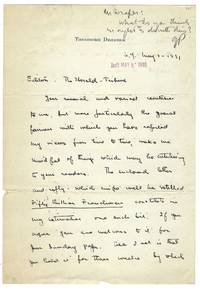
404251Two pages 4to. On Dreiser's letterhead. Small stain on verso otherwise in fine condition. Dreiser writes in to Geoffrey Parsons the editor of the New York Herald Tribune from 1924-1952 describing a writing submission that he has attached with the letter: "Your general and varied courtesies to me but more particularly the general fairness with which you have regarded my views. make me mindful of things which may be entertaining to your readers. The enclosed letter and . which . well be entitled Fifty Million Frenchmen . in my estimation one such bit. If you agree you are welcome to it for your Sunday paper. All I ask is that you hold it for three weeks by which time L'Ordre will have had time to publish or discard it if they see fit. I am -- Yours truly Theodore Dreiser" In 1931 Dreiser became actively involved in the American Writers' League as well as the National Committee for the Defense of Political Prisoners. During this year he also published Dawn: An Autobiography of Early Youth and Tragic America. Dreiser described having a complex relationship with news publications during the 1930s. He stated in 1936 that "many newspapers" had "glossed over" his political views. Nonetheless Dreiser did contribute several interviews as well as poems and book reviews to the New York Herald Tribune during Geoffrey Parsons' term as editor. In an interview given to the Tribune the month before this letter Dreiser discussed dissatisfaction with the Hollywood film adaptation of Tragic America retitled An American Tragedy Frederic E. Rusch and Donald Pizer eds. Theodore Dreiser: Interviews pp. 329 2004. Dreiser's use of the title "Fifty Million Frenchmen" is likely a reference to the 1929 Broadway musical of the same name with music and lyrics by Cole Porter. The piece referred to here as "Fifty Million Frenchmen" was not published as such in either the New York Herald Tribune or in any other newspaper. He published another letter to the editor in the Tribune in February of 1932 replying to a review of Tragic America. Theodore Dreiser Collection Schoenberg Center for Electronic Text and Image. <br/><br/> unknown books
30544<p>Octavo 35 letters 484 manuscript pages dated 26 October 1884 to 10 January 1885 letters mounted on stubs within a leather bound album boards lacking spine badly chipped lettering on spine reads "Letters"; text block split some leaves loose edges of some letters chipped several with slight tears otherwise good written in ink in legible hand. </p><p> Five of the letters are illustrated with cleverly rendered drawings to accompany Noyes' intelligent lengthy and astute observations of his travels. The small ink illustrations are of figures caricatures architecture etc. for a total of twenty-eight illustrations. The letters are all signed by Noyes and addressed mainly to his parents or his mother separately with one letter to his brother one to his grandfather and several to a woman by the name of "Jenny" likely his sister Jane. The letters tend to be written from the various hotels in which Noyes was staying while traveling in Europe including: Liverpool Chester London Oxford all in England; a couple of letters written while aboard the S.S. <i>Venetia</i> which he took from England to Gibraltar; and from hotels in Seville Cordoba Granada Madrid and Barcelona in Spain where he spent a lot of time. There are also a number of letters from Marseilles and Nice in Southern France; and Genoa and Florence in Northern Italy.</p><p> <b>Alexander Dana Noyes 1862-1945</b></p><p> Alexander Dana Noyes was a distinguished American financial columnist born in Montclair New Jersey on 14 December 1862 the second of four sons and the third of six children born to merchant Charles Horace Noyes and his wife Jane Radcliffe Dana both of 17th Century New England families. Alexander studied at Amherst College where he received his A.B. in 1883 he was editor of the college weekly and he completed his education with several months of European travel. </p><p> Noyes got his start in journalism with <i>The Commercial Advertiser</i> where he reluctantly became the paper's Wall Street correspondent in 1884 when the banking house Grant and Moore failed and he happened to be the only reporter in the office not on assignment. Noyes recalls these formative experiences in "<i>The Market Place: Reminiscences of a Financial Editor</i>" a memoir that tends to pay more attention to historically significant financial crises than to autobiographic milestones.</p><p> When Noyes began work as a financial editor of the New York Tribune in 1891 most financial columns in the popular press were "tout" pieces writings advertising risk-free investments as insider tips and agency handouts meant more to promote certain investments than to illuminate the inner-workings of the market. According to historian Robert Sobel Noyes was one of the first American journalists "to combine economic analysis and a knowledge of the market in such a way as to interest the general reader." Through his work as a reporter and financial editor for the <i>Tribune</i> and <i>New York Evening Post</i> Noyes covered the Great Panic of 1891 the 1907 Banker's Panic and the closure of the stock market in 1914 establishing himself as "an American counterpart to Walter Bagehot editor of London's <i>The Economist</i> which is to say that he was read by serious students of the market and had a trans-Atlantic audience." During his career Noyes also authored several monographs including "<i>Forty Years of American Finance</i>" 1907 and "<i>The War Period in American Finance</i>" 1926 which would become standard financial histories in university circles. He started writing the monthly "<i>Financial World</i>" feature for Scribner's Magazine in August 1915. Noyes initially used this space in the magazine to discuss the financial problems arising from the outbreak of World War I but the feature later known as "The Financial Situation" would continue to run well past the war.</p><p> In his article "<i>The Speculative Markets</i>" Noyes warns against the belief on Wall Street that America had entered a New Era that "differs so greatly from any in the past that old-fashioned precaution is out of date." </p><p> In the numerous articles he wrote for Scribner's Noyes uses a strategy of analogy to describe World War I using The Seven Years' War America's Civil War and the Napoleonic Wars to draw out questions about America's apparent wartime prosperity and the fate of Europe's economy following the war. Several of Noyes' contributions to Scribner's Magazine during the war years were compiled into a book "Financial Chapters of War."</p><p> In 1920 Noyes became the financial editor of the <i>New York Times</i> where he continued to prove himself an adept reader of the market. During his tenure at the Times Noyes predicted the bull market that would emerge in 1921 and was "one of only a few voices that chose not to sing in the all-bulls choir" the led up to Black Tuesday in 1929. The skepticism of the Times in the months leading up to the Depression strongly contrasts with the outlook of the Wall Street Journal and several other financial publications that failed to realize the danger signs in the market. Noyes remained at the Times until his death in 1945.</p><p> <b>Sample Quotations: </b></p><p>"London Monday Nov 3 /84</p><p>Dear Folks</p><p>Having finished my breakfast and making myself as comfortable in my room as the morning fog will permit I am ready to take an hour or two and scribble off a few pages in time for the Republic which goes back from Liverpool tomorrow. This time is the best for writing. It would be useless to start out before ten or eleven o'clock to see the city; for London is a lazy place and doesn't get itself started until pretty well along in the morning. Harry Warren and the other Americans settled here complain more than anything else of the slow living and the slow manner in which business moves – something especially unpleasant to an American businessman…</p><p> Without the guide I have seen considerable already though I make a point of never going over more than one great point of interest in a day. Last Thursday I went to the Health Exhibition which was then open for the last day. As a whole it was rather a bore consisting mostly of preserved fruit groceries mammoth squashes patent grates and fire places etc. but there were some more picturesque departments. The most interesting was a representation of a street in old London where houses were built up and shops arranged in studious imitation of the city before the Great Fire. As a historical work it was extremely valuable and was made still more so by the shops which were occupied by business firms whose men with the costume and implements of the seventeenth century plied their several trades to the great admiration of the nineteenth century public. What was interesting in another way was a double modern house full-size one half of which was fitted up as a sanitary house and the other as an "insanitary" house. The object was to exhibit and contrast good and bad arrangements for sewerage drainage heat light comfort and ventilation. The insanitary house through which the visitor first passed had arsenic wall paper deficient traps insufficient ventilation and all the other modern improvements. The other was an exactly duplicate house but had all the proper appliances and the contrast was both instructive and interesting.</p><p> On Friday I went to see the Tower of London and on the whole was rather disappointed. It is really a splendid specimen of mediaeval architecture but these stupid Englishmen have spoilt the whole effect by building modern brick walls with chimney pots between the turrets and using them as barracks for the soldiers. The flag of England floating from the White Tower was very grand but not half so impressive as two or three dozen articles of underclothing waving from a clothes-line attached to the same tower…</p><p> I like my lodging place more every day and have reason to be satisfied at being placed so pleasantly. The street is quiet except for an occasional hurdy gurdy or news boy. The latter animal is most distressing here. He hasn't the cheerful shout of a New York boy with his "Nyawk Herrltime Stribyunean World" or even the Boston boy whose "Morn papes" is a trifle more melancholy. These boys are angry indignant in tone. They shout as if they were forced to sell papers for punishment. One came by our place last night with the false news of Gordon's capture. It is impossible to describe the vindictive malice with which he yelled in a curious rhyming chant: "Pa – Par! Tairble slaugh-Tar! Genl Gordon a pris-NAR! Special Edition of the Obser-VAR!" …</p><p> Everything is high in London especially food. The restaurants are very expensive; indeed one can't get a first-class table-d'hote dinner under five shillings $1.25. The things that are generally cheap are hack hire and well I don't know of anything else that is except the buses. On one of them a visitor can travel five miles through the city for three pence. They are queer looking objects – not at all like a Broadway stage for they have a pair of steps at the back and seats on top. The conductor or guard stands on a little platform behind and hangs on by a strap; his duty is to shout out the They are all good drivers however and have a good deal of the traditional grandeur of the old stage coach driver. The buses look very odd at first with the crowd on top and a collection of stovepipe hats sticking up like destination of the bus with a view to alluring passenger and as no human being was ever capable of understanding what he says his usefulness will be apparent. The driver's duties aside from driving are to hit his horses over the neck hit all covered wagons with his whip and shout sarcastic remarks to the drivers of all other vehicles. corks in all directions. Their appearance is made still more striking by the flaring advertisements boarded up against the sides…</p><p>Hoping to hear often from you all I am aff. yours Alex D. Noyes"</p><p>"Hotel de Madrid Seville</p><p>Spain November 30 1884</p><p>Dear Folks</p><p> When I was half dressed this morning and sipping my chocolade in our bedroom it suddenly dawned upon me that I had neglected you of late; and I determined as soon as I had taken a walk and finished my almuerzo that I would begin a long letter to pay for the long delay.</p><p>My excuse for not writing during the past three or four days is valid. I have been travelling nearly all the time. The consequence is I have seen Spanish scenery and Spanish life about as thoroughly as one can do. All this country is true Spain. Madrid and the north is Parisian; this is Spain and retains in its buildings and customs the peculiarities of centuries ago…</p><p> Let me tell you then that Gibraltar is the hardest place to get out of that I ever knew. We came by the P and O boat. Our plan was to go to Tangier and back and then on to Cadiz. Now it rained nearly all the time we were at Gib and the Levanter the sharp east wind of the Mediterranean had stirred up the sea. Some of our fellow passengers from England started by the little boat Hercules for Tangier the day after we arrived in Gibraltar. The boat broke one paddle wheel and made the best of its way back to Gibraltar. From that time on the sea was so rough that no Tangier boat started. There were several ways to get out of Gibraltar. Gregory and his wife and I could get to Cadiz either by steamer from Algeciras or by diligence from the same place. Burroughs was going by steamer from Algeciras to Malaga and so to Barcelona. We decided to leave Gibraltar on Thursday. Then we learned that the sea was too rough for the Cadiz boat…Fortunately we had engaged seats on the Friday diligence as the coach was to start at five a.m. Friday we were obliged to spend the night of Thursday in Algeciras. So at noon Thursday we prepared to go. A little steamer sails three times a day across the bay from Gibraltar to Algeciras. When we were all ready to go we suddenly learned that the bay was too rough and there was no boat that day from Gib. This is the only conveyance. We thought of chartering a steam yacht but Senor Carrara wanted two pounds for it and would not guarantee that the vessel could land at Algeciras in the gale. The only other way to get from Gib to Algeciras was by land around the bay a distance of nearly fifteen miles along the beach and over very bad roads. There was no alternative; so we hired a crazy little two wheeled trap like a prison van. This was drawn by a two-mule tandem. Mrs. Gregory and the luggage went in this with one man in front driving and another riding the leading mule. The three men of the party were in the saddle Gregory and I riding horses and Burroughs astride of a mule. In such state we left the Spanish lines. The Spanish custom house officers at the Spanish lines beyond Gibraltar began to take down our baggage for examination but a silver peseta about twenty cents fixed them…And here let me tell you one thing which I do not think is generally known but which we soon learned to our cost. Baggage is examined by the custom house officials in every city in Spain no matter if you come direct from another Spanish city. Ours has been overhauled at the lines San Fernando Cadiz and Seville. But a peseta goes a good way with these scoundrels.</p><p> The roads to Algeciras were bad – horrible. Half of the distance was along the beach and as the tide was high we rode sometimes in two feet of water. The interior roads were all ruts and there were two rivers to cross by a pontoon bridge. When it began to grow dark we were somewhat anxious and the last and worst of the way was traversed by moonlight. At last we rode into Algeciras and such a desolate deserted place you never saw. A fierce gale blowing from the bay and scarcely a human being could be seen in the streets. We drove to the Hotel Vittoria Marina facing the bay and then we saw the inhabitants. In accordance with what we have since found to be the universal custom in Spain a dozen ragged and dirty cut throats flung themselves on our baggage We have learned now that the only way to do is not to allow an outsider to touch your luggage unless he is porter of the hotel. They are not satisfied with small fees and whatever you give them they invariably demand more. A ruffian in a blue jacket with a face made for the gallows hauled our luggage upstairs. Then he came into my room and demanded twenty-five pesetas or five dollars. He was drunk and refused to take six pence. The hotel was as deserted as the town. I offered the man through a woman who spoke English the alternative of taking six pence or being kicked down the stairs. He refused and resisted but the proprietor coming up the ruffian was hustled off. Such a lonely place you never saw. Our steps echoed over the brick floors. The hotel people were in a different part of the house and in our two big rooms we seemed to be entirely alone. Burroughs and I put our pistols in handy places and retired to a sleepless night so furiously was the wind howling outside…</p><p> In Tarifa we saw an old Moorish town. Dirty is no name for it. None of the streets are more than ten feet wide and are paved with rough stones the water of the gutter running along the middle. The houses are filthy but all built of brick and white washed. All Spanish buildings are made in that way and a village at a distance looks like a pail of whitewash emptied on the ground. In Tarifa all the women wore the mantilla or black shawl of lace or nun's cloth over their heads. There they cover all their faces leaving only one eye exposed. We saw some faces however in the old Moorish synagogue where the priests were celebrating mass. They were all ugly. Tarifa smelt frightfully and well it may for in addition to their natural dirtiness the sewer is carried through the centre of the town in an open stream. Venta de la Vejer where we ate our lunch is a curious old town built on the side of a very steep hill. The country I cannot stop to describe; if I should this letter would never be done. Thee people are in the Middle Ages still. The farmers sleep in vile huts of straw along with the pigs and chickens; they build fences of prickly cactus all the cooking even in the better farm houses is done outside and they plough with a wooden harrow such as the old Romans used. At San Fernando we seemed to be once more in civilization for there we met the railroad. The customs officers seized our luggage here and had to have another peseta. After shoving away some villains who wanted to carry our luggage and waiting an hour we started for Cadiz. There came another fight. We had to strike the dirty beasts with our canes which we now do without compunction. The courier of the Hotel de Paris spoke English and with his assistance we engaged a cab and drove to the hotel…</p><p>Well I have enjoyed this trip through Spain immeasurably. It has been expensive; for travelling is not cheap here; but it has been worth the money; for the more I see here the more I am convinced how little people know about this country…It is not especially easy to get along here; for neither English nor French is spoken except by special interpreters in the large hotels…Some phrases have been acquired by absolute necessity. "Cuanto" meaning "How much" comes up every few hours…Gregory's Spanish is confined to such idiomatic expressions as "Get your hands off that luggage you dirty beggar" pronounced in a ferocious tone and accompanied by a sharp rap on the beggar's knuckles with a stout stick is invariably understood…</p><p> In America the women wear colors and the men dress in black. Here the positions are reversed. The better class of women dress entirely in black while the men were colors. The commonest peasant has a red sash about his waist and most of them wear colored jackets…</p><p>Aff. Yours Alex D. Noyes"</p><p>"Hotel de Madrid Seville</p><p>December 2 1884</p><p>Dear Folks</p><p> …Speaking of money and beggars – two things nearly related. As for fees Spanish loafers who show you about cathedrals or drag about your luggage are never satisfied with what you give them. Nor will they take small sums. Two reals or ten cents will not content these vagabonds. They come back and scream Spanish at us until we drive them out by main force. The only way to do is to order him off and if he don't go we get Gregory to talk English at him. The beggars are fearful. At Cadiz they were worst of anywhere and nearly all old women. They would hobble after you for blocks along the street and if you paid any bill invariably see one of the filthy creatures whining in the doorway. Here in Seville the beggars are not so bad but they are bad enough. They are worst outside the Cathedral. The other day a girl sat outside the main door in an invalid chair crying out in a harsh shrill voice 'Caridad caridad senores por el amor de Dios!' 'Charity Charity gentlemen for the love of God!' and miserable old women limp about or sit by the doorway with their hands always outstretched.</p><p> I never realized until I came here how very national the bull fight sport is. The photographers' shops are full of likenesses of famous bull fighters; the decorations on placques and china are all scenes from the bull ring. Sunday there was to be a grand bull fight the last of the season. Scores of matadores and picadors came up by the Saturday train posing in striking attitudes with their braided jackets and pig tails and they were the admiration of the common people. This bull fight is not the sport of the vulgar; the best people in Spain go and the entrance money is higher than for any other entertainment. It rained on Sunday and as the bullring or plaza de toras is an open space it was all postponed. We consoled ourselves by going to the theatre Monday night where several laughable farces were performed…The tickets of the corrida de toros or bull fight were ten pesetas or two dollars; for the teatro de Cervantes charge only thirty cents for their best seats. Queen Isabella II the King's mother was there in her box a great coarse fat woman with a huge red nose false hair and the most unbecoming dress possible. She lived in the Palace of the Alcazar…Aff. Yours Alex D. Noyes"</p><p>"Seville Spain Dec. 5 /84</p><p>Dear Folks</p><p>I write a few words now on the eve of leaving Seville to give you an idea of my present position and plans…</p><p> Two classes of people conspire to make our lives miserable. One is the volunteer guide and the other is the beggar. The volunteer guide exists because honest labor is so ill paid. In Pickman's pottery manufactory which we visited in Seville the skilled workman who paint the designs for the porcelain and vases get only a dollar a day; the boys who work get no more than two reals or ten cents. Now if a boy hangs around a cathedral all day and fastens himself on to strangers he will always make three times as much…</p><p> But the beggars. O heaven preserve us! – and don't preserve them in their present state at least. I never struck a beggar in my life before but I have done it here and shall do it again. Their impudence is stupendous. When you stand talking in the street they interrupt you and whine out a supplication. While we were at dinner tonight a sturdy beggar stood at the window whining nearly all the time. In Seville a ragged man had a boy with him whose eyes were diseased. He dragged the boy after us with one hand and opened his eyes for our inspection with the other moaning for money. Little children beg in the public streets and in the most matter of fact way too. They leave their play stretch out their hand and assume the mendicant whine. You say no and back they go with a shout to their lay. I saw a Cordoba beggar early this morning pounding on the locked door of a swelling house and whining. I couldn't distinguish his words but I know what he said: "O for charity's sake for the love of God! - for the hope of heaven give give give. I am a poor orphan with aged parents to support. I have fifteen wives and I don't know how many children. O why don't you hurry up confound you and give me something"</p><p> I wish there wasn't a law against shooting men here. My stock of cartridges would not last long.</p><p>If you want to know the national peculiarity of a Spaniard it is this – mind everybody's business but his own. We can't stop a minute to look into a shop window but we have half a dozen lazy loafers about us looking in too. Then is the time we need Spanish. Gregory used to address them in the following Castilian idiom: "What are you loafing about here for you dirty blackguards" But somehow his meaning escaped them. An altercation with a cabman gathers as large a crowd as a street arrest in New York. Why even at this moment here in the hotel in the writing room a beggarly boy passes the door every two minutes and looks in to see if I am still writing. Anda! Allezan diable! Si vedo V un otro vez en la Puerta I'll throw the inkstand at you! But it is not confined to the common folks. The ladies are the worst of all. The Seville girls are pretty and graceful but they have infernally bad manners. Poor Mrs. Gregory had a jacket of the jersey cut and I suppose such a thing had never before been seen in Seville. When she passed a couple of Spanish senoras in the street both would then turn and look after her with open mouths. The only way we stopped them was for us men to return the complement and stare at the senora from the tip of her toe to the crown of her mantilla. I took a fifteen-mile horseback ride this morning and in the city I was the observed of all observers. In the first place I was riding a horse and that attracted a good deal of attention. In the second pace I was evidently a foreigner for I wore clothes of a cut dating later than the fifteenth century. In the third place I wore my old white cloth hat and if Barnum's circus had entered Cordoba it couldn't have created a greater sensation. I could hear the small boys yell "Sombrero! Sombrero!" on all sides – so I suppose they were trying to say "Shoot the hat!" I longed to drive at them with my whip but it was best to pay no attention…so I kept my temper. As I rode off I could hear them yell "Engles! Engles!" They all put us down for Britishers here. America they never think of. Yesterday on the train I told an old Spaniard in Spanish that we were "Americanos" and straight way the whole care of people stared around looking for the tomahawk and war paint. When I come again I shall come that way. I should like to scalp a few million of these Spaniards. – The sum of it all is Spain is an ill regulated ill governed country. The government is a cheat and a swindle. They do all they can to crush individual enterprise and encourage idleness. The great Spanish industry is the manufacturing of cigars and cigarettes. The government monopolies this and as they entirely prohibit foreign tobacco they make enormous profits. The lottery swindle which has a frightful hold upon the entire Spanish population is run by the government; and we computed the other day that out of this they make a net profit of 33 1/3 per cent and that without the slightest risk. There will be trouble here yet. The king has the consumption and will not live long; and he has no heir. The ministry has fixed upon his mother Isabella who was driven from the thrown for her immorality as his successor. The common people want a republic because they believe that under a republic they will not have to work. So everything is in a beautiful state…Aff. Yours Alex D. Noyes"</p><p>"Dec 14 1884 from Granada Spain: </p><p>Mother </p><p> You spoke in a previous letter of the observance of Sunday. I am afraid you would find an American Sunday a decided impossibility here. It is not even as good as France where they at least make a holiday of it. Here they work on the same as usual. The shops are open the farmers plough on and the holiday is a luxury of the rich alone. I went into the Cathedral this afternoon in search of something a little devotional. But the priests are all hypocrites and humbugs the service a blasphemy and the women who cross themselves and mutter as superstitious as the darkest heathen. Then the organ played. Well nothing can profane music. After all it is the truest worship. I found what I sought in simply standing and listening to the magnificent tones of the organ. Music is the only part of worship that cannot be converted into blasphemy…Alex D. Noyes"</p><p>"Nice France</p><p>Dec 31 1884</p><p>Dear Folks</p><p> …The French girls puzzle me. Some of them look very much like Americans but most of those we see – I take it that they are the women of southern France – have very bright eyes and unnaturally dark lashes pencil arsenic and cologne in my private opinion and are moreover usually rather short a little inclined to be stout with an inevitable Roman nose. The young Frenchman is always a handsome insignificant person; the old French man is very amusing especially in the mincing way with which he approaches the ladies. I could never mistake him. The Russian may be recognized by his unkempt appearance but I cannot distinguish the Russian ladies. They are exactly like the French. These are the main nationalities here; a few Italians and Germans make up the quorum…Alex D. Noyes"</p><p>"Hotel des Etrangers</p><p>Genoa North Italy</p><p>January 5 1885</p><p>Amici tuttli!</p><p>All ahail!</p><p> If you kindly drop the curtain on France and fix your compasses on the map of Italy you will probably observe me in the city of Genoa…</p><p> The transition from France into Italy was easy and graceful. I was seated in the train for Genoa peacefully meditating on home wondering whether my box had arrived there as yet and whether there was any possibility of poisoning John Haley by mail – without a thought of custom house officers or examination of baggage – when I awoke to the consciousness that we were in a very large and wide station. Knowing that the dividing line between France and Italy is very broad I began to think this was the border town of Ventimiglia. A dirty Italian boy who thrust his head in at the door and demanded in Choctaw if I wanted my baggage carried to the other train confirmed this impression…Speaking of female dress leads naturally to the discussion of females. Mark Twain if I remember rightly speaks of the wonderful beauty of the Genoese girls. Now one sees some very pretty faces and figures but I don't think the average age will justify the slightest enthusiasm. There are enormous quantities of ugly women here. And as for the beautiful Italian youth – well never mind; I will wait until I have seen southern Italy before I say he is a humbug…</p><p> Now I must tell you something which will be very hard to believe. There are no beggars in Genoa. At least I have tramped the streets for two days and not been assailed by a mendicant yet. I have tried every device to call them forth; I have stared ragged old men in the face gazed intently at slovenly young women with babies jingled keys in my pockets and done a host of things which would have called out the whole contingent of beggars in a Spanish city; but all in vain. I don't understand it. I feel my loneliness doubly now and mean to speak to the Mayor of Genoa about it. Perhaps all the male beggars have enlisted in the army. It is certainly astonishing how many soldiers one sees in Genoa. It was delightful too to find a variety in military uniform. The Spanish soldiers are only weak imitations of the French and I had begun to think that the European military hero existed only in flaring red flannel trousers and sky-blue coat with a long blouse. But the Italian uniform is really something new for Europe. It is more like the uniform of our soldiers being a bluish gray in color; but differs in the facings which are yellow instead of dark blue. Then there are the Italian fusiliers the name of which troop I would not dare to pronounce or write…Aff. Yours Alex D. Noyes"</p><p>"Florence Italy</p><p>Jan. 10 1885</p><p>My dear Grandfather</p><p> It is nearly three weeks now since I received your letter and I have been intending almost every day since to write; but it is quite impossible to keep up a faithful correspondence while one is travelling about and during my stay at Nice my eyes trouble me considerably so that I could do very little writing.</p><p> I shall never cease to be astonished at the blindness of the average tourist. I say blindness because if they would only keep their eyes open they would see all that I or anybody else could see. The most pitiable spectacle of mental debasement to my mind is the tourist who travels because it is "the thing" to travel keeps his eyes fixed on his guide book while he is en route and trots patiently about at the heels of a guide when he is on the spot of the great sights of Europe. There are people who have travelled all over Europe and seen everywhere exactly what they might have seen in London or Paris. They go to the park the museum and the cathedrals and then they have seen everything. I was in Barcelona with a very intelligent young Englishman who has travelled pretty much all over the world. He had been in Barcelona before and said he would show me the city. He took me down the Rambla – the fashionable promenade – along the port into the park – the fashionable drive and into the inevitable cathedral. The whole thing might have been New York. When he conducted me back to the hotel he said "now you have seen all there is to see in Barcelona." I said "My dear fellow I haven't begun to see the city yet." He asked me what I meant. I told him I wanted to see the old city and the tenement house quarter. He said it was very dirty and unpleasant there. I said that was exactly what I wanted to see. "Well" he said "your taste is different from mine." I didn't tell him what would have been quite true that the trouble was he had no taste at all. Some towns one can see in such a cursory way Pisa was one but the cities are always full of interest. I hope it will not be called heresy if I say that Mark Twain was pretty nearly as bad. He kept his eyes open and told the truth about what he saw; but he was very far from seeing everything…</p><p>Aff. Yours Alex D. Noyes"</p> books
56725Signed as President FDR write to thanks Davis for sending two editorials and cartoons from the Nashville Tennessean. unknown books
192486856Petropolis Berlin 1924. Ltd ed. in French. Hardcover. Near Fine. 61 2p. plus 28 leaves of plates which are printed on one side and seem to alternate with text leaves. Contemporary blue buckram on which almost all of the lighter blue front and back panels of the original wrapper have been mounted. 35cm. Endpapers browned. Glassine tissue guards have some browning and a couple have corner creasing but all are present. French text. This French-language edition was limited to 175 copies 125 of which were to be numbered 1-125 and the other 50 numbered I-L on the colophon page -- this copy is not numbered. Translator not identified. Grigoriev was a Russian painter and graphic artist. <br/><br/> hardcover books
1914L0526433 pages with frontispiece. Small octavo 7 1/2" x 5 1/4" bound in original publisher's blue cloth with gilt lettering to spine and cover with black design in original jacket. First edition in first state binding and second state text.<br /><br /><i>Jennie Gerhardt</i> was Theodore Dreiser's second novel and his first true commercial success. Today it is generally regarded as one of his three best novels along with <i>Sister Carrie</i> and <i>An American Tragedy</i>. As submitted to Harper and Brothers in 1911 Jennie Gerhardt was a powerful study of a woman tragically compromised by birth and fate. Harpers agreed to publish the book but was nervous about its subject matter and moral stance. Jennie has an illegitimate child by one man and lives out of wedlock with another - but Dreiser does not condemn her for her behavior. As a requirement for publication Harpers insisted on cutting and revising the text. Although Dreiser fought against many of the cuts and succeeded in restoring some material Harpers shortened the text by 16000 words and completely revised its style and tone. These changes ultimately transformed Jennie Gerhardt from a blunt carefully documented work of social realism to a touching love story merely set against a social background. Passages critical of organized religion and of the institution of marriage were reduced and altered. Perhaps most important Jennie's point of view - her innate romantic mysticism - was largely edited out of the text. As a consequence the central dialectic of the novel was skewed and the narrative thrown out of balance.<br /><br /><b>Condition:</b><br /><br />Cloth spine lightly sunned with some rubbing previous owner's signatures to front blank and rear paste down. Jacket panels and spine toned and chipped tears at jacket joints and edges else a very good copy in about a very good infrequently found jacket. Harper & Brothers hardcover books
1926LV1748Annonay:: Daniel Jacomet 1926. 1926. Folio. iv 76 pp. Illus. many in beautiful color errata; some cords stretched. Printed wrappers; a bit creased corners bumped. Burndy bookplate. Very good. LIMITED EDITION of 320 copies; this is no. 60. Henry de la Vaulx 1870–1930 who knew Jules Verne was a balloonist author and cofounder of major French and international aeronautical associations. On Oct 9 1900 he and a companion set a distance record in a balloon traveling 1200 miles from Vincennes France to Korostishev near Kiev Ukraine in 35.75 hours. Also in 1900 he received the Grand Medal of the Aero Club of France for exceptional contributions to the progress of aviation. He died on a demonstration flight between Albany and New York City on April 18 1930 and was buried in the Rozoy-Bellevalle cemetery. – Wikipedia. Daniel Jacomet, 1926. unknown books
1938M12991Springfield & Baltimore:: Charles C Thomas 1938. 1938. 8vo. xiv 785 pp. Illus. bibliography index. Navy blue cloth with faded gilt stamped spine; tad worn corners and spine edges. Rubber stamp of Dr. J. Richard Baringer Mass. General Hospital on endpapers and title; ink ownership signature of Robert Coleman Dean Boston University School of Medicine September 1946. Very good. First edition. A monograph of incredible description and detail the product of twenty-five years' work. "The meticulous categorization of meningiomas their presentation clinical outcome and surgical therapies are even further supplemented by Cushing's personal commentary questions and recollections. Cushing's genius was evident in his ability not only to make insightful clinical observations but also to synthesize these ideas within the neurosurgical context of his era. As he says in Meningiomas 'Thus the pathological curiosity of one day becomes in its proper time a commonplace . . . most of which are one and the same disorder- had for their interpretation to await the advent of the Neurosurgeon.'" - Journal of Neurosurgery Abstract October 2003 vol. 99 no. 4 pp. 787-791. REFERENCES: Haymaker & Schiller The Founders of Neurology p. 545. A bibliography of the Writings of Harvey Cushing 24; Courville Collection 520; Fulton Harvey Cushing pp. 186-687 700; Garrison & Morton 4612 & 4909.01; Haskell Norman Library 558 Heirs of Hippocrates 2275. Charles C Thomas, 1938. hardcover books
2208Lithograph. Cailler 168. RARE with the remarque. One of 35 with the remarque. On chine volant paper with very wide full margins. Lithograph from POEMS by Francis Thompson 1939-1942. Some light foxing in margins. 245mm. x 180mm 9 5/8 x 7 margins 455mm x 325mm 16 x 12 3/4. unknown books
19392711<p><b> Lithograph</b>. pg. 50. Love at the knees of Diane. Cailler 168. RARE with the remarque. One of 35 with the remarque. On chine volant paper with very wide full margins. Lithograph from POEMS by Francis Thompson 1939-1942. Some light foxing in margins. 245mm. x 180mm 9 5/8 x 7 margins</p><p>455mm x 325mm 16 x 12 3/4. $ 1500</p> books
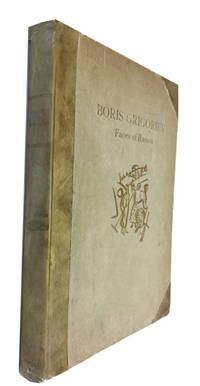
192486714London 1924. Hardcover. Good. 30 illustrations 29 of which are glued along top and at tip of lower corners 8 full-page color 16 full-page black & white and 5 much smaller black & white. The 30th illustration "Waking Children" is full page in reddish brown and printed directly on a leaf. There are also a few small decorations in reddish brown 100 7p. Original 1/4 vellum. 36cm. Moderate cover soil and wear. Backstrip snagged at top. Contents generally sound and clean although one illustration has split along lower corner where glued. The tissue guards are browned a few are missing and a few others are wrinkled or partially gone. Copy No. 20 of an edition limited to 500 numbered copies signed by Grigoriev. Text portions by Louis Reau Claire Sheridan Andre Levinson Claude Farrere and Andre Antoine. <br/><br/> hardcover books