167 résultats
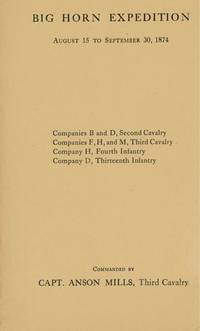
187453597N. P.: Privately printed n. d. ca 1874. 1874. WYOMING TERRITORY. First edition. 8vo. Original printed wrappers 15 pp. large fold-out map. The map traces the route of the Big Horn Expedition. "The Big Horn Expedition of 1874 was a significant military operation involving the United States Army against the Lakota Sioux and Cheyenne Indians in the Wyoming and Montana Territories. This expedition was part of the broader conflicts between the U.S. government and Native American tribes during that period. The operation aimed to assert control over the region and respond to Native American resistance against U.S. expansion and settlement. The discovery of gold in the Black Hills by soldiers under Lieutenant Colonel George A. Custer in 1874 intensified these conflicts as the U.S. sought to acquire the land from the Sioux. The expedition solidified Lakota Sioux and Northern Cheyenne resistance against the United States attempt to force them to sell the Black Hills and live on a reservation beginning the Great Sioux War of 1876." This is an account of an expedition in which Buffalo Bill was along as a scout. They were trailing an Indian war party and comment upon seeing buffalo and other types of game. Also included is a tragic account of a private being mauled by a bear. The man died shortly thereafter from his injuries. Spine neatly repaired else a fine bright copy housed in a quarter leather and marbled paper over boards clamshell case with titles stamped in gilt on the spine. This is a rare item and seldom offered for sale. Privately printed, n. d. (ca 1874). hardcover
1865List2438Camp Low 1865. Original partially printed document 26cm x 77cm. Printed on both sides of the sheet completed in manuscript. Darkening at folds from old tape repairs; partial splits to folds and extremities; complete and quite Good. Docketed verso signed in ink by Lieutenant Morgan Owen. Lists twelve enlisted soldiers most with Spanish surnames two with French surnames. Fine. The formation of the California Native Cavalry in 1863 marked a significant chapter in the state's history. Comprising primarily Mexican-American individuals colloquially referred to as "native" Californians the California Native Cavalry unit was formed 1863. Initially commanded by Maj. Andreas Pico a distinguished hero from the Mexican-American War and later under Salvador Vallejo the regiment drew its ranks from diverse backgrounds. Recruitment efforts began with vaqueros from southern California expanding to include individuals from San José and San Francisco. The unit boasted a varied composition encompassing not only Mexican-Americans but also Chilenos California and Yaqui Indians and even French legionnaires.<br /> Company "B" a contingent largely recruited from the northern part of the state is reflected in the existing muster roll. The company assembled at Camp Low near San Juan Bautista in 1865 making a striking entrance into the town. Described as "gay and gallant Spanish lancaroes" the cavalrymen presented a formidable sight with lances in hand and flags flying leaving a lasting impression on the townspeople who had never before encountered soldiers."The gay and gallant Spanish lancaroes sic came dashing through the town with the lances in their hand a flag flying from each of them. I assure you that they presented a war like appearance the people here had never seen a soldier in their lives – Yes Sir!." letter Maj. Michael O'Brien to Gov. Frederick Low January 1865; quoted in Prezelski "Lives of the Californio Lancers: the First Battalion of Native California Cavalry" in Journal of Arizona History v.40 no.1 Spring 1999. <br /> Under the command of Capt. Porfirio Jimeno Company B swiftly engaged in a critical mission: dismantling the notorious Mason-Henry Gang that had terrorized the San Juan region in the preceding months. Despite successfully wounding John Mason in early April 1865 the gang persisted for another month until Mason met his demise at the hands of a miner he sought to kidnap.<br /> However Company B faced challenges including low morale and a high rate of desertions with over 40 men leaving the company in 1865 alone. Transferred to Tubac Arizona Territory to confront the Apaches the company encountered further desertions along the way. The muster roll listing only twelve soldiers alongside Capt. Porfirio Jimeno reflects this tumultuous period. Overall the muster roll provides scarce documentation of the role of Mexican-Americans in the Civil War with few other examples in the trade or institutionally. unknown
01-1226Paris: chez la Veuve Gandouin; Giffart; David l'Aîné; Jombert; Durand 1754. 4to. 3 vols. Folding engraved and etched plates. Original calf with 5 raised bands on spine. Paris: chez la Veuve Gandouin; Giffart; David l'Aîné; Jombert; Durand, 1754. hardcover
186351386Mobile: S. H. Goetzel 1863. First edition 16mo 3 parts in 1; pp. 2 ii 220; 104; 47 1; 97-108 Bugle Signals; xiv index 2 ads; 38 engraved plates 8 folding; original paper-covered boards rebacked in blue cloth sometime in the 20th century; boards worn text occasionally dampstained and foxed without the front free endpaper and hinges with old archival paper repair; but in all a good sound and compelling copy of a poorly made book. Parrish & Willingham 5116. S. H. Goetzel unknown
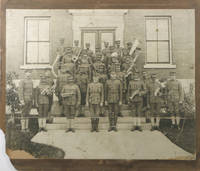
1910List304Fort Ethan Allen 1910. Gelatin silver print mounted to board 16 ¼ x 14 ½ inches. Fair to Good. The 10th Cavalry was one of the original “Buffalo Soldier†regiments of the post-Civil War segregated U.S. Army first seeing action in the Indian Wars. Their band is shown here most likely during their stint at Fort Ethan Allen in Vermont. They are wearing a mix of insignia from 1902 to 1908 and some are shown in civilian clothing which suggests the picture was taken in Vermont as this was during the time the Army used a vast mix of insignia and the brick architecture of the background also matches that of the fort. <br /> <br /> They were exposed to some racism during their time in Vermont - the soldiers were punished for associating with neighboring white women with some of the offenders being confined to the guardhouse for punishment which fits with the strictly segregated Army policies of the time. The soldiers did also record positive aspects of their time at the fort including studying at the fort’s library and playing nightly games of the newly-invented sport of basketball. These amenities provided some positive contrast to the previous assignments of the regiment who had been mostly stationed on the frigid plains where the army believed racial tensions would be kept to a minimum. <br /> <br /> The picture shows the band with the normal marching band instruments of clarinets tubas and sousaphones as well as an alto clarinet oboe and what appears to be a baritone saxophone. We find no other examples of the 10th Cavalry Band and the picture shows the regiment at a relatively calm time as they would soon be sent to the Mexican-American border in 1913 to deal with rising tensions. The picture has condition issues with damage to the mount some damage to the bottom left corner and a crease along the bottom third of the image along with closed tears and chipping to the title label. It remains in fair to good condition attractive and worthy of preservation. unknown
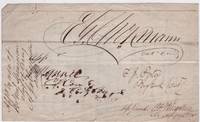
18632604050021United States Army 1863. First Edition. Manuscripts & Paper Collectibles. Very Good. Signed. Large two sided document. Printed with manuscript names filled in. The first name listed is Colonel Eli Long. This document shows the Colonel Captains Sergeants Lieutenants and the privates. This document shows the pay from October 31st 1863 to December 31st 1863. <br> According to NPS: "On February 23 1863 Long was appointed colonel of the 4th Ohio Cavalry a regiment which recently had surrendered to the Confederate raider Brigadier General John Hunt Morgan. Long improved the morale of the regiment and led it in the Tullahoma Campaign. He commanded the regiment's brigade the 2nd Brigade 2nd Division Cavalry Corps of the Department of the Cumberland between March 1863 and August 20 1864 including service at the Battle of Chickamauga. Long was wounded in the left side at the Battle of Farmington Tennessee October 7 1863. He was distinguished in the Atlanta Campaign where he suffered a head wound at the Battle of Jonesboro Georgia August 20 1864 and wounds in the right arm and right thigh at the Battle of Lovejoy's Station Georgia August 21 1864. Long received brevet grade appointments as major lieutenant colonel and colonel in the Regular Army of the United States for "gallant and meritorious services" at the Battle of Farmington and Battle of Fort Sanders Knoxville in Tennessee and Battle of Lovejoy's Station in Georgia respectively. Between November 16 1864 and April 2 1865 Long commanded the 2nd Division of the Cavalry Corps of the Military Division of Mississippi under Major General James H. Wilson. On April 2 1865 during Wilson’s Raid Long was severely wounded in the head at the Battle of Selma Alabama. During that battle he led the 2nd Division in a charge upon the entrenchments that resulted in the capture of that town. During the Civil War Long was wounded five times and also cited for gallantry five times. On January 13 1866 President Andrew Johnson nominated Long for appointment to the brevet grade of major general of volunteers United States Army unknown
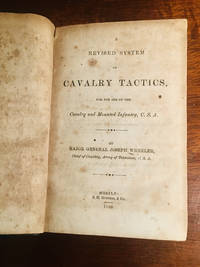
18631214<p>Rare Confederate Imprint:</p><p>24 mo. 5 1/2 by 3 3/4 inches 1 preliminary leaf ii </p><p>Three parts in one volume: "Cavalry Tactics For Single Line Formation" 220 pages</p><p>"Evolutions of a Regiment" 104 pages</p><p>"Skirmish Drill for Mounted Troops" 47 pages</p><p>"Bugle Signals" pages 97-108 among them: "To Arms" "The Charge" "Reveille" "Retreat" "Dinner Call" and "Tattoo" all with musical notation</p><p>"Table of Contents" plus Index and "Skirmish Drill For Mounted Troops" xiv pages</p><p>38 plates some folded: diagrams tables and charts.</p><p>Good condition collated perfect in green paper covered boards old blue cloth re-backing with worn black paper label mild foxing to some pages – not affecting contents.</p><p>"Fighting Joe" Wheeler was a cavalry general in the Confederate States Army. He was the senior cavalry general in the Army of Tennessee and fought in most of its battles in the Western Theater.</p><p>He earned his nickname on the Western frontier where he distinguished himself in skirmishes against Native Americans.</p> S. H. Goetzel, & Co. hardcover
1881000073USA. Good. 1881. Original Cloth. Three curious diaries/logs/journals of Peter H. Grisham mustered out a Corporal of the 2nd Kentucky Cavalry. Peter tends to write front to back and then change back to front in these 'pocketbook' type journal. Peter meanders making observations jotting memories detailing genealogical histories; Mrs. Mary Bevins his sister some famed people he knew through his father and notes the history of the family's steel works is in the snippets to follow. "July 10th 1883. My duties have been arduous have neglected to keep up any diary regularly. I went to Arkansas - last May was a year - via Baltimore Harrisburg Pittsburg Chicago St. Louis by RRs and by Steamer too Memphis by RR to Little Rock Geary Ark. to my sister Mrs. Mary Blevins near Pangburn White Co. Ark" "July 22nd 1883 - Wrote letter to J. Lundy Brotherton Phila. in reply to his in regard to Benj Lundy and Elihu and Elijah Embree who printed published the 1st Emancipation newspaper in the US States some 50 years ago.took me to clerk at his great ironworks in 1838.I stayed at his house as a clerk near six years and was present when he died." "About six years ago Bridget an Irish girl that sews for them that G. Eaton was paymaster general under Genl Scott killed himself before this: he ran away with the granddght of his 1st wife. Col. Clark.knows of it." July 29th 1883 Alexandria Va. This ancient city is still inhabited by many of the old Virginia Aristocracy who own the best of the property. The city was mostly of the tory sort I believe in the days of Washington - who attended Church here in the same building I did today.That it sympathised with England and the King may be inferred from the names of the streets - King St. Queen St. Prince.It was also a strong rebel city during the late war sending about a thousand soldiers into the rebel army under Genl R.E. Lee who lived a few miles above opposite the city of Washington. The pocketbook has a page or two missing one hinge is loose is written in pencil blue crayon and pen. A number of pages are financial - stock holdings monies loaned and repaid. Some more legible than others especially the log parts where he has crossed out information that was no longer relelvant. 50pp. Diary for 1881 also a pocketbook style tells the long tale of the death of Catherine M. Melville and other historically relevant events for Washington City DC as he writes. 20pp.Diary for 1890 is for the most part very much like the others.; Manuscript; 32mo - over 4" - 5" tall; HANDWRITTEN MANUSCRIPT DOCUMENT LETTER AUTOGRAPH DIARY JOURNAL LOG KEEPSAKE WRITER HAND WRITTEN DOCUMENTS SIGNED LETTERS MANUSCRIPTS HISTORICAL HOLOGRAPH WRITERS DIARIES JOURNALS LOGS AUTOGRAPHS PERSONAL MEMOIR MEMORIAL PERSONAL HISTORY AMERICANA Genealogy Tennessee Washington Dc Alexandria Virginia Americana Civil War . hardcover
186358198Virginia; various places including City Point 1863-1865. Fine original condition. 8vo. With a brief signed note describing the finding of these letters on a farm near Albany New York. Two letters from Charles Seaver to his sister describe a night-time call to arms arrival on the Rapidan coming under battery fire and forcing the enemy infantry across the river; hoping to relocate to Washington rather than South Carolina; effecting the surrender of "five Rebble sentenals" and the destruction of a railroad bridge by axe and fire. To his mother from City Point he writes of religion; of money due him and how to collect it in case he is killed; and a temporarily successful Rebel capture of 2500 cattle. Merrill Flint writes to his sister on April 6th 1865 from Virginia about walking the streets of Petersburg "it looks very rough"; and not expecting to see Richmond for some time "for we are following Old Lee as fast as the Army can march.the Confederate Army is on its last pins." With one original addressed envelope. unknown
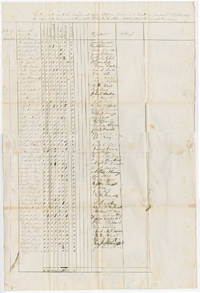
186223879.02<p><b>COMPANY D 1st VERMONT CAVALRY. CIVIL WAR.</b> Manuscript Document Signed June 1862: List of clothing distributed to 54 men including 25 caps 24 blouses 50 trousers 66 flannel shirts 15 drawers 19 bootees 69 stockings and 3 blankets. <b>Each row signed by the soldier who received the items</b>. 1 p. 15½ x 23¾ in. </p><p>"<i>We the undersigned Non Commissioned Officers Artificers Musicians & Privates of Company 'D' 1st Vt Cavalry do acknowledge to have received of Capt. A. W. Preston the articles of Clothing set oposite our respective names</i>"</p><p><b>Soldiers included:</b></p><p>Jacob Trussell Rodney Eames</p><p>Harrison B. Michell James Esdon</p><p>Josiah H. Moore Samuel L. Higgins</p><p>George P. Blair Orin S. Hendrick</p><p>George C. C. Clemment Azro H. Kinerson</p><p>Horace Ide Harvey A. Marckres</p><p>Barney Decker Arthur Murray</p><p>George A. Austin John Morse</p><p>Dan Adams Henry A. Moore</p><p>Harvey Bickford Kyron Morrill</p><p>William Buck Warren Norris</p><p>B. H. Bard Elijah C. Page</p><p>Bartlett S. Bard Francis Rowell</p><p>John A. Beaton L. S. F. Reed</p><p>George F. Bennett Curtis L. Stacy</p><p>Austin A. Bailey Edwin W. Southworth</p><p>C. W. Clifford Martin V. B. Vance</p><p>Ansen L. Chandler John Woodard</p><p>Loren Chase Jr. William Woodard</p><p>Antipas H. Curtis signed with mark John Woodbury</p><p>Milo J. Corliss Fernal H. Webber</p><p>Consealer F. Durlam William Wheaton</p><p>John S. Coombs Mark M. Wheeler</p><p>James Davis James Wright</p><p>John C. Gracy Darwin J. Wright</p><p>Joseph W. Gordon Died J. Hale Powers</p><p>Patrick C. Gilligan Charles Knapp</p>
190781587Pana Illinois: Kerr's Printing House 1907. Presumed First Edition First printing thus. Staplebound wraps. Fair. 50 pages plus seven illustrations/plates. Front cover and next page have the names and address of previous owner and a date stamped on it. Cover is worn torn chipped and soiled. The 2nd Illinois Cavalry Regiment was a cavalry regiment that served in the Union Army during the American Civil War. Companies "A" to "L of the 2nd Illinois Cavalry was mustered into service at Camp Butler Illinois on August 12 1861. Company "M"" was mustered in on December 30 1861. The regiment was mustered out on December 30 1865.<br/>The regiment suffered 8 officers and 50 enlisted men who were killed in action or who died of their wounds and 3 officers and 173 enlisted men who died of disease for a total of 234 fatalities. Commanders: Colonel Silas Noble - mustered out February 16 1863; Colonel John J. Mudd - killed in action May 3 1864; Colonel Daniel B. Bush Jr. - discharged July 24 1865; and Colonel Benjamin F. Marsh. The first photograph appears to be of the reunion attendees. The following photographs are: Sergt. Wm. M. Baldwin Company K; Colonel D. B. Bush Colonel John J. Mudd Lieut. Col. Harvey Hogg Lieut. Col. B. F. Marsh and Major F. B. Moore. This is a storehouse of information with names of survivors some addresses and vignettes about fallen comrades and others and death notices of members of the Association. There is some information on the Battle of Bolivar. This copy belonged to James P. Chase of Socorro New Mexico and an empty envelop addressed to him remains with this work. He appears to have been a founder of a Masonic lodge in Socorro. Kerr's Printing House paperback
002856No Place: No Publisher Printed single sided broadside approximately 380mm x 465mm in size n.d. but probably 1794. Slightly creased small scuff to head with small amount of loss otherwise quite bright and clean. "Thomas Grimston of Kilnwick and Grimston offered to raise a cavalry force in Holderness and he set about his task with characteristic thoroughness. He issued the articles of enrolment based on those of the Northamptonshire Yeomanry and then travelled round the Holderness villages explaining his plans to the farmers. The response was very poor and he followed up his visits with letters to the Clergy suggesting that parish meetings be called so that the importance and purpose of the proposed corps could be explained to all the parishioners. Once more the results were disappointing. A letter received from the Vicar of Sproatley partly explains why this was so. "The sentiments of the People here are not changed I apprehend since you conversed with them. What they object to is the smallness of the pay from which circumstances one may r think infer two things First they are aware of the Necessity of the Measure and Secondly in return for their Services they expect a valuable consideration adequate at least to the Profits arising from Labour". Several letters were written in similar tenus and some also pointed out that volunteers were unlikely to come forward during . First Edition. Unbound. Good. Elephant Folio. Broadside. No Publisher Paperback
1833AQ25433London: Printed by J. Hartnell 1833. 20pp 4. Contemporary calf tooled in blind ruled and lettered in gilt A.E.G. Inscribed to upper board 'Earl of Lovelace'. Rubbed loss to head and foot of spine. Marbled endpapers lightly creased and spotted. Autograph letter pasted to front blank fly-leaf 8pp of manuscript tables to rear blank fly-leaves listing the 'Return of the arms and accoutrements in possession of the Surrey Yeomanry Cavalry on 1 Jan. 1835' 'Return of the present enrolled and serving in the Surrey Yeomanry Cavalry commanded by the R. Hon. Col. William Lord King' and 'Returns made to the Sec. of State on 1 April 1835 of the strength of the S.Y.C.' With a loosely inserted manuscript list of names. The printed ordinances regarding the pay of members of the mounted component of the British Volunteer Corps; from the library of William King eighth Baron King of Ockham 1805-1893 with autograph letter to Lord King confirming his commission as Lt. Colonel Commandant of the Surrey Regiment of Yeomanry Cavalry in 1833. In 1838 King was created the Earl of Lovelace on his marriage to Augusta Ada Lovelace 1815-1852 pioneering female scientist computer programmer and the only legitimate child of George Gordon Lord Byron. . 8vo. Printed by J. Hartnell unknown
19852082702114907448Whale Cavalry Military History Publishing Committee 1985. Soft Cover. Fine. Number of pages: 478 pages Size: 22cm Whale Cavalry Military History Publishing Committee paperback
AQ24115s.l.: s.n. 1842-46 Manuscript on paper. 102 leaves. 14 used the remainder blank. Contemporary green cloth contrasting red paper lettering-piece to upper board title in manuscript to spine and bottom edge metal clasp. Extremities rubbed and a trilfe marked. Upper hinge exposed. A mid-nineteenth-century manuscript guest book for the Westmorland Yeomanry Cavalry. The regiment was raised by Colonel Henry Lowther as the Westmorland Yeomanry Cavalry in 1819. It was re-raised as the Westmorland and Cumberland Yeomanry Cavalry in 1828 and was called upon to suppress chartist riots at Penrith and Carlisle in 1839. It was called upon again to suppress fighting between English and Irish labourers working on the Lancaster and Carlisle Railway at Lowther Park in 1846. Although there had been no intention for the Yeomanry to serve overseas a series of defeats during Black Week in December 1899 convinced the British Government that additional troops were needed to supplement the regular army. A Royal Warrant was issued on 24th December 1899 to allow volunteer forces to serve in the Second Boer War and the Yeomanry were duly dispatched. . 8vo. [s.n.], [1842-46] hardcover
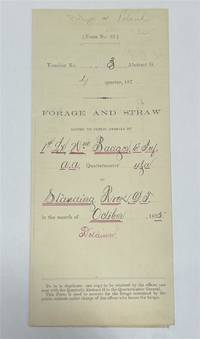
1875320963Standing Rock 1875. unbound. Partly printed military document signed 6th Infantry seven months before Little Big Horn 16.75 x 10.75 inches Standing Rock Nov. 1 1875 "A Statement Of Forage and Straw Issued to and Consumed by the Public Animals under my direction at Standing Rock Dakota Territory during the month of October 1875" for transient animals from Fort Rice signed by Captain and Commander of Post James S. Poland an officer who served under Major Reno at the Little Big Horn and was erroneously reported as "Killed In Action" when severely wounded in the back. At the time this document was signed Poland was ordered to cease his sale of rifles and ammunition to Indians at the Standing Rock Reservation as the recipients were closely connected with Sitting Bull's band. One month later the Commissioner of Indian Affairs called for the use of troops against those Indians. Also signed by Lieutenant William Badger a close friend of Custer who survived the Black Hills Campaign. His son Tom who filled out the body of this document became General Custer's personal secretary in 1876 and was killed at Little Big Horn. Also included: a Xerox of a rare photograph of the 7th cavalry 6th infantry in uniform with accoutrements all identified including Custer Badger and Poland. Partial tearing along one of the folds; otherwise near fine condition.<br/> <br/> unknown
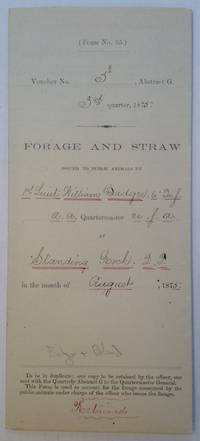
18755905Dakota Territory 1875. unbound. 2 pages Dakota Territory August 1875. This document -- a Statement of Forage and Straw -- is signed by Captain James S. Poland "J.S. Poland" who served under Reno at Little Big Horn and by Lt. William Badger "W. Badger" a close friend of General Custer and survivor of the Black Hills Campaign. The document lists the amount of oats corn barley hay fodder and straw consumed by the animals at the Standing Rock Reservation in The Dakota Territory. The front cover measures 8.5 x 3.75 inches and folds out to the inner page with lists measuring 16.75 x 11 inches. Natural folds and slight creasing in one spot; near fine condition.<br/> <br/> unknown
184735018February 6th 1847. 1847. Very good. - Letter penned in black ink & filling almost 3 sides of a sheet of light gray paper folded once to form 4 sides approximately 7-1/4 inches high by 4-5/8 inches wide. The letter has been mounted on a lightly larger sheet of cream-colored stiff paper. Signed "Anglesey" There are a few small ink smudges to the 2nd & 3rd sides. Very good. <p>The letter is addressed to Scottish geologist Sir Roderick Murchison and concerns a publication which Murchison is proposing and how it would be funded. "Some Estimate of the probable cost of money and of time is called for from General Colby and when it is received you shall again hear from me." The reference is probably to General Thomas Frederic Colby a leading geographer who had been director of the Ordnance Survey.<p>Henry Paget 1st Marquess of Anglesey 1768-1854 was a British army officer and politician. After serving as Member of Parliament for Carnarvon and then for Milborne Port he took part in the Flanders Campaign. During the Peninsula War he commanded the cavalry for Sir John Moore's army in Spain and at the Battle of Sahagun virtually destroyed a regiment of French cavalry. He led the charge of the heavy cavalry against Comte d'Erlon's column at the Battle of Waterloo losing part of one of his legs to a cannonball at the end of the battle. In later life he served as Master-General of Ordnance from 1846 to 1852.<p>The Scottish geologist Sir Roderick sometimes as here spelled "Rhoderick" Impey Murchison 1st Baronet 1792-1871 was the first to describe and investigate the Silurian system. During the last decade of his life he chiefly investigated the Highlands of Scotland. Murchison was one of the founders and a president of the Royal Geographical Society and served on the Royal Commission on the British Museum. In 1855 he was appointed director-general of the British Geological Survey and director of the Royal School of Mines and the Museum of Practical Geology in Jermyn Street London. February 6th, 1847. unknown
186145596n.p. 1861. Very good folded edge worn light soiling and ink staining. 1 sheet. 7.75 x 4.5 inches. Signed by Ernest G. Chormann Brig. Gen. Fitz John Porter Col. William Woods Averell Chief of ordnance Charles P. Kingsbury and Assistant Adjutant-General Andrew J. Alexander for Gen. George Stoneman with the note "approved" by three signatures. Though undated it was likely signed between September 1861 and January 17 1862 based on the service records of those who signed it.<br /> <br /> 1. Ernest G. Chormann in 1861 recruited a volunteer regiment called "Chorman’s Independent Mounted Rifle Rangers" in Philadelphia. See Library Company of Philadelphia for the broadside. The first company of this regiment was mustered into service July 23 1861 and the last was mustered Sept. 15th 1861. The regiment was then under the command of Col. E. G. Chormann. It was numbered the 89th of the line and the 8th Cavalry and left Pennsylvania for Washington on Oct. 4 where it was brigaded with the 3rd Pa. cavalry thus putting Chormann under the command of William Woods Averell who in turn was under the command of Brigadier General Fitz John Porter. On Nov. 9 1861 the New York Times reported "The Eighth Pennsylvania Cavalry Col. Chormann has been brigaded with the Third from the same State. The brigade is commanded by Col. W.W. Averell of the latter regiment. Both are rapidly improving in efficiency and drill." But on Nov. 27 the Philadelphia Inquirer reported that "The statement that charges have been filed against Col. Chormann is said to be erroneous. The Colonel is laboring energetically to ensure the perfection of drill desireable in all well disciplined regiments." By January 17 1862 Chormann had resigned his commission to be replaced by Capt. David Gregg of the 6th U. S. cavalry an experienced officer and a graduate of West Point. Chormann had endorsed Merrill’s Patent Breech-Loading Carbine on September 19th 1861 his letter to General J. W. Ripley Chief of Ordnance Washington D. C. soon appearing in an advertisement for the weapons but so had many other officers. Thus both the reason for his resignation and the purpose of this document remain unknown.<br /> <br /> Little is known about Ernest G. Chormann other than in his autobiography below and for his filing of numerous patents. He was an inventor and also active as an artist between 1853-1880 See Frick Museum Art Reference Library. In 1852 he exhibited saddle patterns at the Twenty-second Exhibition of American Manufactures at the Franklin Institute; in 1861 listed as an engraver and die sinker he bid on a $2500 contract with the U.S. Government for coin designs as part of ongoing experiments into how to prevent “abrasion counterfeiting and deterioration of the coins of the United States; †he was hired as the engraver; he filed for optical and mechanical patents; in 1880 he painted "Letitia Street House 1880" now at the Historical Society of Pennsylvania. The Pennsylvania's Rangers' War song: "Up ! up ! with our flag let its bright stars gleam out" was dedicated to him. <br /> <br /> The Pennsylvania Historical Review 1886 lists his firm Chormann & Mitchell as "inventors and patentees of the specialties manufactured. They manufacture all kinds of art furniture including parlor easels novel and chaste in design labor- saving studio easels sketching easels artists’ kits etc. together with interior decorations. the studio easel being awarded the first premium and diploma at the Centennial Exposition of 1876."<br /> <br /> Chormann adds his somewhat rather fanciful biography:<br /> <br /> "Mr. Chormann the founder of this business was born in France. Early in life he was noted for his energy talent and determination and visited as an explorer and traveller nearly every country in the civilized world. In 1836 he was a colonel in the San Jacinto war where he manifested great courage and prudence and on its termination made an effort to explore almost alone the sources of the Nile. Eventually after exploring various portions of Australia New Mexico Arizona and Lower California and undergoing great hardships and dangers from climate and Indians he was appointed on his arrival in Texas in 1845 captain and superintendent of the Texan Rangers. He was actively engaged in 1847 and 1848 in the Mexican war where his distinguished military ability was of great service to the United States. During his explorations and travels in the West he was associated with those famous old Indian fighters namely De Soto and California Joe. Mr. Chormann was the first white man who explored the Western portion of the Colorado River the whole of the country at that period 1843 watered by this stream being inhabited by tribes of Indians of the most cruel and treacherous nature. Colonel Chormann organized the first regiment that served during the war and which was known as Chormann’s Mounted Rangers. On the 14th April 1861 immediately after the bombardment of Fort Sumpter he began recruiting and put 5000 men in the field. In 1865 he brought East the first specimen of the moss agate. In a few months Mr. Chormann intends to publish a work on Colorado and the West illustrated with splendid engravings which will prove of the greatest interest to all lovers of nature. He was the inventor of stylograph printing and is noted in scientific and artistic circles for his inflexible integrity and sterling ability."<br /> <br /> 2. Fitz John Porter 1822-1901 Civil War Union Major General West Point 1845 served in the Mexican–American War promoted to brigadier general of volunteers in 1861 and divisional commander in the newly formed Army of the Potomac under Maj. Gen. George B. McClellan who was soon is patron. On November 25 1862 Porter was arrested and court-martialed for his actions at Second Bull Run after McClellan was dismissed by Lincoln. He spent the next 16 years trying clear his name and record which he finally did in 1878.<br /> <br /> 3. William Woods Averell 1832-1900 Civil War Union Brigadier General West Point 1855 2nd Lieutenant assigned to the United States Army Mounted Rifles and served in the Indian Wars on the Western frontier severely wounded in a fight with Navajos in 1859 became a 1st Lieutenant with the Mounted Riflemen and was placed on staff duty in Washington D.C. In August 1861 he was appointed as Colonel of the 3rd Pennsylvania Volunteer Cavalry and soon became a Brigadier General.<br /> <br /> 4. Andrew Jonathan Alexander 1833-1887 Civil War Union Brevet Brigadier General served first as a Captain in the 3rd United States Regular Cavalry then as Lieutenant Colonel and Assistant Adjutant General on the staff of Union General George Stoneman.<br /> <br /> 5. Charles Peeble Kingsbury 1816-1879 graduated from West Point in 1840 2nd in a class of 42 served in the Mexican War as General Wolf's ordnance officer and on General Taylor’s staff wrote 'Elementary Treatise on Artillery and Infantry' 1849 and was a contributor to the American Whig Review Western Quarterly Review Putnam’s Monthly and the Southern Literary Messenger from 1840-67 was superintendent of the Armory at Harper's ferry and Chief of Ordnance for the Army of the Potomac August 12 1861 to July 1862 promoted to Colonel and aide-decamp September 28 1861. unknown
190881586Pana Illinois: Kerr's Printing House 1908. Presumed First Edition First printing thus. Staplebound wraps. Fair. 2 16 8 pages Three illustrations/plates. Front cover and title page have the names and address of previous owner and a date stamped on it. Cover is worn torn chipped and soiled. The 2nd Illinois Cavalry Regiment was a cavalry regiment that served in the Union Army during the American Civil War. Companies "A" to "L of the 2nd Illinois Cavalry was mustered into service at Camp Butler Illinois on August 12 1861. Company "M"" was mustered in on December 30 1861. The regiment was mustered out on December 30 1865.<br/>The regiment suffered 8 officers and 50 enlisted men who were killed in action or who died of their wounds and 3 officers and 173 enlisted men who died of disease for a total of 234 fatalities. Commanders: Colonel Silas Noble - mustered out February 16 1863; Colonel John J. Mudd - killed in action May 3 1864; Colonel Daniel B. Bush Jr. - discharged July 24 1865; and Colonel Benjamin F. Marsh. Plates I is of Mrs. John J. Mudd Mrs. Ella Mudd Baldwin and Wm M. Baldwin. Plate II is of Lt.-Col. Harvey Hogg who was killed in the Battle of Middleburg Tenn in 1862. Plate III is of George C. Houchens President of the Second Ill. Cavalry Association who died in 1906. These proceedings include the lengthy poem We've All Grown Old by David G. Palmer. This copy was owned by James P. Chase who served in Company H and later lived in Socorro New Mexico. Related marks on page 8. On pages 10-12 is a letter written by M. H. Musser to his wife in 1962 that addresses the battle in which Lt.-Col. Hogg was killed. Other discussion of the battle follow. Kerr's Printing House paperback
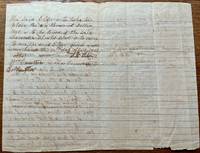
186336642Hamilton County Tennessee: n/a 1863. Document. Good. Document. Folded sheet of paper. 9" x 5". Paper has blue lines and multiple folds. 4 pages with 2 pages of content. Some fading to the ink and light toning to the paper. Chattanooga Tennessee is the seat of Hamilton County. Hand written document transcribed here: "State of Tennessee Hamilton County I Sam Elder of said County and State have this day hired Thomas Cavender as a substitute to serve as a Private in Capt J B Kings company or Capt Lyness for which I agree to pay the said Cavender one thousand dollars in hand & the other thousand dollars to be paid in three months from this date and to be loned at interest for twelve months two years is the time of service I have hired the said Thos Cavender now if the said Cavendar serves faithful as a substitute for the time of two years and at the expiration of that time the said Elder to take his place the one thousand dollars that is to be loned if the said Cavender should desert is to come to me the said Elder given under our hands this 30th day of April 1863 attest Wm Caruthers and Bob Caruthers signed seal S. H. Elder signed seal Thos Cavender." A Confederate soldier who paid another person to take his place is often referred to as a "substitute" soldier. During the American Civil War individuals who were drafted or conscripted into military service had the option to hire a substitute to serve in their place if they could afford it. These substitutes were typically individuals who were either unemployed or seeking financial gain. The practice of hiring substitutes was more prevalent among wealthier individuals who could afford to pay for someone else to take their place in the military.<br /> <br /> The Elder family were pioneers in Tennessee. Some of the family settled in Hamilton County. This excerpt is copied from Chattanoogan dot com: "The children of Robert S. Elder included Samuel Houston Sarah Jane Minerva Jane Robert and James B. Sarah married Thomas Monger a Unionist who was on the County Court. Minerva married James Clifford Allen who fought for the Union and was in the Legislature from Bradley County. Samuel H. was on the Confederate side joining 2nd Co. K of the First CSA Cavalry on Sept. 23 1862. He married Sarah J. White. Their daughter Mary A. married Aaron E. Smith. Samuel H. and his brother Robert had a "store boat'' that made calls at the various river landings and they also had a general store at Snow Hill. Samuel H. was postmaster at Long Savannah. He died in 1910 of a heart attack while walking from Avondale to Snow Hill."<br /> <br /> A record for Benjamin Franklin Cavendar from Hamilton County was found. However no mention of Confederates in Hamilton County for Thomas. Although a "Reader's Comment" from the Chattanoogan dot com states this: CAVENDER Benjamin Franklin Co. B 1TN Cav. Carter's Born 1839 in TN son of Henry Cavender. Farmer in Ooltewah. 1860 HC Census Reader Comment; Henry Cavender by his first wife did have a son named Benjamin S. Cavender b. ca. 1806 in NC living in Hamilton in 1850 but d. March 14 1858 in Dade Co. MO. By his 2nd wife Henry Cavender had a son named Franklin b. ca. 1839 in Hamilton Co. TN. However Henry Cavender relocated with several of his married and unmarried children after the 1860 census but prior to the War to Pitman Randolph Co. AR. In service with nephews in Company A of the 12th Missouri Infantry is Henry's son Francis Marion Cavender and an F.N.C. Cavender who I assume may be Henry's son Franklin. I cannot say for certain since there are no enlistment dates on this post but this Benjamin Cavender may be the son of Henry's son Thomas Cavender who remained in Hamilton Co. Thomas' son Benjamin J. Cavender was b. ca. 1844 in Hamilton Co. relocating after the War to Jeffersonville IN. I would be interested in hearing how the authors pegged this solder as Benjamin Franklin Cavender as Civil War soldiers database only lists him as Benjamin. I regret I cannot say anything more definitive than to cast some doubts. Kendall Sparkman.<br /> <br /> According to a record found in familysearch dot org: Captain J. B. King mentioned in the document was an officer for for Company B of the 1st Regiment Tennessee Cavalry Carter's. This regiment was organized in November 1862 using the 3rd Tennessee Cavalry Battalion as its nucleus. This company was active in the Vicksburg Campaign and was captured July 1863. By exchanged it was attached to Waul's Texas Legion then returned to the regiment. It surrendered with the Army of Tennessee.1<br /> <br /> The Caruthers individuals who attested this document were not found in a brief internet search. However there are other possible spellings of the name such as CARRUTHERS CARETHERS CAROTHERS. Some of the individuals named in the site Chattanoogan dot com were near the Chattanooga area during the Civil War. n/a unknown
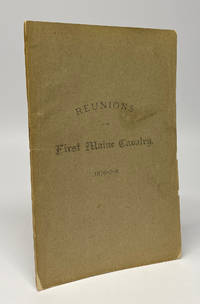
187911869Augusta ME: George E. Nason Printer 1879. First Edition. Softcover. Very good. Octavo 77pp. A clean sound very good copy in the publisher's printed wraps. Long tear and crease to the rear wrap with one small hole affecting the last leaf with no text. Two contemporary library labels internally not at all offensive. A vanishingly scarce volume recording the proceedings of some early reunions of the First Maine Cavalry regiment. Detailed reminiscences of the war make up much of the contents as well as some soldier-authored poetry and some administrative business. As with many cavalry regiments the First Maine saw significant action from the beginning to the end of the war at too many battles to list but including at Gettysburg and in Sheridan's final campaign through Virginia. OCLC notes a single holding at AAS. Ephemeral and considerably rarer than the two regularly published regimental histories of the regiment which both command strong prices in the rare book market. George E. Nason, Printer unknown
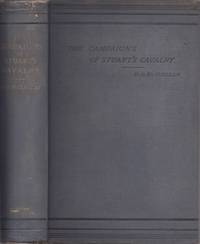
188535742Boston and New York/ Richmond: Houghton Mifflin/ J. W. Randolph 1885. First Edition. Hardcover. Good. Octavo. 1 xviii 468 pages 1. Illustrated with steel engraved frontispiece and 7 maps 3 in folding pocket on rear paste down. Gray cloth hardcover with title on the front cover and gilt title on the spine. Gray end papers. Light foxing to the frontispiece title page and foredge. Some light edge wear to the cloth including just inside the covers. Previous owner inscription written on the right front flyleaf - "R. B. Pleasants December 1874" mistaken year written. <br /> <br /> Howes M 41; Nevins II page 73. Houghton Mifflin/ J. W. Randolph hardcover
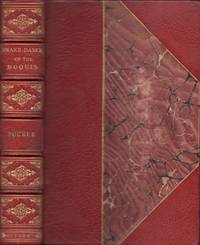
188435196London: Sampson Low Marston Searle & Rivington 1884. Three-quarter leather. Good. Octavo. xvii 371 pages 32 page publisher catalog bound in back. Illustrated with color frontispiece and 31 plates in the back of the text. Recased. Three quarter red leather binding with reddish marbled paper covered boards. Reddish marbled end papers. The original green cloth front cover and spine with gilt title and gilt illustration is bound in the back of the book. The right front flyleaf and the the title page are both clipped at the top edge suggesting a possibly clipped signature of the previous owner. Book plate of Robert C. Euler former anthropologist of the National Parks located on the front paste down. <br /> <br /> Howes B 655; Graff 368 - "The Moquis Indians of Arizona are of course the Hopi. The snake-dance is still performed but is too fascinating to be called "revolting" today. Sampson, Low, Marston, Searle, & Rivington unknown