(U S ), Cavalry SchoolBiblio.com

1 098 résultats
1019390174.Ghardcover. Good. Access codes and supplements are not guaranteed with used items. May be an ex-library book. hardcover
189930107Atlanta: The Franklin Printing and Publishing Co 1899. First Edition. Hardcover. Good. Octavo. xii 246 pages. Color frontispiece of the Confederate and American Flag. Gray cloth hardcover ruled in blind on covers with gilt title on spine. Marbled edges. Light soiling and edge wear to cloth. Author lived in Madison Georgia. <br /> <br /> Nevins I page 52. The Franklin Printing and Publishing Co hardcover
189933074Atlanta: The Franklin Printing and Publishing Co 1899. First Edition. Hardcover. Fair. Octavo. xii 246 pages. Color frontispiece of the Confederate and American Flag. Gray cloth hardcover ruled in blind on covers with gilt title on spine. Faded marbled edges. Soiling wear and light damp stains to the covers. Slight lean to the binding. Toning to the paper. Fair only.<br /> <br /> Nevins I page 52; Dornbush II p.536. The Franklin Printing and Publishing Co hardcover
10 pages. Piano sheet music. Above-average wear. Binding intact. Water-stained. A worthy working copy. Sheet music
Features: The more you make, the less it buys - Prices are rising rapidly - prices of many goods and services over the past 10 years are presented in charts; Yes, it is a coffin - Jean-Marc Beliveau of Sarcofab says his company's caskets will keep their integrity longer; $600 and all the dirt you can eat - motocross racing - many colour photos; four pages of lovely colour nature photos from across Canada; Maggie Grant; Doug Wright's Family; Bernie Welch wants you - to join the Household Cavalry and guard the Queen. Unmarked with light wear. A quality copy. Book
Lower corners bumped. Else book and DJ have minor shelfwear. ; 1.06 x 8.75 x 5.75 Inches; 380 pages; This book is the first to examine how classical Greek cavalry actually operated on the battlefield. It looks at its prime characteristics, including mobility, protection, armament, training, leadership, flexibility, and motivation. Until now, it was generally assumed that ancient Greek cavalry was subordinated to the infantry because it was less effective in battle. This book challenges this assumption, analyzing the position of Greek cavalry, and especially the Athenian arm, not only in the battlefield but in society as a whole.
2 corners and base of spine bumped. Ex-library copy with usual stamps, call numbers and pocket. ; 1.06 x 8.75 x 5.75 Inches; 380 pages; This book is the first to examine how classical Greek cavalry actually operated on the battlefield. It looks at its prime characteristics, including mobility, protection, armament, training, leadership, flexibility, and motivation. Until now, it was generally assumed that ancient Greek cavalry was subordinated to the infantry because it was less effective in battle. This book challenges this assumption, analyzing the position of Greek cavalry, and especially the Athenian arm, not only in the battlefield but in society as a whole.
197912848London, Orbis Publishing, 1979, pt in-4°, 256 pp, abondamment illustré de cartes et de photos, cart. éditeur, jaquette illustrée
181 pages including index, bibliography and black and white plates. The first book in a series of Concise Guides to various campaigns. A short guide to the whole war. Includes among the appendices a complete key to the British cavalry and infantry regiments with their titles i n1854, 1900 and 1971. Illustrations lean heavily upon the well-known engravings from the drawings by William Simpson. Usual library markings. Moderate lean to spine. Above average but not excessive wear. Pocket removal from front endpaper has caused some peeling. Book
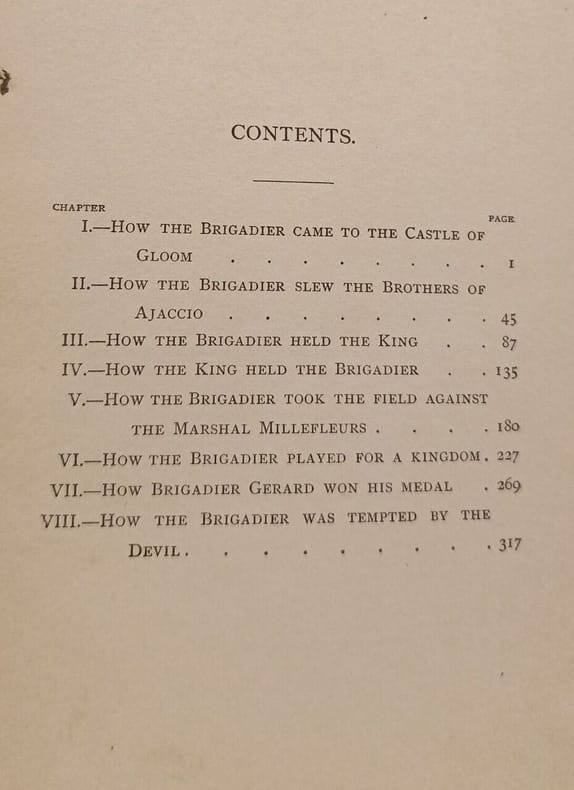
1896100150020AL Burt Company 1896 in8. 1896. Cartonné. Recueil de nouvelles d'Arthur Conan Doyle mettant en scène les aventures du brigadier Gérard un hussard français courageux mais vantard et cocardier servant sous Napoléon. Ses exploits souvent invraisemblables et teintés d'humour le voient accomplir des missions périlleuses pour l'Empereur
1957013054Portland Oregon: Champoeg 1957. Limited Edition. Octavo. Limited to 1000 copies. 74p. Edited by Edgard I. Stewart and Jane R. Stewart with a note on the Kicking Bear Pictography by Carl S. Dentzel. index. notes. folding maps Yellowstone and Missouri River Areas and Lt. Godfrey's Map of the Battle of Little Big Horn. Photographs illustrations etc. Subtitle of book continues: ". when Brigadier General Alfred H. Terry left Fort Abraham Lincoln Bismarck Dakota Territory until the return of the battered regiment a few days after September 24 1976 to the same place. Bound in blue cloth pictorial illustration mounted to upper board spine lettering gilt. A very good copy. Champoeg unknown
1957013054Portland Oregon: Champoeg 1957. Limited Edition. Octavo. Limited to 1000 copies. 74p. Edited by Edgard I. Stewart and Jane R. Stewart with a note on the Kicking Bear Pictography by Carl S. Dentzel. index. notes. folding maps Yellowstone and Missouri River Areas and Lt. Godfrey's Map of the Battle of Little Big Horn. Photographs illustrations etc. Subtitle of book continues: ". when Brigadier General Alfred H. Terry left Fort Abraham Lincoln Bismarck Dakota Territory until the return of the battered regiment a few days after September 24 1976 to the same place. Bound in blue cloth pictorial illustration mounted to upper board spine lettering gilt. A very good copy. Champoeg unknown books
8vo., First and Sole Edition, on laid paper, with portrait frontispiece, 7 plates, 4 illustrations and maps in the text, and folding map, preliminaries lightly foxed; original khaki cloth, upper board and backstrip blocked and lattered in gilt and black, gilt top, red endpapers, uncut, joints mildly rubbed, some mild age-soiling else a very good, bright, clean copy. The Fife and Forfar Yeomanry served as 20th Company Imperial Yeomanry in South Africa from April 1900 to June 1901. They were commanded variously by Hunter, Hutton, Clements and Cunningham. In December 1900 the 20th was attacked at Nooitgedacht where the British sustained heavy casualties and the Fifes were reduced to half strength. The remnants joined Cunningham's force to the end of January 1901 and were then attached to Col. Benson's column in south western Transvaal. In April 1901 the Fifes regrouped at full strength at Bloemfontein, joining Col. Pilcher's column in Orange River Colony and returning home in May 1901.The work includes a nominal roll and campaign history. VERY SCARCE. Hackett, p.190 (see also p.ix for coloured plate of cover and lengthy assessment); White, .p.176.
4to., First Edition thus, on laid paper, with frontispiece and 3 maps (2 folding); green cloth gilt, gilt back, a fine copy. The hardback edition is very scarce.
1169481485.Ghardcover. Good. Access codes and supplements are not guaranteed with used items. May be an ex-library book. hardcover
1162233052.Ghardcover. Good. Access codes and supplements are not guaranteed with used items. May be an ex-library book. hardcover
195287562Atlanta GA: Albert Love Enterprises c1952. Presumed First Edition First printing. Hardcover. Good. The format is approximately 9 inches by 12 inches. Dornbusch 411. Unpaginated. Endpaper map. Illustrations. Maps. Cover worn and soiled. Edges and corners rubbed. No dust jacket present. Large volume somewhat shaken. If sent outside of the U. S. this would require additional shipping charges. Includes a section on the History of the First Team prior to Korea going back to its precursor lineage units its formal organization in 1921 and its spectacular achievements during World War II. After a substantial text and pictorial section on the combat operations and military activities the volume ends with information on The Division Patch information on the Headquarters and Headquarters Company 1st Cavalry Division 5th Cavalry Regiment 7th Cavalry Regiment of Custer fame and Garry Owen 8th Cavalry Regiment; Headquarters and Headquarters Battery 1st Cavalry Division Artillery 61st Field Artillery Battalion 77th Field Artillery Battalion 82nd Field Artillery Battalion 99th Field Artillery Battalion 29th Antiaircraft Artillery Automatic Weapons Battalion 92d Antiaircraft Artillery Automatic Weapons Battalion 8th Engineer Combat Battalion 13th Signal Company 15th Quartermaster Company 15th Medical Battalion 15th Replacement Company 16th Reconnaissance Company 27th Ordnance Maintenance Company 70th Heavy Tank Battalion 71st Heavy Tank Battalion 191st Counter-Intelligence Corps Detachment 545th Military Police Company and 1st Cavalry Division Band. This is followed by the Roster First Cavalry Division which gives unit name street address and home town and state. The 1st Cavalry Division initially organized in September 1921 at Fort Bliss Texas was serving on occupation duty in Japan when the Korean War began in the summer of 1950. On 18 July 1950 elements of the division went ashore at P'ohang-dong South Korea moving quickly westward to block the enemy along the main Taejon-Taegu corridor which led back to the ports on the Sea of Japan. With unrelenting pressure from the enemy the division withdrew to Kumch'on and later east of the Naktong River where it held part of the front near Taegu on the Pusan perimeter. During the month of August "The First Team" successfully countered five major North Korean attacks in that section. In early September the division launched an attack against the "Walled City" a series of high mountain ridges along the perimeter which the enemy repelled. On 15 September however the United Nations began a new offensive with an amphibious landing at Inch'on near Seoul; with the opening of the second front the 1st Cavalry Division began a drive northwest of Taegu. Six days later the division broke out of the perimeter and North Korean pressure in the south ended. Pursuit of the enemy followed and on 27 September the division met the 7th Infantry Division at Osan. From there the 1st Cavalry Division shifted north to the Kaesong area near the 38th Parallel the dividing line between North and South Korea. On 9 October the 1st Cavalry Division was ordered to take Kumch'on in North Korea which fell on 14 October. Shortly thereafter the division reached P'yongyang the North Korean capital. Elements of the division linked up with the 187th Airborne Infantry at Sunch'on and other elements turned southwest to Chinnamp'o the main port of North Korea. Oon 1 November a new more savage conflict began. Waves of enemy forces swept over the 1st Cavalry Division area near Unsan and the division fell back to a line between the coast and the Taedong River valley. By 12 December the division had withdrawn to only six miles north of Seoul and in January 1951 it occupied positions south of Seoul in the Ch'ungju area. Seoul had been captured but the enemy did not cross the Han River. When the enemy failed to follow up its recapture of Seoul the 1st Cavalry Division undertook a reconnaissance in force resulting in a limited offensive north and west of the capital. By the end of February "The First Team" had reached the Hongch'on area in the central front midway between Seoul and the Sea of Japan. In February the 1st Cavalry Division pushed to the Hwach'on Reservoir north of the 38th Parallel and then went into reserve. On 22 April the Chinese Communists began a new offensive to dislodge the UN forces and the division was given the mission of defending Seoul and the area north of the city. The division pushed northward and by the end of May it was again in North Korea. The 1st Cavalry Division's next assignment was to attack the "Iron Triangle" an area from P'yonggang southeast to Ch'orwon and southwest to Kumhwa which served as a marshalling zone for the enemy. In December 1951 the 45th Infantry Division replaced the 1st Cavalry Division which then began redeploying to Hokkaido Japan. The last element of the 1st arrived in Japan in mid-January 1952. Albert Love Enterprises hardcover
8vo., First Edition, with plates and maps; blue cloth, gilt back, a near fine copy in unclipped dustwrapper. Sandler 1850.
8vo., First Edition, with coloured frontispiece, 8 plates, 9 maps in the text and endpaper maps; blue cloth, gilt back, blue top, boards lightly faded at backstrip as usual, a very good, bright, clean copy in price-clipped dustwrapper. Sutcliffe, p.43; White, p.16.
"The Wonders of Aircraft in the War Copiously Illustrated". Front cover photos of General Pau, one of France's most famous Commanders. Centerfold devoted to the Officers and Men of the Royal Flying Corps. Photos and illustrations include: types of german aeroplanes; Diagrammatic representation of a Zeppelin dropping a bomb on the ill-fated city of Antwerp; Bullet-proof cage of the Zeppelin Bomb-thrower; German anti-aircraft gun; Dusseldorf Zeppelin shed; Zeppelin 5 is brought down by the Russian cavalry; The 'Astra Torres'; Parisians observe a German aeroplane, the Taube, overhead; and more. Somewhat above-average wear. Front cover almost detached and bears 6" tear from left edge. Book
"Brilliant narrative of Mons in this enlarged issue." - from front cover which features photos of Brigadier-General Sir David Henderson, K.C.B., D.S.O., Commander of the Royal Flying Corps. Excellent portrait of Joseph Jacques Cesaire Joffre, Chief of the General Staff of the French Army. General progress of the war to the eve of Mons. The French Frontier Battle and the British Stand at Mons. Centerfold illustration of 'Wounded helping the Wounded - Pathetic episode between Le Cateau and Landrecies during the Retreat from Mons. Photos and illustrations include: Destruction near Mulhausen; Barricades near Mons; German column mowed down by British machine guns at Landrecies; French Cavalry on the way; French's indomitable little army on the eve of the Battle of Mons; Scene of the retreat from Mons; Map of Western Europe; With the British Forces fighting along the Franco-Belgian Frontier; German troops trapped near Cambrai; and more. Covers still weakly attached. Unmarked. Sound copy. Book
Front cover illustration of Major-General E.H.H. Allenby, the brilliant Cavalry Leader. Later phases of the Great Retreat. With the Northern French Armies during the Great Retreat. The Course of Events from Mons to Lemberg. Photos and illustrations include: The Grand Duke Nicholas - Generalissimo of the Russian Armies; with our French Allies - horse, foot, and artillery - in the field; Big Guns employed by the Allies against heavy artillery of the Germans; Buses converted to Lorries in France; and more. Average wear. Sound and unmarked copy. Book