Wallenstein, Albrecht Graf von Friedland (1583 - 1634)Antiquariat.de

66 résultats
1660158428(Antwerpen, ca. 1660). Format (Platte): 240 x 172 mm. Blattgröße: 380 x 270 mm.
170020805Nancy Vagner 1700 in-18 plein-veau un volume, reliure demi-veau bordeaux in-18 à coins (binding half calfskin in-18 à coins) (14,7 x 9,1 cm), RELIURE D'EPOQUE, dos à nerfs (spine with raised band), décoré or et à froid (gilt and blind stamping decoration), titre frappé or, entre-nerfs à fleuron or , filet à froid de part et d'autre des nerfs et en tête et en pied, plats décorés or mors et coins ornés d'un filet "or", toutes tranches lisses dorées, sans illustration (no illustration), 128 Pages, 1856 à Nancy : Vagner Editeur,
1650142122Ca. 1650. Format (Oval): 15,4 x 11,5 cm. Blattgröße: 17 x 13 cm. Gebräunt, insgesamt ordentlich erhalten. Auf Untersatzpapier montiert.
1700115583Nürnberg, um 1700. Plattengröße: 360 x 240 (bis fast an den Bildrand beschnitten).
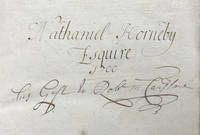
169757867<p>PEACETIME ARMIES ENABLE ABSOLUTISM - AN IMPORTANT DEBATE WITH ENDURING IMPLICATIONS - GIFTED BY A JACOBITE LONDON BANKER TO AN IRISH LANDOWNER</p><p>Collection of 5 items bound together on the issue of a Standing Army being:- <br /><strong>TRENCHARD John</strong> An Argument shewing that a Standing Army is inconsistent with a Free Government and absolutely Destructive to the Constitution of the English Monarchy.<br />London: Printed in the Year: 1697 4to. iv numbered v in error 30 2 advertisement & blankpp. . bound with<br /><strong>MOYLE Walter</strong> The Second Part of an Argument shewing that a Standing Army is inconsistent with a Free Government and absolutely destructive to the Constitution of the English monarchy. With remarks on the late published list of King James's Irish forces in France.<br />London: Printed in the Year: 1697 4to. 27 1 blankpp. . bound with<br /><strong>SOMERS John</strong> A Letter ballancing the Necessity of keeping a Land-Force in times of Peace: with the Dangers that may follow on it.<br />London: Printed in the year: 1697 4to. 2 blank 2 title 16pp. complete with preliminary blank . bound with<br /><strong>TRENCHARD John</strong> A Letter from the Author of the Argument against a Standing Army to the Author of the Balancing Letter.<br />London: Printed in the Year: 1697 4to. 15 1 blankpp. . bound with<br /><strong>FLETCHER Andrew</strong> A Discourse concerning Militia's and Standing Armies with relation to the Past and Present Governments of Europe and of England in particular.<br />London: Printed in the Year: 1697 4to. 2 30pp. <br />The five items bound together in contemporary mottled calf decorative blind tooled panels on sides marbled endpapers very small stain at outer top corner of the last two items small piece of shaved calf repair to the calf skin prior to binding flaked away near upper edge of rear board else a fine fresh copy. Contemporary signature on title of first item "Natt. Horneby" and inscribed on a preliminary blank leaf in a calligraphic hand "Nathaniel Horneby/ Esquire/ 1700" and below that probably at a slightly later date "his gift to Robt. Mc Causland".</p><p><br />1 Trenchard: ESTC r509611 WING T2110. This issue has a press-figure dagger only on leaf B1v and an advertisement on final leaf. Signature C2 is under the "ere is" of "there is". This edition is rare with ESTC locating 5 copies only 2 in B.L. 2 in Oxford & 1 other. See ESTC R16216 for another edition. Wing does not distinguish between the editions. <br />2 Moyle ESTC r177336 WING M3030 ESTC notes "The first part entitled An argument shewing that a standing army is inconsistent with a free government was written by John Trenchard and Walter Moyle. It is often thought Trenchard also assisted in the second part; however attributed solely to Moyle by BM Wing".<br />3 Somers ESTC r11547 WING S4642 <br />4 Trenchard ESTC r16213 There are 2 printings this one line 8 of title page has: 'Balancing'; there is no press-figure on p. 7; p. 15 has additional paragraph beginning: "Now Sir if a Parliament should subject all the Lands .". WING T2113 <br />5 Fletcher ESTC r5238 WING F1294</p><p>Following his invasion of England in 1688 the Glorious Revolution William of Orange became King William III and reigned jointly with his wife Mary. The English parliament's Bill of Rights of 1689 established a constitutional monarchy with extensive restrictions on the royal prerogative. One of those restrictions was that the Sovereign could not raise a standing army during peacetime without parliamentary consent. While William opposed such constraints he accepted them and chose not to engage in a conflict with Parliament. In the following years William was much engaged in European wars that ended with the Treaty of Ryswick in 1697.<br />The wars now over parliament to the king's displeasure decided to reduce the size of the army to 10000 men and later to 7000.<br />The ideological and political significance of the issue was argued out in a series of pamphlets of which these five are probably the most important on both sides of the issue. "The pamphlets . had a powerful effect upon the immediate controversy of 1697-99. The anti-army tracts moreover played a vital role in the formulation of an anti-army attitude which lived on in eighteenth century England and was transmitted along with many other ideas in liberal and republican seventeenth political thought to the American colonies. . Against the peacetime army were principally John Trenchard Walter Moyle Andre Fletcher of Saltoun the Rev. Samuel Johnson and John Toland. Arguing for the king's proposal were chiefly the lord chancellor John Somes and Daniel Defoe . Outstanding among the men who opposed the army was John Trenchard who may be regarded as the leader of the pamphleteers" Schwoerer.<br />Trenchard 1662 - 1723 educated at T.C.D. studied law in London and was a man of considerable wealth through inheritance and marriage. From initial support of the 1689 Revolution he became disenchanted with William and used his wide knowledge of sixteenth and seventeenth century republican political thought to oppose what he judged to be a potentially dangerous power grab by the monarchy. His Argument written in conjunction with Moyle the first pamphlet in this collection launched the debate and determined its parameters. Moyle's <em>Second Part</em> continued their argument. Somers apparently without great conviction argued for retention of a standing army and Trenchard in turn wrote a riposte.<br />Fletcher of Saltoun 1655 - 1716 Scottish writer patriot and politician had returned from European exile with William of Orange in 1688 but terminated his support when he judged that William also King of Scotland was only interested in using the country to help fight foreign wars. He like the other anti-army writers argued that history indicated a direct relationship between absolutism and a peacetime army. He perceived a decay in liberty around 1500 a product of economic and social changes that produced luxury and an abandonment of an old frugal military way of life. Such circumstances allowed defence of the realm to slip into the hands of princes who eliminated ancient rights and freedoms. England the last bastion of liberty faced following 'all the other kingdoms of Europe' along this path unless she avoided a standing army in peacetime.<br />Trenchard and his supporters the group of Whig religious political and economic reformers later sometimes Commonwealth men through their writings promoted republicanism in Britain. However while they were rejected in Britain their ideas were widely influential in British colonial America and on Republicanism in the United States.<br />Nathaniel Hornby or Horneby a London goldsmith and banker served as a Commissioner of Excise 1683 to 88 and in 1691. From the Restoration in 1660 to 1683 the state's excise was farmed out to investors willing to pay the government for the right to collect taxation. In 1683 a new group of Commissioners was chosen to be more efficient in collection than the foregoing. The Revolution of 1688/89 overturned the leadership of the excise branch and only 2 of the 7 Commissioners in office in Feb. 1688 survived a purge in April 1689 with most removed for political reasons. In 1684 when a remodelled department was considered "Sir John Somers whose influence was rising as the Whigs ascended recommended dismissal for virtually all of the commissioners. In particular he singled out Nathaniel Nornby and Thomas Aram who 'were such avowed Jacobites that there was nothing to be said for them'" Krenzke.<br />Nathaniel Hornby perhaps to provide himself with a bolt-hole far from London in the early 18th century rented a house and farm at Muff now Eglinton in Co. Londonderry from Ireland richest commoner and Speaker of the Irish parliament William Conolly himself a head tenant of the London Grocer's Company. Robert McCausland lived at Fruit Hill now Drenagh only a few miles from Muff and near Limavady. That estate was bequeathed to him on his death by William Conolly in 1729 and thereafter alternate eldest sons in the family were named Conolly. Modern McCausland family sources state that Robert was married to a daughter of Conolly but the latter was officially at least childless. Conolly did however support the families of his siblings which may be the connection. Evidently it was as neighbours that a rich London Jacobite banker came to know McCausland and present him with an important collection of pamphlets flagging the perils of creeping central power. From the inscription both men perceived the pamphlets as significant both in themselves and as a gift.<br />Lois G. Schwoerer 'The Literature of the Standing Army Controversy 1697-1699' <em>Huntington Library Quarterly</em> vol. 28 no. 3 1965 p. 187-212 <br />John Krenzke <em>Change in Brewing. Industrialization of the London Beer Brewing Trade 1400-1760</em>.</p> hardcover
1660158427(Antwerpen, ca. 1660). Format (Platte): 260 x 177 mm. Blattgröße: 380 x 270 mm.
1650142513(ca. 1650). Format (Platte): 24,5 x 16,5 cm. Blattgröße: 27,5 x 19 cm. (Gut erhalten).
1670142353Ca. 1670. Format (Platte): 20 x 15,5 cm. Mit kleinem umlaufendem Rändchen. ( Gut erhalten).
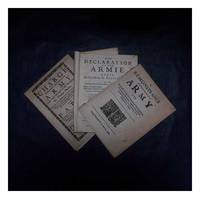
1647413058London : Printed for B.A. ; Printed by the appointments of the Officers ; Printed for Laurence Chapman 1647. First Edition. Softcover. Good set of pamphlet copies; edges slightly nicked and dust-toned as with age. Remain surprisingly well-preserved overall; bright and clean. Physical description; 3 pamphlets dis-bound as issued: paged and unpaged 8; 14 7 pages ; 18 cm. Notes; Full titles: A Remonstrance of the representations of the army for redresse of the grievances of the kingdom : With certain remedies humbly remonstrated to the Parliament for the setling of the kingdome in peace Iune 21. 1647 --- The Declaration of the armie under his Excellency Sir Thomas Fairfax as it was lately presented at Saffron-Walden in Essex unto Major-Generall Skippon.and Colonell Fleetwood members of the House of Commons and Commissioners there for the Parliament. by Colonell Whaley.and Major Disborow with the names of two hundred thirty more Commission-Officers annexed; which declaration is to manifest and set forth to them they being Members of Parliament and of the Army the Armies reall love and diligent care to discharge that duty for which they were raised as will manifestly appeare in time to all that wish well to mercy peace and justice 1647 --- A Charge delivered in the name of the Army under the command of His Excellency Sir Thomas Fairfax unto the commissioners of Parliament with the Army at S. Albans June 14. 1647. : and by them sent up to the Parliament against several members of the Honorable House of Commons. Also a paper delivered to the said commissioners of Parliament June 15. from his Excellency Sir Tho: Fairfax and the Army under his command of some farther humble proposals and desires to the Honorable Houses of Parliament. Printed and published by the appointment of his Excellency Sir Tho: Fairfax and the officers and soldiers of the Army under his command. St. Albans June 17 1647. Signed by me John Rushworth. Subjects; Petitions Resolutions. England and Wales. Army ; Early works to 1800. Great Britain History Civil War 1642-1649 ; Early works to 1800. Great Britain Politics and government 1642-1649 ; Early works to 1800. England and Wales. Parliament Expulsion ; Early works to 1800. Impeachments England ; Early works to 1800. London : Printed for B.A. ; Printed by the appointments of the Officers ; Printed for Laurence Chapman paperback
1611110639(Wohl Nürnberg), Kilian, datiert 1611. 18,5 x 13 cm. Beschnitten bis zum oder über den Plattenrand. In älterer Zeit an den Ecken auf kartoniertes Papier montiert.
162165315Siena, H. Gori, 1621. Qu.-4°. Mit rad. illustr. Titel, einer rad. Portraittafel, einem rad. ganzs. Portrait, 54 blattgr. Radierungen. 2 Bll., 315 (recte 321) (1) S., Ldr. d. Zt. m. goldgepr. Eckfleurons, Rückenverg., goldgepr. Rückenschild, Stehkantenverg. u. Rotschnitt.
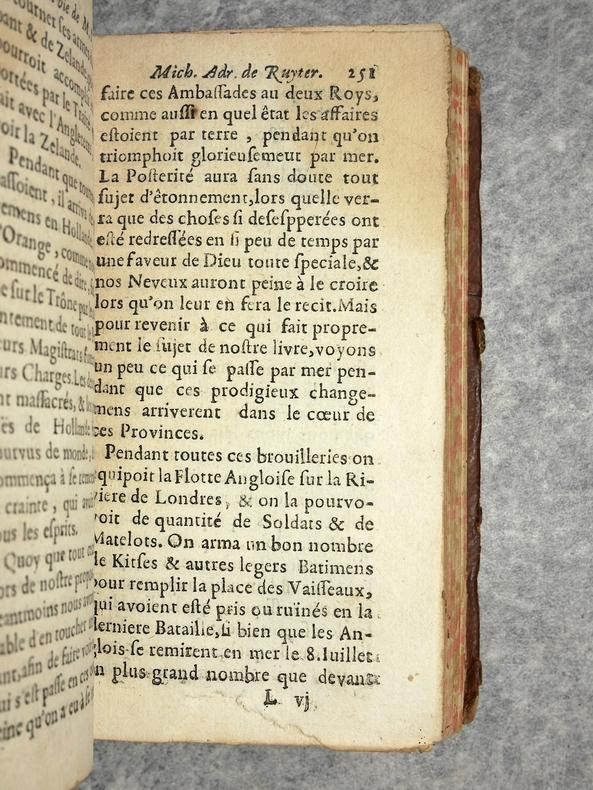
16773682A AMSTERDAM. CHEZ HENRY & THEODORE BOON. 1677. 2 VOLUMES PETIT IN-12 (9 X 14,5 X 6,5 CENTIMETRES ENVIRON) DE (18) + 408 ET 453 PAGES, RELIURE D’EPOQUE PLEIN VEAU BRUN, DOS A QUATRE NERFS ORNE DE CAISSONS A FLEURONS DORES, ROULETTE DOREE SUR COUPES, TITRE DORE, TRANCHES MOUCHETEES ROUGES. ILLUSTRE D’UN PORTRAIT EN FRONTISPICE. TRACES D'USURE EXTERIEURE, PETIT MANQUE DE PAPIER EN MARGE INFERIEURE D’UN FEUILLET DU TOME 2 (PAGES 251-252), SANS AUCUNE ATTEINTE AU TEXTE, SINON BON EXEMPLAIRE.
1660140845ca. 1660. Format (Platte): 210 x 165 mm, bis an die Plattenkante beschnitten.
1690126431(Antwerpen, ohne Datierung, ca. 1690). Format (Platte): 243 x 164 mm. Blattgröße: 375 x 235 mm.
1660158438(Antwerpen, ca. 1660). Format (Platte): 243 x 164 mm. Blattgröße: 380 x 270 mm.
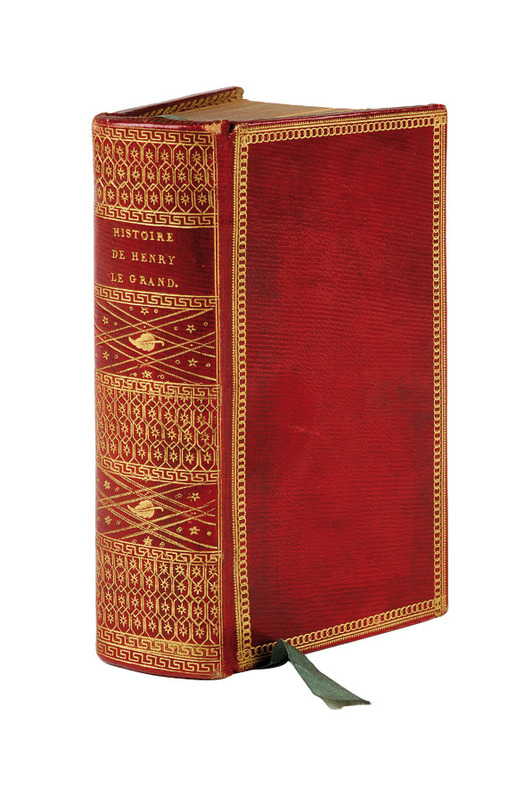
166417474Amsterdam, Daniel Elsevier, 1664; in-12, maroquin rouge, dos lisse à faux nerfs dorés, entièrement décoré et doré «à la Bozérian», roulettes d'encadrement des plats, filet sur les coupes, roulette d'intérieur, tranches dorées (sort très probablement de l'atelier des Bozérian) ; (6) ff. y compris le frontispice gravé et le titre, 566 pp. , (10) ff. , le dernier blanc, Henry le Grand au Roy. Poème par Cassagnes.
1660158443(Antwerpen, ca. 1660). Format (Platte): 243 x 157 mm. Blattgröße: 380 x 270 mm.
1700160897Um 1700. Format: 31 x 22 cm. Bis an den Bildrand beschnitten und an 2 Ecken alt auf Untersatzpapier montiert.
16861235701686 A Cologne, Chez Jean de Clou, 1686 - Seconde édition - 1 volume in-12; reliure pleine basane; dos à 5 nerfs; titre et filets en dorés (effacés par le temps) - 392 pages
1699910144CGZürich:, 1699. Kupferstich, Plattengröße 19,5 x 29,5 cm, Blattgröße 23 x 35,5 cm.
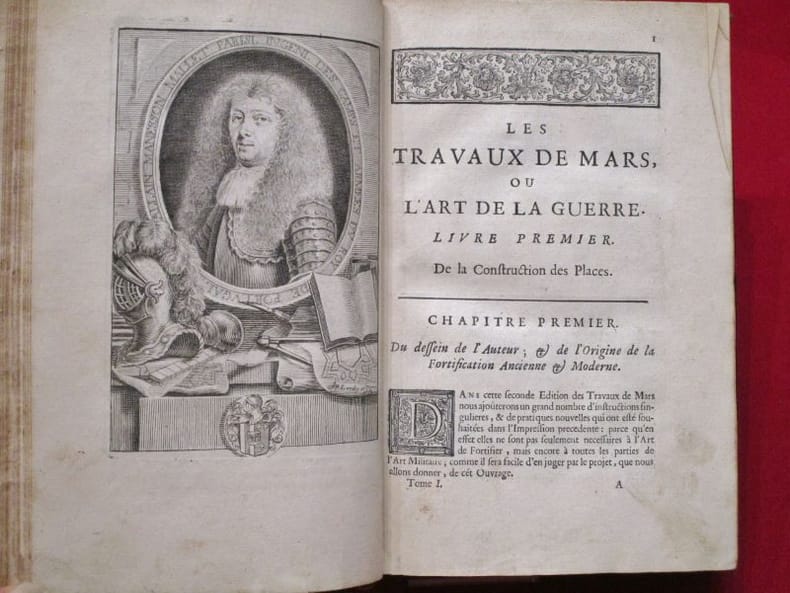
1685114486Denys thierry 1685 A Paris, Chez Denys Thierry, 1685, 1 volume in-8 de 135 x 215 mm, (12) ff., 363 pages, (2) ff. (Table). Tome I seul sur 3, contient 2 frontispices et 155 planches. Pleine reliure d'époque, dos à 5 nerfs portant tires et tomaisons dorés, roulette dorée sur les coupes, gardes blanches. Coiffes, coins et un mors abimés, quelques manques de cuir, quelques rousseurs, de rares déchirures en marge (sans atteinte au texte), bon état général.
169053646Ohne Ort, um 1690. Platte ca. 18 x 13 cm, Blatt ca. 20,5 x 15 cm. 1 Blatt, verso weiß.
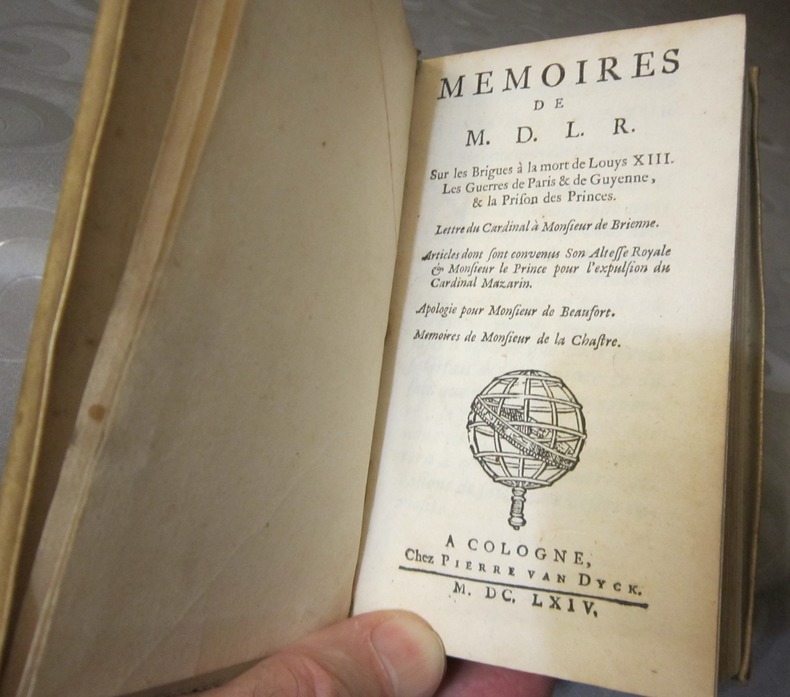
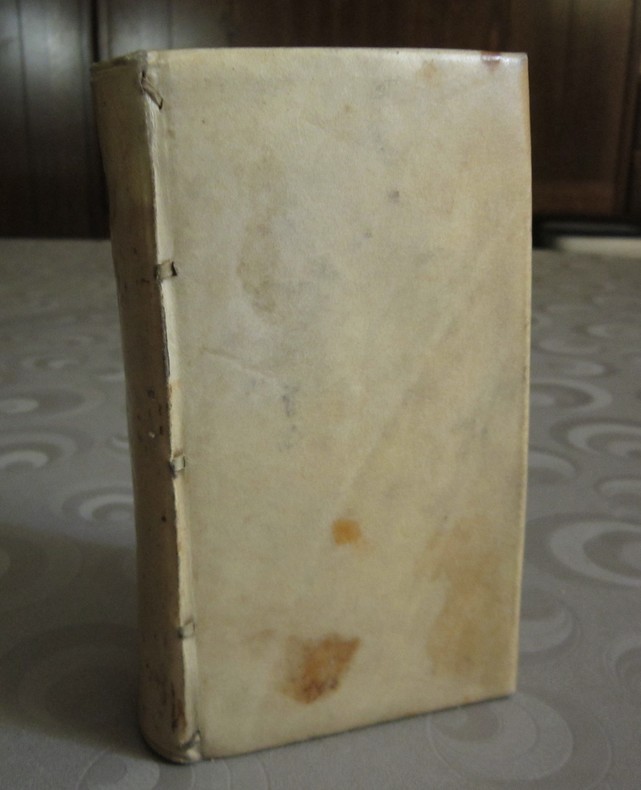
1664003335A Cologne, Chez Pierre van Dyck (Bruxelles, Foppens). in-12 (13,5 x 8 cm), 2 ff., 400 pp., reliure d'époque vélin ivoire à recouvrement, auteur, titre et date calligraphiés sur le dos, tranches jaspées et tête rouge. Sphère sur le page de titre.
1669003341A Cologne, chez Pierre Van Dyck. in-12 (13,8 x 8,2 cm), 2 ff. (titre et avis au lecteur), 400 pp., reliure d'époque vélin ivoire à recouvrement, dos muet, tranches jaspées, sphère sur le page de titre. (petites taches sur le vélin)
1700125431ca.1700. Format (Platte): 203 x 158 mm. Blattgröße: 230 x 163 mm