9 442 résultats
19192092902143801436Kinzashi Houryu-do Kanda district Tokyo 1919. Soft Cover. Fine. Number of books: 1 book Kinzashi Houryu-do (Kanda district, Tokyo) paperback
19212080202105600515Not Available 1921. Soft Cover. Fine. The book is in fine condition. Not Available paperback
38668London John Murray 1915. . Square 12mo. pp. xxviii260 brown cloth black lettering b/w illustrations fold-outs and tables advertisement pages to endpapers light toning and soiling to margins rubbed to extremities lightly creased to spine a very good copy. No dust-jacket. London, John Murray, 1915. hardcover
19432091502135700009Dainihon Educational Book 1943. Soft Cover. Fine. The book is in fine condition. Dainihon Educational Book paperback
19352091502135704160Army War Mountain College General School Assembly Hall 1935. Soft Cover. Fine. The book is in fine condition. Army War Mountain College General School Assembly Hall paperback
19422080302106808994National Association for the Advancement of Education 1942. Soft Cover. Fine. Number of books: one National Association for the Advancement of Education paperback
16446Identified and dated 1870 in another early hand on lower margin. unknown
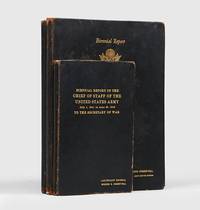
1943190146Washington: United States Government Printing Office 1943-45-46. Presentation copies from General George Marshall to his "miracle worker" General Brehon B. Somervell A complete set of the original official US Army wartime reports handsomely produced the personal copies of General Brehon Burke Somervell 1892-1955 George Marshall's commander of Services of Supply the first two being presentation copies from Marshall the cover of each volume gilt lettered with Somervell's name and rank. Services of Supply was one of the three "superagencies" organized by the US Army after the United States's entry into the war in December 1941 - the other two being Army Ground Forces and Army Air Forces - and gathered under its overarching aegis Quartermaster Corps Chemical Warfare Service Signal Corps Corps of Engineers Ordnance Department Medical Corps and Transportation Corps. "General George C. Marshall the army's chief of staff during World War II held Somervell in high regard for his ability to perform monumental tasks and was willing to overlook his penchant for antagonizing others. "What he did was a miracle" said Marshall in a postwar interview. The U.S. Army in World War II was probably the best-supplied army that had ever gone to war. Much of the credit for that accomplishment goes to Somervell who provided the "sinews of war" for a military effort that literally spanned the globe" American National Biography. Somervell is mentioned directly by Marshall in his concluding remarks to the first volume where he notes "The requirements of logistics are seldom understood. The burdens they impose on the responsible military authorities are rarely appreciated. The conflicting demands of our theater commanders of Allied sovereign powers and of the home front pose difficulties never before approximated in war. The necessity for a high degree of efficiency in management is evident and it has been found in the coordination of all the various supplies and administrative departments of the Army under the command and leadership of Lt. Gen. Brehon B. Somervell. "Published at two-year intervals these reports provide a comprehensive picture of global war as seen from the perspective of the Chief of Staff. The first report describes the race to mobilize an unprepared country and Marshall's appeal on the eve of war for the renewal of Selective Service a reminder of how far the U.S. Army had to come to meet the Axis challenge. The second recounts the initial defeats after Pearl Harbor and the ultimately successful efforts of the United States and its Allies to turn the tide. The final report describes the drive to victory and outlines Marshall's analysis of the reasons for the Allied triumph. Summaries give an overall view of the progress of the war but the scholar and military professional will find most interesting Marshall's comments on such topics as technology the "90-division gamble" the replacement system troop morale and the citizen-soldier and demobilization. These comments and the other material presented in the reports provide not only a fresh perspective on the myriad problems of conducting a global war at the highest levels but also renewed appreciation for the man whom Churchill appropriately called 'the organiser of victory'" Brigadier-General John W. Mountcastle foreword to the 1996 Center of Military History edition. This is a set of the scarce original edition produced by the United States Government Printing Office in Washington; trade editions were also produced by the Infantry Journal Press in the US and HMSO in Britain. The set comprises: Biennial Report of the Chief of Staff of the United States Army July 1 1941 to June 30 1943 to the Secretary of War. Octavo pp. v 56. 6 folding maps and 19 folding charts. Presentation copy from General George Marshall inscribed on a preliminary blank: 'To General Somervell with appreciation and warm regard G. Marshall". Biennial Report of the Chief of Staff of the United States Army to the Secretary of War July 1 1943 to June 30 1945 to the Secretary of War' Quarto pp. iii 123. bound with the supplementary Atlas of World Battle Fronts in Semimonthly Phases to August 15 1945 pp. 101. Presentation copy from General George Marshall inscribed on a preliminary blank: "Dear Somervell - Please accept this copy of my final report as Chief of Staff with appreciation of your tremendous service to the army and support of me with my affectionate regards - G. Marshall October 5 1945". Report by the Supreme Commander to the Combined Chiefs of Staff on the Operations in Europe of the Allied Expeditionary Force 6 June 1944 to 8 May 1945. Quarto pp. x 123. Several colour maps. 3 vols one octavo 232 x 135 mm 2 quarto 305 x 210 mm. Contemporary black pebble-grained skiver gilt lettered on front covers first 2 vols with dark blue vertical-rib cloth endpapers third with white moiré silk-effect endpapers. Bindings a little worn at extremities some mottling to covers scattered foxing otherwise very good. hardcover
53304050-nnew. unknown
53304050like new. unknown
1462027237.Ghardcover. Good. Access codes and supplements are not guaranteed with used items. May be an ex-library book. hardcover
2011SONG1462027237iUniverse 2011-08-16. First Edition. hardcover. Used: Good. 6.00x1.56x9.00. Buy with confidence. Excellent Customer Service & Return policy. iUniverse hardcover
1939192368Edinburgh: 1939-45. Digging for victory A small but evocative collection tracing the war work of the artist Mary Paton who served with the Women's Land Army in Scotland throughout the Second World War. The highlight of the collection is a pair of standard-issue corduroy breeches made by Redman Bros in January 1943. Other than a couple of small oil stains to the right inner thigh they are well-preserved and have been supplemented with non-standard leather reinforcing patches to the inner knees. Two certificates in the collection are addressed to "Frances M. R. Paton" the full name of Mary Paton 1920-1990 who studied at the Edinburgh College of Art before and after the war and later lived in Aberdeenshire. A letter of thanks records her service as having lasted from 11 October 1939 to 10 October 1945 while the two WLA armbands show her service at 3 1/2 and 5 1/2 years respectively. The collection also includes two enamelled WLA lapel badges and a silver gelatine photograph 86 x 57 mm showing a young woman with "Mave. Freiburg '37" inscribed on the verso. Together eight items. One certificate with storage folds overall in very good condition. hardcover
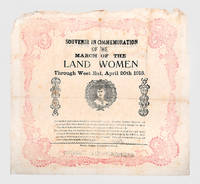
1918170820London: Sarah Burgess 1918. An ephemeral piece of wartime memorabilia A souvenir tissue napkin advertising a parade through London of the Women's Land Army intended to promote the organization and encourage agricultural volunteers. Napkins were commonly printed for large public ceremonies: "the most spectacular napkins were the souvenir issues of Mrs S. Burgess of London who created items for various historical and period events" Florey p. 108. The march was an enormous undertaking consisting of over 200 women and farmers: "the war has afforded many stirring spectacles in the streets but these processions could hardly be excelled for picturesqueness or the appeal they made to national gratitude" The Times p. 4. The focus of the procession was promoting agricultural pursuits; the women were flanked by a myriad farmyard animals hay-balers and tractors. Recruitment speeches were delivered imploring women to support troops abroad by ensuring that industry and agriculture were appropriately maintained at home. "The soldiers are giving their lives for England. All that we ask of you girls is to give one year of your lives in the Land Army in the same noble cause" ibid. Known as "Auntie" in the trade Sarah Burgess operated from premises in Bishopsgate and later off the Strand as here advertising as a "manufacturer of paper switches cut tissues lace paper and shelf trimmings & confetti and stationer wholesale and export" Crawford. The napkin squares were imported into London from Japan already printed with a decorative border in up to five colours and a blank central area. After being printed with the appropriate commemorative design they were sold for about one penny by street traders lining the route of the event. Burgess was particularly involved with producing commemorative napkins for the suffrage movement including for the march to the House of Commons on 29 June 1909 the Suffrage Coronation Demonstration on 17 June 1911 and Emily Wilding Davison's internment in Morpeth on 14 June 1913. However "the WSPU had mixed feelings about Burgess's efforts. Disturbed by her producing an 'unauthorized official programme' for the June 29 event they nevertheless pointed it out as an example of 'how the movement interests the public'. Mrs Burgess's products demonstrated quite clearly how important the concept of a suffrage 'souvenir' or collectible had become to suffrage sympathizers who wanted to retain a tangible memory of a major event that they might have participated in" ibid. Square of plain crepe paper 325 x 360 mm. Central printed illustration depicting a portrait of Queen Mary of Teck set within oak and laurel leaves and flanked by two scrollwork motifs surrounded by decorative floral border printed in red. Some nicks and creases at extremities mostly to top edge gently creased from folding and a couple of small damp stain patches offset from ink lettering; overall a very good and intact example of a fragile product. Elizabeth Crawford "Ephemera: Mrs Sarah Burgess Printer" Woman and Her Sphere blog 12 Sep. 2019 accessible online; Kenneth Florey Women's Suffrage Memorabilia: An Illustrated Historical Study 2013; "Women War Workers. Munition Makers at St. Paul's. Land Army Procession" The Times 22 Apr. 1918. unknown
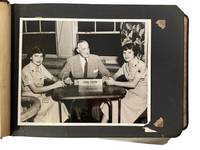
1950231531950. WACKorean War Women's Army Corps photo album compiled by Sgt. Elizabeth Adamek of Cairnbrook PA ca. early to mid 1950s extensively recording enlisted women in post-1948 U.S. Army administrative operations at Camp Zama Japan during the Korean War period. Elizabeth Adamek later Elizabeth Adamek Pierce 1932-2016 served approximately twenty years in the United States Army as an administrative assistant and instructor including service in Japan and the Korean Theater during the Korean War. Adamek is shown several times in uniform with her twin sister Cpl. Cristania Adamek indicating the sisters served in the WAC around the same time period. This album documents postwar U.S. Army overseas base administration showing how clerical labor recordkeeping and office management were carried out by WAC personnel during the Korean War. Images of Hill and fellow servicewomen engaged in office work reveal women's roles in the Army's daily bureaucratic and logistical functions while stationed abroad. A comprehensive primary-source documentation of the operational role of women within permanent peacetime Army structures following the formal establishment of the Women's Army Corps in 1948.<br /> <br /> Photo archive of approximately 240 silver gelatin photographs from Camp Zama Japan and the United States circa early to mid 1950s. The album is housed in a Japanese lacquer-style postbound binding with black paper leaves containing a mixture of small snapshot prints deckle-edge photographs and larger mounted images. The visual content centers on Hill frequently shown in WAC uniform posed in front of barracks administrative buildings and landscaped areas as well as inside office environments seated at desks surrounded by stacked files paperwork and card index systems. Several images explicitly depict clerical workspaces including a servicewoman operating a typewriter beside filing drawers reinforcing the administrative function of WAC personnel. A clearly legible building sign reads "Camp Zama 8030th Army Unit APO 50" situating the album within a specific military unit structure. Additional photographs include formal military reviews with officers and dignitaries group portraits of uniformed women before display walls and social scenes in dining facilities and clubs. Off-duty life is extensively documented through images of Japanese urban streets market stalls rail platforms commercial signage shrine gateways temple architecture zoo enclosures and landscaped gardens alongside recreational scenes such as swimming roadside travel and barracks exteriors collectively illustrating both the operational and social dimensions of overseas Army life. Adamek is posed throughout the album with a romantic partner one Sgt. Kidder whose service at Camp Zama is also documented extensively.<br /> <br /> The album captures the workings of U.S. Army overseas base administration demonstrating the process by which women in the Women's Army Corps sustained military infrastructure through administrative labor. Camp Zama functioned as a major logistical and support installation during the Korean War era and the photographs provide insight into the women that maintained its operations while also recording the social networks and cultural encounters experienced by American service personnel in postwar Japan.<br /> <br /> Elizabeth Adamek Pierce's obituary in The Oklahoman indicates she was honorably discharged from the US Army in 1971 after which she relocated to Oklahoma City and worked in an administrative role with the OKC Police Department. Adamek was a member of the Civil Air Patrol the VFW Post 1335 and a volunteer at Tinker Air Force Base in Oklahoma City. Light edge wear and chipping to album leaves occasional corner wear scattered fading and softness to prints and general handling wear to the binding; overall good condition. A cohesive and well-identified visual record of women's military service in the U.S. Army in East Asia. unknown
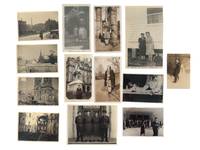
1945214301945. WWII era Women's Army Corps photo archive documenting servicewomen including two African Americansand four partially identified individuals. Creation of the WAC in 1942 marked the first permanent institutional incorporation of women into the U.S. Army placing female personnel into administrative communications intelligence and logistical roles across both domestic bases and overseas commands. One photograph identified on the verso as "Gynnie Polly Corsica '45" provides additional documentation of Black women serving overseas in segregated Army units during the final year of the war.<br /> <br /> Archive of 18 silver gelatin photographs from W.W.II. Photographs measure approximately 3 x 2 inches to 6 x 3.5 inches. The images depict American servicewomen in a range of wartime contexts including official uniform portraits informal snapshots and scenes taken in European cities damaged by combat. Several photographs show women wearing standard WAC dress uniforms with garrison caps and enlisted insignia while others depict personnel wearing British style battledress associated with American administrative units stationed in Europe. One photograph shows three uniformed personnel two women and one man standing at attention before a formal government building likely in Britain. Another image places a uniformed American servicewoman before the gilded equestrian statue of Joan of Arc in Paris a landmark associated with Allied presence in liberated France. Additional photographs depict ruined urban landscapes with bombed churches and collapsed structures suggesting scenes from Germany or France shortly after liberation. A photograph inscribed "Chattanooga Tenn." shows a woman standing in civilian clothing at the entrance of a home indicating a stateside context connected to the servicewoman's life before or after deployment. Another photograph labeled "Ann & Lillie Mother" shows two women standing outside a residence likely relatives of one of the servicewomen. <br /> <br /> Women's military service expanded rapidly during World War II as the War Department created organizations such as the Women's Army Corps and the Navy's WAVES to address labor shortages across the armed forces. Overseas deployments placed WAC personnel in newly liberated European cities and military headquarters throughout the Allied command structure. Light toning minor edge wear and occasional handling marks. Overall very good condition. Although African American women served within segregated units their participation in overseas assignments including Mediterranean theater postings marked a significant shift from earlier military policy which had typically limited Black women's service to domestic assignments within segregated support units. unknown
0282101764.Gpaperback. Good. Access codes and supplements are not guaranteed with used items. May be an ex-library book. paperback
1334649022.Gpaperback. Good. Access codes and supplements are not guaranteed with used items. May be an ex-library book. paperback
19378079H81220NY: Paisley. Inked name on endpaper. . Acceptable. Hardcover. First Edition. 1937. Paisley hardcover
1505339537.Gpaperback. Good. Access codes and supplements are not guaranteed with used items. May be an ex-library book. paperback
1990S25624USA: WOLFE LIBARY CLASSICS 1990. HARDCOVER. MINT/N0 JACKET. USA: WOLFE LIBARY CLASSICS 1990. MINT/N0 JACKET. Wolfe Library Classics USA 1990 based on 1934 edition hardcover limited edition #1263 of 1500 near fine book appears unread no jacket as issued satin page ribbon cloth with 1/4 leather binding unmarked not remaindered bookclub or library all pages gilded beautiful and collectible WOLFE LIBARY CLASSICS hardcover
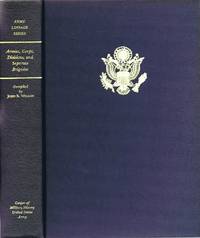
198730555Washington D. C. : Center of Military History United States Army. 1987. Stated First Edition. First Printing. Hard Cover. Near Fine in No DJ As Issued dust jacket. Publisher's full blue cloth gilt lettering on spine and on black panel on spine US Eagle medallion on cover. Profusely illustrated with full-color photographs of the heraldic symbols insignia for each army corps division and brigade. Page edges only very lightly browned but pages supple all text and illustrations clean and bright; else fine; unmarked unread tight square and clean. A large heavy book - additional shipping charges may apply particularly for expedited or international shipment. NEAR FINE. Army Lineage Series. Insignia. Small 4to 9" - 11" tall. xx 736 pages . Center of Military History, United States Army hardcover
1999Q-0160499925Department of the Army 1999-08-25. Paperback. New. New. In shrink wrap. Looks like an interesting title! Department of the Army paperback
243375 May 1896; on leterhead of 130 Edgeware Road London W. See his entry in the Oxford DNB. The Church Army still active today was founded in 1882 as a Church of England equivalent to the Methodists’ Salvation Army. From the papers of the recipient Wilfred Seymour De Winton of Haverfordwest. 3pp 12mo. On a bifolium of grey paper. In good condition lightly aged. Signed ‘W Carlile / Hon. Chief Sec.’ To the left of the signature in the bottom-left of the recto of the second leaf is a purple ink stamp of the following: ‘WRITTEN BY ONE OF OUR POOR STRUGGLING LABOUR HOME BROTHERS’. He begins what is undoubtedly one of many such letters he had to write: ‘Dear Mr De Winton / The Vagrant Criminal and Inebriate Classes a seething mass of our fellow men look to us as the hand of the Church held out to give them a last chance.’ While many could ‘get a fresh start in life after 2 or 3 months staying in one of our Labour Homes the lack of funds compels us day by day to refuse numbers of genuine helpable persons’. He stresses that the homes ‘are not Shelters and are limited to 25 Inmates men women and youths all received irrespective of creed’. He states that 51 1/2 per cent of those who passed through the institutions in the year 1895 ‘obtained a fresh start’ and that the organisation requires ‘£100000 annually’. ‘The financial burdens come heavily on us who nearly all work without any pay.’ He asks if De Winton can help them ‘regain by labour & religion many rapidly sinking into the vortex of crime and misery.’ 5 May 1896; on leterhead of 130 Edgeware Road, London W. unknown
181400535755Eastburn Kirk and Co 1814. First Edition. Hardcover. Very Good/No Jacket. 8vo - over 7¾" - 9¾" Brig Gen. Duncan McArthur's Orders to Attend General Hull's Court Martial A remarkable document from the Court Martial Brig. General William Hull following his surrender of Detroit which resulted in a death sentence for cowardice. Although his sentence was later remitted General William Hull is the only U.S. general to be sentenced to death by an American court-martial. This copy of the court martial transcript belonged to Hull's second in command Brig Gen. Duncan McArthur and includes the actual hand-written orders commanding him to attend and testify. McArthur's testimony was an essential and central part of the trial filling the entirety of pages 47 to 73. In it as well as numerous contemporary accounts his outrage against Hull's conduct as Commander of the Army of the Northwest during the War of 1812 including the entire campaign in and around Detroit which ended with Hull's surrender not only of Detrit and the forces directly under his command but for some reason of detached troops under McArthur's command which particularly enraged McArthur. Tipped in is the handwritten order a letter of summons from Inspector General Abimael Youngs Nicoll to Brigadier General Duncan McArthur commanding his appearance at General Hull's court martial letter is dated December 2nd 1813 and includes the folded envelope addressed to McArthur. Duncan McArthur 1772-1839 Brigadier General later Governor of Ohio. 156pp. 177 29pp. appendices. Rebound in black cloth gilt title on spine. Light foxing in places; cloth has light surface wear else a Very Good copy. The President of the Court was Major General Henry Dearborn and the special Judge Advocate was Martin van Buren later President of the United States. There is a signature on the title page somewhat reminiscent of Van Buren's during this period appearing to read 'M.v.B illegible'. Additional provenance: Later the property of Brig. General Thomas McArthur Anderson copy grandson of Brig Gen. Duncan McArthur with his signature to the title page pg. 19 and the last page of text. General Anderson had four decades of decorated service 1861-1900 extending from his rise to brevet rank of Lt. Colonel during the Civil War to command of the Army force sent to Skagway and Dyea Alaska to protect American miners heading to the Klondike Gold Rush to his command of the first 'Philippine Expeditionary Force' during the Spanish-American War. During the Philippine campaign he was promoted to the brevet Major General of U.S. Volunteers two stars and retired as a Brigadier General. Eastburn, Kirk and Co hardcover