9 442 résultats
194833971Washington DC: GPO 1948. First Edition. First Printing. good. 324 v.8 only illus. maps pencil erasure on front endpaper boards somewhat worn and soiled. GPO hardcover
194833970Washington DC: GPO 1948. First Edition. First Printing. fair. 921 v.7 only maps fold-out plates at rear front board weak shaken bottom corner dinged and bumped. GPO unknown
194833967Washington DC: GPO 1948. First Edition. First Printing. good. 693 v.5 only illus. maps pencil erasure on front endpaper. GPO unknown
194833966Washington DC: GPO 1948. First Edition. First Printing. good. 743 v.3 only pencil erasure on front endpaper press release laid in. GPO unknown
194833969Washington DC: GPO 1948. First Edition. First Printing. good. 563 v.6 only illus. maps some wear and soiling to boards pencil erasure on front endpaper. GPO hardcover
19742507230073U.S. Department of the Army; 1974. First Edition. Hardcover. Very Good. 21 volumes. A large collection of Army Studies on the Vietnam War. Most volumes softcover 3 hardcover. Good binding and cover. Clean unmarked pages. Includes: 1. Medical Support of the US Army in Vietnam 1965-1970 Spurgeon H. Neel 2 copies; 2. Airmobility 1961-1971 John J. Tolson; 3. The development and training of the South Vietnamese Army 1950-1972 James Lawton Collins Jr.; 4. U.S. Army Special Forces 1961-1971 Francis J. Kelly; 5. U.S. Army Engineers 1965-1970 Robert R. Ploger 2 copies; 6. Riverine Operations 1966-1969 William B. Fulton; 7. Allied Participation in Vietnam Stanley Robert Larsen James Lawton Collins Jr.; 8. Base Development In South Vietnam 1965-1970 Carroll H. Dunn; 9. Logistic Support Joseph M. Heiser Jr.; 10. Field Artillery 1954-1973 David Ewing Ott; 11. The War in the Northern Provinces 1966-1968 Willard Pearson; 12. Tactical and Material Innovations Hay; 13. Seven Firefights in Vietnam John A. Cash Allan W. Sandstrum John Albright; 14. Communication-Electronics 1962-1970 Thomas Matthew Rienzi; 15. Air Base Defense in the Republic of Vietnam Roger Fox; 16. Law at War: Vietnam 1964-1973; 17. Financial Management Taylor; 18. The Role of Military Intelligence 1965-1967 Joseph A. McChristian; 19. Cedar Falls-Junction City: A Turning Point Bernard W. Rogers; 20. Sharpening the combat edge: the use of analysis to reinforce military judgment. <br> This is an oversized or heavy book which requires additional postage for international delivery outside the US. U.S. Department of the Army; hardcover
1396567836.Ghardcover. Good. Access codes and supplements are not guaranteed with used items. May be an ex-library book. hardcover

1391563816.Gpaperback. Good. Access codes and supplements are not guaranteed with used items. May be an ex-library book. paperback
1396851445.Ghardcover. Good. Access codes and supplements are not guaranteed with used items. May be an ex-library book. hardcover
1396851283.Gpaperback. Good. Access codes and supplements are not guaranteed with used items. May be an ex-library book. paperback
1396851453.Ghardcover. Good. Access codes and supplements are not guaranteed with used items. May be an ex-library book. hardcover
1396851275.Gpaperback. Good. Access codes and supplements are not guaranteed with used items. May be an ex-library book. paperback
195836365Fort Monroe VA: U.S. Continental Army Comm 1958. good. 144 wraps glossary page change taped in at p.72 ink & marker notations on front cover several marks & underlining to text. This is a scarce and early Cold War example of training and doctrine development. This manual was published with the view of incorporating its provisions in a joint departmental level publication. U.S. Continental Army Comm paperback
054722USA: US Army. Hard Cover - Binder. Near Fine/No Jacket. 4to - over 9¾" - 12. 20-ring binder; HB beige w/white&blk.; slight rub w/cleantight pgs. Illustrated descriptions of 48 Army bases from Aberdeen Proving Ground to White Sands Missile Range. color photos&maps. <br/> <br/> US Army? hardcover
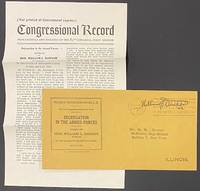
1951186401951. Dawson William L. African American congressman from Chicago and World War I veteran of the segregated 366th Infantry Regiment House of Representatives speech delivered April 13 1951 addressing segregation in the United States armed forces during the early years of the Cold War. Dawson served in Congress for nearly three decades and became the first African American to chair a congressional committee. His speech was delivered during a critical period in the history of American civil rights and military policy following President Harry Truman's 1948 Executive Order 9981 directing the desegregation of the armed forces. Debates in Congress during the early 1950s addressed the pace and implementation of integration and Dawson used the floor of the House to argue that racial segregation contradicted the principles for which American soldiers fought.<br /> <br /> Dawson William L. "Segregation in the Armed Forces." Speech of Hon. William L. Dawson of Illinois in the House of Representatives April 13 1951. Congressional Record 82nd Congress First Session. Single printed sheet measuring approximately 6 x 9 inches preserved with original mailing envelope. The printed text reproduces Dawson's remarks opposing segregation within the military establishment. In the speech Dawson declared: "If there is one place in America where there should not be segregation that place is in the armed services among those who fight for this country." He continued with a broader appeal to constitutional ideals and national unity: "I would give up this life of mine to preserve this country and every American in it white or black. Deny to me today if you will all that American citizenship stands for I will still fight to preserve our Nation knowing that someday under the Constitution of the United States all of these restrictions will be removed and that we will move forward before the world as one people American people joined in a democracy which shall set the pattern for all the world."<br /> <br /> Dawson's remarks formed part of the ongoing political struggle over civil rights and military policy during the early Cold War. The Korean War had begun the previous year and questions about equality within the armed forces remained under active debate as the military implemented Truman's desegregation order. Dawson's own wartime service in a segregated unit during World War I informed his critique of racial discrimination within the military establishment. As a senior African American political leader in Congress his advocacy contributed to broader legislative and political pressure supporting the continued dismantling of segregation in the armed forces. Minor wear consistent with age; overall condition very good. unknown
3380792like new. unknown
3190896like new. unknown
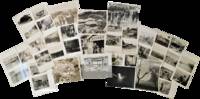
1945189141945. U.S. Army and Navy photographs of Okinawa 1945 document the immediate aftermath of the Battle of Okinawa and the establishment of American control over a strategically critical island at the close of the Pacific War. The images place American troops within the Okinawan interior and along coastal installations following the April 1945 landings including the secured Yontan airfield a primary objective of the invasion. The archive records the physical destruction resulting from one of the war's most intensive campaigns alongside scenes of civilian movement and return situating the photographs within the transition from active combat to military occupation.<br /> <br /> Archive of 37 black and white silver gelatin photographs. Okinawa Japan circa 1945. Photographs measure approximately 3.75 x 4.5 inches to 7 x 10.5 inches with brief handwritten captions on verso. Images depict American troops in villages farmland and near shrines as well as at Yontan airfield. Several photographs show destroyed aircraft including a crashed Japanese plane and associated debris along with damaged infrastructure and equipment. Naval activity is represented through images of American ships in harbor and offshore including a landing ship dock LSD transport vessel. An aerial photograph shows a harbor with multiple wrecked ships and flattened industrial areas. One image documents a column of civilians carrying belongings captioned "civilians returning to homes."<br /> <br /> The Battle of Okinawa fought from April to June 1945 resulted in extensive military and civilian casualties and widespread destruction of the island's infrastructure. The subsequent American occupation transformed Okinawa into a major U.S. military base in the western Pacific a status it retained even after reversion to Japanese administration in 1972. These photographs document both the operational objectives of the invasion and the conditions encountered in its aftermath including the displacement and return of local populations. The archive provides material for examining military strategy occupation practices and the impact of large-scale warfare on civilian landscapes in the Pacific theater. Light wear consistent with handling; overall very good condition. unknown
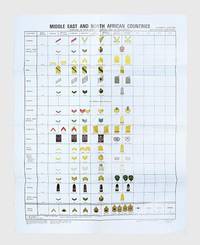
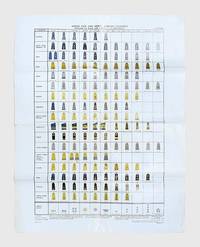
1982178862Washington DC: Defense Intelligence Agency January 1982. A poster comparing the enlisted ranks of US army to that of 17 Middle Eastern countries from basic private through to W-4 chief warrant officer. They were never distributed to the public and were marked to be destroyed after they became outdated. This was as part of a series featuring various militaries from around the world; other examples include the NATO countries and the Asian and Pacific countries. It covers Algeria The Arab Republic of Egypt Iran Iraq Israel Jordan Kuwait Lebanon The Libyan Arab Republic Morocco Oman Saudi Arabia South Yemen People's Democratic Republic of Yemen Sudan Syria Tunisia and the Yemen Arab Republic. Colour poster 555 x 430 mm folded as issued. Bright a few small creases two small pinholes: a very good example. unknown
1979178863Washington DC: Defense Intelligence Agency January 1979. A poster comparing the officer ranks of the US air force to that of 17 Middle Eastern countries from 2nd lieutenant through to general of the air force. They were never distributed to the public and were marked to be destroyed after they became outdated. This was issued as part of a series featuring various militaries from around the world; other examples include the NATO countries and the Asian and Pacific countries. It covers Algeria The Arab Republic of Egypt Iran Iraq Israel Jordan Kuwait Lebanon The Libyan Arab Republic Morocco Oman Saudi Arabia South Yemen People's Democratic Republic of Yemen Sudan Syria Tunisia and the Yemen Arab Republic. This is marked as chart 3 of 3 the other two possibly showing the comparative officer ranks of the army and navy. Colour poster 555 x 430 mm folded as issued. Bright a few small creases split along fold not touching printed area a few pinholes: a very good example. unknown
2004Q-0787970832Jossey-Bass/Leader to Leader Institute 2004-03-02. Hardcover. New. In shrink wrap. Looks like an interesting title! Jossey-Bass/Leader to Leader Institute hardcover
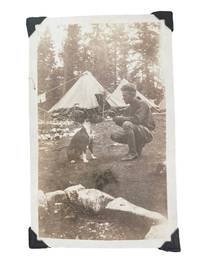
1918232501918. World War I Fort Bliss soldier training and camp life photo album from El Paso ca. 1918 recording the rapid wartime expansion of a border post into a large World War I training environment through tent rows drill formations truck convoys gas-mask instruction and group portraits of enlisted men in uniform. The album grounds that setting in specific internal evidence including the handwritten caption "Thanksgiving Ft. Bliss Texas 1918" beneath a group portrait the tent sign "Ambulance Company No. 10 / Men Wanted" and a large camp scene captioned "Ready for Business / W.H. Horse Co / El Paso Tex." Additional photographs follow soldiers through inspection lines recreational and theatrical moments camp interiors and exteriors and transport scenes giving the album a broad documentary range centered on military routine rather than formal ceremony alone.<br /> World War I era training album at Fort Bliss El Paso Texas. Circa 1917-1918. Photograph album containing 49 original black-and-white photographs mounted on black cardstock photographs ranging approximately from 2 x 3 inches to 3.5 x 5 inches. Images include extensive camp views including long rows of tents men standing in formation a soldier posed before camp quarters and a large gathering identified in manuscript as "Ready for Business." One image shows a woman in military-style uniform saluting the camera possibly a YWCA servicewoman. A substantial section documents motor transport and field organization through ambulance and truck lines crowded vehicle scenes and the recruiting sign for Ambulance Company No. 10 but these sit within a wider record of ordinary post life that includes mess and tent arrangements wooded camp settings dogs and mascots informal portraits a gas-mask training portrait stage performance views beneath an American flag rail lines and trestles mountain roads canyon routes and several personal portraits among them a woman in military dress and another street portrait with a uniformed soldier. The sequence suggests a soldier-assembled working album built from service experience at Fort Bliss and nearby western travel rather than a commercially produced souvenir.<br /> The album places Fort Bliss within the wartime transformation of the U.S. Army on the Mexican border and in the Southwest when posts such as El Paso functioned as training transport and staging environments for newly mobilized troops. Its strongest documentary value lies in the accumulation of ordinary but specific military details: tent architecture vehicle organization gas defense drill troop formations mess arrangements rail infrastructure and the handwritten Thanksgiving 1918 notation that fixes part of the sequence to the closing months of the war. Black paper album with spiral binding; photographs corner-mounted throughout; several prints with creases abrasions or edge losses but images in overall very good condition; album itself sound and complete. Overall very good condition. A photographic record of Fort Bliss that preserves how soldiers organized camp life training movement and leisure in El Paso during the World War I years. unknown
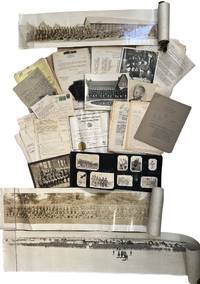
1917190211917. WWINational GuardWWII Primary-source archive documenting U.S. Army transportation command operations supporting Allied logistics following the Normandy landings centered on the development of Cherbourg as a critical supply hub. Assembled from the career of Lieutenant Colonel George C. Sullivan the collection spans World War I mobilization through World War II and into postwar reserve service with particular emphasis on mid-twentieth-century military infrastructure and coordination. The archive comprises hundreds of pages of official documents correspondence and service records alongside a substantial photographic component including large-format panoramic rolls depicting assembled training formations and unit organization at scale. Together the materials provide detailed evidence of the administrative and logistical systems that sustained Allied operations in Europe situating individual service within broader frameworks of wartime transportation supply distribution and postwar military restructuring.<br /> <br /> Archive comprises hundreds of pages of military documents dated primarily from the 1940s through the 1950s; three panoramic photographic rolls from World War I service; one photograph album containing 83 photographs from 1917-1918; four loose photographs; and three letters dated 1945-1948. The World War I album depicts training at Fort Sill Oklahoma mounted artillery drills including a three-inch field gun mounted cavalry movement across desert terrain doughboy uniformed infantry and a Peace Parade in Lawton Oklahoma in November 1918. Sullivan's own written service summary records his federal call-up transfers promotion to corporal commissioning and discharge in December 1918. The panoramic rolls measuring approximately 44 to 56 inches in length show large assembled formations at Camp Cody New Mexico and officer training at Camp Taylor Kentucky including the 25th Battery Central Officers Training School. World War II and postwar materials include commendations transfer requests rosters promotion records certificates and administrative correspondence. A 1949 silver gelatin photograph of Headquarters Company 371st Support Group summer training personnel includes a roster naming forty-eight officers among them First Lieutenant Catherine M. Henry documenting the integration of women officers in postwar reserve structures.<br /> <br /> Sullivan's World War II documentation centers on transportation command responsibilities essential to sustaining Allied operations in Normandy and the rapid development of Cherbourg as a logistical hub following D-Day. The archive traces the evolution of the United States Army from early twentieth-century National Guard mobilization to logistics work in World War II. Postwar papers reflect Sullivan's continued reserve duty into the mid-1950s and his civilian engagement in the sale of military surplus goods in Seattle Washington illustrating the reintegration of career officers into postwar commercial life. Documents generally clean and legible with occasional edge wear; panoramic photographs show some cracking but remain intact; photograph album well preserved; loose photographs with light handling wear. Overall very good condition. Extensive archive chronicling four decades of a United States Army officer's career. unknown
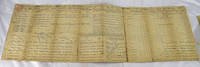
18632604050021United States Army 1863. First Edition. Manuscripts & Paper Collectibles. Very Good. Signed. Large two sided document. Printed with manuscript names filled in. The first name listed is Colonel Eli Long. This document shows the Colonel Captains Sergeants Lieutenants and the privates. This document shows the pay from October 31st 1863 to December 31st 1863. <br> According to NPS: "On February 23 1863 Long was appointed colonel of the 4th Ohio Cavalry a regiment which recently had surrendered to the Confederate raider Brigadier General John Hunt Morgan. Long improved the morale of the regiment and led it in the Tullahoma Campaign. He commanded the regiment's brigade the 2nd Brigade 2nd Division Cavalry Corps of the Department of the Cumberland between March 1863 and August 20 1864 including service at the Battle of Chickamauga. Long was wounded in the left side at the Battle of Farmington Tennessee October 7 1863. He was distinguished in the Atlanta Campaign where he suffered a head wound at the Battle of Jonesboro Georgia August 20 1864 and wounds in the right arm and right thigh at the Battle of Lovejoy's Station Georgia August 21 1864. Long received brevet grade appointments as major lieutenant colonel and colonel in the Regular Army of the United States for "gallant and meritorious services" at the Battle of Farmington and Battle of Fort Sanders Knoxville in Tennessee and Battle of Lovejoy's Station in Georgia respectively. Between November 16 1864 and April 2 1865 Long commanded the 2nd Division of the Cavalry Corps of the Military Division of Mississippi under Major General James H. Wilson. On April 2 1865 during Wilson’s Raid Long was severely wounded in the head at the Battle of Selma Alabama. During that battle he led the 2nd Division in a charge upon the entrenchments that resulted in the capture of that town. During the Civil War Long was wounded five times and also cited for gallantry five times. On January 13 1866 President Andrew Johnson nominated Long for appointment to the brevet grade of major general of volunteers United States Army unknown
1481833464.Gpaperback. Good. Access codes and supplements are not guaranteed with used items. May be an ex-library book. paperback