9 442 résultats
19621809175PN. New. 1962. 35 Pages. Soft Cover. I-367 Date is original print. This is a reprint edition. . PN paperback
1141Eastern Digital Resources. NEW. NEW 817 pgs Eastern Digital Resources unknown
1390916626.Gpaperback. Good. Access codes and supplements are not guaranteed with used items. May be an ex-library book. paperback

1396385290.Ghardcover. Good. Access codes and supplements are not guaranteed with used items. May be an ex-library book. hardcover
18781097Washington D.C.: U.S. Government Printing Office 1878. First Edition. Hardcover in red lacquered cloth original US Government Binding stated. Very Good. With included provenance this copy of this report was prepared by the Grandfather of the poet of the same name - Stephen Vincent Benet who wrote John Brown's Body and The Devil and Daniel Webster.<br /> <br /> The book is amazingly well-preserved for its age and is protected in a Book Saver polyethylene cover. Covers bumped and rubbed and have some stains but are very good with one closed tear at the tail. Pages are toned but tightly bound and the book contains 154 plates showing guns canon test results facilities and other important information.<br /> <br /> A very good copy and a testament to the former owners' care and attention. Receipt for last sale in 2000 is included. Incredibly collectable. U.S. Government Printing Office hardcover
1396606084.Ghardcover. Good. Access codes and supplements are not guaranteed with used items. May be an ex-library book. hardcover
1130767493.Gpaperback. Good. Access codes and supplements are not guaranteed with used items. May be an ex-library book. paperback
1396629335.Ghardcover. Good. Access codes and supplements are not guaranteed with used items. May be an ex-library book. hardcover
194445115Washington DC: U.S. Army Orientation Course 1944. fair to good. 46.5" x 35" 1 sheet 1 oversized sheet illus. color maps creases small tears and chips along edges. Contains articles illustrated with maps and photographs on the war fronts. Also contains a full-page series of five maps and a photograph on the conquest and liberation of France. U.S. Army Orientation Course unknown
194445113Washington DC: U.S. Army Orientation Course 1944. fair. 46.5" x 35" 1 sheet 1 oversized sheet illus. color maps creases small tears and chips along edges small stains. Contains articles illustrated with a map and photographs on the war fronts. Also contains a full-page well illustrated article on landing craft and invasion. U.S. Army Orientation Course unknown
194345112Washington DC: U.S. Army Orientation Course 1943. fair. 46.5" x 35" 1 sheet 1 oversized sheet illus. color maps creases small tears and chips along edges several large edge tears 1 repaired w/ tape Contains articles illustrated with a map and photographs on the war fronts. Also contains a full-page Li'l Abner cartoon illustrated by Al Capp on the regulations for saluting. U.S. Army Orientation Course unknown
0260033316.Ghardcover. Good. Access codes and supplements are not guaranteed with used items. May be an ex-library book. hardcover
026015668X.Ghardcover. Good. Access codes and supplements are not guaranteed with used items. May be an ex-library book. hardcover
195950534Aberdeen Proving Ground MD: U.S. Army Ordnance Corps 1959. fair. Quarto 23 14 wraps illus. maps foxing and staining to covers and some pages entire document creased. Contains general information for the Military Academy students on the annual Army Ordnance Corps demonstration a condensed schedule of activities and a detailed schedule of demonstration. A roster of the USMA class of 1959 and of the personnel accompanying the class to Aberdeen Proving Ground for this tour 26-28 May 1959 is laid in; the roster includeselective tour assignments and dinner hour options. U.S. Army Ordnance Corps paperback
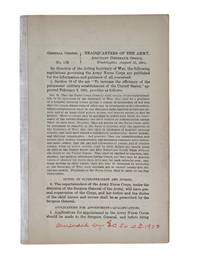
1901219711901. MilitaryNursingWomen in Medicine Military directive establishing the Army Nurse Corps 1901. General Orders No. 113. Headquarters of the Army Adjutant General's Office. Washington August 22 1901. Washington: War Department 1901. First edition. 10 pages. Bound with cloth tape lacking wrappers as issued. A foundational federal directive outlining the regulatory framework for the newly established Army Nurse Corps as authorized by Section 19 of the Act of February 2 1901-legislation intended to increase the efficiency of the U.S. military's permanent establishment. This pamphlet marks a critical milestone in the formal integration of women into the military medical apparatus and reflects early 20th-century gendered labor structures within federal institutions. It defines duties pay appointment qualifications leave policies and uniform standards for female nurses employed by the U.S. Army. Of particular historical note is its stipulation that the superintendent must be a graduate of a hospital training school emphasizing the formal credentialing of women in a field long dominated by informal care roles. The directive further outlines pay rates for chief and reserve nurses entitlements to quarters and medical care and the procedural logistics of leave and illness rendering it an early articulation of professional military nursing policy.<br /> <br /> The text includes sixteen numbered provisions covering areas such as applications for appointment travel reimbursements illness treatment and efficiency reporting. Paragraph 15 specifies the required uniform including "a waist and skirt of suitable white material adjustable white cuffs shoulder collar white apron and cap according to patterns prescribed by the Surgeon General's Office." Such mandates reinforce both the militarization and gendered expectations placed upon early 20th-century women in uniform. A marginal annotation in red ink on the cover notes that this issue was "amended by G.O. 54 W.D. 1908" signaling its eventual revision which adds bibliographic and institutional value for those studying the evolution of military nursing. Light toning. Red pen annotation on page one noting the order's amendment in 1908. Overall very good to near fine condition. A comprehensive government document that institutionalized women's medical labor within the Army. unknown
1396649387.Ghardcover. Good. Access codes and supplements are not guaranteed with used items. May be an ex-library book. hardcover
1391640772.Gpaperback. Good. Access codes and supplements are not guaranteed with used items. May be an ex-library book. paperback
1965E3493Redstone Arsenal: U.S. Army Missile Comman 1965. 1st ed. . Paperback. Good/Wraps. 165 pages. Original 12 April 1965 edition of the United States Army Missile Command's Directorate of Procurement and Production's on the application of The Experience Curve for the Military's purposes. Much math slide rule usage logarithms and log charts. What makes this work different is their liberal use of cave people cartoons some tongue-in-cheek risque alongside the technical stuff. Definitely not PC. Quite scarce. Good/Wraps. Heavy-duty staple-bound book with card covers. Cost reduction formula for the CR-6 slide rule taped inside front cover. Item #: E3493. SAVE MORE Additional books in the same order ship for FREE via Standand Shipping. U.S. Army Missile Comman paperback
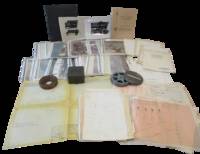
1950229621950. This exceptionally dense technical archive documents U.S. Army rocket and missile development during the height of the Cold War and Vietnam War originating from the estate of a retired aerospace engineer Thomas T. Howell affiliated with the U.S. Army Missile Command with direct work conducted at Redstone Arsenal Alabama and White Sands Missile Range New Mexico. The materials capture the applied test-driven reality of American rocketry at the moment when battlefield rocket systems solid-fuel propulsion and rapid-deployment tactical missiles became central to U.S. military doctrine. Of particular importance is the archive's sustained focus on field testing propulsion diagnostics firing mechanisms and structural integrity analysis with repeated references to multi-stage motors booster threads nozzle pressure profiles thrust measurement strain-gauge instrumentation and dynamic propulsion testing under operational conditions. The presence of Vietnam-era documentation situates this archive squarely within the escalation of U.S. missile and rocket deployment in Southeast Asia when systems such as the Little John rocket and related short-range artillery rockets were actively refined tested and evaluated for combat reliability. <br /> <br /> Collection includes; 2 original testing mechanisms; a 16mm film roll documenting a test launch; over 40 original photographs showcasing different testing sites and rocket units; over 40 hand drafted graphs on red paper; several hand written pages of calculations with formulas and schematics; several signed printed documents signed regarding the procedures for assembly static test flight weight booster motor components all dated in the summer of 1969; and a heavily annotated blueprint.<br /> Redstone Arsenal established in the early Cold War and shaped by the integration of German rocket scientists after World War II became the intellectual and engineering hub of U.S. Army missile work where propulsion systems launch mechanisms instrumentation and tactical doctrines were conceived refined and standardized. White Sands Missile Range by contrast functioned as the proving ground where theory met reality. This Redstone-White Sands pipeline allowed the United States to move rapidly from concept to deployable weapon. The archive comprises a combination of original testing hardware primary testing documentation photographic evidence and engineering drawings and graphs offering a nearly end-to-end view of the rocket development and validation process. Included is an original Electrical Output Firing Mechanism Tester for rocket launchers which is distinctly labeled for testing electrical firing mechanisms with milliwatt-second measurements a piece of surviving test equipment seldom encountered outside institutional collections; a rubber ring with conductive instrumentation in the interior a ring-type electromagnetic integrator or pickup coil used to measure missile velocity by electrically integrating acceleration over time with the central aperture allowed a magnetic core conductor or shaft associated with missile motion to pass through; extensive hand-plotted K&E bar graphs trajectory charts acceleration and velocity curves displacement diagrams and launch-segment data sheets many executed on period engineering graph paper with handwritten annotations calculating thrust pressure acceleration in g's and burnout timing; a substantial group of typed Army test procedures and data-requirement documents several signed and approved by supervising engineers details assembly procedures static and dynamic propulsion tests booster motor configurations which include tapered buttress threads and pin joints strain-gauge placement chamber pressure measurement and photographic documentation protocols; and a blueprint with extensive handwritten calculations in areas surrounding schematic drawings titled "Revisions -- Body Pressure Transducer" dated 1969. The calculations mention error rates "at 0.4% to 0.6% due to boost acceleration." These documents reveal the rigor of U.S. Army missile testing culture where every firing was instrumented recorded and analyzed as part of an iterative engineering feedback loop.<br /> A binder containing over 40 original photographs many stamped on the verso identifying the various locations and rockets such as "LITTLE JOHN" and "WHITE SANDS" on glossy photo paper shows test stands firing sequences hardware setups and missile components in both black-and-white and color. These images provide rare ground-level views of rocket testing infrastructure and procedures at one of the most historically significant U.S. missile ranges. Also present is 16mm film apparently documenting test-stand or firing activity; the film appears physically intact and represents a rare moving-image record of Army missile testing during the era. Completing the archive are large-format blueprints and technical drawings including a detailed pressure-transducer body schematic bearing U.S. Army Materiel Command identifiers Redstone Arsenal attribution and extensive handwritten calculations direct evidence of hands-on analytical work by an engineer engaged in real-time problem solving under Cold War weapons development pressures.<br /> <br /> Materials show expected handling and working-archive wear consistent with active engineering use: edge wear folds staple and paper-clip rust toning and some stains to paper; handwritten calculations and annotations throughout; photographs generally well preserved with strong contrast; hardware tester shows surface wear and oxidation consistent with age and field use; 16mm film appears physically sound but untested. Overall very good condition. This archive represents a rare primary source for the study of U.S. Army rocketry missile engineering and weapons testing during the Vietnam War and late Cold War period. Its combination of original equipment signed technical procedures analytical charts photographs and film makes it especially valuable for institutional collections focused on military technology Cold War science aerospace engineering history and the material culture of U.S. weapons development. unknown
195919198US Army Europe 1959 321 pp. US army Military intelligence pamphlet to the eastern Communist bloc in Europe 10 march 1959.Unmarked.Rare.Includes two articles from the Stars and Stripes March 2 1969 " The Soviet Soldier" and January 2 1974 "Red Build up in East Germany". Tall Softcover. 1st Edition. Soft cover. Very Good. US Army Europe paperback
1410224546.Gpaperback. Good. Access codes and supplements are not guaranteed with used items. May be an ex-library book. paperback
199885515Fort Detrick MD: US Army Medical Research Institute of Infectious Diseases Public Health Training Network Centers for Disease Control and Prevention and the Food and Drug Administration 1998. Presumed First Edition of this compilation. Box with participant materials included. Box is approximately 9 inches by 12 inches. Very good. Box has slight wear and soiling. Contents in very good condition. Unclear is some are reprints or produced for this satellite broadcast training. This includes a Dear Participant letter from the Office of the Commander US Army Medical Research Institute of Infectious Diseases Colonel Gerald W. Parker dated July 7 1998; Key Information sheet of Dates of Broadcasts and Taped Rebroadcast Dates and Time Telephone Call-in Instructions and Fax Instruction Forms; Optical Scan Forms Instruction Sheets; List of State and Territorial Health Departments; Student Booklet for Satellite Broadcasts on Tuesday September 22 1998 Wednesday September 23 1998 and Thursday September 24 1998; Student Booklet for Taped Rebroadcasts Saturday October 3 1998 and Sunday October 4 1998; Handout on Packaging and Shipping Infectious Materials; Case Definitions for Infectious Conditions Under Public Health Surveillance CDC Morbidity and Mortality Weekly Report May 2 1997 Vol. 46 No. RR-10 approximately 60 pages; NATO Handbook on the Medical Aspects of NBC Defensive Operations AMedP-6B Part II - Biological FM 8-9 NVMED-P-509 AFJMAN 44-151V1V2V3 February 1996 Approximately 100 pages; Medical Management of Biological Casualties Handbook Third Edition July 1998 approximately 150 pages plus fold-outs Format is approximately 4.5 inches by 6.25 inches; Defense Against Toxin Weapons by David Franz approximately 5.5 inches by 8.5 inches approximately 50 pages; Booklet at Open At Final Exam Time seal still intact--unopened. The United States Army Medical Research Institute of Infectious Diseases USAMRIID; pronounced: you-SAM-rid is the U.S Army's main institution and facility for defensive research into countermeasures against biological warfare. It is located on Fort Detrick Maryland near Washington D.C. and is a subordinate lab of the U.S. Army Medical Research and Development Command USAMRDC headquartered on the same installation. USAMRIID is the only U.S. Department of Defense DoD laboratory equipped to study highly hazardous viruses at Biosafety Level 4 within positive pressure personnel suits. USAMRIID employs both military and civilian scientists as well as highly specialized support personnel totaling around 800 people. In the 1950s and '60s USAMRIID and its predecessor unit pioneered unique state-of-the-art biocontainment facilities which it continues to maintain and upgrade. Investigators at its facilities frequently collaborate with the Centers for Disease Control and Prevention the World Health Organization and major biomedical and academic centers worldwide. USAMRIID was the first bio-facility of its type to research the Ames strain of anthrax determined through genetic analysis to be the bacterium used in the 2001 anthrax attacks. By U.S. Department of Defense DoD directive as well as additional U.S. Army guidance USAMRIID performs its "biological agent medical defense" research in support of the needs of the three military services. This mission and all work done at USAMRIID must remain within the spirit and letter of both President Richard Nixon's 1969 and 1970 Executive Orders renouncing the use of biological and toxin weapons and the U.N. Biological Weapons Convention of 1972. During the period of Desert Shield and Desert Storm 1990-91 USAMRIID provided the DoD with expert advice and products vaccines and drugs to ensure an effective medical response if a medical defense were required. USAMRIID scientists trained and equipped six special laboratory teams for rapid identification of potential BW agents which fortunately never appeared. Following the conflict USAMRIID physicians and engineers were key members of a United Nations Special Commission UNSCOM Inspection Team that evaluated the BW capabilities in Iraq during the 1990s. US Army Medical Research Institute of Infectious Diseases ,Public Health Training Network, Centers for Disease Control and Preve unknown
19671144916Dept of the Army 1967. A sharp like new copy. Hardcover. Fine/No Jacket as Issued. Small Quarto. Book. Dept, of the Army Hardcover
195831202Washington DC: GPO 1958. good. 544 illus. tables charts footnotes index slight soiling to fore-edge minor wear to board and spine edges. GPO unknown
196015094Washington DC: GPO 1960. good. 530 pages. Illus. 1 color maps tables charts footnotes apps index some scuffing to bds. Signed by Col John Coates Dir Hist Unit. GPO unknown