von Scharnhorst, GerhardAntiquariat.de

10 371 résultats
198397853Osnabrück, Biblio Verlag, 1983. XVIII + 520 S. 8° Oktav, Leinen
192537144ABBerlin, Hobbing, 1925. 4°, XIV, 414 S. mit 6 Tafeln in Lichtdruck und 12 Textillustrationen, gold-verzierte Vorsätze, Text: Fraktur, roter original Leineneinband mit goldener Rückenbeschriftung und -verzierung sowie schönem goldenen Deckelwappen, Erstausgabe die Seite 99 (wohl herstellungbedingt) etwas schmutzspurig, sonst aber ein altersgemäß gutes, sauberes Exemplar und recht dekorativ (Ti3)
192537143ABBerlin, Hobbing, 1925. 4°, XII, 429 S. mit 15 Tafeln in Lichtdruck, 16 Textillustrationen und 2 Kartenskizzen, gold-verzierte Vorsätze, Text: Fraktur, roter original Leineneinband mit goldener Rückenbeschriftung und -verzierung sowie schönem goldenen Deckelwappen Erstausgabe altersgemäß schönes, sauberes Exemplar und recht dekorativ (Ti3)
1915MILI2460Wien 1915. 4°, 80(1) S., 48 Tafeln, OHLn. m. Kartondeckeln,
198037963Gütersloh [u.a.] : Bertelsmann-Club [u.a.], c 1980. 318 S. 8°. Lizenzausg. OPpbd. ohne SU. (Buch ; 29314)
1942053306Ankara: TBMM Hususi" Letterhead Dated 11. IV. 1942 Ankara 1942. Soft cover. Very Good. Original manuscript autograph letter signed ALS by Ali Çetinkaya sent to Turkish doctor Ethem Akif Battalgil who was the father of Fahire Battalgil Battalgazi who was the first Turkish zoologist. For Battalgil's brother's death Çetinkaya is conveying his condolences. The letter was written and signed by Ali Çetinkaya but he added his wife and daughter. Dated 11. IV. 1942 Ankara. Ali Çetinkaya also known as "Kel" Ali Bey was an Ottoman-born Turkish army officer and politician who served eight terms in the Grand National Assembly of Turkey including a period in 1939-40 as his country's first Minister of Transport. He was born in Kara Hisâr-i Sâhib present-day Afyonkarahisar in Hüdavendigâr Vilayet as the son of Ahmed Efendi. He studied in the Bursa Military High School Bursa Askerî Idadisi . After graduating from military high school he entered the Ottoman Military Academy Mekteb-i Füsûn-u Harbiyye-i Sâhâne In 1898 he graduated the academy and joined the Ottoman military as a Second Lieutenant Mülâzim-i Sani . During World War I he served for the army in the Caucasus and Galicia fronts. When the Greek forces were landing at Smyrna on May 15 1919 he was a lieutenant colonel and the commander of 172nd Infantry Regiment stationed in the Aegean coastal town of Ayvalik. His regiment was under the command of the 56th Division of Hürrem Bey. Ali played a key role in the first stage of the Greco-Turkish War of 1919-1922 starting with the opening battle. He was briefly able to hold back the advance into the city of Greek occupation forces. His action is considered to mark the first shots fired by regular forces in the 1919-22 Greco-Turkish War although there were earlier confrontations in which irregular militias participated including the battle involving Hasan Tahsin in Izmir as well as actions in Urla and Ödemis. The hill in Ayvalik from where the first shots were fired is now called Ilk Kursun Tepesi First Bullet Hill. Today there is a military rehabilitation center on that hill. After the war Ali Çetinkaya was elected to the Turkish Grand National Assembly for eight successive terms and served until 1942 holding ministerial posts in six different governments including with the formation of a Ministry of Transport becoming Turkey's first Minister of Transport. Ali Çetinkaya is considered a hero in Turkey. Cunda Island of Ayvalik was renamed Alibey Adasi Ali Bey Island after him although the old name remains in common use. <br/> <br/> TBMM Hususi" Letterhead, Dated 11. IV. 1942, Ankara paperback
192536447Washington DC: April 9 1925. 1925. Very good. - Letter penned in black ink & filling all 4 sides of a sheet of letterhead folded once to form 4 black-bordered sides each 6-3/4 inches high by 5-1/8 inches wide. The address where Hoskins is staying is printed at the top. Signed "Reginald Hoskins". There is a light paper-clip mark to the top edge of each side & the recipient's "date answered" stamp is is on the first side at top right. Folded once for mailing. Together with a sample brochure promoting a previous Hoskins lecture tour. Also with a carbon copy of the recipient's reply. Near fine. <p>Hoskins writes to J.B. Pond of the Pond Lecture Bureau following up on their discussion of a possible American lecture tour. He is about to leave for London and wonders if the financial arrangements will make it feasible for him to return for an extended tour. "I know that it is not easy to foresee with any certainty what sort of a success financially can be made and you quite understood my disinclination to return on an off chance."<p>Major-General Sir Arthur Reginald Hoskins 1871-1942 was a senior British Army officer during the First World War. Hoskins served in the army from 1891 to 1923. Prior to World War I he saw active service In in the Dongola Expedition the Mahdist War the Second Boer War and the Somaliland Campaign. In September 1914 he was recalled from East Africa where he was acting as Inspector of the Kings Africa Rifles and joined the 8th Division then engaged on the Western Front. He was given command of the 8th Brigade in 1915 and in early 1916 was transferred to the East African Campaign. He became Commander-in-Chief of British Forces in East Africa in 1917 later serving as commander of the 3rd Lahore Division in Mesopotamia and Palestine for the remainder of the war. Washington, DC: April 9, 1925. unknown
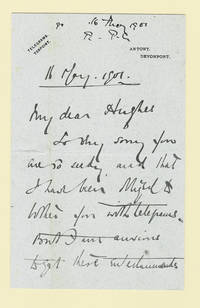
1901101174<p>Antony / Devonport May 16 1901. 1901. Fine. - Over 135 words penned on four sides of 7 inch high by 4-3/8 inch wide "Antony / Devonport" stationery. In his letter addressed to "My dear Hughes" from his Antony House Estate in Cornwall the British Army Officer and Liberal Unionist Member of Parliament Sir Reginald Pole-Carew discusses arrangements for outdoor festivities "".I am anxious to get these entertainment done quickly as promised - and as there is a clever Conjuror whom I know in Plymouth now so seems a pity not to have the out of door's show while he is here and while this lovely weather lasts." He hopes Hughes can come as "Mother will be delighted to see you on Friday." In a postscript he agrees with Hughes that "the Band should be on the evening preceding the outdoors show" and ponders whether there is still time to arrange it. Signed "Reg Pole-Carew". Folded for mailing else fine.</p><p>Celebrated as a military hero the British army officer and landowner Lieutenant-General Sir Reginald Pole-Carew 1849-1924 was commissioned into the Coldstream Guards in 1869. He served with Lord Roberts in the Second Anglo-Afghan War and in the Second Boer War. Promoted to Colonel he was given command of the 9th Brigade with the "local" rank of major-general and led during the Battle of Modder River. Appointed to command the Guards Brigade he later commanded the 11th Division of the South Africa Field Force and in 1903 became the General Officer Commanding the 8th Division in Southern Ireland. He served as a Liberal Unionist Member of Parliament for Bodmin. In February of 1901 the year of this letter Pole-Carew married Lady Beatrice Frances Elizabeth Butler the King and his family receiving them two days prior to their wedding to present Beatrice with wedding presents.</p> Antony / Devonport, May 16, 1901.
1969737280PN. New. 1969. Soft Cover. Date is original print. This is a reprint edition. . PN paperback
19631341690PN. New. 1963. Soft Cover. md . PN paperback
1963722379PN. New. 1963. Soft Cover. Date is original print. This is a reprint edition. . PN paperback
1983770371PN. New. 1983. Soft Cover. Date is original print. This is a reprint edition. . PN paperback
1994436439PN. New. 1994. Soft Cover. Date is original print. This is a reprint edition. . PN paperback
1997297633PN. New. 1997. . Soft Cover. Date is original print. This is a reprint edition . PN paperback
1987777909PN. New. 1987. Soft Cover. Date is original print. This is a reprint edition. . PN paperback
1989791595PN. New. 1989. Soft Cover. Date is original print. This is a reprint edition. . PN paperback
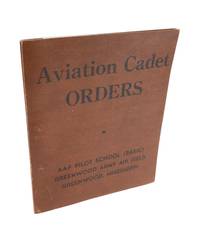
19444146Greenwood Mississippi: United States Army Air Force 1944. Original binder of printed card covers measuring 176 x 228 mm. ii 24 pages continuously paginated. Well preserved. The first leaf of the booklet is authorised by Captain Raymond M. O'Connor in his role as Commandant of Cadets. Dated 25 February 1944 it notes that sheets are to be replaced as regulations are updated although the entire contents of this booklet bear the original date. The Regulations cover organisation and rank billeting accommodation 'recreational and social priviliges' postal censorship visitors and so forth. United States Army Air Force unknown
1971740978PN. New. 1971. Soft Cover. Date is original print. This is a reprint edition. . PN paperback
1991242676PN. New. 1991. Soft Cover. Date is original print. This is a reprint edition . PN paperback
1981764071PN. New. 1981. Soft Cover. Date is original print. This is a reprint edition. . PN paperback
1977755657PN. New. 1977. Soft Cover. Date is original print. This is a reprint edition. . PN paperback
198478997Washington DC: Department of the Army Headquarters 1984. Presumed First Edition First printing thus. This Manual Supersedes FM 1-88 7 July 1980. Wraps. Good. Various paginations approximately 400 pages. Illustrations. Appendixes on training information a conversion chart and tactical vehicle identification gaming device. Glossary. References. Index. When issues the distribution was restricted for official Government use only. Given the passage of time and the introduction of information into the public domain this restriction is understood to no longer apply. Book has small creases to a few text pages. Cover is somewhat worn and soiled. The purpose of this manual is to familiarize aircrews with modern combat equipment provide a reference for aircrew field use and provide a guide for commanders conducting unit training in equipment recognition. The equipment shown in this manual is grouped by type: rotary-wing aircraft fixed-wing aircraft antiaircraft guns surface-to-air missiles armor artillery light armored vehicles and miscellaneous equipment. This manual provides information on current operational combat vehicle guns and aircraft of the United States allied western powers and threat countries which reasonable can be expected to be observed from the air during hostilities. Included in this manual are the best photographs available at writing time. The tactical vehicle identification gaming device depicted in Appendix C can be used as an instructional tool for increasing knowledge of combat equipment and for proficiency testing. The device also may be effectively used in class instruction or for self-testing. Aircraft recognition is a visual skill taught to military personnel and civilian auxiliaries since the introduction of military aircraft in World War I. It is important for air defense and military intelligence gathering. Aircraft recognition generally depends on learning the external appearance of the aircraft both friendly and hostile most likely to be encountered. Techniques used to teach this information have included scale models printed silhouette charts slide projectors computer aided instruction and even specially-printed playing cards. In the United Kingdom The Royal Observer Corps ROC was formed as a defence warning organization with civilians trained in aircraft recognition and operated primarily as such between 1925 and 1957. Aircraft recognition was first developed between the First and Second World wars when aerial warfare was first recognized as a future threat after 208 Zeppelin and 435 aircraft raids over London during the First World War. In 1917 Germany had started using fixed-wing bombers and the number of airship raids diminished rapidly. To answer this new threat Major General Edward Bailey Ashmore a First World War pilot who had later been in command of an artillery division in Belgium was appointed to devise improved systems of detection communication and control. The Metropolitan Observation Service was created covering the London area known as the London Air Defence Area and was soon extended to the coasts of Kent and Essex. This led to the establishment of the Observer Corps in 1925. In September 1942 the government recognized the usefulness and effectiveness of the systems developed by volunteer observers and first published Aircraft Recognition The Inter-services Recognition Journal. With official recognition by HQ Royal Observer Corps and the Air Ministry that accurate recognition of aircraft was achievable the systems developed by the volunteers were adopted as official training. In the US during World War II civilians were enlisted into a Ground Observer Corps to support air defense operations receiving training in aircraft identification. The US military continues to use "WEFT" as a mnemonic for the major features of an aircraft: Wings or rotors to provide lift Engines to provide power a Fuselage to carry the payload and pilot and a Tail assembly which controls the direction of flight. These elements differ in shape size number and position. The differences distinguish one aircraft type from another. The individual components can be taught as separate recognition and identification features but it is the composite of these features that must be learned to recognize and identify an aircraft. Department of the Army, Headquarters paperback
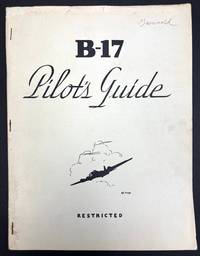
1943h44640NP: NP 1943. Wraps. Good. 10.5 x 8 inches sheets stapled along left side good to very good light wear toning and soil to covers staples beginning to rust "Greenwald" in pencil on front cover. In two sections with separate pagination: "B-17F Amplified Check List" is 16 pp followed by "Standardized Two & Three Engine Operation B-17 Type Airplanes" is 8 pp. There are no illustrations. Very rare with no recorded copies in Worldcat or OCLC. This was owned by William H. Greenwald. Greenwald who lived in the Pittsburgh area passed away in 2005 at the age of 85. He was a retired Lt. Col.of the 911th Air Wing of Pittsburgh who served during WWII for the U.S. Army Air Corp as a pilot of a B17 and he was a member of the Air Force Reserve Office Association. NP unknown
1993269118PN. New. 1993. Soft Cover. Date is original print. This is a reprint edition . PN paperback
19981308435PN. New. 1998. Soft Cover. Date is original print. This is a reprint edition . PN paperback