MARSHALL-CORNWALL (General Sir James).Livre Rare Book
11 073 résultats
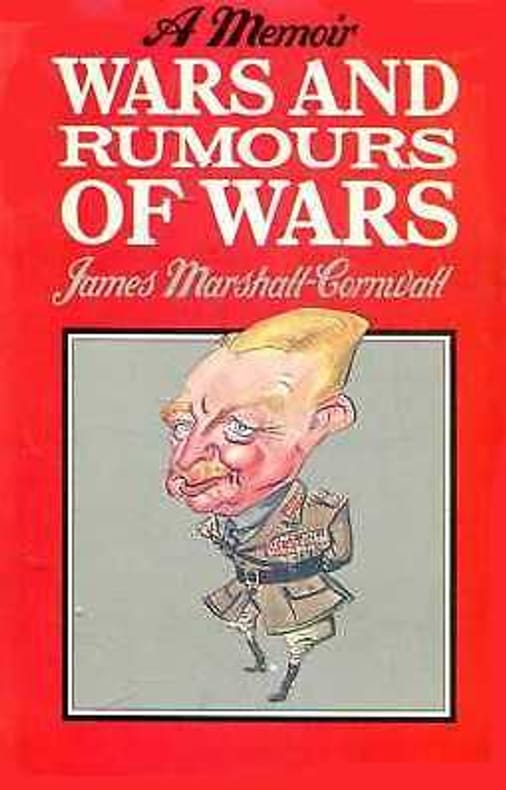
198473374London, Leo Cooper, Secker & Warburg, 1984 in-8°, vi-257 pp, 24 photos sur 16 pl. hors texte, notes, index, reliure éditeur, jaquette illustrée, bon état
198128382JANE'S, 1981, in-4°, New Edition. London, Jane's 1981, 120p., in-4, illustré, index, reliure d'éditeur & jaquette (bon état).
196695976London, Weidenfeld & Nicolson, 1966, gr. in-8°, 224 pp, environ 170 illustrations en noir ou en 2 couleurs, index, cart. éditeur, jaquette illustrée (très lég. abîmée), bon état. 1st edition.
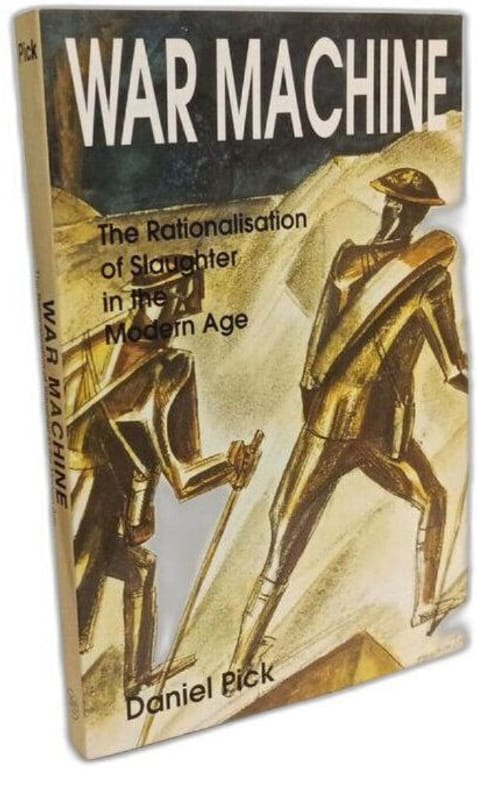
1996100138941Yale University Press 1996 292 pages 15 5x23 3x1 7cm. 1996. Broché. 292 pages.
1973R300262548David & Charles. 1973. In-4. Relié. Bon état, Couv. convenable, Dos satisfaisant, Intérieur frais. U.K., David & Charles, 1973, in 4, reliure éditeur sous jaquette, nombreux dessins à la plume légendés, 96 pp.. Avec Jaquette. . . Classification Dewey : 359-Marine militaire
1981100554Orbis Publishing, 1981, in-4°, 328 pp, très nombreuses photos et cartes en noir et en couleurs, chronology, biblio, index, cart. éditeur, jaquette illustrée, bon état
198080040London, Salamander Books, 1980, in-4°, 224 pp, nombreuses illustrations en couleurs d'uniformes, armes, équipement, navires de guerre, machines de siège, 16 cartes en couleurs, 50 plans de bataille et diagrammes tactiques, plus de 120 photos en noir et en couleurs, glossaire, index, reliure cartonnée illustrée de l'éditeur, jaquette illustrée, bon état. Texte en anglais
1997gg2004Concord Publications Company Dos carré collé 1997 In-4 (21,5 x 28 cm), dos carré collé, 52 pages ; très bon état. Livraison a domicile (La Poste) ou en Mondial Relay sur simple demande.
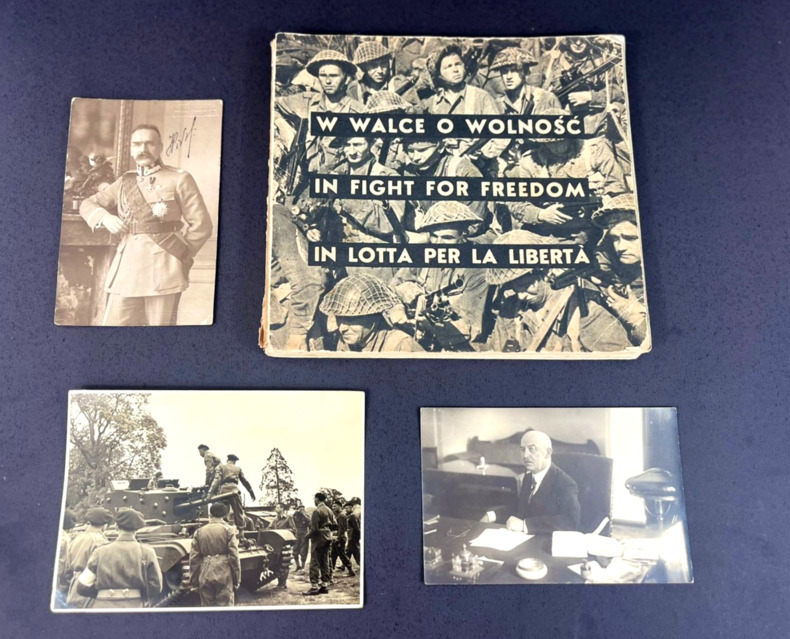
1945517This is a set which belonged to Janusz Gluchowski, a high-ranking Polish military officer at the time of the WW2. The set contains three original B&W pictures. First one: undated postcard showing Marshal Jozef Pilsudski, signed by himself in black ink, 8.5 x 13.5 cm, with two embossed mentions above and below. Second picture: undated postcard showing Poland President Gabriel Narutowicz, with a written mention on the back. Third picture: 11 x 15.5 cm photograph. General Tadeusz Bór-Komorowski inspecting a British Cromwell tank, accompanied by Polish officers of the 3rd Armored Regiment (3 puk pancerny). The image was captured during an official ceremony in the city of Kelso, Scotland, in the immediate post-war period, on June 15, 1945. The scene shows the General in an observation position, climbing onto the tank while surrounded by Polish soldiers. The tank corresponds to a British model widely used by Polish forces in exile during the Western European campaign. On the reverse, the following handwritten inscriptions appear: VI 1945, Kelso. N. Wódz gen. Bór-Komorowski dokonuje inspekcji 3 p. panc. N. Wódz w towarzystwie bryg. puku na czogu." / June 15, 1945, Kelso The book is an illustrated three-languages (Polish, English and Italian) set commemorating the struggles of the Polish II Corps. Edited by Wyda Rererat [Referat] Kultury i Prasy Kresowej Dywizji Piechoty in Rome, 1945. Oblong book of 21 x 19 cm, unpaginated (144 pp.). Cover detached. Endpapers and first page show Janusz Gluchowski's stamp. In publisher's photographically illustrated wrappers. Each page contains a photographic image or a photomontage accompanied with a short text in three languages. Front cover shows some wear and tear, the binding is a bit loose - we would advise having this book bound. The Polish II Corps was a major tactical and operational unit recruited from Polish deportees in the Soviet Gulags in 1943. First they fought in the Middle East, and in 1944 February they were transferred to Italy and as independent part of the British Army to fight in the Italian campaign, in the battles of Monte Cassino and Ancona and also the Battle of Bologna during the final offensive in Italy in 1945. The book goes through the story of Poland and the later established Polish II Corps, starting with the German and Soviet occupation in 1939. It shows the deportation of Poles to forced labour to the Gulag and, after the Polish-Russian Military Agreement in 1941, the establishment of the Polish Army on Soviet soil, also their military training and their fights in various battles. Janusz Julian Gluchowski was a Major General in the Polish Army during the Second Polish Republic. He was born on August 6, 1888, in Bukowa. He fought in the Polish Legions in World War I, the Polish-Ukrainian War, the Polish-Soviet War, and the invasion of Poland by Nazi Germany, Slovakia, and the Soviet Union in 1939, which culminated in the start of World War II. In his adolescence, he attended high school in Czstochowa. In 1905, he became a member of the Combat Organization of the Polish Socialist Party and was wounded in the hand during an attack near Czstochowa. To avoid arrest by the Russian authorities, he left for Belgium, where he studied at the University of Liège. He returned to divided Poland around 1910 and settled in Austrian Galicia. In 1912 he graduated from the Officers' School of the Riflemen's Association in Stroza, near Krakow. In the early hours of August 1914, he commanded a platoon in Oleandria and was Wadysaw Belina-Pramowski's representative during the legendary attack of the so-called Seven Lancers of Belina (Uaska siódemka). On August 6th, together with the First Cadre Company, he left Krakow and marched to Miechów. In October 1914 he was promoted to Lieutenant (Poruchik) and, in November 1916, to Rittmeister (Cavalry Master). Until 1917 he served in the First Uhlan Regiment of the Polish Legions. After the Oath Crisis (Kryzys przysigowy) he was interned first in Fort Beniaminów and later in Werl. Released in October 1918, he went to Lublin, where, in early November, he formed the Third Ulan Regiment (later renamed the Seventh Ulan Regiment of Lublin). Along with his unit, he fought in the Polish-Soviet War. On May 29, 1920, he was promoted to Polkovnik. He was transferred in July 1920 to Eastern Galicia, taking command of the First Cavalry Brigade, fighting against the Soviets in Galicia and Volhynia. After the war, he remained in this position until 1925, when he was transferred to the Fourth Cavalry Brigade. Promoted to Brigadier General on March 16, 1927. Appointed commander of the Center for Higher Military Studies on June 4, 1930, and three years later, after the death of General Stanislaw Tessaro, he was appointed commander of Military District X in Przemyl. In October 1935, he became Deputy Minister of Military Affairs. In the early days of the 1939 invasion of Poland, Gluchowski ordered General Walerian Czuma to prepare the defense of Warsaw. In mid-September 1939, he fled to Romania. After his escape, he managed to travel to the Middle East and, in January 1941, received orders to go to London. In October 1941, he was appointed Commander of the Training Brigade stationed in Scotland. On September 23, 1943, he was appointed commander of all Polish Army units stationed in Great Britain, except the First Independent Parachute Brigade, which remained under the authority of the Commander-in-Chief. He was promoted to Major General on June 1, 1945. He decided not to return to Soviet-occupied Poland and remained in Great Britain. He frequently criticized the Soviet regime and the Soviet occupation authorities in postwar Poland. Furthermore, he was one of the founders and president of the Jozef Pilsudski Institute in London. He was, therefore, an active member of the Polish community in Great Britain. He was president and honorary member of several Polish veterans' organizations. He died on June 11, 1964, in London, England.
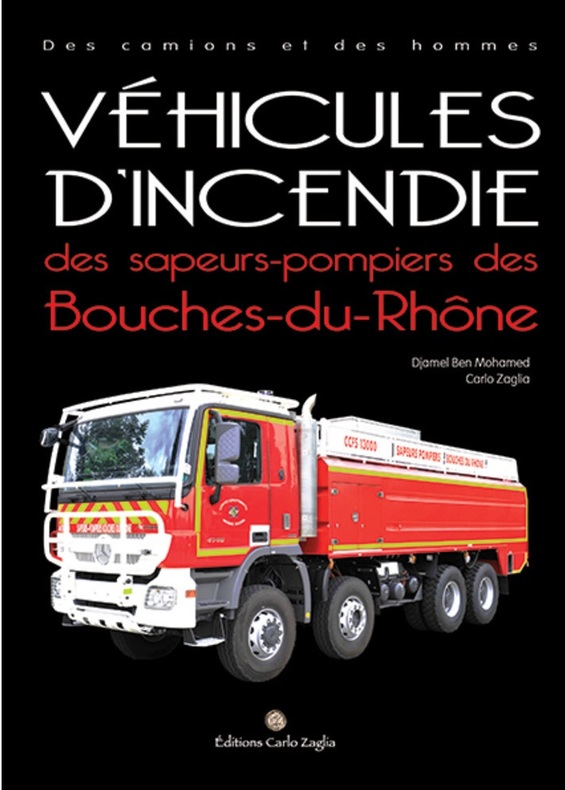
2015120799La Seyne-sur-mer, Editions Carlo Zaglia, 2015, in-4°, 287 pp, 405 photos en couleurs, 3 cartes sur double page, reliure cartonnée illustrée de l'éditeur, bon état (Coll. Des camions et des hommes)
152759Paris, 1835 in-plano (68,5 x 52 cm), [4] ff. n. ch. (titre et table des planches), et 68 grandes planches à double page, gravées par Perdoux, Desaulx, Cardano, Misbach, Schroeder, Lameau, Fortier, etc., d'après les dessins de Bagetti ; le tout monté sur onglets demi-maroquin vert, dos lisse (reliure à l'imitation). Taches et rousseurs à certaines planches, trace de pliure à la page de titre.
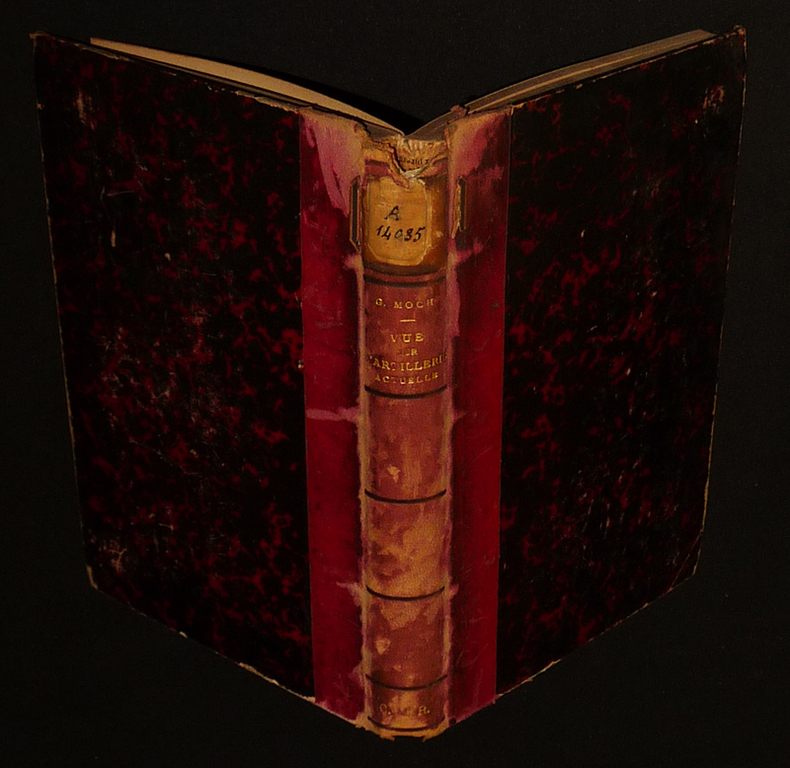
1895va1325Berger-Levrault et Cie Relié 1895 In-8 (14,5 x 22 cm), reliure demi-peau, dos lisse, VIII-221 pages ; épidermures sur le cuir, coupes frottées, usures aux plats, ancien exemplaire de bibliothèque (étiquette au dos, tampons à l'intérieur), en l'état. Livraison a domicile (La Poste) ou en Mondial Relay sur simple demande.
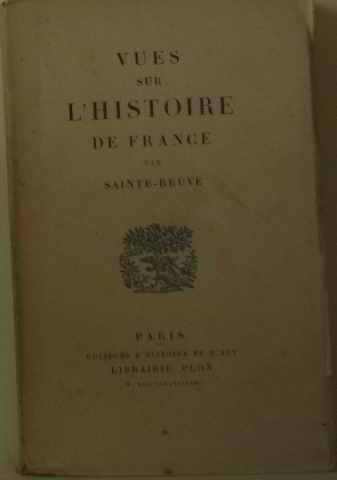
1946182135D'histoire et d'Art 1946 in12. 1946. Broché.
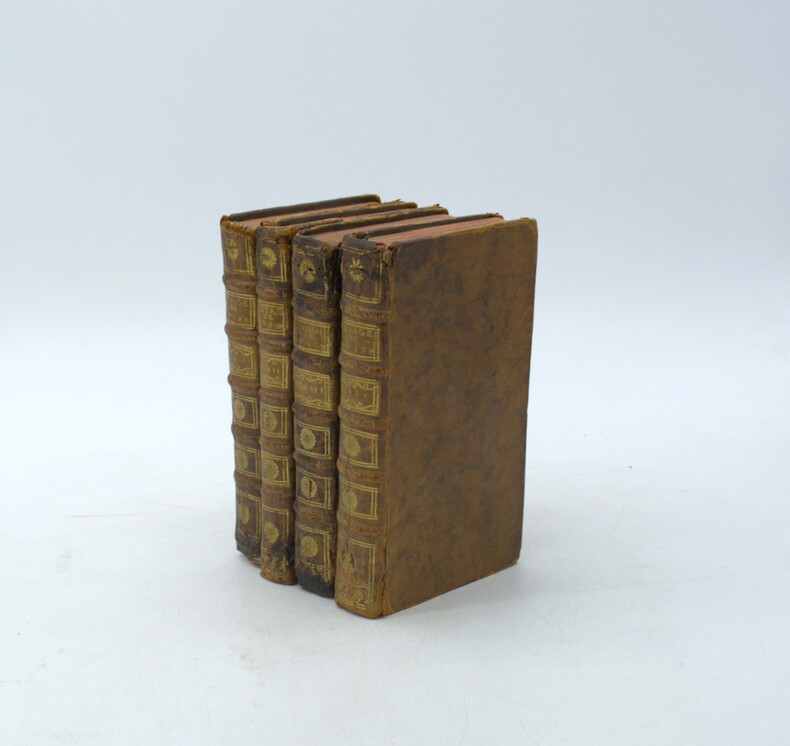
PHO-2244Paris, Quillau, Delorme, Leloup. 3 tomes en 4 volume in-12 (17x10cm), veau marbré époque, dos cinq nerfs orné avec titre et tomaison, tranches rouges. Frottements, coins usés, coiffes abimée, mouillures au tome 2, charnières avec défauts. Exemplaire sans planches.
1792PHO-1270Paris, Chez Plassant, 1792. ATLAS seul in-4, en feuilles , titre , liste des planches , 4 cartes dépliantes et 88 planches dont 19 à double page , non rogné , pages de titre et liste des planches légèrement effrangés et salies
1792PHO-1271Paris, Chez Plassant, 1792. ATLAS seul in-4, relié cartonnage d’attente , titre , liste des planches , 4 cartes dépliantes et 87 (88) planches dont 18 (19) à double page , non rogné , quelques brunissures , défauts à la reliure.
1821PHO-2038Paris, Imprimerie Royale et Imprimerie de L. Toinon et C ,1821-1862, 2 volumes in-folio. 1ère Partie, brochage papier bleu avec étiquette de titre sous coffret moderne, vieille mouillure, papier gondolé, quelques rousseurs. 2nde Partie, sous coffret moderne, rousseurs sur les planches en noir et blanc, mouillure angulaire au début et marginale en fin, petites déchirures en marge sur quelques feuillets, coin manquant faux-titre. XVII-120pp., 24 planches sous serpentes dont 2 cartes et une planche en couleur d’époque et 2ff. (faux-titre, titre)-V (avant-propos) -27pp. (explication , appendice) -20 planches (21) dont 4 en double pages et 9 en couleurs d’époque .
1826PHO-2360Sl, imprimerie royale, 1826-27 - 4 vol. in 8° (21,5x13cm), 4ff - 429 pp. -2ff./442 pp.-2ff.- 431 pp./ 2ff.- 416pp., demi-basane tabac, dos à nerfs avec auteur, titre et tomaison, épidermures, petites rousseurs, mouillure angulaire au tome 2 Texte seul, illustré de 12 planches de costumes en couleurs, dont 4 planches de costumes en noir (T1), et de 3 planches inscription archéologiques.
1997R300262798"La Découverte. 1997. In-12. Broché. Bon état, Couv. convenable, Dos satisfaisant, Intérieur frais. "" A-t-on des nouvelles de Lapérouse ? "", demandait Louis XVI à la veille de son exécution. Huit ans plus tôt, il avait personnellement couvé de ses soins les plus attentifs les préparatifs d'un voyage conçu comme l'"" idée du règne "". Toute la France avait suivi avec passion le voyage du navigateur. Parti en 1785, il n'a plus donné signe de vie après 1788, date à laquelle il a pu expédier son dernier courrier. En 1791, l'Assemblée constituante a voté les crédits d'une expédition de recherche qui restera infructueuse. Ce n'est qu'en 1828 que Dumont d'Urville pourra localiser avec précision la fin tragique de l'expédition de Lapérouse sur les rives de l'île de Vanikoro... "" Sa Majesté regarderait comme un succès des plus heureux de l'expédition qu'elle pût être terminée sans qu'elle eût coûté la vie à un seul homme "", précisaient les instructions du navigateur. Elle n'eut aucun survivant. L'importance du voyage de Lapérouse vient de ce qu'il clôt définitivement une époque : prenant la relève de l'amateurisme éclairé et brillant de Bougainville, tirant les leçons des explorations méthodiques de Cook, il se présente comme une véritable expédition scientifique, tant par le matériel très élaboré que par le haut niveau de l'équipe de savants embarqués. Désormais, c'est la notion de progrès, le critère d'utilité qui prévalent. Si l'on voit se dégager ainsi les fondements de la réflexion anthropologique du XIXe siècle, c'est bien surtout aux débuts de la mise en pratique de l'idéologie coloniale moderne que l'on assiste. Deux siècles plus tard, le journal de bord de Lapérouse a passé le relais à de nouveaux journaux de bord, ceux des expéditions d'autres savants, d'autres marins, partis à sa recherche. Aujourd'hui encore, l'aventure continue.. . . . Classification Dewey : 359-Marine militaire"
9473Melun, Imprimerie Administrative, 1939. Placard 32 x 50 cm.
2011GITd543bParis Perrin 2011. Fort in-8 broché couverture illustrée 675pp Avec une carte et des illustrations hors texte en noir et en couleurs.
1833PHO-1493Paris, Arthus Bertrand, 1833. — 3 volumes in-8, 210x130, et un Atlas in-4, 305x235 : XV, 286 pp., 1 carte ; (2 ff.), 326 pp.; (2 ff.), 439 pp.; (2 ff.), 30 pl. pour l’Atlas. Texte : Demi basane bleue, dos lisse orné avec auteur et titre, tranches mouchetées, plats légèrement frottés, petites rousseurs, accompagné de son Atlas, Titre, explication des planches et 30 planches, relié plein papier bleu, dos lisse avec auteur, titre et tomaison, frottements, trace de réparation, mouillure angulaire, quelques rousseurs.
1833PHO-1890Paris, Arthus Bertrand, 1833. — 3 volumes in-8, (210x130) : XV, 286 pp., 1 carte ; (2 ff.), 326 pp.; (2 ff.), 439 pp., relié demi basane, dos lisse orné avec pièces d’ auteur et titre rouge et tomaison vertes, tranches jaunes, supra libris, cachets aux titres, rousseurs plats légèrement frottés, frottements au dos, petites rousseurs, mouillure angulaire au tome 1 sur 15 feuillets.
202003210Paris, Edition du gerfaut, 1979 ; in-12, 220 pp., broché, couverture illustr. N°347.
202002985Paris, Edition du gerfaut, 1979 ; in-12, 220 pp., broché, couverture illustr. N°347.