Buffalo SoldierBiblio.com
1 160 résultats
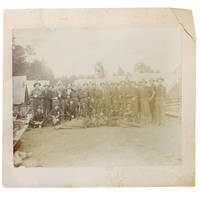
1890187391890. African American soldier photographed among members of a United States Army camp unit in the American West during the late nineteenth century providing visual documentation of Black participation within the military environment during the era of segregated service. African American soldiers served in the United States Army throughout the nineteenth century most prominently in units known as the Buffalo Soldiers which were formally organized after the Civil War. While Black soldiers were typically assigned to segregated regiments images occasionally record their presence in mixed military environments such as camps labor details or logistical units. The photograph captures a group of soldiers gathered in a temporary camp setting and includes a seated Black soldier identified by a contemporary handwritten note on the verso reading "Notice 'Black Soldier.'"<br /> <br /> Albumen sepia tone photograph mounted on photographer's board showing a group of American soldiers posed within a military encampment. Photograph measuring approximately 8.5 x 10 inches mounted on a photographer's board measuring approximately 10.75 x 10 inches. The men are dressed in clothing typical of western military and frontier settings of the late nineteenth century including dark buttoned shirts trousers supported by suspenders and boots. The African American soldier appears seated among the group with a cigarette in his mouth. The soldiers are gathered in a clearing surrounded by trees where rows of tents are arranged on raised wooden platforms suggesting an organized encampment. Cooking equipment stacked blankets plates and tankards are visible indicating a communal meal or informal gathering. One soldier holds what appears to be a long rifle with a visible barrel and wooden stock. Several soldiers sit or recline on the ground in the foreground while others stand behind them creating the appearance of an informal group portrait taken during daily camp life rather than a formal military arrangement. Handwritten note on the verso reads "Notice 'Black Soldier.'" Top right corner of the board cracked with tape repairs on the verso; slight water staining at the top left corner and damp staining at the lower left corner with partial cracking at the lower right corner. Image itself remains clear and largely unaffected. Overall condition good. The photograph preserves a visual record of African American presence within the late nineteenth century U.S. Army camp environment during a period when the armed forces remained formally segregated. unknown
19461045CG1946. Oel auf Holz. 72 x 43 cm. + Wichtig: Für unsere Kunden in der EU erfolgt der Versand alle 14 Tage verzollt ab Deutschland / Postbank-Konto in Deutschland vorhanden +
16269Grant Cottage King's Road Sloane Square London. 21 January 1813. 2pp. cr.8vo 30 x 18.5cm. In fair condition aged and worn with slight damage to one corner resulting in loss of one word of text. 62 lines of text with deletions and emendations and the thirteen lines of the conclusion largely rewritten. Headed: 'To the Right Honorable the Earl of sic Bathurst His Majestys Principal Secretary of State for the Colonial & War Department &c &c &c the Memorial of Major General Charles Viscount Grant de Vaux Shewest sic'. The first paragraph reads: 'That your memorialist although a french Emigrant is descended from two ancient and noble British families both by his father and mother and holds at present the rank of major general in the British Service - having resided in England since the year 1790 during which period after his services in the Emigrants Army became unnecessary he devoted his attentions to objects of Science and has published several works on Astronomy Navigation History &c tending to discoveries particularly on Nautical Science and on the history of Mauritius; which having met the approbation of men of talents and the patronage of Government your memorialist humbly hopes that his labours will ultimately prove beneficial to this country and to his unfortunate and numerous family.' The second paragraph concerns 'a large tract of Land in Canada' granted to him in 1794 'with a view to remove to that country a considerable number of french Emigrants who were to be conducted by him'. The third paragraph concerns 'the island of Mauritius where your memorialist was born' where his father 'the late Baron Grant &c commanded the troops' which has been 'conquered by his majesty's arms and is a valuable colony of Great Britain' The fourth paragraph concerns his family he having married 'a native of this country by whom he has eight children not provided for all born in England'. In the fifth paragraph he stresses his 'loyalty and integrity'. In conclusion he prays that 'your Lordship be pleased to issue an order that his Grant of land may be conferred to him in the isle of France 'the Isle of France' was another name for Mauritius his native country in lieu of the grant in Canada which was extensive according to his rank and numerous family'. Biographical/Historical NoteCharles Grant vicomte de Vaux was the descendant of a family of nobles who had emigrated from Scotland to France in the 14th century. Vaux was born in 1749 on the island of Mauritius where his father Louis-Charles Grant the Baron de Vaux served as governor. As a youth Vaux sailed to France to be educated and settled at Vaux-sur-Seulle in Normandy and eventually became an army officer. During the American Revolution he sided with the colonists and earned money selling supplies to the colonies and investing in ships to engage in privateering. The majority of the ships were lost and after the war Vaux petitioned the United States Congress for compensation. Though Vaux considered emigrating to North America he remained in France until forced by the revolution in France to flee to Great Britain in 1790. During his time as a refugee Vaux became interested in the prospect of starting a settlement in Canada and much of his energy during the next decade was focused on gaining permissions and raising money for the expedition. In the mid-1790s Vaux attempted to support himself as an army officer after being granted the position of colonel and permission to recruit a regiment which he formed with other French émigrés; it was stationed temporarily in Holland. This pursuit failed however and the regiment was dispersed after France invaded Holland during the French Revolutionary wars. Vaux then turned to writing to support himself publishing numerous books which included History of Mauritius and Introduction to Four New Maps of the Four Quarters all the while still attempting to plan a Canadian settlement. Despite his constant petitioning planning and pleas for aid Vaux was never able to realize his dream of moving to Canada. Little is known of the last two decades of his life but he is thought to have died in France around 1818." Grant Cottage, King's Road, Sloane Square [London]. 21 January 1813. unknown
19461045CG1946. Oel auf Holz. 72 x 43 cm.
1952002334Paris Gérard Le Gris 1952
542-Eo.J. Schwarze Kreide und etwas Bleistift, auf bräunlichem Velin, verso bezeichnet ?Ferdinand von Rayski?. 2124,7 cm. Verso an den Rändern Reste einer alten Verklebung. Vorstudie zu einem Porträt, vermutlich um 1845/55 entstanden. Zur Körperhaltung des Dargestellten vgl.: Ausst. Katalog: Ferdinand von Rayski. Dresden, Galerie Neue Meister 2006, Farbabb. Ss. 65 und 75.
229-Eo.J. Bleistift, auf chamoisfarbenem Bütten, links unten signiert ?P. Hess?. 16,5:22,8 cm Rand rechts unregelmäßig beschnitten, minimal fleckig, verso in den Ecken Reste alter Verklebung. Sicher Figurenstudien zu einem Gemälde.
Very Good Turkish, Ottoman (1500-1928) Original typescript letter signed (TLS) by Kâzim Karabekir to Nevzat Ayas [Abdullatif Nevzad Ayasbeyoglu], (1889-1966), who was an important Turkish politician. 21x15 cm. In Turkish (Modern) with Latin letters. 1 p. [in four]. 'Sevgili Bay Nevzad Ayas, Yazilarinizi ilgili iç makama bildirmemizi uygun görürüm. Sevgilerimle gözlerinizden öperim, K. Karabekir'. "The Grand National Assembly of Turkey Presidency - Special" letterhead. The letter has five typescript lines with autograph signature of Karabekir. Musa Kâzim Karabekir was a Turkish general and politician. He was the commander of the Eastern Army of the Ottoman Empire at the end of World War I and served as Speaker of the Grand National Assembly of Turkey before his death. Karabekir was born in 1882 as the son of an Ottoman general, Mehmet Emin Pasha, in the Kocamustafapasa quarter of the Kuleli neighborhood of Constantinople, Ottoman Empire. The Karabekir family traced its heritage back to the medieval Karamanid principality in central Anatolia. Karabekir toured several places in the Ottoman Empire while his father served in the army. He returned to Istanbul in 1893 with his mother after his father's death in Mecca. They settled in the Zeyrek quarter. Karabekir was put into Fatih military secondary school the next year. After finishing his education there, he attended the Kuleli Military High School, from which he graduated in 1899. He continued his education at the Ottoman Military College, which he finished on 6 December 1902 at the top of his class. As a junior officer, after two months he was commissioned in January 1906 to the Third Army in the region around Bitola in North Macedonia. There, he was involved in fights with Greek and Bulgarian komitadjis. For his successful service, he was promoted to the rank of Senior Captain in 1907. In the following years, he served in Constantinople and again in the Second Army in Edirne. During his service in Edirne, Karabekir was promoted to the rank of major on 27 April 1912. He took part in the First Balkan War against Bulgarian forces, but was captured during the Battle of Edirne-Kale on 22 April 1913. He remained a POW until the armistice of 21 October 1913. Before the outbreak of World War I, Karabekir served for a while in Constantinople and was then sent to some European countries like Austria, Germany, France and Switzerland. In July 1914, he returned home, as a world war was likely. He was commissioned to the Iraqi front to join the Sixth Army. For his success at Gallipoli, he was decorated in December 1915 both by the Ottoman and German Command, and was contemporaneously promoted to colonel. In April 1916, he took over the command of the 18th Corps, which gained a great victory over the British forces led by General Charles Townshend during the Siege of Kut-al Amara in Iraq. Karabekir was appointed commander of the 2nd Corps on the Caucasian front and fought bitterly against the Russian and Armenian forces for almost ten months. In September 1917, he was promoted to brigadier general by a decree of the Sultan. In compliance with the Treaty of Sèvres, which ended World War I, Ottoman Sultan Mehmet Vahdettin gave Karabekir the order to surrender to Entente powers, which he refused to obey. He stayed in the region and, on the eve of the Erzurum Congress when Mustafa Kemal had just arrived in Erzurum, he secured the city with a Cavalry Brigade under his command to protect him and the congressmen. He pledged with Mustafa Kemal to join the Turkish national movement and subsequently took the command of the Eastern Front during the Turkish War of Independence by the Kuva-yi Milliye. Karabekir Pasha moved to Ankara in October 1922, and continued to serve in the parliament as Deputy of Edirne. He was still the acting commander of the Eastern Army when he was elected Deputy of Constantinople on 29 June 1923. Six months later, he was appointed Inspector of the First Army. Parliament awarded him the highest Turkish "Order of Inde
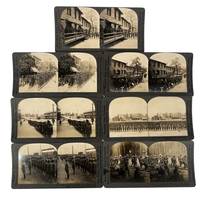
1918205031918. Keystone View Company. Buffalo Soldiers stereoview photographs World War I era document African American military service in the American Expeditionary Forces and place segregated Black troops within the broader Allied war effort in Europe. The images identify units of "Colored Troops" including engineers of the Signal Corps and depict formations logistical organization and moments of assembly such as soldiers "lined up for democracy." These photographs situate African American soldiers-many of whom descended from the Buffalo Soldier regiments established after the Civil War-within a transnational military environment that included French British and colonial forces. Scenes showing interaction with Moroccan and Indian troops on French roads reflect the multinational composition of Allied armies during the final phases of the war while the presence of Black American troops underscores their continued participation in major military operations despite segregation within the U.S. Army.<br /> <br /> France and possibly other European locations circa 1917-1919. Archive of seven stereoview photographs published by the Keystone View Company. Images depict African American soldiers in formation including lines for mess and organized ranks as well as mixed Allied groupings on roadways and near encampments. Stereographic format intended for three-dimensional viewing with printed captions identifying subjects and units. Photographs emphasize both structured military order and the varied roles occupied by Black troops particularly in engineering and support divisions.<br /> <br /> Produced during the final years of World War I these stereographs align with the expanded deployment of African American soldiers overseas and the broader visibility of Black troops within global conflict. While their service contributed to Allied operations these soldiers returned to a United States that maintained racial segregation and limited civil rights situating the archive within the larger history of African American military participation and postwar inequality. As visual records the images support research into race military organization and the international dimensions of the war. Light handling wear; overall very good condition. unknown
Sixteen colour prints of Vietnamese children's art circa 1968 through 1970. Prints measure approximately 10.25" by 7.25" with actual picture size of approximately 8.5" by 6.25". All text in Vietnamese. Verso of each print bears print number (1 through 16), plus what appears to be title, artist's name, date, and age of artist. Print one shows a seated Ho Chi Minh surrounded by adoring children. Print five shows children gathering vegetation to assist soldiers in the camouflaging of a large truck-mounted rocket. Print 16 shows a soldier teaching children how to use a rifle. Prints are stored in a well-worn but still attractive colour-illustrated protective cover. Bottom of cover reads "Nha xuat ban my thuat - am nhac." Prints in nice shape with no markings. Includes yellowed business card of a Japan-based Canadian academic. A lovely, fascinating and unique set. Book
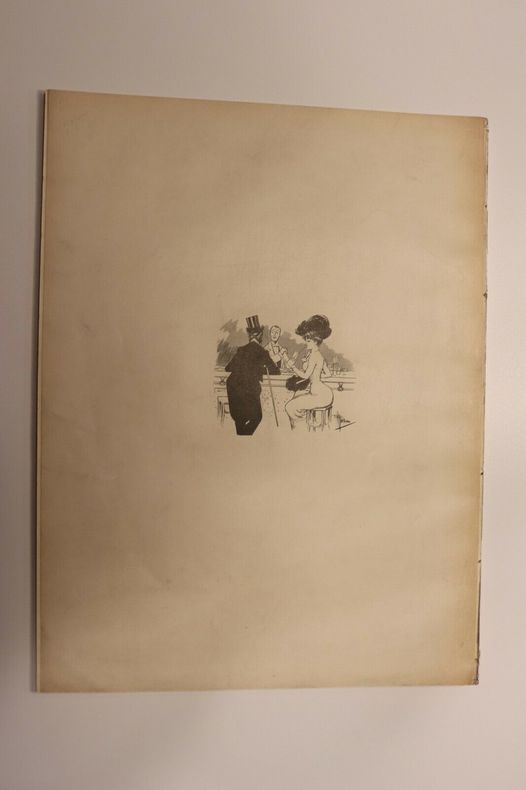
1900AMO-4198Pour vos beaux yeux. Album en couleurs (colorié au pochoir - ateliers Greningaire). Par Albert Guillaume. Préface de Coquelin Cadet. H. Simonis Empis, éditeur, s. d. (1900). Format 35,5 x 28 cm. Couverture illustrée en couleurs (premier plat) et 20 planches imprimées en couleurs (coloriage au pochoir par Greningaire) (avec 1 feuillet de faux-titre, 1 feuillet de titre et 2 feuillets de préface). Superbe et très rare tirage de luxe sur papier du Japon à 13 exemplaires seulement signé par l'artiste Exemplaire dérelié. Tête dorée. Superbe état de fraicheur des couvertures (les deux plats sont conservés en très bon état). A relier (un cartonnage papier serait le bienvenu). Voir photos de l'annonce. Très rare dans ce tirage.
64 pages. Features: Nice colour ad for Dominion Oilcloth & Linoleum inside front cover includes illustration of amourous military couple; Nice colour-illustrated Pepsi ad features pretty blonde and illustration of boys fishing; News digest includes The Marsh Report, 'Cradle to Grave' security, and more; Nice one-page illustrated Canadian Pacific Air Lines ad explains their substantial contributions to the war effort, amid dramatic air and land battle scene; Colour Ritz cracker ad includes service man and woman; Editorial discusses how the war has tarnished certain words and lifted others; Ford Motor Company one-page ad with illustration of Canadian troops in firefight; One-page Northern Electric ad includes illustration of deHavilland Mosquito; Friendly Invasion - great photo-illustrated article on construction of the Alaska Highway, with photo of Felix Murawski, 74th Engineers of Oklahoma City; Pigs' Feet (short story); The Penalty is Death (short story); Canada's Future Housing - photo-illustrated article explains ideas to be borrowed from Great Britain and the U.S.; Chowder Boy (short story); Sea Water Gurney's Boy (short story); Hollywood News and photos; One-page Parker Pen ad shows mailman handing mother a letter beneath caption "Your boy writes often now!"; Beer is Booze; One-page ad for the T. Sisman Shoe Co. includes great illustration of soldier on motorcycle; Canadian General Electric half-page ad boldly proclaims "Vitamins For Victory"; Woodbury Powder ad includes nice photo of Lana Turner; Magnificent centrefold two-colour (red and black) Victory Bonds ad entitled "Shoulder Your Own Share" includes text on left and, on right, a large illustration of Madame Chiang Kai-Shek super-imposed over scene of fighting in her war-torn China; Army Meals Go Modern - nice photo-illustrated article explains and illustrates meal preparation for the gigantic 7,000 man "army restaurant" at Webb Hall in Toronto; Nice colour one-page ad for Heinz Tomato soup includes illustration of tomato-headed aristocrat in top hat and monocle; Fashion illustrations; Is Your Daughter Happy in the Service? - article with photos of Daisy Horner of Dorset, Ontario, Dolly Mawson and Gay Sutton of Toronto, Elizabeth Cook from Creemore, Wren Barbara McClelland of Toronto, and twins AW2 Beryl and AW2 Daphne MacPhee of Charlottetown; Fashion article; Quotes from around the world; Elaborately colour-illustrated Canadian Pacific - Canadian National Victory Bond ad inside back cover entitled 'A Profession of Faith' includes calligraphy explaining their faith in Canada's future; Nice colour Wabasso Cottons ad on back cover shows mother, daughter and sewing machine; and more. Unmarked with moderate wear. Covers detached as one. A quality copy of this excellent wartime issue. Book
1957193551957. Vernacular photograph archive of African American soldiers in integrated U.S. Army units circa 1950s documents the early implementation of military desegregation following Executive Order 9981 and provides visual evidence of Black and white soldiers serving together during and after World War II including the Korean War. The photographs place African American servicemen within the first generation of formally integrated military units preceding broader civil rights gains in civilian society. Scenes of joint training transport and daily life show Black soldiers operating alongside white counterparts in contexts ranging from shipboard movement to antiaircraft defense positions indicating the practical realities of integration in active and post-conflict environments. The archive captures both structured military activity and informal moments offering a record of service that contrasts with the segregated conditions that had defined earlier periods of U.S. military history.<br /> <br /> United States and Korea circa 1950s. Archive of 21 silver gelatin vernacular photographs with several images bearing manuscript captions on the verso identifying individuals and locations including one noting Korea 1957-1958. Photographs depict a range of settings including military bases in Korea stateside camps shipboard scenes and antiaircraft gun emplacements in snowy terrain. Multiple images show interracial groups of soldiers posing with rifles and submachine guns while others capture informal activities including one sequence featuring a soldier holding an inflated puffer fish aboard a ship. One photograph includes a note written in Italian on the verso indicating cross-cultural contact or circulation. Composition and subject matter vary from posed group portraits to candid operational and leisure scenes.<br /> <br /> Created during the first decade of enforced military integration these photographs align with the transitional period in which desegregation policies were implemented unevenly across the armed forces with fuller integration not realized until the mid-1950s. The Korean War served as a critical testing ground for integrated units accelerating changes in military structure and social dynamics within the ranks. This archive provides a ground-level view of those developments documenting both the normalization of interracial military service and the persistence of shared routines duties and environments across racial lines. Light wear from handling with minor surface marks and occasional verso annotations; overall very good condition. unknown
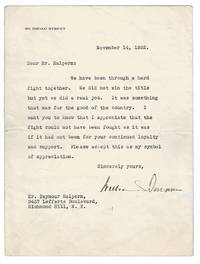
1932100747<p>New York November 14 1932. 1932. Very good. - Over 85 words typed on his 8-5/8 inch high by 6-1/2 inch wide "90 Broad Street" stationery. Addressing the young campaign volunteer Seymour J. Halpern William J. Donovan the future head of the Office of Strategic Services writes "We have been through a hard fight together. We did not win the title but we did a real job." He goes on to show his appreciation to the young autograph collector "I want you to know that I appreciate that the fight could not have been fought as it was if it had not been for your continued loyalty and support. Please accept this as my symbol of appreciation." Signed in full "William J. Donovan". Donovan ran for Governor of New York State to succeed FDR in 1932. A Republican he lost to Herbert Lehman. Folded in half for mailing the edges are soiled and there are tears to the edges of the fold. Very good.</p><p>To house his law firm in March of 1932 Colonel William J. Donovan leased a large suite of offices in the Stone & Webster Building at 90 Broad Street in New York City.</p><p>The American attorney diplomat soldier and intelligence officer William J. Donovan 1883-1959 is best known as the head of the OSS the Office of Strategic Services which was the war time precursor to the CIA. A veteran of World War I Donovan was awarded the Medal of Honor the Distinguished Service Cross the Distinguished Service Medal and the National Security Medal. In 1941 FDR established the Office of the Coordination of Information with Donovan as its director. Once the U.S. entered the war the COI became the OSS in June of 1942 with Donovan now a major general as its head. Donovan created the OSS as a military psychological warfare service to include both psychological and unconventional warfare. The service would soon include elements that would be called "special operations" the first phase of which would be intelligence penetration including research and analysis and propaganda followed by a second stage incorporating sabotage and subversion. This second stage would be followed by guerilla action commando raids and support of resistance movements.</p><p>An avid autograph collector in his youth the then 19-year old campaign volunteer the future Queens New York Republican Congressman Seymour Halpern 1913-1997 started his political career as a campaign aide to New York's powerful mayor Fiorella La Guardia and first served in New York's State Senate for 14 years before seeking a seat in the U.S. Congress. In Albany Halpern sponsored 279 bills that became law including measures on schools housing civil rights nutrition and mental health. A Liberal he was something of an anomaly as the lone Republican representative from New York City and generally garnered support from Labor Unions and endorsement from the Liberal Party. Yet he never even considered switching parties as he considered membership in the Republican Party a family tradition and commitment. While he found ample time for his private pursuits including painting and collecting autographs he took his legislative duties very seriously. Of these he was proudest of his co-sponsorship of the 1964 Civil Rights Act and of the original 1965 Medicare legislation.</p> [New York], November 14, 1932.
18901108171890 A Paris, Librairie Haar & Steinert (C. Haar, Successeur) - 1890 - 2 volumes In-Folio, cartonnages verts, formats à l'italienne, illustrations contrecollées sur les premiers plats, étiquettes de titre manuscrites aux dos - 207 pages + environ 90 pages pour le second tome (suite des aquarelles sous serpente) - Illustrés de 620 gravures sur bois et accompagnée de 45 aquarelles en chromolithographie - Texte sur deux colonnes
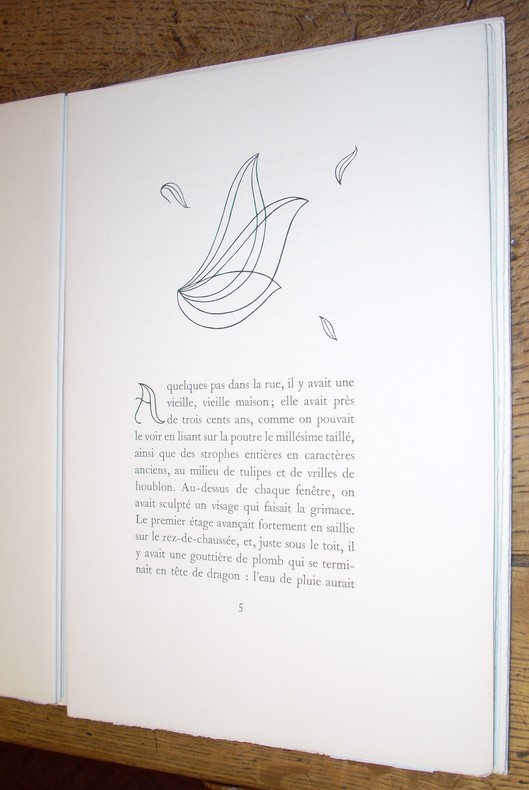
19359489Paris, Editions de la Clé d'Or, 1935 ; grand in-4 en feuilles sous couverture crème rempliée, illustrée en couleurs, chemise-étui de l'éditeur, pièce de titre havane imprimée en doré ; 201, (5) pp., 1 photographie hors-texte et 24 aquarelles hors-texte coloriées au pochoir par le procédé Duval-Beaufumé.
182323886St. Petersburg, Karl Kray, 1823. XI, 180 SS. 8°, Halbleder der Zeit, marmorierte Einbanddeckel. Einband etwas berieben, das Leder des Rückens etwas mürbe.
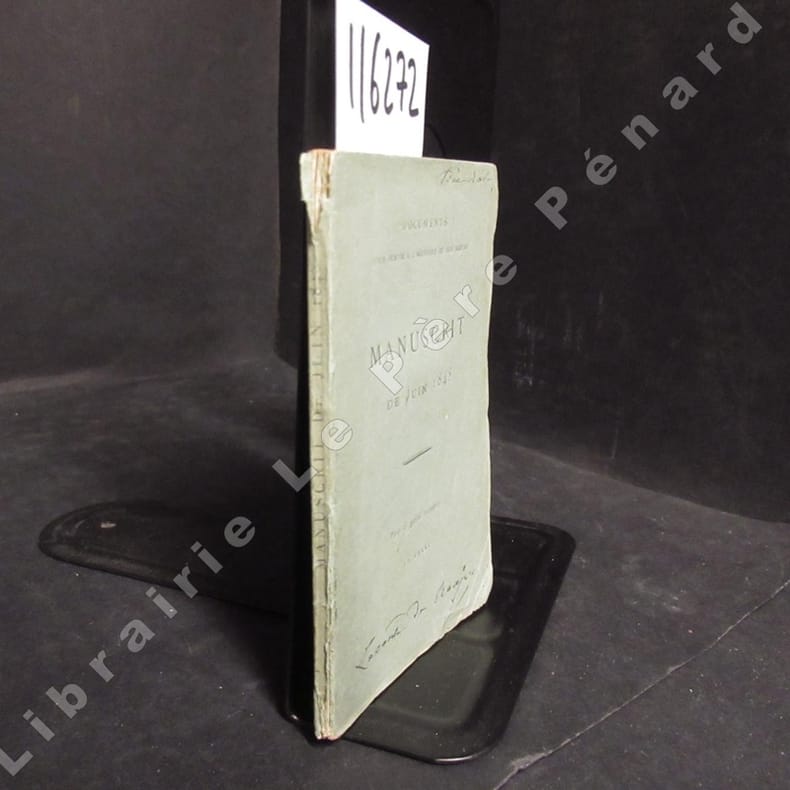
18681162721868 A la Librairie Frédéric Henry, au Palais-Royal, Galerie d'Orléans, collection "Documents pour servir à l'histoire de nos moeurs" publiée par Lorédan Larchey, exclusivement composée de documents originaux. Imprimé par Emile Voitelain et Cie - 1868 - In-18, broché - 62 pages - Publication tirée à quatre cent exemplaires, sans justificatif de tirage
189017551Paris, Garnier Frères, 1890 ; fort in-8, cartonnage polychrome sur fond kaki, titre doré, dos décoré et doré, second plat décoré en noir, plats biseautés, tranches dorées ; (4), 1138 pp. , 54 illustrations aquarellées à la main, dont 16 hors-texte, 30 en-tête et 8 dessins in-texte, 7 vignettes en noir et blanc.
0119-Bo.J. Kreidelithographie, 1816, auf leicht gräulichem Velin. 20,9:28,1 cm. Literatur: Jahn 178, I (von II), unverkürzt; Dussler 7; Winkler 16, I (von II). - Inkunabel der Lithographie! Sehr selten!
472-Eo.J. Aquarell über Bleistift, weiß und mit Goldbronze gehöht, auf Zeichenkarton, links unten signiert und datiert ?J. Schram 1849?. 22,3:18,5 cm. Miniaturhaft fein durchgeführtes Bildnis eines vornehmen, zwei Orden tragenden Herrn, vermutlich entstanden im Zusammenhang mit Schramms geplantem Porträtwerk ?Deutsches Album berühmter Zeitgenossen?.
473-Eo.J. Aquarell auf hellem Karton, unbezeichnet. 27,4:21,1 cm. Miniaturhaft fein durchgeführtes Porträt.
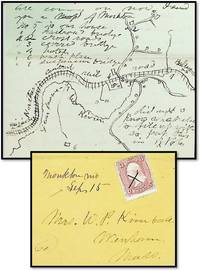
21451Very Good. HAND-DRAWN MAP OF MONKTON MD - UNION SOLDIER DESCRIBES GUARDING THE NORTHERN CENTRAL RAILROAD AND A CHAOTIC 'CHICKEN RAID' DURING THE FINAL YEAR OF THE CIVIL WAR.<br /> <br /> An original Civil War manuscript letter dated September 14 1864 written by a Union soldier stationed in Monkton Maryland. The letter features a remarkable hand-drawn map of the town and military outposts documenting the regiment's duty guarding the vital Northern Central Railroad bridges and a humorous incident involving a 'liberated' flock of chickens.<br /> <br /> Key Features:<br /> Visuals: The final page features a detailed pen-and-ink hand-drawn map of Monkton MD. It identifies the 'Northern Central Rail' 'River' Gunpowder Falls 'Covered Bridge' 'Hotel' and 'Our House' Barracks.<br /> Content: The soldier details life on guard duty at the 'Covered Bridge' building a brick stove for warmth and sleeping on straw. He recounts a a vivid and informal account of an improvised 'chicken raid' following a rail stop illustrating camp life food scarcity and soldierly opportunism late in the war. where a train passed carrying chickens; eight chickens "got off" escaped or were pulled off leading to a chaotic chase by the soldiers and the Captain to secure 'soup for dinner.' Full transcription available<br /> Postal History: Includes the original envelope addressed to Mrs. W.P. Kimball in Wenham Mass featuring a 3-cent George Washington stamp 1861 issue and a Monkton MD postmark.<br /> The envelope features a 3-cent George Washington stamp 1861 Issue tied by a Monkton MD postmark. Please Note: A previous owner noted this as a 'Scott #64' on the protective sleeve; however it has not been expertized and is sold as the more common Scott #65 Rose variety. We leave the final determination of the shade to the buyer.<br /> Transcription: A previous owner has handwritten the letter onto one page in attractive cursive. We also has a typed transcript available.<br /> <br /> Physical Specs:<br /> Date: September 14 1864<br /> Dimensions: Standard bi-fold letter sheet approx. 5x8 inches folded; Envelope included.<br /> Format: Handwritten ink on period writing paper.<br /> <br /> Condition: Very Good - The handwriting is legible and ink remains dark. Paper shows standard age-toning and fold lines consistent with mailing. The map is clean and sharp. This letter offers a specific window into the defense of the Northern Central Railroad NCR a critical supply line for the Union Army connecting Baltimore to Harrisburg. In 1864 regiments like the 8th Massachusetts Infantry were stationed along this line to protect bridges from Confederate raiders Gilmor's Raid had struck this area just months prior in July 1864. <br /> <br /> The mention of the 'Covered Bridge' at Monkton is historically significant as this was a key infrastructure point. The soldier's map provides a rare first-hand topographical view of the encampment layout relative to the rail line.<br /> <br /> Keywords: Civil War Letter Monkton MD Northern Central Railroad Hand Drawn Map Soldier Art 8th Massachusetts Infantry Wenham MA Covered Bridge Military Correspondence 1864. unknown
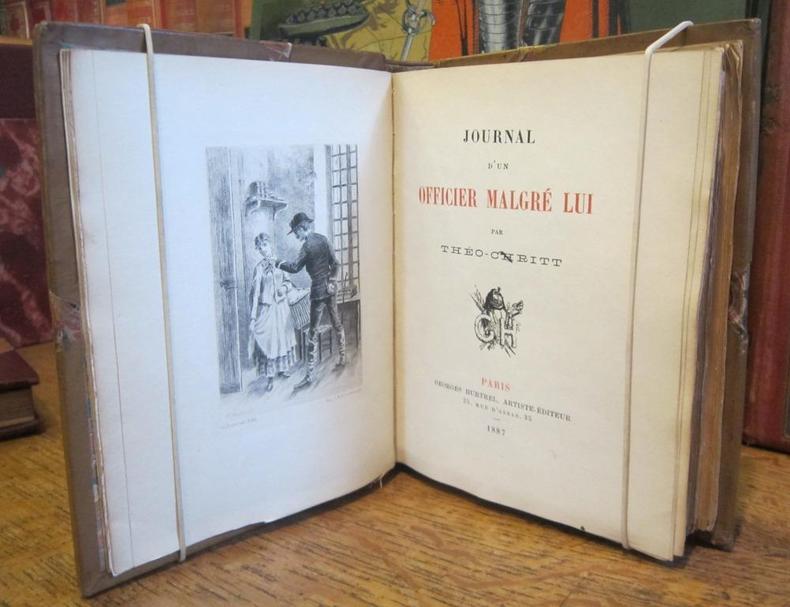
1887000311Paris Hurtrel 1887
25043Paris 7 October 1821. Three pages 4to bifolium good condition. An elegant handwriting. Allow me to present yo you Mr Grattan my country man - the author of Philibert a gentleman and a scholar. He has resided some time in France and is going to London perhaps more to ascertain what he can do there thro' the medium of his literary invocations for the benefit of his Wife and young Family than with any fixed object or well arranged plan. Should he happen to be in London during the Session of Parliament Mr Grattan may probably wish to offer himself to you as a reporter for which situation from his information and habits I should suppose him to be well qualified and should he make any such application will you have the kindness to recollect this letter. I am quite aware how rarely it can happen to find you without a long list of applicants for a connexion with your highly popular and valuable Establishment and I know also the praise-worthy anxiety with which you so liberally protect and give the preference to your old acquaintance - your faithful and talented assistant but yet with this knowledge as there must be occasional vacancies and changes in all such extensive concerns I give Mr Grattan this introduction which from your polite and friendly attention to me at all times I venture to hope will dispose you to receive kindly his visit tho' it should not at once procure for him that connexion with you he would naturally be so desirous to establish should he happen to determine upon residing in London. .". Note: a. Wikipedia Grattan 1792 – 1864 was an Irish novelist poet historian and diplomat. " It was here Bordeaux that he started as a writer beginning with Philibert 1819 an octo-syllabic poem in six cantos. Soon after he moved to Paris where he made met Thomas Moore Washington Irving Adolphe Thiers Béranger Lamartine and other distinguished literary men and became a steady contributor to the Westminster Review Edinburgh Review the New Monthly Magazine and other periodicals."; b. a very substantial obituary appeared in the New Monthly Magazine 1826 pp.517-520 for what it's worth. Paris, 7 October 1821. unknown