Mirbach, WillyAntiquariat.de

549 résultats
1997110936Geldern : Historischer Verein für Geldern und Umgegend, 1997. 288 S., Ill. Gewebe, gebundene Ausgabe.
198951745München : Schneekluth 1989. 551 S. ; 22 cm Gewebe, gebundene Ausgabe, Leinen, Exemplar in gutem Erhaltungszustand
199851153Berlin : Aufbau-Verl. 1998. 229 S. : 30 Abb.. ; 22 cm, mit Schutzumschlag Top Zustand, Pp., gebundene Ausgabe, Hardcover/Pappeinband, Exemplar in sehr gutem Erhaltungszustand
19951054857Hamburg : Hamburger Edition, 1995. 95 S. Originalbroschur.
191347586Berlin, Erich Reiß, (1913). 104 S. Mit 19 Farbtaf. (18,5 x 14,5 cm) Farb. illustr. OPp.
19461045CG1946. Oel auf Holz. 72 x 43 cm. + Wichtig: Für unsere Kunden in der EU erfolgt der Versand alle 14 Tage verzollt ab Deutschland / Postbank-Konto in Deutschland vorhanden +
19461045CG1946. Oel auf Holz. 72 x 43 cm.
19611168731961 Editions J'ai lu, N° 121 et 122 - 1961 - In-12, broché couverture illustrée par Jan Lenica - 446 pages
1995142217Münsingen. Privatdruck. (Druckhaus Baader). 1995. 411 Seiten. Mit zahlreichen faks. Abbildungen u. faks. Dokumenten. Farbig illustrierter Original-Einband. 24x16,5 cm
1911000418Schenectady New York. Fine with no dust jacket. 1911. PETER J. ARNOLD - Union solider in the 134th NY Vols. Partly cropped slip on which he writes "I saw General Grant many times this word cropped away in front of Petersburg during 1864 and 1865." Signed with his X mark and full name Schenectady 1911. ; Manuscript Handwritten Autograph Civil War Era Union Americana Confederate; Signed by Autograph . unknown
19671083331967 Imprimer chez Alsagraphic, réalisé avec le soutien du Ministère des Anciens Combattants et des Victimes de la Guerre, Délégation à la Mémoire et à l'Information Historique - 1995 - In-8, broché, couverture illustrée en couleurs - 333 p. - Reproductions photographiques en N&B
19801112201980 Editions J.M. Collet - 1980 - In-4, cartonnage rouge illustré - 80 pages - Nombreuses reproductions photographiques en N&B
19620001450KOREA. Very Good. 1962. Manuscript. On offer is a super manuscript relic of Canada's Korean War participation being a handwritten day book diary pages of a soldier with the famed French Canadian regiment the 'Van Doos'. The 2-ring 6 x 4 inch pages record terse fact filled sometimes intimate personal notations of this soldier's duties and life in the Korean Theatre. Some pages are missing but from April 2nd 1952 through November 3rd 1952 he notes 216 days in Korea at this point this serviceman provides an intimate picture of a support soldier laying cables building rafts laying out minefields and many times under attack. June July August and September are the most filled months and in roughly 137 pages one reads the day to day mundane and of course the definitely not mundane entries - how he was driving a jeep with a Sergeant and a military officer and the jeep was under mortar fire and it rolled over down an embankment. Other entries include: May 17th 1952 29 years old; check Vandoos reg. 2000 mine A/P minefield. Got shelled in the valley. 18 - 75 mm came in on us in ½ hour. No casualties; received letters from patootie. Wrote letter to patootie; started booby trap MF mine field; Sgt. Jackson went to battle school in Japan; attended class pontoon raft demonstration at Widgeon bridge; June 25th 7th Wedding Anniversary; mention of Operations Buster and Buckingham Noahs Ark; went over to Sgt's mess a HQ. Tied one on; constructed & operated close 50/60 raft all day; buffet lunch @ Vandoos HQs; took 5 L/Cpls up to Black Watch; almost got clobbered by a heavy mortar which landed 25' behind jeep and much more. One online source provides: BACKGROUND NOTES: The Royal 22e Régiment is an infantry regiment and the most famous francophone organization of the Canadian Forces. The regiment comprises three Regular Force battalions two Primary Reserve battalions and a band making it the largest regiment in the Canadian Army. The ceremonial home of the regiment is La Citadelle in Quebec City where the regimental museum is housed. The regiment is nicknamed the Van Doos an anglicized mispronunciation of vingt-deux "twenty-two" in French. The regiment's regimental headquarters is located in Quebec City with all three of its regular battalions stationed at various bases in the province of Quebec. The regiment serves as the "local" infantry regiment for Quebec. During the Korean War 1951-1953 the regiment expanded to three battalions each serving in turn as part of the Canadian brigade in the 1st Commonwealth Division. Thus the "Van Doos" represented one-third of Canada's infantry contingent throughout the war. Overall in very good condition save for one page chewed as noted by 'Kibbles'.; 12mo - over 6¾" - 7¾" tall; KEYWORDS: CANADIANA FRENCH CANADIAN REGIMENTS VAN DOOS VANDOOS 22ND REGIMENT KOREAN WAR SEOUL PYONG YANG OPERATION NOAHS ARK OPERATION BUCKINGHAM MINE FIELDS BLACK WATCH CANADA Personal Memoir Handwritten hand written autograph autographs signed letters document documents manuscript manuscripts writers writer author holograph personal ANTIQUITÉ CONTRAT VÉLIN MANUSCRIT PAPIER ANTIKE BRIEF PERGAMENT DOKUMENT . unknown
1981146129Bonn: Herausgegeben vom Evangelischen Kirchenamt für die Bundeswehr 1980-1981. 234; 200 Seiten. 8° (17,5-22,5 cm). Orig.-Broschuren. [Softcover / Paperback].
198117756Gütersloh [u.a.] : Bertelsmann-Club [u.a.], [1981]. 191 S. 8°. Lizenzausg. Ill. OBroschur.
1977MILI1131Ldn., Batsford Ltd. (1977). 140 S., mit zahlr. sw. Abb., OPp. m. farb. ill. OU., dieser mit geringen Gebrauchsspuren, Kopfschn. schwach angestaubt m. kl. Fl., Besitzerstemp. am vord. Innendeckel. In Englisch.
19901216881990 Editions Productions "Le Burnous" - Sans date (années 1990-2000) - In-8, broché, couverture illustrée en couleurs - 104 pages - nombreuses illustrations et reproduction photographiques en couleurs in-texte
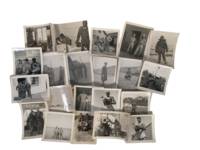
1957193551957. Vernacular photograph archive of African American soldiers in integrated U.S. Army units circa 1950s documents the early implementation of military desegregation following Executive Order 9981 and provides visual evidence of Black and white soldiers serving together during and after World War II including the Korean War. The photographs place African American servicemen within the first generation of formally integrated military units preceding broader civil rights gains in civilian society. Scenes of joint training transport and daily life show Black soldiers operating alongside white counterparts in contexts ranging from shipboard movement to antiaircraft defense positions indicating the practical realities of integration in active and post-conflict environments. The archive captures both structured military activity and informal moments offering a record of service that contrasts with the segregated conditions that had defined earlier periods of U.S. military history.<br /> <br /> United States and Korea circa 1950s. Archive of 21 silver gelatin vernacular photographs with several images bearing manuscript captions on the verso identifying individuals and locations including one noting Korea 1957-1958. Photographs depict a range of settings including military bases in Korea stateside camps shipboard scenes and antiaircraft gun emplacements in snowy terrain. Multiple images show interracial groups of soldiers posing with rifles and submachine guns while others capture informal activities including one sequence featuring a soldier holding an inflated puffer fish aboard a ship. One photograph includes a note written in Italian on the verso indicating cross-cultural contact or circulation. Composition and subject matter vary from posed group portraits to candid operational and leisure scenes.<br /> <br /> Created during the first decade of enforced military integration these photographs align with the transitional period in which desegregation policies were implemented unevenly across the armed forces with fuller integration not realized until the mid-1950s. The Korean War served as a critical testing ground for integrated units accelerating changes in military structure and social dynamics within the ranks. This archive provides a ground-level view of those developments documenting both the normalization of interracial military service and the persistence of shared routines duties and environments across racial lines. Light wear from handling with minor surface marks and occasional verso annotations; overall very good condition. unknown
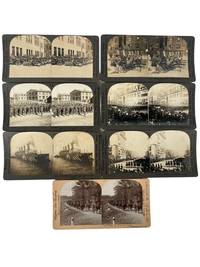
1918205021918. Buffalo Soldier regiments depicted in stereoview photographs from the World War I era document African American cavalrymen and infantry units serving in segregated formations of the United States Army during the early twentieth century. These images record soldiers from several historically significant Black military units including the 9th U.S. Cavalry the 10th Cavalry and the 369th Infantry Regiment. African American soldiers served in large numbers during World War I despite segregation in the armed forces and the war marked a turning point in public recognition of Black military service. The photographs capture cavalry movement machine gun training and celebratory returns from the European front preserving visual evidence of the military presence and public visibility of Buffalo Soldiers during the conflict.<br /> <br /> Archive consists of seven stereoview photographs published by the Keystone View Company during the World War I period. The views depict soldiers from the 9th U.S. Cavalry the 8th Regiment of Colored Troops the 10th Cavalry the Chicago Regiment of Colored Troops and the 15th Regiment of the 369th Infantry. Two stereoviews show Black machine gun companies operating Lewis guns one of the principal light machine guns used on the Western Front during the war. Another view shows Troop K of the 10th Cavalry moving on horseback at Camp Chickamauga in Georgia. Additional stereoviews depict African American soldiers returning from European service and marching in public celebrations including scenes of troops parading along major boulevards such as Fifth Avenue in New York.<br /> <br /> The Buffalo Soldier regiments had already established a long military record before the First World War. Units such as the 10th Cavalry formed part of the segregated Regular Army created after the Civil War and served in campaigns across the western United States during the Indian Wars later participating in the Spanish American War the Philippine American War and operations during the Mexican Revolution. World War I marked one of the final periods in which cavalry units remained visible in American military organization as mechanized armor and motorized vehicles soon replaced mounted troops. At the same time Black soldiers who returned from service were celebrated in wartime parades yet continued to face segregation and racial discrimination within American society. Stereoview cards remain well preserved with light age wear typical of early twentieth century photographic prints. Very good condition overall and a visually compelling record of Buffalo Soldiers during the World War I era. unknown
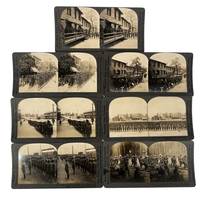
1918205031918. Keystone View Company. Buffalo Soldiers stereoview photographs World War I era document African American military service in the American Expeditionary Forces and place segregated Black troops within the broader Allied war effort in Europe. The images identify units of "Colored Troops" including engineers of the Signal Corps and depict formations logistical organization and moments of assembly such as soldiers "lined up for democracy." These photographs situate African American soldiers-many of whom descended from the Buffalo Soldier regiments established after the Civil War-within a transnational military environment that included French British and colonial forces. Scenes showing interaction with Moroccan and Indian troops on French roads reflect the multinational composition of Allied armies during the final phases of the war while the presence of Black American troops underscores their continued participation in major military operations despite segregation within the U.S. Army.<br /> <br /> France and possibly other European locations circa 1917-1919. Archive of seven stereoview photographs published by the Keystone View Company. Images depict African American soldiers in formation including lines for mess and organized ranks as well as mixed Allied groupings on roadways and near encampments. Stereographic format intended for three-dimensional viewing with printed captions identifying subjects and units. Photographs emphasize both structured military order and the varied roles occupied by Black troops particularly in engineering and support divisions.<br /> <br /> Produced during the final years of World War I these stereographs align with the expanded deployment of African American soldiers overseas and the broader visibility of Black troops within global conflict. While their service contributed to Allied operations these soldiers returned to a United States that maintained racial segregation and limited civil rights situating the archive within the larger history of African American military participation and postwar inequality. As visual records the images support research into race military organization and the international dimensions of the war. Light handling wear; overall very good condition. unknown
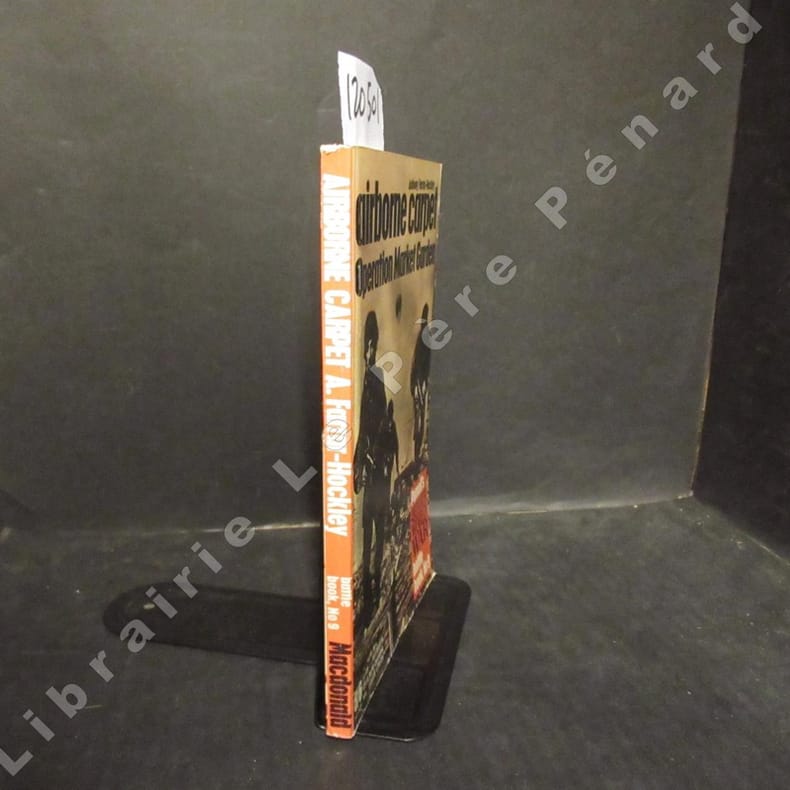
19701205011970 Published by Macdonald & Co., Purnell's History of the Second World War, collection "Battle Book", N° 9 - 1970 - In-8, broché couverture illustrée - 160 p. - Très nombreuses illustrations et reproductions photographiques en N&B in et hors texte - Ouvrage en anglais
1988RO80211690De Cosson. 1988. In-8. Relié plein cuir. Très bon état, Couv. fraîche, Dos impeccable, Intérieur frais. Environ 50 + 118 pages. Sous emboitage en très bon état. 1 volume en français et 1 volume en espagnol - Reimpression de 1829. nombreuses planches d'illustrations en couleurs. Tranches de têtes dorées. Ouvrage en français numéroté n°700.. . Sous Emboitage. . Classification Dewey : 848-Ecrits divers, citations, journaux intimes, souvenirs, mémoires
19942091502135413109Hebei Science and Technology Publishing House 1994. Soft Cover. Fine. Number of books: 4 Hebei Science and Technology Publishing House paperback
19241038381924 Les Editions du Combattant, Paris - 1924 - 1 vol in-8 - Broché, couverture illustrée - 394 pages - Illustrations en noir & blanc dans le texte
198840432München : Universitas-Verl., 1988. 440 S. Gr. 8°. 3. Aufl. Bibl.- Einbd.