13 032 résultats
a015.016GB: R T Birchall - Preston 326 x 255 mm. Old half dark green leather and marbled boards. Spines heavily decorated in gold and all lettered "HAYDN - BOOK C". Leather title labels on front covers. All with the large armorial bookplate of Frederick A Heygate Lambert with small Garratts Hall Library case label. PAGINATION ERRATIC THROUGHOUT but appear to be complete as issued. Salomon is in 7 sets of 16 pages whilst Hague is about 48 pages. All fairly clean tight and sound BUT some offsetting throughout and some occasional damp and other marks. A good working set but perhaps not for the collector. Hardback. Good. R T Birchall - Preston Hardcover
50930Folio half parchment binding in good condition. Two extra pages included: numbered 17 17 vso andn 23 23 vso. Illustrated with a folding map by S. de Bray dated 1644 some restorations on the back. B10059 unknown
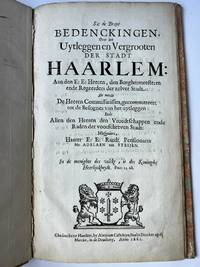
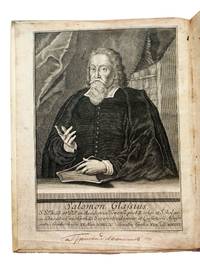
17431935Lipsiae Leipzig: Apud Jo. Fridericum Gleditschium By Johann Friedrich Gleditsch 1743. 18 6-32 16 2138 columns i.e. 1069 pp. 107 pp. Quatro 23 x 18 cm. Edition novissima New edition. Copper engraving of the author's portrait on the frontispiece. Period vellum with embossed gilt spine. Engraved decorative headpieces tailpieces initials. In Latin some Hebrew and Greek.<br /> <br /> Good condition. Slight damage to the top of the spine. Bookplate pasted down to the front endpaper. Library number in ink on the title pre-revolutionary library stamp on the title and cols. 43-45 305-306 589-590 793-794 1037-1038 1293-1294. Ink and pencil numbers on the front and back endpapers. Minor foxing. Owner's marks on the first pages. Marginalia in ink on col. 1915.<br /> <br /> The inscription on the bottom margin title p. 1 3 5 7. reads Ex libris Nicolai Chanenko Signiferi Generalis i.e. From the books of Mykola Khanenko the Grand Standard-Bearer.<br /> Mykola Khanenko 1693 - 1760 was a prominent Ukrainian politician scholar and writer. Starting his military career at 17 under Peter the Great Khanenko rose from a scripture to the one of the most respected titles in the army. He became what is known as khorunzhiy an officer responsible for bearing the standard for the Getman's army. Grand Standard Bearer was an official title in the Zaporozhian Cossack army and was a high official rank.<br /> Khanenko meticulously studied for years - first in Kyiv Academy in Lviv later on his own: he was a proponent of something known today as lifelong education. He became a polyglot keen in Latin wrote poetry in different languages and translated Latin books into Russian.<br /> This attentiveness and encyclopaedic education made him a person close to the Getman figure: he was akin to procurator for both Ivan Skoropadsky and Pavel Polubotok. Polubotok and Khanenko were imprisoned by Peter the Great for a number of years after submitting a plea to choose a new Getman in a democratic way. Freed in 1726 Khanenko took part in the Russian-Turkish war in Crimea.<br /> <br /> Later Khanenko switched to compiling the Ukrainian Malorossian law codex. His activities and interests do show the reality of Cossack officers: a tough but educated democratic and self-governing community.<br /> Khanenko also left one of the first ever written memoirs on Ukrainian life of the era. He consistently wrote a diary from 1719 to 1754 and it was published a century later Chteniya v Imperatorskom Obschestve. Moskva: V Universitetskoi tipografii 1858. // Diariusch ili Zhurnal. His love for books and interest in religious studies was in detail reviewed by some scientists among which an article inquired in great detail describing the presumably personal library of Khanenko of at least 150 books. His diary notes dozens of Latin books: bought gifted sent for binding translated. Most of those are historical scientific and religious editions Bilokin' S. Knyzhni interesy Mykoly Khanenka // Ï€Ïοσφώνημα. Istorychni ta filolohichni rozvidky. no. 5 pp. 117-124. L'viv 1998. Later the volume left Khanenko family library and for some time was a part of the Novgorodseverskaja gimnazia library. This is shown by the rubber stamp visible across different pages and a librarian inscript - both clearly dated as pre-1917.<br /> The library inscript in walnut ink runs through the bottom margin of the frontispiece p. 1 and p. 3 stating the book "Belongs to Novgorodseverskaja gimnazia". The Novgorod-Seversk gymnasium was a Russian Empire secondary school active 1808-1918 within the modern Chernigov region of the Western Ukraine. The gymnasium is considered one of the oldest schools situated within the historical Ukraine territory with Ukrainian classic writer Panteleimon Kulish 1819-1897 and teacher Konstantin Ushinskiy 1823-1870 among its pupils.<br /> Closer to the modern days during the 20th century the book was a part of Prof. Jurgis BaltruÅ¡aitis 1903-1988 collection. BaltruÅ¡aitis was a son of a known symbolist poet and Lithuanian ambassador in Soviet Russia. He was an art historian specialising in the styles and spiritual phenomena of the Middle Age thus the book suited his collection well. The bookplate depicts his satirical self-portrait.<br /> <br /> Salomon Glass 1593-1656 was a German theologian Jena professor since 1620's specialising in Hebraism. Editor of the Nuremberg Bible. This encyclopaedic Philologia sacra is his major work. With the 1st edition of the 1st vol issued in 1623 the five vols. present in this book were completed by 1636 and subsequently reissued a number of times.<br /> <br /> The work is divided into five parts. Glassius looks into philology as a tool to understand the Holy scripture and describes the methods to use this tool. He provides a system of biblical literature and examines different languages used in them including literal and figurative meanings of the tropes. This systematic approach is considered a great example of the new research practices in theology and the encyclopedia became a classic. Apud Jo. Fridericum Gleditschium [By Johann Friedrich Gleditsch] unknown
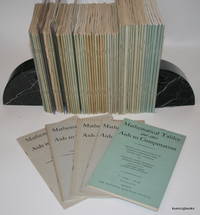
194320095Washington D. C.: The National research Council 1943. First Edition. Wraps. Near Fine. First Edition. We offer a nearly complete run of this important early computer serial: Numbers 1 2 5-59 66-70 each in the original wrappers as published. Small quarto and octavo sizes approx 12 inches shelf space. Occasional minor soiling. From the library of Frank M. Verzuh with his name on some covers. Wraps. MTAC is the first period journal devoted entirely to the literature of computation. The journal had a very small subscription base in the early years. Through 1946 it's subscription list was less than 350 readers. Many were discarded as computing advanced at a rapid pace. As of this writing Worldcat shows less than 80 institutions with even partial runs. <br /> <br /> The first volume contains lists and descriptions of printed tables where they were published as well as new errors discovered in the published sources. These errors introduced by humans whose job description were "computers" continued to appear until mechanical computers significantly reduced and eventually eliminated them. Large businesses military and financial operations used these tables to save time - so error notices were important. Later issues particularly in Volume 2 of this serial contained interesting and groundbreaking material related to the development of computers as we know them today. <br /> <br /> Previous owner Professor FM Verzuh attended the Moore School lectures and was a participant in early computering at MIT. The fact that this serial was still present on his shelf at his retirement is an indication of it's importance. <br /> <br /> Scarce in the marketplace. See Origins of Cyberspace 777 for a detailed description and history of the serial which was published in a total of 14 volumes until a title change in 1960. Important articles included in this run include Origins of Cyberspace 577 579 1077 and 1078. "MTAC remains the primary periodical source of information on the electromechanical and electronic digital computers designed and built during the late 1940s and early 1950s as well as on the scientific uses of punched-card machines mechanical desk calculators etc" It also served as a journal of record for the newly formed Association of Computing Machinery until the founding of their own journal in January 1954. The National research Council unknown
178632947-1233Paris l'Auteur des Estampes Veuve Hérissaut & Barrois l'ainé 1786-93. With 2 engr. frontispieces 3 engr. titles 72 engr. plates and 70 vignettes engr. after Le Barbier by Bacquoy Dambrun Godefroy a.o. XII pp. 1 leaf 215 pp.; 182 pp.; 236 pp. Large 4to. Contemp. calf gilt lettering on spine all edges gilt marbled endpapers slightly rubbed. Paris l'Auteur des Estampes Veuve Hérissaut & Barrois l'ainé 1786-93. One of the most beautiful 18th-century de luxe editions in France of Salomon Gessner's 1730-1788 complete works with the charming illustrations by Barbier. Gessner's friend Michael Huber 1727-1804 Henri Meister and Bruté de Loirelle were responsible for the translation. At the end of volume three are two letters by Gessner addressed to Barbier concerning the illustrations and the translation. Barbier had dedicated this work to Madame de Genlis and Gessner expressed his pleasure about this gesture. - Nice copy. - Leemann-van Elck Gessner p. 691; Cohen/de Ricci 433; Lewine 209; Sander 786. LITERATURE: FRENCH ; HELVETICA: ALLGEMEIN ; LITERATUR: FREMDSPRACHIGE ; Paris, l'Auteur des Estampes, Veuve Hérissaut & Barrois l'ainé unknown
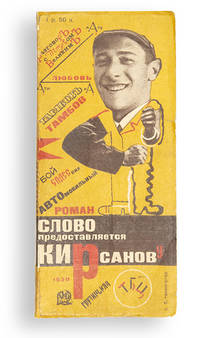
114096Moscow GIZ 1930. . First edition slim 8vo 20.4 x 9.2 cm; text by Kirsanov and design by Telingater; original printed wrappers with photomontage and typographic design by Telingater small repairs to spine otherwise a very good copy.<br /> An attractive copy of one of the most striking books of the Russian avant-garde rarely found in such fresh condition. <br /><br />A student of El Lissitzky Telingater was awarded the Gutenberg Prize for his achievements and design of books and typefaces. This work combines typographic and photomontage design for the covers as well as inventive layout for the text.<br /> Rowell and Wye 913. Moscow, GIZ, 1930. unknown
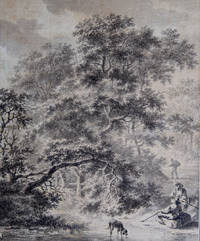
1830AGLavierte Tuschzeichnung in Sepia. 22 x 17 cm. unknown
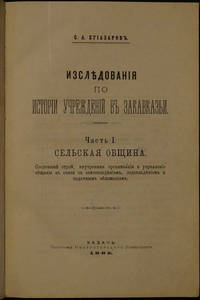
3515278Short description: In Russian. Egiazarov Solomon Adamovich. Studies on the history of institutions in Transcaucasia: Kazan: type. Unta 1889-1891. The image is provided for reference only. It may reflect condition of one of the available copies or only help in identifying the edition. Please feel free to contact us for a detailed description of the copies available. SKU3515278 unknown
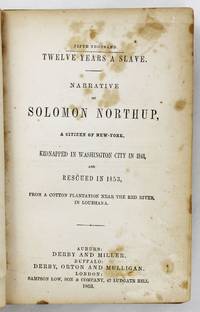
18536011Auburn; Buffalo; London: Derby and Miller; Derby Orton and Mulligan 1853. Good plus. 4336pp. plus frontispiece portrait and six plates. 12mo. Original publisher's cloth spine gilt. Spine ends and corners worn cloth rubbed; patches of discoloration to rear board. Slightly later pencil ownership inscription and annotation on front free endpaper recto. Scattered staining and soiling heavier to initial leaves; moderate toning and dust soiling. Second printing "Fifth thousand" of this classic and powerful slave narrative. The author Solomon Northup was a free Black landowner in New York but was kidnapped into slavery during a trip to Washington DC in 1841 and spent twelve years enslaved under several owners in Louisiana before his freedom was obtained in 1853 after a coordinated search. His story in the words of Frederick Douglass "chills the blood" and Northup's work became one of the most influential and popular anti-slavery narratives of the 1850s. The first edition of 4000 copies was published in early July 1853 and sold out in weeks requiring the immediate undertaking of the present second printing and in the July 15 1853 it is advertised that "To-day the long looked for issue of the fifth thousand.will commence at Derby Orton & Mulligan's." A good copy and only slightly later printing of this cornerstone of American abolitionist literature. Derby and Miller; Derby, Orton, and Mulligan unknown
19321694041932. TELINGATER Solomon. O Lenine. O komsomole. On Lenin. On the Komsomol. 7 volumes. 8vo 190 x 130 mm. each volume bound in publisher's photographically illustrated wrappers preserved in publisher's red slip case with photograph of Lenin designed by Telingater preserved in a new cloth box. Moscow: Molodaia gvardiia 1932. A classic example of Telingater's genius as a book designer. This particular work was banned and withdrawn from circulation after Pavel Postyshev the author of part 5 was jailed as an enemy of the USSR and subsequently the complete set in its original box is extremely rare with OCLC listing only NYPL and U. of Chicago in the U.S. The set is made up as follows: 1. Lenin V. Zadachi soiuzov molodezhi i.e. Tasks of Youth Unions. 32 pp.: ill. 2. Stalin I. O Lenine i.e. On Lenin. 32 pp. 3. Stalin I. O komsomole i.e. On the Komsomol. 64 pp. 4. Kaganovich L. Mezhdunarodnoe i vnutrennee polozhenie i zadachi komsomola i.e. International and internal situation and tasks of the Komsomol. 108 pp. 5. Postyshev P. Za bol'shevistskoe vospitanie novyh kadrov komsomola i.e. For the Bolshevik Education of New Komsomol Cadres. 64 pp. 6. Krupskaya N. Vospominaniia o Lenine i.e. Memories of Lenin. 248 pp.: ill. 7. Ul'ianova-Elizarova A. Vospominaniia ob Il'iche i.e. Memories of Ilyich. 96 pp.: ill. hardcover
1853140942732Auburn / Buffalo: Derby and Miller / Derby Orton & Mulligan 1853. First Edition. Poor. First edition first printing. Bound in publisher's original brown cloth decorated in blind with spine lettered in gilt. A poor copy with heavily binding worn and soiled front hinge tender missing preliminary pages including the portrait frontis and opening directly to the title page binding appears repaired with spine seemingly glued down. Contents heavily browned and spotted. A well-worn copy. Derby and Miller / Derby, Orton & Mulligan unknown
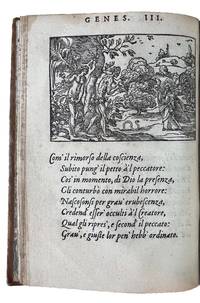
15544378Lyon: Giovanni di Jean I de Tournes 1554. 8vo 151 x 102 mm. Printer’s woodcut device on title Cartier 5 woodcut author portrait on title verso 228 half-page woodcuts by Bernard Salomon. Upper margins cut close touching an occasional headline title soiled and with repair to lower blank corner small wormhole through woodcuts of 30 leaves fols. A1-D6 larger wormhole in 7 leaves fols. L3-M1 P5 with a small hole in cut B5 with small burnhole affecting two words. Late 18th-century marbled sheep smooth spine gold-tooled in panels citron morocco gilt lettering-piece speckled edges marbled endpapers ribbon marker extremities rubbed head of spine cracked. Provenance: 18th-century price note; Dr. Alamartine surgeon of the Lyon hospitals 20th-century blindstamp on flyleaf.<br /> <br /> First Italian edition of the de Tournes / Salomon picture Bible Old Testament only. The poet Damiano Maraffi provided the verse paraphrases which accompany each woodcut; he did the same for the New Testament published by de Tournes in 1554 with fewer woodcuts 95. Maraffi dedicated this edition to Marguerite de France Duchesse de Berry youngest daughter of Francis I. The wood engraver Bernard Salomon nearly all of whose oeuvre was published by de Tournes was one of the few Renaissance illustrators to achieve fame during his lifetime. His Old Testament woodcuts first appeared in 1553 with Claude Paradin’s French verse text Quadrins historiques de la Bible and Quadrins historiques d’Exode. De Tournes republished the cuts with texts in Spanish 1553 English 1553 and German 1554 as well as Italian. Successive editions contain varying numbers of cuts. “Considerable work could be done on Salomon’s sources for these blocks. But the cumulative effect of Salomon’s carefully detailed scenes is that of an individual contribution to Bible illustration. Particularly interesting from the point of view of technique are the night scenes in Exodus and the storm over Noah’s ark†Harvard/ Mortimer French 81. <br /> <br /> A modest copy but with fine impressions of the woodcuts of one of the greatest sixteenth-century French illustrated books. Cartier Bibliographie des éditions des de Tournes 268; Adams M-507; USTC 840556; cf. Brun Le livre français illustré de la Renaissance 1969 pp. 77-70 & 131.<br /> <br /> Giovanni di [Jean I de] Tournes unknown
1991248172Statesboro GA: The Boxwood Press 1991. First Edition one 50. Designed illustrated and translated by Bernard Solomon. Illustrated with 110 woodblocks by Solomon including a large fold-out depicting his ideal Passover seder with living and dead notables plus other folding plates. Incorporates poems by David Ignatow Marge Piercy Harvey Shapiro Grace Paley David Meltzer and others. Folio. Cloth. Mint in slipcase. First Edition one 50. Designed illustrated and translated by Bernard Solomon. Illustrated with 110 woodblocks by Solomon including a large fold-out depicting his ideal Passover seder with living and dead notables plus other folding plates. Incorporates poems by David Ignatow Marge Piercy Harvey Shapiro Grace Paley David Meltzer and others. Folio. The Boxwood Press unknown
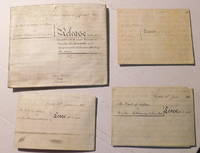
181899422Liverpool June 16 1818. 1818. Fine. - Original vellum document consisting of 2 attached sheets with scalloped top edges. An indenture 24 inches high by 30 inches wide and the assigns 22 inches high by 30 inches wide as usual folded down to 9 inches by 10-1/2 inches. 84 lines of text handsomely calligraphed over the two sheets. Within the initial "T" is the British emblem encircled by the words: "Honi soit qui mal y pense" a motto of the British chivalric Order of the Garter which translated means "Shamed be whoever thinks ill of it". The document has 2 George III embossed revenue stamps with a metal band one for three pounds and the other for one pound. There are also 2 Royal Cyphers.<p>On the rear fold of the document is a sketch of property showing several divisions including "Embleton Street 12 yards wide Dr Solomons land & Cottage". Upper Stanhope Street "20 yards wide" is on the south and Hayton Street "6 yards wide" is on the north. To the west of Solomon's land is land of Bland and another party. Further to the west is a 12 yard plot of land sold to Rowland Owen and "Release dated 23rd & 24th December 1818". This parcel appears to have the signature of Sefton over its description. Another entry on the indenture dated August 11th & 12th 1820 conveys property to Robert Rawlinson and Thomas Hesketh by the trustees of the will of Samuel Solomon. The conveyance is signed by two of Solomon's sons Abraham an oculist in Birmingham and John an amateur boxer and non-practicing lawyer. It is also signed by Ebenezer Daniell the manager of Solomon's Cordial Balm firm. Further in 1828 there is notice of "59 yards including half of Hayton Street" being conveyed to James Watts of Toxteth Park. It was later conveyed to a M J Hicks in October 1832. Both of these later conveyances are accompanied by minimal sketches. <p>The document is signed by the Earl of Sefton a party of the first part Peter Still and Alexander Strong of Lincoln's Inn parties of the second part Joseph Dawson of Liverpool party of the third part John Henderson of Toxteth party of the fourth part John Clare of Liverpool party of the fifth part. The lessees are described as "Samuel Solomon of Gilead House near Liverpool Doctor of Physic" and his Trustees "John Bird of Liverpool aforesaid Architect" and "Thomas Murrow of Liverpool".<p>In addition to the June 16 indenture there are 3 others:<p>1 A 15 inch high by 24 inch wide indenture on parchment dated June 15 1818 and titled "The Earl of Sefton to Doctor Solomon & Trustee / Lease for a year". The trustee is identified as John Bird of Liverpool Architect and it is signed by Sefton.<p>2 A 16 inch high by 23-1/2 inch wide indenture on parchment dated June 15 1818 and titled "The Earl of Sefton to Doctor Solomon & Trustee / Lease for a year". The trustee is identified as John Bird of Liverpool Architect and it is signed by Sefton.<p>3 A 17 inch high by 23 inch wide indenture on parchment dated August 17 1818 and titled "Peter Brown to Dr. Solomon and Trustee / Lease for a year". The trustee is identified as John Bird of Liverpool Architect and it is signed by Peter Brown. The indentures are folded down to approximately 8-1/4 by 6 inches.<p>Each of these 3 indentures on parchment has a George III embossed revenue stamp of one pound fifteen shillings a royal cypher the stamp of James Walker of Bermondsey parchment dealer and the British emblem within the initial "t" encircled by the words: "Honi soit qui mal y pense".<p>The 3 indentures by the Earl of Sefton are of particular interest for this reason - parliamentary elections were being held from June 17 to July 18 1818 and being an Irish peer Sefton was eligible to run for a seat. Dr. Solomon who by this time had become quite wealthy was the chief organizer of the Earl's campaign. Solomon spared no expense on his behalf in Liverpool which was famous for lively electioneering. It was to no avail as Sefton lost his election to George Canning. It seems quite possible that these leases given their dates within 2 days of the campaign served as a kind of reward for Solomon's future efforts.<p>"Doctor" Samuel Solomon c. 1768 - May 21 1819 was born in Cork and moved to Dublin influenced by his uncle Isaac Solomon who worked as a druggist there. Around 1789 he and his uncle went into business in Liverpool's dockland area. In 1796 he began marketing his "Cordial Balm of Gilead" which he claimed would cure one of ulcers of the lung kidneys and liver sexual dysfunction hypochondria female complaints etc. His claim to have been a Doctor of Medicine is suspect. Solomon became very wealthy from the sales of his expensive tincture made from a mixture of brandy and turpentine flavored with herbs as well as from real estate investments. [Liverpool], June 16, 1818. hardcover
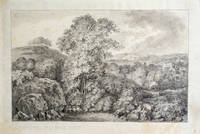
17751821AG1775. 1775. Lavierte Tuschzeichnung. Blattformat: 324 x 478 cm. Tuschzeichnung: 264 x 418 cm. Unten in der Mitte vom Künstler signiert «S. Gessner. 1775». Das Papier etwas stockfleckig. Kunsthaus Zürich 1930 Katalog-Nr. 741 Tafel XVI. unknown
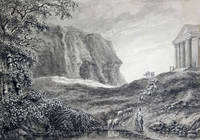
17731823AG1773. 1773. Lavierte Tuschzeichnung mit weiss gehöht. 224 x 32 cm. Unten rechts vom Künstler signiert «S. Gessner f.». Leemann 1930 S.322 Antike Berglandschaft. unknown
172549774Augsburg 1725. Wahrhaffte und genaue Abbildung sowohl der Keyserl.Burg und Lust-Häuser als andere Fürstl. und Gräfl.Paläste u.schöne Prospecte.Pars secunda Vorsatzbl. Knittrig Johann Andreas Pfeffel Quer-2°. Hldr. Oesterreich unknown
1583ABC_50293Lyon: Jean de Tournes 1583. 18th- or 19th-century elaborately gold-tooled pebble-grained dark greenish-blue sheepskin with the titles and place and year of publication for both titles lettered in gold on the spine gold-tooled board edges and turn ins gilt edges marbled endpapers. 8vo. Ad 1: with the title in an ornamental woodcut border with the printers device including two vipers 233 half-page woodcut illustrations and 2 woodcut vignettes. Ad 2: with the title in a historiated woodcut border Cartier "Nains" with the same woodcut printers device Cartier Vipères I1 and 96 half-page woodcut illustrations including one repetition arabesque headpieces and a large woodcut on the last page Cartier "Lac damour. 2 works in 1 volume. With: 2 FONTAINE Charles & Bernard SALOMON. Figures du nouveau testament.Lyon Jean de Tournes 1579. Later edition of this well-known series of woodcut Bible illustrations to the Old Testament engraved by the famous woodcutter Bernard Salomon "le petit Bernard" ca. 1506-ca. 1561 working in Lyon especially for one of the most important Lyon publisher/printers Jean de Tournes 1504-1564. Another collaborator of De Tournes Claude Paradin ca. 1510-1573 is the author of the accompanying quatrains in French which are printed in italics. Claude Paradin is a genealogist and collector of "emblems" or devises published by De Tournes in 1551 as the influential collection Devises Heroïques. The first edition of the Quadrins historiques appeared in 1553 with 199 woodcuts the second and following editions in 1555 1558 and 1560 with 231 cuts. The series is also published with the quatrains in Italian English Spanish and Latin translations. Un pur chef doeuvre de lécole lyonnaise Brun.Ad 2: Fifth edition of the sequel series of woodcut Bible illustrations now to the New Testament also engraved by the famous woodcutter Bernard Salomon. This time the poet Charles Fontaine 1514-ca.1560 who lived in Lyon since 1540 and who was also a close collaborator of Jean de Tournes is the author of the accompanying 96 quatrains in French which are also printed in italics. The first edition of the Figures appeared in 1554 the third in 1558 and the fourth in 1559.With the armorial bookplate "Bibliotheca In memoriam Weiler Trautner Falkiana 1972" on the verso of the first flyleaf and the faint offsetting of a round pair of glasses between the final two leaves of ad 1. Several woodcuts slightly worn out slight browning and foxing throughout. Otherwise in good condition.l Ad 1: Brunet IV col. 995; Cartier Bibliogr. des éditions des De Tournes no. 452; Le livre illustr. De la Renaissance no. 132 2nd ed.; cf. Adams P-293 1st ed.; Brun Le livre illstr. en France 1930 p. 203; Fairfax Murray no. 615; ad 2: Cartier Bibliogr. des éditions des De Tournes II no. 593; Mortimer no. 95 cf. also no. 81; cf. Adams F-706; Brunet IV col. 995. Jean de Tournes, unknown
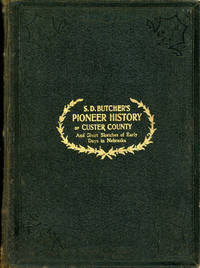
190148781Broken Bow Nebraska: Copyrighted By Solomon D. Butcher and Ephrain S. Finch 1901. 1901. NEBRASKA. First edition. 8vo. Original edition published in 1901. Blind stamped cloth titles in gilt on the front cover decorated front and rear endpapers 4 403 7 pp. dedication preface illustrated mostly from photographs plates portraits advertisements errata sheet all edges in red. Introduction by Solomon D. Butcher. Butcher came to Nebraska in the early 1880s in time to catch a fleeting glimpse of the fading western frontier and to photograph thousands of scenes. Butcher photographed many scenes of Custer County including wild animals livestock pioneers log and sod buildings prominent citizens cowboys Indians ranches Indian villages and much more. Six Guns 350 says: "Has a long chapter on the lynching of Kid Wade the horse thief one on the exploits of Dick Milton and material on I. P. Olive and the burning of Mitchell and his companion Ketchum." Light wear to spin ends and corners a few nicks to the fore-edges of a few pages front hinge starting to loosen else a very good and internally clean copy of an elusive title and an excellent piece of pioneer history. Copyrighted By Solomon D. Butcher and Ephrain S. Finch, 1901. hardcover
192545523Tel-Aviv/Berlin: Dvir 1925. First edition. Hardcover. g to g. Quartos. Vol.1: xvi 174pp. Vol.2: xii 156pp. Green cloth boards with blind-stamped lettering and motif on the front covers. Gilt lettering and motifs on the spines. Decorative endpapers. Signed and inscribed by acclaimed Hebrew poet Hayim Nachman Bialik and his longtime collaborator Yehoshua Hana Ravnitzki to seminal Hebrew writer and philosopher Ahad Ha'am Asher Zvi Hirsch Ginsberg 1856 - 1927 on the half-title. Both Bialik and Ravnitzky served as the editors arrangers and commentators of these volumes. The inscription states "The fruit of our joint labor in joint suffering a gift of love to Ahad Ha'Am" dated March 27th 1924. Each of the title pages contain the ownership inscriptions of Ahad Ha'Am at the top.<br /> <br /> This set collects the entirety of the poetic works of 11th century Spanish-Jewish poet and philosopher Solomon ibn Gabirol. The set is organized into two volumes with the first 1924 containing his "secular poems" and the second 1925 containing his religious poems "sacred poems" including "Keter Malchut" considered his magnum opus. Commentary organization and editing of the works throughout the volumes by Hayim Nachman Bialik and Y.H. Ravnitski. Each volume contains a table of Hebrew abbreviations roshe tevot used. <br /> <br /> Text in Hebrew.<br /> <br /> Bindings with some degree of bowing to the front boards. Light rubbing to extremities with the second volume with light soling the front cover and some rippling and water stains throughout. Spine of vol.2 repaired along the hinge. Vol.1 with some tears chipping and damp stains to the half-title with some addition damp stains along the gutter of the introductory pages. Decorative endpapers of vol.1 reinforced with japan tissue. Age toning to pages throughout both volumes. Bindings in good- to good interiors in good- to good condition overall. Hebrew title: שירי שלמה בן יהודה ×בן גבירול תרפ"ד<br /> <br /> A later edition from 1927 was released in 5 volumes. Dvir hardcover
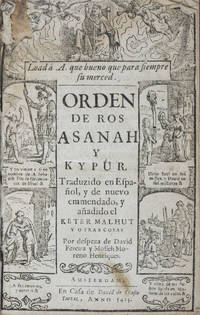
43956Amsterdam: David Fereira y Mosseh Moreno Henriques/ David de Crasto Tartaz David de Castro Tartas 5423. Hardcover. g- to g. Duodecimo. 6.5x4.5". 479pp. Original brown calf boards with gilt-stamped motifs and raised bands on the spine. Blue ribbon marker. Edges of the book block in red. Marbled endpapers. The title page is illustrated with copper plate engravings in the form of small vignettes of biblical scenes surrounding the text. This is an early Spanish-language edition of the complete Jewish High Holiday prayer book Machzor based on the original translation by Abraham Usque originally printed in Ferarra Italy in 1553. This edition contains some added material not previously present including most prominently Solomon ibn Gabirol's famed philosophical poem "Keter Malkhut" Royal Crown which over the years has come to be read as part of the Yom Kippur service in some Jewish traditions. <br /> <br /> This edition of the Machzor was published by David Fereira and Mosseh Moreno Henriques to serve members of the then sizable Sephardic Jewish community in Amsterdam. A significant portion of the community would have been ex-Marranos Jews who had outwardly converted to Catholicism during the inquisition in Spain who then immigrated and were able to reestablished their Jewish identity and thus were unable to read Hebrew hence the text's publication in Spanish. As stated in the foreword this edition includes some additions to the text not included in previous versions and omits some material deemed to have been unnecessary. The prayer book starts with the penitential prayers Selichot p.3-47 which includes decorative head and endpeices. This section is followed by the Rosh Hashanah service p.48-195 and then the Yom Kippur service including "Keter Malkhut" p.254-289. The title page is illustrated with scenes from the biblical stories of King David Saul and Goliath and contain small captions underneath with corresponding biblical passages in Spanish. <br /> <br /> There are a number of pagination printing errors including: p.45-46 are misprinted as 54 and 36 p.264 is misprinted as 164. p.450 is misprinted as 350 p.414 is misprinted as 144. Like in the case of the earlier 1652 edition of the work pages 305-352 are misprinted as "321-368" but in this copy the leaf containing p. 353-354 directly following "368" seems to be missing. Overall this edition follows very closely the 1652 edition of the same work in terms of pagination content and organization. Includes large initials throughout the text. All text in Spanish. <br /> <br /> Binding with rubbing scratches and abrasions to the covers spine and extremities. Some chipping to the head and tail of the spine. Interior front covers with some starting and the loosening of the endpapers. Title page with starting light creases stains and and light chipping on the top left corner resulting in slight loss of image. Some light water staining along the top edge of the pages with some other sporadic light staining throughout. Page 365 torn along the side edge with no loss of text. Starting at a number of pages throughout the book. Binding in good- interior in good condition overall. Binding protected with modern mylar. David ben Abraham de Castro 1630-1698 was a French-born Portuguese Jewish printer/publisher in Amsterdam. Between 1662 and 1701 his press printed the "Gazeta de Amsterdam" a newspaper for the exiled Sephardic Jewish community in Amsterdam. He started his printing career as a typesetter at the printing house of Menasseh Ben Israel a printer and leading Rabbi in community who printed the earliest Amsterdam edition of this work in 1630. Castro started his own business in 1662 making this edition among his earliest publications. <br /> <br /> References: RODRIGUEZ 1781 p. 643 KAYSERLING 1890 p. 62 PALAU1923 202416 PEETERS1933 1038. David Fereira y Mosseh Moreno Henriques/ David de Crasto Tartaz (David de Castro Tartas) hardcover
180440694Kbhvn. 1804-28 1830 og 1834-35. Indbundet i 51 bind. Bd- 1-49 i samt. halvlæderbind bd. 1-4 i 8vo resten i 4to. Bd. 1 og 2 mangler øverste del af ryg de sidste 2 bind i nyere halvmaroquin alle med stempler på titelblade og etiketter på rygge. Bd. 16 mangler nr. 96 og 100. I Allernyeste 1830 mangler spalte 1-4. <br/><br/><em>Yderst sjælden række af dette omfattende kulturhistorisk/topografiske værk. "Nyeste Skilderie af Kjøbenhavn" grundlages i 1803 af Johan Werfel og eksisterede til 1837. Johan Werfel døbte bladet Nyeste Skilderie af Kjøbenhavn til minde om sin ven samfundsrevseren Niels Ditlev Riegels som var død året før. Riegels havde 1786-1790 udgivet det samfundskritiske blad Månedsskriftet Kjøbenhavns Skilderie men efter Trykkefrihedsforordningen af 1799 var grænserne for hvad man kunne skrive væsentligt indskrænkede. Werfel forsøgte i nogle numre af sit blad at mindes Riegels ved at udgive nogle af hans efterladte skrifter men måtte efter nogle numre stoppe forsøget. Boghandleren og forlæggeren Salomon Soldin blev snart ansat som redaktør og efter at Werfel i 1808 forsvandt og foregav at være død for at undgå sine kreditorer overtog Soldin også udgivelsen af bladet.I de første årgange var bladet et lille ugeblad der udkom i kvartformat men det udvidedes snart så bladet i format og udgivelse kunne konkurrere med tidens andre populære blade såsom Berlingske Tidende og Adresseavisen.Soldin skrev selv en stor del af indholdet i bladet men også flere af tidens betydelige personligheder som Rasmus Nyerup Knud Lyne Rahbek Christian Molbech og Nikolaj Frederik Severin Grundtvig bidrog ofte med indlæg.Nyeste Skilderie af Kjøbenhavn var et særligt københavnsk blad og det læstes fortrinsvis af de dannede borgere. Det var desuden i sin levetid et af de væsentligste blade hvor bl.a. mange af de vigtigste litterære fejder stod.Allerede i 1825 afhændede Soldin redaktionen af bladet til Frederik Thaarup. Omgangskredsen frygtede for bladets skæbne og selv sagde Soldin at han ved overgivelsen til Thaarup havde sørget for at de fik "kristelig Begravelse". Det var dog ikke Thaarup der lagde det i graven for efter 6 år på posten overlodes det til Hans Christian Wosemose Claudius Rosenhoff og J. H. Stabell som omdøbte det til Allernyeste Skilderie. Det levede endnu 6 år men i 1837 samme år som Soldin døde gik bladet endeligt ind. - Bibl. Danica IV: 614. </em> unknown
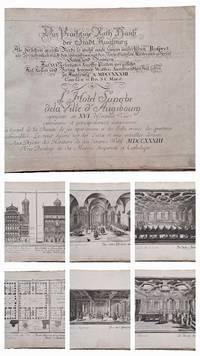
17331602202271<p>Kleiner Salomon / Pintz Johann Georg engraver.</p><p>Das Prachtige Rath-Hauss der Stadt Augsburg / L'Hôtel Superbe de la Ville d'Augsbourg.</p><p>Augsburg: Jeremias Wolff's Heirs 1733.</p><p>Folio approx. 29 × 42 cm. Complete with engraved title and 16 finely executed copper plates.</p><p>Magnificent architectural suite depicting the celebrated Augsburg Town Hall one of the most beautiful civic buildings of the German Baroque. The engravings executed by Johann Georg Pintz after drawings by Salomon Kleiner 1700–1761 present the exterior and richly decorated interiors of the Rathaus including the famed Goldener Saal Golden Hall and princely chambers. Parallel German and French text engraved throughout.</p><p>Collation of plates complete 16 total:</p><p>1. Engraved title page German–French</p><p>2. I. Prospect des schönen Rath-Hauses zu Augsburg General View</p><p>3. II. Zwey Profille des schönen Rath-Hauses zu Augsburg Two Cross Sections</p><p>4. III. Grund-Riße von dreyen Etagen des Rath-Hauses zu Augsburg Three Floor Plans</p><p>5. IV. Das untere Pfletsch oder Saal Entrance Hall with Staffage</p><p>6. V. Die Fürsten-Stube gegen dem Perlach-Platz Princely Chamber toward Perlach Square</p><p>7. VI. Die Fürsten-Stube gegen St. Peters Kirchen Princely Chamber toward St. Peter's Church</p><p>8. VII. Die Gericht-Stuben Courtrooms</p><p>9. VIII. Die Bau-Stuben / Daß Pfleg-Ampt Construction and Administration Rooms</p><p>10. IX. Daß Vor-Zimmer / Die Steuer-Stuben Antechamber and Tax Offices</p><p>11. X. Der große so genandte Guldene Saal auf dem Rath-Hauß zu Augsburg The Great Golden Hall folded plate</p><p>12. XI. Der große Guldene Saal im Grundriß mit A. bezeichnet Golden Hall Plan A</p><p>13. XII. Der große Guldene Saal im Grundriß mit B. bezeichnet Golden Hall Plan B</p><p>14. XIII. Die Erste Fürsten-Stuben First Princely Chamber</p><p>15. XIV. Die Andere Fürsten-Stuben Second Princely Chamber</p><p>16. XV–XVI. Die Dritte und Vierte Fürsten-Stuben Third and Fourth Princely Chambers</p><p>Condition: Complete copy. One plate misplaced bound out of order. Small expert restoration of a pinhole in one plate. Some plates lightly dusty; minor water staining to upper right corner not affecting image areas. Binding worn and requires restoration or replacement but the interior plates are generally clean well-printed and strong impressions throughout.</p><p>References: Katalog der Ornamentstichsammlung Berlin 2118; Schefold Bayerisch Schwaben p. 184; Thieme/Becker XX 452 f.</p><p>A complete and well-preserved example of this rare and important architectural series — one of the most impressive engraved monuments to Baroque civic architecture in southern Germany.</p> Jeremias Wolff’s Heirs
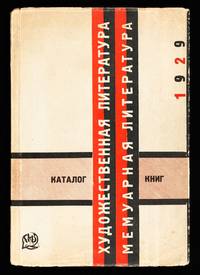
55047Moscow: Gosudarstvennoe izdatel'stvo 1929. Octavo 19.8 × 13.5 cm. Original decorative wrappers; 106 pp. with four sections of different width forming a tabbed structure. Signed and inscribed by Aleksandra Miroliubova to Galina Chichagova on title. Light soil to wrappers; wrapper corners scuffed; still about very good. A Constructivist time capsule this catalog of fiction and memoir publications compiled by Gosizdat the Soviet State Publisher with original typographic design by the graphic artist Solomon Telingater 1903-1969 is inscribed by fellow Constructivist artist Aleksandra Miroliubova: "To the famous Constructivist Galina Dmitrievna Chichagova as a sign of great and everlasting friendship from your best friend. 1917-1963". The tabbed sections of the catalog are reminiscent of Telingater and El Lissitzky's collaborative projects such as the 1927 exhibition catalog on typography "All-Union Printing Trades Exhibition: Guidebook". As Rowell and Wye write: "Despite the content that was far from seductive these volumes show a remarkable graphic invention sometimes imaginatively inspired by this very content and designed for popular appeal" See: MoMA: The Russian Avant-Garde Book 1910-1934 p. 222. Born in Tiflis Georgia Telingater studied at VKhUTEMAS in 1920-1921 often dubbed the Bauhaus of the Soviet Union for its experimental edge. In addition to working on books and catalogs such as this one Telingater did layout design for the Constructivist architecture periodical "CA" Contemporary Architecture as well as architectural periodicals "SSSR na stroike" USSR in Construction and "Stroitel'stvo Moskvy" Construction of Moscow.<br /> <br /> The author of the inscription Aleksandra Miroliubova 1898-1987 and the addressee Galina Chichagova 1891-1967 also studied at VKhUTEMAS with artists such as Aleksandr Rodchenko and Liubov Popova. Galina Chichagova and her sister Olga Chichagova were part of the first working group of Constructivists headed by Rodchenko and would go on to incorporate Constructivist design into Soviet children's books. They also famously experimented with typography turning letters into design elements with the present volume by Telingater engaging in similar graphic play. <br /> <br /> This volume is no. 838 in Rowell/Wye The Russian Avant-Garde Book pictured on p. 230.<br /> <br /> As of March 2025 KVK OCLC show five copies worldwide of which two in North America. unknown
19560012056<p>Vedado Havana Cuba: Rabbi Frederick K. Solomon of Temple Beth Israel Havana Cuba. Good with no dust jacket. 1956. Non-Book. On offer is a spectacular relic of post WWII judaica being a 16-page sermon titled The Will to Be a Jew handwritten and edited by progressive rabbi Dr. Frederick K. "Fritz" Solomon originally Solomonski 1899-1980 SEE BIO NOTES FOLLOWING LISTING. Rabbi Solomon delivered this lecture in 1956 while he was rabbi of the Temple Beth Israel synagogue in Vedado Havana Cuba. In this thoughtfully composed sermon Dr. Solomon argues that Reform Judaism should be accepted as a way forward for the next generation of Jews who view religion differently than the orthodox and older generations. However the sermon is also a meditation on Jewishness more broadly. Solomon opens the sermon by asking that listeners consider the gaps between opinion and fact and how muddled the concepts often become. He then begins to discuss Judaism throughout history. Next Solomon reflects on what it is to be a Jew whether being born to a Jewish mother makes a Jew the racial and political components of Jewishness the Nazis' view of Jews and more. An excerpt of his discussion about what a Jew is follows: "Another conception of a Jew is his membership to the Jewish race and his descent from Abraham as teh first Hebrew. This was a principle laid down by the theorists of the 19th century especially Arthur de Gobineau who maintained that the decline of western civilization was caused by the infiltration of Semites into Europe. It was as you remember the principle adopted by the Nazis who did not care for a person's religion at all and therefore established rule that a Jew is everyone who has at least one Jewish grandparent. This was certainly quite arbitrary as science tells us that even after many generations a pure specimen of the original race can re-appear" p. 6-7. On page 9 the Rabbi states that "a Jew is everyone who adopts the Jewish faith" and then discusses the essence of the Jewish faith being challenged by the wide spectrum of Jewish people. He argues that Reform or Liberal Jews are being driven out of religion and Judaism by "the religiosity of orthodox Judaism". He states: "I am convinced that most of the younger generation who come from orthodox homes join our liberal Synagogues because they realize the discrepancy between observances and religious reality" p. 10. He closes by reading from Micah 6: 6-8 then stating: "When all is said and done it is your heart that makes you a Jew. And nobody can judge whether you are a good Jew but yourself" p. 13-13a. This sermon is a phenomenal piece of judaica that would enhance any collection. Its meditation on what it means to be Jewish is one that many Jews grapple with now as they have throughout history. Solomon's progressive take on Judaism feels ahead of its time and this sermon would make an excellent addition to a religious studies program or a progressive organization. BIO NOTES: Frederick Solomon 1899-1980 painter and Rabbi was born in Berlin Germany in 1899. In 1938 when the synagogue he was serving at was torched by Nazis and he was subsequently summoned by the Gestapo he left Germany with his wife Margot and emigrated to England. Solomonski was interned in the Isle of Man in Hutchinson Square camp in the early 1940s as a prisoner of war along with many other artists. While still in Europe Solomon had studied art under the German-Jewish artists Max Liebermann Martin Brandenburg and Eugene Spiro and German expressionist Willy Jaeckel. In England he continued his artistic career exhibiting his religious and expressionistic work at various galleries throughout the country including the Royal Academy and the Kensington Art Gallery in London where he had a one-man show. His work is in the permanent collections of the Courtauld Institute the Bazalel Museum in Jerusalem and the Ben Uri Art Gallery St. John's Wood London now incorporating the London Jewish Museum of Art. In 1954 he left England to take a position as Rabbi for Temple Beth Ha Shalom in Williamsport PA. After three years in Pennsylvania he sought another position and as a member of the Central Conference of American Rabbis was appointed rabbi at Temple Beth Israel in the Vedado suburb of Havana where he wrote sermons and hosted religious services for his congregation a part of the Union of American Hebrew Congregations. Solomon was also active in the Jewish Progressive movement frequently communicating with representatives of The World Union for Progressive Judaism throughout the 1950s in an attempt to officially associate his congregation with the organization Bio Note Credit to East Coast Books. The sermon pages measure 8x10 inches and there are a total of 16 pages of writing. Solomon has numbered his work pages one through 13 with three additional pages tipped in throughout the sermon as addendums. The sermon is unbound. The pages are all intact with some minor bends and tears that do not interfere with the readability of the document. The sermon is written in blue pen with the Rabbi's changes written in red pen and pencil. The writing is legible though in a somewhat tricky cursive hand. Overall Good. ; Manuscripts; 8vo 8" - 9" tall; 16 pages; Signed by Author .</p> Rabbi Frederick K. Solomon of Temple Beth Israel, Havana, Cuba