660 résultats
2009x-160473292XUniv Pr of Mississippi 2009. Paperback. New. 545 pages. 8.25x5.50x1.50 inches. Univ Pr of Mississippi paperback
2006199436np.: State Forestry Bureau of China. 2006. First edition. . Hardcover. . Fine copy in fine dust jacket in mylar. . Folio. Illustrated in black white and color. Important reference work. Very scarce in this condition. State Forestry Bureau of China. hardcover
20181-1933189614Avotek Information Resources 2018. Paperback. New. 708 pages. 10.71x8.31x1.30 inches. Avotek Information Resources paperback
2006SONG141022581XUniversity Press of the Pacific 2006-08-09. paperback. Used: Good. 8.25x0.65x11.00. Buy with confidence. Excellent Customer Service & Return policy. University Press of the Pacific paperback
20172-1939878314Elite Aviation Solutions 2017. Paperback. New. 310 pages. 11.00x8.50x0.73 inches. Elite Aviation Solutions paperback
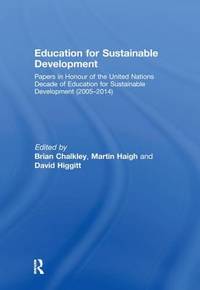
2009020524London & New York: Routledge 2009. Appears unread. This is the original 2009 printing -- NOT print on demand edition or reprint. NOT a library discard. Fine condition. Sharp corners. NO owner's name or bookplate. Pages are fresh crisp clean and unmarked -- apparently never read. NO underlining. NO highlighting. NO margin notes. 2009. First Edition Thus. Bound in the original blue laminated boards lettered in white. 7" wide by 10" tall. From the front matter: "In 2005 The United Nations launched its Decade of Education for Sustainable Development which recognises that education including Higher Education is the key to the change in social attitudes that will be needed to protect the welfare of future generations. This involves helping learners to live as though the future matters and to achieve ecoliteracy. This includes the understanding that personal lifestyle decisions may have consequences ranging from climate change through loss of biodiversity to pollution and resource depletion that may permit environmental degradation on a planetary scale. It also involves helping them to develop the skills needed to cope with such challenges. This international collection of research papers and position statements from special issues of the Journal of Geography in Higher Education and Applied Environmental Education and Communication written by many of the leading practitioners in the field aims to provide resources and practical guidance for all seeking to promote and engage in education for a sustainable future. Rabindranath Tagore encouraged each learner to make their actions demonstrate a harmonious union between education and environment. David Orr argued that the world needs people who live well in their places to make the world both habitable and humane and that the main challenge for education is to help learners make their minds fit for life on Earth. This book tries to chart a practical route towards these objectives. This book was previously published as special issues of the JOURNAL OF GEOGRAPHY IN HIGHER EDUCATION and APPLIED ENVIRONMENTAL EDUCATION AND COMMUNICATION.". First Edition. Hardcover. Fine condition/No dust jacket as issued. vii 307pp. Great Packaging Fast Shipping. Routledge Hardcover
2025x-1644255243Aviation Supplies & Academics 2025. Paperback. New. 920 pages. 10.50x8.25x2.00 inches. Aviation Supplies & Academics paperback
2008SONG1605902632Government Institutes 2008-07-04. paperback. Used: Good. 8.66x0.24x11.03. Buy with confidence. Excellent Customer Service & Return policy. Government Institutes paperback
2021SKU0620877Aviation Supplies & Academics Inc 2021-11-15. paperback. New. 8x0x10. New Textbook Ships with Tracking Aviation Supplies & Academics, Inc paperback
20191-1933189681Avotek Information Resources 2019. Paperback. New. 522 pages. 10.70x8.30x1.20 inches. Avotek Information Resources paperback
20202-1619549646Aviation Supplies & Academics 2020. Paperback. New. pck pap/ps edition. 672 pages. 10.75x8.25x1.35 inches. Aviation Supplies & Academics paperback
2008DADAX0865875219Government Institutes 2008-03-26. paperback. New. 6.03x0.33x9.19. Buy with confidence. Excellent Customer Service & Return policy. Government Institutes paperback
2021x-987881226XAirworthyAircraft 2021. Paperback. New. 784 pages. 11.00x8.50x1.56 inches. AirworthyAircraft paperback
2021167212Independentlypublished 2021-01-01. paperback. Good. 0x0x0. Independentlypublished paperback
200888971Washington DC: National Aeronautics and Space Administration c2008. Presumed First Edition First printing this. Single sticker sheet printed on both sides peal line is about at the diameter line. Very good. The format is a circle with a 4 inch diameter. Sticker seam at the back is at the mid-point. Rare surviving copy. One side is a version of the ARES logo originally designed by Star Trek artist Michael Okuda with 10 stars and a rocket ascending but no image of Earth in the background. The other side has the following text: NASA's Ares I-X Flight Test Vehicle NASA's first flight test of the full rocket for the agency's next-generation spacecraft and launch vehicle systems is launching in 2009. The flight test called Ares I-X will bring NASA one step closer to its exploration goals--to return to the moon for more ambitious exploration of the lunar surface ad to travel to Mars and destinations beyond." Then two links to on-line resources. Ares I-X was the first-stage prototype and design concept demonstrator of Ares I a launch system for human spaceflight developed by the National Aeronautics and Space Administration NASA. Ares I-X was successfully launched on October 28 2009. The Ares I-X vehicle used in the test flight was similar in shape mass and size to the planned configuration of later Ares I vehicles but had largely dissimilar internal hardware consisting of only one powered stage. By flying the vehicle through first-stage separation the test flight also verified the performance and dynamics of the Ares I solid rocket booster in a "single stick" arrangement which is different from the solid rocket booster's then-current “double-booster†configuration alongside the external tank on the space shuttle. Ares I was the crew launch vehicle that was being developed by NASA as part of the Constellation program. The name "Ares" refers to the Greek deity Ares who is identified with the Roman god Mars. Ares I was originally known as the "Crew Launch Vehicle" CLV. NASA planned to use Ares I to launch Orion the spacecraft intended for NASA human spaceflight missions after the Space Shuttle was retired in 2011. Ares I was to complement the larger uncrewed Ares V which was the cargo launch vehicle for Constellation. NASA selected the Ares designs for their anticipated overall safety reliability and cost-effectiveness. However the Constellation program including Ares I was canceled by U.S. president Barack Obama in October 2010 with the passage of his 2010 NASA authorization bill. In September 2011 NASA detailed the Space Launch System as its new vehicle for human exploration beyond Earth's orbit. Unlike the Space Shuttle where both crew and cargo were launched simultaneously on the same rocket the plans for Project Constellation outlined having two separate launch vehicles the Ares I and the Ares V for crew and cargo respectively. Having two separate launch vehicles allows for more specialized designs for the crew and heavy cargo launch rockets. The Ares I rocket was specifically being designed to launch the Orion Multi-Purpose Crew Vehicle. Orion was intended as a crew capsule similar in design to the Apollo program capsule to transport astronauts to the International Space Station the Moon and eventually Mars. Ares I might have also delivered some limited resources to orbit including supplies for the International Space Station or subsequent delivery to the planned lunar base. NASA selected Alliant Techsystems the builder of the Space Shuttle Solid Rocket Boosters as the prime contractor for the Ares I first stage. NASA announced that Rocketdyne would be the main subcontractor for the J-2X rocket engine on July 16 2007. NASA selected Boeing to provide and install the avionics for the Ares I rocket on December 12 2007. On August 28 2007 NASA awarded the Ares I Upper Stage manufacturing contract to Boeing. The upper stage of Ares I was to have been built at Michoud Aerospace Factory which was used for the Space Shuttle's External Tank and the Saturn V's S-IC first stage. The Ares V formerly known as the Cargo Launch Vehicle or CaLV was the planned cargo launch component of the canceled NASA Constellation program which was to have replaced the Space Shuttle after its retirement in 2011. Ares V was also planned to carry supplies for a human presence on Mars. The Ares V was to launch the Earth Departure Stage and Altair lunar lander for NASA's return to the Moon which was planned for 2019. It would also have served as the principal launcher for missions beyond the Earth-Moon system including the program's ultimate goal a crewed mission to Mars. The uncrewed Ares V would complement the smaller and human-rated Ares I rocket for the launching of the 4–6 person Orion spacecraft. Both rockets deemed safer than the then-current Space Shuttle would have employed technologies developed for the Apollo program the Shuttle program and the Delta IV EELV program. National Aeronautics and Space Administration unknown
201086164Houston TX: National Astronautics and Space Administration Johnson Space Center 2010. Presumed First Edition First printing. This is one of multiple originals issued. Single sheet printed on both sides. Very good. The format is approximately 8.5 inches by 11 inches. This is a single sheet with printing/imagery on both sides in a plastic sleeve. On the front side is a large color photograph of the six members of the Crew of Space Shuttle Mission STS-133. On the other side there are four columns. At the top of the left column is a small photograph of the crew with last names present. At the bottom of the right two columns is a description of the STS-133 mission patch. The crew members were Commander Steven W. Lindsey Colonel USAF RET. Pilot Eric A. Boe Colonel USAF Specialist Benjamin Alvin Drew Jr. Colonel USAF Specialist Timothy L. Kopra Colonel USA Specialist Michael R. Barratt M.D and Specialist Nicole Passonne Stott. Tim Kopra was injured and was replaced by Stephen Bowen--making this photograph a rarity. In the foreground a solitary orbiter ascends into a dark blue sky above a roiling fiery plume. A spray of stars surrounds the orbiter and a top lit crescent forms the background behind the ascent. The mission number STS-133 is emblazoned on the patch center and crewmembers' names are listed on a sky-blue border around the scene. The Shuttle Discovery is depicted ascending on a plume of flame as if it is just beginning a mission. However it is just the orbiter as it would be at mission's end. This is to signify Discovery's completion of its operational life and the beginning of its new role as a symbol of NASA's and the nation's proud legacy in human spaceflight. The Shuttle Discovery is depicted ascending on a plume of flame as if it is just beginning a mission. However it is just the orbiter without boosters or an external tank as it would be at mission's end. This is to signify Discovery's completion of its operational life and the beginning of its new role as a symbol of NASA's and the nation's proud legacy in human spaceflight. STS-133 ISS assembly flight ULF5 was the 133rd mission in NASA's Space Shuttle program; during the mission Space Shuttle Discovery docked with the International Space Station. It was Discovery's 39th and final mission. The mission launched on February 24 2011 and landed on March 9 2011. The crew consisted of six American astronauts all of whom had been on prior spaceflights headed by Commander Steven Lindsey. The crew joined the long-duration six person crew of Expedition 26 who were already aboard the space station. About a month before lift-off one of the original crew members Tim Kopra was injured in a bicycle accident. He was replaced by Stephen Bowen. The mission transported several items to the space station including the Permanent Multipurpose Module Leonardo which was left permanently docked to one of the station's ports. The shuttle also carried the third of four ExPRESS Logistics Carriers to the ISS as well as a humanoid robot called Robonaut. The mission marked both the 133rd flight of the Space Shuttle program and the 39th and final flight of Discovery with the orbiter completing a cumulative total of a whole year 365 days in space. The mission was affected by a series of delays due to technical problems with the external tank and to a lesser extent the payload. The launch initially scheduled for September 2010 was pushed back to October then to November then finally to February 2011. The mission commander Steven Lindsey handed over his position as Chief of the Astronaut Office position to Peggy Whitson in order to lead the mission. For the first time two mission crew members were in space when a crew assignment announcement was made as Nicole Stott and Michael Barratt were aboard the ISS as part of the Expedition 20 crew. During STS-133 Alvin Drew became the last African-American astronaut to fly on the Space Shuttle as no African-Americans were among the crews of STS-134 and STS-135. Having flown onboard Atlantis' STS-132 mission Bowen became the first and the only NASA astronaut to be launched on two consecutive missions until Doug Hurley launched aboard Crew Dragon Demo-2 in May 2020 after having previously launched on STS-135. National Astronautics and Space Administration, Johnson Space Center unknown
200386119Kennedy Space Center FL: National Aeronautics and Space Administration Kennedy Space Center 2003. Presumed First Edition First printing. Wraps. Very good. The format is approximately 8.5 inches by 11 inches. 61 3 pages plus covers. Illustrated covers. Illustrations most in color. Contents include Center Director's Message; NASA Vision and Mission; KSC Goals and Principles; The President's Management Agenca; Significant Events; Expendable Launch Vehicle Program; Space Shuttle Program; Shuttle Upgrades; International Space Station and Shuttle Payload Processing; Payload Carriers Program; Spaceport and Range Technologies; Future Vehicles; Safety and Health First; Environmental Stewardship; Partnerships; Outreach to the World; Education; KSC Business Report; Economic Impact; Workforce Diversity; Procurement Report; and Financial Statement. The John F. Kennedy Space Center KSC originally known as the NASA Launch Operations Center located on Merritt Island Florida is one of the National Aeronautics and Space Administration's NASA ten field centers. Since December 1968 KSC has been NASA's primary launch center of human spaceflight. Launch operations for the Apollo Skylab and Space Shuttle programs were carried out from Kennedy Space Center Launch Complex 39 and managed by KSC. Located on the east coast of Florida KSC is adjacent to Cape Canaveral Space Force Station CCSFS. The management of the two entities work very closely together share resources and operate facilities on each other's property. Though the first Apollo flights and all Project Mercury and Project Gemini flights took off from the then-Cape Canaveral Air Force Station the launches were managed by KSC and its previous organization the Launch Operations Directorate. Starting with the fourth Gemini mission the NASA launch control center in Florida Mercury Control Center later the Launch Control Center began handing off control of the vehicle to the Mission Control Center in Houston shortly after liftoff; in prior missions it held control throughout the entire mission. Additionally the center manages launch of robotic and commercial crew missions and researches food production and in-situ resource utilization for off-Earth exploration. Since 2010 the center has worked to become a multi-user spaceport through industry partnerships even adding a new launch pad LC-39C in 2015. There are about 700 facilities and buildings grouped throughout the center's 144000 acres. Among the unique facilities at KSC are the 525-foot tall Vehicle Assembly Building for stacking NASA's largest rockets the Launch Control Center which conducts space launches at KSC the Operations and Checkout Building which houses the astronauts dormitories and suit-up area a Space Station factory and a 3-mile long Shuttle Landing Facility. There is also a Visitor Complex on site that is open to the public. National Aeronautics and Space Administration, Kennedy Space Center paperback
200986122George C. Marshall Space Flight Center Huntsville A.: National Aeronautics and Space Administration George C. Marshall Space Flight Center 2009. Xerox-style reproduction. Assume only a few copies were made for medial representatives. Stapled at upper left corner. Good. Front cover i 1 36 2 pages. Illustrations. Three-hole punched. The top corner of some of the some of the back pages are bent/creased. Contents include Contacts; Media Services Information; LRO/LCROSS Executive Summary; Mission Quick Facts; LRO Quick Facts; LCROSS Quick Facts; Launch Vehicles Mated with LRO/LCROSS; LRO/LCROSS Mission Trajectory; Why the Moon; Historical Explorations of the Moon; LRO Mission Overview; LRO Mission at a Glance; LRO Instruments; LRO Across the Country; LRO Products and Benefits: LRO Spacecraft With Instruments; Treasure Hunting on the Moon: LRO and the Search for Water; Robot Scout: Fly Me Safely to the Moon; LCROSS Mission Overview; LCROSS Mission at a Glance; The Search for Water on the Moon; LCROSS Science Instruments; LCROSS Spacecraft; LCROSS Observation Campaign; Future NASA Lunar Missions; and Program/Project Oversight. The Lunar Reconnaissance Orbiter LRO is a NASA robotic spacecraft currently orbiting the Moon in an eccentric polar mapping orbit. Data collected by LRO have been described as essential for planning NASA's future human and robotic missions to the Moon. Its detailed mapping program is identifying safe landing sites locating potential resources on the Moon characterizing the radiation environment and demonstrating new technologies. Launched on June 18 2009 in conjunction with the Lunar Crater Observation and Sensing Satellite LCROSS as the vanguard of NASA's Lunar Precursor Robotic Program LRO was the first United States mission to the Moon in over ten years. LRO and LCROSS were launched as part of the United States's Vision for Space Exploration program. The probe has made a 3-D map of the Moon's surface at 100-meter resolution and 98.2% coverage excluding polar areas in deep shadow including 0.5-meter resolution images of Apollo landing sites. The first images from LRO were published on July 2 2009 showing a region in the lunar highlands south of Mare Nubium Sea of Clouds. The total cost of the mission is reported as US$583 million of which $504 million pertains to the main LRO probe and $79 million to the LCROSS satellite. As of 2019 LRO has enough fuel to continue operations for at least seven more years and NASA expects to continue utilizing LRO's reconnaissance capabilities to identify sites for lunar landers well into the 2020s. The Lunar Crater Observation and Sensing Satellite LCROSS was a robotic spacecraft operated by NASA. The mission was conceived as a low-cost means of determining the nature of hydrogen detected at the polar regions of the Moon. Launched immediately after discovery of lunar water by Chandrayaan-1 the main LCROSS mission objective was to further explore the presence of water in the form of ice in a permanently shadowed crater near a lunar polar region. It was successful in confirming water in the southern lunar crater Cabeus. It was launched together with the Lunar Reconnaissance Orbiter LRO on June 18 2009 as part of the shared Lunar Precursor Robotic Program the first American mission to the Moon in over ten years. LCROSS was designed to collect and relay data from the impact and debris plume resulting from the launch vehicle's spent Centaur upper stage and data-collecting Shepherding Spacecraft striking the crater Cabeus near the south pole of the Moon. Centaur had nominal impact mass of 5081 lb and an impact velocity of about 5600 mph releasing the kinetic energy equivalent of detonating approximately 2 tons of TNT. LCROSS suffered a malfunction on August 22 depleting half of its fuel and leaving very little fuel margin in the spacecraft. Centaur impacted successfully on October 9 2009 at 11:31 UTC. The Shepherding Spacecraft descended through Centaur's ejectate plume collected and relayed data impacting six minutes later at 11:37 UTC. Contrary to media reports at the time neither the impact nor its dust cloud could be seen from Earth using the naked eye or telescopes. National Aeronautics and Space Administration, George C. Marshall Space Flight Center unknown
200786168Washington DC: National Aeronautics and Space Administration c2007. Presumed First Edition First printing. Single sheet sticker of mission patch printed on both sides. Very good. The format is 4.5 inches by 4.5 inches. The design is one square offset over a square of equal size making an eight-pointed 'star'. The base square has the number 122 in the upper left corner the alphanumeric 1E in the upper right corner and part of a graphic design in the lower two corners that blend into the graphic on the main square. The square has an image of the earth and one of a figure of a sailing ship 'morphing' into the space shuttle One the four sides are the crew names of Eyharts o Frick o Poindexter o Walheim o Melvin o Schelgel o Love. On the reverse there is text which reads STS-122 Patch Description The primary objective of the STS-122 mission is to install and outfit the European Space Agency's Columbus laboratory module. Atlantis will rendezvous and dock with the International Space Station ISS on flight day three and Leopold Eyharts will official become a member of the ISS crew replacing Dan Tani who will return to Earth as part of the STS-122 crew. The crew will conduct three spacewalks to prepare the Columbus module and replace a nitrogen tank on the station. The STS-122 patch depicts the continuation of the voyages of early explorers to today's frontier: space. The ship denotes the travels of the early expeditions from the East to the West. The shuttle shows the continuation of that journey along the orbital patch from west to east. A little more than 500 years after Columbus sailed to the new world the STS-122 crew will bring the European laboratory module ":Columbus" to the ISS to usher in a new ear of scientific discovery. NASA and Space Flight Awareness logos. STS-122 was a NASA Space Shuttle mission to the International Space Station ISS flown by the Space Shuttle Atlantis. STS-122 marked the 24th shuttle mission to the ISS and the 121st Space Shuttle flight overall. The mission was also referred to as ISS-1E by the ISS program. The primary objective of STS-122 was to deliver the European Columbus science laboratory built by the European Space Agency ESA to the station. It also returned Expedition 16 Flight Engineer Daniel M. Tani to Earth. Tani was replaced on Expedition 16 by Léopold Eyharts a French Flight Engineer representing ESA. After Atlantis landing the orbiter was prepared for STS-125 the final servicing mission for the Hubble Space Telescope. The original target launch date for STS-122 was December 6 2007 but due to engine cutoff sensor ECO reading errors the launch was postponed to December 9 2007. During the second launch attempt the sensors failed again and the launch was halted. A tanking test on December 18 2007 revealed the probable cause to lie with a connector between the external tank and the shuttle. The connector was replaced and the shuttle launched during the third attempt on February 7 2008. Columbus is a science laboratory that is part of the International Space Station ISS and is the largest single contribution to the ISS made by the European Space Agency ESA. Like the Harmony and Tranquility modules the Columbus laboratory was constructed in Turin Italy by Thales Alenia Space. The functional equipment and software of the lab was designed by EADS in Bremen Germany. It was also integrated in Bremen before being flown to the Kennedy Space Center KSC in Florida in an Airbus Beluga. It was launched aboard Space Shuttle Atlantis on 7 February 2008 on flight STS-122. It is designed for ten years of operation. The module is controlled by the Columbus Control Centre located at the German Space Operations Center part of the German Aerospace Center in Oberpfaffenhofen near Munich Germany. The European Space Agency has spent €1.4 billion about US$2 billion on building Columbus including the experiments it carries and the ground control infrastructure necessary to operate them. National Aeronautics and Space Administration unknown
200786172Washington DC: National Aeronautics and Space Administration c2007. Presumed First Edition First printing this. Single sticker sheet printed on both sides peal line is about one third up from the trangle's base. Very good. Michael Okuda. The format is an equilateral triangle with each side measuring approximately 5 inches. Rare surviving copy. One side is the ARES logo designed by Star Trek artist Michael Okuda. The other side has the following text: The Ares Projects The United States is leading the next phase of human Space exploration. The journey begins with two new launch vehicles--the Ares I crew launch vehicle and the Area V cargo launch vehicle--being developed by the Ares Projects managed out of NASA'a Marshall Space Flight Center in Huntsville Alabama. These launch vehicles were for missions to the International Space Station the Moon and beyond. The rockets are part of NASA's Constellation fleet which includes the Orion crew exploration vehicles a lunar lander habitats rovers and scientific equipment. Space exploration propelled by the area rockets promotes leading-edge science leads to innovative technologies and products expands economic opportunities and inspires the next generation of scientists and explorers. Star Trek artist Michael Okuda designed the Ares logo which will adorn both Ares I and Ares V. The Logo's 10 stars represent 10 NASA centers that ware working on the new vehicles. A bright star representing the Ares rocket ascends above Earth's outline depicted in the background. Michael Okuda is an American graphic designer known for his work on Star Trek including designing computer user interfaces known as "okudagrams". His work for NASA's Project Constellation subsequently canceled included logos for the Ares booster the Altair lunar lander and the Orion spacecraft. Ares I was the crew launch vehicle that was being developed by NASA as part of the Constellation program. The name "Ares" refers to the Greek deity Ares who is identified with the Roman god Mars. Ares I was originally known as the "Crew Launch Vehicle" CLV. NASA planned to use Ares I to launch Orion the spacecraft intended for NASA human spaceflight missions after the Space Shuttle was retired in 2011. Ares I was to complement the larger uncrewed Ares V which was the cargo launch vehicle for Constellation. NASA selected the Ares designs for their anticipated overall safety reliability and cost-effectiveness. However the Constellation program including Ares I was canceled by U.S. president Barack Obama in October 2010 with the passage of his 2010 NASA authorization bill. In September 2011 NASA detailed the Space Launch System as its new vehicle for human exploration beyond Earth's orbit. Unlike the Space Shuttle where both crew and cargo were launched simultaneously on the same rocket the plans for Project Constellation outlined having two separate launch vehicles the Ares I and the Ares V for crew and cargo respectively. Having two separate launch vehicles allows for more specialized designs for the crew and heavy cargo launch rockets. The Ares I rocket was specifically being designed to launch the Orion Multi-Purpose Crew Vehicle. Orion was intended as a crew capsule similar in design to the Apollo program capsule to transport astronauts to the International Space Station the Moon and eventually Mars. Ares I might have also delivered some limited resources to orbit including supplies for the International Space Station or subsequent delivery to the planned lunar base. NASA selected Alliant Techsystems the builder of the Space Shuttle Solid Rocket Boosters as the prime contractor for the Ares I first stage. NASA announced that Rocketdyne would be the main subcontractor for the J-2X rocket engine on July 16 2007. NASA selected Boeing to provide and install the avionics for the Ares I rocket on December 12 2007. On August 28 2007 NASA awarded the Ares I Upper Stage manufacturing contract to Boeing. The upper stage of Ares I was to have been built at Michoud Aerospace Factory which was used for the Space Shuttle's External Tank and the Saturn V's S-IC first stage. The Ares V formerly known as the Cargo Launch Vehicle or CaLV was the planned cargo launch component of the canceled NASA Constellation program which was to have replaced the Space Shuttle after its retirement in 2011. Ares V was also planned to carry supplies for a human presence on Mars. The Ares V was to launch the Earth Departure Stage and Altair lunar lander for NASA's return to the Moon which was planned for 2019. It would also have served as the principal launcher for missions beyond the Earth-Moon system including the program's ultimate goal a crewed mission to Mars. The uncrewed Ares V would complement the smaller and human-rated Ares I rocket for the launching of the 4–6 person Orion spacecraft. Both rockets deemed safer than the then-current Space Shuttle would have employed technologies developed for the Apollo program the Shuttle program and the Delta IV EELV program. National Aeronautics and Space Administration unknown
200280753Washington DC: National Nuclear Security Administration 2002. Contemporary Xerox-style copy. Staplebound. Good. 4 18 18 pages of Risk & Opportunity Assessment 19-21 pages Fold-outs. This 90=day study was commissioned at the request of NA-12 senior management with the express purpose of finding weaknesses in the current ADAPT Campaign-level management and administrative processes and developing fixes alternatives and/or instituting new processes. The study was facilitated by experts from Westinghouse Savannah River Corp. and used their approach to systems engineering. The core members of the analysis team consisted of the seven ADAPT site manages and three MTE Major Technical Effort managers. The team was lead by the NA-12 Campaign Manager in collaboration with the NA-11 and NA-12 HQ ADAPT leads. The team developed a new vision for ADAPT with the future of the Nuclear Weapons Complex NWC in mind. Supporting the vision was a set of eleven goals that were intended to support a balance between short-term vs. long-term development needs efficient processes and procedures vs. effective stewardship and optimization of limited funds site-unique capability improvement vs. increased multi-site cooperation and collaboration; and improved communication of priorities problems expectations and requirements both from and to designers weapons program managers other campaigns and senior management. One of NNSA's core missions is to ensure the United States maintains a safe secure and reliable nuclear stockpile through the application of unparalleled science technology engineering and manufacturing. The Office of Defense Programs carries out NNSA's mission to maintain and modernize the nuclear stockpile through the Stockpile Stewardship and Management Program. The Stockpile Stewardship Program enables NNSA to extend the lifespan and ensure the continued safety reliability and effectiveness of weapons that have reached the end of their original design life through life extension programs. These life extensions address aging and performance issues enhance safety features and improve security.<br/><br/>As with any complex mechanical system components in nuclear weapons degrade over time even when kept in storage. A life extension program comprehensively analyzes all of a weapon's components and determines whether to reuse refurbish or replace them to extend the service life of the weapon. When planning life extension programs NNSA must develop specific solutions to extend the lifetime of each weapon type because each is unique. Life extension programs also require NNSA to certify the weapon's protected period its new lifetime for 20 to 30 years. By extending the time that a weapon can safely and reliably remain in the stockpile NNSA is able to maintain a credible nuclear deterrent without producing new weapons or conducting underground nuclear explosive tests.<br/><br/>NNSA also conducts alterations of weapons at the system sub-system or component level to make sure the weapons is safe secure and effective. An alteration is a limited scope change that affects assembly tests maintenance and/or storage of weapons. An alteration may address identified defects and component obsolescence however it does not change a weapon's operational capabilities. National Nuclear Security Administration unknown
200579903Albuquerque NM: Sandia National Laboratories 2005. Presumed First Edition First printing thus. Wraps. Very good. 2 ii 32 4 pages. Footnotes. Illustrations color. Appendices A-E includes Glossary Visuals. Tables. ASC Timeline. Cover has minor wear and soiling. The Advanced Simulation and Computing Program ASC is a cornerstone of the Stockpile Stewardship Program providing simulation capabilities and computational resources to support the annual stockpile assessment and certification to study advanced nuclear-weapons design and manufacturing processes to analyze accident scenarios and weapons aging and to provide the tools to enable Stockpile Life Extension Programs SLEPs and the resolution of Significant Finding Investigations SFIs. This requires a balanced resource including technical staff hardware simulation software and computer science solutions. This Program Plan describes the ASC strategy and the deliverables required to accomplish the FY 2006-2010 multifaceted objectives defines program goals introduces the new national work breakdown structure and details the new subprograms their strategics and their associated performance indicators. The plan also includes ASC Level 1 Milestones and the top ten risks. To ensure synchronizations with the SSP's needs the Program Plan will be reviewed and updated annually. The Advanced Simulation and Computing Program or ASC is a super-computing program run by the National Nuclear Security Administration in order to simulate test and maintain the United States nuclear stockpile. The program was created in 1995 in order to support the Stockpile Stewardship Program or SSP. The goal of the initiative is to extend the lifetime of the current aging stockpile. After the United States' 1992 moratorium on live nuclear testing the Stockpile Stewardship Program was created in order to find a way to test and maintain the nuclear stockpile. In response the National Nuclear Security Administration began to simulate the nuclear warheads using supercomputers. As the stockpile ages the simulations have become more complex and the maintenance of the stockpile requires more computing power. Over the years due to Moore's Law the ASC program has created several different supercomputers with increasing power in order to compute the simulations and mathematics. Within the ASC program there are six subdivisions each having their own role in the extension of the life of the stockpile. Facility Operations and User Support: The Facility Operations and User Support subdivision is responsible for the physical computers and facilities and the computing network within ASC. They are responsible for making sure the tri-lab network computing storage space power usage and the customer computing resources are all in line. Computational Systems and Software Environment: The Computational and User Support subdivision is responsible for maintaining and creating the supercomputer software according to NNSA's standards. They also deal with the data networking and software tools. The ASCI Path Forward project substantially funded the initial development of the Lustre parallel file system from 2001 to 2004. Verification and Validation: The Verification and Validation subdivision is responsible for mathematically verifying the simulations and outcomes. They help software engineers write more precise codes in order to decrease the margin of error when the computations are run. Physics and Engineering Models: The Physics and Engineering Models subdivision is responsible for deciphering the mathematical and physical analysis of nuclear weapons. They integrate physics models into the codes in order to gain a more accurate simulation. They deal with the way that the nuclear weapon will act under certain conditions based on physics. They also study nuclear properties vibrations high explosives advanced hydrodynamics material strength and damage thermal and fluid response and radiation and electrical responses. Integrated Codes: The Integrated Codes subdivision is responsible for the mathematical codes that are produced by the supercomputers. They use these mathematical codes and present them in a way that is understandable to humans. These codes are then used by the National Nuclear Society Administration the Stockpile Steward Program Life Extension Program and Significant Finding Investigation in order to decide the next steps that need to be taken in order to secure and lengthen the life of the nuclear stockpile. Advanced Technology Development and Mitigation: The Advanced Technology Development and Mitigation subdivision is responsible for researching developments in high performance computing. Once information is found on the next generation of high performance computing they decide what software and hardware needs to be adapted in order to prepare for the next generation of computers. Sandia National Laboratories paperback
201875706Washington DC: National Nuclear Security Administration 2018. Presumed First Edition First minting thus. Coin/Medal. As new. Approximately 2.25 inches in diameter. Front side has a black band at the outer edge with Mutual Defense Agreement at the top 60 years of partnership and Security at the bottom and the center image has the flags of both nations large number 60 and smaller dates 1958 and 2018. The back side has the same black band and text and the center has the following text: Here we are together defending all that to free man is dear. Prime Minister Winston Churchill Addressing the U.S. Congress December 24 1941. The 1958 US-UK Mutual Defense Agreement or UK-US Mutual Defence Agreement is a bilateral treaty between the United States and the United Kingdom on nuclear weapons cooperation. The treaty's full name is Agreement between the Government of the United States of America and the Government of the United Kingdom of Great Britain and Northern Ireland for Cooperation on the uses of Atomic Energy for Mutual Defense Purposes. It allows the United States and the UK to exchange nuclear materials technology and information. While the US has nuclear cooperation agreements with other countries including France and some NATO countries this agreement is by far the most comprehensive. Harold Macmillan called it "the Great Prize" National Nuclear Security Administration unknown
200680402Washington DC: National Nuclear Security Administration Office of Defense Programs 2006. Presumed First thus. Three Ring Binder. Good. This binder has seven tabs five with information. After a table of contents the tabs are: Agenda Attendee Listing NA-11 Opening Comments Draft QMU Business Operating Procedure missing Definition of Terms QMU Site Differences missing and White Paper on "National Certification Methodology for the Nuclear Weapon Stockpile" . The White Paper is 8 pages with color illustrations. The Table of Contents has the name Deeny sic Deeney written in the upper right corner. This is believe to have been the copy of a Dr. Christopher Deeny then a senior executive in the office of Assistant Deputy Administrator for Research Development and Simulation NA-11. He later rose to the Assistant Deputy Administrator position. The agenda included assessments of QMU Methodologies at each lab a W76 Nuclear example a W80 example QMU differences between sites QMU Inconsistencies and a Path Forward discussion. There are 30 attendees listed from Sandia Los Alamos Livermore Argonne DOE Office of Science and NNSA. The NA-11 Opening Comments is a nine vugraph presentation that addressed workshop purpose goals description history external interest and desired outcome. The White Paper was authored by Bruce T. Goodwin then of Livermore and Raymond Juzaitis then of Los Alamos later head of the LLC that operated the Nevada National Security Site. This is a rare surviving snapshot of the U.S. Weapons Program development and assessment of Quantification of Margins and Uncertainties in the context of the U.S. Nuclear Weapons Program absent underground testing. Derived from Wikipeida: Quantification of Margins and Uncertainty QMU is a decision-support methodology for complex technical decisions. QMU focuses on the identification characterization and analysis of performance thresholds and their associated margins for engineering systems that are evaluated under conditions of uncertainty particularly when portions of those results are generated using computational modeling and simulation. QMU has traditionally been applied to complex systems where comprehensive experimental test data is not readily available and cannot be easily generated for either end-to-end system execution or for specific subsystems of interest. Examples of systems where QMU has been applied include nuclear weapons performance qualification and stockpile assessment. QMU focuses on characterizing in detail the various sources of uncertainty that exist in a model thus allowing the uncertainty in the system response output variables to be well quantified. These sources are frequently described in terms of probability distributions to account for the stochastic nature of complex engineering systems. The characterization of uncertainty supports comparisons of design margins for key system performance metrics to the uncertainty associated with their calculation by the model. QMU supports risk-informed decision-making processes where computational simulation results provide one of several inputs to the decision-making authority. There is currently no standardized methodology across the simulation community for conducting QMU; the term is applied to a variety of different modeling and simulation techniques that focus on rigorously quantifying model uncertainty in order to support comparison to design margins. The fundamental concepts of QMU were originally developed concurrently at several national laboratories supporting nuclear weapons programs in the late 1990s including Lawrence Livermore National Laboratory Sandia National Laboratories and Los Alamos National Laboratory. The original focus of the methodology was to support nuclear stockpile decision-making an area where full experimental test data could no longer be generated for validation due to bans on nuclear weapons testing. The methodology has since been applied in other applications where safety or mission critical decisions for complex projects must be made using results based on modeling and simulation. Examples outside of the nuclear weapons field include applications at NASA for interplanetary spacecraft and rover development missile six-degree-of-freedom simulation results and characterization of material properties in terminal ballistic encounters. QMU focuses on quantification of the ratio of design margin to model output uncertainty. The process begins with the identification of the key performance thresholds for the system which can frequently be found in the systems requirements documents. These thresholds also referred to as performance gates can specify an upper bound of performance a lower bound of performance or both in the case where the metric must remain within the specified range. For each of these performance thresholds the associated performance margin must be identified. The margin represents the targeted range the system is being designed to operate in to safely avoid the upper and lower performance bounds. These margins account for aspects such as the design safety factor the system is being developed to as well as the confidence level in that safety factor. QMU focuses on determining the quantified uncertainty of the simulation results as they relate to the performance threshold margins. This total uncertainty includes all forms of uncertainty related to the computational model as well as the uncertainty in the threshold and margin values. The identification and characterization of these values allows the ratios of margin-to-uncertainty to be calculated for the system. These M/U values can serve as quantified inputs that can help authorities make risk-informed decisions regarding how to interpret and act upon results based on simulations. Verification and validation V & V of a model is closely interrelated with QMU. Verification is broadly acknowledged as the process of determining if a model was built correctly; validation activities focus on determining if the correct model was built. V&V against available experimental test data is an important aspect of accurately characterizing the overall uncertainty of the system response variables. V&V seeks to make maximum use of component and subsystem-level experimental test data to accurately characterize model input parameters and the physics-based models associated with particular sub-elements of the system. The use of QMU in the simulation process helps to ensure that the stochastic nature of the input variables as well as the underlying uncertainty in the model are properly accounted for when determining the simulation runs required to establish model credibility prior to accreditation. National Nuclear Security Administration, Office of Defense Programs unknown
200875228Washington DC: National Nuclear Security Administration Defense Programs Program Integration Office Office of Program Management & Evaluation 2008. Presumed First Edition First issuance of disc content included draft material. CD-R. Good. The NNSA proposed a new Weapon Surveillance Facility WSF for non-destructive weapon and pit surveillance to supplement the existing Weapons Evaluation Test Laboratory. By relocating some testing now done at Lawrence Livermore National Laboratory the NNSA says the new WSF would help consolidate non-destructive testing facilities and reduce the number of sites in the nuclear weapons complex with Category I/II SNM. Since all significant quantities of Cat I/II SNM have now been removed from Livermore the NNSA must either find another location for the environmental testing carried out there or seek special authorization to allow Livermore to continue working with SNM for limited periods. The WSF could also free up some Pantex bays now used for evaluation to return to use for assembly/disassembly operations. This CD includes a draft final report of the Weapon surveillance Facility Integrated Project Team unfilled out Official Use Only stamp which as such has no force or effect. In addition to the 23 page draft report there are six word Expert Choice files Minimize investment Impact Minimize Cost Impact Workforce Impact Reduced Length of Transition Reduce square footage Storage Consolidation Decision Criteria and WSF Design Criteria. Some of the functions were being performed at the Lawrence Livermore National Laboratory building 332 but the major emphasis was on options for new construction at Pantex. This type of material rarely survives in either hardcopy or electronic form. This offers a rare snapshot into facility planning and mission assignments within the United States Nuclear Weapons Complex. National Nuclear Security Administration, Defense Programs, Program Integration Office, Office of Program Management & Evalu unknown