8 349 résultats
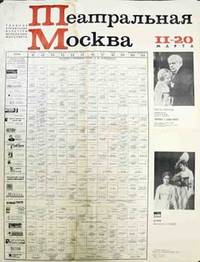
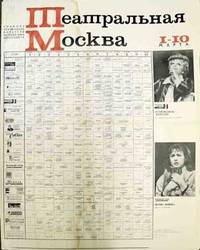
16-2669Moscow Russia: Moskovskaja Pravda 1977. Folio. 108 x 84 cm. Wove Paper with Color Graphics. Moscow Theater Listing for March 1977. Edition of 1750 Copies. Moscow, Russia: Moskovskaja Pravda, 1977. unknown
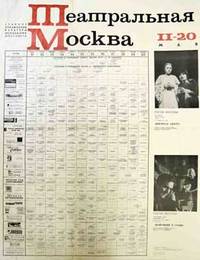
16-2675Moscow Russia: Moskovskaja Pravda 1977. Folio. 108 x 84 cm. Wove Paper with Color Graphics. Moscow Theater Listing for May 1977. Edition of 1750 Copies. Moscow, Russia: Moskovskaja Pravda, 1977. unknown
16-2670Moscow Russia: Moskovskaja Pravda 1977. Folio. 108 x 84 cm. Wove Paper with Color Graphics. Moscow Theater Listing for March 1977. Edition of 1750 Copies. Moscow, Russia: Moskovskaja Pravda, 1977. unknown
1877024233Monroe NC 1877. First Edition. Paperback. Good. Sewn pamphlet pp 81-160 Volume I No. 2 April 1877 front cover wrap is missing rear is torn in several places and chipped at one corner 5% loss title page chipped along fore-edge Full refund if not satisfied. Second issue."The Chi-Phi Quarterly is the only Representative Publication of the Chi-Phi Fraternity. paperback
197710828Pasadena CA: Jet Propulsion Laboratory / California Institute of Technology. Very Good. 1977. Soft Cover. Original wraps. Numerous illustrations and fold-outs. Tight binding clean pages. A hint of light shelf wear to wraps otherwise an excellent copy of this very scarce publication. Not ex-library. Collectible. ; 4to; 210 pages . Jet Propulsion Laboratory / California Institute of Technology paperback
199311780Greenbelt MD: NASA 1993. Preprint Edition. Wraps. good. Quarto approx. 1 000 2 vols. wraps figures tables references slight soiling to covers slight creasing to covers v.2 a few pages bent. Ink name on table of contents v.2. These two volumes contain 100 scientific papers to be presented at the symposium jointly sponsored by theAmerican Astronautical Society and the NASA Goddard Space Flight Center. NASA paperback
197190735Johnson Space Center Texas Presumed: U. S. Government Printing Office 1971. Presumed to have been uniquely signed in person. Photograph. Very good. The format is approximately 8 inches by 10 inches. There is a quarter inch white border around the color image. At the bottom edge in the white space there is the following text: ASTRONAUT VANCE D. BRAND. The color image is of the full face of Astronaut Brand in has astronaut space suit showing him from the waist up. Near his ungloved hands is a globe of the earth. Internet research dated this picture as from 1971. Across his chest he has inscribed the photograph as follows "To Randy with Best wishes! Vance Brand." The back of the photograph is blank. Vance DeVoe Brand born May 9 1931 is a retired American naval officer aviator aeronautical engineer test pilot and NASA astronaut. He served as command module pilot during the first U.S.-Soviet joint spaceflight in 1975 and as commander of three Space Shuttle missions. Brand's flight experience includes 9669 flying hours which includes 8089 hours in jets 391 hours in helicopters 746 hours in spacecraft and checkout in more than 30 types of military aircraft. One of the 19 pilot astronauts selected by NASA in April 1966 Brand initially was a crew member in the thermal vacuum chamber testing of the prototype command module alongside astronauts Joe Engle and Dr. Joseph Kerwin and support crewman on Apollos 8 and 13. During the Apollo 13 crisis Brand was CAPCOM during the PC2 burn. Later he was backup Command Module Pilot for Apollo 15 and was likely to be named to the prime crew of Apollo 18 before that mission was canceled. Brand was backup commander for Skylabs 3 and 4. When Skylab 3's CSM had problems with its Reaction Control System Brand was put on standby to command a rescue mission with backup Pilot Don Lind; however the crew stood down when it was decided that the problem did not require the rescue mission to be launched. As an astronaut he held management positions relating to spacecraft development acquisition flight safety and mission operations. Brand flew on four space missions; Apollo–Soyuz STS-5 STS-41-B and STS-35. He commanded three missions. Brand was the last member of his astronaut class to remain active with NASA and was the only Apollo-era astronaut to pilot the Space Shuttle in the post-Challenger era. Brand departed the Astronaut Office in 1992 to become Chief of Plans at the National Aerospace Plane NASP Joint Program Office at Wright-Patterson Air Force Base. In September 1994 he moved to California to become Assistant Chief of Flight Operations at the Dryden Flight Research Center then Acting Chief Engineer Deputy Director for Aerospace Projects and Acting Associate Center Director for Programs. He retired from NASA in January 2008. U. S. Government Printing Office unknown
Sq28246Office of the Federal Register 2016-09-15. Paperback. Very Good. Clean sturdy copy; no marks rips or folds on pages; some dust marks on page edges EH Office of the Federal Register paperback
194389909Washington DC: Office of Price Administration U.S. Government Printing Office 1943. Presumed First Edition First issuance to this individual. Single sheet printed on one side. Fair. The format is approximately 11.25 inches by 4.25 inches folded in half with removable stamps originally within. Many War Ration stamps remain. First sheet has ration stamps 1-48 intact with an artillery piece illustration . Sheet 2 is 1-48 with a tank illustration. Sheet 3 is 1-48 with a ship illustration. Sheet 4 has 4-48 illustrated with an airplane illustrations. Four stamps laid in G1 H 1 H2 and H3 with a torch illustration laid in may not have been part of Book Three. This was issued undated. Signed Alena A. Smith. Ms. Smith was 38 years of age a female weighing 195 pounds and standing 5 foot six inches. Her occupation was an Inspector. War ration books varied in design and content throughout the war years. Some were simple booklets with basic information while others included more elaborate instructions and patriotic messages. The stamps inside were often brightly colored and featured images of everyday items like shoes and cooking oil serving as a constant reminder of the sacrifices being made for the war effort. War Ration Book Two - January 1943 was the property of the United States Government. It is unlawful to sell or give it to any other person or to use it or permit anyone else to use it except to obtain rationed goods for the person to whom it was issued. Persons who violate Rationing Regulations are subject to $10000 fine imprisonment or both. By 1944 whisky had disappeared from stores as distilleries converted to the production of industrial alcohol. New car production was banned as of January 1 1942 as former auto plants switched to the production of military vehicles. Civilians first received ration books—War Ration Book Number One or the "Sugar Book"—on 4 May 1942 through more than 100000 schoolteachers PTA groups and other volunteers. Sugar was the first consumer commodity rationed with all sales ended on 27 April 1942 and resumed on 5 May with a ration of 1 2 pound 8 oz per person per week half of normal consumption. Bakeries ice cream makers and other commercial users received rations of about 70% of normal usage. Coffee was rationed nationally on 29 November 1942 to 1 pound every five weeks about half of normal consumption in part because of German attacks on shipping from Brazil. As of 1 March 1942 dog food could no longer be sold in tin cans and manufacturers switched to dehydrated versions. As of 1 April 1942 anyone wishing to purchase a new toothpaste tube then made from metal had to turn in an empty one. By June 1942 companies also stopped manufacturing metal office furniture radios television sets phonographs refrigerators vacuum cleaners washing machines and sewing machines for civilians. By the end of 1942 ration coupons were used for nine other items: typewriters gasoline bicycles shoes rubber footwear silk nylon fuel oil and stoves. Meat lard shortening and food oils cheese butter margarine processed foods canned bottled and frozen dried fruits canned milk firewood and coal jams jellies and fruit butter were rationed by November 1943. Many retailers welcomed rationing because they were already experiencing shortages of many items due to rumors and panics such as flashlights and batteries after Pearl Harbor. Ration Book Number Five is a very rare ration book only issued to very few people. By the end of 1942 ration coupons were used for nine other items: typewriters gasoline bicycles shoes rubber footwear silk nylon fuel oil and stoves. Meat lard shortening and food oils cheese butter margarine processed foods canned bottled and frozen dried fruits canned milk firewood and coal jams jellies and fruit butter were rationed by November 1943. Many retailers welcomed rationing because they were already experiencing shortages of many items due to rumors and panics such as flashlights and batteries after Pearl Harbor. Ration Book Number Five is a very rare ration book only issued to very few people. Office of Price Administration, U.S. Government Printing Office unknown
194389910Washington DC: Office of Price Administration U.S. Government Printing Office 1943. Presumed First Edition First issuance to this individual. Single sheet printed on one side with stamps inside. Fair. The format is approximately 11.25 inches by 4.25 inches folded in half with removable stamps originally within. Many War Ration stamps remain. First sheet has ration stamps 1-48 intact with an artillery piece illustration . Sheet 2 is 1-48 with a tank illustration. Sheet 3 is 1-48 with a ship illustration. Sheet 4 has 2-48 illustrated with an airplane. This was issued undated. Signed Elmer Schurtze. Not otherwise filled out. Ink notation at bottom front as Book 4. War ration books varied in design and content throughout the war years. Some were simple booklets with basic information while others included more elaborate instructions and patriotic messages. The stamps inside were often brightly colored and featured images of everyday items like shoes and cooking oil serving as a constant reminder of the sacrifices being made for the war effort. War Ration Book Two - January 1943 was the property of the United States Government. It is unlawful to sell or give it to any other person or to use it or permit anyone else to use it except to obtain rationed goods for the person to whom it was issued. Persons who violate Rationing Regulations are subject to $10000 fine imprisonment or both. By 1944 whisky had disappeared from stores as distilleries converted to the production of industrial alcohol. New car production was banned as of January 1 1942 as former auto plants switched to the production of military vehicles. The official War Ration book four was released in late 1943. Form No. R-145 Civilians first received ration books—War Ration Book Number One or the "Sugar Book"—on 4 May 1942 through more than 100000 schoolteachers PTA groups and other volunteers. Sugar was the first consumer commodity rationed with all sales ended on 27 April 1942 and resumed on 5 May with a ration of 1 2 pound 8 oz per person per week half of normal consumption. Bakeries ice cream makers and other commercial users received rations of about 70% of normal usage. Coffee was rationed nationally on 29 November 1942 to 1 pound every five weeks about half of normal consumption in part because of German attacks on shipping from Brazil. As of 1 March 1942 dog food could no longer be sold in tin cans and manufacturers switched to dehydrated versions. As of 1 April 1942 anyone wishing to purchase a new toothpaste tube then made from metal had to turn in an empty one. By June 1942 companies also stopped manufacturing metal office furniture radios television sets phonographs refrigerators vacuum cleaners washing machines and sewing machines for civilians. By the end of 1942 ration coupons were used for nine other items: typewriters gasoline bicycles shoes rubber footwear silk nylon fuel oil and stoves. Meat lard shortening and food oils cheese butter margarine processed foods canned bottled and frozen dried fruits canned milk firewood and coal jams jellies and fruit butter were rationed by November 1943. Many retailers welcomed rationing because they were already experiencing shortages of many items due to rumors and panics such as flashlights and batteries after Pearl Harbor. Ration Book Number Five is a very rare ration book only issued to very few people. By the end of 1942 ration coupons were used for nine other items: typewriters gasoline bicycles shoes rubber footwear silk nylon fuel oil and stoves. Meat lard shortening and food oils cheese butter margarine processed foods canned bottled and frozen dried fruits canned milk firewood and coal jams jellies and fruit butter were rationed by November 1943. Many retailers welcomed rationing because they were already experiencing shortages of many items due to rumors and panics such as flashlights and batteries after Pearl Harbor. Ration Book Number Five is a very rare ration book only issued to very few people. Office of Price Administration, U.S. Government Printing Office unknown
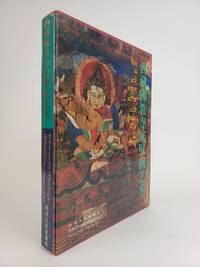
19941362047Chengdu: Sichuan People's Publishing House 1994. First edition first printing. Hardcover. Folio: 387 pages. Good. Pictorial dust jacket with green and navy panels to spine gold and yellow lettering. House in pictorial slip case with red cloth top and bottom panels lightly bumped and shelf-worn at edges and corners. Dust jacket lightly bumped and worn at corners; Boards lightly bumped at lower corners; Front hinge split rear hinge cracking; Text block beginning to show light age-toning. Text in English Chinese and Tibetan. SH consignment. <p>This is an oversized item which may require additional postage; please inquire for rates. 1362047. Special Collections. Sichuan People's Publishing House hardcover
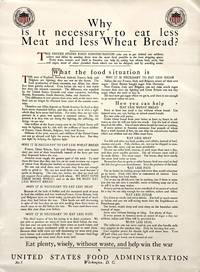
1917319368United States Food Administration 1917. Original Poster. Lithograph. Measures 29" x 21".<br/> <br/> All-lettered poster has a two-column article with lengthy text explaining the need to conserve meat wheat fats sugar and coal. Some crumpling and foxing at edges. Otherwise in good condition. Print is clear and red color is vivid.<br/> <br/> United States Food Administration unknown
197641967Washington DC: ERDA 1976. First Edition. First Printing. good. Wraps 2-vol. set illus. footnotes appendices covers somewhat worn and soiled summary sheet laid in. ERDA-1542. Volume 2 is contains Appendices and Comment Letters. This Statement represents an analysis of the U.S. nuclear power export activities from the inception of the Atoms for Peace program in 1953 through the year 2000. The analysis addresses generic issues relating to a continuation of U.S. nuclear power export activities through the year 2000 at various projected levels and to reasonably available alternatives. The Statement analyses the potential environmental impacts on the U.S. and the high seas resulting from U.S. nuclear power export activities conducted within the U.S. or on the high seas. This is a major analysis and forecast taken before the events at Three Mile Island. ERDA paperback
1937RWORIDA00tpmCaxton Printers 1937. Good. Works Progress Administration. Idaho: A Guide in Word and Picture. Fisher Vardis. Caldwell Idaho: Caxton Printers 1937. 1st edition. 431pp. Indexed. Illustrated. Bibliography. 8vo. Green cloth with gilt lettering and designs. Book condition: Good with lightly rubbed edges and bumped corners. The spine ends are chipped and the hinges are slightly weak. Pages are slightly stiff rippled and have a slight yellowing. Caxton Printers hardcover
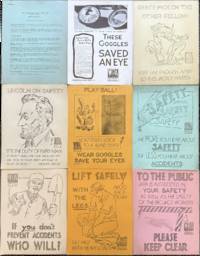
78816Two-page bulletin on "Specification for Goggles" prepared by Herbert J. Brammeier for the Safety Division of the Works Progress Administration for Illinois. Undated it is mimeographed on two sheets of light green paper and bound with a staple.<br /> <br /> Accompanied by eight illustrated broadsides 8 ½" x 11" issued by the Safety Division:<br /> <br /> THESE GOGGLES SAVED AN EYE. Three copies printed in black on the recto of coated white stock.<br /> <br /> DON'T PICK ON THE OTHER FELLOW. SD Poster #9. Mimeographed on the recto of light yellow stock.<br /> <br /> LINCOLN: ON SAFETY. SD Poster #10. Mimeographed on the recto of cream stock.<br /> <br /> PLAY BALL! SD Poster #11. Mimeographed on the recto of goldenrod stock.<br /> <br /> THE MORE YOU HEAR ABOUT SAFETY. SD Poster #12. Mimeographed on the recto of light green stock.<br /> <br /> IF YOU DON'T PREVENT ACCIDENTS. SD Poster #15. Two copies mimeographed on the recto of cream stock.<br /> <br /> LIFT SAFELY! SD Poster #16. Two copies mimeographed on the recto of goldenrod stock.<br /> <br /> TO THE PUBLIC. SD Poster #17. Two copies mimeographed on the recto of pink stock.<br /> <br /> Light toning along the extremities with minimal smudging to a few of the broadsides; otherwise very good. OCLC locates no holdings. unknown
1845elala484Brussels: Weissenbruch Père 1845. 1845. 8vo. pp. 2 p.l. iv 316 ccxv 1errata. 3 folding lithographed plans. partially unopened in original printed wrs. wrs. & outer leaves chipped at edges & detached lower margins of plates ragged upper inner margin of two leaves of preface wanting affecting several words. Brussels: Weissenbruch Père, 1845. unknown
1816267001in der J.G. Cotta`schen Buchhandlung Stuttgart 1816. Hardcover mit Lederrücken und -ecken Rundumfarbschnitt ohne Schutzumschlag 5. Auflage 18161817. Zustand: keine Beschädigungen eine Namenseintragung. Rücken Ecken Kanten bestoßen berieben abgeschabt. Block fest und gut. In allem original. in der J.G. Cotta`schen Buchhandlung, Stuttgart, hardcover
1851266996Verlag von B.G. Teubner Leipzig 1851. Hardcover mit Lederrücken und -ecken ohne Schutzumschlag Zustand: keine Beschädigungen keine Eintragungen. Rücken Ecken Kanten bestoßen und berieben. Einband abgeschabt Block fest und gut. In allem original. Verlag von B.G. Teubner, Leipzig, hardcover
1972743412PN. New. 1972. Soft Cover. Date is original print. This is a reprint edition. . PN paperback
1965727053PN. New. 1965. Soft Cover. Date is original print. This is a reprint edition. . PN paperback
1956704912PN. New. 1956. Soft Cover. Date is original print. This is a reprint edition. . PN paperback
047125858XNew. Brand new and still unused unknown
2003031621Philadelphia Pennsylvania: KAPPA ALPHA PSI FRATERNITY 2003. Near Fine condition in a bright and shiny Near Fine dust jacket The book itself is in near PERFECT condition but for one margin note and yellow highlighting on some of the first 32 pages. All other pages are crisp clean and unmarked. NO underlining. NO highlighting. NO margin notes. Sharp corners. Square and tight. The jacket has minor shelfwear at the edges but NO chips. NO tears. NO fading. NO owner's name or bookplate. NOT a library discard. NOT a remainder. Profusely illustrated with b/w photos and member portraits. Subtitle: "A History of the Beginning and Development of a College Greek Letter Organization 1911-1999." Name Index. Bound in the original yellow and red laminated boards with matching dust jacket. Oversize Hardcover. 8.5" wide by 11" tall. This large heavy book will require SUBSTANTIAL extra postage for International shipments but only the standard charge for priority or media mail. Fifth Edition. Oversize Hardcover. Near Fine condition/Near Fine dust jacket. Illus. by NOT a library discard. xiv 389pp. Great Packaging Fast Shipping. KAPPA ALPHA PSI FRATERNITY Hardcover
2004026099Reno Nevada: University of Nevada Oral History Program 2004. Fine condition in a bright and shiny Near Fine dust jacket just a touch of rubbing at the jacket's extremities. NO chips or tears. Sharp corners. NO owner's name or bookplate. NOT a remainder. Pages are crisp clean and unmarked - probably never read. NO underlining. NO highlighting. NO margin notes. Photo illustrated. Index. Laid-in is a typed letter on University of Nevada Reno Oral History Program letterehead signed by Mary Larson Assistant Director. Bound in the original dark blue cloth stamped in bright silver. Complete with dust jacket. From the publisher/Gooogle: "NOT LIKE A RIVER: THE MEMOIR OF AN ACTIVIST ACADEMIC is the oral history of Elmer Rusco a distinguished professor of political science at the University of Nevada in Reno. This memoir is the summation of Professor Rusco's life in civil liberties and civil rights and his pursuit of legal and historical truth. It provides insight into the exceptional scope of Professor Rusco's work and contributions as well as the reasons for his extraordinary lifelong commitment to advancing the cause of social justice. Originally from Kansas Professor Rusco chose to spend more than four decades in Nevada. He was one of the founding group of faculty members of the University of Nevada's Department of Political Science when it separated from the History Department between 1958 and 1963; and he helped establish the reputation of that faculty for teaching public service and mentoring. Professor Rusco was one of the volunteer leaders of the American Civil Liberties Union of Nevada that sustained it from its founding in 1966 to 1985 and in the 1970s he served as its state president. Professor Rusco was active in community state and national organizations including those committed to the environment Friends of Rancho San Rafael and Friends of Pyramid Lake religion the Unitarian Universalists civil rights the ACLU Nevada and the Northern Nevada Black Cultural Awareness Society political reform Common Cause legal aid Washoe Legal Services direct help for the poor Community Services Agency and Habitat for Humanity and much more. Professor Rusco's oral history also provides insight into how his religious personal and political philosophy was shaped. The sources were mostly rooted in rural Kansas but also involved a cattleboat excursion that spanned several continents and a Midwesterner's encounters with the Jim Crow South. For Elmer Rusco 'retirement' in 1986 added to his life the time to become the state's leading authority on Nevada's civil rights legacy and its struggle with racism. He was able to complete monumental studies on federal Indian policy and on Nevada's encounters with its Chinese residents in addition to a myriad of published studies on poverty and the black experience in Nevada.". First Edition. Hardcover. Fine condition/Near Fine dust jacket. Illus. by NOT a library discard. 8vo. x 305pp. Great Packaging Fast Shipping. University of Nevada Oral History Program Hardcover
This study of six historians from the edges of the Roman world at the end of the Republic--the author of I Maccabees, Posidonius, Diodorus Siculus, Pompeius Trogus, Nicolaus of Damascus, and Memnon of Heraclea--combines discussion of their biographical details, the intellectual and elite culture in which they composed, and the methodological difficulties of interpreting fragmentary texts, with textual analysis of their representations of Rome. These authors show remarkable unity in their acceptance of Roman hegemony. Nevertheless, their interpretations of Roman rule assume political significance in the light of their intentions in writing and the audiences whom they addressed. They therefore provide a unique insight into the minds of the conquered peoples and the intellectual culture which allowed them to influence their conquerors. ; Oxford Classical Monographs; 416 pages