[LAW - FRENCH].Biblio.com
798 résultats
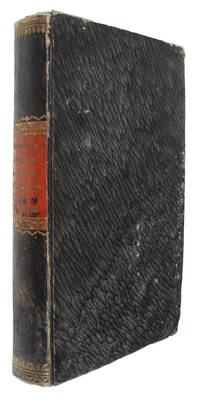
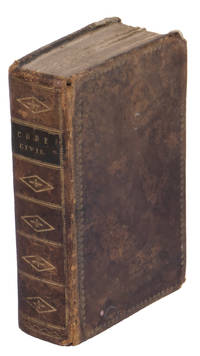
1804ABC_48704Paris 1804. 12mo. Louis Courcier; Angoulême Adrien Marrot; Bordeaux Thiron and Sigal Contemporary gold-tooled calf with a black morocco title label on the spine lettered in gold marbled endpapers. 2 parts in 1 volume. 2 329 1 blank; 4 268 pp. Very rare early edition only one copy found in WorldCat of this famous French civil code published in two volumes in 1804 the year in which also the first edition appeared Paris Imprimerie de la République An XII - 1804. In 1807 its title was changed into Code Napoléon Napoleonic Code under which it is commonly known today.The initiative for drawing up a civil code of laws was taken by Napoleon Bonaparte 1769-1821 in 1800 at that time First Consul of France. The text was drafted by a commission of four eminent jurists under the presidency of the French lawyer Jean Jacques Régis de Cambacérès 1753-1824 who had made a first attempt in 1793 to concipiate a codification of French civil law. In France civil law was mainly based on customary law which differed greatly from each other in various parts of the country. With a single set of laws the traces of feudal law could also be eliminated as a consequence of the French Revolution.This legal code is divided into three parts comprising 36 laws and 2.281 articles written in a clear and concise style. It is known that the famous French writer Stendhal pseudonym of Marie Henri Beyle 1783-1842 read a few pages of it every day to obtain its qualities of clarity and simplicity. The first part is mainly concerned with family law the second part mainly with the property of goods and the third part mainly with contracts. After the publication in 1804 a series of new French codes of law followed: in 1806 the Code de procédure civile Code of civil procedure in 1807 the Code de commerce Commercial code in 1808 the Code dinstruction criminelle Code of criminal procedure and in 1810 by the Code pénal Criminal code. Due to Napoleons occupations to Germany Italy the Low Countries and Poland the French civil code became highly influential in European legal history. It still leaves its mark in private law particularly in the field of contract law family law and property law.With traces of use binding slightly worn along the extremities two corners of the back cover slightly damaged first free endpaper missing owners entry in black ink on the title-page of the first part a few text pages loosening occasionally slightly soiled/browned. Otherwise in good condition. unknown
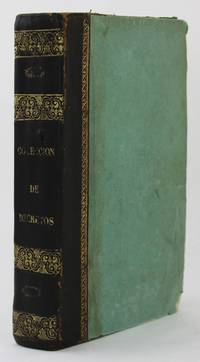
18252575Mexico City 1825. Still very good. Two volumes in one. 2xxvi221xi2; 2xviii190xviiiiii pp. Contemporary quarter calf and paper boards spine gilt. Light rubbing and a pair of small perforations to spine leather. Edges worn; corners bumped. Light tanning scattered foxing. A handsome copy of an early Mexican imprint that Lathrop Harper described succinctly as the "First edition of the first decrees of the first independent Mexican Congress." This collection of decrees issued for the first and second sessions of the Mexican Congress established after the promulgation of independence in 1821 contains a wealth of information relevant to the founding of the country. These include the act relating to the "coronation of D. AgustÃn de Iturbide the hereditary successor to the throne†formalizing that “the acts of his government are declared invalid." <br /> <br /> Of particular interest are two decrees directly relating to Anglo-American settlement in Texas. The first of these dated April 11 1823 begins “Que el gobierno si no encuentra inconveniente acceda a la solicitud de Estevan Austin sobre que se confirme la concesión de establecer 300 familias en Tejas.†Roughly translated this decree states that "the government if it finds no objection agrees to Estevan Austin's request for confirmation of the concession to establish 300 families in Texas.†Stephen F. Austin's "Old Three Hundred" families were the foundation of Anglo-American settlement in Texas and here the nation of Mexico authorizes their emigration.<br /> <br /> The second decree dated September 29 1823 is titled “Esención de derechos por siete años a los efectos que se introduzcan en Tejas.†The text of the decree reads in full: “El Soberano Congreso mexicano tomando en consideracion el deplorable estado a que las hostilidades de los barbaros han reducido a la provincia de Tejas y para ocurrir en parte a la miseria de sus habitantes civilizados ha venido en decretar y decreta. Que todos los efectos de cualquiera clase nacionales o estrangeros que se introduzcan en la provincial de Tejas para el consume de sus habitants sean libres de derechos; durando esta esencion siete anos contados desde su publicacion en aquella capital.†This second decree effectively extended the term for duty-free trade allowed to the Texas settlers as recompense for the troubles they experienced at the hands of the local "barbarians" i.e. the indigenous native peoples who had lived on the land for centuries.<br /> <br /> Of course the works also stand alone as a significant document of the first independent Mexican government and contains many important details on the early organization of the new country the Constitution of 1824 and the first presidential elections amongst much else. The two works present here were printed simultaneously but were issued separately and are not always found together as here. The first compilation of laws governing the fledgling nation of Mexico with early Texas colonization content. <br /> Palau 56388. Lathrop Harper 220:116. unknown
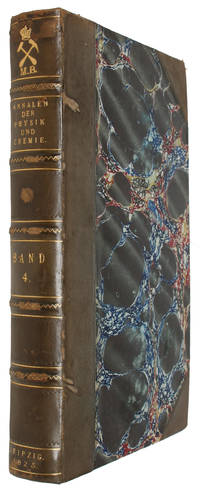
185053436Leipzig Johann Ambrosius Barth 1850. Contemp. marbled boards. Gilt spine titlelabel with gilt lettering. Light wear to spineends corners and edges. Stamps on title-page Gusstahlfabrik Fried. Krupp. In "Annalen der Physik und Chemie" Dritte Reihe 19. Band 79. Band der ganzen Reihe. IX1580 pp. and 3 folded engraved plates. Entire volume offered. Endpapers and the first and last few leaves with brownspots. Clausius's paper: pp. 368-397 a. pp. 500-524. Internally clean. <br/><br/><em>First edition of this monumental famous paper in thermodynamics in which Clausius for the first time states the Second Law of Thermodynamics one of the most importent laws of Nature having a huge impact on the development of physical theory cosmology communications and information theory. The law states that a the energy of the Universe is constant and b the Entropy of the Universe tends to a maximum."Clausius' contribution to thermostatics is comparable to those of Newton and Maxwell to mechanics and electromagnetism respectively. In the obituary J.W. Gibbs remarked that Clausiu's first memoir "marks an epoch in the history of physics."" Chowdhury and Stauffer in "Principles of Equilibrium Statistical Mechanics".In "The Nature of the Physical World" Eddington writes: "The Law that entropy increases - the Second Law of Thermodynamics - holds I think the supreme position among the laws of Nature. If someone points out to you that your pet theory of the Universe is in disagreement with Maxwell's equations - then so much the worse for Maxwell's equations. If it is found to be contradicted by observation - well these experimentalists do bungle things sometimes. But if your theory is found to be against the Second Law of Thermodynamics I can give You no hope; there is nothing for it but to collapse in deepest humiliation.".Parkinson "Breakthroughs" 1850 P. </em> hardcover
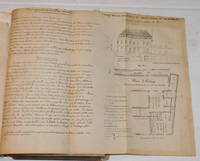
182897115Paris: impr. Dezanche and impr. Pihan Delaforest and Delangle Freres 1828-1835. 1828-1835. Fair. - Octavo 8-1/4 inches high by 5-1/4 inches wide. Four pamphlets bound into early brown calf with an elaborate floral device embossed in blind at the center of both the front and rear covers within an elaborate outer gilt ruled frame with formal decorations. All edges are marbled. The rubbed & worn covers are detached and the spine has perished and thus lacking. The pagination is as follows: i-xii 1-96 pp.; 5 6-45 1 pp.; 5 folding plates; 5 6-66 pp.; 4 pp. 1-82. There is foxing throughout.<p>The ownership name of James Stewart and the faded date of "1881" is penned on the front blank. In what appears to be his hand the statement "From Pierre Soule" is penned along the top of the verso of the front endpaper. Additionally the attractive sienna-toned ex-libris bookplate of "R.G.S." is mounted on the front pastedown. <p>Stated to be from the library of Pierre Soule with his name signature at the head of the first pamphlet. Soule 1801-1870 was the French-born New Orleans attorney and Louisiana Senator.<p>The lawyer involved in these 4 cases Gustave Louis Chaix d'Est-Ange 1800 - 1876 was the son of the attorney general at the court of criminal justice of Reims. As a lawyer his oratorical talent was noted at the Paris bar where he practiced. He was entrusted with a number of important cases and from 1842-1844 was president of the Paris Bar Association.<p>1 Plaidoyer et réplique de Me Chaix-d'Est-Ange dans le procès d'Émile de La Roncière précédés d'une Note de M. le lieutenant-général Clément de la Roncière d'Esquisse préliminaire de M. Eugène Roch et d'une lettre de M. Émile de La Roncière adressée à "l'Observateur des tribunaux". Paris: De L'Imprimerie De Dezauche 1835. The sensational trial of Emile de La Ronciere 1803 - 1874 was most recently memorialized by John Fowles in his novel "The French Lieutenant's Woman". In chapter 28 of the novel he discusses the trial of the young cavalry officer who was accused of raping Marie the sixteen-year-old daughter of his commanding General Baron de Morell. The trial itself revolved around a series of anonymous letters threatening the Morell family and signed "E. de La R.". La Ronciere was found guilty and sentenced to ten years in prison. The verdict was controversial and has been debated for many years. In the pamphlet at hand is included the text of a letter to the l'Observateur des Tribunaux written by La Ronciere's father Clement de La Ronciere on August 25 1835 and one written by the imprisoned La Ronciere himself on September 10 1835. These are followed by a preliminary outline by Eugene Roch. The text from the trial is based on reporting in l'Observateur des Tribunaux journal des documens judiciaires. It begins with the plea of La Ronciere's attorney Chaix d'Est-Ange. Although misbound later in this collection of pamphlets facsimiles of items used as evidence in the trial are included. These include 4 folding facsimiles on which are printed 8 samples of handwriting of La Ronciere and of Marie de Morell. Also included on a fifth folding plate is a remarkable plan of the home of the Morells with a view of the floor where Marie's room was located.<p>2 Plaidoyer de Me Chaix-d'Est-Ange pour M. le ministre du Commerce et des Travaux publics intervenant contre M. Victor Hugo. Paris: Imprimerie De Pihan Delaforest 1832. Victor Hugo's play "Le Roi s'amuse" was the basis for the libretto of Verdi's opera Rigoletto. The opening of the play on November 22 1832 was highly anticipated. The opening night box office receipts were an enormous success but the play was not. Both the audience and the critic's responses were negative. However the most devastating response came from the Minister of the Interior. He saw the play as an attack on the royal family and ordered it suspended i.e. banned. In the Charter of 1830 censorship was stipulated to "never be re-established". This conflict led to a trial on December 19 1832. Odilon Barrot represented Hugo and Chaix d'Est-Ange represented the Ministry of Commerce. He took the unpopular stand that the State had the authority to examine dramatic works before production. His plea is published here. Hugo lost this free-speech debate and the play was banned for 50 years.<p>3 Plaidoyer de M. Chaix d'Est-Ange pour le sieur Auguste Labauve et les sieur et dame Formage plaignans et parties civiles contre Frédéric Benoît accusé. Paris: Imprimerie De Pihan Delaforest Morinval 1832. A VIVID ACCOUNT OF MATRICIDE! Frederic Benoit 1810 - 1832 known as "Le Parricide" was executed by the guillotine at the Place St. Jaques in the 14th arrondisement of Paris on August 30 1832. The story of Benoit's killing of his mother in November 1829 and that of his male lover seventeen-year-old Joseph Formage on July 22 1831 is well documented and need not be repeated here. In this civil plea of June 14 1832 on behalf of the butcher Auguste Labauve and also on behalf of Joseph Formage's parents Chaix d'Est-Ange outdoes himself in painting with vibrant colors the slaughter by Benoit of his own mother. Labauve was the second victim of this crime. In January of 1830 an anonymous letter was found threatening Benoit's father a justice of the peace as well as Labauve with the same fate as that of Madame Benoit. The letter was said to be in the hand of Labauve. He was brought to trial for murder and was acquitted by a divided jury. However he was sentenced to a 5 year prison term for having written the threatening letter.<p>4 Procès fait à la lettre adressée au duc d'Orléans par Cauchois-Lemaire. Paris: Delangle Freres Libraires 1828. In December 1827 the editor of the Constitutionnel Louis Francois Auguste Cauchois-Lemaire 1789 - 1861 published a notorious 69 page pamphlet "Sur la crise actuelle lettre a S.A.R. le duc d'Orleans". The pamphlet addressed to Louis-Philippe the Duke of Orleans was a powerful attack on the ultra-royalist government of Joseph de Villele and a denunciation of the so-called "massacre" that took place on the rue Saint-Denis on July 27 1827. Cauchois-Lemaire concludes his essay paraphrasing the French "Thus liberty awaits the day which should let it emerge from its prison. And we who are tired of the long wait together we call for a favorable star to hasten it." The result was that Cauchois-Lemaire was accused of trying to persuade the duc d'Orleans the "favorable star" to lead the opposition to the government and have it overthrown. He and the two publishers Ponthieu and Schubart were brought to trial on January 12 1828. Cauchois-Lemaire was sentenced to 15 months in La Force prison in addition to a fine. In defense of Cauchois-Lemaire Chaix d'Est-Ange given that the facts of the matter were difficult to vindicate delivered a brilliant thesis on constitutional law. The press at the time praised his eloquence. Cauchois-Lemaire himself was so impressed that he wrote Delangle Freres from prison on January 28 1828 requesting that they publish a transcript of the trial. That letter together with the proceedings of the trial are published here. Paris: impr. Dezanche, and impr. Pihan Delaforest, and Delangle Freres, 1828-1835. unknown
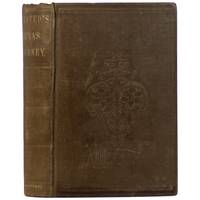
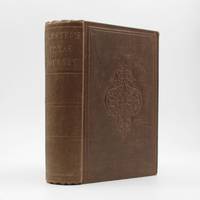
1857365383New York: Dix Edwards & Co 1857. First Edition. Very good. One of the best accounts of antebellum Texas written as a series of letters about life in the slave states commissioned for the New York Times. This is the second of three volumes issued separately in Olmsted's "Our Slave States" series. While not a radical Olmsted in sending a copy of this book to Edward Everett Hale said that he hoped that his book would help slavery to "retreat upon itself" and collapse under its own weight with "masters running away from the slaves" Quoted in Papers of Frederick Law Olmsted vol. 2 p. 398.<br /> <br /> Jenkins in Basic Texas Books calls this "the most civilized of all 19th century books on Texas" and "the most interesting and most dependable." He also says Olmsted "gives one of the earliest descriptions of the Texas cattle ranch." Greene in the 50 Best Books on Texas writes "the book is both good reading and good sociology."<br /> <br /> Larry McMcMurtry in his book In a Narrow Grave called Olmstead "perhaps the most readable of the nineteenth century travelers."<br /> <br /> The book includes a small folding map of the state titled "Map of Part of the State of Texas" prepared by J. H. Colton & Co. of New York. The Salt River fork on the Brazos river marks the northern and western boundary of the map. <br /> <br /> This book sold well. It was published at the beginning of 1857 and by February 16 Olmsted reported to his brother who had accompanied him on the journey and who edited the letters for this publication that only 200 of the first printing of 2500 copies remained. He also wrote that the paper ordered by the publisher of which Olmsted was an investor had "been a month on the way not yet arrived." A second printing of this book in 1857 is not referenced in any of the bibliographies known to your cataloguer. <br /> <br /> There are two variants of the book with 1857 on the title page. The most obvious difference is that one variant has plain endpapers and another has endpapers printed with reviews for the first volume in Olmstead's travels. I think it is most likely that the variant with ads is the second printing. On the title page of the copies with ad endpapers the counters empty spaces in the capital 'A's of the list of Olmsted's previous books are mostly filled in which is common when stereotype plates reproduce small letters the publishing agreement for this book survives and it required the publisher to make stereotype plates. The endpaper variant is also much more common which would also seem to fit this narrative; given that the first printing sold out in weeks the publisher is much more likely to have printed a larger number of the second printing which apparently lasted until 1859 when the book was reprinted for a third time a fourth printing appeared in 1860. Likely first printing with no ads on the endpapers. A very good copy worn at the corners and bumped on the spine ends. Small illegible previous owner's name on the front free endpaper; original price $1.25 marked above in pencil. Rather scarce; copies with ads on the endpapers are much more common. Dix, Edwards & Co unknown
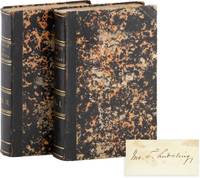
182788857New Orleans: A.T. Penniman & Co 1827-29. First Edition. First printing. Two octavo volumes. Early straight-grained morocco over marbled boards; gilt spine-titles; pp. lxxxiii 364; iii--xv 429pp. Half-titles present. Rubbing to board edges and spine ends with heavier rubbing at crowns and board corners; foxing generally mild more conspicuous but not obtrusive to a few gatherings in each volume. A well-preserved example in an attractive early binding Very Good. With ownership signature to both volumes of John T. Ludeling see note. <br /> <br /> A desirable copy of this early keystone work of Louisiana history. Author François-Xavier Martin 1762-1846 born in France emigrated to North Carolina around 1783 establishing himself first as a printer and then after reading law as a legal scholar and jurist. He entered politics in 1806 and in 1809 was appointed to be the first Attorney General of the newly-acquired Territory of Orleans. As an eye witness to and active protagonist in the legal establishment of the state of Louisiana in 1812 Martin was in a unique position to pen the current history. Though the work was never a popular success - possibly due to Martin's stilted legalistic style which resulted in a work described by his contemporary Charles Gayarré as "lifeless as the minutes and records of proceedings in a court of justice" - subsequent historians have praised the History as for example ".one of the best examinations of the judicial structure from the colonial period to the early nineteenth century. Martin's History of Louisiana has withstood the test of time becoming not only a useful secondary source but also an important primary document." see Mark F. Fernandez From Chaos to Continuity : The Evolution of Louisiana's Judicial System 1712-1862. Baton Rouge: 2001.<br /> <br /> In addition to serving as Louisiana's first Attorney General Martin served for a decade 1836-46 as Chief Justice of the Louisiana Supreme Court a fact that lends special interest to this copy of the History which bears the ownership markings of John Theodore Ludeling 1827-1891. Ludeling a prominent Louisiana-born lawyer and jurist just one generation removed from Martin would serve as the Court's Chief Justice from 1868-1877 - and no doubt would have approached the current work with special interest as both a primer on the State's early legal history as well as the product of a distinguished direct predecessor. A notable and well-preserved copy of an uncommon work. SABIN 44871. HOWES M-332. A.T. Penniman & Co unknown
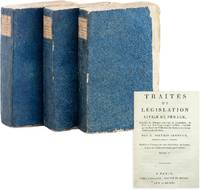
180288519Paris: Chez Bossange Masson et Besson 1802. First Edition. First impression. Three octavo volumes 22cm. Publisher's blue paste-paper wrappers; original printed spine labels; xlii1-370; xx1-434; viii1-452pp. A very fresh mostly unopened set; page edges untrimmed; mild wear to wrappers with some subtle re-touching to spines; expected creasing to spine labels; overall a remarkably well-preserved set in the very scarce publisher's wraps. Text entirely in French.<br /> <br /> A systematic application of Bentham's Utilitarian principles to the philosophy of law. Though adapted from Bentham's own writings in both English and French the work is substantially that of Bentham's long-time editor and expositor the Swiss political philosopher Pierre Étienne Louis Dumont 1759-1829. Dumont assembled the work from a series of manuscripts received directly from Bentham over a decade beginning around 1788; to these he applied his own organization and extensive editorial hand. The resulting work was sufficiently altered from the originals that Samuel Romilly Bentham and Dumont's mutual friend and go-between could write in a letter to Dumont on the eve of publication: "It is very entertaining to hear Bentham speak of it.he says that he is very impatient to see the book because he has a great curiosity to know what his own opinions are upon the subjects you treat of" quoted in Charles Atkinson Benthams's Theory of Legislation; Oxford: 1914 p.viii. The work was never fully reproduced in English though substantial extracts from it appeared in Bowring's edition of Bentham's Works 1838-1843 and an English-language abridgment appeared in 1863 under the title Theory of Legislation. The current French edition was reprinted in Paris in 1820.<br /> <br /> Bentham's great insight into the theory of laws and their enforcement was that both should be designed to create the greatest good for the greatest number of people - the essence of Utlitarianism. He was particularly convincing in his approach to penology to which he applied the then-novel concepts that first a criminal penalty should be proportionate to the crime committed; second that legal penalties should function as deterrents rather than simply as retaliations. To quote Atkinson "In Bentham's days it was not generally recognized that the main end of punishment was the repression and prevention of crime. There were many persons ready to act on the belief that it mattered little how many murders or felonies were committed provided only that some man was hanged in respect of each one of them.Bentham on the other hand maintained that the certainty of a mild punishment properly allotted was far more effective than the mere chance of suffering death" Theory of Legislation p.xi. The imperative of criminal repression is also evident in Bentham's invention of the Panopticon - a prison-in-the round that would allow full-time surveillance of prisoners in their cells without individual prisoners ever knowing whether they were being watched - a surefire inducement to civil behavior if also a cringeworthy negation of the right to privacy. Dumont devotes an entire substantial section of the current work to Bentham's writings on the panopticon and its applications which in addition to prisons included factories poor-houses and schools. No panopticons were build during Bentham's lifetime though a few experimental 20th-century prisons e.g. the "Presidio Modelo" on the Isla de Pinos Cuba utilized Bentham's designs which are today more likely to be interpreted as a blueprint for the surveillance state than one for reform and rehabilitation.<br /> <br /> While not strictly speaking rare the Traités are a major milestone in the real-world applications of Utilitarianism and an essential continuation of Bentham's foundational work Introduction to the Principles of Morals and Legislation 1789. Suitable copies have appeared at auction a few times over the past three decades but we can find no evidence of a similar set in publisher's wrappers having appeared in commerce. For background see MUIRHEAD "A Jeremy Bentham Collection" in The Library v.1 no.1 June 1946 p.17ff. CHUO LIBRARY Bibliographical Catalogue of the Works of Jeremy Bentham T8.1. Chez Bossange, Masson, et Besson unknown
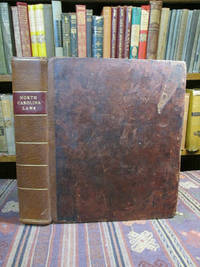
1804034606Newbern: Martin & Ogden: 1804. Volume I & II bound in 1 volume. Volume I 501 pages I page Errata. "Containing the acts from 1715 to 1790 revised and published under the authority of the Legislature." Afterwards one of the Associate Justices of the Supreme Court of the United States and now revised by Francois-Xavier Martin. Volume II: 224 pages I page Errata. "Containing the acts from 1790 to 1803 revised and published under the authority of the Legislature." By Francois-Xavior Martin. GOOD HARDCOVER rebound into a modern brick- red linen binding with new endpapers. Internally a nice clean and tight copy. Sign by John Strother Esq and is partly scribbled out. scarce. This is the 1804 editions. . Hardcover. Very Good. 4to - over 9¾" - 12" tall. Martin & Ogden: hardcover
1823034604Washington City: Printed by the author by Way and Gideon: 1823. 316 pages. "The fourth and last of Taylor's full-scale books on the Constitution in which he fully expounds his philosophy of government. Taylor was one of the major political theorists of the early United States as well as the most articulate and persuasive exponent of the states' rights agrarian school." Signed by J. T. Brown with somebody's pencil note saying this copy belonging to John Thompson Brown Virginia Congressman. GOOD LEATHER HARDCOVER pages foxed binding is tight. Covers has been repaired at some point. Binding is tight. RARE. . Hardcover. Good. 8vo - over 7¾" - 9¾" tall. Printed by the author by Way and Gideon: hardcover
1889ZB394145Harvard Law Review Publishing Association 1889-1996. Volumes 3 12 17 33 38 59 61; 65-70; 73-78; 80-81; 85; 89-101; 106 107 109 1889-1996. partly bound library markings else textually clean & tight. - If you are reading this this item is actually physically in our stock and ready for shipment once ordered. We are not bookjackers. Buyer is responsible for any additional duties taxes or fees required by recipient's country. Photos available upon request. Harvard Law Review Publishing Association unknown
185446907Leipzig Johann Ambrosius Barth 1854. Contemp. marbled boards. In: "Annalen der Physik und Chemie. Hrsg. von J.C. Poggendorff" Vierte Reihe Bd. 3 = Poggendorff Bd. 93. Entire volume offered. Two stamps to titlepage. X632 pp. and 4 folded engraved plates. Clausius's paper: pp. 481-506. Internally clean and fine. <br/><br/><em>First printing of this milestone paper in thermodynamics which together with his paper from 1850 established the second law of thermodynamics. In the offered paper Clausius introduces the symbol T for the universal function of temperature a 1 and he introduces the concept of "entropy" the greek word for 'transformation' but without using the word Clausius introduced the word later in 1865 he calls this new theorem "the principle of the equivalence of transformations". This principle paints a dramatic picture of the end of the world the so-called "heath-death of the universe"."Entropy on the other hand of the complementary experience of water seeking its own level of hot bodies cooling of springs untensing of magnetism wearing off and electrical charges leaking away of a destiny suchThat no life lives forever; - That dead men rise up never; that even the weariest river Winds somewhere safe to sea: a world getting old and running down."Gillespie in "The edge of Objectivity" p. 400-01."Clausius discovered that if he took the ratio of the heat content of a system and its absolute temperature this ration would always increase in any process taken place in a closed system. A closed system is one that loses no energy to the outside world and gains no energy from it. With perfect efficiency which is never realized in the real world of course the ratio would remain constant but i would never under any circumstances decrease."Asimov. - Parkinson: Breakthroughs 1854 C. </em> hardcover
182643632Leipzig Johann Ambrosius Barth 1826. Without wrappers as issued in "Annalen der Physik und Chemie. Hrsg.von Poggendorff" Bd. 6 7 Viertes u. Fünftes Stück. Entire issues 4 and 5 present. Titlepage to vol. 6. Pp. 369-514 a. 1 engraved plate Titlepage to vol. 7. Pp. 1-136 a. 1 engreved plate. Ohms paper: pp. 459-469 pp. 45-54 a. pp. 117-118. Clean and fine. <br/><br/><em>First appearence of a major paper in 19th century electrical theory breaking new ground in associating an electric tension with both open and closed galvanic circuits unifying the theory of Galvanic electricity and containing Ohm's Law in the simpler and last form."Ohm's second major paper of 1826 announced the beginnings of a comprehensive theory of galvanic electricity based he said on the fact that the contact of heterogenous bodies produced and maintained a constant electric tension Spannung. He deferred the systematic exposition of thsi theory to a later work however and limited himself to stating without derivation the two eqautions that constituted its heart: X=kwa/l and u-c = /- x/lawhereX is the strenght of the electric current in a conductor of lenght l cross section w and conductibility Leitungsvermögen k produced by a difference in electric tension a at its end points. By means of the first equation one can .reduce the actual lenght of a wire of whatever cross section and conductibility to the equivalent lenght of one of the wire chosen arbitrarily as a standard. Letting l now be this equivalent lenght - called the reduced lenght reducirte Länge of the conductor - Ohm WROTE HIS FIRST LAW IN THE SIMPLER FORM X=a/l THE EXPRESSION WHICH HAS BECOME KNOWN AS OHM'S LAW."DSB X pp. 188-89. </em> unknown
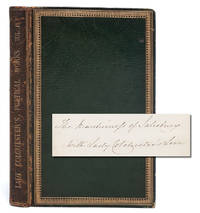
18496119London: Not Published 1849. First editions. Three volumes bound in one and including a presentation inscription to the verso of front endpaper: "The Marchioness of Salisbury with Lady Colchester's Love." Additional signature to title of second volume. Full straight grain morocco presentation binding by White of Pall Mall with gilt title to spine. Boards and turn-downs stamped in gilt. All edges brightly gilt. Yellow endpapers. Measuring 187 x 111mm bound in reverse chronological order and collating complete with half titles: 8 61 1; viii 66; 2 vi 104. Spine sunned and a large patch of discoloration to the rear board; joints cracked but holding firm. Occasional marginal foxing but overall fresh with the author's occasional handwritten corrections. Each printed privately Law's poetry titles are each scarce with OCLC reporting 15 10 and 8 copies respectively. Drawn together here with feminist political associations Lady Colchester bestows the works on Mary the second Marchioness of Salisbury nee Sackville-West who was an active Tory in addition to overseeing a salon that included Charles Darwin and Benjamin Disraeli among its visitors.<br /> <br /> The author of several privately printed poetry collections in addition to published translations Elizabeth Susan Law Abbot Lady Colchester was noted in her own time for deploying "anecdotal self-deprecating and ironic" tones that complicated her otherwise polite literary output Comic Women's Poetry of the 19th Century. The three books combined here demonstrate that tendency. Folded within seemingly common upper-class topics are reflections on intelligent women's loneliness in a marriage economy that devalued their selfhood in the opening poem Le Beau Ideel of her volume dedicated to Lord Colchester; on the ways a woman's appearance might cause society to overlook her "rarest gifts.a head with heart combin'd" in the dedication of her volume to the late Sophia Countess Darlington; and on exercises of musical lyricism and translation in the volume dedicated to Joseph Jekyll the political raconteur best known for ensuring that his friend Ignatius Sancho's biography reached publication and spread the story of his birth during the Middle Passage and his life as a free Black intellectual.<br /> <br /> Even Lady Colchester's recipient speaks to her political interests. Mary the Marchioness of Salisbury was the second wife of the Marquess; and she was noted for her public engagement with political and intellectual figures including Benjamin Disraeli and Charles Darwin. Knowing of the Marchioness' own intellect and ambition her choice to present these three books speaks to the deeper meanings hidden within her own writing.<br /> <br /> Jackson 193.3 and 193.6. Not Published unknown
1857E0857<p>xxxiv516 pages with frontispiece folding map and appendix. Small octavo 7 1/2" x 5" bound in original publisher's brown cloth stamped in blind gilt titles on spine. First edition.</p><p>Frederick Law Olmsted made extensive tours throughout the region from 1852 to 1857. In 1853-1854 with his brother John he made a celebrated trip across Texas. His route took him from Natchitoches Louisiana across East Texas to Austin then south through San Marcos and New Braunfels to San Antonio. Following a side trip to Boerne and Sisterdale the brothers made their way to the coast at Indianola returned to San Antonio and then traveled to Eagle Pass on the Rio Grande where they made a brief foray into Mexico. Retracing their steps to San Antonio they headed east through LaGrange Houston and Beaumont and left Texas at Turner s Ferry on the Sabine River.</p><p>During the trip Olmsted wrote letters that commented on all phases of town and country life in Texas fifteen of which were published in the New York Daily Times. Three years after the trip the letters served as the framework for a book written as much by his brother John as by Olmsted himself entitled <em>A Journey through Texas; Or A Saddle-Trip on the Southwestern Frontier: With a Statistical Appendix</em>. The first printing 2500 copies of the book nearly sold out within one month of publication and eventually became a major source for historians of Texas and slavery.</p><p><strong>Condition: </strong>Rubbed stained and faded corners slightly bumped light foxing previous owner's name to title and end papers else about very good.</p> Dix, Edwards & Company hardcover
1857369454New York: Dix Edwards & Co 1857. First Edition. Frontispiece and engraved folding map of Texas by J. H. Colton. xxxiv 516pp. 8vo. Original cloth with gilt lettered spine printed advertisements in red on the yellow endpapers. One signature starting to come loose else very good. First Edition. Frontispiece and engraved folding map of Texas by J. H. Colton. xxxiv 516pp. 8vo. "Olmsted later famous as a landscape architect and the designer of Central Park undertook a series of travels in the American South in the 1850s which are probably the best picture of antebellum life by any single author. A careful observer and entertaining writer his description of Texas in 1856 deserves equally high praise as a picture of life in the southwest at the time" Reese. Raines p. 159; Howes 0-79; Rader 2549; Sabin 57243; Graff 3097; Jenkins 157 "The most civilized of all 19th century books on Texas this is also the most interesting and the most dependable."; Clark III:481 482; Reese Best of the West 147 Dix, Edwards & Co unknown
1871323879Brooklyn: I. Van Andens Print 1871. Map. Color lithograph. 12" x 19" in archival gold frame with empire French matting 20 x 28"<br/> <br/> Rare plan of Prospect Park designed by Frederick Law Olmsted and Calvert Vaux. The map depicts the entirety of Prospect Park as it was designed by commission in 1866. It was their firs project together. Pathways lakes trees and rocks are noted along with elevations and buildings. The streets and avenues surrounding the park are included with land for sale identified. Renowned Landscape architect Frederick Law Olmsted 1822-1903 also designed some of the most famous parks in the United States including Central Park in New York City and Golden Gate Park in San Francisco. Clavert Vaux 1824-1895 was a British architect and co designer of Central Park with Olmsted. A wonderful map.<br/> <br/> I. Van Andens Print unknown
1891675561891. Debates in Parliament 1892-1908 Great Britain. Parliament. The Parliamentary Debates Fourth Series. London: Reuter's Telegram Co. and Others 1892-1908. 136 of 199 volumes lacking Volumes 16-77 1893-1899 and 100 1901. Contemporary cloth blind frames to boards gilt titles to spine. Several volumes bound in three-quarter calf over paper-covered boards some with cloth-reinforced spines a few bound in recent buckram. Moderate to heavy shelfwear with chipping to spine ends most hinges cracked several boards loose or detached interiors clean. Ex-law school library. Location labels to spines bookplates and other markings to pastedowns and endleaves. $1995. Fourth Series. Authorized by Parliament this series was the successor to Hansard's Parliamentary Debates which succeeded the series commenced by William Cobbett in 1804. unknown
185444808Leipzig Johann Ambrosius Barth 1854. No wrappers in "Annalen der Physik und Chemie. Hrsg. von J.C. Poggendorff" Bd. 93 No 12 entire issue offered. Titlepage to vol. 93. Pp. 481-632. Clausius's paper pp. 481-506. <br/><br/><em>First printing of this MILESTONE PAPER IN THERMODYNAMICS which together with his paper from 1850 established the second law of thermodynamics. In the offered paper Clausius introduces the symbol T for the universal function of temperature a 1 and he introduces the concept of "entropy" the greek word for 'transformation' but without using the word Clausius introduced the word later in 1865 he calls this new theorem "the principle of the equivalence of transformations". This principle paints a dramatic picture of the end of the world the so-called "heath-death of the universe"."Entropy on the other hand of the complementary experience of water seeking its own level of hot bodies cooling of springs untensing of magnetism wearing off and electrical charges leaking away of a destiny suchThat no life lives forever; - That dead men rise up never; that even the weariest river Winds somewhere safe to sea: a world getting old and running down."Gillespie in "The edge of Objectivity" p. 400-01."Clausius discovered that if he took the ratio of the heat content of a system and its absolute temperature this ration would always increase in any process taken place in a closed system. A closed system is one that loses no energy to the outside world and gains no energy from it. With perfect efficiency which is never realized in the real world of course the ratio would remain constant but i would never under any circumstances decrease."Asimov. - Parkinson: Breakthroughs 1854 C. </em> unknown
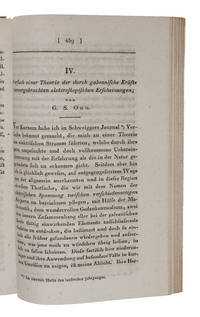
182543090Leipzig Johann Ambrosius Barth 1825. Contemp. hcalf. 5 raised bands gilt spine and gilt lettering to spine. A few scratches to spine. Small stamp on verso and on titlepage. A tear to right margin of titlepage repaired. In: "Annalen der Physik und Chemie. Hrsg. von J.C. Poggendorff" Poggendorff Bd. 4. 10476 pp. 4 large folded tables 6 engraved plates some folding. Small stamp on verso of plates. Ohm's paper: pp.79-88. Internally fine and clean. <br/><br/><em>First appearance of a paper of outmost importence in the history of electricity - it is Ohm's first scientific paper and it contains the report on the different original experiments sending a current through a variety of test wires that was the foundation for his famous law Ohm's Law. The paper contains the original research material that was to immortalize his name for the mathematical formulation of the law two years later in the well-known work "Die galvanische Kette mathematisch bearbeitet" 1827. - This paper was at the same time published in Schweiggers Journal."Ohm's first scientific paper was "Vorläufige Anzeige des Gesetzes." the paper offered. In it he sought a functional relationship between the decrease in the electromagnetic force excerted by a current-carrying wire and the lenght of the wire.Fromthe zinc and copper poles of a voltaic pile he ran two wires A and B the free ends of which terminated in small mercury-filled cups M and N; between M and another cup O he ran a third wire C. Together AB and C formed what he called the "invariable conductor" to distinguish it from one of the seven wires of different lenghts that when placed in a circuit between O and N constituted the "variable conductor". Among the latter was one "veru thick" wire four inches long and six thinner ones 0.3 line .025" in diameter ranging in lenght from one foot to seventy-five feet. Finally over wire C hung the magnetic needle of a Coulomb torsion balance which served to measure the electromagnetic force exerted when one of the variable conductors completed the circuit.He then found that the loss in force was equal to the difference between the normal force and the lesser force occasioned by one of the other wires divided by the normal force. Tabulating these value against the lenghts of the wires he found that his data were well represented by the formula v=0.41 log 1x where v is the loss in force and x is the lenght of the wire in feet."DSB X p.187. - This expression is the preliminary formula for his famous relations between voltage amperage and resistance R=V/I.Parkinson "Breakthrough" 1825 P. - Ronald's Library p. 376.The volume contains other importent papers in the history of chemistry and physics Berzelius F. Wöhler F.E. Neumann Heinrich Rose Chr. Hansteen Fresnel etc. </em> hardcover
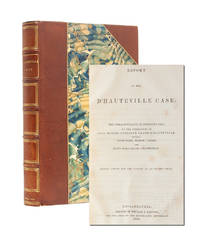
18404910Philadelphia: W. S. Martien 1840. First edition. bound with The Petition of Henry C. De Rham to the General Assembly of Rhode Island To Except Paul Daniel Gonsalve Grand d'Hauteville From the Operation of the Law 'To Secure the Fulfillment of Certain Contracts and for the Relief of Married Women in Certain Cases.' Together with a Remonstrance of Ellen S. d'Hauteville.Providence: Knowles & Vose 1841. First edition. <br /> <br /> bound with Review of the d'Hauteville Case: Recently Argued and Determined in the Court of General Sessions.Boston: Weeks Jordan and Co. 1841. First edition.<br /> <br /> Three volumes bound in one. Finely bound by Bradstreet's in half morocco over marbled boards with gilt to spine. Top edge gilt. Marbled endpapers. Armorial bookplate of Samuel F. Barger to front pastedown. Measuring 225 x 135mm and collating complete including titles: 295 1 blank; 124 2 errata; 2 44. A just about Fine copy with some inoffensive pencil annotations and corrections to volume I and occasional faint foxing; overall a pleasing copy of three scarce legal works related to women's custody rights according to international and interstate law. <br /> <br /> Three scarce tracts documenting the international custody battle that became highly publicized and debated in its time. In 1837 American citizen Ellen Sears married Daniel Gonsalve d'Hauteville a member of the Swiss nobility. During their brief union Ellen survived emotional neglect and mental cruelty from her husband whose "self-image as paterfamilias conflicted with Ellen's growing sense of herself as a mother tormented by an unfeeling spouse" DiFonzo. Pregnant and unhappy she left her husband for the U.S. giving birth to her son after her arrival. Under Common law doctrine d'Hauteville demanded that his wife and child return to his household in Switzerland. "But Sears and her Philadelphia lawyers devised a strategy that would challenge the accepted legal formulation along its emerging cultural fault line.leveraging mental cruelty into an accusation that d'Hauteville had violated the standards of the changing American family" DiFonzo. This strategy combined with gains that the women's movement had made in the U.S. and Europe marital property laws within the century helped bolster her position and win her custodial rights.<br /> <br /> "The d'Hauteville case was not a single event in a courtroom but a set of multiple legal experiences that exposed timebound and timeless realities of American legal culture. The case began in an insular way as a domestic drama must with the rapid rise and equally rapid fall of the d'Hauteville marriage. But as the fight for the son Frederick displaced their marriage as the central focus of Ellen and Gonsalve's relationship the law assumed a greater and greater presence in their lives. The pair not only confronted contradictions between their own ideas about justice and the legal rules they had to learn they also experienced the transformation of their domestic tragedy into a legal event with innumberable participants from lawyers judges and legislators to courtroom spectators newspaper reporters and diarists" Grossberg. <br /> <br /> The present tracts trace d'Hauteville's initial petition for Habeas Corpus followed by his petition to be exempted from a Rhode Island law protecting the rights of mothers. The final title tracks the case's conclusion providing a review. W. S. Martien unknown
18038854Cambridge: W. Hilliard 1803. Fourth Edition with Additions and Improvements Printed upon a New Plan. Hardcover. Very good. Full sheep scuffed with small pull top of spine joints good old paper library label. Oblong 13 cm 5 1/4 x 8 3/4 inches library name & withdrawn stamps on front paste-down library stamp on title page bookplate & withdrawn stamp of Young Folks' Library of La Junta Colorado on rear paste-down. 1806 ownership inscription in brown ink on ffep. Printed copyright statement tipped in behind title page not included in pagination. 1-24 31-160 1-96 last few leaves bound out of order.Defective: lacking three leaves of the Musical Primer pp. 25-30 leaf 59-60 chipped with corner loss. There is a stub between p. 6 & 7 the same width as the tipped-in copyright slip; we are unsure if it is waste or if something was cut out. Nothing of the sort is mentioned in the precise collation described in Crawford. This tunebook has three parts. The title page for the book as a whole has the imprint Cambridge: W. Hilliard 1803.The title page for the Second Part has the imprint Windsor Vermont: Naham Mower 1805.The third part has Boston: Printed for the Author by E. Lincoln 1805.The first two parts of the volume have continuous pagination; the third part begins with new page numbers. The three imprints and the pagination scheme match what Crawford calls the third edition - in other words this is how this volume is expected to be found.Crawford identifies this as the true third edition see bottom of p. 278 in his Andrew Law American Psalmodist. The three missing leaves are the "Scale of Rules" and Lessons I-IV. He does not mention the copyright as tipped in but as the verso of the tp. This may be a print run performed before the copyright was secured and then tipped in afterwards. The other item indicating a very early run or possibly first is the mistake in the title page "Christian" is misspelled as "Chistian". It is corrected on the title page for Part SEcond. The book is printed with the long and sort "s".Stanislaw 128. "The rudiments were widely copied by later compilers. 4th ed. was first to use four-shape system. Reverse faw and law shapes from Little and Smith's more popular system; no staff note-locations approximate.""Andrew Law's largest and most important work the Art of Singing is a collection of tunebooks composed of three different parts issued in four editions over a period of sixteen years and with inconsistent regard by the compiler for providing accurate bibliographical information on the title page of each item." Crawford Andrew Law American Psalmodist pp. 269-70.Andrew Law 1749-1821 b. Milford Ct; one of the first Americans to write about music and the pioneer of a shape-note system of musical notation. "Andrew Law was the most ambitious American psalmodist of the eighteenth century.He traveled the length of America establishing singing schools in eleven states; he devised an original musical notation; he was the first American musician to become actively interested in copyright legislation; and though not primarily a composer he was his generation's most prolific compiler of tunebooks publishing in all more than thirty separate items." - ibid. preface pp. xv.-xvi. W. Hilliard hardcover
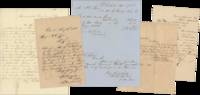
1860Cat354South Carolina and others 1860. Approximately 125pp with each item usually about 1 page. Some with slight water damage though legible; generally very good to excellent. A collection of mainly letters with some documents sent to the law firm Spain & Richardson of South Carolina—Albertus Chambers Spain 1821–1881 who in 1860 would sign the state’s Ordinance of Secession and James Sanders Guignard Richardson 1815–1879. Most of the documents concern estate administration and debt collection: a letter from Charleston presses the firm to “force the debtor to pay†August 20 1855; one from New York complains of “a rascal . trying to swindle meâ€; and a different Charleston writer complains that a boarder and his father had stiffed him on multiple bills:<br /> <br /> “I have not seen or heard from old McLeod since although I have written over one doz letters to him he has acted in a villanous manner to me a common hod carrier would not act in the manner he has Done although claiming to be a Class Leader in the Methodist Church . ‘Excuse’ his mother was sick &c&c which I have since learned was all a fabrication . I did not think there was any such tricky folks in Sumter or Clarendon &c . You will please write me as soon as you receive this & Read it & give me your advice in the matter & what is best to Do if Mr McLeod has his property in his own name if it is in his wifes but I Do not think so I could hold them as all the goods he Bought was for the wife & children & negro’s.†1860<br /> <br /> Also included are a document and a letter concerning the sale of enslaved people by the Kelley family of Sumter County. They were enslaved by the estate of Simon Kelley 1787–1852 which was being handled by his daughter Sarah 1812–d. Sarah Kelley’s brother-in-law Castus Belk writes:<br /> <br /> “I received your letter requiring me & the other parties concerned to arrange the matter with the old lady on the terms I have assertained by Sarah Kelley’s husband Mr Drury Boykin that the old lady will come to no agreement as yet But I have sent her a return showing to give her concent to the sale of the negros and for her to assigne which if she dose will be presented to you by Mr B Kelley if she dose assigne it and it answers to the perpose intended I shall be glad to hear from you for the old lady intendes to make no defence at all. NB beware of the man R.K. but pick all out of him you can getâ€. September 1856<br /> <br /> R.K. is Reddick Kelley 1815–1886 another Kelley child who witnessed the following assent to sale included in the collection:<br /> <br /> “State of South Carolina Sep 8th / 56<br /> Sumter District<br /> I the said Sarah Kelley of the said state and district do hereby assign and give my consent to the sale of the said negros belonging to the Estate of Simon Kelley Dec of the said state and district here unto my mark<br /> Reddick Kelley X Sarah Kelley / her markâ€<br /> <br /> Finally there is an intriguing letter from fellow lawyer James Hart Norwood concerning the trial of an enslaved man for an unknown crime:<br /> <br /> “I attended the trial of Kelly’s negro on Thursday and we achieved a clean victory verdict ‘not guilty.’ Beasley says I made the best speech he ever heard from me. I spoke 55 minutes Marley followed spoke 45. The trial was at Brown’s house he gave his testimony in bed. Mrs B- gave us thunder during her examination our argument but Marley will give you a graphic description of it when he sees you.†June 14 1858<br /> <br /> We did not find a record of this trial in newspapers from the time.<br /> <br /> Of interest to historians of enslavement in the law and legal history in antebellum South Carolina. unknown
1804044518Newbern North Carolina: Martin & Ogden 1804. Hardcover. Very Good. 4to - over 9¾ - 12" tall. 4to. 501 1; 226 156 1 1 pages. Bound in full leather with a clear removable mylar cover. Early leather over boards with a modern reback in brown leather with spine rules in gilt and with a burgundy leather title label. A sound copy. Professionally conserved. Front flyleaf is tipped in. THE TITLE PAGE IS IN FACSIMILE as are the next two leaves the leaf in printed in italics front and back and the leaf on the Second Charter by Charles II front and back. Very nicely done. The leaf following the last facsimile leaf of Charles II is the remains of the original leaf on Charles II 3/4 of the page encapsulated in tissue and properly tipped in. The rear flyleaf blank is also tipped in. The leather spine is fresh and clean. The boards are scuffed bumped and abraded with a piece chipped out from the top corner of the front cover. The text block is sound likely re-sewn. The text is toned with occasional foxing. The title page to the second part also dated 1804 shows heavier foxing. The conservation work is very good. An attractive copy. <br/> <br/> Martin & Ogden hardcover
184816627London: Longman Brown Green and Longmans. Good. 1848. First Edition; First Printing. Hardcover. Usual xlib marks. The spine has been reinforced with tape as have the internal hinges. I would be surprised if these were necessary as the book is still partially unopened! Original cloth covers are slightly bumped at the corners but show no other signs of wear. To bad some overzealous librarian got to the book. Probably worth having a conservator remove the extraneous bits. ; Ex-Library; 8vo 8" - 9" tall; 19332 pages . Longman, Brown, Green, and Longmans hardcover
185443057Leipzig Johann Ambrosius Barth 1854. No wrappers as extracted from: "Annalen der Physik und Chemie. Hrsg. von J.C. Poggendorff" Vierte Reihe Bd. 3 = Poggendorff Bd. 93 No. 12. Pp. 481-506. Clean and fine. <br/><br/><em>First printing of this milestone paper in thermodynamics which together with his paper from 1850 established the second law of thermodynamics. In the offered paper Clausius introduces the symbol T for the universal function of temperature a 1 and he introduces the concept of "entropy" the greek word for 'transformation' but without using the word Clausius introduced the word later in 1865 he calls this new theorem "the principle of the equivalence of transformations". This principle paints a dramatic picture of the end of the world the so-called "heath-death of the universe"."Entropy on the other hand of the complementary experience of water seeking its own level of hot bodies cooling of springs untensing of magnetism wearing off and electrical charges leaking away of a destiny suchThat no life lives forever; - That dead men rise up never; that even the weariest river Winds somewhere safe to sea: a world getting old and running down."Gillespie in "The edge of Objectivity" p. 400-01."Clausius discovered that if he took the ratio of the heat content of a system and its absolute temperature this ration would always increase in any process taken place in a closed system. A closed system is one that loses no energy to the outside world and gains no energy from it. With perfect efficiency which is never realized in the real world of course the ratio would remain constant but i would never under any circumstances decrease."Asimov. - Parkinson: Breakthroughs 1854 C. </em> unknown