15 758 résultats
257481350. <blockquote><p>This work takes its place on the lineage of great early works along with the Arthurian tales</p><p> </p><p>These are exceptionally early witnesses to this most important literary text the most popular secular work of the entire Middle Ages</p><p> </p><p>Appearances of this seminal text are uncommon only a handful having reached the market in decades</p><p> </p><p>Linguistic variations suggest a non-Parisian scribe; evidence of re-use in the 17th century from manuscript markings</p></blockquote><p>video width=""1920"" height=""1080"" mp4=""https://cdn.raabcollection.com/wp-content/uploads/20231204130246/Roman-de-la-Rose.mp4""/video</p><p> </p><p>The influence of the Old French allegorical poem the Roman de la Rose ripples through the Middle Ages into the Renaissance even into Modernity attracting the attention and inspiring the works of Chaucer Dante and C. S. Lewis. Lewis even stated that in cultural importance it ranks second to none except the Bible and the Consolation of Philosophy Allegory of Love 1936 p. 157.</p><p>The Roman de la Rose according to Lewis was an important step in the development of Western literature and thought. He wrote in the above work “We have seen how… in the hands of a great poet the Arthurian story treated in terms of courtly love produced the first notable examples of psychological or sentimental’ fiction… The radical defect in Chrétien’s poetry is that these two kinds of interest lie side by side in it without being really fused. The emotions of Lancelot and Guinevere are not really illustrated save in a very shallow sense by their adventures; their adventures are not really explained by their emotions.â€</p><p><img class=""alignnone wp-image-25764 size-post-window"" src=""https://cdn.raabcollection.com/wp-content/uploads/20231204140340/Roman-B-1-e1667227860712-1600x744.jpg"" alt="""" width=""1600"" height=""744"" /></p><p>This defect of emotional appeal of the primacy of love is rectified per Lewis in Roman de la Rose. “But the whole truth about Guillaume author of the Roman is missed until we see that he is more of a realist than Chrétien Chretien de Troyes fl. c. 1160–1191 was the author of some of the fundamental texts of Arthurian lore. Of the two things that he found in Chrétien it was the fantastic that he rejected and the natural that he used.â€</p><p>The great success then of the Roman de la Rose was fairly novel use of allegory to highlight the emotional journey of love as it would have appeared to someone at that time and in a courtly setting.</p><p><img class=""alignnone wp-image-25765 size-post-window"" src=""https://cdn.raabcollection.com/wp-content/uploads/20231204140328/Roman-A-1-e1667227983201-1600x752.jpg"" alt="""" width=""1600"" height=""752"" /></p><p><strong>Summary of the Romance of the Rose:</strong></p><p>In 1230 Guillaume de Lorris began the dream-vision poem a first-person narrative describing the efforts of a young man stricken by the arrows of the God of Love to obtain his beloved the Rose. Guillaume’s Amant Lover wished to tell the reader all that he knew of love and the poem describes a dream in which Amant is taken by Oiseuse Leisure into a pleasure garden where he meets the allegorical figures of Deduiz Pleasure Deliz Delight Cupid and others finally catching sight of and falling in love with the Rose. He is held back by the figures of Dangier Danger Honte Shame Mal Bouche Scandal and Jalousie Jealousy who imprison the Rose in a castle after Amant attains a kiss from the Rose.</p><p>Death claimed Guillaume before he was able to conclude his work. He is only remembered to us through a mention by the poem’s successive author Jean de Meun a friend of Dante who resumed the poem around 1275 adding around 17700 more lines to the approximately 4000 extant lines. There are therefore 2 authors for this same work separately themselves by a relatively great span of time each with his own milieu and sensibilities.</p><p>Both authors use the allegory to examine philosophical cruces emerging in the 13th century through scholasticism such as free will and determinism optics and the adjusting social orders which put mendicant friars in positions of increasing power. However Jean’s vision for how the Lover relates to his beloved— what he is prepared to do— diverges from Guillaume’s.</p><p>Jean provides a mirror for the turn from chivalric romances and courtly love which guided Guillaume. Jean’s social and political commentary sees the Lover deceiving and achieving the Rose in a way that that shifts away from the idealized and innocent sensuality of the first part of the poem to a biting satire on contemporary society blended with an overt realization of sexuality. Jean’s Amant makes war on the castle debates with Reson Reason Nature and Genius and finally enters the inner chamber of the Rose. His advice to the lover includes sections on how a man should keep his mistress study the arts ignore any infidelities offer flattery but never advice and how a lady might keep her male lover use false hair make up and perfume avoid getting so drunk you fall asleep at dinner only have intercourse in the dark to hide imperfections of the body and avoid poor men and foreigners - except very rich ones.</p><p>caption id=""attachment_25767"" align=""alignnone"" width=""1600""<img class=""wp-image-25767 size-post-window"" src=""https://cdn.raabcollection.com/wp-content/uploads/20231204140309/Roman-D-1-e1667228165675-1600x828.jpg"" alt="""" width=""1600"" height=""828"" /> Notes from use in the 17th century/caption</p><p><strong>The Manuscript & the Manuscript Tradition:</strong></p><p>Manuscript scholars have attempted to calculate the survival rate of medieval texts. Usually this calculation is done by comparing the catalogues of library books with known copies. Earlier in 2022 a team at the University of Antwerp has applied statistical principals usually used for tracking wildlife to estimate that approximately 9% of medieval manuscripts have survived to present day.</p><p>Johns Hopkins University and the Bibliotheque nationale de France have listed 324 known manuscript copies of the Roman de la Rose from the 13th 14th and 15th centuries exceeding the number of manuscripts of the works of Dante and Chaucer. With the suggestion of an original 3600 copies of the Roman de la Rose based on the 9% survival rate we are looking at what remains of a medieval best-seller. Yet few of these reach the market.</p><p><strong>Medieval manuscript poem</strong> 14th century France consisting of 2 double-sided folia from the Roman de la Rose from key sections of this great manuscript see “further details†below for a detailed entry and the Johns Hopkins system of categorization. There are manuscripts notations from use in the 17th century likely as binding.</p><p>This fragment opens with Friend’s advice to the lover to guard that Scandal doesn’t see him approach the castle where the Rose is kept. If the lover is spotted by Scandal he should not show hatred or rancor towards him ‘de hayne ne de racune’ because “a wise man covers his bad humour… those who deceive deceivers do a good deed and all lovers at least the wise ones should do so†‘sages hommes son maul talent ceuvre. cil fet bone euvre qi les decheveeurs decoivent…faire le doivent tretuit amans au mains li sage.†The scribe of this text has stricken through a line of his text “si sachies que cil fet bone euvre†which he was a repeat of two lines above. Jean de Meun’s jaded narrative has Friend giving the lover the advice to “serve and honor†Scandal and all his lineage ’tout son lignage’ because it is “no sin to trick those who are tainted by trickery†‘De ceus bouler nes pas pechies qi de bouler sont entechies’. And Scandal is indeed a boulierre a trickster. Friend goes on to explain the shameful tricks that Scandal’s bad mouth plays on men to steal— money and reputation. Friend warns that Old Woman and Jealousy also guard Bel Acueil Warm Welcome the lover’s companion who has also been taken into the castle. Through false courtesy bribes and weeping— even false weeping— will be needed for Amans to make his way through the castle.</p><p><img class=""alignnone wp-image-25768 size-post-window"" src=""https://cdn.raabcollection.com/wp-content/uploads/20231204140257/Roman-E-1-e1667228257297-1600x856.jpg"" alt="""" width=""1600"" height=""856"" /></p><p>At this point the fragment breaks off and resumes nearly a thousand lines later. The break in lines from one folio to the next from lines 7301-7379 to 8415-8575 occurs because of the way the book was put together. Large leaves of vellum were folded in half to create bifolia which were in turn nested into one another to create gathering of folios or pages in a modern sense. Since the folded bifolia were still attached a loose bifolia will contain text that jumps from one folio to the next. This is to say that the text on a bifolium will not follow sequentially unless it is the very center of the quire.</p><p>We reenter the narrative as Friend is telling of an idyllic time which slides slowly towards Jean de Meun’s cynicism but also with a great statement of the primary of love over earthly physical power and domination — “No king or prince had yet committed any crime by robbing and seizing from another. All were accustom to being equal and no one wanted any possessions of his own. They knew well the saying neither lying nor foolish that love and lordship never kept each other company nor dwelth together. The one that dominates separates them†“N’encor n’avoit fet roy ne price Meifet qui lautrui tout et pinche Testuit pareil estre souloient Ne riens propre avoir ne vouloient. Bien savoient ceste parole Qui nest mencongiere ne fole Conques amour et seignourie Ne sentrefirent compaignie Ne ne demourerent pas ensemble: Cil qui mestrie les dessemble’. Immediately following this the relationships between a jealous husband and frivolous wife is examined. Jealousy laments his own marriage and the bygone days of women like the Grecian Penelope of Homer’s Odysseya who waited loyally on Odysseus’s return.</p><p><strong>A Note on the Rarity:</strong></p><p>The text is far from common on the market with the vast Schoenberg database listing only ten codices appearing at auction since the 1970s and only three of those of the fourteenth century: Christies' 7 June 2006 lots 23 and 31 once Phillipps MS. 2838 and 4185 now both Senshu University Japan; and another in the same rooms 9 July 2001 lot 12; Sotheby's 17 June 1997 lot 6 once Phillipps MS. 129; Drouot 16 December 1994 lot 1; another in the same rooms 9 December 1992 lot 371; Ader Picard Tajan in Paris 16 September 1988 lot 152 this previously in Sotheby's New York sale of Carleton Richmond's library in 1981; the Astor copy sold in Sotheby's 21 June 1988 then Beck collection and stolen; Christie's 25 June 1980 lot 232 once Phillipps MS. 4357 now in the Ferrell collection; another sold in Ader Picard Tajan in Paris 20 May 1980 lot 60; and that sold in Sotheby's 13 July 1977 lot 48 to Peter Ludwig and thence to the Getty Museum. Fragments seem to come to the market even less frequently with the last examples in Christie's 30 May 1984 lot 200 a small miniature trimmed to its edges from a manuscript of the second half of the fourteenth century; Alde Libraire Giraud Badin 8 June 2012 a fourteenth-century leaf most probably the missing first leaf of Columbia University Plimpton MS. 284; and two fifteenth-century bifolia recovered from bindings sold through Dreweatt’s 6 July 2017 lots 34 and 35.</p><p><img class=""alignnone wp-image-25769 size-post-window"" src=""https://cdn.raabcollection.com/wp-content/uploads/20231204140244/Roman-F-1-e1667228424857-1600x828.jpg"" alt="""" width=""1600"" height=""828"" /></p><p><strong>The Scribe and His France:</strong></p><p>While the parent manuscript of the present leaves was probably a Parisian product and made for an aristocratic audience in the early 14th century the scribe of the manuscript probably came from farther afield than the ÃŽle-de-France.</p><p>Comparing the paleographic style the manuscript is similar to a manuscript at Oxford Bodleian MS Selden Supra 57 composed in 1348 in Paris arriving in the Bodleian Library in 1659. However a comparison of a sampling of 10 lines from both manuscripts reveals an interesting linguistic difference between the Parisian manuscript and the fragments here.</p><p>Lines 7307-7316 Selden Sura 57 on left fragment on right with differences in bold.</p><p><strong>Nene fetes chiere neisune/ ne faites chiere neysune</strong></p><p>De <strong>haine</strong> ne de rancune;/ de <strong>hayne</strong> ne de rancune ;</p><p>Et se vous ailleurs l'<strong>encontrez</strong>/et se vous ailleurs <strong>lencontres</strong></p><p>Nul mautalent ne li <strong>montrez</strong>:/nul mautalent ne li <strong>monstres</strong> :</p><p>Sages hons son mautalent <strong>cueure</strong>/ sages hommes son mautalent <strong>ceuvre</strong></p><p>Si <strong>sachiez</strong> que cil<strong> font bonne eur</strong>e/ si <strong>sachies</strong> que cil <strong>fet bone euvre</strong></p><p><strong>Qui</strong> les <strong>deceveours</strong> decovient;/ <strong>qi</strong> les <strong>decheveeurs</strong> decoivent;</p><p><strong>Sachiez ainsi fere</strong> le doivent/ <strong>sachies</strong> <strong>qu’ainssi</strong> faire le doivent</p><p><strong>Trestuit</strong> <strong>amant</strong> au <strong>mainz</strong> li sage./ <strong>tretuit amans</strong> au <strong>mains</strong> li sage.</p><p>Male Bouche et tout son linage/ Male Bouche et tout son lignage</p><p>We can examine another stylistically manuscript from Central France likely Paris in the 4th quarter of the 14th century London British Library MS Add. 42133.</p><p>Lines 7307-7316: Add. 4233 left Selden Sura 57 middle fragment right with differences in bold.</p><p>Nene fetes chiere <strong>nisune</strong>/ Nene fetes chiere <strong>neisune</strong>/<strong> ne faites</strong> chiere <strong>neysune</strong></p><p>De hayne ne de racune/ De <strong>haine</strong> ne de rancune;/ de hayne ne de rancune ;</p><p>Et se vous ailleurs lencontrez/Et se vous ailleurs l'encontrez/et se vous ailleurs <strong>lencontres</strong></p><p>Nul <strong>maltalent</strong> ne li monstrez/ Nul mautalent ne li montrez:/nul mautalent ne li <strong>monstres</strong> :</p><p>Sages hommes son <strong>maltalent</strong> cueure/ Sages hons son mautalent cueure/ sages hommes son mautalent <strong>ceuvre</strong></p><p>Si sachiez que cil font bonne <strong>oeure</strong>/Si sachiez que cil font bonne <strong>eure</strong>/ si sachies que cil fet bone <strong>euvre</strong></p><p>Qi les <strong>deceveurs</strong> decoivent/ <strong>Qui</strong> les <strong>deceveours</strong> decovient;/ qi les <strong>decheveeurs</strong> decoivent;</p><p>Sachiez quainsi fere le doivent/ Sachiez ainsi fere le doivent/ sachies qu’ainssi faire le doivent</p><p><strong>Tretuit</strong> amant au mains lo sage/ <strong>Trestuit</strong> amant au <strong>mainz</strong> li sage./ tretuit <strong>amans</strong> au mains li sage.</p><p>Male Bouche et tout son <strong>linguage</strong>/ Male Bouche et tout son <strong>linage</strong>/ Male Bouche et tout son <strong>lignage</strong></p><p><img class=""alignnone wp-image-25770 size-post-window"" src=""https://cdn.raabcollection.com/wp-content/uploads/20231204140228/Roman-G-1-e1667228920615-1600x832.jpg"" alt="""" width=""1600"" height=""832"" /></p><p>Comparing the fragment of the Rose with the other dated and located copies of the same text invites out the linguistic diversity of Old French the pre-Modern French in use from the 8th to 14th centuries. “Old French†is somewhat of an umbrella term housing the attested dialects that comprised the linguistic landscape of the Francophone region. The French spoken in the Paris region at this time is known as Francien in Champagne it is Champeniose Picard is Picardie Normans spoke Normand and the French of England is often called Anglo-Normand. These are only a sampling from the five linguistically distinct regions in the overarching region of langue d’oil France roughly the distinction between Northern France where they say oui for yes and Southern France where they say oc for yes. A simplified map of the langues de oil are represented below:</p><p>While some differences in the orthography of the Rose texts can be due to the lack of standardization in spelling in this period the differences can help us better understand the most likely profile of the scribe and can likely rule out a Parisian scribe who would have been native in the Francien-dialect. We begin to suspect that the scribe of these fragments was more likely to have come from a region outside of Paris. The data suggests Hainaut Orleans Indre-et-Loire or Ardennes as likely regions with overlap of the linguistic features. Two of these areas Hainaut and Ardennes are geographically close north and northeast of Paris while Indre-et-Loire and Orleans are further southwest from Paris.</p><p>Though inconclusive we can begin to paint a picture of our writer: a talented scribe arriving in Paris and adapting the Parisian style of writing but never losing his regional flare or maybe he was commissioned by a family of one of these areas and was delighted for the opportunity to produce a manuscript in his own dialect rather than Francien.</p><p><strong>Further details:</strong></p><p>Jean de Meun section of Roman de la Rose in Old French with regional features from outside of Paris <strong>illuminated manuscript on parchmen</strong>t northern France mid-fourteenth century Two large leaves each with double column of 40 lines of an early gothic French vernacular hand with lines 7301-7379 and 8415-8575 of the poem with one-line initials offset in margins 2-line initials in gold on blue and dark-pink grounds heightened with white penwork but with an apparent quire signature ""VII'"" at foot of verso of second leaf recovered from an account book binding that dated ""1622"" and ""1623"" and so with some stains cockled areas later scrawls discoloration to outer surfaces of that binding and holes but overall in good and presentable condition each leaf approximately 330 by 225mm. written space 226 by 167mm. These are exceptionally early witnesses to this most important literary text the most popular secular work of the entire Middle Ages. Manuscript notations from use in the 17th century likely as binding.</p><p>Provenance: Recently discovered in an American collection.</p><p><strong>Johns Hopkins Standardized Section Headings:</strong></p><p>Folio 1</p><p>1. Amans Lover and Amis Friend discuss the situation Amis assuring Amans that the situation is not desperate; no prison can hold Bel Acueil Warm Welcome once he has awarded Amans a kiss J3b 1-99 Lines 7204-7302</p><p>2. Amis counsels Amans to play nice with Male Bouche Slander J3c 1-66 7303-7368</p><p>3. Amis counsels Amans to be sweet to Vielle Old Woman and Jalousie J3d 1-32 7369-7400</p><p>Folio 2:</p><p>1. Amis Friend observes that things have not always been so; during the golden age love was sincere and loyal not rapacious J3o 1-96 lines 8323-8418</p><p>2. Amis interrupts himself to note that love is incompatible with domination beginning an account of a jealous husband Jalous Jealousy J3p 1-18 8419-8436</p><p>3. Amis in the voice of the husband berates his wife for carrying on when he goes off on business and for paying attention to young men J3q 1-94 8437-8530</p><p>4. Jalous laments that he should have followed the advice of Theofrastus and never married: whether a women is ugly or beautiful she will betray her husband J3r 1-42 8531-8572</p><p>5. All women can be seduced; women like Penelope or Lucrece no longer exist J3s 1-72 8573-8656<br />See Also:</p><p>Price Michael “‘Lost’ Medieval Literature Uncovered by Techniques Used to Track Wildlife†Science Feb. 17. 2022</p><p>Solly Meilan “How Much Medieval Literature Has Been Lost Over the Centuries†The Smithsonian March 8 2022</p><p><img class=""alignnone wp-image-24867 size-post-window"" src=""https://cdn.raabcollection.com/wp-content/uploads/20231204144901/Folder-site-10-1600x1327.jpg"" alt="""" width=""1600"" height=""1327"" /></p> hardcover
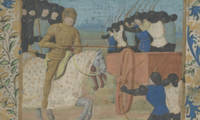
1450258541450. <blockquote><p>The sole known surviving piece of a once vast and grand 15th century ""Faits des Romans"" doubtless for a noble patron of enormous wealth.</p><p> </p><p>The artist is a follower of the Coëtivy Master</p></blockquote><p><strong>The twin nostalgias of Europe— one for the powerful all-encompassing Roman Empire the other for connecting with the mysterious pre-Roman peoples— combine in this 15th century French illumination of Caesar’s final and questionably successful encounter with the Britons led by Cassivellaunus. While Caesar won this battle his dream of a conquered and Roman Britain would not be realized within his lifetime. His legacy however was studied admired and immortalized far after his fatal betrayal by Brutus. This illustration captures this historic moment of Caesar’s triumph the beginning of the end for the Britons and the cultural legacy as viewed during the waning of the Middle Ages.</strong></p><p><a href=""https://cdn.raabcollection.com/wp-content/uploads/20231204135204/A-2.jpg""><img class=""alignnone size-post-window wp-image-25868"" src=""https://cdn.raabcollection.com/wp-content/uploads/20231204135204/A-2-1600x632.jpg"" alt="""" width=""1600"" height=""632"" /></a></p><p>In the nineteenth century European medievalists began shoring up their nations’ relationships with medieval literature to try to create firm claims of their peoples’ innate heroic attributes their noble histories their glorious pasts. This led for example to the French identifying themselves with the Chanson de Roland and the English lionizing King Arthur. But the desire to have these medieval roots overshadowed the more complicated histories: the Chanson de Roland though composed in French is about an emperor best known by his French name Charlemagne but who was born in Aachen Germany and is buried there. The first legends of King Arthur from the 9th century reflecting a much earlier time came from Wales a nation suppressed by the English and the major inventions in the narrative like the love story of Guinevere and Lancelot and the Round Table were invented in France. Though English storytellers engaged with Arthur and his knights it wasn’t until Thomas Malory in the 15th century that Arthur became English.</p><p>During the Middle Ages Rome was the empire to draw connections to for auctoritas. This is why the empire established by Charlemagne became known as the Holy Roman Empire. Though the term was not in use until the 13th century the Emperors were instilled with translation imperii-- a transfer of rule directly inherited from the historic emperors of Rome.</p><p>One aspect of Rome that was particularly admired in the Middle Ages was the conquering and bringing into Civilization of the barbarians north of the Alps and west of the Rhine that includes Caesar's foray into England and his confrontation with Cassivellanus. Cassivellaunus was likely the chief of the Catuvellauni of Hertfordshire whose tribal name translates to ‘war-chiefs’. In British accounts he appears in Welsh literature ranging from Geoffrey of Monmouth’s chronicle about the history of the Kings of Britain in both Latin Historia regum Britanniae and Welsh Brut y Brenhinedd to the more folkloric-based Trioedd Ynys Prydein The Triads the second branch of the Mabinogi and Cyfranc Lludd a Llefelys The Adventure of Lludd and Llefelys. The British chieftain even appears briefly in the Greek Stratagemata by Polyaenus. The Latin literature of course written by the winners includes Julius Caesar’s own Commentary de Bello Gallico Commentary on the Gallic War.</p><p>During the account of his second campaign in Britain from Gaul in 54 BCE after a failed first a year earlier Caesar writes that Cassivellaunus was a rabble-rouser conquering the Trinovantes the most powerful British tribe perhaps how the tribe received their appellation of ‘war-chiefs’. Though his location was betrayed by the Cenimagni Segontiaci Ancalites Bibroci and Cassi who had surrendered to Caesar Cassivellaunus gathered the forces of the Kentish kings Cinetorix Varvilius Taximagulus and Segovax. The tribes retreated to higher ground when they saw the sheer masses of Romans that Caesar had brought to avert the same failure of preparedness he suffered the year before. The legions established their military camp on the beaches and sought out the Britons. As they searched their party was harassed by Britons on chariots; it was chariots which had given the edge to the British during Caesar’s first invasion. About 12 miles away he encountered Cassivellaunus’ forces at a hillfort at the River Stour. A storm destroyed Caesar’s fleet of ships and the repair gave the Britons time to regroup and rally behind Cassivellaunus.</p><p>Previously the Britons operated as independent tribes; under Cassivellaunus these tribes became an army growing with more tribes coming to support Cassivellaunus. Their knowledge of the land and their use of chariots created a powerful enemy against Caesar’s army which was not used to fighting such a chaotic force. Had the Britons continued this strategy history might have played out differently; however they appeared to try to meet the Romans head-on in large-scale battle a tactic at which the Romans were well-practiced and deadly.</p><p>Cassivellaunus’s attempt to attack a foraging party as had been done to the Briton’s success in 55 BCE was the beginning of the end for the Britons now. Though he had unified some of the tribes the Trinovantes remained staunchly against Cassivellaunus since he murdered their king. The murdered king’s son bargained with Caesar— his tribe would support Rome and Rome would defend the tribe from any retribution. This gave the Romans a newfound understanding of the land and the warfare tactics of the Britons. Once again the tribes were divided which inclined them to making alliances with Rome. The final two-fronted battle between the Romans and Britons saw British defeat. It is this routing of the British charioteers that the French illuminator included in this illustration of the Faits de Romains some 1500 years later.</p><p>The Britons essentially defeated Caesar sent Commius the King of the conquered Atrebates to negotiate peace. Cassivellaunus agreed to paying tribute. In writing up the terms Caesar used specific legal terms which would eventually make Britain a province of Rome. But this would not come to pass before Caesar’s untimely death on the Roman Senate floor nearly a decade later. It would be another century before Britain came truly under Roman rule.</p><p>In 13th century medieval writers began to compile works by Caesar Lucan Suetonius and Sallust retelling Caesar’s life in the format of a chanson des geste a song of deeds— the same genre as the Chanson de Roland. The text which is listed under many names but most commonly Faits des Romans grew very popular from 14th century onwards with over 50 manuscripts now recorded – these usually grand commissions for noble reading with many miniatures set into the text columns opening significant chapters of which this extract serves as an example.</p><p>This miniature depicts the great scene introduced above: Caesar's confrontation with the Cassivellanus during the former's great invasion of Britain.</p><p><strong>Caesar routing the chariot-mounted forces of the British cheiftain Cassivellanus miniature on a cutting from an illuminated manuscript of the Faits des Romains</strong></p><p>France most probably Paris mid-15th century. The illuminator represented the two armies in armor contemporary with his own time— the armor of chivalric knights— rather than the Roman legion outfits of Caesar’s time and blue-painted leather-clad attire of the Britons. Differentiation between the Britons and the Romans is made by the Britons wearing blue and white tunics over their armor and using bows while the Romans have pikes and silver armor without tunics with the exception of a figure who may be Commius a Celt-turned-Roman-ally.</p><p>An historic cutting of an illumination on verso and 16 lines of one of two original columns of text on recto. 128x98mm in total. Text column of 102mm on verso. Written in Middle French in a Gothic bâtarde script with minimal abbreviations for legibility. Some oxidation from the silver-gilt on the illustration have bled through to the text side but still legible. Illumination is flanked on both sides by blue and gold acanthus leaves and green-leaved penwork-foliage. Illuminator applied silver to highlight the armour of the armies and gold touches to illuminate Caesar himself.</p><p>The artist is a follower of the Coëtivy Master worked in Paris c. 1450-85 and shares that artist’s simple but delicate facial modelling as well as his love of finely depicted drapery.</p><p>What remains of the text here allows us to see that this miniature came from a very grand manuscript almost certainly produced at vast expense for an important noble patron. Its text was clearly in two columns like many grand copies of the text with column-wide miniatures set at the head of crucial chapters. Examination of other copies of the text shows that about 3700 characters of text are missing between the foot of the miniature on the recto and the first partial line of text on the verso here. With an approximate average line length of 41 characters here this allows us to predict that the miniature here most probably sat in the inner column of the recto and thus some 90 lines of text are missing between its foot and the first line of text on the other side. Allowing for two columns this indicates that each column had 45 lines plus the 12 lines on the verso of this fragment allowing us to predict that the text on each page of the parent manuscript was approximately 57 lines in height. This is more than the 50 lines in some of the grandest surviving manuscripts such as BnF Fr. 64 made in the fifteenth century for an unknown noble patron. In addition as the cutting here gives us measurements for the column width 95mm. and the line height 5mm. we can further calculate that the parent codex of this cutting had a text block of approximately 285 by 220mm. the last 9595mm. plus 30mm. for an approximate gutter measurement. BnF Fr. 64 has a text block that measures 278 by 200mm. and a complete size including borders of 430 by 315mm - comparable to the copy from the library of the Comte d'Angouleme Fr. 250: 420 by 317mm. but far smaller than that made for a member of the De Fou family and later taken into the fine library of Cardinal Richelieu Fr. 23084: 345 by 245mm. and with only one miniature. The parent codex of the present miniature must have been on the same scale as Fr. 64 and 250 if not slightly larger. It was a vast codex produced on a scale to impress through its sheer opulence doubtless for a noble patron of enormous wealth.</p><p><img class=""alignnone wp-image-25018 size-post-window"" src=""https://cdn.raabcollection.com/wp-content/uploads/20231204144051/Folder-site-11-1600x1327.jpg"" alt="""" width=""1600"" height=""1327"" /></p> hardcover
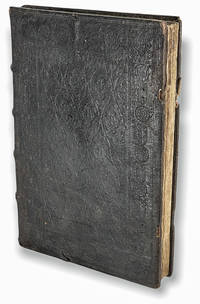
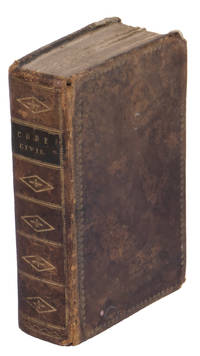
149153<p><b>Two fundamental works of Canon Law </b><b>in one single volume in a fine contemporary binding.</b></p><p><b>Fully rubricated im red and blue both volumes not in BMC - Only 4 copies in USA libraries.</b></p><p>Pope Bonfacius VIII Benedetto Gaetano. <i>Liber sextus Decretalium</i>With: Johannes Andreae. <i>Super arboribus consanguinitatis et affinitatis.</i> Strasbourg: Johann Reinhard Grüninger 14 February 1491. </p><p>Bound with: </p><p>Pope Clemens V Raimundus Bertrandi del Goth. <b><i>Constitutiones.</i></b> Strasbourg: Johann Reinhard Grüninger 19 March 1491. </p><p>Two works in one volume royal folio 408 x 279mm Contemporary blindstamped leather over wooden boards vol. I ff. 98 vol. II ff. 53 of 54 lacking final blank. Signature: Vol. I aâ¸bcâ¶dâ¸eâ¶fâ¸ghâ¶iâ¸klâ¶m–o⸠Vol. II: Aâ¸B–Eâ¶FGâ¸Hâ¶</p><p>Nice incunable edition by the renowned Strasburg Printer Johann Reinhard Grüninger printed in red and black rubricated in red and blue</p><p>The <i>Liber Sextus Decretalium</i> part of the <i>Corpus Juris Canonici</i> is a collection of regulations of canon law promulgated with the bull <i>Sacrosanctae</i> on 3 March 1298 by Pope Boniface VIII to integrate the <i>Liber Extra</i> the <i>Decretalium</i> by Pope Gregorius IX with the new canonical norms issued by 1234.</p><p>It was initially intended as an appendix to the same <i>Liber Extra</i> by Gregorio IX but it is better considered a real collection by itself divided into five books based on the example already provided by the <i>Quinque compilationes antiquae </i>the anthologies grouping the decretals issued in the period following the issuing of the <i>Decretum Gratiani</i> composed in order by Bernardo Balbi Giovanni di Wales Innocent IV Giovanni Teutonico and Tancredi from Bologna.</p><p> At the end of the work it appears for the first time in a canonical compilation the <i>De Regulis Iuris</i> in imitation of the Digest written by the jurist Dino del Mugello.</p><p>The work is then followed by the fundamental treatise on family by Giovanni De Andrea the <b><i>Super arboribus consanguinitatis et affinitatis.</i></b></p><p>The<i> Constitutiones </i>by Pope Clemens V or <i>Constitutiones Clementinæ</i> not officially known as <i>Liber Septimus</i> but so designated by historians and canonists of the Middle Ages were officially promulgated by Clement V in a consistory held at Monteaux near Carpentras southern France on 21 March 1314 and sent to the University of Orléans and the Sorbonne in Paris.</p><p>The death of Clement V occurring on 20 April of the same year gave rise to certain doubts as to the legal force of the compilation. Consequently John XXII by his Bull <i>Quoniam nulla</i> of 25 October 1317 promulgated it again as obligatory without making any changes in it. Johannes Andreæ compiled its commentary or <i>Glossa Ordinaria</i>. It was not an exclusive collection and did not abrogate the previously existing laws not incorporated in it</p><p>Johannes Grüninger 1455–1533 was a German printer mainly based in Strasburg whose career spanned from 1482–1533 and produced up to 500 publications. Grüninger was one of the single most prolific printers of Strasbourg printing up to 80 books a year. While a great deal of his publications was Catholic he managed to print a great variety of works ranging from humanist to scientific texts. His work was equally representative of both Latin and the vernacular; about 39% of his works were printed in Latin and the remaining 61% in German</p><p>Conditions: Small tear to a1 of first work professionally restored on verso without loss some small wormholes and faint marginal staining original clasps missing binding lightly rubbed a few splits in leather but in general a fine copy internally very clean and perfectly preserved of an interesting and rare edition of a precious collection of two among the most important and well-known legal work of that time.</p><p>Provenance: Heinrich Sedelhammer from Manching Bavaria a student at Ingolstadt University; inscription dated 1553 – Johannes Pfrontner from Füssen a student at Ingolstadt University; partially erased inscription – Georg Hennschberger inscription dated 1623 – Cuno Hernndl inscription dated 1630 – Dingolfing Franciscan Monastery inscription. </p><p>Bibliography: This copy of the <i>Liber sextus Decretalium </i>is the variant with the red printing on leaves 45 and 46; HC 3617 5444; GW 4887 7107; neither work is in BMC; BSB-Ink B-727 C-458; ISTC ib01005000 ic00735000; Goff B-1005 C-735.</p> Johann Reinhard Grüninger hardcover
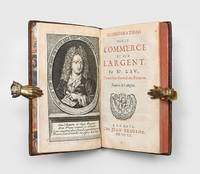
1720135019Leipzig: in der Missisippischen Staats-Druckerey 1720. John Law and the Mississippi Company Rare first edition of this anonymous account of the State of France under Louis XIV and under the Regent who "under the clever guidance of Mr. Law has to the amazement of all fortunately improved it" our translation. Dedicated to "Mons. Law" who "der Welt bey anderthalb Jahren so viel zu reden gemacht hat" the stubbornly anonymous author he signs himself so gives an account of the rise and decline of France under Louis XIV the state of France following his death its subsequent recovery under the Prince Regent and an account of Law's activities and Mississippi Company. Bound after this work is a copy of the life of Cardinal Giulio Alberoni prime minister of Anjou a German translation apparently from the Italian published in 1718. The work is attributed in WorldCat to Jean Rousset de Missy. Octavo 163 x 100 mm. With engraved portrait frontispiece of John Law. Bound with another work in contemporary speckled paste paper boards paper spine label lettered in manuscript. Housed in a dark brown flat-back cloth box by the Chelsea Bindery. Spine ends joints and corners rubbed with some flaking of sprinkled paper coverning paper stock lightly browned with occasional spotting; a very good copy. Alden 720/58; Goldsmiths' 5608; Kress 3185; Sabin 39308. hardcover
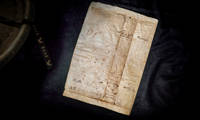
1450261961450. <blockquote><p>Uberti's father had been referenced by Dante</p></blockquote><p>The City State of Florence:</p><p>In the 1300s the Italian city-states were embroiled in complex political machinations between each other—chiefly Milan Florence Pisa Siena Genoa Ferrara Mantua Verona and Venice— and the overarching powers of the Papacy and the Holy Roman Empire. Even within factions that seemed to support the same objectives: the Guelphs who battled the Ghibellines split in to the White Guelphs and Black Guelphs and ultimately the Black Guelphs exiled Dante Alighieri 1265-1321 from his beloved city state of Florence in 1302. During this exile Dante wrote the Commedia his love-song to Beatrice to his pagan and Christian poet-idols to a reimagined theology incorporating courtly love and Greek philosophy and to the city and people of Florence. He wrote his three canticles in a style called terza rima rhyming stanzas of three lines which was frequently imitated by later poets.</p><p>The Power and Poetry of Florence:<br />Despite the political turmoil Florence rose in power not only in Italy but throughout Europe in part because of the strength of its gold based economy. Florence stepped out of the Middle Ages into the Renaissance with a flourish of distinct and memorable art and poetry but the mid-1300s offered another tragedy for the dazzling city state. In 1348 the Black Plague ravaged the Italian peninsula. Poets turned their pens towards chronicling this devastation with perhaps the most-well known being the Decameron of Florentine poet Giovanni Boccaccio 1313-1375. The Decameron likely begun shortly after 1348 and completed in 1353 follows ten young people as they leave Florence to flee the plague. On the way they entertain themselves through a series of stories to take their minds off of the horrors around them.</p><p>Fazio degli Uberti and Dante:<br />Fazio degli Uberti 1305/9- ca.1367 is not as well-known as Dante or Boccaccio who are two of the “Tre Corone†of Italy with Petrarch as the third crown. Fazio was born in 1305 or 1309 to a family of some importance who identified politically as Ghibellines who supported the Holy Roman Emperor rather than the Pope. The family’s Ghibelline alignment accorded Fazio’s ancestor Farinata degli Uberti a place in Dante’s Inferno. In Canto 6 Farinata is listed among the Florentines who have done more bad than good for the city. Though in Canto 6 Dante asks where the great Florentines are who had “minds bent towards good†including Farinata he is told that in fact these Florentines are those with the blackest souls and the fact that Dante thinks of them with esteem shows how warped Florence has become. Later in Canto 10 Dante will meet with Farinata himself among the heretics and in Canto 28 he will understand how Florence suffers because of men such as Farinata in part because of the schism between the Guelfs and Ghibellines.</p><p>Despite this condemnation of his family in 1345 Fazio wrote his most noted poem the Dittamondo an emulation of Dante’s Commedia. The title Dittamondo is an vernacularization of the Latin dicta mundi indicating that it is an encyclopaedic text of what is known and said of the world. Like Dante’s journey under the guidance of Virgil Statius and finally Beatrice Fazio’s narrator meets with the allegorical figure of Virtue he and the Roman geographer Solinus travelled the whole world Italy Greece Germany France Spain northern Europe Africa and parts of Asia with Solinus giving the narrator descriptions of the cities visited. In addition numerous other snippets of information are added from the works of Pliny the Elder Isidore of Seville and Pomponius Mela. Even the style of poetry Fazio employed for his didactic poem was modelled after Dante’s own terza rima. However unlike Dante’s poem Fazio’s is far more encyclopaedic rather than a tour de force of allegorical and contemporary political satire clothed in Dante’s masterful command of language. Like Dante Fazio was exiled from Florence and like Dante Fazio wrote of his exile from the city. The Dittamondo remained incomplete upon Fazio’s death around 1367.</p><p>History of the Manuscript Tradition of Dittamondo:<br />While no comprehensive survey of manuscripts exists it is clear that the text is rare in manuscript with the Arlima database listing only BnF. italien 81 and Venice Biblioteca Nazionale Marciana Cl. IX c. XI. To these should be added Turin Biblioteca Nazionale Universitaria cod N 1 5; Milan Biblioteca Nazionale AC.X.30; and other single volumes in the Biblioteca Riccardiana in Florence the Biblioteca Angelica in Rome and the university library of Bologna as well as a fourteenth-century fragment in the Biblioteca Archiginnasio in the same city.</p><p>The Schoenberg database lists no copy offered for sale since that from the Joseph Martini library by Hoepli on 27 August 1934 lot 177 there with that previously appearing as Sotheby's 10 June 1918 lot 504.</p><p>The document:</p><p><strong>Bifolium from a large humanist manuscript</strong> of Fazio degli Uberti Dittamondo in Italian on parchment Italy mid-fifteenth century within a century of Fazio’s death. Each leaf approximately 330 by 240mm. Two conjoined leaves each with single column of 33 lines of an accomplished humanist hand with parts of chapters X-XI and XIII-XIV of Book 6 one large simple initial in pale blue the text set within an extensive gloss in Italian in smaller script recovered from the binding of a seventeenth-century book and hence with scuffs spots small holes one corner torn away with loss to gloss there scrawls and areas of text on outerside abraded and illegible.</p><p>This bifolium would be one of the center leaves in the gathering or quire sandwiched between other successive leaves folded and sewn in the gutter the crease in the center of the bifolium separating the earlier part of the text from the later to create the legible linear text.</p><p>The content deals with Old Testament and Hebrew Bible figures.</p><p>Chapter X gives a précis of Old Testament stories in terza rima mentioning Jacob Laban Rachel and Lia Reuben Gad Asher and Potiphar.</p><p>Chapter XI continues with the genealogy of the tribe of Levi which includes and touches on Aaron and Moses who is the main focus of this section.</p><p>The text on the bifolium jumps forward to Chapter XIII where holy lives are described including that of Mary of Egypt. From the Book of Kings in the Hebrew Bible Fazio weaves in mention of Elisha’s punishment of Ghazi who stole robes and treasure from his Naaman the Syrian. Elisha transferred Naaman’s leprosy to Ghazi. Fazio demonstrating his wide knowledge of this material says that “io non ti canto apertamente qui come Eliseo reuscitò un morto col Santo prego…†I won’t tell you openly how Elisha resurrected a dead man with holy prater and follows with another secret: “io non ti canto poi che li fu scorto fuel pargoletto…†I won’t tell you that a little baby was seen there that gave light and brightness….</p><p>Beginning with Ahaziah the sixth King of Judah Chapter XIV follows this line through Ezechias and castigates Sennacherib the king of the Neo-Assyrian Empire who did not accept God. Fazio finds and points to “Olda d’Ain†a female prophet heard by the world.</p><p>The text of the Dittamondo is surrounded by annotations in a contemporary hand employing more frequent abbreviations. These notes provide further details about the events described in the poem with a patte-de-mouche flourish at the end of each section.</p><p><img class=""alignnone wp-image-25018 size-post-window"" src=""https://cdn.raabcollection.com/wp-content/uploads/20231204144051/Folder-site-11-1600x1327.jpg"" alt="""" width=""1600"" height=""1327"" /></p> hardcover
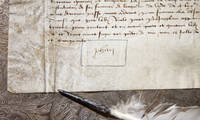
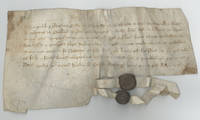
14502275018/10/1450. <blockquote><p>We can recall nothing similar having reached the market</p><p> </p><p>From the collection of Dr. Otto O. Fisher who bought primarily in the 1930s and 1940s so this not been offered for sale in nearly a century</p></blockquote><p>The Hundred Years’ War was one of the most notable conflicts of the Middle Ages. For 116 years interrupted by several truces five generations of kings from two rival dynasties - the English House of Plantagenet and the French House of Valois - fought for the throne of the largest kingdom in Western Europe - France. The war’s effect on European history was lasting. Both sides produced innovations in military technology and tactics such as professional standing armies and artillery that permanently changed warfare in Europe; chivalry which had reached its height during the conflict subsequently declined. Stronger national identities took root in both countries which became more centralized and gradually rose as global powers that expanded into the New World.</p><p>In the 1430s-50s the English clung to their dwindling possessions while French King Charles VII of the Valois dynasty slowly chipped away at them one piece at a time. By 1440 the French had driven the English completely from the valley of the Loire and the English retained only Normandy in the north and Gascony in the south. The Truce of Tours in 1444 gave the French a much-needed respite during which time Charles completed some necessary military reforms and prepared for the final grinding campaigns in a conflict that had begun more than a century earlier—well before anyone’s living memory.</p><p>Soon the war started up again. Under the weak kingship of Henry VI England seemed powerless to stop the French offensive of 1449 to recapture Normandy. The last major battle occurred in April 1450. With no other significant English forces in Normandy the whole region quickly fell to the victorious French. Caen was captured in June and Cherbourg the last English-held fortress in Normandy fell in August.</p><p>Among the commanders on the French side were the Count of Armagnac and his son the Viscount both named John.</p><p><strong>Autograph document signed</strong><em> ""Jehan John D'Armagnac""</em> October 18 1450 receiving 2000 livres a significant sum originally bestowed by the French King to Estienne Petit the treasurer to King Charles VII in the region the <em>""last march""</em> as the document notes for the purpose of attacking the English in April 1450 and after. <em>""I Jehan d'Armagnac Vicomte de Lomagne swear that I have received from Mr. Etienne Petit treasurer and collector of Languedoc the sum of 2000 livres that Mons. the King by distribution of his finances for Languedoc of 170000 livres awarded to the said Seigneur a Montpelier in the month of March last gave to furnish for us our expenses and to compensate for our efforts done in the surveying and conquest of Normandy.""</em></p><p>Jehan V was the last in the line of powerful Armagnac rulers. He fell out of favor with Charles who dispatched ""John the Bourbon"" to capture him but John fled to Spain. He was granted a return by Louis XI but soon revolted against him as well. Armagnac was part of the league that called itself ""Bien public"" or ""public good"" and threatened Paris at the head of 6000 mounted men. In 1469 Louis responded under the pretense that John was treating with ambassadors from England and sent an army under Antoine de Chabannes to rout him. John fled to Spain only to reappear in 1471 in the train of the king's rebellious brother the duc de Guyenne. John was stabbed to death in the 1470s without eligible male heir.</p> unknown
1481ABC_50450Cologne: colophon: Johann Koelhoff the Elder 1481. 18th-century gold-tooled beige calf with red and green labels lettered in gold on the spine gold-tooled board edges red edges marbled endpapers. Folio. With an anonymous engraved portrait in a sprinkled frame on the verso of the second flyleaf the whole rubricated in red. First incunable edition of the Methodus utriusque iuris emerged from one of the most enterprising presses of the late 15th century that of Johann Koelhoff the Elder active ca. 1471-1487 died 1493.Koelhoff was not originally a printer. Born in Lübeck he began his career as a merchant trading in cattle grain wool and paper a commercial background that would later shape his success in the book trade. By 1471 he had established a printing house in Cologne likely after learning the craft in Venice possibly in the workshop of Wendelin von Speyer active in Venice 1468 to 1477. The clear rotunda type he favoured along with other technical features suggests a Venetian influence carried north to the Rhineland. His press produced over 125 known editions primarily Latin theological and philosophical works though from 1475 onwards he also printed legal texts intended for university use.This Methodus utriusque iuris belongs precisely to that academic world. It served as a methodological guide and lexical aid for the study of the two laws: civil law Roman law rooted in the Corpus Juris Civilis of Justinianus I and canon law. Cologne home to the influential University of Cologne was a centre for the study of the ius commune and works such as this were essential tools for students and jurists alike.With an ownership label mounted on the front pastedown reading Ex libris Van Vaernewyck of Albert-Philippe-Charles Vicomte de Vaernewyck 1762-1841 his library was sold at auction in Mechelen in July 1847. Contemporary manuscript annotations to the recto and verso of the final leaf including references such as Digesti Veteris. Otherwise in very good condition.l BMC I 224; Catalogue d'une riche et nombreuse collection des livres et gravures formant la bibliothèque rénommé de seu Messire Albert-Philippe-Charles Vicomte de Vaernewyck 1847 no. 5256; Copinger part I no. 1895; GW M23075; ISTC im00526500; Polain 2683; Proctor 1048A; Rhodes Oxford 1197; USTC 741179; Voulliéme 787; not in Goff. (colophon:) Johann Koelhoff the Elder, unknown
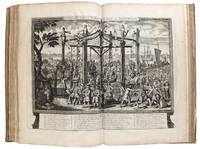
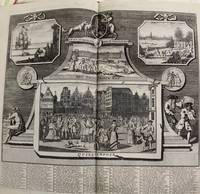
1720J68DA7J71DZAAmsterdam 1720. Folio ca. 39 x 25.5 cm. Contemporary elaboratly gold-tooled mottled calf sewn on 6 supports with corresponding raised bands on the spine and with the title lettered in gold on the spine gold-tooled board edges marbled edges bound by the so-called Double Drawer Handle Bindery in Amsterdam between 1720 and 1742 - Storm van Leeuwen With the title-page printed in red and black and 76 engraved plates mostly double-page and several are larger folding sheets including several maps the plate with the complete set of 52 playing cards and an extra copy of plate 18 Muller loosely inserted at the front of the work. 1 1 blank 25 1 52 "31" = 29 1 blank 8 10 pp. and engraved ll. A famous collection of texts and plates satirizing the Englishman John Law his Mississippi Company and the international land and trading speculation in worthless shares of the South Sea Bubble of 1719-1720 which resulted in an international scandal. The speculation began in Paris London and Hamburg spreading to the Netherlands in the summer of 1720. While plays satirizing the speculation already opened in September 1720 the bubble really burst in October. Pieter Langendijk and Gysbert Tysens have been identified as authors of some of the plays. The book also provides the texts of official documents relating to the Dutch trading companies involved.Text and plates were originally issued in parts and were continuously supplemented over a longer period. Work on the book as a whole must have begun after the Amsterdam disturbances of 5 October 1720 though some of the plays and other items had been separately published before that. There are four editions known of the letterpress of which this one is listed as the first by Muller. Within each edition the number and makeup of the plates varies greatly from copy to copy. Muller gives a list of 74 plates in the most extensive contemporary published list but no copy of any edition includes them all some are alternatives and several plates frequently included are not in those lists. The present copy includes 72 in Muller's list of 74 omitting nos. 57 and 74 and includes 4 not in that list Muller 3611-3613 and 3615. The book is an important source for multidisciplinary research e.g. iconology economic history colloquial proverbs and idioms.The binding is very slightly rubbed the joints have been professionally reinforced slightly browned throughout some plates show small tears along the folding lines without any loss. Otherwise in very good condition.l De Bruyn "Het Groote Tafereel . " in: Eighteenth-Century Life XXIV 2000 pp. 62-87; Kress 3217 eds. not distinguished; Muller Historieplaten II pp. 103-124; Van Rijn het groote tafereel der dwaasheid 1905; Sabin 28932 eds. not distinguished; STCN 254984576; cf. slightly differing collation or fingerprint STCN 254984185 293084076 228136539; for the binding: Storm van Leeuwen vol. I pp. 228-284. hardcover
1720B6829Amsterdam. 1720. Plates are clean and crisp.<br><br>. Edition: First Edition. Binding: Full contemporary mottled Dutch calf expertly rebacked in matching calf. Matching upper and lower boards with triple frame of decorative gilt fillet and a panel of darker calf between inner two gilt frames. Gilt stamp in centers of boards. Spine with 5 raised bands decorative gilt fillet on bands and in compartments. Title in gilt lettering on brown label in 2 remaining compartments with gilt stamps. Decorative gilt rolls on board edges. Notes: “The engravings which illustrate the rise and fall of the great speculation are full of humor; many of them are exceedingly ludicrous and some very obscene†Sabin. “Published in Amsterdam the giant tome includes pamphlets legal documents economic analyses maps satirical plays poems playing cards and more than seventy prints. The volume attracted wide audiences feeling the sting of the financial crises taking place in England France and the Dutch Republic that together resulted in the first international stock market crash.â€<br>“Het Groote Tafereel der Dwaasheid references Tulipmania in the Dutch Republic where the prices of tulip bulbs spiked and abruptly plummeted in 1637; the South Sea Bubble in England and Mississippi Bubble in France that burst in 1720; and other British French and Dutch enterprises that failed in 1720. Investing frenzy is characterized as a form of contagion moving from one country to the next: a consequence of the craze for international emulation as was evident in the English for example adopting the measures of John Law’s Mississippi Company that ultimately resulted in the South Sea Bubble. Prints in the volume commonly depict the dreams disordered states of mind and moral failures of investors caught up in the speculative zeal—alluding to herd behavior gambling corruption insanity immorality and demonic possession.â€<br>The text first appeared in 1720/21 and continued to be reprinted throughout the 18th century. Very few copies of this book survive as most were broken apart so that engravings could be sold individually. Professor Arthur Cole writes: “Rarely does a single volume combine in itself so much economic interest and so many bibliographical puzzles as Het Groote Tafereel Der Dwaasheid. There is scarcely another item just like it. Not merely are the identity of the compiler and the place of publication unknown and not merely is the date of original issuance uncertain but the volume went through an evolutionary process over time quite unnoticeable by ordinary superficial inspection. Moreover so strange was the mode of issuance that no two specimens even of approximately the same actual issue date are exactly the same. Neither the textual material nor the engraved prints are always identical nor do they appear in the same sequence within the volume.â€<br><br> Size: Folio 390x248 mm Illustration: Text in Dutch.<br>With the exceedingly rare index leaf. Extra illustrated with 80 plates.<br>A near fine example of this “extraordinary visual record of the first banking crash showing the shocking effects of the South Sea Bubble in France England and Holland and placing John Law 1671-1729 with his Mississippi company scheme squarely at the centre of the disastrous chain of events. ‘A unique historical document … of real significance’†Cole p.1. This copy is complete with the 74 plates listed in the very scarce index leaf included in this text in addition to 6 extra plates; 80 plates in total. With many folding and double-page plates. Includes frontispiece original engraving of John Law and a deck of “bubble cards.†Title in red and black. Pg. 43 mislabeled as 23. In full contemporary decorative Dutch calf. References: Cole Great Mirror of Folly 1949; Goldsmiths' 5879; Kress 3217; Sabin 28932. Pages: Blank 2. Frontispiece. Blank. Title. Blank. Index. P. 1 – 25. Aanwyzinge Der Projecten. 1 – 52. Versameling van Gedigten… 1 – 31. Blank. Papegaay of Actie-Kaart… 1 – 8. Copye Van Een Brief… 1 – 10. 80 plates. Blank 2. Category: Book Caricatures; Book Europe Benelux; Book Plate Books General; hardcover
1720297394Amsterdam 1720. First. hardcover. very good. Rubricated title 25 1 52 31 10 pages 74 copper engraved plates 58 folding including 3 maps 2 folding and 1 plate laid in. Bookplate of Dutch writer Jan Te Winkel pasted on upper corner of title page. Light dampstain on the top margin of some plates. Folio full contemporary mottled calf elaborately gilt spine and covers black leather spine label rubbed at corners and bottom of spine. Amsterdam: 1720. Very good.<br/> <br/> Contemporary Dutch account of the Mississippi Land bubble. A renowned monument for the speculative mania of 1720: The great mirror of folly showing the rise progress and downfall of the bubble in stocks and windy speculation in France England and the Netherlands. It constitutes a collection of mostly satirical plates on the operations of John Law in France and the South Sea Bubble in England together with the text of the charters of speculative companies in Holland and a number of satyrical plays and comedies published during the bubble. The first text-part reprints the charters of some 30 speculative companies of commerce navigation and assurance' established or at least projected in Holland between June and October 1720. The following parts contain comedies and poetry published during the mania an explanation of the large print with playing cards known as April-kaart'. The book is divided into six sections with no general table of contents. The first part contains the articles of various Dutch companies. The second section consists of comedies and farces; the third part poems often containing street language; the fourth part descriptions of playing cards satirizing speculators; the fifth part four letters to "N.N."; and the sixth section chiefly pictures. A.H. Cole The Great Mirror of Folly Boston 1949; Kress 3217; Sabin 28932.<br/> <br/> unknown
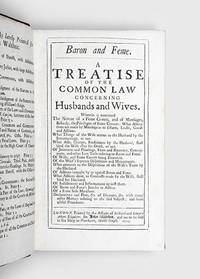
1700176470London: Printed by the Assigns of Richard and Edward Atkyns Esquires for John Walthoe 1700. The first English treatise devoted exclusively to family law First edition in an exceptionally well-preserved binding of this oft-cited work on the legal position of women in 17th- and 18th-century England and a key summary of the social mechanisms underpinning such works as The Taming of the Shrew. "Baron and Feme" refers to the legal fiction that husband and wife shared one legal personhood. The anonymous author of this treatise draws heavily on Sir Edward Coke's edition of Littleton aiming to codify and explain family law "in all the Circumstances of Life from the Solemnization of Marriage to the Divorce" p. vi. "Although written in English at a time when many law books were still published in Latin and law French it was clearly intended for a legally trained reader" Glover p. 75. This copy includes extensive ink annotations in an 18th-century hand suggesting a similar level of legal training. The annotations mainly cite other legal reference works but they also explicate several points of law and invoke others to challenge assertions in the text. The notes on the rear blank verso for instance observe that "the Wife's Portion consisting of Choses in action shall not upon ye husb's death be liable to his debts tho' ye husb: before marriage had made an adequate Jointure on her". Further editions appeared in 1719 and 1738. Octavo 192 x 115 mm pp. xxxii 380 misprinting pp. 178-9 182-3 186-7 and 190-1 as 162-3 166-7 170-1 and 174-5 36. Contemporary calf spine ruled in black and lettered in black manuscript covers with double fillet in black. Housed in custom green morocco book-form case. With 18th-century ink annotations and infrequent underlining to contents and rear blank verso. One corner just worn at tip infrequent brown marks to several pages contents otherwise bright and fresh: a fine copy. ESTC R6177; Wing B899. Susan Glover Engendering Legitimacy: Law Property and Early Eighteenth-century Fiction 2006. unknown
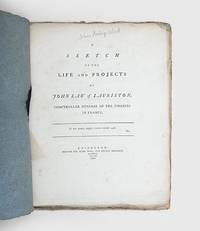
1791173742Edinburgh: for Peter Haill and George Kearsley London 1791. The first biography of the economic pioneer First edition of the first biography of Law whose financial schemes of an expanded paper money supply brought economic ruin to France yet paved the way for the modern credit economy. The biographer John Philip Wood was a local historian of Cramond where Law was born. He had "access to certain materials which are not now available" and "included a number of interesting genealogical and personal details in his book" though he "made no attempt to examine the 'system' objectively or even to analyse his subject's character in the light of his career" Hyde pp. 36 216. Both Antoin Murphy and James Buchan cite Wood's work in their scholarly biographies of Law although part of Wood's account of Law's genealogy is challenged by Murphy. The work was republished in an expanded edition in 1824. Quarto pp. 4 ii 48. Original stab-sewn blue wrappers edges uncut. Housed in 20th-century clamshell portfolio backed with earlier marbled paper. Rear wrapper detached a little chipped and torn at extremities light spotting and patch of toning to title page else contents fresh: a very good copy. ESTC T8458; Goldsmiths' 14941; Kress B2240. H. Montgomery Hyde John Law 1969. unknown
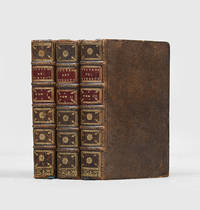
1739164842The Hague: Pierre de Hondt 1739. The best contemporary account of John Law's system First edition of Marmont's history of French finance during the minority of Louis XV an important record of the activities and operations of John Law. A tax collector from Flanders Marmont was a great admirer of Law's system despite its dramatic collapse in 1720. He covers Law's foundation of the Banque Générale through to the formation of the Compagnie des Indes which by absorbing various other chartered companies acquired the monopoly on trade to Africa America and the Far East. This finally transformed into the Mississippi Company giving Law control of France's finances most notably tax collection and debt management. 6 vols bound in 3 duodecimo 160 x 93 mm. Engraved plate in vol. 4 2 folding letterpress tables printed on both sides in vol. 6 woodcut devices and vignettes title pages printed in red and black. Contemporary sprinkled calf spines decorated in gilt in compartments red morocco labels marbled endpapers red edges silk bookmarkers. Head of spines of vols 2 and 3 slightly chipped corners worn front cover of vols 1 and 2 slightly darkened in places; marginal stain to fore edge of preliminary leaves of vol. 1 contents otherwise clean and fresh: a very good copy. Einaudi 3728; Goldsmiths' 7712; INED 1553; Kress 4447; Mattioli 2247; Sraffa 3776. unknown
172542567Amsterdam 1725. Folio. 15 3/8 x 10 inches. Title printed in red and black. Folding engraved frontispiece engraved list of plates within a decorative surround 1 title page and 87 engraved plates maps and broadsides 40 double-page 22 folding single-page 6 folding double-page and 17 single-page. Includes some plates with multiple variants. Vellum tooled gilt with 8 raised bands forming 9 compartments spine gilt morocco lettering piece in second compartment<br/> <br/> A rare work exhibiting a collection of contemporary satirical prints relating to the financial exploits of John Law and his infamous Mississippi Bubble.<br/> <br/> John Law 21 April 1671 - 21 March 1729 was a Scottish economist who believed that money was only a means of exchange that did not constitute wealth in itself and that national wealth depended on trade. He is said to be the father of finance responsible for the adoption or use of paper money or bills in the world today. Law was a gambler and a brilliant mental calculator and was known to win card games by mentally calculating the odds. An expert in statistics he was the originator of economic theories including two major ideas: The Scarcity Theory of Value and the Real bills doctrine. The present work records the economic crisis precipitated by Law. The crisis had its origins in the decision of the French regent Philippe d'Orléans to appoint John Law the Controller General of Finances for France. In May 1716 the Banque Générale Privée which developed the use of paper money was set up by Law. It was a private bank but three quarters of the capital consisted of government bills and government accepted notes. In August 1717 he bought the Mississippi Company to help the French colony in Louisiana. In 1717 he also brokered the sale of Thomas Pitt's diamond to the regent Philippe d'Orléans. In the same year Law floated the Mississippi Company as a joint stock trading company called the Compagnie d'Occident which was granted a trade monopoly of the West Indies and North America. The bank became the Banque Royale in 1718 meaning the notes were guaranteed by the king. The Company absorbed the Compagnie des Indes Orientales Compagnie de Chine and other rival trading companies and became the Compagnie Perpetuelle des Indes on 23 May 1719 with a monopoly of commerce on all the seas. The system however encouraged speculation in shares in The Company of the Indies the shares becoming a sort of paper currency. In 1720 the bank and company were united and Law was appointed Controller General of Finances to attract capital. Law's pioneering note-issuing bank was extremely successful until it collapsed and caused an economic crisis in France and across Europe. Law exaggerated the wealth of Louisiana with an effective marketing scheme which led to wild speculation on the shares of the company in 1719. In February 1720 it was valued for a very high future cash flow at 10000 livres. Shares rose from 500 livres in 1719 to as much as 15000 livres in the first half of 1720 but by the summer of 1720 there was a sudden decline in confidence leading to a 97 percent decline in market capitalization by 1721. Predictably the bubble burst at the end of 1720 when opponents of the financier attempted en masse to convert their notes into specie. By the end of 1720 Philippe II dismissed Law who then fled from France. Originally published by a group of Amsterdam booksellers the work has a convoluted bibliographic history owing to the ongoing enlargement of the number of prints published between late 1720 and the ensuing years coupled with the issuance of the plates as separate unbound sheets as well as later editions with yet more plates which maintained the title page dated 1720. In short nearly every extant example is unique in composition. "This remarkable complexity helps to explain why the book continues to fascinate scholars and readers to the present day: Het groote tafereel der dwaasheid in its many diverse copies represents an important witness to the events of 1720 and their aftermath which makes it valuable to cultural and economic historians . The book presents the rise progress and downfall of the deceptive trade of 1720 what that a group of booksellers who published it in 1720 when in Amsterdam where in order to restore social and ethical norms in Dutch society why by making fools of the greedy in a theatrical setting how. In short the Tafereel is an Amsterdam-born satirical comedy in disguise" Kuniko Forrer "Het groot tafereel der dwaasheid: A Bibliographical Interpretation" in The Great Mirror of Folly: Finance Culture and the Crash of 1720 Edited by William N. Goetzmann et. al. pp. 35-36. The present example corresponds to Forrer's third edition issued shortly after 1723 with the "Register" listing 73 plates and bound in a contemporary binding attributed to the Double Drawer Handle Bindery. This edition noted as the final edition published in the 1720s and the most complete including portraits of Madame Law and the King of the Mississippi "Der Koning van Missisipi" not found in earlier issues among other additions.<br/> <br/> Goldsmiths 5829; Kress 3217; Muller 3535; Sabin 28932; A.H. Cole The Great Mirror of Folly . an economic-bibliographical study Harvard: 1949; The Great Mirror of Folly: Finance Culture and the Crash of 1720 Edited by William N. Goetzmann et. al. Yale University Press: 2013. unknown
1720B5707c. 1720 . Altogether a very good and attractive copy of this important caricature platebook.<br>. Edition: First Edition Binding: Contemporary full calf with raised bands in 7 compartments. Text on 2 gilt centerpieces and decorative borders in compartments. Notes: Text is in Dutch. “This great Theatre of Folly representing the origin progress and downfall of the South Sea Bubble in France England and Holland is an exceedingly curious collection of emblematical plates and caricatures on the scheme of J. Law and the Mississippi Company and the imitations of it in Holland with their fatal results. Not a few of the scenes here depicted have been reproduced in the New York Exchange. The engravings which illustrate the rise and fall of the great speculation are full of humor; many of them are exceedingly ludicrous and some very obscene. They are finely engraved on copper and are accompanied with full descriptions in prose and poetry. So much offence was given to the English and French by this book that medals were struck by them in ridicule of the Dutch which was perhaps the beginning of the hostility which long existed in the minds of the English against the latter. The number of the plates in copies varies from sixty to seventy-four.†<br><br>This first edition of the most elaborate publication was inspired by the economic events of 1720 primarily satirizing Dutch manifestations of the speculative mania that led to the Mississippi Bubble in France a financial scheme that shook the French economy to its core and instigated the use of paper money in the country; engineered by Scottish economic theorist John Law and the South Sea Bubble in England.†Sabin<br> Size: Folio 394x235mm. Illustration: Illustrated with red and black title 74 engraved plates including many double-page or folding; 70 of 74 plates as listed in Koninck's rarely preserved index of plates of early editions; plates 26 29 39 and 71 of this list are not included but instead four other plates one of these a map entitled “Louisiana by the River Mississippiâ€. References: Alden European Americana 720/114; Cole The Great Mirror of Folly pages 23-35; Sabin Bibliotheca Americana 28932; Goldsmith 5879; Howes G 442; Muller America 1503 Pages: Title bl. 25 list of towns; 1-52; 1-14; detached insert of four letters 195x156mm: 1st: title bl. 1-10; 2nd: title bl. 1-10; 3rd: title bl. 1-10; 4th: title bl. 1-9; 15-26 29-31 bl. 1-8. Category: Book Caricatures; Book Europe Benelux; Book Europe France; Book Plate Books General; hardcover
172520771Amsterdam 1725. Folio. 15 3/8 x 9 3/4 inches. Title printed in red and black. Folding engraved frontispiece engraved list of plates within a decorative surround 72 engraved plates maps and broadsides on 73 leaves 5 of the single-page plates cut to the edge of the image and mounted as issued 45 double-page 19 folding and including 10 which combine both engraving and letterpress text one plate loosely inserted 2 with sections of blank margins torn away some other clean tears occasionally affecting the image area. Contemporary Dutch speckled calf spine in eight compartments with raised bands red morocco lettering-piece in the second compartment repeat decoration in gilt in the others.<br/> <br/> A rare work exhibiting a collection of contemporary satirical prints relating to the financial exploits of John Law and his infamous Mississippi Bubble.<br/> <br/> John Law 21 April 1671 - 21 March 1729 was a Scottish economist who believed that money was only a means of exchange that did not constitute wealth in itself and that national wealth depended on trade. He is said to be the father of finance responsible for the adoption or use of paper money or bills in the world today. Law was a gambler and a brilliant mental calculator and was known to win card games by mentally calculating the odds. An expert in statistics he was the originator of economic theories including two major ideas: The Scarcity Theory of Value and the Real bills doctrine. The present work records the economic crisis precipitated by Law. The crisis had its origins in the decision of the French regent Philippe d'Orléans to appoint John Law the Controller General of Finances for France. In May 1716 the Banque Générale Privée which developed the use of paper money was set up by Law. It was a private bank but three quarters of the capital consisted of government bills and government accepted notes. In August 1717 he bought the Mississippi Company to help the French colony in Louisiana. In 1717 he also brokered the sale of Thomas Pitt's diamond to the regent Philippe d'Orléans. In the same year Law floated the Mississippi Company as a joint stock trading company called the Compagnie d'Occident which was granted a trade monopoly of the West Indies and North America. The bank became the Banque Royale in 1718 meaning the notes were guaranteed by the king. The Company absorbed the Compagnie des Indes Orientales Compagnie de Chine and other rival trading companies and became the Compagnie Perpetuelle des Indes on 23 May 1719 with a monopoly of commerce on all the seas. The system however encouraged speculation in shares in The Company of the Indies the shares becoming a sort of paper currency. In 1720 the bank and company were united and Law was appointed Controller General of Finances to attract capital. Law's pioneering note-issuing bank was extremely successful until it collapsed and caused an economic crisis in France and across Europe. Law exaggerated the wealth of Louisiana with an effective marketing scheme which led to wild speculation on the shares of the company in 1719. In February 1720 it was valued for a very high future cash flow at 10000 livres. Shares rose from 500 livres in 1719 to as much as 15000 livres in the first half of 1720 but by the summer of 1720 there was a sudden decline in confidence leading to a 97 percent decline in market capitalization by 1721. Predictably the bubble burst at the end of 1720 when opponents of the financier attempted en masse to convert their notes into specie. By the end of 1720 Philippe II dismissed Law who then fled from France. Originally published by a group of Amsterdam booksellers the work has a convoluted bibliographic history owing to the ongoing enlargement of the number of prints published between late 1720 and the ensuing years coupled with the issuance of the plates as separate unbound sheets as well as later editions with yet more plates which maintained the title page dated 1720. In short nearly every extant example is unique in composition. "This remarkable complexity helps to explain why the book continues to fascinate scholars and readers to the present day: Het groote tafereel der dwaasheid in its many diverse copies represents an important witness to the events of 1720 and their aftermath which makes it valuable to cultural and economic historians . The book presents the rise progress and downfall of the deceptive trade of 1720 what that a group of booksellers who published it in 1720 when in Amsterdam where in order to restore social and ethical norms in Dutch society why by making fools of the greedy in a theatrical setting how. In short the Tafereel is an Amsterdam-born satirical comedy in disguise" Kuniko Forrer "Het groot tafereel der dwaasheid: A Bibliographical Interpretation" in The Great Mirror of Folly: Finance Culture and the Crash of 1720 Edited by William N. Goetzmann et. al. pp. 35-36. The present example corresponds to Forrer's third edition issued shortly after 1723 with the "Register" listing 73 plates and bound in a contemporary binding attributed to the Double Drawer Handle Bindery. This edition noted as the final edition published in the 1720s and the most complete including portraits of Madame Law and the King of the Mississippi "Der Koning van Missisipi" not found in earlier issues among other additions. This copy is accompanied by: GOETZMANN William N. et al. The Great Mirror of Folly: Finance Culture and the Crash of 1720. New Haven: Yale University Press 2013. The definitive modern study of the present work edited by William N. Goetzmann Catherine Labio K. Geert Rouwenhorst and Timothy Young. The volume reproduces and interprets the full range of plates satires and texts situating it within the broader visual and cultural history of the early modern financial revolution. Richly illustrated and deeply researched it brings together essays by leading scholars on economic thought print culture theatre and art illuminating how Law's System and the speculative mania of 1720 transformed Europe's understanding of credit risk and value.<br/> <br/> Goldsmiths 5829; Kress 3217; Muller 3535; Sabin 28932; A.H. Cole The Great Mirror of Folly . an economic-bibliographical study Harvard: 1949; The Great Mirror of Folly: Finance Culture and the Crash of 1720 Edited by William N. Goetzmann et. al. Yale University Press: 2013. unknown
784Dubuque: Ralph Law 1975. 33 3/4 x 16. Excellent. This is an original large watercolor by noted steamboat artist Ralph Law. The watercolor is on board. It is an exceptionally nice rendering of the steamboat America. The detail is so great that you can see the stars on the America flag. The steamboat was launched in 1900 and was designed for excursions between Cincinnati and Louisville. It was originally named the Indiana. It was partially destroyed by a fire at the Cincinnati waterfront on May 1st 11916. The original builders Howard Shipbuilders rebuilt the boat using the hull of the Indiana. They renamed the boat "America." It was a large vessel being 285 feet Lon and 45 wide at the hull and 82 feet over the deck. The boat operated between Cincinnati and Louisville even at low water because the hull pulled only six feet for clearance. The boat was originally set up for packet service between the two cities. The owners remodeled the vessel into an exclusive excursion boat that could carry up to 3400 passengers. The boat operated as such It was one of the most popular boats on the Ohio River during the Roaring 20s. The boat is fondly memriorialized through the painting of Ralph Law. He executed this work as others in a fine hand reflecting great appreciation for the subject. The resulting painting is a superb example od Law work. As can be seen in the picture there was a windowed mat originally place over this watercolor most like by Law himself. This is witnessed by the double signature of Law in the lower lefthand corner Matter and framed this would be a superb cornerstone piece of any art collection/ Please see pics!!! Ralph Law unknown
1720ABC_50107Amsterdam 1720. Contemporary gold-tooled mottled calf with the title and year lettered in gold on the spine sewn on 7 supports with the corresponding raised bands on the spine bound by the Double Drawer Handle Bindery in Amsterdam Storm van Leeuwen. Folio. With the title page printed in red and black and 79 engraved plates most double-page and several larger folding sheets including several maps and the plate with the complete set of 52 playing cards. The copy contains the register listing 74 items and 4 plates not in Mullers principal list Muller 3611note 3612 3613 and 3615. Second edition according to Muller of one of the most remarkable works in the history of finance. Few books equal the visual power satirical brilliance or bibliographical complexity of Het groote tafereel der dwaasheid. First published in Amsterdam in 1720 in the very year of the financial collapses it depicts this extraordinary work stands as the most ambitious and visually arresting contemporary response to the speculative mania that engulfed France England and the Dutch Republic.The work chronicles the rise frenzy and catastrophic collapse of the Mississippi Scheme in France under John Law 1671-1729 and the South Sea Bubble in England speculative ventures designed in part to consolidate and manage national debt in Englands case tied to the funding of the navy but which spiralled into one of the first great international stock market crashes. Laws Compagnie dOccident with its monopoly over Louisiana and trade along the Mississippi ignited feverish dealing in Paris Rue Quincampoix London answered with its own speculative excesses and the contagion swiftly spread to Amsterdam.The Dutch seasoned participants in organised finance responded not merely with alarm but with satire of unparalleled inventiveness. The Tafereel der dwaasheid gathers together emblematic engravings caricatures poems plays pamphlets and moralising texts all exposing the greed credulity and collective madness of the wind trade transactions in nothing more substantial than air.The engravings are by turns humorous grotesque theatrical and occasionally deliberately obscene. They chart the entire arc of speculation: the seduction of investors the carnival atmosphere of trading houses and coffee rooms the frenzied crowds and finally ruin and flight. Law himself appears in portrait placed squarely at the centre of events.The publication history of the Tafereel der dwaasheid is famously intricate. Four editions of the letterpress are known the present work corresponds to the second edition as classified by Muller. Within each edition the number and arrangement of plates varies considerably from copy to copy. Muller recorded 74 plates in the most extensive contemporary published list and several plates frequently encountered are listed seperately. The present work is complete according to the engraved register listing 74 items also present at the start of the work although several plates appear here in their variant often later states. It also includes 4 plates showing portraits and a map of Louisiana not in Mullers principal list Muller 3611-3613 and 3615 including different portraits and the map of Louisiana on the Mississippi.Together they form one of the most striking and bizarre monuments in all economic literature a merciless visual anatomy of financial hysteria.The present work appears here in a striking contemporary gold-tooled binding. This binding is the work of the so-called Double Drawer Handle Bindery according to Jan Storm van Leeuwen. The decorations are made up from numerous impressions of 12 different stamps and 4 different rolls. The bindery was active in Amsterdam between circa 1697 and 1742 and is regarded as the most important Amsterdam workshop of the eighteenth century.The binding is very slightly rubbed the hinges and edges and corners of the boards show signs of wear. Occasional browning and staining some plates show small tears mainly along the folding lines and often repaired/reinforced with paper on the verso without any loss. Plates 33 no. 32 in Muller 77 and 78 nos. 73 and 74 in Muller loose in binding. Otherwise in very good condition.l Cole The Great Mirror of Folly nrs. 1-4 6-8 10-71 73; De Bruyn Het Groote Tafereel in: Eighteenth-Century Life XXIV 2000 pp. 62-87; Goetzmann The Great Mirror of Folly 2013 esp. pp. 35-51 bibliogr. analysis by K. Forrer; Kress 3217; Landwehr 230; Lipperheide Xf 5; Muller Historieplaten esp. nos. 3536-3609; pp. 103-131; Sabin 28932; STCN various issues and made-up copies: the present work resembles 254984185; cf. for the binding: Storm van Leeuwen Dutch Decorated Bookbinding in the Eighteenth Century pp. 228-284. hardcover
1720182235The Hague: Chez Jean Neaulme 1720. Stimulating the French economy after the wars of Louis XIV First edition in French of Law's seminal disequilibrium theory of money published as the Mississippi Bubble was coming close to bursting. By 1720 Law had finally been appointed minister of finance in France and was in near-total command of the French economy. At the same time his scheme to monopolize the commercial development of French North America was running into difficulties: shares in the Mississippi Company stagnated amid increasing reports of underdevelopment in the French colonies. By December these shares had crashed completely sparking a general stock market crash in France and prompting Law to flee to Venice. Considerations had originally been published in English as Money and Trade Considered in 1705 when Law was attempting to persuade the Scottish government of his ideas. He was bitterly opposed to this French edition not least because it revealed details of the man he had killed in a duel 25 years earlier. Although ruinous to many individual investors Law's system is generally credited with stimulating the French economy exhausted after Louis XIV's wars. Octavo 158 x 95 mm pp. viii 168 167-187 19. Engraved portrait frontispiece title page printed in red and black and with woodcut device woodcut headpiece. Contemporary mottled calf spine ruled and decorated in gilt and with red morocco label marbled endpapers edges red green silk book marker. With 20th-century library ticket. Restoration to joints and extremities. Minor browning and foxing to contents: a very good copy. Einaudi 3274; Goldsmith's 5820; Kress 3235; STCN 202328686. unknown
1720B4227Netherlands c. 1720. A few tears in the plates expertly repaired; mispagination in 3rd part pp. 26 jumps to 29 but foliation remains constant no loss; see below for information on plates; otherwise a fine copy of this infamous work bound in decorative gilt 18th-century Dutch full calf.<br>Plates and text are clean and crisp.<br>. Edition: First edition later issue Binding: Contemporary 18th-century gilt-panelled mottled calf with arabesque centerpiece on covers spine in seven compartments of raised gilt bands and gilt floral motifs morocco label on two board edges gilt-tooled. Rebacked skillfully. Notes: Text in Dutch. “This great Theatre of Folly representing the origin progress and downfall of the South Sea Bubble in France England and Holland is an exceedingly curious collection of emblematical plates and caricatures on the scheme of J. Law and the Mississippi Company and the imitations of it in Holland with their fatal results. Not a few of the scenes here depicted have been reproduced in the New York Exchange. The engravings which illustrate the rise and fall of the great speculation are full of humor; many of them are exceedingly ludicrous and some very obscene. They are finely engraved on copper and are accompanied with full descriptions in prose and poetry. So much offence was given to the English and French by this book that medals were struck by them in ridicule of the Dutch which was perhaps the beginning of the hostility which long existed in the minds of the English against the latter. The number of the plates in copies varies from sixty to seventy-four.†<br><br>The first edition of the most elaborate publication was inspired by the economic events of 1720 primarily satirizing Dutch manifestations of the speculative mania that led to the Mississippi Bubble in France a financial scheme that shook the French economy to its core and instigated the use of paper money in the country; engineered by Scottish economic theorist John Law and the South Sea Bubble in England.†Sabin<br> Size: Folio 390x240mm Illustration: With 61 copper engraved plates including caricatures portraits and 2 maps – one finely hand-coloured- of which some are single- page many double-page and larger some folding. Title in red and black.<br>At publication copies of this book were composed with whichever caricature plates were at hand at the time resulting in a great variation in the number of plates contained in each some as few as 46 others as many as 84. Generally the typical complement of illustrations of the first edition was 74 plates --this copy has 61 in total. It contains plates# 3-8 10-26 28-33 35-37 39-43 45 47-56 58 60-64 66x2-68 70 73 according to Koninck's rarely preserved list of plates seen in early editions plus a portrait entitled ‘’een schooner Lotkrans…’’. Volume: 5 parts in 1 volume. References: Ref: Alden European Americana 720/114; Cole The Great Mirror of Folly pages 23-35; Sabin Bibliotheca Americana 28932; Goldsmith 5879; Howes G 442; Muller America 1503 Pages: P. Plate 64 Map illustrated title bl. 1-25 list of towns in report 1-31 bl. 1-26 29-52 1-8 1-9 bl. including 60 engravings. Category: Book Caricatures; Book Plate Books General; Book Europe Benelux; unknown
14222599612/04/1422. <div class=""gs""><div class=""""><div id="":2pv"" class=""ii gt""><div id="":2pu"" class=""a3s aiL ""><blockquote><div dir=""ltr"">Part of an important professors collection the majority of which was assembled and last offered for sale 25 years ago</div></blockquote><div class=""adL""></div></div></div></div></div><p>Myles Standish was an English military officer hired to accompany the Pilgrims in 1620 on the ship Mayflower as their military adviser. He played a leading role in the administration and defense of Plymouth Colony. He was one of the first settlers and founders of the town of Duxbury Massachusetts. He died on October 3 1656 in the New World in Duxbury-- a town the Pilgrims had named after his likely ancestral home in Lancashire England and an estate that occupied by these very men. what does this mean On February 17 1621 the Plymouth Colony militia elected him as its first commander and continued to re-elect him to that position for the remainder of his life. Standish served at various times as an agent of Plymouth Colony on a return trip to England as assistant governor of the colony and as its treasurer.</p><p>Taking the Standish Family back to their home in the Greater Manchester towns of Standish Chorley and Duxbury we see this important family’s expansion in terms of land and power. Since the 1200s the Standish Family had been the Lords of the Standish Manor.</p><p>Ralph de Standish was the Lord of the Manor from 1396-1415; in 1406 he acquired the estates of his uncle Sir Ralph de Standish of Scholes. As the Lord of the Manor he supplemented the family’s landholdings through purchases in nearby Wigan Shevington and Winstanley. In 1415 John de Standysshe likely Ralph’s brother was recorded at the Battle of Agincourt. Other Standishes at this important turning point in the Hundred Years War included Thomas Sir Rowland Sir Hugh and Christopher the latter two of which were of the Duxbury Branch of the Standishes. Christopher would become Lord of the Manor of Duxbury from 1421 to 1437 and die shortly thereafter.</p><p>Ralph’s death passed the Lordship of the Manor to his eldest son Lawerence; however he had two other sons Robert and Gilbert. Records about Gilbert only give few details. He was “living in 1423/4†and “in 1400 he was mentioned in a deed and entered into covenants with John Smith chaplain and Henry Matthew chaplain 1411/2 authorized by his mother and father.â€</p><p>Though the records remain inconclusive The Families of Standish states that “Sir Ralph de Standish of Scholes is considered to be the ancestor of the Standishes of Ormskirk and through them the ancestor of Captain Myles Standish of Plymouth and Duxbury Massachusetts who came in the ‘Mayflower’ 1620†p. 51.</p><p>Lancashire England 1422 <strong>Small indenture in Latin</strong> with two seals attached 103mm by 180mm approximately 12 April 1422 10th year of the reign of Henry V affirming a debt of 40 pounds by Gilbert de Standyssh Esq. of Blakerode i.e. Blackrod Lancs. Roger de Molyneux Esq. of Pemberton Lancs. and William son of Roger de Assheton Esq. of Abram Lancs. to Christopher de Standyssh. With original seals attached.</p><p>Through a small document the consolidation of Standish wealth is demonstrated. Further the exchange of £40 equivalent to approximately £34572 or $41700 in modern currency between Gilbert Standish Roger de Molyneux and William de Assheton son of Roger to Christopher Standish demonstrates the intimate ties between important families. Roger Ashton’s father was a soldier under King Henry IV and Henry V; his father before him was Sir John de Ashton who served with John of Gaunt in 1369 and whose part in the siege of Noyon in 1370 is mentioned by name by Froissart’s Chronicles in French.</p><p>Roger’s brother and William’s uncle was the famed alchemist given permission by Henry IV for his experiments.</p><p>See also:</p><p>Weis Frederick Lewis. The Families of Standish of Standish Lancashire England and Standish of Duxbury Arley Ormskirk Gathurst Croston Park Brook and Wantage… 1959.</p><p><img class=""alignnone wp-image-25018 size-post-window"" src=""https://cdn.raabcollection.com/wp-content/uploads/20231204144051/Folder-site-11-1600x1327.jpg"" alt="""" width=""1600"" height=""1327"" /></p> unknown
1804ABC_48704Paris 1804. 12mo. Louis Courcier; Angoulême Adrien Marrot; Bordeaux Thiron and Sigal Contemporary gold-tooled calf with a black morocco title label on the spine lettered in gold marbled endpapers. 2 parts in 1 volume. 2 329 1 blank; 4 268 pp. Very rare early edition only one copy found in WorldCat of this famous French civil code published in two volumes in 1804 the year in which also the first edition appeared Paris Imprimerie de la République An XII - 1804. In 1807 its title was changed into Code Napoléon Napoleonic Code under which it is commonly known today.The initiative for drawing up a civil code of laws was taken by Napoleon Bonaparte 1769-1821 in 1800 at that time First Consul of France. The text was drafted by a commission of four eminent jurists under the presidency of the French lawyer Jean Jacques Régis de Cambacérès 1753-1824 who had made a first attempt in 1793 to concipiate a codification of French civil law. In France civil law was mainly based on customary law which differed greatly from each other in various parts of the country. With a single set of laws the traces of feudal law could also be eliminated as a consequence of the French Revolution.This legal code is divided into three parts comprising 36 laws and 2.281 articles written in a clear and concise style. It is known that the famous French writer Stendhal pseudonym of Marie Henri Beyle 1783-1842 read a few pages of it every day to obtain its qualities of clarity and simplicity. The first part is mainly concerned with family law the second part mainly with the property of goods and the third part mainly with contracts. After the publication in 1804 a series of new French codes of law followed: in 1806 the Code de procédure civile Code of civil procedure in 1807 the Code de commerce Commercial code in 1808 the Code dinstruction criminelle Code of criminal procedure and in 1810 by the Code pénal Criminal code. Due to Napoleons occupations to Germany Italy the Low Countries and Poland the French civil code became highly influential in European legal history. It still leaves its mark in private law particularly in the field of contract law family law and property law.With traces of use binding slightly worn along the extremities two corners of the back cover slightly damaged first free endpaper missing owners entry in black ink on the title-page of the first part a few text pages loosening occasionally slightly soiled/browned. Otherwise in good condition. unknown
1720ABC_50108Amsterdam 1720. Near- Contemporary gold-tooled mottled calf with the title and year lettered in gold on the spine sewn on 7 supports with the corresponding raised bands on the spine. Bound by the Bird's Head Bindery in Amsterdam ca. 1728-1765 see Storm van Leeuwen. Folio. With the title page printed in red and black and 79 engraved plates including 1 repeat of plate 54 3589 Muller most double-page and several larger folding sheets including several maps and the plate with the complete set of 52 playing cards Pasquin variant. The copy contains the register listing 74 items and 4 plates not in Mullers principal list Muller 3611-3613 and 3615 but unfortunately lacks plate 18 3553 Muller. Third edition of one of the most remarkable works in the history of finance. Few books equal the visual power satirical brilliance or bibliographical complexity of Het groote tafereel der dwaasheid. First published in Amsterdam in 1720 in the very year of the financial collapses it depicts this extraordinary work stands as the most ambitious and visually arresting contemporary response to the speculative mania that engulfed France England and the Dutch Republic.The work chronicles the rise frenzy and catastrophic collapse of the Mississippi Scheme in France under John Law 1671-1729 and the South Sea Bubble in England speculative ventures designed in part to consolidate and manage national debt in Englands case tied to the funding of the navy but which spiralled into one of the first great international stock market crashes. Laws Compagnie dOccident with its monopoly over Louisiana and trade along the Mississippi ignited feverish dealing in Paris Rue Quincampoix London answered with its own speculative excesses and the contagion swiftly spread to Amsterdam.The Dutch seasoned participants in organised finance responded not merely with alarm but with satire of unparalleled inventiveness. The Tafereel der dwaasheid gathers together emblematic engravings caricatures poems plays pamphlets and moralising texts all exposing the greed credulity and collective madness of the wind trade transactions in nothing more substantial than air.The engravings are by turns humorous grotesque theatrical and occasionally deliberately obscene. They chart the entire arc of speculation: the seduction of investors the carnival atmosphere of trading houses and coffee rooms the frenzied crowds and finally ruin and flight. Law himself appears in portrait placed squarely at the centre of events.The publication history of the Tafereel der dwaasheid is famously intricate. Four editions of the letterpress are known the present work corresponds to the third edition as classified by Muller. Within each edition the number and arrangement of plates varies considerably from copy to copy. Muller recorded 74 plates in the most extensive contemporary published list yet barely any copy of any edition contains them all some serving as alternatives and several plates frequently encountered are absent from that list. The present work includes 73 plates from Muller's list of 74 omitting no. 18 contains a duplicate of no. 54 and includes the engraved register listing 74 items together with 4 plates not in Mullers principal list Muller 3611-3613 and 3615 including different portraits and the map of Louisiana on the Mississippi. Together they form one of the most striking and bizarre monuments in all economic literature a merciless visual anatomy of financial hysteria.The present work appears here in a striking contemporary gold-tooled binding. This binding is the work of the so-called Bird's Head Bindery active ca. 1728-1765 according to Jan Storm van Leeuwen. The decorations are made up from several impressions of 5 different stamps and 5 different rolls. Two stamps on the present binding seem to be unrecorded by Storm van Leeuwen for this bindery namely the lozenge-shaped stamp on the spine and the small cornerpieces on the spine surrounding the lozenge-shaped stamp. These seem to be variants of the bindery's recorded stamps but several stamps also do bear similarities to other major Amsterdam binderies of the early 18th century like the so-called "Double Drawer Handle Bindery".With plate "Lauw-maands herdenking . Nieuwjaarsgeschenk" no. 54 - 3589 Muller included twice as plates 54-55 and lacking plate "Monument consacré - Ter eeuwiger gedagtenisse." no. 18 - 3553 Muller. The hinges are weakened the head of the spine is slightly damaged the corners and edges of the boards show slight signs of wear with a 3.5 x 1 cm repair to the leather on the back board not affecting the gold-tooling. The first flyleaf is partially loose a large tear in plates 7 and 12 resp. nos. 6 and 11 Muller repaired on the verso some plates with small tears along the folding lines slightly affecting the illustration of plate 51 same no. Muller and the map of Enkhuisen is torn along the paper stub it is mounted on not affecting the plate. Some occasional browning foxing and staining. Otherwise in very good condition.l Cole The Great Mirror of Folly nrs. 1-4 6-8 10-71 73; De Bruyn Het Groote Tafereel in: Eighteenth-Century Life XXIV 2000 pp. 62-87; Goetzmann The Great Mirror of Folly 2013 esp. pp. 35-51 bibliogr. analysis by K. Forrer; Kress 3217; Landwehr 230; Lipperheide Xf 5; Muller Historieplaten esp. nos. 3536-3609; pp. 103-131; Sabin 28932; STCN various issues and made-up copies: the present work resembles 228136539; Van Leeuwen Dutch Decorated Bookbinding I 2006 pp. 228-284. hardcover
18252575Mexico City 1825. Still very good. Two volumes in one. 2xxvi221xi2; 2xviii190xviiiiii pp. Contemporary quarter calf and paper boards spine gilt. Light rubbing and a pair of small perforations to spine leather. Edges worn; corners bumped. Light tanning scattered foxing. A handsome copy of an early Mexican imprint that Lathrop Harper described succinctly as the "First edition of the first decrees of the first independent Mexican Congress." This collection of decrees issued for the first and second sessions of the Mexican Congress established after the promulgation of independence in 1821 contains a wealth of information relevant to the founding of the country. These include the act relating to the "coronation of D. AgustÃn de Iturbide the hereditary successor to the throne†formalizing that “the acts of his government are declared invalid." <br /> <br /> Of particular interest are two decrees directly relating to Anglo-American settlement in Texas. The first of these dated April 11 1823 begins “Que el gobierno si no encuentra inconveniente acceda a la solicitud de Estevan Austin sobre que se confirme la concesión de establecer 300 familias en Tejas.†Roughly translated this decree states that "the government if it finds no objection agrees to Estevan Austin's request for confirmation of the concession to establish 300 families in Texas.†Stephen F. Austin's "Old Three Hundred" families were the foundation of Anglo-American settlement in Texas and here the nation of Mexico authorizes their emigration.<br /> <br /> The second decree dated September 29 1823 is titled “Esención de derechos por siete años a los efectos que se introduzcan en Tejas.†The text of the decree reads in full: “El Soberano Congreso mexicano tomando en consideracion el deplorable estado a que las hostilidades de los barbaros han reducido a la provincia de Tejas y para ocurrir en parte a la miseria de sus habitantes civilizados ha venido en decretar y decreta. Que todos los efectos de cualquiera clase nacionales o estrangeros que se introduzcan en la provincial de Tejas para el consume de sus habitants sean libres de derechos; durando esta esencion siete anos contados desde su publicacion en aquella capital.†This second decree effectively extended the term for duty-free trade allowed to the Texas settlers as recompense for the troubles they experienced at the hands of the local "barbarians" i.e. the indigenous native peoples who had lived on the land for centuries.<br /> <br /> Of course the works also stand alone as a significant document of the first independent Mexican government and contains many important details on the early organization of the new country the Constitution of 1824 and the first presidential elections amongst much else. The two works present here were printed simultaneously but were issued separately and are not always found together as here. The first compilation of laws governing the fledgling nation of Mexico with early Texas colonization content. <br /> Palau 56388. Lathrop Harper 220:116. unknown
170954195København 1709. Folio. In contemporary full calf Cambridge-style mirror binding with blindstamped borders. Light wear to extremities. Seven leaves with minor repairs to margins one leaf with a 15 cm long closed tear and one leaf with an 30 cm long closed tear all professionally executed and with no loss of imprint. Margins slightly soiled. 19 leaves -text and frames engraved. The broad frames that all differ from each other ornamentally depict animals and plants as well as the different trades of the country. A nice copy printed on thick heavy paper. Housed in a cardboard box.Provenance: From the collection of Danish book collector Viggo Lohse. The present copy was exhibited at 'Dansk Bibliofil-Klubs 50 års Jubilæumsudstilling' in 1992 The 50 year anniversary exhibition for the Danish Society of Bibliophiles no. 94. <br/><br/><em>First edition of this landmark work of Danish book production and the constitution of the Danish absolute monarchy. The Royal Law established the absolute right of the Monarch to rule and it defined the line of royal succession. It was more rigorous than the other monarchal laws of Europe at the time.The text which is written by Peder Griffenfeld is engraved in copper throughout in order to prevent the possibility of re-printing pirated editions and text-counterfeiting. Frederik Rostgaard the King's state archivist who was famous for his excellent taste in books was in charge of the editing and issuing of the work. In front of the actual law text a leaf is inserted with the portrait of King Frederik III on his horse and everything except for the head of the king which was engraved after his death-mask is executed in the beloved flourishing- or scroll- manner of the time. The titles and the text are engraved throughout by Michael Røg. </em> unknown