15 758 résultats
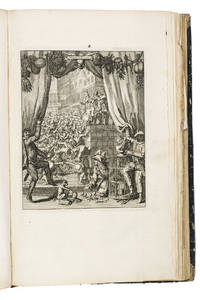
1720B7274Nakomelingen c.1720. Edition: First Edition. Binding: No binding. Notes: Text in Dutch.Folio. Approx. 410 x 260 mm. <br>A very good example of this “extraordinary visual record of the first banking crash showing the shocking effects of the South Sea Bubble in France England and Holland and placing John Law 1671-1729 with his Mississippi company scheme squarely at the centre of the disastrous chain of events. ‘A unique historical document … of real significance’†Cole p.1; “the engravings which illustrate the rise and fall of the great speculation are full of humor; many of them are exceedingly ludicrous and some very obscene†Sabin. “Published in Amsterdam the giant tome includes pamphlets legal documents economic analyses maps satirical plays poems playing cards and more than seventy prints. The volume attracted wide audiences feeling the sting of the financial crises taking place in England France and the Dutch Republic that together resulted in the first international stock market crash.â€<br>“Het Groote Tafereel der Dwaasheid references Tulipmania in the Dutch Republic where the prices of tulip bulbs spiked and abruptly plummeted in 1637; the South Sea Bubble in England and Mississippi Bubble in France that burst in 1720; and other British French and Dutch enterprises that failed in 1720. Investing frenzy is characterized as a form of contagion moving from one country to the next: a consequence of the craze for international emulation as was evident in the English for example adopting the measures of John Law’s Mississippi Company that ultimately resulted in the South Sea Bubble. Prints in the volume commonly depict the dreams disordered states of mind and moral failures of investors caught up in the speculative zeal—alluding to herd behavior gambling corruption insanity immorality and demonic possession.â€<br>The text first appeared in 1720/21 and continued to be reprinted throughout the 18th century. Very few copies of this book survive as most were broken apart so that engravings could be sold individually. Professor Arthur Cole writes: “Rarely does a single volume combine in itself so much economic interest and so many bibliographical puzzles as Het Groote Tafereel Der Dwaasheid. There is scarcely another item just like it. Not merely are the identity of the compiler and the place of publication unknown and not merely is the date of original issuance uncertain but the volume went through an evolutionary process over time quite unnoticeable by ordinary superficial inspection. Moreover so strange was the mode of issuance that no two specimens even of approximately the same actual issue date are exactly the same. Neither the textual material nor the engraved prints are always identical nor do they appear in the same sequence within the volume.â€<br><br>This copy with 68 plates many folding out and/or double-page. Includes frontispiece original engraving of John Law and a deck of “bubble cards.†Title in red and black. Papegaay of Actie-Kaart-Klap… pages unnumbered but all text present. Pg. 29 mislabeled as 92. Page numbers jump from 26 to 29 where noted in pagination above but text continuous. Unbound all leaves loose.<br><br><br>TEXT<br>-Pg. 29 mislabeled as 92 signature H<br>-Goes from pg. 26 – 29 but matches complete bound book same online<br>-Last text pgs. 1-8 are unnumbered but all present<br>-Online copy has Copye Van Een Brief as very last text before plates so did that<br><br>PLATES<br>Missing<br>-Y Pg. 139 on Gale resource/163 on NYPL: “De Kermis-Kraam Van De Actie-Knaapenâ€<br>-Pg. 281 on NYPL/185 Gale: man’s portrait ‘QUINQU/ENPOIX’<br>-Pg. 299 on NYPL: Louisiana <br>-Pg. 327 on NYPL: woman’s portrait<br>-Pg. 329 on NYPL: man’s portrait #2 profile<br><br>-Not seeing plate #29 Tonneel<br>-#65 Kaart-spel van Momus<br>-#68 B have card decks in place<br>-#70 Ronde Godt Have Biespieling… in place<br>-#73 Tooverkaart magic card; have De Wintgot there instead<br>-#74 Tooverkaart twede Stuk magic cad; have other cards there<br><br>Y = confirmed missing plate with contents plate<br><br> Size: Folio Provenance: Ex-Library Chicago Historical Society; embossed and perforated stamps on title elsewhere. References: Cole Great Mirror of Folly 1949; Goldsmiths' 5879; Kress 3217; Sabin 28932. Pages: P Frontispiece. Blank. Title. Blank. Pp. 1 – 25. Aanwyzinge Der Projecten. Pp. 1 – 52. Versameling van Gedigten… 1 – 26 pagination jumps 29 – 31. Blank. Papegaay of Actie-Kaart-Klap… 8. Copye Van Een Brief… 1 – 10. 67 plates. Category: Book Caricatures; Book Europe Benelux; Book Plate Books General; Nakomelingen, unknown
1720ABC_49340Amsterdam 1720. Folio. Contemporary gold-tooled half blueish green roan with a red morocco title label lettered in gold on the spine blue paste paper sides. With the title page printed in red and black 78 mostly double-page or folding engraved plates with caricatures on the 1720 Bubble and a double-page hand-coloured plate of the foundations of a house near Leiden loosely inserted in the back. 1 1 blank 25 1 52 "31" = 29 1 blank 8 9 1 blank pp. and engraved ll. A famous collection of texts and plates satirising the Englishman John Law his Mississippi Company and the international land and trading speculation in worthless shares of the South Sea Bubble of 1719-1720 which resulted in an international scandal. The speculation began in Paris London and Hamburg spreading to the Netherlands in the summer of 1720. While plays satirizing the speculation already opened in September 1720 the bubble really burst in October. Pieter Langendijk and Gysbert Tysens have been identified as authors of some of the plays. The book also provides the texts of official documents relating to the Dutch trading companies involved.In The great mirror of Folly Cole presents lists of plates which can be found in various copies the total of which however is never found in a single copy. The present copy contains no. 22 with a German title and no. 65 the famous playing cards in the later "Pasquin" version. Rare prints that are seldom present are no. 73 the magic cards and supplement nos. 2 3 4 and 6. The interest and importance of the collection is hardly to be exaggerated. It presents a unique source on one of the most interesting periods in economic history commenting on the feverish activity of speculation accompanying the introduction of the stock market not only in the Netherlands itself but also in France and England including the activities of John Law the Mississippi Bubble in France and the South Sea Bubble in England. The prints also include a map of the American State of Louisiana near the Mississippi River.With the bookplate of B. Eveleigh Winthrop mounted on the front pastedown. The binding is worn. The text is partly browned the plate with the playing cards has a large horizontal tear and the upper left corner has been torn off but is still present. Otherwise a good copy.l Cole The great mirror of folly nrs. 1-4 6-8 10-71 73; Muller Historieplaten 3535 ff.; Van Rijn Atlas van Stolk 3452 ff.; STCN 254984576; cf. slightly differing collation or fingerprint STCN 254984185 293084076 228136539. unknown
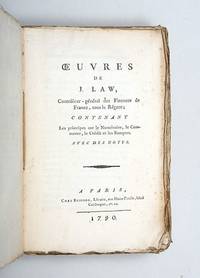
1790143822Paris: Buisson 1790. Uncut in original wrappers First collected edition of the works of the French finance minister John Law whose financial schemes led to the Mississippi Bubble and economic collapse during regency France. Apart from Money and Trade Considered all the works in the collection including two Mémoires sur les Banques and a number of letters were previously unpublished. The publication of the collection during the French Revolution reflected a revived interest in solutions to deficit financing and a re-appraisal of the previously discredited Law and his grand schemes of long-term government finance. The editor Gabriel-Étienne de Sénovert "made a point of highlighting its current relevance. 'Credit' he wrote at the beginning of his introduction to the edition citing Sir James Steuart for corroboration 'plays so considerable a role in the political economy of modern nations and is connected so intimately to their prosperity and even to their existence that it could be said that the science of government is nothing but the science of credit itself'. Sénovert's assessment of Law was however judiciously neutral. As he went on to emphasise both in the rest of his introduction and in the notes that he added to Law's own works it was difficult to decide whether Law's system was a real example or a dreadful warning" Sonenscher pp. 314-15. The revolutionary government's solution to the economic situation issuing the assignats backed by land and confiscated property was not dissimilar to Law's solution of notes tied to French land in North America; both rapidly lost value and further destabilized France's economy. Octavo. Uncut in contemporary marbled paper wrappers paper spine label lettered in manuscript printer's waste pastedowns. Occasional light spotting. A remarkably well preserved copy. Goldsmiths' 14361; Kress B.1919. Michael Sonenscher Sans-Culottes: An eighteenth-century emblem in the French Revolution 2008. unknown
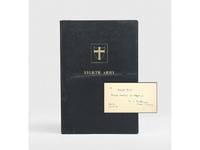
1944186789Italy: Printed and Bound by Printing and Stationery Services 21 Army Group 1944. Inscribed by the victor amid the ruins First edition presentation copy inscribed by Montgomery on the front free endpaper "To: Ernest Bevin Foreign Secretary of England. B. L. Montgomery Field-Marshal. Berlin 29-8-45". After the Labour Party's surprise victory in the July 1945 general election Prime Minister Attlee appointed his close ally Ernest Bevin as Foreign Secretary allowing him significant autonomy in foreign policy decisions. Montgomery met the new Foreign Secretary at the Potsdam Conference and wrote "I was much impressed by Bevin; he will be the power behind the throne in the new set-up" Hamilton p. 551. Montgomery signed this volume the day before the conference at which he joined Georgi Zhukov Dwight Eisenhower and Jean de Lattre de Tassigny in forming the Allied Control Council the supreme governing authority in occupied Germany. The book privately produced and surviving in very few copies collects the printed personal messages issued by Montgomery to the Eighth Army as it fought its way from Alamein to Tunisia. These messages were central to the legendary morale of the Eighth Army. As Freddie de Guingand says in his foreword "These messages were always eagerly looked forward to by the troops and fostered the spirit and the will-to-win that made the Eighth Army such a great and happy family". An additional message from Montgomery from 25 August 1945 is loosely inserted. Small folio. Original black sand-grain cloth with Eighth Army insignia to front cover. Light rubbing to cloth ink marks to initial and final leaf. A very good copy. Nigel Hamilton Monty Final Years: 1944-1976 1986. hardcover
2014547732014. ISBN-13: 9781584779773. ISBN-10: 1584779772. "The Megatherium of the Older Abridgments" Viner Charles. A General Abridgment of Law and Equity: Alphabetically Digested Under Proper Titles with Notes and References to the Whole. Originally published: Aldershot: Printed for the Author 1742-1753. 23 volumes. Hardcover folio 9" x 14". Reprinted 2009 2014 by The Lawbook Exchange Ltd. ISBN 9781584779773. Hardcover. New. $4995. Reprint of the First edition. Descended from Rolle's Abridgment Viner's Magnum Opus marks the end of an era in English legal bibliography. Originally intended as a continuation of D'Anver's abridgment which ends at "Factor" Viner's work went on to become the longest and most detailed work of its kind. According to Winfield "it is the megatherium of the older abridgments.For several years we have used Viner for the purpose of getting all available references to all existing cases on three or four branches of the law and we have found his book very useful." Marvin adds that "it is a vast Index of the law" that "often rewards the labour when all other resources have failed." In addition to the Abridgment Viner 1678-1756 contributed much for the study of English law through his posthumous establishment of the Vinerian chair and Vinerian scholarships. The first holder of the Vinerian Chair was Sir William Blackstone. During his tenure he delivered the lectures that formed the basis of his Commentaries on the Laws of England. Winfield The Chief Sources of English Legal History 244-45. unknown
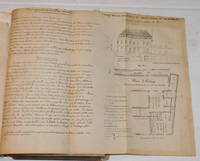
1723135461Paris: Ches Louis-Denis Delatour & Pierre Simon 1723. John Law accused of illegally building on claimant's land First edition setting out the claim of Jean Pasquier in the legal action brought against the financier John Law and others concerning a building in Chaillot in Paris. The claimant disputes Law's title to the land and calls for the building's demolition and the claimant's renumeration. The land in question is across the river from where the Eiffel Tower now stands. Pasquier claims he inherited the land through his wife but that his neighbour Jean Des Vaux acquired it on false legal pretexts. Des Vaux partnered with John Law who built an iron foundry there in 1719 using English workmen. Pasquier repeatedly appealed to the Paris parlement for his right seeking the return of the land to him and demolition of the foundry as well as damages. This publication presents his claims making extensive observations on private rights and public welfare and the nature of property law in France and its relation to civil society. The Mémoire implies that Law was arguing that as the enterprise was of national importance and built on good faith with Des Vaux it should not be demolished. Law moved his then-skyrocketing wealth into various enterprises and had already invested in a factory in Harfleur in 1718 similarly bringing over English workmen including the engineer Richard Jones. The British parliament was concerned by these enterprises due to the mercantilist perception that France's gain would be England's loss - they drafted a law forbidding any British manufacturer to develop enterprises abroad Buchan p. 187. The Mémoire is dated 5 July 1723. Pasquier had printed another claim the previous year with the same publishers and under the same title which is dated 5 September 1722; the same ground is covered but the text is different and this further elucidates and updates the case into 1723. We could trace only one other copy that in the Bibliothèque nationale de France who also have the only traced copy of the 1722 publication. Folio 394 x 239 mm 14 pp. Recent blue boards red label. Neat early annotation and notation to first page. Slightly spotted faint staining at head of inner margin. A very good copy. James Buchan John Law 2018. hardcover
14502454001/01/1450. <blockquote><p>A very uncommon leaf from Livy very few manuscript examples having survived</p></blockquote><p>Rome having survived the invasions of the Celtic Gauls in the early 4th century BC set its sights on further expansion in the middle part of the century. They re-conquered those Latin and Etruscan towns that had left the fold during the Gallic occupation and in absorbing others reconsolidated their position as the dominant force in Latium and Central Italy. With their home turf secured or so it seemed the Romans looked south towards Campania.</p><p>At this time the Samnites had moved into the fertile lands of Campania from the south-central Appenines. They already controlled the towns of Capua and Cumae to the south of Rome and held sway to the east as well. Rome to protect its flanks while still in the midst of re-taking Latium and Etruria wisely entered into an alliance with the Samnites in 354 BC. Conflict with Samnium over Campanian dominance was inevitable however and would soon turn into a series of wars lasting from 343 - 290 BC.</p><p>The years surrounding the Samnite Wars were not only one of military prowess for Rome but of great public works as well. In 329 BC the Circus Maximus got one of many face-lifts throughout its history gaining permanent horse-stalls and starting gates. The first Roman road the Via Appia was constructed from Rome to Capua in 312 BC and the first aqueduct the Aqua Appia was also established at the same time. These magnificent structures not only were of great benefit to Rome and her people but proved the flourishing disposition of the state even during time of war and expansion. At the end of the Samnite Wars Rome held perhaps as many as 150000 people making it one of the largest cities in the Mediterranean region. As many as 1000000 people claimed citizenship to Rome and vastly larger numbers were obligated through Latin rights and allied status.</p><p>With the defeat of Samnium the last major Italian threat Rome was the master of nearly the entire Italian peninsula save for the Gauls occupying the Po valley in the north and the Greek holdout cities like Tarentum in the far south. This growing power soon gained the attention of regional powers in Greece and later the masters of the Mediterranean the Carthaginians.</p><p>Livy or Titus Livius 59 BC - 17AD wrote his history of Rome starting with the foundation myth of Aeneas 510 BC up to the successful German campaigns and death of Emperor Drusus 9 BC. This history comprised 142 books. Of those books 35 survive to present day with the bulk being the first 10 years Books 1-10 fragments of 11 Books 21-45 fragments of 91 and scattered quotations preserved in secondary works.</p><p>Though the accounts differ the destruction of Livy’s work has been attributed to the hand of Pope Gregory the Great 590–604 who was trying to eliminate pagan works from Christian hands. This biblioclasm whether it was through the Pope’s doing or through the natural loss of material to time has severed us from an important access point to Roman history as some of the material used by Livy has not been found in his source texts.</p><p>With the bulk of the texts destroyed Livy’s History of Rome passed into the Middle Ages primarily through summary and with the extreme length of the work the original Classical and Early Medieval manuscripts were not recopied and fell into decay and loss. Thus by the so-called 12th Century Renaissance Livy’s historical writing was quite rare. It was not until the 1300s that Livy regained popularity. Dante was one of those who respected Livy and in his Inferno the poet references Livy ""come Livïo scrive che non erra"" as Livy wrote who does not err.</p><p>The hunt was on for Livy’s lost manuscripts even just a fragmental scrap was a treasure worth finding in the 1300s. Even Pope Nicholas V turned his efforts towards finding these rare manuscripts some of which had been destroyed by his papal predecessor. The Italian Humanist period into the Renaissance increasingly sought any extant versions of this history; as the esteem for and ardent imitation of Greco-Roman culture increased so did the need for access points to this history. Entire country homes in Italy were sold to buy a single manuscript of Livy’s works copied by one of the men primarily responsible for the new handwriting style now known as the Humanist hand. Scholarship and commentary ranging from England by Dominican Friar Nicholas Trevet to Italy by Laurentius Valla paved the way for further analysis of the Roman historian.</p><p>This Italian manuscript leaf likely from the mid-1400s to the very early 1500s comprises part of Book 9 from BC 308. With only minor deviations from the Loeb Classical Library text which is the scholarly standard. These deviations indicate that this manuscript descends from a different stemma than the most common or most “correct†one which was for the Loeb edition further painting the picture of the Humanist effort to grasp this fading history from the jowls of history and the pains to retaining the original text despite the lack of exemplars.</p><p>In addition to representing an important moment in the recuperation of history the script throws us into modernity. Towards the end of the 14th century several Italian humanists including Niccolò Niccoli and Poggion Bracciolini began set about to reform the increasingly dense Gothic handwriting which had dominated book making since the mid-13th century. The Gothic script whose legacy in printing extends to 20th century German fraktur found in pre-war books was full of letters fused together ornate thorns and hairlines and single strokes called minims which became impossible to read. These 14th century Italians set about to recreate a script that utilized space between each letterform and simpler strokes— a new take on the handwriting endorsed by Charlesmagne himself for the education of his Holy Roman Empire. This script known as Humanist caught on and proliferated. By the time texts were bring printed at the end of the 15th century the printers looked to this script to make a font and further our modern Times New Roman font is based on the Humanist script which is in part why this text of Livy is so legible to us as a modern audience.</p><p>Pierre Maréchaux “The Transmission of Livy from the End of the Roman Empire to the Beginning of the Seventeenth Century: Distortion or Discovery a Story of Corruption†A Companion to Livy ed. Bernard Mineo John Wiley & Sons: 2014 pp. 437-452.</p><p><strong>More details</strong></p><p>LEAF FROM LIVY’S AB URBE CONDITAS in Latin text manuscript on parchment Northeastern Italy perhaps Padua 1456 Single column of 34 lines written in brownish ink in Humanist hand with some slant and ligatures. Letters beginning sections set in margins with two hatch marks in pen next to all but one of the initials. Single correction indicated by strike through with amended word written above line 15 recto; Ruled horizontally in red ink. Distinct hair and flesh sides. Modern pencil number 185 at the bottom left hand of the column on verso. Provenance: Sothebys March 1825 Payne and Foss 1825 Sothebys 1902 & 1923 Parke-Bernet 1941 Otto Ege. Gwara Handlist 52.</p><p><strong>Text & Translation:</strong></p><p>…ruperat Fabius consul nec dubia nec difficili victoria dimicat. Ipsum oppidum—nam ad moenia victor accessit—cepisset ni legati dedentes urbem exissent. Praesidio Perusiae imposito legationibus Etruriae amicitiam petentibus prae se Romam ad senatum missis consul praestantiore etiam quam dictator victoria triumphans urbem est invectus; quin etiam devictorum Samnitium decus magna ex parte ad legatos P. Decium et M. Valerium est versum; quos populus proximis comitiis ingenti consensu consulem alterum alterum praetorem declaravit.</p><p>XLI. Fabio ob egregie perdomitam Etruriam continuatur consulatus; Decius collega datur. Valerius praetor quartum creatus. Consules partiti provincias: Etruria Decio Samnium Fabio evenit. Is profectus1 ad Nuceriam Alfaternam cum pacem petentes quod uti ea cum daretur noluissent aspernatus essetoppugnando ad deditionem subegit. Cum Samnitibus acie dimicatum. Haud magno certamine hostes victi; neque eius pugnae memoria tradita foret ni Marsi eo primum proelio cum Romanis bellassent. Secuti Marsorum defectionem Paeligni eandem fortunam habuerunt.</p><p>Decio quoque alteri consuli secunda belli fortuna erat. Tarquiniensem metu subegerat frumentum exercitui praebere atque indutias in quadraginta annos petere. Volsiniensium castella aliquot vi cepit; quaedam ex his diruit ne receptaculo hostibus essent; circumferendoque passim bello tantum terrorem sui fecit ut nomen omne Etruscum foedus ab consule peteret. Ac de eo quidem nihil impetratum; indutiae annuae datae. Stipendium exercitu Romano ab hoste in eum annum pensum et binae tunicae in militem exactae; ea merces indutiarum fuit.</p><p>Tranquillas res iam in Etruscis turbavit repentina defectio Umbrorum gentis integrae a cladibus belli nisi quod transitum exercitus ager senserat. concitata omni iuventute sua et magna parte Etruscorum ad rebellionem compulsa tantum exercitum fecerant ut relicto post se in Etruria Decio ad oppugnandam inde Romam ituros magnifice de se ac contemptim de Romanis loquentes iactarent. Quod inceptum eorum ubi ad Decium consulem perlatum est ad urbem ex Etruria magnis itineribus pergit et in agro Pupiniensi ad famam intentus hostium consedit. Nec Romae spernebatur Umbrorum bellum et ipsae minae metum fecerant expertis Gallica clade quam intutam urbem incolerent Itaque legati ad Fabium consulem missi sunt ut si quid laxamenti a bello Samnitium esset in Umbriam propere exercitum duceret. Dicto paruit consul magnisque itineribus ad Mevaniam ubi tum copiae Umbrorum erant perrexit.</p><p>Repens adventus consulis quem procul Umbria in Samnio bello alio occupatum crediderant ita exter-ruit Umbros ut alii recedendum ad urbes munitas…</p><p>In the same year the consul Fabius fought a battle with the remnants of the Etruscan forces near Perusia—which together with other cities had broken the truce—and gained an easy and decisive victory. He would have taken the town itself—for after the battle he marched up to the walls—had not ambassadors come out and surrendered the place. Having placed a garrison in Perusia and having sent on before him to the senate in Rome the Etruscan deputations which had come to him seeking friendship the consul was borne in triumph into the City after gaining a success more brilliant even than the dictator’s; indeed the glory of conquering the Samnites was largely diverted upon the lieutenants Publius Decius and Marcus Valerius of whom at the next election the people with great enthusiasm made the one consul and the other praetor.</p><p>In recognition of his remarkable conquest of Etruria Fabius was continued in the consulship and was given Decius for his colleague. Valerius was for the fourth time chosen praetor. The consuls cast lots for the commands Etruria falling to Decius and Samnium to Fabius. The latter marched against Nuceria Alfaterna and rejecting that city’s overtures of peace because its people had declined it when it was offered them laid siege to the place and forced it to surrender. A battle was fought with the Samnites in which the enemy were defeated without much difficulty nor would the engagement have been remembered but for the fact that it was the first time that the Marsi had made war against the Romans. The Paeligni imitated the defection of the Marsi and met with the same fate.</p><p>Decius the other consul was also successful in war. When he had frightened the Tarquinienses into furnishing corn for the army and seeking a truce for forty years he captured by storm a number of strongholds belonging to the people of Volsinii. Some of these he dismantled lest they should serve as a refuge for the enemy and by devastating far and wide he made himself so feared that all who bore the Etruscan name begged the consul to grant them a treaty. This privilege they were denied but a truce for a year was granted them. They were required to furnish the Roman army with a year’s pay and two tunics for each soldier; such was the price they paid for a truce.</p><p>The tranquility which now obtained in Etruria was disturbed by a sudden revolt of the Umbrians a people which had escaped all the distress of war except that an army had passed through their territory. Calling up all their fighting men and inducing great part of the Etruscans to rebel they mustered so large an army that they boasted with much glorifying of themselves and fleering at the Romans that they would leave Decius behind them in Etruria and march off to the assault of Rome. When this purpose of theirs was reported to the consul Decius he hastened by forced marches from Etruria towards the City and encamped in the fields belonging to Pupinia eagerly waiting for word of their approach. At Rome no one made light of an Umbrian invasion. Their very threats had excited fear in those who had learnt from the Gallic disaster how unsafe was the City they inhabited. Accordingly envoys were dispatched to carry word to Fabius the consul that if there were any slackening in the Samnite war he should with all speed lead his army into Umbria. The consul obeyed the order and advanced by long marches to Mevania where the forces of the Umbrians at that time lay.</p><p>The sudden arrival of the consul whom they had believed to have his hands full with another war in Samniurn a long way from Umbria so dismayed the Umbrians that some were for falling back on their fortified cities and others for giving up the war…</p><p><img class=""alignnone wp-image-24457 size-post-window"" src=""https://cdn.raabcollection.com/wp-content/uploads/20231204150746/Folder-site-8-1600x1327.jpg"" alt="""" width=""1600"" height=""1327"" /></p> unknown
185053436Leipzig Johann Ambrosius Barth 1850. Contemp. marbled boards. Gilt spine titlelabel with gilt lettering. Light wear to spineends corners and edges. Stamps on title-page Gusstahlfabrik Fried. Krupp. In "Annalen der Physik und Chemie" Dritte Reihe 19. Band 79. Band der ganzen Reihe. IX1580 pp. and 3 folded engraved plates. Entire volume offered. Endpapers and the first and last few leaves with brownspots. Clausius's paper: pp. 368-397 a. pp. 500-524. Internally clean. <br/><br/><em>First edition of this monumental famous paper in thermodynamics in which Clausius for the first time states the Second Law of Thermodynamics one of the most importent laws of Nature having a huge impact on the development of physical theory cosmology communications and information theory. The law states that a the energy of the Universe is constant and b the Entropy of the Universe tends to a maximum."Clausius' contribution to thermostatics is comparable to those of Newton and Maxwell to mechanics and electromagnetism respectively. In the obituary J.W. Gibbs remarked that Clausiu's first memoir "marks an epoch in the history of physics."" Chowdhury and Stauffer in "Principles of Equilibrium Statistical Mechanics".In "The Nature of the Physical World" Eddington writes: "The Law that entropy increases - the Second Law of Thermodynamics - holds I think the supreme position among the laws of Nature. If someone points out to you that your pet theory of the Universe is in disagreement with Maxwell's equations - then so much the worse for Maxwell's equations. If it is found to be contradicted by observation - well these experimentalists do bungle things sometimes. But if your theory is found to be against the Second Law of Thermodynamics I can give You no hope; there is nothing for it but to collapse in deepest humiliation.".Parkinson "Breakthroughs" 1850 P. </em> hardcover
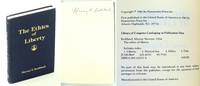
1982566j0533Atlantic Highlands New Jersey: Humanities Press. Good with no dust jacket. 1982. First Edition. Hardcover. 0391023713 . Signed without inscription by Murray Rothbard atop front free endpaper. "Economics can help supply much of the data for a libertarian position but it cannot establish that political philosophy itself. For political judgements are necessarily value-judgements political philosophy is therefore necessarily ethical and hence a positive ethical system must be set forth to establish the case for individual liberty." - Preface. "Rothbard 1926-1995 was a central figure in the 20th-century American libertarian movement and a founder and leading theoretician of anarcho-capitalism" - Wikipedia. Clean and unmarked with moderate peripheral wear to original dark blue cloth brightly lettered in gilt. Binding tight. Light foxing to edges. No dust jacket apparently as issued. A quality signed copy of this fascinating study. ; Sm 4to; Signed by Author . Humanities Press hardcover
1758016251Philadelphia: William Bradford 1758. First Edition. Hardcover. Title page with a few repaired tears hinged with following Preface page; two adjoining leaves pages 441-444 of text lacking and supplied with facsimiles. Contents Very Good binding about Fine. Folio 7-1/4" x 11-1/2" bound in contemporary calf leather with a decorative blindstamped border recently rebacked with a new gilt-lettered and decorated spine preserving original paste-downs and free endpapers; 4 763 pages. Title within rule border decorative woodcut head- and tail-pieces. An important compilation of the fundamental New Jersey charters and session laws of the proprietary period 1664 to 1702 up to Lord Cornbury's commission and instructions as Royal Governor when New Jersey became a crown colony under Queen Anne. Publication was ordered by the New Jersey Assembly in 1752 but two years were required to collect the documents to be included while the typesetting and printing took Bradford an additional three. By the date of publication some 170 copies had been subscribed. This title was the largest volume issued from Bradford's press and one of the largest from any eighteenth-century American press. Evans 8205; Sabin 39527. Early owner name on the title page and early twentieth century names on the front pastedown. <br/><br/> W[illiam] Bradford hardcover
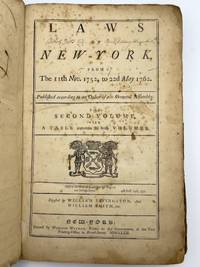
1762408263New York: James Parker I; William Weyman II 1762. Joints cracked but holding cloth tape reinforcements on inner hinges some light browning and occasional spotting dampstaining in volume 2. Together two volumes folio. Vol. 1: Title 3-page list of subscribers Preface i-iii 1-488 Errata leaf. Vol. 2: 1 1 3 268 pages. Contemporary calf leather spine labels on volume 1 one a modern replacement. Provenance: Swann Galleries 21 October 2004 lot 323 $2530. FIRST EDITIONS. Volume one is signed on the title by Petrus Stuyvesant 1727-1805 the great-grandson of the British Colonial Governor by the same name. Volume two is signed on the front free endpaper and title by colonial statesman and Revolutionary patriot Robert Yates. Evans 6897 and 9213; Tower 624 and 625. James Parker [I]; William Weyman [II] unknown
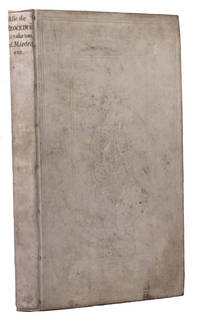
1743ABC_46524The Netherlands 1743. Folio ca. 32 x 21.5 cm. Contemporary blind-tooled vellum sewn on 6 vellum supports laced through the joints with the manuscript title on the spine red sprinkled edges. With some woodcut decorated initials. 24 parts in 1 volume. 4 15 1 31 1 30 2 7 1 9 2 blank 1 4 10 2 2 2 21-27 3 1 6 20 67 1 9 2 blank 1 48 8 1 2 blank 1 8 4 10 1 1 2 2 pp. Rare collection of missives ordinances petitions and extracts from resolutions concerning the conflicts surrounding and law proceedings concerning Jacob Coren van der Mieden 1698-1751. He fled his hometown of Alkmaar in fear he would be captured by the Court of Holland. Initially the Van der Mieden family was a wealthy noble family with a good reputation. Jacob's father Aris was mayor of the city of Alkmaar Jacob was appointed bailiff of Nieuwburgen in 1731. Here one of his judicial officers ran a reign of terror. The people felt that bailiff Jacob was protecting his officer which made him very unpopular. Jacob was also lord of Callantsoog where he imprisoned the former bailiff Jan Harge in 1740 after Harge was being accused of abuse of office. The problem was that he did so under such bad conditions that the wife of Harge complained to the Court of Holland after which Harge was exonorated and the Court of Holland turned to Van der Mierde. Out of fear of being put behind bars he fled to Lent near Nijmegen. His wife Susanna Doubleth appealed the court and advocated that her husband would be tried by the local court in Alkmaar instead of the Court of Holland. These request are added in this collection. The last ordinance in the collection is the conviction of his younger brother Adriaan counselor of the Court of Holland who was accused of co-writing the requests with Susanna which were quite libel and defamatory undermining the Court of Holland as the highest judiciary institution of Holland. Adriaan was suspended from the court in 1747. The fate of Jacob van der Mieden remains unclear.With a manuscript annotation on the title page signed by G.J. van Persijn 1791. Govert Jan van Persijn was a lawyer advocaat at the Court of Holland Antonius Quirinus van Persijn was his son. Govert Jan van Persijn also added letters to the index and occassionaly made some marginal annotations and corrections in the text. The binding is slightly dust soiled otherwise in very good condition.l J.G. Gijsberti Hodenpijl van Hodenpijl Extracten uit de crimineele ordonnantien van Holland gives the pamphlets individually; STCN 240322061 3 copies; WorldCat 1144496082 1258013052 3 copies also in STCN; not in De Buck; Knuttel; Tiele. hardcover
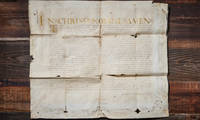
15852363525/09/1585. <blockquote><p>The Renaissance was a period of crucial cultural artistic social and financial development in late Medieval and Renaissance Italy and particularly the affluent cities of Florence Venice Genoa and Padua.</p></blockquote><p>The Holy Roman Empire spanned central Europe in one form or another for the span of a millennia. For much of that time it contained vast swaths of Italy mainly in the north and included the Italian city of Padua which would become a hub in the Renaissance in that country and a major university center. As the Middle Ages bled into the period of the Renaissance the Empire slowly lost direct control over Italy. It managed to maintain its power into the 16th century in part via old established orders that maintained local control.</p><p>Among these Holy Roman imperial titles was the ""comes palatinus caesareus"" or the imperial count palatine. The office of imperial count palatine was hereditary and the emperors seem to have used it to create an Italian aristocratic class loyal to the empire. In 1357 the Emperor Charles IV added the power of conferring licenses and doctorates of civil law to those of the counts palatine. Later on they acquired the power to confer doctorates in general. In 1363 Charles himself bestowed this honor to Giacomo Santacroce. His heir to this title and power given by it which was significant was Giovanni Santcroce who in addition to being the benefactor for religious and cultural efforts in the region was a businessman.</p><p>The Facino or Facini family was a prominent one from the town of Feltre. The Ioannes Baptista Facinus namd in the document was prominent in the cultural community. There remains today a church bearing the crest of this family constructed shortly before his birth.</p><p>Francisco Fabriano and Andreas Tinto were important functionaries and notaries of the period in Padua.</p><p><strong>Document signed</strong> September 25 1585 in Latin using the Latin names of the people involved including The Holy Roman Emperor Charles signed by important figures of the late Italian renaissance. In it <em>""Ioannes Sancta Cruce""</em> bestows the position of <em>""comes palatinus caesareus""</em> on <em>""Ioannes Baptista Facinus""</em> and all his male heirs. The document is witnessed and signed not only by Santa Cruce himself described as <em>""the most excellent lawyer lord count soldier knight horseman of the Court of Caesar""</em> but also by Fabriano and Tinto. The document is likely in the hand of Tinto himself.</p><p>Such Italian Renaissance documents are very uncommon. The most direct comparable was acquired by J.P. Morgan and is now in the Morgan Library.</p><p>There is an extended portion in the middle about Holy Roman Emperor Charles IV who it describes in 1357 added the power of conferring licenses and doctorates of civil law to the position.</p><p><img class=""alignnone wp-image-23609 size-post-window"" src=""https://cdn.raabcollection.com/wp-content/uploads/20231204153244/Folder-site-6-1600x1327.jpg"" alt="""" width=""1600"" height=""1327"" /></p> unknown
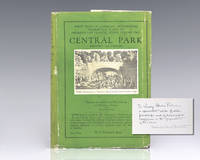
1928129463New York and London: G. P. Putnam's Sons 1928. First edition of the second volume of the autobiography of one of the foremost figures in American landscape architecture Frederick Law Olmsted. Octavo original cloth illustrated tissue-guarded frontispiece portrait of Olmsted. Edited by Frederick Law Olmsted Jr. and Theodora Kimball. Association copy inscribed by Frederick Law Olmsted on the front free endpaper “To George Haven Putnam in appreciation alike of old friendships and of his constant helpfulness in the preparation of this book. Frederick Law Olmsted.†The recipient American publisher George Haven Putnam was the eldest son of George Palmer Putnam the founder of G. P. Putnam's Sons. Putnam published the books of many classic American authors including his close friend Washington Irving William Cullen Bryant James Fenimore Cooper and Edgar Allan Poe. Upon his father's death in 1872 George Haven Putnam took over the business with his brothers John Bishop and Irving. He was made president of the firm a position he held for the next fifty-two years. In 1884 he hired 26-year-old Theodore Roosevelt as a special partner; Roosevelt would write several works published by Putnam. Putnam had already retired from the family firm at the time of this volume’s issue but was clearly still involved with this publication. Near fine in the rare original dust jacket which is in very good condition. An exceptional association copy. Frederick Law Olmsted Senior was one of America's foremost artists and a founder of the profession of landscape architecture in the U.S. The Park as a work of art - designed by Olmsted and partner Calvert Vaux - and as a great and novel public enterprise undertaken by the City of New York has played a vital part in the political history and cultural life of the metropolis and exerted a far-reaching influence on outdoor recreation and the landscape art in America. G. P. Putnam's Sons hardcover
182897115Paris: impr. Dezanche and impr. Pihan Delaforest and Delangle Freres 1828-1835. 1828-1835. Fair. - Octavo 8-1/4 inches high by 5-1/4 inches wide. Four pamphlets bound into early brown calf with an elaborate floral device embossed in blind at the center of both the front and rear covers within an elaborate outer gilt ruled frame with formal decorations. All edges are marbled. The rubbed & worn covers are detached and the spine has perished and thus lacking. The pagination is as follows: i-xii 1-96 pp.; 5 6-45 1 pp.; 5 folding plates; 5 6-66 pp.; 4 pp. 1-82. There is foxing throughout.<p>The ownership name of James Stewart and the faded date of "1881" is penned on the front blank. In what appears to be his hand the statement "From Pierre Soule" is penned along the top of the verso of the front endpaper. Additionally the attractive sienna-toned ex-libris bookplate of "R.G.S." is mounted on the front pastedown. <p>Stated to be from the library of Pierre Soule with his name signature at the head of the first pamphlet. Soule 1801-1870 was the French-born New Orleans attorney and Louisiana Senator.<p>The lawyer involved in these 4 cases Gustave Louis Chaix d'Est-Ange 1800 - 1876 was the son of the attorney general at the court of criminal justice of Reims. As a lawyer his oratorical talent was noted at the Paris bar where he practiced. He was entrusted with a number of important cases and from 1842-1844 was president of the Paris Bar Association.<p>1 Plaidoyer et réplique de Me Chaix-d'Est-Ange dans le procès d'Émile de La Roncière précédés d'une Note de M. le lieutenant-général Clément de la Roncière d'Esquisse préliminaire de M. Eugène Roch et d'une lettre de M. Émile de La Roncière adressée à "l'Observateur des tribunaux". Paris: De L'Imprimerie De Dezauche 1835. The sensational trial of Emile de La Ronciere 1803 - 1874 was most recently memorialized by John Fowles in his novel "The French Lieutenant's Woman". In chapter 28 of the novel he discusses the trial of the young cavalry officer who was accused of raping Marie the sixteen-year-old daughter of his commanding General Baron de Morell. The trial itself revolved around a series of anonymous letters threatening the Morell family and signed "E. de La R.". La Ronciere was found guilty and sentenced to ten years in prison. The verdict was controversial and has been debated for many years. In the pamphlet at hand is included the text of a letter to the l'Observateur des Tribunaux written by La Ronciere's father Clement de La Ronciere on August 25 1835 and one written by the imprisoned La Ronciere himself on September 10 1835. These are followed by a preliminary outline by Eugene Roch. The text from the trial is based on reporting in l'Observateur des Tribunaux journal des documens judiciaires. It begins with the plea of La Ronciere's attorney Chaix d'Est-Ange. Although misbound later in this collection of pamphlets facsimiles of items used as evidence in the trial are included. These include 4 folding facsimiles on which are printed 8 samples of handwriting of La Ronciere and of Marie de Morell. Also included on a fifth folding plate is a remarkable plan of the home of the Morells with a view of the floor where Marie's room was located.<p>2 Plaidoyer de Me Chaix-d'Est-Ange pour M. le ministre du Commerce et des Travaux publics intervenant contre M. Victor Hugo. Paris: Imprimerie De Pihan Delaforest 1832. Victor Hugo's play "Le Roi s'amuse" was the basis for the libretto of Verdi's opera Rigoletto. The opening of the play on November 22 1832 was highly anticipated. The opening night box office receipts were an enormous success but the play was not. Both the audience and the critic's responses were negative. However the most devastating response came from the Minister of the Interior. He saw the play as an attack on the royal family and ordered it suspended i.e. banned. In the Charter of 1830 censorship was stipulated to "never be re-established". This conflict led to a trial on December 19 1832. Odilon Barrot represented Hugo and Chaix d'Est-Ange represented the Ministry of Commerce. He took the unpopular stand that the State had the authority to examine dramatic works before production. His plea is published here. Hugo lost this free-speech debate and the play was banned for 50 years.<p>3 Plaidoyer de M. Chaix d'Est-Ange pour le sieur Auguste Labauve et les sieur et dame Formage plaignans et parties civiles contre Frédéric Benoît accusé. Paris: Imprimerie De Pihan Delaforest Morinval 1832. A VIVID ACCOUNT OF MATRICIDE! Frederic Benoit 1810 - 1832 known as "Le Parricide" was executed by the guillotine at the Place St. Jaques in the 14th arrondisement of Paris on August 30 1832. The story of Benoit's killing of his mother in November 1829 and that of his male lover seventeen-year-old Joseph Formage on July 22 1831 is well documented and need not be repeated here. In this civil plea of June 14 1832 on behalf of the butcher Auguste Labauve and also on behalf of Joseph Formage's parents Chaix d'Est-Ange outdoes himself in painting with vibrant colors the slaughter by Benoit of his own mother. Labauve was the second victim of this crime. In January of 1830 an anonymous letter was found threatening Benoit's father a justice of the peace as well as Labauve with the same fate as that of Madame Benoit. The letter was said to be in the hand of Labauve. He was brought to trial for murder and was acquitted by a divided jury. However he was sentenced to a 5 year prison term for having written the threatening letter.<p>4 Procès fait à la lettre adressée au duc d'Orléans par Cauchois-Lemaire. Paris: Delangle Freres Libraires 1828. In December 1827 the editor of the Constitutionnel Louis Francois Auguste Cauchois-Lemaire 1789 - 1861 published a notorious 69 page pamphlet "Sur la crise actuelle lettre a S.A.R. le duc d'Orleans". The pamphlet addressed to Louis-Philippe the Duke of Orleans was a powerful attack on the ultra-royalist government of Joseph de Villele and a denunciation of the so-called "massacre" that took place on the rue Saint-Denis on July 27 1827. Cauchois-Lemaire concludes his essay paraphrasing the French "Thus liberty awaits the day which should let it emerge from its prison. And we who are tired of the long wait together we call for a favorable star to hasten it." The result was that Cauchois-Lemaire was accused of trying to persuade the duc d'Orleans the "favorable star" to lead the opposition to the government and have it overthrown. He and the two publishers Ponthieu and Schubart were brought to trial on January 12 1828. Cauchois-Lemaire was sentenced to 15 months in La Force prison in addition to a fine. In defense of Cauchois-Lemaire Chaix d'Est-Ange given that the facts of the matter were difficult to vindicate delivered a brilliant thesis on constitutional law. The press at the time praised his eloquence. Cauchois-Lemaire himself was so impressed that he wrote Delangle Freres from prison on January 28 1828 requesting that they publish a transcript of the trial. That letter together with the proceedings of the trial are published here. Paris: impr. Dezanche, and impr. Pihan Delaforest, and Delangle Freres, 1828-1835. unknown
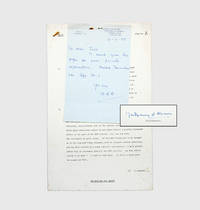
1955162675London: March 1955. The security they think they have in Europe today is a pure facade Copy number 2 of an unknown but inevitably small distribution signed by Montgomery on the final sheet and classified "private and top secret" together with a covering note dated 17 March 1955 in Montgomery's hand: "My dear Jock: I send you this paper for your private information. Harold Macmillan has copy No. 1. Yrs ever M of A". Sir John "Jock" Colville 1915-1987 was the wartime private secretary to Winston Churchill and rejoined him when he became prime minister in 1951 receiving this paper from Montgomery one month before Churchill resigned from office. A powerful mandarin Colville formed with Christopher Soames the duumvirate that effectively ran the country for several months following Churchill's stroke in June 1953. He was personally as well as professionally close to Montgomery their correspondence including for example a playful bet on the outcome of the 1956 US election. Montgomery's memo presented some stark warnings about NATO's capabilities. "It is in no position today March 1955 to fight a war and succeed. We would lose Western Europe if attacked" p. 1. He argues that in light of the reality that defence spending will not be increased money should be used more wisely. NATO members should pool resources and avoid overlap "joint defence". The three branches of the armed forces should be integrated and harmonized - rather than "squabble about who should do the task" and "get in each other's way" p. 6 - and the military's leadership should cultivate new attitudes. "Let us put pride prejudice inter-racial and inter-Service jealousies aside; these are instruments of the enemy and of the devil" p. 8. After Macmillan became Minister of Defence in 1954 Montgomery was one of the first officials with whom he met. "On his first incursion into NATO enclaves Macmillan found himself immediately at one with the abrasive little Field-Marshal on the NATO ministers of defence" Horn p. xlix. We have traced only other copy from the distribution held in the papers of Major-General Percival Napier White 1901-1982 at the Liddell Hart Centre for Military Archives. Eight sheets of duplicate typescript 330 x 205 mm text on one side only wire-stitched top left. With autograph cover letter signed 195 x 125 mm from Montgomery to John Rupert "Jock" Colville on single sheet of Ministry of Defence printed letterhead written on one side only affixed to first sheet with pin. Folded horizontally browning at staples and pin light toning and foxing: very good. Alistair Horn Macmillan: The Official Biography 2012. unknown
1857365383New York: Dix Edwards & Co 1857. First Edition. Very good. One of the best accounts of antebellum Texas written as a series of letters about life in the slave states commissioned for the New York Times. This is the second of three volumes issued separately in Olmsted's "Our Slave States" series. While not a radical Olmsted in sending a copy of this book to Edward Everett Hale said that he hoped that his book would help slavery to "retreat upon itself" and collapse under its own weight with "masters running away from the slaves" Quoted in Papers of Frederick Law Olmsted vol. 2 p. 398.<br /> <br /> Jenkins in Basic Texas Books calls this "the most civilized of all 19th century books on Texas" and "the most interesting and most dependable." He also says Olmsted "gives one of the earliest descriptions of the Texas cattle ranch." Greene in the 50 Best Books on Texas writes "the book is both good reading and good sociology."<br /> <br /> Larry McMcMurtry in his book In a Narrow Grave called Olmstead "perhaps the most readable of the nineteenth century travelers."<br /> <br /> The book includes a small folding map of the state titled "Map of Part of the State of Texas" prepared by J. H. Colton & Co. of New York. The Salt River fork on the Brazos river marks the northern and western boundary of the map. <br /> <br /> This book sold well. It was published at the beginning of 1857 and by February 16 Olmsted reported to his brother who had accompanied him on the journey and who edited the letters for this publication that only 200 of the first printing of 2500 copies remained. He also wrote that the paper ordered by the publisher of which Olmsted was an investor had "been a month on the way not yet arrived." A second printing of this book in 1857 is not referenced in any of the bibliographies known to your cataloguer. <br /> <br /> There are two variants of the book with 1857 on the title page. The most obvious difference is that one variant has plain endpapers and another has endpapers printed with reviews for the first volume in Olmstead's travels. I think it is most likely that the variant with ads is the second printing. On the title page of the copies with ad endpapers the counters empty spaces in the capital 'A's of the list of Olmsted's previous books are mostly filled in which is common when stereotype plates reproduce small letters the publishing agreement for this book survives and it required the publisher to make stereotype plates. The endpaper variant is also much more common which would also seem to fit this narrative; given that the first printing sold out in weeks the publisher is much more likely to have printed a larger number of the second printing which apparently lasted until 1859 when the book was reprinted for a third time a fourth printing appeared in 1860. Likely first printing with no ads on the endpapers. A very good copy worn at the corners and bumped on the spine ends. Small illegible previous owner's name on the front free endpaper; original price $1.25 marked above in pencil. Rather scarce; copies with ads on the endpapers are much more common. Dix, Edwards & Co unknown
17801278931780. ADULTERY. Collection of Adultery Trials. London: various circa 1780-1808. Octavo contemporary full tan calf gilt raised bands marbled endpaper and edges. $3500.A collection of reports of 11 adultery trials from the late 18th and early 19th centuries combined with 30 engravings of scandalous encounters.Published accounts of adultery trials were very popular in late-18th/early 19th-century England a way to indulge a taste for the erotic and the scandalous under the thin veil of condemnation. Included here are the trials of Robert Gordon for adultery with the wife of Joseph Seymour Biscoe Rev. Mr. Cooper with the wife of Lord Cadogan Sir John Bennett Piers with the wife of Lord Cloncurry ""Thomas Theaker Coachman for Adultery with Mrs. Gregson"" Thomas Sheridan with the wife of Peter Cambell Captain Elwin with the wife of Sir George Brograve J. Hacket with Mrs. Mansergh R. J. Fergusson with the Countess of Elgin Lord Borringdon and Sir A. Paget ""for criminal conversation with the plaintiff's wife"" Colonel T.R. Powlett and Lord Sackville with another plaintiff's wife and Ralph Benson with the wife of Thomas Parr The collection of 30 engravings bound at the back of this book are taken from Trials for Adultery: or a History of Divorces a multivolume work published beginning in 1779. First two trials without title pages; ink marks to a few early pages; expert repair to contemporary binding. hardcover
1567171<p>Folio 30.5 x 19.5 cm 10 ff. 307 i.e. 308 13 ff. including woodcut title showing Ferrara and Este arms and full-page woodcut portrait of the printer Rossi on EEEviii v. Bound in 18th-century stiff vellum title stenciled on spine. Some minor staining in scattered leaves and some trivial worming in margin but generally a broad-margined and fresh copy excellent. Rare and most likely the earliest acquirable edition of the municipals laws of Ferrara one of the richest and most cultivated of Northern Italian courts published shortly after the concluding session of the Council of Trent 1563. The work contains one of the earliest portrait of a printer in a book he himself produced see below. The work significantly revises the previous publication of local statutory law and is signed by a committee of local jurists 3v-4r. The statutes govern all aspects of civil and criminal law from the buying and selling of goods and property marriage testaments to criminal procedure. The work is of interest for containing a portrait of the printer. Note: Rossi had no editorial or authorial part in the work; he is expressly designated "Typographus" printer in the identifying legend. This is of interest to historians of the book for it showing the developing confidence and prestige enjoyed by 16th-century printers and is analogous though considerably more assertive to putting an element of the printer's process or trade in a publisher's device. "Rossi was near the end of a career as a printer at Ferrara that covered more than 50 years and certainly justified the use of his portrait in this volume" Mortimer I.261. Although it should be regarded as a form of self-indulgence and did not catch on-as say the author portraits on which it is based obviously did-it nonetheless remains an interesting bit of evidence for the elevated status of Italian printers. There is no repertory of examples and we know of no study of the subject but in querying colleagues we have located only two earlier analogous portraits: Rossi pictured himself in smaller format in the colophon to another book he published: Giovanni Maria Verrato's 1561 response to critics of the Council of Trent: Contra responsiones et protestationes. And Francesco Priscianese pictured himself in a Latin grammar published in 1540. Also Prof. Anthony Grafton draws our attention to the portraits of the illustrators in the Historia Stirpium of Leonhart Fuchs 1542. Further searching would doubtless turn up a few other examples but it is clearly an isolated phenomenon The statutes received an incunable edition in 1476 published by Severino da Ferrara BMC VI.609 the only copy we have been able to locate: this edition is not in Goff and we locate no American copy. The next edition was published by Rossi in 1534 with a less elaborate version of the title cut and without the portrait. The present edition is next making it third. According to Mortimer the hypothetical issue points raised by F. Berlan in his Bibliografia degli statuti municipali ed inediti di Ferrara Rome 1878 pp. 21-7 are in need of substantial copy-checking. There are no copies of the editio princeps or the 1534 edition in America; for the present edition OCLC lists Kansas Minnesota and the Waseda Library to which should be added the Harvard copy described by Mortimer. Mortimer Italian 182; Adams F266; Fumagalli Lexicon p. 128 fig 45 portrait; L. Manzoni Bibliografia degli statuti ordini e leggi dei municipali italiani I.2 Bologna 1876 pp. 177-78.</p> Francesco Rossi hardcover
1943005853Tunisia: British Eighth Army 28 April 1943. Leaflet. This compelling Second World War artifact is an original message from General Bernard Law Montgomery to his Eighth Army troops on 28 April 1943 during the final Allied effort to expel Axis forces from North Africa. This printed message is not only a remarkable survivor but is signed by Montgomery B. L. Montgomery just below his printed name. While the signature is undated it seems almost certainly to have been signed in situ; Montgomery was created Viscount Montgomery of Alamein in January 1946 and thereafter routinely signed Montgomery of Alamein. <br /> <br />The leaflet measures 8 x 10 inches 20.3 x 25.4 cm printed in black on a single side of thin acidic stock. Condition shows wear expected for an original piece of North African theatre ephemera. A single vertical crease and two horizontal creases testify that the leaflet was folded notionally to fit in a soldiers pocket. The folds and edges show wear and fractional chipping there is overall soiling particularly to the blank verso and a central rectangle of the printed and signed recto is differentially toned indicating that it was once framed and thereby exposed to sun. Nonetheless like the solder to whom it once belonged and the General who authored and signed it this copy survived. <br /> <br />Montgomerys EIGHTH ARMY Personal Message from the Commander specifies that it is To be read out to all troops and consists of eight numbered points. The first three points encapsulate recent Eighth Army objectives and accomplishments. Points 4-7 are a spur to action with a specific repeated exhortation to KEEP UP THE PRESSURE!. The final point 8 is Good luck to each one of you. You can rest assured that I am watching over the battle carefully and together we will finish the job. Montgomerys signature is faded but still clear below his printed name at the lower right and the leaflet is printed 28.4.43 Tunisia. at the lower left. Operation Vulcan which began on 22 April 1943 was among the final Allied initiatives to overcome the last Axis North Africa defenses. By 13 May 1943 British Middle East Commander-in-Chief Harold Alexander sent Churchill the message the Tunisian campaign is over We are masters of the North African shores. Churchill THoF p.780 <br /> <br />Nearly two and a half millennia after Thucydides discussed the unpredictable role of chance in war Bernard Law Montgomery 1886-1976 and the Eighth Army found one another in North Africa. In July 1942 British troops checked Rommels forces in the First Battle of El Alamein but Allied momentum stalled. Churchill flew to Cairo on 1 August to assess command replacing Middle East Commander-in-Chief Claude Auchinleck with General Alexander and appointing General Gott to command the Eighth Army. When Gott was killed on 7 August flying back to Cairo Churchill acceded to General Montgomery in Gotts stead. Montgomery seized command two days earlier than authorized by his C-in-C and began an historic transformation of a beaten body of men into the legendary Eighth Army that fought its way from Alamein to Tunisia between August 1942 and May 1943. North Africa and the Eighth Army proved the perfect milieu for Montgomerys messianic vitality and vanity. Montgomerys political ineptitude and diplomatic limitations earned him significant postwar hostility and criticism but did not prevent his becoming widely regarded as the outstanding British field commander of the twentieth century. As this Personal Message testifies Above all Montgomery understood soldiers hearts and minds thousands of miles from home in a citizen army The men of the Eighth Army wanted to know what they were required to do Montgomery gave them an immediate answer. ODNB Montgomery later said the intent of his Personal Messages was to define the common objective and thereby foster unity of purpose.I like to think that these messages did much to foster the spirit and the will-to-win El Alamein to the River Sangro <br/><br/> British Eighth Army unknown
16811278921681. ENGLISH LAW. Proceedings Upon Impeachments from the year 1666 to the year 1681. Manuscript. No place circa 1681. Quarto modern full brown calf raised bands red morocco spine label. $3200.Original manuscript from the late 17th century with the parliamentary impeachment proceedings against 14 individuals during the reign of Charles II.The accountswritten in legible script with an index at frontbegin with the proceedings against Viscount Mordaunt charged with raping the daughter of the surveyor of Windsor Castle when Mordaunt was the castle's constable. Although they include a number of cases including that of William Penn in 1668 the clear focus is on the Popish plot a supposed conspiracy promulgated in 1678 that led to the arrest and trial of five Catholic lordsBaron Arundell the Marquess of Powis Baron Belasyse Baron Petre and Viscount Staffordall of which are recounted in this manuscript. As anticatholic hysteria waned and it became increasingly clear that the ""plot"" was a fiction the fallout entrapped more of the players: the impeachment of William Scroggs who served as the Chief Justice during the trials is detailed as is that of the Lord High Treasurer the Earl of Danby who was charged with concealing the plot and Edward Fitzharris who had attempted to implicate Danby in Sir Edmondbury Godfrey's murder in 1678 an event which fanned the flames of anticatholic hysteria. Armorial bookplates; inkstamp of the Grotius Society.Spine toned; text clean. hardcover
19159356Madrid: Revista de Derecho Privado 1915-1974.- Tamaño 4º; Los 15 primeros años que ofrecemos están encuadernados en Media Piel.- Contiene además un índice sistemático de 1934 a 1946. La revista ha sido catalogada por mensualidades en vez de por números considerando el mes que se omita como número falto. DERECHO EN GENERAL Libro en español Revista de Derecho Privado hardcover
1908019606Washington: Government Printing Office 1908. First Edition . Blue Cloth Gilt. Fine. 9 7/8' Tall. 81 Pp. First Printing Of Roosevelt's Speech Regarding The Need For Further Regulation Of The Relations Of Capital And Labor In The Standard Blue Cloth Bindings Used For White House Copies Of Presidential Speeches For Decades. The Document Showing Roosevelt's Unelectability By Any Major Party. The Personal Copy Of Rudolph Forster A Highly Responsible Non-Political Official In The White House For Over Forty Years And Recipient Of Roosevelt's Personal Copies Of His Presidential Publications. "Rudolph Forster Was Executive Clerk And Administrative Officer In Charge Of Executive Papers At The White House Until His Death In 1943. He Had Piled Up Nearly Fifty Years Of Service To Eight Presidents. His Job Was To Remind The President That A Bill For Example Must Be Acted Upon In A Certain Amount Of Time Or That By Law He Must Fill A Vacancy Within A Definite Period. He Was Also Responsible For The 'Orderly Handling Of Documents' And Supervision Of The Large Clerical Staff. He Was The Most Important Permanent Official At The White House. " -Off The Record With F.D.R. Rutgers University Press 1958. "Rudolph Is A Man Without Faults." - Franklin D. Roosevelt As Cited In That Book P. 140. With The Bookplate Of Forster's Son Warren Rudolph Forster No Other Marks No Signatures Or Writing. <br/> <br/> Government Printing Office hardcover
182788857New Orleans: A.T. Penniman & Co 1827-29. First Edition. First printing. Two octavo volumes. Early straight-grained morocco over marbled boards; gilt spine-titles; pp. lxxxiii 364; iii--xv 429pp. Half-titles present. Rubbing to board edges and spine ends with heavier rubbing at crowns and board corners; foxing generally mild more conspicuous but not obtrusive to a few gatherings in each volume. A well-preserved example in an attractive early binding Very Good. With ownership signature to both volumes of John T. Ludeling see note. <br /> <br /> A desirable copy of this early keystone work of Louisiana history. Author François-Xavier Martin 1762-1846 born in France emigrated to North Carolina around 1783 establishing himself first as a printer and then after reading law as a legal scholar and jurist. He entered politics in 1806 and in 1809 was appointed to be the first Attorney General of the newly-acquired Territory of Orleans. As an eye witness to and active protagonist in the legal establishment of the state of Louisiana in 1812 Martin was in a unique position to pen the current history. Though the work was never a popular success - possibly due to Martin's stilted legalistic style which resulted in a work described by his contemporary Charles Gayarré as "lifeless as the minutes and records of proceedings in a court of justice" - subsequent historians have praised the History as for example ".one of the best examinations of the judicial structure from the colonial period to the early nineteenth century. Martin's History of Louisiana has withstood the test of time becoming not only a useful secondary source but also an important primary document." see Mark F. Fernandez From Chaos to Continuity : The Evolution of Louisiana's Judicial System 1712-1862. Baton Rouge: 2001.<br /> <br /> In addition to serving as Louisiana's first Attorney General Martin served for a decade 1836-46 as Chief Justice of the Louisiana Supreme Court a fact that lends special interest to this copy of the History which bears the ownership markings of John Theodore Ludeling 1827-1891. Ludeling a prominent Louisiana-born lawyer and jurist just one generation removed from Martin would serve as the Court's Chief Justice from 1868-1877 - and no doubt would have approached the current work with special interest as both a primer on the State's early legal history as well as the product of a distinguished direct predecessor. A notable and well-preserved copy of an uncommon work. SABIN 44871. HOWES M-332. A.T. Penniman & Co unknown
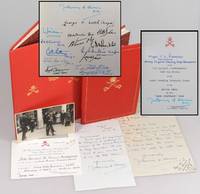
004319Aldershot. This archive centers on the Centenary of the British Army Physical Training Corps A.P.T.C. at Aldershot and one of its most famous sons Field Marshal Bernard Law Montgomery Corps Commandant from 1946-1960. Spanning 1958 to 1962 the archive includes: two books signed by Montgomery two holograph signed letters from Montgomery a signed note on the verso of an invitation and an original photograph. The books are a 1960 Centenary publication about the A.P.T.C. and a 1960 Presentation of the Freedom of the Borough of Aldershot to the A.P.T.C. Both bindings feature the same marbled endpapers and the Corps gilt crossed swords device on the front cover. <br /> <br />The Centenary is strikingly bound in full red morocco with an elaborate glassine jacket featuring a web motif and housed in a red cloth case lined with matching marbled paper. Profusely illustrated the Centenary opens with a facsimile holograph Forward by Montgomery opposite his frontispiece portrait. Montgomery offers the volume as an account of the development of physical training in our Army during the past hundred years. Affixed to the front free endpaper is a special printed plate hand addressed to Major T. L. Fletcher Secretary Army Physical Training Corps Association and signed Montgomery of Alamein F.M. above his printed title Colonel Commandant Army Physical Training Corps. <br /> <br />The Presentation book is bound in red cloth the front free endpaper boldly signed by Montgomery of Alamein F.M. as well as thirteen other individuals including T.L. Fletcher and Aldershot civic leaders. Condition of both books is exceptional. A 9 August 1958 holograph letter from Montgomery on personal letterhead from Trianon Palace Hotel Versailles conveys regrets for a Reunion event citing The 13 and 14 September is my last week in NATO and promising Next Year 1959 I will be with you. A red WAR OFFICE ink stamp is dated 12 AUG 1958 and ink notation from T. L. Fletcher at the lower right states that the letter is to be Read out at The Reunion Dinner. A printed and autograph invitation to the 16 September 1961 Corps Annual Reunion Dinner is inked in red by Montgomery on the verso: I regret it is not possible for me to attend. I will be in China in September. and is signed M of A 15-7-61 with subsequent notation dated two days later by Major Fletcher at the upper left corner. <br /> <br />The final piece of correspondence is an autograph note from Montgomery to the new Training Corps Commandant thanking him for a telegram regarding the Annual Reunion. This note is on Isington Mill Alton Hampshire Montgomerys home stationery dated 17-9-62 and signed Montgomery of Alamein. Purple ink stamped at the upper left reads: ARMY SCHOOL OF PHYSICAL TRAINING 18 SEP 1963 ALDERSHOT. A 13.75 x 8.5 cm photograph of Montgomery in dress uniform ostensibly in Aldershot for the 1960 Training Corps Centenary - is stamped on the verso NATURAL FOTOS with an ALDERSHOT HANTS address. <br /> <br />In 1854 the heathland of Aldershot became the site of the first permanent training camp for the British Army and has since remained the Home of the British Army. Major T. L. Fletcher was an Army Physical Training Corps Master-at-Arms from 1939-1954 and served as Honorary Curator of the Army Physical Training Corps Museum. During fifty years in the British Army Field Marshal Bernard Law Montgomery 1st Viscount Montgomery of Alamein 1887-1976 became the outstanding British field commander of the twentieth century. ODNB He earned fame in North Africa during the Second World War later commanding Allied ground forces during the Normandy invasion. After the war he rose to Chief of the Imperial General Staff and retired in 1958 as NATOs deputy supreme commander. Lines of Aldershot barracks bear the names of great British military leaders. In April 1965 Montgomery was at Aldershot to formally open the Montgomery lines which are still in use. <br/><br/> hardcover