52 résultats
1572D4701Venice: F. Rampazeto 1572. Hardcover. Very Good. 8vo 175 x 120mm. 48 366pp. Signatures: a-f 8; A-YY 8; ZZ 8 -ZZ7-8 blank. Woodcut printers device on title of basilisk fighting a bird with motto Terrena coelestibus obsunt; in an architectural frame and woodcut historiated headpiece woodcut vignette beginning book of the Institutiones; on leaf 212r a full-page representation of the arbor civilis. Text is all-around gloss; printed in black and red. Dedicatory letter of H. Messaggius to Senator Federicus Baduarius prelim. leafs 2 is dated 1558. Period vellum three raised bands; leaves slightly offset slightly browned; hinge cracked at rear some quires loose rear pastedown glue-stained. The Corpus Iuris Civilis or the Justinian Code was the result of Emperor Justinians desire that existing Roman law be collected into a simple and clear system of laws or code. Tribonian a legal minister under Justinian lead a group of scholars in an effort to codify existing Roman law. The result was the first Justinian Code completed in 529. This code was later expanded to include Justinians own laws as well as two additional books on areas of the law. In 534 the Justinian Code made up of the Code the Digest and the Institutes was completed. Justinians collections were in ancient times always copied separately and afterwards they were printed in the same way. This part of the Institutiones falls under the whole Corpus Iuris Civilis is an early example before the unification under this heading. The present name of Justinians codification was only adopted in the 16th century when it was printed in 1583 by Dionysius Gothofredus. The legal thought behind the Corpus Juris Civilis served as the backbone of the single largest law reform of the modern age the Napoleonic Code which marked the abolition of feudalism. <br/><br/> [F. Rampazeto] hardcover
1581616552Ingolstadt, W. Eder, 1581. 4to. 16 Bl. Mit fast blattgr. Wappen-Holzschnitt Titel verso. Geheftet. [2 Warenabbildungen]
1585616894Straßburg, A. Bertram, (etwa ca. 1585. 4to. 18 Bl. Neuer Rückenfalz.
1590616896Straßburg, A. Bertram, (etwa ca. 1590. 4to. 16 Bl. Mit Holzschnitt-Druckermarke auf d. Titel. Neuer Rückenfalz.
1595616895Straßburg, A. Bertram, (etwa ca. 1595. 4to. 22 Bl. Neuer Rückenfalz.
1593616556Ingolstadt, W. Eder, 1593. 4to. 1 Bl., 21 S. Mit Holzschnitt-Titelbordüre. Geheftet.
1552617178Paris, C. Guillard et al. 1552. 8vo. 58 nn., 147 num., 1 weißes Bl.; 2 nn. Bl., num. Bl. 148-312. Mit Holzschnitt-Druckermarke (wiederholt). Moderner Pappband.
157118254Gulielmum Rouillum. Good. 1571. Hardcover. Bound in full leather. The top of the spine has been repaired with another piece of leather glued on. The binding is splitting at the bottom of the spine. Contents have been trimmed at the top but are otherwise "fine". ; 32mo 4" - 5" tall; 1116 pages . Gulielmum Rouillum hardcover
1573610737Basel, Oporinus, 1573. 8 Bl., 611 S., 22 Bl. Mit 3 gefalteten Tabellen. Flexibler Pergament d. Zeit mit Schließbändern (angestaubt). [2 Warenabbildungen]
15627634BBFrankfurt am Main, Christian Egenolff Erben, 1562. Folio. (6) Bl., 157 Bl. Titel in rot und schwarz, mit reicher figürlicher Holzschnitt-Einfassung. Auf Verso Porträt-Medaillons mit den Bildnissenvon Gobler und Egenolff. Kalbldr. d. 18. Jh., Rücken mit Blindprägung. + Wichtig: Für unsere Kunden in der EU erfolgt der Versand alle 14 Tage verzollt ab Deutschland / Postbank-Konto in Deutschland vorhanden +, A|B|C [3 Warenabbildungen]
1595183271Frankfurt/M. Basse, 1595. 8 Bl., 750 (recte 752) S., 84 Bl. HSchweinsldrbd. d. Zt. Einbd. angeschmutzt, beschäd. u. wurmstichig. Vord. Bindung gelockert. Durchg. gebräunt, teils braunfl. u. m. Nässespur. M. einzelnen Marginalien von alter Hd. Titel in Rot u. Schwarz.
1530600803Lyon, Seb. Gryphius, 1530. Folio. 268 S., 8 Bl. Mit Holzschnitt-Titelbordüre und Holzschnitt-Druckermarke. Moderner Halbleder mit Rückenschild.
1577631667Ingolstadt, D. Sartorius, 1577. 4to. 10 Bl. Mit fast blattgr. Wappen-Holzschnitt Titel verso. Geheftet. [2 Warenabbildungen]
1597251859Frankfurt, Spieß für Saur, 1597. 16 Bl., 229 S., 5 Bl.; 8 Bl., 581 S., 5 Bl.; 328 S., 4 Bl. Pergament d. Zeit (gebräunt u. fleckig, freie Vorsätze u. Schließbänder fehlen, Bezug der Spiegel teils mit Wurmspuren u. an den Kanten geplatzt). [3 Warenabbildungen]
1581616551Ingolstadt, W. Eder, 1581. 4to. 14 Bl. Mit Holzschnitt-Titelbordüre u. Holzschnitt-Bordüren im Text. Geheftet. [2 Warenabbildungen]
1575617022Köln, J. Gymnich, 1575. 8 Bl., 388 (recte 384) S. Mit kleiner Holzschnitt-Druckermarke auf dem Titel u. 5 großen Holzschnitt-Initialen aus einem Figuren-Alphabet. Moderner Pappband.
1588186757Köln, J. Gymnich, 1588. M. kl. Holzschnittdruckermarke a. Tit. 30 Bl., 636 S. Ppbd. d. Zt. m. Rsch. Einbd. bestoßen u. berieben. Gebräunt, teils leicht braunfl. Eigentumsverm. a. Innendeckel.
1579616550Ingolstadt, W. Eder, 1579. 4to. 2 Bl., 15 S. Mit Holzschnitt-Titelbordüre. Geheftet.
1591485914(Lyon, cum Licentia, 1591). 32 Bl., 1273 (recte 1272) Spalten; 9 Bl., 754 Spalten; 5 Bl., 406 Spalten; 4 Bl., 158 Spalten, 21 Bl. Pergament d. 18. Jahrhunderts (fleckig). [3 Warenabbildungen]
152932012Paris, apud Galliotum Praetensem, 1529. Groß 8°. Beschädigter, wohl späterer Halbledereinband. [5 Warenabbildungen]
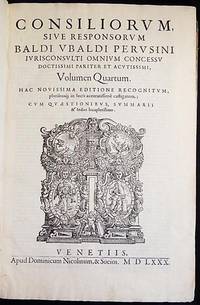
1580003503Venice: apud Dominicum Nicolinum & Socios Domenico Nicolino 1580. Hardcover. Very Good . Vols. 4 & 5 of 5 only. 2 volumes in 1. "Hac novissima editione recognitum pluribusq; in locis accuratissime castigatum; cum quaestionibus summarii & indice locupletissimo." 117 leaves 234 p. 139 leaves 278 p.; 37 cm. Signatures: A-P8 -P7 -P8 A-R8 S4 last leaf blank folio. Original parchment over boards. Five spine compartments between raised bands; hand-written title in first compartment. Handwritten identification also on lower page edges. Large and elaborate printer's device on title pages which combines the earlier printer's device of Domenico Nicolino a woman holding a wreath with three others presumably of the partners Socios referred to in the imprint. In Very Good Condition: original parchment over boards rubbed and soiled with loss of parchment at ends of spine and over raised bands; loss at lower corner of front board; small stain along lower edge of 5:2-22 not impacting text; minor soiling along lower edge of 5:42 verso and 5:43 recto; marginal worming in vol. 5; otherwise clean and bright. apud Dominicum Nicolinum, & Socios [Domenico Nicolino] hardcover
1569616549Ingolstadt, A. Weissenhorn, 1569. Kl.-4to. 4 Bl. Neuer Rückenfalz.
1587600493Frankfurt, Feyerabend, 1587. Folio.. 12 Bl., 956 Sp.; 12 Bl., 532 S.; 4 Bl., 64 Sp., 32 Bl.; 30, 76, 1 Bl. Blindgeprägter Schweinslederband der Zeit auf 5 Bünden
1551616951Lyon, J. de Tournes u. G. Gazeau, 1551. 16, 272 S. Mit Holzschnitt-Druckermarke auf dem Titel. Leder d. Zeit (leicht berieben, Rücken unter Verwendung alten Materials ausgebessert u. mit kleinen Fehlstellen oben u. unten, Rückdeckel mit Wurmfraß an der oberen Ecke und etwas abgestoßen). [2 Warenabbildungen]
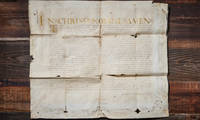
15852363525/09/1585. <blockquote><p>The Renaissance was a period of crucial cultural artistic social and financial development in late Medieval and Renaissance Italy and particularly the affluent cities of Florence Venice Genoa and Padua.</p></blockquote><p>The Holy Roman Empire spanned central Europe in one form or another for the span of a millennia. For much of that time it contained vast swaths of Italy mainly in the north and included the Italian city of Padua which would become a hub in the Renaissance in that country and a major university center. As the Middle Ages bled into the period of the Renaissance the Empire slowly lost direct control over Italy. It managed to maintain its power into the 16th century in part via old established orders that maintained local control.</p><p>Among these Holy Roman imperial titles was the ""comes palatinus caesareus"" or the imperial count palatine. The office of imperial count palatine was hereditary and the emperors seem to have used it to create an Italian aristocratic class loyal to the empire. In 1357 the Emperor Charles IV added the power of conferring licenses and doctorates of civil law to those of the counts palatine. Later on they acquired the power to confer doctorates in general. In 1363 Charles himself bestowed this honor to Giacomo Santacroce. His heir to this title and power given by it which was significant was Giovanni Santcroce who in addition to being the benefactor for religious and cultural efforts in the region was a businessman.</p><p>The Facino or Facini family was a prominent one from the town of Feltre. The Ioannes Baptista Facinus namd in the document was prominent in the cultural community. There remains today a church bearing the crest of this family constructed shortly before his birth.</p><p>Francisco Fabriano and Andreas Tinto were important functionaries and notaries of the period in Padua.</p><p><strong>Document signed</strong> September 25 1585 in Latin using the Latin names of the people involved including The Holy Roman Emperor Charles signed by important figures of the late Italian renaissance. In it <em>""Ioannes Sancta Cruce""</em> bestows the position of <em>""comes palatinus caesareus""</em> on <em>""Ioannes Baptista Facinus""</em> and all his male heirs. The document is witnessed and signed not only by Santa Cruce himself described as <em>""the most excellent lawyer lord count soldier knight horseman of the Court of Caesar""</em> but also by Fabriano and Tinto. The document is likely in the hand of Tinto himself.</p><p>Such Italian Renaissance documents are very uncommon. The most direct comparable was acquired by J.P. Morgan and is now in the Morgan Library.</p><p>There is an extended portion in the middle about Holy Roman Emperor Charles IV who it describes in 1357 added the power of conferring licenses and doctorates of civil law to the position.</p><p><img class=""alignnone wp-image-23609 size-post-window"" src=""https://cdn.raabcollection.com/wp-content/uploads/20231204153244/Folder-site-6-1600x1327.jpg"" alt="""" width=""1600"" height=""1327"" /></p> unknown