15 758 résultats
1983480873Commerce Clearing House. Very Good/No Dust Wrapper. 1983. 2 Volume Set. Hard Cover. I406 . Commerce Clearing House hardcover
201067337New York NY: Oxford University Press 2010. First Edition 1st printing . Trade Paperback with Flaps. Good -/No Jacket as Issued. 8vo - over 7¾" - 9¾" tall. 312pp. Index. Original wraps. 1st Printing with complete number line. Pages are bright and clean no writing underlining or highlighting. Front hinge is cracked but still secure. Inner text block is tight with no cracks or breaks. Covers are slightly scuffed with a vertical crease across front panel. Shelfwear small nick to head of spine light rubbing to extremities. This is not a remainder or ex-library. No previous owner amrkings. Nice reading copy. <br/> <br/> Oxford University Press paperback

19795591317Sijthoff & Noordhoff 1979. This is an ex-library book and may have the usual library/used-book markings inside.This book has hardback covers. Book contains pencil markings. In poor condition suitable as a reading copy. No dust jacket. Please note the Image in this listing is a stock photo and may not match the covers of the actual item650grams ISBN:9028608281 Sijthoff & Noordhoff hardcover
1975002216New Haven CT U.S.A.: Yale University Press 1975 1975. Hardcover. Good. Hard Cover. Good/Fair. Signed by Editor. 8vo - over 7¾" - 9¾" tall. Personal inscription and signature by book editor/not an ex-library book/ book shows moderate wear/ D.J. has several small tears rips and creases/ D.J. not price clipped/ corners lightly bumped/spine tight pages cleanWe ship most book within 24 hoursCustomer satisfaction 100% guaranteedOver 22 years of experience in the book selling community New Haven, CT, U.S.A.: Yale University Press, 1975 hardcover
1938037314New York: Will Durant WOR 1938. Carbon Typescript . No Binding. Very Good. 11" x 8 1/2. 16 full pages of carbon typescript. Durant's typescript carbon copy dated April 7 1938 at end with his pencil note "uncorrected" at top of first page. Typewritten and pencil corrections to the carbon typescript. From his estate. <br/> <br/> (Will Durant) WOR unknown
1945037325New York: Will Durant WGN 1945. Carbon Typescript . No Binding. Very Good. 11" x 8 1/2. 2 Full Pages Only Of Carbon Typescript Pp. 5 And 6 Of A Larger Typescript. Durant's Typescript Carbon Copy Dated February 6 1945 With Broadcast Date Of Fe. 11 For The Wgn Program Sponsored By Carson Pirie And Scott. From His Estate. <br/> <br/> (Will Durant) WGN unknown
1935037312New York circa 1935: Will Durant 1935. Carbon Typescript . No Binding. Very Good. 11" x 8 1/2. 8 full pages. Durant's typescript carbon copy of his column double spaced paginated at top of each page undated with his pencil note "uncorrected" at top but with some typed pencilled and inked corrections throughout. The manuscript is incomplete lacking pages after 8. From his estate. <br/> <br/> Will Durant unknown
1935037313New York: Will Durant WOR 1935. Carbon Typescript . No Binding. Very Good. 11" x 8 1/2. 6 full pages of carbon typescript with another version of page one in original typescript. Durant's typescript carbon copy of his radio talk on WOR 10:15PM October 15 1935 double spaced paginated at top of each page dated. One pencil correction to the original typescript. From his estate. <br/> <br/> (Will Durant) WOR unknown
12578Thames House Millbank SW1. On House of Commons letterhead. 12 May 1933. Copy of Starmer's reply dated the same day. Both Sylvester's letter and the copy of the letter by Starmer to which it is replying are in good condition on lightly-aged paper each with punch holes to one margin. Starmer who at the time of writiing was proprietor of a large group of newspapers had begun his career on the 'Northern Echo'; he had for many years been a Liberal member of parliament standing down in 1931 due to ill health. Cober Hill Guest House was at that time an early experiment in what would become the children's home or retreat. For clarity's sake this description begins with the copy of Starmer's letter: 1p. 4to. 17 lines. 'The Guest House is about 15 miles from Whitby and you pass it on the way to Scarborough. Last Saturday Prince George was at the Guest House and was very much interested in what is being done. This is only the beginning of an effort of this kind so far as the "Northern Echo" is concerned.' He would like to be present if Lloyd George visits and asks Sylvester to let 'Miss Andrews the general manager know. If it is a sudden visit I suggest you should telephone Cober Hill and let Miss Andrews know so that she can have the children on view. Otherwise they might be on the sands or taken into Scarborough for the day.' Sylvester's letter: 1p. 4to. 17 lines. Addressed to Starmer at the Westminster Press Ltd The Newspaper House Fleet Street. It is not possible to give 'a definite answer' regarding the planned visit. 'The situation is this. Mr. Lloyd George must return to London on the 1 p.m. train by Tuesday. He is due to speak in good time that morning but he does not know how long the discussion will last.' He thinks it would be best for him to telephone 'to Miss Andrews'. He apologises for the short notice: 'it will not give you an opportunity of being there personally which I am sure Mr. Lloyd George would have liked.' Thames House, Millbank, SW1. On House of Commons letterhead. 12 May 1933. Copy of Starmer's reply dated the same day. unknown
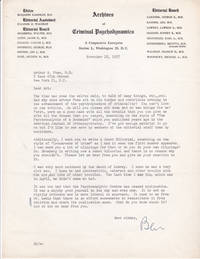
195735690Washington DC: November 18 1957. 1957. Fine. - Typed letter filling one side of an approximately 11-inch high by 8-1/2 inch wide sheet of Archives of Criminal Psychodynamics letterhead with Karpman's name printed at the top as Editor and Foxe's name as a member of the Editorial Board. Signed "Ben". There are 2 tiny marks to the top left corner. Folded twice for mailing. Near fine. Karpman writes to Freudian psychiatrist and expert in criminology Dr. Arthur Foxe entreating him to write an article for the Archives and also to contribute a guest editorial. "The time has come the walrus said to talk of many things etc. etc. And why does Arthur Foxe sit on his touchus and contribute nothing to the advancement of the psychodynamics of criminality You can't live on one article. So will you please sit down and do two things for me First work on a good case with all the details that you can give me with all the dreams that you can get something on the style of 'The Psychoanalysis of a Sodomist' which you published years ago in the American Journal of Orthopsychiatry. Additionally I want you to write a Guest Editorial."<p>Benjamin Karpman 1886-1962 was an American psychiatrist known for his work on human sexuality. He served as Professor and Head of Psychiatry at Howard University College of Medicine from 1921 to 1941. He was critical of the treatment of criminals by law and by medicine. "The question is simply 'Is the accused sick or not' You can'r have mental illness and criminal responsibility in the same person at the same time." Washington, DC: November 18, 1957. unknown
43456regretting "that I am unable to accept your kind invitation to become a Patron of the Victory Club for Ladies but I am afraid however that my official work makes this impossible." 11 Downing Street headed paper 17th July Law first held Cabinet office as Secretary of State for the Colonies in H. H. Asquith's Coalition Government May 1915 December 1916. Upon Asquith's fall from power he declined to form a government instead becoming Chancellor of the Exchequer in David Lloyd George's Coalition Government. He resigned on grounds of ill health early in 1921. unknown
39014saying that he did receive "your letter of the 10th inst and thank you for your kind congratulations." 1 side 4to. together with the hand written envelope and an unsigned postcard photo Pembroke Lodge Kensington 20th November It appears that his typewriter had stopped working so he wrote over the text in pencil. In 1911 Law was appointed a Privy Councillor and stood for the vacant party leadership. Despite never having served in the Cabinet and despite trailing third after Walter Long and Austen Chamberlain Law became leader when the two frontrunners withdrew rather than risk a draw splitting the party. He became leader on 13th November a week before this letter. unknown
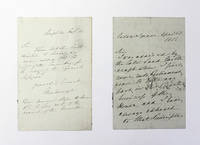
1856029028UK 1856. First Edition . Paper. Good. 48mo - over 3 - 4" tall. Two Original Handwritten and Signed Letters by Politician and Former Governor-General of India Edward Law 1st Earl of Ellenborough. Dated 1856 and undated. Both letters discuss political matters. Edward Law 1st Earl of Ellenborough 1790-1871 was a British Tory politician. He was four times President of the Board of Control and also served as Governor-General of India between 1842 and 1844. Size of letters 185mm x 120mm. Condition is good. Light age toning. Light folding creases. Gum marks to the rear edge of one letter. More images can be taken upon request. Ref18068 <br/> <br/> unknown
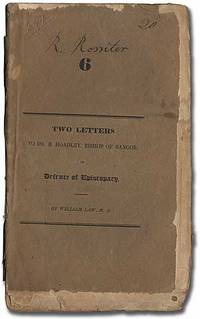
1830285602Philadelphia: Jesper Harding 1830. Softcover. Very Good. First edition. Brown printed wrappers. Untrimmed. 92pp. Some wear to the wrappers a few light stains and some foxing to the text very good. Jesper Harding unknown
257481350. <blockquote><p>This work takes its place on the lineage of great early works along with the Arthurian tales</p><p> </p><p>These are exceptionally early witnesses to this most important literary text the most popular secular work of the entire Middle Ages</p><p> </p><p>Appearances of this seminal text are uncommon only a handful having reached the market in decades</p><p> </p><p>Linguistic variations suggest a non-Parisian scribe; evidence of re-use in the 17th century from manuscript markings</p></blockquote><p>video width=""1920"" height=""1080"" mp4=""https://cdn.raabcollection.com/wp-content/uploads/20231204130246/Roman-de-la-Rose.mp4""/video</p><p> </p><p>The influence of the Old French allegorical poem the Roman de la Rose ripples through the Middle Ages into the Renaissance even into Modernity attracting the attention and inspiring the works of Chaucer Dante and C. S. Lewis. Lewis even stated that in cultural importance it ranks second to none except the Bible and the Consolation of Philosophy Allegory of Love 1936 p. 157.</p><p>The Roman de la Rose according to Lewis was an important step in the development of Western literature and thought. He wrote in the above work “We have seen how… in the hands of a great poet the Arthurian story treated in terms of courtly love produced the first notable examples of psychological or sentimental’ fiction… The radical defect in Chrétien’s poetry is that these two kinds of interest lie side by side in it without being really fused. The emotions of Lancelot and Guinevere are not really illustrated save in a very shallow sense by their adventures; their adventures are not really explained by their emotions.â€</p><p><img class=""alignnone wp-image-25764 size-post-window"" src=""https://cdn.raabcollection.com/wp-content/uploads/20231204140340/Roman-B-1-e1667227860712-1600x744.jpg"" alt="""" width=""1600"" height=""744"" /></p><p>This defect of emotional appeal of the primacy of love is rectified per Lewis in Roman de la Rose. “But the whole truth about Guillaume author of the Roman is missed until we see that he is more of a realist than Chrétien Chretien de Troyes fl. c. 1160–1191 was the author of some of the fundamental texts of Arthurian lore. Of the two things that he found in Chrétien it was the fantastic that he rejected and the natural that he used.â€</p><p>The great success then of the Roman de la Rose was fairly novel use of allegory to highlight the emotional journey of love as it would have appeared to someone at that time and in a courtly setting.</p><p><img class=""alignnone wp-image-25765 size-post-window"" src=""https://cdn.raabcollection.com/wp-content/uploads/20231204140328/Roman-A-1-e1667227983201-1600x752.jpg"" alt="""" width=""1600"" height=""752"" /></p><p><strong>Summary of the Romance of the Rose:</strong></p><p>In 1230 Guillaume de Lorris began the dream-vision poem a first-person narrative describing the efforts of a young man stricken by the arrows of the God of Love to obtain his beloved the Rose. Guillaume’s Amant Lover wished to tell the reader all that he knew of love and the poem describes a dream in which Amant is taken by Oiseuse Leisure into a pleasure garden where he meets the allegorical figures of Deduiz Pleasure Deliz Delight Cupid and others finally catching sight of and falling in love with the Rose. He is held back by the figures of Dangier Danger Honte Shame Mal Bouche Scandal and Jalousie Jealousy who imprison the Rose in a castle after Amant attains a kiss from the Rose.</p><p>Death claimed Guillaume before he was able to conclude his work. He is only remembered to us through a mention by the poem’s successive author Jean de Meun a friend of Dante who resumed the poem around 1275 adding around 17700 more lines to the approximately 4000 extant lines. There are therefore 2 authors for this same work separately themselves by a relatively great span of time each with his own milieu and sensibilities.</p><p>Both authors use the allegory to examine philosophical cruces emerging in the 13th century through scholasticism such as free will and determinism optics and the adjusting social orders which put mendicant friars in positions of increasing power. However Jean’s vision for how the Lover relates to his beloved— what he is prepared to do— diverges from Guillaume’s.</p><p>Jean provides a mirror for the turn from chivalric romances and courtly love which guided Guillaume. Jean’s social and political commentary sees the Lover deceiving and achieving the Rose in a way that that shifts away from the idealized and innocent sensuality of the first part of the poem to a biting satire on contemporary society blended with an overt realization of sexuality. Jean’s Amant makes war on the castle debates with Reson Reason Nature and Genius and finally enters the inner chamber of the Rose. His advice to the lover includes sections on how a man should keep his mistress study the arts ignore any infidelities offer flattery but never advice and how a lady might keep her male lover use false hair make up and perfume avoid getting so drunk you fall asleep at dinner only have intercourse in the dark to hide imperfections of the body and avoid poor men and foreigners - except very rich ones.</p><p>caption id=""attachment_25767"" align=""alignnone"" width=""1600""<img class=""wp-image-25767 size-post-window"" src=""https://cdn.raabcollection.com/wp-content/uploads/20231204140309/Roman-D-1-e1667228165675-1600x828.jpg"" alt="""" width=""1600"" height=""828"" /> Notes from use in the 17th century/caption</p><p><strong>The Manuscript & the Manuscript Tradition:</strong></p><p>Manuscript scholars have attempted to calculate the survival rate of medieval texts. Usually this calculation is done by comparing the catalogues of library books with known copies. Earlier in 2022 a team at the University of Antwerp has applied statistical principals usually used for tracking wildlife to estimate that approximately 9% of medieval manuscripts have survived to present day.</p><p>Johns Hopkins University and the Bibliotheque nationale de France have listed 324 known manuscript copies of the Roman de la Rose from the 13th 14th and 15th centuries exceeding the number of manuscripts of the works of Dante and Chaucer. With the suggestion of an original 3600 copies of the Roman de la Rose based on the 9% survival rate we are looking at what remains of a medieval best-seller. Yet few of these reach the market.</p><p><strong>Medieval manuscript poem</strong> 14th century France consisting of 2 double-sided folia from the Roman de la Rose from key sections of this great manuscript see “further details†below for a detailed entry and the Johns Hopkins system of categorization. There are manuscripts notations from use in the 17th century likely as binding.</p><p>This fragment opens with Friend’s advice to the lover to guard that Scandal doesn’t see him approach the castle where the Rose is kept. If the lover is spotted by Scandal he should not show hatred or rancor towards him ‘de hayne ne de racune’ because “a wise man covers his bad humour… those who deceive deceivers do a good deed and all lovers at least the wise ones should do so†‘sages hommes son maul talent ceuvre. cil fet bone euvre qi les decheveeurs decoivent…faire le doivent tretuit amans au mains li sage.†The scribe of this text has stricken through a line of his text “si sachies que cil fet bone euvre†which he was a repeat of two lines above. Jean de Meun’s jaded narrative has Friend giving the lover the advice to “serve and honor†Scandal and all his lineage ’tout son lignage’ because it is “no sin to trick those who are tainted by trickery†‘De ceus bouler nes pas pechies qi de bouler sont entechies’. And Scandal is indeed a boulierre a trickster. Friend goes on to explain the shameful tricks that Scandal’s bad mouth plays on men to steal— money and reputation. Friend warns that Old Woman and Jealousy also guard Bel Acueil Warm Welcome the lover’s companion who has also been taken into the castle. Through false courtesy bribes and weeping— even false weeping— will be needed for Amans to make his way through the castle.</p><p><img class=""alignnone wp-image-25768 size-post-window"" src=""https://cdn.raabcollection.com/wp-content/uploads/20231204140257/Roman-E-1-e1667228257297-1600x856.jpg"" alt="""" width=""1600"" height=""856"" /></p><p>At this point the fragment breaks off and resumes nearly a thousand lines later. The break in lines from one folio to the next from lines 7301-7379 to 8415-8575 occurs because of the way the book was put together. Large leaves of vellum were folded in half to create bifolia which were in turn nested into one another to create gathering of folios or pages in a modern sense. Since the folded bifolia were still attached a loose bifolia will contain text that jumps from one folio to the next. This is to say that the text on a bifolium will not follow sequentially unless it is the very center of the quire.</p><p>We reenter the narrative as Friend is telling of an idyllic time which slides slowly towards Jean de Meun’s cynicism but also with a great statement of the primary of love over earthly physical power and domination — “No king or prince had yet committed any crime by robbing and seizing from another. All were accustom to being equal and no one wanted any possessions of his own. They knew well the saying neither lying nor foolish that love and lordship never kept each other company nor dwelth together. The one that dominates separates them†“N’encor n’avoit fet roy ne price Meifet qui lautrui tout et pinche Testuit pareil estre souloient Ne riens propre avoir ne vouloient. Bien savoient ceste parole Qui nest mencongiere ne fole Conques amour et seignourie Ne sentrefirent compaignie Ne ne demourerent pas ensemble: Cil qui mestrie les dessemble’. Immediately following this the relationships between a jealous husband and frivolous wife is examined. Jealousy laments his own marriage and the bygone days of women like the Grecian Penelope of Homer’s Odysseya who waited loyally on Odysseus’s return.</p><p><strong>A Note on the Rarity:</strong></p><p>The text is far from common on the market with the vast Schoenberg database listing only ten codices appearing at auction since the 1970s and only three of those of the fourteenth century: Christies' 7 June 2006 lots 23 and 31 once Phillipps MS. 2838 and 4185 now both Senshu University Japan; and another in the same rooms 9 July 2001 lot 12; Sotheby's 17 June 1997 lot 6 once Phillipps MS. 129; Drouot 16 December 1994 lot 1; another in the same rooms 9 December 1992 lot 371; Ader Picard Tajan in Paris 16 September 1988 lot 152 this previously in Sotheby's New York sale of Carleton Richmond's library in 1981; the Astor copy sold in Sotheby's 21 June 1988 then Beck collection and stolen; Christie's 25 June 1980 lot 232 once Phillipps MS. 4357 now in the Ferrell collection; another sold in Ader Picard Tajan in Paris 20 May 1980 lot 60; and that sold in Sotheby's 13 July 1977 lot 48 to Peter Ludwig and thence to the Getty Museum. Fragments seem to come to the market even less frequently with the last examples in Christie's 30 May 1984 lot 200 a small miniature trimmed to its edges from a manuscript of the second half of the fourteenth century; Alde Libraire Giraud Badin 8 June 2012 a fourteenth-century leaf most probably the missing first leaf of Columbia University Plimpton MS. 284; and two fifteenth-century bifolia recovered from bindings sold through Dreweatt’s 6 July 2017 lots 34 and 35.</p><p><img class=""alignnone wp-image-25769 size-post-window"" src=""https://cdn.raabcollection.com/wp-content/uploads/20231204140244/Roman-F-1-e1667228424857-1600x828.jpg"" alt="""" width=""1600"" height=""828"" /></p><p><strong>The Scribe and His France:</strong></p><p>While the parent manuscript of the present leaves was probably a Parisian product and made for an aristocratic audience in the early 14th century the scribe of the manuscript probably came from farther afield than the ÃŽle-de-France.</p><p>Comparing the paleographic style the manuscript is similar to a manuscript at Oxford Bodleian MS Selden Supra 57 composed in 1348 in Paris arriving in the Bodleian Library in 1659. However a comparison of a sampling of 10 lines from both manuscripts reveals an interesting linguistic difference between the Parisian manuscript and the fragments here.</p><p>Lines 7307-7316 Selden Sura 57 on left fragment on right with differences in bold.</p><p><strong>Nene fetes chiere neisune/ ne faites chiere neysune</strong></p><p>De <strong>haine</strong> ne de rancune;/ de <strong>hayne</strong> ne de rancune ;</p><p>Et se vous ailleurs l'<strong>encontrez</strong>/et se vous ailleurs <strong>lencontres</strong></p><p>Nul mautalent ne li <strong>montrez</strong>:/nul mautalent ne li <strong>monstres</strong> :</p><p>Sages hons son mautalent <strong>cueure</strong>/ sages hommes son mautalent <strong>ceuvre</strong></p><p>Si <strong>sachiez</strong> que cil<strong> font bonne eur</strong>e/ si <strong>sachies</strong> que cil <strong>fet bone euvre</strong></p><p><strong>Qui</strong> les <strong>deceveours</strong> decovient;/ <strong>qi</strong> les <strong>decheveeurs</strong> decoivent;</p><p><strong>Sachiez ainsi fere</strong> le doivent/ <strong>sachies</strong> <strong>qu’ainssi</strong> faire le doivent</p><p><strong>Trestuit</strong> <strong>amant</strong> au <strong>mainz</strong> li sage./ <strong>tretuit amans</strong> au <strong>mains</strong> li sage.</p><p>Male Bouche et tout son linage/ Male Bouche et tout son lignage</p><p>We can examine another stylistically manuscript from Central France likely Paris in the 4th quarter of the 14th century London British Library MS Add. 42133.</p><p>Lines 7307-7316: Add. 4233 left Selden Sura 57 middle fragment right with differences in bold.</p><p>Nene fetes chiere <strong>nisune</strong>/ Nene fetes chiere <strong>neisune</strong>/<strong> ne faites</strong> chiere <strong>neysune</strong></p><p>De hayne ne de racune/ De <strong>haine</strong> ne de rancune;/ de hayne ne de rancune ;</p><p>Et se vous ailleurs lencontrez/Et se vous ailleurs l'encontrez/et se vous ailleurs <strong>lencontres</strong></p><p>Nul <strong>maltalent</strong> ne li monstrez/ Nul mautalent ne li montrez:/nul mautalent ne li <strong>monstres</strong> :</p><p>Sages hommes son <strong>maltalent</strong> cueure/ Sages hons son mautalent cueure/ sages hommes son mautalent <strong>ceuvre</strong></p><p>Si sachiez que cil font bonne <strong>oeure</strong>/Si sachiez que cil font bonne <strong>eure</strong>/ si sachies que cil fet bone <strong>euvre</strong></p><p>Qi les <strong>deceveurs</strong> decoivent/ <strong>Qui</strong> les <strong>deceveours</strong> decovient;/ qi les <strong>decheveeurs</strong> decoivent;</p><p>Sachiez quainsi fere le doivent/ Sachiez ainsi fere le doivent/ sachies qu’ainssi faire le doivent</p><p><strong>Tretuit</strong> amant au mains lo sage/ <strong>Trestuit</strong> amant au <strong>mainz</strong> li sage./ tretuit <strong>amans</strong> au mains li sage.</p><p>Male Bouche et tout son <strong>linguage</strong>/ Male Bouche et tout son <strong>linage</strong>/ Male Bouche et tout son <strong>lignage</strong></p><p><img class=""alignnone wp-image-25770 size-post-window"" src=""https://cdn.raabcollection.com/wp-content/uploads/20231204140228/Roman-G-1-e1667228920615-1600x832.jpg"" alt="""" width=""1600"" height=""832"" /></p><p>Comparing the fragment of the Rose with the other dated and located copies of the same text invites out the linguistic diversity of Old French the pre-Modern French in use from the 8th to 14th centuries. “Old French†is somewhat of an umbrella term housing the attested dialects that comprised the linguistic landscape of the Francophone region. The French spoken in the Paris region at this time is known as Francien in Champagne it is Champeniose Picard is Picardie Normans spoke Normand and the French of England is often called Anglo-Normand. These are only a sampling from the five linguistically distinct regions in the overarching region of langue d’oil France roughly the distinction between Northern France where they say oui for yes and Southern France where they say oc for yes. A simplified map of the langues de oil are represented below:</p><p>While some differences in the orthography of the Rose texts can be due to the lack of standardization in spelling in this period the differences can help us better understand the most likely profile of the scribe and can likely rule out a Parisian scribe who would have been native in the Francien-dialect. We begin to suspect that the scribe of these fragments was more likely to have come from a region outside of Paris. The data suggests Hainaut Orleans Indre-et-Loire or Ardennes as likely regions with overlap of the linguistic features. Two of these areas Hainaut and Ardennes are geographically close north and northeast of Paris while Indre-et-Loire and Orleans are further southwest from Paris.</p><p>Though inconclusive we can begin to paint a picture of our writer: a talented scribe arriving in Paris and adapting the Parisian style of writing but never losing his regional flare or maybe he was commissioned by a family of one of these areas and was delighted for the opportunity to produce a manuscript in his own dialect rather than Francien.</p><p><strong>Further details:</strong></p><p>Jean de Meun section of Roman de la Rose in Old French with regional features from outside of Paris <strong>illuminated manuscript on parchmen</strong>t northern France mid-fourteenth century Two large leaves each with double column of 40 lines of an early gothic French vernacular hand with lines 7301-7379 and 8415-8575 of the poem with one-line initials offset in margins 2-line initials in gold on blue and dark-pink grounds heightened with white penwork but with an apparent quire signature ""VII'"" at foot of verso of second leaf recovered from an account book binding that dated ""1622"" and ""1623"" and so with some stains cockled areas later scrawls discoloration to outer surfaces of that binding and holes but overall in good and presentable condition each leaf approximately 330 by 225mm. written space 226 by 167mm. These are exceptionally early witnesses to this most important literary text the most popular secular work of the entire Middle Ages. Manuscript notations from use in the 17th century likely as binding.</p><p>Provenance: Recently discovered in an American collection.</p><p><strong>Johns Hopkins Standardized Section Headings:</strong></p><p>Folio 1</p><p>1. Amans Lover and Amis Friend discuss the situation Amis assuring Amans that the situation is not desperate; no prison can hold Bel Acueil Warm Welcome once he has awarded Amans a kiss J3b 1-99 Lines 7204-7302</p><p>2. Amis counsels Amans to play nice with Male Bouche Slander J3c 1-66 7303-7368</p><p>3. Amis counsels Amans to be sweet to Vielle Old Woman and Jalousie J3d 1-32 7369-7400</p><p>Folio 2:</p><p>1. Amis Friend observes that things have not always been so; during the golden age love was sincere and loyal not rapacious J3o 1-96 lines 8323-8418</p><p>2. Amis interrupts himself to note that love is incompatible with domination beginning an account of a jealous husband Jalous Jealousy J3p 1-18 8419-8436</p><p>3. Amis in the voice of the husband berates his wife for carrying on when he goes off on business and for paying attention to young men J3q 1-94 8437-8530</p><p>4. Jalous laments that he should have followed the advice of Theofrastus and never married: whether a women is ugly or beautiful she will betray her husband J3r 1-42 8531-8572</p><p>5. All women can be seduced; women like Penelope or Lucrece no longer exist J3s 1-72 8573-8656<br />See Also:</p><p>Price Michael “‘Lost’ Medieval Literature Uncovered by Techniques Used to Track Wildlife†Science Feb. 17. 2022</p><p>Solly Meilan “How Much Medieval Literature Has Been Lost Over the Centuries†The Smithsonian March 8 2022</p><p><img class=""alignnone wp-image-24867 size-post-window"" src=""https://cdn.raabcollection.com/wp-content/uploads/20231204144901/Folder-site-10-1600x1327.jpg"" alt="""" width=""1600"" height=""1327"" /></p> hardcover
63-1845Leningrad: Theatre Of Experiment 1982. 11 Black & White Photographs 5" x 7" 11 photographic strips. Very Good. Notes on verso of some photos in Russian. Photographs from the Alma Law Collection. Leningrad: Theatre Of Experiment, 1982. unknown
63-1826Moscow: Sovremennik Theatre 1959. Eleven Black & White Photographs 5" x 7" Oblong. Very Good. Notes on verso of photographs in Russian. Photographs from the Alma Law Collection. Moscow: Sovremennik Theatre, 1959. unknown
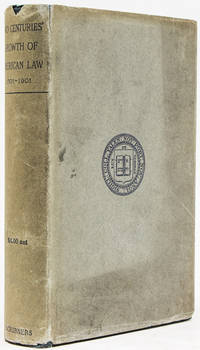
1901234877New York: Charles Scribners' Sons 1901. First edition. Yale Bicentennial Publications. xviii ii 538 pp. 1 vols. 8vo. Blue cloth. Fine in very good gray printed dust jacket. First edition. Yale Bicentennial Publications. xviii ii 538 pp. 1 vols. 8vo. Charles Scribners' Sons unknown
19011363501New York: Charles Scribner's Sons 1901. Hardcover. Octavo; 538 pages; VG-; Bound in blue cloth with silver lettering on red spine label; Bumping to corners minor rubbing to corners and along edges; Textblock has light age toning along edges; RWO.<br /> <br /> <p>NOTE: Shelved in Locked Annex Area Wegewood Section. 1363501. Special Collections. Charles Scribner's Sons hardcover
133362008X.Gpaperback. Good. Access codes and supplements are not guaranteed with used items. May be an ex-library book. paperback
0666915091.Ghardcover. Good. Access codes and supplements are not guaranteed with used items. May be an ex-library book. hardcover
1528454340.Ghardcover. Good. Access codes and supplements are not guaranteed with used items. May be an ex-library book. hardcover
1528411633.Gpaperback. Good. Access codes and supplements are not guaranteed with used items. May be an ex-library book. paperback
0265415772.Ghardcover. Good. Access codes and supplements are not guaranteed with used items. May be an ex-library book. hardcover
1989790745PN. New. 1989. Soft Cover. Date is original print. This is a reprint edition. . PN paperback