3 535 résultats
1950KULT1484Affoltern am Albis, Aehren Verl. (1950). XVI, 319 S., OLn., geringe Gebrauchsspuren.
22413Genève - Paris, Droz - Minard 1957, 235x155mm, 98pages, relié demi-basane à coins brun, dos à nerfs, titre au dos doré. Belle reliure. Très bel exemplaire.
200942253Berlin : Rowohlt Berlin, 2009. 414 S. 8°. 1. Aufl. Bibl.- Einbd. (broschiert).
New Turkish Paperback. Roy. 8vo. (24 x 17 cm). In English. 48 p. The Loizidou case: A critical examination. This article is a critical examination of the judgement of the European Court of Human Rights in the Loizidou case, delivered on 18 December 1996, relating to complaints of violation of applicant's rights to her possessions in Kyrenia (Girne) in North Cyprus. The Court found that the prevention of the applicant, a Greek Cypriot living in South Cyprus, from having access to her property in North Cyprus amounted to a violation of her right to possessions. The incident happened during a demonstration by a Greek Cypriot women's group. The applicant was arrested by the Turkish Cypriot police after she violated the United Nations (UN)-controlled buffer-zone and the borders of the Turkish Republic of Northern Cyprus (TRNC). The applicant complained to the European Commission of Human Rights against her arrest and argued that her right to possessions was violated as she was not allowed access to her property. The Commission did not accept her complaints. However, the European Court of Human Rights reversed the finding of the Commission relating to allegation of violation of the right to possessions. The Court wrongly attributed responsibility to Turkey, having failed to take into consideration the political and legal status of the Turkish Cypriot people and the exercise of substantial jurisdiction by the authorities of the TRNC. Moreover, the Court dealt with the right to possessions in isolation of the political situation in the Island. In doing so the Court ignored completely the status of the UN-controlled buffer-zone, and decided the case in isolation of the talks between the Turkish Cypriots and Greek Cypriots and the principles agreed upon in that context. The judgement undermines the principle of "bi-zonality" and therefore, constitutes a set-back to efforts to reach an agreed and peaceful settlement in the Island.
Very Good English Paperback. Demy 8vo. (22 x 17 cm). In English. 163 p. Human rights and the Cypus question. Turkish Cypriot Human Rights Committee, Seminar Proceedings, 22-23 October 1990, Lefkosa.
Fine Fine Turkish Original bdg. Dust wrapper. Folio. (34 x 23 cm). In Turkish. 160 p., color and b/w ills. Düyûn-i Umûmiye'den Istanbul (Erkek) Lisesi'ne. Edited by M. Sabri Koz.
New English Paperback. Demy 8vo. (21 x 14 cm). In English. 172 p. New building typologies of the Prussian and Ottoman Empires. Mass housing and shopping. Bilateral relations between the Prussian Empire and the Ottoman Empire reached their peak during the reign of Sultan Abdülhamid II in the 19th century, when the Industrial Revolution was taking place. This was a period of great change in living conditions and social culture as well. Necessities for housing changed as well, and the "birth" of a new housing type; the apartment blocks with shops and passages beneath - took place, especially in European capitals. This research focuses on this point of history, and aims to illuminate the relations between the Ottoman Empire and Prussian Empire in an architectural context; and also to show the shaping of urban life in 19th century Istanbul. The main focus of this work, however, is the relation between socio-cultural issues and architecture in the Prussian and Ottoman Empires, from the perspective of urban planning and apartment building construction in two capitals, Berlin and Istanbul, in the same period of time in the 19th century. When public issues meet daily social housing problems, the 19th century apartment blocks with passages beneath emerge as a new type of building, based on examples from Istanbul and Berlin alike.
New English Paperback. Pbo. Roy. 8vo. (24 x 17 cm). In English. 136 p. 'Ambassador Cevat Açikalin, who twice acted as Secretary-General of the Turkish Ministry of Foreign Affairs, played a vital and at times central role in the implementation of Turkish foreign policy in the 1940s and 1950s. Açikalin was a lawyer by training and a diplomat by instinct. He was not only a witness to great events but also a participant.'.
1953013562Editions André Bonne, Paris 1953. Première Édition Broschur Solide
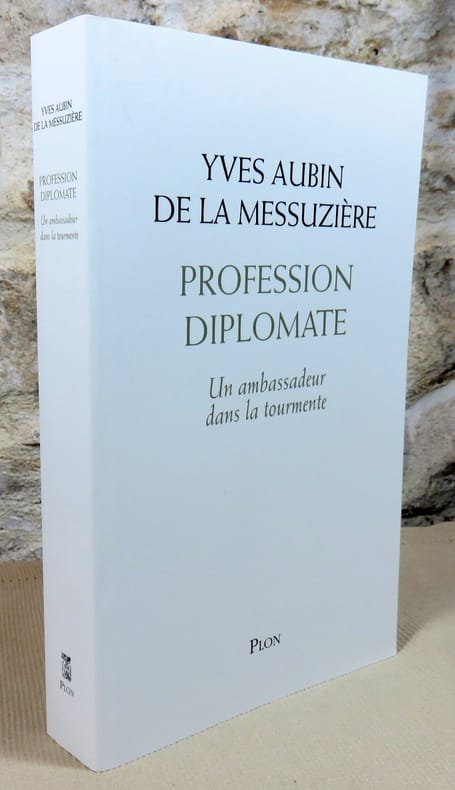
35341Broché, 22X14 cm, 2018, 396 pages, éditions Plon. Très bon état.
Very Good Turkish, Ottoman (1500-1928) Original manuscript autograph letter signed 'Ortaç' by Yusuf Ziya Ortaç to an unknown friend of him. 2 p. Full. In Ottoman script. 'Akbaba' satiric magazine's letterhead with its address in its period, Klodfarer (Claude Farer) Street, Istanbul. It's written with an interesting satiric style of Ortaç and it mentions 50's Turkey. It starts as 'Aziz kardesim, dostum, efendim'. He told that he received his friend's letter and upon this he wrote 'after I've read your letter, I felt like I've seen and heard you, it was like a "fondness feast!'". And he mentions 'Turkish nation' by criticizing as 'This nation knows only just forgiveness! They forgive superabundant; they forget fabrics, chimneys; but never forget some things!'. A rare and very collectible autograph.
Madrid, 2005. 4to.; 336 pp. Cubiertas originales.
Madrid, CSIC-Instituto Francisco de Vitoria, 1967. 4to.; XX-271 pp. Cubiertas originales.
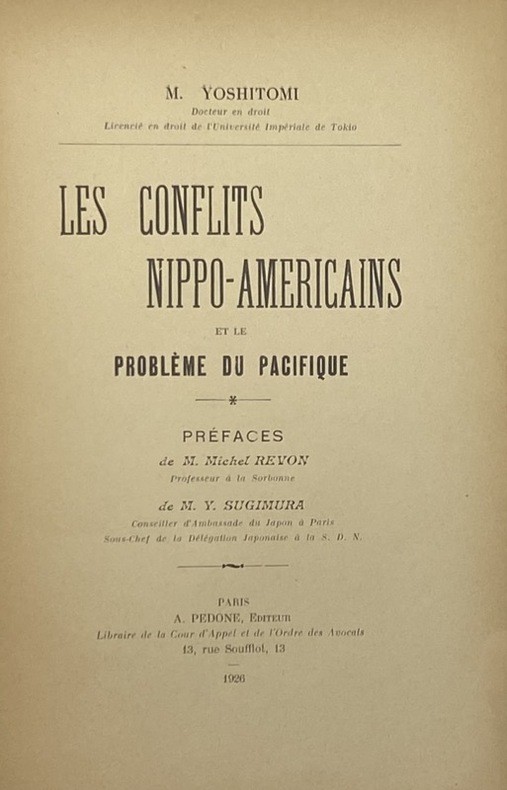
232932Paris, A. Pedone, 1926 in-8, XV pp., 388 pp., broché.
New English Paperback. Pbo. Roy. 8vo. (24 x 17 cm). In Turkish. 183 p. Avrupa arsivlerinde Osmanli Imparatorlugu. Selected papers submitted to a conference in 2010 on the European (English, German, French, Spanish, Dutch, Hungarian, Romanian, Bulgarian, Polish, Macedonian, Albanian and Bosnian) archives where documents concerning Ottoman Empire exist.
Very Good Turkish, Ottoman (1500-1928) Paperback. Pages are untrimmed and not opened. 12mo. (17 x 12 cm). In Ottoman script. 151 p. Hegira-Hijri: 1306 = Gregorian: 1889. Yirmisekiz Mehmed Çelebi Efendi (died 1732), also Mehmed Efendi (sometimes spelled Mehemet Effendi in France), was an Ottoman statesman who was delegated as ambassador by the Sultan Ahmed III to Louis XV's France in 1720. He is remembered for his account of his embassy mission (a sefâretnâme, 'book of embassy'). Yirmisekiz Mehmed Çelebi was born in Edirne to a family of Georgian descent. His date of birth is unknown. He is the son of an officer in the Janissary corps, Süleyman Aga, who died during a campaign to Pécs. Mehmed Çelebi himself was enrolled in the Janissary corps, and since he had served in the 28th battalion ("orta" in Janissary terminology) of the corps, he came to be known with the nickname Yirmisekiz ("twenty-eight" in Turkish) for his entire life. His descendants, including his son who became a grand vizier, also carried the name in the form of Yirmisekizzade ('son of twenty-eight'). He rose through the military hierarchy and then oriented his career to the service of the finances of the state, as superintendent for the Ottoman mint first, and as chief imperial accountant (defterdar) by the reign of Ahmed III. In 1720, while in that position, he was assigned as Ottoman ambassador to Louis XV's France and sent to Paris. His embassy of eleven months was notable for being the first ever foreign representation of a permanent nature for the Ottoman Empire. On his return to the Ottoman capital, Mehmed Çelebi presented his contacts, experiences and observations to the Sultan in the form of a book. His sefâretnâme is one of the most important examples of the homonymous genre, both for its literary merits and in terms of the insights it provides on his time and environment. He describes his journey to France, the 40-days quarantine in Toulon for fear of plague, his journey through Bordeaux towards Paris, his reception by Louis XV, the ceremonies and the social events to which he participated, notably a night at the theatre, places of interest in Paris, the curiosity with which he examines the Western culture and the curiosity he aroused among his Western interlocutors, for instance his days of fasting in Ramadan becoming a reason for public gathering for curious Parisian women. Aside from setting the pace and nature of the long-term trend of Westernization in the Ottoman Empire, his embassy also had immediate repercussions in the Ottoman Empire, notably in the form of the first printing house managed by Ibrahim Müteferrika, a Hungarian convert, which published books in Turkish, having been opened in the same year of 1720 as a direct consequence of Mehmed Çelebi's mission in Paris, and under the personal protection and auspices of his son Yirmisekizzade Mehmed Said Pasha, later grand vizier. Constantinople's renowned Sadabad Gardens, one of the symbols of the Tulip Era were also largely inspired by the gardening techniques used in Tuileries Palace, described in length by the author/ambassador. His book was translated into French in 1757 and also into other Western languages afterwards. (Source: Wikipedia). Özege 17660. Koray 1870. Second Edition. Rare.
Lérida, 1925. Dos volúmenes en 4to.; XI-495 pp. + XII-379 pp., 7 pp., más 5 láminas fuera de texto, dos de ellas plegadas. Cubiertas originales.
Madrid, 1998. 4to.; 420 pp. Cubiertas originales.
New English Paperback. Demy 8vo. (22 x 14 cm). In English. 126 p. This book aims to explore and determine which domestic factor(s) are more decisive in The Gambia's foreign policy decision-making. The book further investigates whether The Gambia's traditional liberal foreign policy of the First Republic has change direction under the Second Republic and if it does, what are the factors responsible for such foreign policy reorientation under Jammeh. Employing the neo-classical realism theory, data has been collected for this book from both primary and secondary sources. The findings of this book have shown that domestic factors are more compelling in Gambia's foreign policy decision-making. We observed that personality and character of the leader, economic development and natural resources, and diplomacy are too strong and decisive in foreign policy formulation in The Gambia. Equally, our book also shows that external factors such as international organization and alliance formation are significant in foreign policy making in The Gambia. Foreign policy formulation in The Gambia is highly personalized, centralized and bureaucratic in nature. Since previous research to some extent, failed to show the nexus between domestic politics and small states foreign policy making, this book could be a valuable reference material for both scholars and policy makers.
19152Liège, Imprimerie H. Vaillant-Carmanne, 1960. 16 x 25, 75 pp., broché, non coupé, bon état.
New English Paperback. Pbo. Roy. 8vo. (24 x 17 cm). In French. 335 p. Center for Ottoman Diplomatic History. De Bagdad à Berlin: L'itineraire de Yanko Aristarchi Bey Diplomate Ottoman. Correspondance officielle et privee Vol. I: Bagdad 1846-1852.
New English Paperback. Pbo. Roy. 8vo. (24 x 17 cm). In French. 341, [1] p. Center for Ottoman Diplomatic History. De Bagdad à Berlin: L'itineraire de Yanko Aristarchi Bey Diplomate Ottoman. Correspondance officielle et privee Vol. II: Berlin 1854-1892.
New English Paperback. Pbo. Roy. 8vo. (24 x 17 cm). In French. 2 volumes set: (335 p.; 344 p.). Center for Ottoman Diplomatic History. De Bagdad à Berlin: L'itineraire de Yanko Aristarchi Bey Diplomate Ottoman. Correspondance officielle et privee. 2 volumes set: Vol. I: Bagdad 1846-1852. Vol. II: Berlin 1854-1892.
Bilbao, Imprenta Grijelmo, 1938. 4to.; 210 pp., con 20 láminas con fotografias. Cubiertas originales.
198735002Zürich : Buchclub Ex Libris, 1987. 448 S. 8°. Lizenzausg. OPpbd. mit SU.