Livre Rare Book
mai 68
environs 400 tracts originaux, ronéotypés provenants de la fac de droit.
4 341 résultats
environs 400 tracts originaux, ronéotypés provenants de la fac de droit.
23026Norrkoeping, Eric Biornström, (below, on printed cover: En Commission - Londres, Trübner & Co), 1863. (2), iv, (2, blank), 96 pp. 8vo. Modern boards, original covers preserved. Anderson 302; Kilgour 436; Zaleski 197. First separate edition: Herzen's letters to Turgenev, which first appeared in My Past and Thoughts, published here with a new introduction. 'Herzen's renewed interest in Russia's past and future was closely linked to his bitter disappointment in the "old world". He was a discerning critic of bourgeois society, even if his strictures were not always fair. The modern reader is struck especially by certain far-sighted observations, that seem to anticipate criticism of a complex phenomenon we have come to refer to as "mass culture". Herzen's most interesting comments in this respect are to be found in a series of articles entitled Ends and Beginnings, in which he conducted a polemic with Ivan Turgenev, who had become the moral authority for liberal Westernizers in Russia' (Andrzej Walicki, A History of Russian Thought, Oxford, Clarendon Press, 1980, p. 170). Alexander Herzen (1812-70) was a prominent nineteenth-century Russian social thinker and is known as the 'father of Russian socialism.' Early in his intellectual development, Herzen was influenced by German idealist thinkers such as Schiller and Schelling. He believed in the autonomy and dignity of the individual and opposed forces, such as family and state, that oppressed the individual. Later, under the influence of French socialist thinkers such as Charles Fourier, Herzen's thought became more radical. Herzen projected his earlier concern for the oppressed individual onto society at large and he became a supporter of socialism. The socialism he envisioned was a loose federation of self-governing communes. Only in such a system could the ideal society be achieved- according to Herzen that society would be a free association of individuals which provided for the full flowering of each personality. Herzen initially placed his hopes for this future order in the European socialist movement. After the failure of the 1848 revolutions to achieve socialist principles, however, Herzen became disillusioned about European prospects and turned his attention to Russia. Herzen argued that socialist transformation would actually come first to Russia because communal institutions such as the peasant commune survived and bourgeois attitudes hadn't yet emerged. This sense of the advantages of Russian 'backwardness' was influential among the Populists in the 1870s. Herzen has been called a 'gentry revolutionary.' The illegitimate son of a wealthy landowner, Herzen viewed the gentry as a progressive class. The revolution he envisioned was for the people but not necessarily by them. Also, his socialism was a national destiny rather than a class one, and because he promoted the value of individualism in collectivist form--in other words, the full flowering of the individual could best be realized in a socialist order. Among Herzen's works are From the Other Shore (1848-50) and The Russian People and Socialism and his autobiography, My Past and Thoughts.He founded a periodical, the famous Kolokol, in whose pages the free word first appeared in the Russian language, unhampered by censor or police, exposing the government's secrets, criticizing bureaucratic abuses, approving the good intentions of the czar, the 'liberator', and trying to dictate to him a reform program.
200887351Gdansk City Office | Gda?sk 2008 | 15 x 21 cm | broché
236485S.l., s.d. (1944) in-4, titre, avec un tirage photographique (11,5 x 10 cm), 16 pp. dactylographiées, en feuilles, agrafé, sous couverture de papier bleuté.
233901Milan, Feltrinelli, 1963 in-8, VIII pp., 429 pp., un f. n. ch., 23 pp. de fac-similé de l'édition originale, avec un tableau dépliant hors texte, toile grise (reliure de l'éditeur).
194787712S. n. | s.l. (Paris) 1947 | 27.50 x 35 cm | agrafé
183636795Paulin et Perrotin | Paris 1836 | 13 x 21 cm | 4 volumes reliés
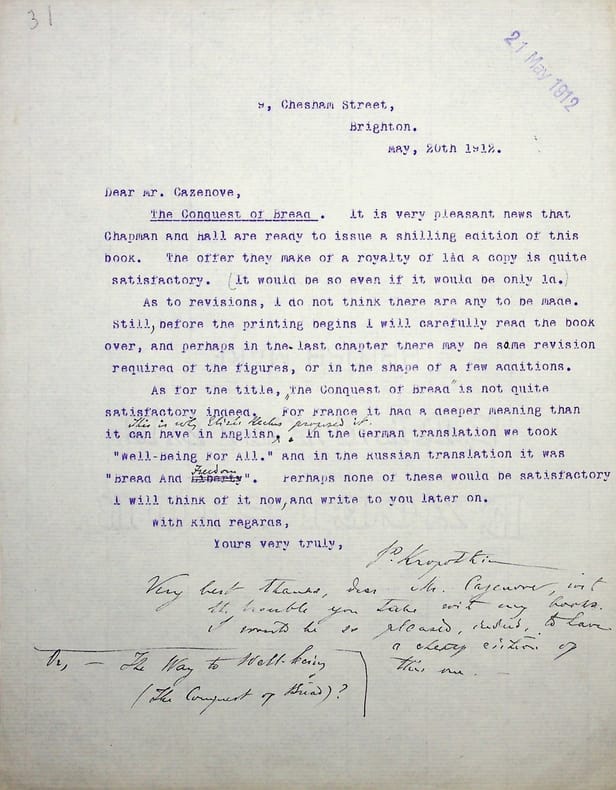
016248Pierre Piotr Kropotkine (1842-1921), prince russe, géographe, anarchiste, théoricien du communisme libertaire. L.S. avec corrections et large partie autographe, 20 mai 1912, 1p in-4 A Charles-François Cazenove (1870-1915), agent littéraire à Londres. « Dear Mr Cazenove, The Conquest of Bread. It is very pleasant news that Chapman and Hall are ready to issue a shilling edition of this book. The offer they make of a royalty of 1 œd a copy is quite satisfactory. It would be so even if it would be only 1d. As to revisions, I do not think there are any to be made. Still, before the printing begins I will carefully read the book over, and perhaps in the last chapter there may be some revision required of the figures, or in the shape of a few additions. As for the title, "The Conquest of Bread" is not quite satisfactory indeed. For France, it had a deeper meaning than it can have in English, this is why Elisée Reclus proposed it. In the German translation we took "well-Being for All" and in the Russian translation it was "Bread and Freedom". Perhaps none of these would be satisfactory. I will thing of it now, and write to you later on. Yours very truly, P Kropotkine. Very best thanks, dear M Cazenove, with the trouble you take with my books. I would be so pleased, indeed, to have a cheep edition of this one. Or - The Way to Well-being (The Conquest of Bread) ? ». Très intéressante lettre pour la nouvelle édition de son ouvrage. [135]
195888306Comité de défense des enseignants | Paris 1958 | 13.50 x 20.70 cm | agrafé
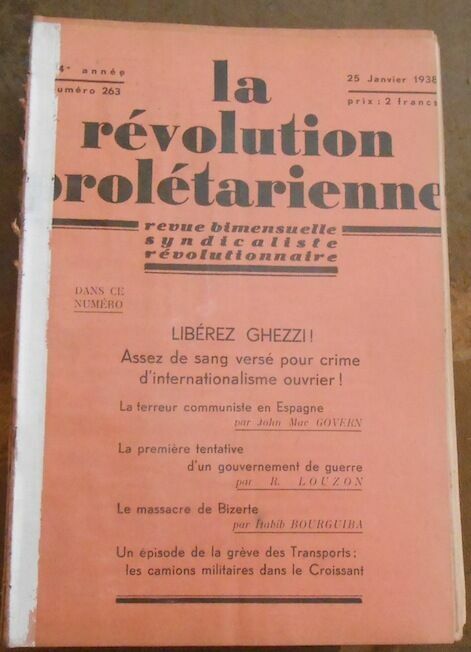
1938124141938. Paris La Révolution Prolétarienne du n°263 (25 janvier 1938) au n°300 (10 août 1939) dernier numéro paru avant la guerre - Brochés 18 cm x 26 5 cm 16 pages par numéro- Textes de Victor Serge Maurice Chambelland Robert Louzon Léon Jaloux J. Mesnil B. Giauffret Habib Bourguiba J. Barrué N. Lazarévitch Daniel Guérin J. Duperray E. Berth A. Ciliga R. Hagnauer Maurice Yvon Walter Krivitsky etc.. ; nombreux articles sur la Guerre Civile Espagnole - Etat correct tous ces numéros ayant été mal reliés avec une toile collée ! mais ils sont complets
42786Edité par les groupes anarchistes d'action révolutionnaire. Directeur de publication : Christian Lagant. Collection quasi complète de 42 numéros (manque 4 numéros : 1, 11, 28 et 43). Brochure ronéotée et agrafée du numéro 3 au numéro 28 (21,3x16 cm) de 70 à 100 pages, puis imprimée par "La Ruche ouvrière" au format 24x16,5 cm de 30 à 40 pages. Le numéro 2 est en feuilles au format 31x21 cm agrafées et pliées en deux. Textes de Christian Lagant, Paul Zorkine, Errico Malatesta, Christo Botev, Paul Rolland, Bernard Prat-Cotter, Théo Lecomte, T. Duparc, Israël Renof, Pierre Vidal, Octave Alberola, etc. Manque la couverture du numéro 29 mais complet de son supplément de 16 pages, quelques couvertures passées, numéros inscrits au dos de 8 exemplaires. Tous les numéros sont complets et l'ensemble est en bon état de conservation.
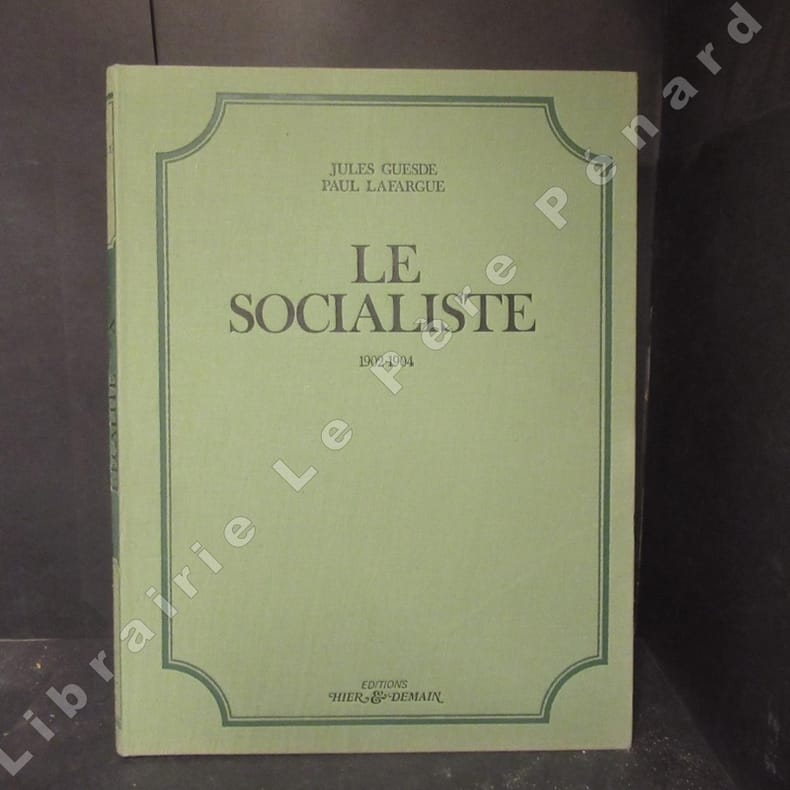
19741137421974 Editions Hier et Demain, Département éditions et rééditions d'oeuvres fondamentales - 1974 - 16 volumes cartonnage toilé vert avec pièce de titre au dos vert foncé dont 2 volumes (Tomes I et II) format in-4, 13 volumes (Tomes III à XV) in-folio et 1 volume (Tome XVI) in-6 - Sans pagination continue - Le tirage de la présente réimpression de la collection complète de l'Egalié et du Socialiste a été limité à sept cents exemplaies tus numérotés sur le volume un; exemplaire n°015.
337881 page in8 - 15 lignes - trés bon état - au dos de la couverture du tome premier des "Communistes" dans le livre de poche -
190828102Paris 1908-1912 | 12.50 x 19 cm | 6 volumes reliés
238102Paris, Lib. Phalanstérienne, 1848 in-8, VII-264-21 pp. (Doctrine de l'harmonie universelle...), broché. Couverture très abîmée, dos renforcé.
193482880Publication La paix internationale | Paris 1934 | 12 x 19 cm | broché
200786351Editions de L'aube Seuil | Paris 2007 | 14.50 x 22 cm | broché
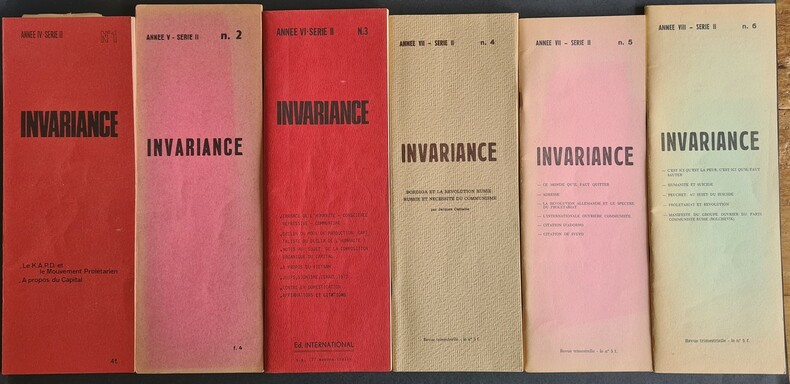
1619817Série complète Revue Invariance, Année IV - Série II, numéro 1 à 6 de 1971 à 1975. Six volumes in-8 oblong, brochés, puis agrafés de 76, 62, 124, 68, 64 pages, au format 29,5 ou 30,5 x 11 cm. Couvertures de différentes couleurs avec titres imprimés. Dos carrés ou pincés. Plats et intérieur frais, avec quelques passages en marges notés au crayon, et des notes sur fiches bristol. Complet des feuilles d'errata. Invariance est à la fois une revue française à la parution irrégulière et un groupe militant du même nom fondée par Jacques Camatte, en 1968, à la suite de sa rupture avec le Parti communiste international dont il jugeait les positions trop activistes. Cette revue fut d'abord consacrée à une ligne de stricte orthodoxie bordiguiste d’après les idées d’Amadeo Bordiga, puis s'éloigna de cette tradition pour finalement rompre avec le marxisme et développer des thèmes proches de l'anarcho-primitivisme. mondial. Cette revue de la " Radicalité Intellectuelle " post-1968 eut de nombreux collaborateurs : Philippe Leclerc, Gianni Collu, Nicola La Porta à Florence, Giorgio Cesarano, Henri et Claudie Bastelica, Jean-Louis Darlet, Saïa et Danièle Voldman ( articles « À propos du Vietnam » et « Juifs, sionisme, Israël »). La revue attira l’attention de tout un milieu à gauche du trotskysme, tant en France qu’en Italie. Toni Negri, en prison, lisait Invariance. Certains groupes marginaux italiens ( Ludd, Comontismo ) prétendirent même s’en inspirer dans des actions de « récupération ». Jacques Camatte, né en 1935 à Cannes, fut professeur de Sciences de la Vie et de la Terre (SVT), théoricien « Bordiguiste » de 1957 à 1967. Engagé dans la FEN jusqu’en 1967 il fut le créateur cette revue, qui pour lui était le produit du mouvement de 68 en lequel, Jacques Camatte voyait, la fin de la phase de contre-révolution…Il disait que Mai 68, ce n’est pas la révolution, c’est son émergence. Une émergence qui, toujours selon lui, avait été préparée par la guerre du Vietnam, la crise monétaire internationale,la lutte des guérilleros en Amérique latine, et surtout celle du mouvement ouvrier noir, provoquée par les conséquences de l’automation... Série complète en état superbe. Edition originale de toute rareté.
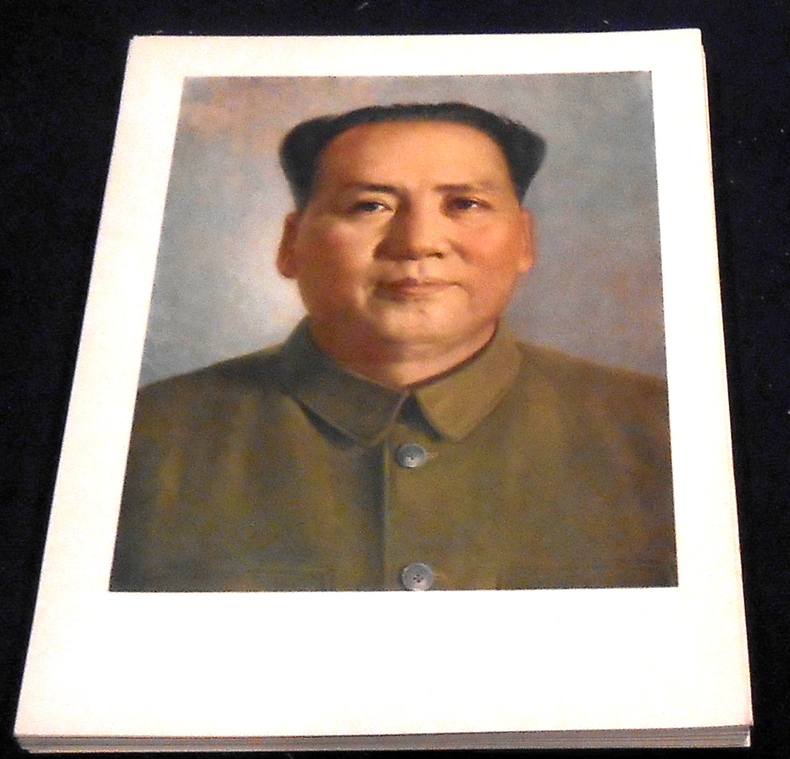
195423252Chine, La Chine – Revue Illustrée, 1954, édition originale. Porte-folio en toile de lin à rabats, titre en caractères chinois sur le premier plat, fermoir en os, 18,5 cm x 26 cm, en feuilles, liste des photographies, introduction de Soong Ching Ling, 48 planches photographiques en couleur dont le portrait du Président Mao. Légendes et texte en chinois, français, anglais et russe. Bien complet, état neuf
2671J. Mallet et Cie, éditeurs, Paris, 1842
1193Au Bureau du Populaire. 1848. Fort in-8° broché. Couverture typographique. VIII + 600 pages. 5è. édition.
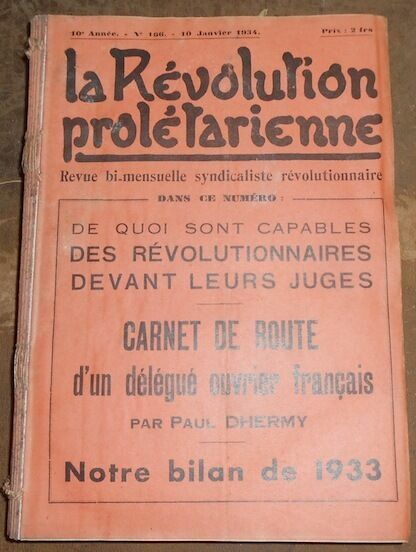
1934124131934. Paris La Révolution Prolétarienne du n°166 (10 janvier 1934) au n°189 (25 décembre 1934) - Brochés 18 cm x 26 5 cm 20 pages par numéro- Textes de Félicien Challaye J. Barrué Maurice Chambelland Robert Louzon B. Giauffret R. Hagnauer Paul Dhermy Maurice Yvon E. Berth Pierre Monatte J. Péra J. Mesnil Lucile Pelletier etc.. - Etat correct tous ces numéros ayant été mal reliés avec une toile collée ! mais ils sont complets
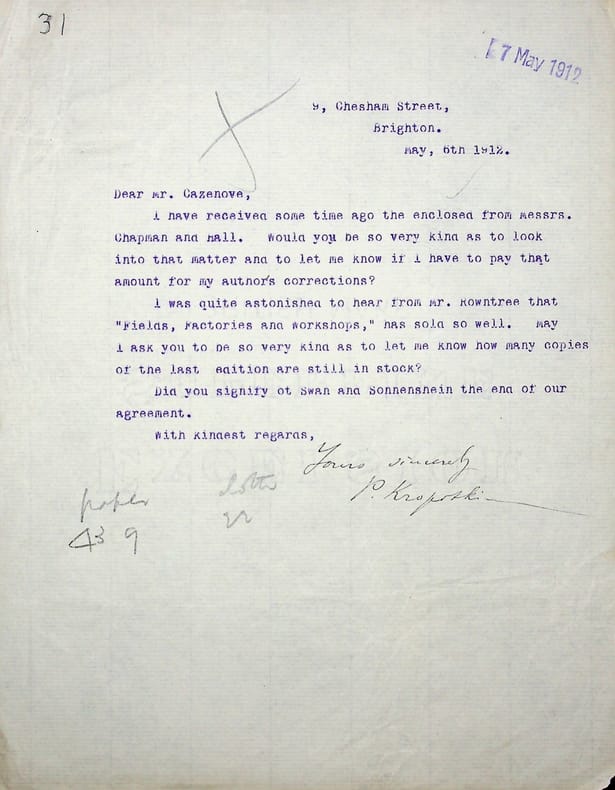
016244Pierre Piotr Kropotkine (1842-1921), prince russe, géographe, anarchiste, théoricien du communisme libertaire. L.S. avec quelques mots autographes, 6 mai 1912, 1p in-4. A Charles-François Cazenove (1870-1915), agent littéraire à Londres. Intéressante lettre : « Dear Mr Cazenove, I have received some time ago the enclosed from Messrs Chapman and Hall. Would you be so very kind as to look into that matter and to let me know if I have tu pay that amount for my authors corrections ? I was quite astonished to hear from Mr Rowntree that "Fields, Factories and Workshops" has sold so well. May I ask you to be so very kind as to let me know how many copies of the last edition are still in stock ? Did you signify at Swan and Sonnenshein the end of our agreement. With kindest regards. Yours sincerely. P Kropotkine ». Kropotkine s'enquiert donc de savoir si on lui fait payer le bon prix pour les corrections et où en est la vente d'un de ses principaux ouvrages, Champs Usines et Ateliers. Il y aura une nouvelle édition anglaise en 1912 qui est l'édition de référence. Beau document. [135]
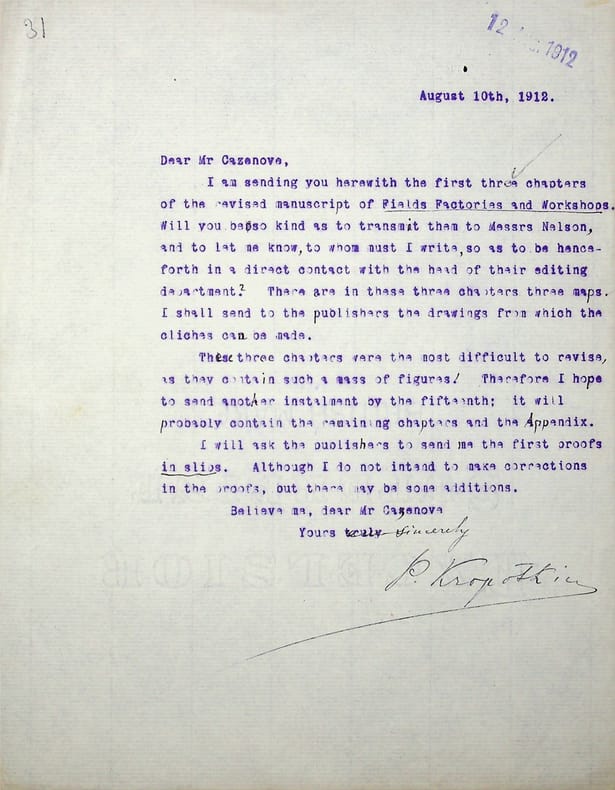
016245Pierre Piotr Kropotkine (1842-1921), prince russe, géographe, anarchiste, théoricien du communisme libertaire. L.S. avec corrections autographes et un mot autographe, 19 août 1912, 1p in-4. A Charles-François Cazenove (1870-1915), agent littéraire à Londres. Intéressante lettre : « Dear Mr Cazenove, I am sending you herewith the first three chapters of the revised manuscript of Fields Factories and Workshops. Will you be so kind to transmit them to Messrs Nelson, and to let me know, to whom must I write, so as to be henceforth in a direct contact with the head of their editing department ? There are in these three chapters three maps. I shall send to the publishers the drawings from which the cliches can be made. These three chapters were the most difficult to revise, as they contain such a mass of figures. Therefore I hope to send another instalment by the fifteenth ; it will probably contain the remaning chapters and the Appendix. I will ask the publishers to send me the first proofs in slips. Although I do not intend to make corrections in the proofs, but there may be some additions. Believe me, dear Mr Cazenove. Yours truly sincerely. P Kropotkine ». Kropotkine travaille donc à la nouvelle édition d'un de ses principaux ouvrages, Champs Usines et Ateliers. Cette édition de 1912 est l'édition de référence. Beau document. [135]
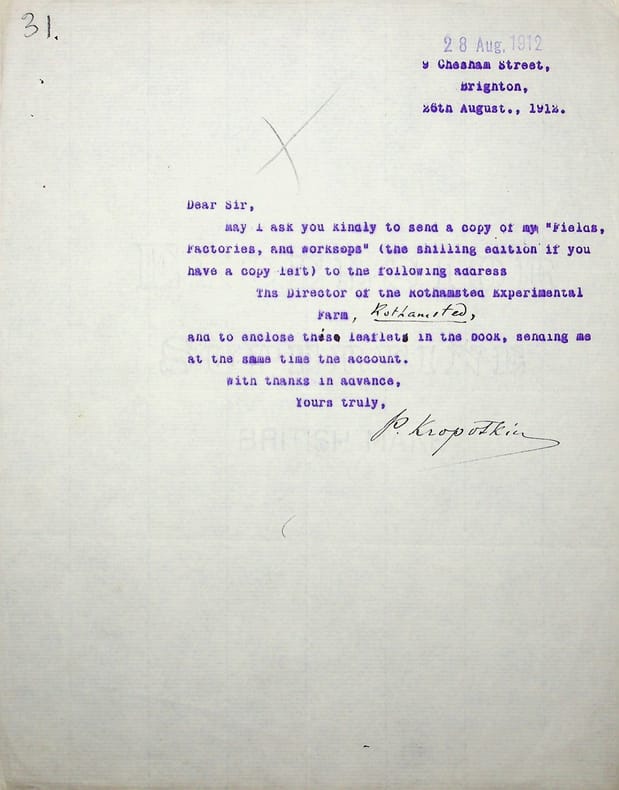
016247Pierre Piotr Kropotkine (1842-1921), prince russe, géographe, anarchiste, théoricien du communisme libertaire. L.S. avec corrections autographes et un mot autographe, 26 août 1912, 1p in-4. A Charles-François Cazenove (1870-1915), agent littéraire à Londres. « Dear Sir, May I ask you kindly to send a copy of my "Fields, Factories, and Workshops" (the shilling edition if you have a copy left) to the following address. The Director of the Rothamsted Experimental Farm, Rothamsted, and to enclose this leaflet in the book, sending me at the same time the account. With tranks in advance. Yours truly. P Kropotkine ». Kropotkine envoie donc un exemplaire de son ouvrage à Edward John Russell (1872-1965), probablement au moment où celui-ci devient directeur de la ferme de Rothamsted. [135]