14 441 résultats
190688451Chicago Ill: Charles H. Kerr & Co. London: Swan Sonnenschein & Co. 1906 1907 1909. First Editions First Printings. Three Volumes. Octavo. 22.5cm. Publisher's deep maroon ribbed cloth titled in gilt to spines and ruled in blind to boards. 869pp.; 618pp.; 1048pp. Generally strong and tight; mild scuffing and to spine ends and corners and a few minor exterior stains. Spine gilt is significantly oxidized to Vol II as is usually seen on the first printing; internally clean and fresh some very light spotting in places mainly confined to the page edges. A very good handsome set of first printings. <br /> <br /> A full set of first printings of this bibliographically complex edition issued over the course of three years. Marx published the first volume of his epic analysis of capitalism in German in 1867. The first translation into English was of Volume 1 only and was accomplished by Edward Aveling and Samuel Moore in 1887 based on the revised 4th German edition as edited by Engels. The 1906 first American printing under the Charles Kerr impint as here largely follows this translation with the subsequent translation work for Volumes II and III being performed by Ernest Untermann. Thus the earliest printings of the Kerr edition comprise the first complete edition of Capital in the English language. The printing was done in Chicago by James Higgins Kerr's printer of choice making this also the first complete edition of Capital to be printed entirely by a union-run print shop. Untermann did most of his translation work from remote Florida beginning the effort in 1905 discovering in the process a number of indices footnotes and at least ten pages of text that Aveling and Moore had not included in their London edition - making the Kerr edition the most complete up to its time. <br /> <br /> Kerr burned through the first two-thousand copy print run of Volume I almost immediately and rushed to get Volume II out by July 1907. It's very possible that financial constraints were already making themselves known by Volume II as Kerr was selling the books at a loss to encourage sales; the almost ubiquitous oxidation of the gilt on Vol II is likely a result of experimental economy that swiftly failed. Vol III returns to the higher standards of the first volume. The bindings on the first printings also feature a triple blind rule to the ribbed cloth boards with subsequent printings having double rules. Kerr's reprint system seems to have incorporated dates on the title pages for some length of time with the dates on the copyright pages remaining unchanged; after a certain point around the early 1920's reprints were issued without dates to the title pages and any volume without a date can safely be deemed a post-1920s reprint. Issues of Kerr's International Socialist Review from the period of printing recount in detail some of his problems and concerns publishing and selling the work with detailed data on dates numbers of copies and the firm's hopes for the completed book. <br /> <br /> Genuine first printing sets of this important edition are tremendously scarce in commerce. The lack of any real bibliographical authority for the American edition combined with Kerr's generally lax approach to differentiating printings has over the years led to frequent errors and misjudgments on the part of cataloguers including in full disclosure ourselves. After a good deal of research most in the advertising pages of the International Socialist Review we're confident we've finally got it right. Charles H. Kerr & Co. [London: Swan Sonnenschein & Co.] unknown
1808AMO-4498A Leipzig [i.e. Lyon], 1808 1 volume in-8 (20 x 12,5 cm) de (4)-425-(3) pages et un grand tableau dépliant (replié relié entre les pages 56 et 57). Reliure strictement de l'époque demi-basane fauve, dos lisse orné de plattes dorées en guise de faux-nerfs, fleurons dorés, pièce de titre de maroquin rouge, plats de papier marron. Quelques usures (coins, plats, coupes, légères fentes en tête des mors, légères marques et éraflures au dos, le tout sans gravité), intérieur frais. Quelques rousseurs peu pregnantes aux premiers et aux derniers feuillets. Quelques annotations manuscrites, corrections et rajouts, notamment sur le grand tableau dépliant. Collationné complet. Edition originale rare du premier livre de Fourier.
Signed and inscribed by author upon front free endpaper to General R.E. Wood [1879-1969], under whose leadership Sears Roebuck was transformed from a mail-order to a retail sales behemoth. pp. [6], 7-90. "Communist plotters, in the United States as elsewhere, are preparing for the conquest of political power. The discerning student, however, should consider how interventionism, under various enticing labels, is setting the stage for the final overthrow of the voluntary society, the market economy and constitutional government. [This work], by a world-famous expert, will prove a valuable aid to understanding in this field. It will help to explain the errors of those who believe a system based on individual freedom can be 'mixed' with socialism." - Foreword. Book clean and unmarked with moderate wear. Binding tight. Above-average wear to price-clipped dust jacket now preserved in archival-grade Brodart. Greaves & McGee B-14. Book
A document which should have rocked the USA to its core but was squelched by the very powers it exposed. In the course of her duties as legal analyst for the Committee, Kathryn Casey was granted access to the archived minutes of the board of directors of the Carnegie Endowment for International Peace. According to the Committee's Research Director Norman Dodd, it was here that Ms. Casey discovered the board's conclusion that the best way to create world government, and permanent peace, was to involve the United States in a terrible war. The Reece Committee and its findings came to prominence decades later when Norman Dodd, Research Director for the Committee, came forward with stunning revelations of the Committee's findings. Printed for the use of the committee, this booklet contains pages 627-665b from the printed hearings. Includes 20 tables, 12 charts and 10 data sheets. Moderate wear. Unmarked. Crease to lower corner. A sound copy of this powerful document. Book
194887160s. d. [1948] | 21 x 30 cm | 8 pages et demi sur 9 feuillets
- s.l. [Paris] 22 février 1952, 21x27cm, 3 pages sur 3 feuillets. - Manuscrit autographe signé rédigé à l'encre bleue sur trois feuillets de papier blanc ; nombreuses ratures et corrections. "Si quelque part au monde le coeur de la liberté continue à battre, s'il est un lieu d'où ses coups nous parviennent mieux frappés que de partout ailleurs, nous savons tous que ce lieu est l'Espagne." Ce magnifique texte fut prononcé par André Breton le 22 février 1952 lors du meeting organisé par la Ligue des Droits de l'Homme Salle Wagram. Le discours sera ensuite publié dans Le Libertaire du 6 mars 1952. "N'oublions pas que le monstre qui pour un temps nous tient encore à sa merci s'est fait les griffes en Espagne. C'est là qu'il a commencé à faire suinter ses poisons : le mensonge, la division, la démoralisation, la disparition, qui pour la première fois il a fait luire ses buissons de fusils au petit matin, à la tombée du soir ses chambres de torture. Les Hitler, les Mussolini, les Staline, ont eu là leur laboratoire de vivisection, leur école de travaux pratiques. Les fours crématoires, les mines de sel, les escaliers glissants de la N.K.V.D., l'extension à perte de vue du monde concentrationnaire ont été homologués à partir de là. C'est d'Espagne que part l'égouttement de sang indélébile témoignant d'une blessure qui peut être mortelle pour le monde. C'est en Espagne que pour la première fois aux yeux de tous, le droit de vivre libre a été frappé." "Breton ne saurait rester indifférent aux évènements internationaux. En Espagne, le régime de Franco se maintient par la répression policière, mais il ne peut empêcher une succession de grèves importantes, animées par les organisations anarchistes toujours vivaces. En mars, onze meneurs sont condamnés à mort. Une campagne alertant l'opinion publique européenne se déclenche en leur faveur. Breton prend la parole au meeting organisé salle Wagram le 22 février 1952. Citant les grèves de Barcelone, lancées sur un prétendu mot d'ordre de la Phalange, il prophétise à terme une victoire totale. L'humeur des meneurs clandestins annonce la révolte contre la misère économique, contre le fascisme, monstre tricéphale qui a d'abord essayé ses griffes en Espagne." (Henri Béhar, André Breton) [ENGLISH DESCRIPTION ON DEMAND]
187247305Paris: Maurice Lachatre et Cie 1872-1875. First French Edition. Large octavo 28.5cm.; original parts bound in early 20th century blue cloth gilt-lettered spine; 351pp.; pictorial half title and title pages full-paged steel-engraved portrait and facsimile additional vignettes throughout; text printed in double column. Boards a bit rubbed and corners bumped foxing and toning to preliminaries as well as minor dampstaining to last few leaves of text light foxing to rear cover; overall Very Good and sound. First appearance in French of Marx's "Das Kapital" the translation the only such to have been executed with the collaboration of the author whose letter to Lachatre appears in facsimile on p. 7: "J'applaudis à votre idée de publier la traduction de 'Das Kapital' en livraisons périodiques. Sous cette forme l'ouvrage sera plus accessible à la classe ouvrière et pour moi cette considération l'emporte sur toute autre" "I congratulate you on your idea to publish the translation of 'Das Kapital' as a periodical. In this format the work should be more accessible to the working class and to me this is more important than all else" our translation. Maurice Lachatre 1814-1900 was a Parisian radical bookseller publisher and collaborator of Félix Pyat's with whom Marx butted heads over the growth of the International Working Men's Association in France. Lachatre's projected publication of the anarchist newspaper "La Commune" nearly cost him his life after the fall of the Paris Commune when his bookshop was attacked with murderous intent by the Versaillaise army see "The Publisher's Weekly" Vol. 19 1881 pp. 50-1. It was while exiled first in Belgium and then Switzerland that Lachatre began work on publishing the present edition though he was not free to return to Paris until 1879. Maurice Lachatre et Cie unknown books
195282356s. l. [Paris] 22 février 1952 | 21 x 27 cm | 3 pages sur 3 feuillets
Inscribed and initialed by Polanyi to "Sir Ernest and Lady Simon", Sir Ernest Simon, The Lord Simon of Wythenshawe, and his wife, upon front free endpaper. Simon, a British industrialist, politician and public servant, had a long association with the University of Manchester where Polanyi was a professor at the time of publication. Ink stamp reading "University of Manchester Broomcroft Hall" atop front free endpaper and inside back board solidifies this provenance as it was then the residence of the Simons. ix, [1], 116 pages. Includes these essays: The Rights and Duties of Science (1939), Collectivist Planning (1940), Soviet Economics - Fact and Theory (1935), and Truth and Propaganda (1936). "In those years the ideas of liberty... were left almost uncultivated." - from Preface. Minimal faint pencil markings to contents. Average wear and some fading to publisher's pale green cloth which is sunned at spine. Binding intact. Heavy wear to dust jacket which is now preserved in archival-grade Brodart. Today, the thoughts of the author, a scientist and philosopher who lived from 1891 to 1976, are faithfully upheld by a society named in his honour. Book
195087220s. d. [circa 1950] | 21 x 30 cm | une page sur un feuillet
pp. [6], 7-181. Index. Maps and diagrams. "This book may help the reader to understand what secret forces are at the back of the many civil wars, strikes and acts of sabotage, that are so typical of our epoch, and how these are organized and conducted. The People's War destroys the soul of a nation, systematically leading it into disobedience and disrespect of law and order. As in all revolutions, the People's War means complete chaos, a savage struggle in which the end justifies the means, and vengeance, trickery, and even treachery, play a great part." - Introduction. Chapters include: Marxism and Modern Warfare; Strategy of Secret Warfare; Technique of Underground War; Defence (Against Underground Warfare). F.O. Miksche [1905-1992] wrote several books on military topics relating to WWII. Dust jacket not included. Moderate wear to publisher's black cloth. Binding intact. Former library copy with usual markings. A book for our times? Enser p.371. Book
187247305Paris: Maurice Lachatre et Cie 1872-1875. First French Edition. Large octavo 28.5cm.; original parts bound in early 20th century blue cloth gilt-lettered spine; 351pp.; pictorial half title and title pages full-paged steel-engraved portrait and facsimile additional vignettes throughout; text printed in double column. Boards a bit rubbed and corners bumped foxing and toning to preliminaries as well as minor dampstaining to last few leaves of text light foxing to rear cover; overall Very Good and sound. First appearance in French of Marx's "Das Kapital" the translation the only such to have been executed with the collaboration of the author whose letter to Lachatre appears in facsimile on p. 7: "J'applaudis à votre idée de publier la traduction de 'Das Kapital' en livraisons périodiques. Sous cette forme l'ouvrage sera plus accessible à la classe ouvrière et pour moi cette considération l'emporte sur toute autre" "I congratulate you on your idea to publish the translation of 'Das Kapital' as a periodical. In this format the work should be more accessible to the working class and to me this is more important than all else" our translation. Maurice Lachatre 1814-1900 was a Parisian radical bookseller publisher and collaborator of Félix Pyat's with whom Marx butted heads over the growth of the International Working Men's Association in France. Lachatre's projected publication of the anarchist newspaper "La Commune" nearly cost him his life after the fall of the Paris Commune when his bookshop was attacked with murderous intent by the Versaillaise army see "The Publisher's Weekly" Vol. 19 1881 pp. 50-1. It was while exiled first in Belgium and then Switzerland that Lachatre began work on publishing the present edition though he was not free to return to Paris until 1879. Maurice Lachatre et Cie unknown
187561169Charles Silvain | Paris 1875 | 13.50 x 22 cm | relié
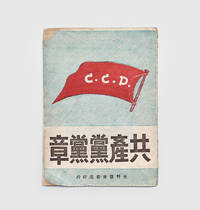
1947182588Shexian: Taihang qunzhing shudian "Taihang People's Bookstore" 1947. Maoism made official First edition thus. Passed at the party's seventh congress in 1945 the constitution for the first time formalized "Mao Zedong Thought" as the guiding ideology of Chinese communism. Following the historic congress the new constitution was disseminated by local printers in the rural base areas under party control. This example was issued in the foothills of the Taihang Mountains near the capital of the strategically important Shanxi-Hobei-Shandong-Henan "liberated zone." In 1948 Mao took up residence in nearby Xibaipo where he lived until his triumphant entry into Beijing in March 1949. This first printing dates to September 1947. Subsequent printings appeared in December 1947 and several times in 1948 but they did not have a frontispiece. Rural printers had access to only the most rudimentary facilities and the vast majority of base-area publications have now perished. Octavo pp. ii 27 1. Half-tone frontispiece portrait of Mao decoration above table of contents. Text in Chinese. Original illustrated wrappers front cover lettered in black. Tidemark at head of volume spine worn split at head of front joint chip to front cover several gatherings uncut: a very good copy typical of publications printed in the Chinese Communist Party's rural base areas. unknown
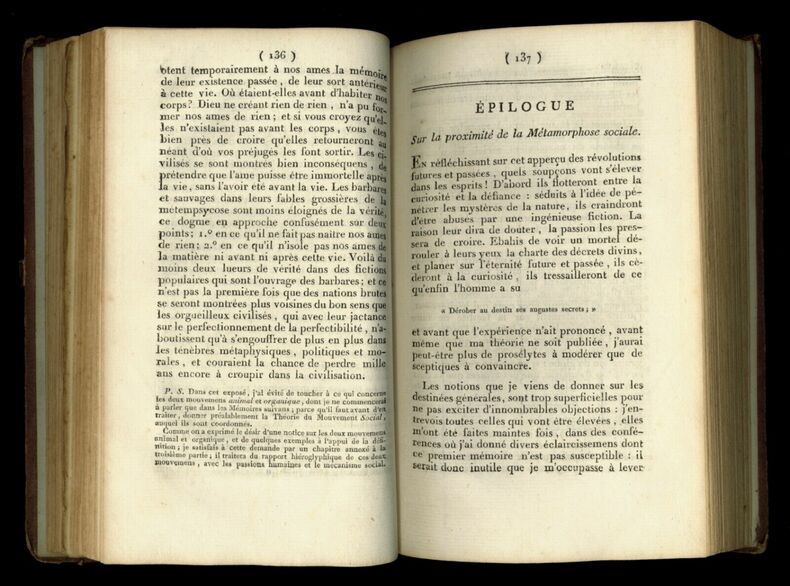
178911350S.l., s.n., 1789 ; in-8 ; demi-chagrin rouge à petits coins, dos à nerfs, titre doré (reliure moderne) ; 206 pp. y compris le faux-titre et le titre (INED, 578 ; Barbier, I-531).
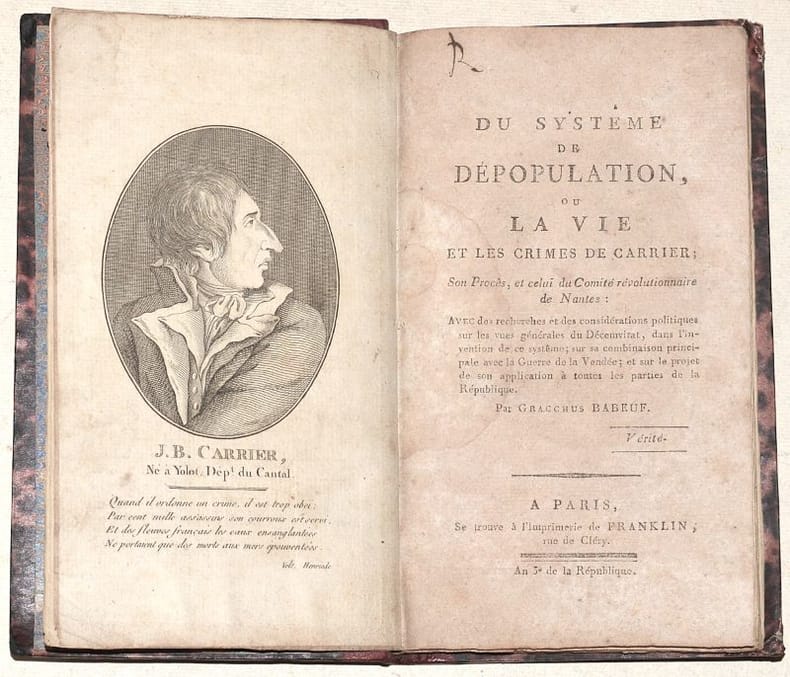
17940057101794 Paris, Imprimerie de Franklin, An 3e de la République [1794]. In-8 (207 X 125 mm) demi-chagrin grenat, dos lisse cloisonné de filets dorés, titre doré (Reliure postérieure) ; portrait-frontispice, 194 pages [i. e. 192 pages, passage de la page 152 à 155 sans manque], dont faux-titre, titre, sommaire et errata. La marge inférieure n'a pas été rognée par le relieur. Cerne de mouillure en marge intérieure des premiers feuillets (faux-titre, titre, sommaire et errata), rousseurs, lettre "R" calligraphiée à l'encre noire en marge supérieure de la page de titre, restauration à un coin de la reliure.
FT) Original Stapled Wrappers. 8vo. 24; 56; 24; 15; 40; 12; 2; 6; 20; 47; 24; 32; 52; 16; 38 pages. In Russian. Title translates to English as, Diary of a Social Democrat. Menshevik journal edited by Plekhanov published sporadically from 1905-1911 containing open letters and polemics on various subjects. Issue no. 4 includes a letter directed To Comrade X, likely directed at Lenin, with whom he famously split a few years prior, and a direct response to Aleksandr Martinov. CONTENTS: Patriotizm I Sotsializm [Patriotism and Socialism] --- Nashe Polozhenie [Our Position] ---Esche o Nashem Polozhenii: Pismo k Tovarischu X [More on Our Position: A Letter to Comrade X] --- K Agrarnomu Voprosu v Rossii [On the Agrarian Issue in Russia] --- O Chrezvyshaynom Partiynom Sezde (Otkritoe Pismo k Tovarischam) [On the Emergency Party Congress (An Open Letter to the Comrades) ] --- O Vozobnovlenii Moego Dnevnik [On Resuming my Diary] --- Samoubiystvo ili Borba [Suicide or Struggle] --- Poslednee Plenarnoe Sobranie Nashego Tsentralnago Komiteta [The Last Plenary Meeting of our Central Committee] --- Legalnyya Rabochiya Organizatsii I Rossiyskaya Sotsial-Demokraticheskaya Rabochaya Partiya [Legal Labor Organizations and the Russian Social Democratic Labor Party] --- Polemicheskaya Bezpomoshnost (Otvet t. Martynovu) [Polemical Helplessness (A Response to c. Martinov) ] --- K Voprosu o Vozrozhdenii Nashey Partii [On the Issue of the Rebirth of our Party] --- Chrezvychaynyy Sezd Mezhdunarodnago Sotsialisticheskago Byuro [Emergency Congress of the International Socialist Bureau]. French title across top-margin: Le Journal dun Socialdemocrate. OCLC lists one copy (National Library of Israel) . Nos. 1 & 9 covers detached and worn at edges, but present. Supplement to No. 7 chipping at edges with minor loss of text. Remaining issues are nice and clean. Very Good Condition. (RUS-11-26A)
223, 16 (ads) pp. Index. "The problem of the Jews in Britain, and the power they wield in public affairs, is a matter of the most absorbing interest in these days when propaganda has clouded the issue and made it almost impossible for the ordinary man to see the subject in its true perspective. This book is a critical but strictly impartial analysis written by a well-known Fleet Street journalist who has studied the whole problem for a number of years in the light of events since the Great War." - from dust jacket. Unmarked with moderate wear to publisher's orange cloth. Binding intact. Small contemporary Buenos Aires bookseller's sticker inside front board. Above-average wear to dust jacket, now preserved in archival-grade Brodart. A sound copy. Singerman 494. Book
Very Good Turkish Original wrappers. Cr. 8vo. (19 x 13 cm). In Turkish. 305, [1] p., errata. Extremely rare in this condition and in original wrappers. Fading on spine, slight stains on cover. Untrimmed. Otherwise a very good copy. Repaired by tape on the front cover's bottom corner. Yorulmaz's rare first Turkish translation of 'Das Kapital' has been the subject of many 'translation studies'. The most important work in the entrepreneurship of Yorulmaz's left thought repertoire that was published within his cultural series was 'Sermaye [= Das Kapital]'. Published as the 7th book of 'the Capital Culture Series', an abridged translation of Das Kapital by Karl Marx. Yorulmaz wrote about his translation: "I had an experience on these empty days and I am translating and publishing a loyal story of 14 volumes, "Das Kapital", collected by Gabriel Dövil. If this abridged edition is requested, I will finally begin with these 14 volumes, starting in June 1937, and translating four every year." Yorulmaz had translated 'Das Kapital' to Turkish from Gabrielle Deville's French translation which was an abridged edition. According to his comments, the purpose of Yorulmaz was, if this abridged edition is requested or demanded he would translate full text of 'Das Kapital'. However, he couldn't realize this dream. Nevertheless, the effect of the 'Sermaye' in the Turkish leftist thought had been considerable. As "Capital" was the first translation of "Das Kapital" into Turkish, it functioned at that time to fill the gap that existed in terms of socialist thought. He was concerned with knowing Karl Marx's thoughts, and therefore in his preface to 'Sermaye', he described his intellectual approach as "[one] sect which is one of the deepest thoughts and has made the biggest earthquake in the world in social and political life". In his preface, he wrote: "We have nothing but a small realized interference about Karl Marx's study in the law school in Ankara by Cavit Bey and the Turkish attorney Sükrü Kaya Bey, five to ten pages of translations." (Source: Haydar Rifat Yorulmaz'in çevirileri, (1908-1940): Bir sol düsünce 'repertuvari'nin kurulusu, Bilal Çelik). In the preface of the 1888 English Edition of 'Das Kapital', Engels says "I was told that the Armenian translation, which was expected to be published in Istanbul a few months ago, did not see the light of day because the publisher was afraid to release a book bearing the name of Marx, while the translator refused to show it as his own work.". (Das Kapital in Turkey, Savran & Tonak). Haydar Rifat was a Turkish lawyer, intellectual, translator and author. He brought the works of world-famous writers such as Emil Ludwig, Lenin, Gustav, Balzac, Tolstoy, Dostoevsky and Karl Marx into Turkish; he published his translations under the series titled 'Dün ve Yarin Tercüme Külliyati' [i.e. Yesterday and Tomorrow as Translation]. In addition, many articles he wrote in the fields of law and literature appeared in various newspapers and magazines. Not in OCLC.
230803Bruxelles, à la Librairie romantique, 1828 2 tomes en 1 vol. in-8, VIII-325 pp. et 327-[5] pp., demi-veau olive, dos lisse orné de filets dorés, de fleurons à froid et de roulettes dorées, tranches marbrées (reliure pastiche). Qqs rousseurs, prononcées sur les pages de faux-titre et de titre.
165791Bruxelles, à la Librairie romantique, 1828 2 tomes en 1 vol. in-8, VIII-325 pp. et 327-[4] pp., demi-chagrin rouge, dos à nerfs orné (reliure postérieure). Rousseurs.
226 pages including index. Rare surviving first edition copy of this classic conspiracy work. "Because knowledge is necessary to inspire action we make facts known which we hope will activate citizens, and cause them to take strong, determined, measures in accordance with our Constitution and Laws, which will put an end to all phases of the international conspiracy, and bring all conspirators before the bar of justice." - from inside front cover. "Published because we are convinced that an international conspiracy is in operation for the purpose of destroying our national and religious institutions in America. Presents evidence obtained by Commander Carr, as the result of thirty five years of investigations" - from Foreward. Average wear. Binding intact. Few markings to contents. Two ink stamps to title page. Singerman 922, Weems p.59. Book
186 pages. "Published to expose the ramifications of the International Conspiracy which was originated by a small group of wealthy and influential men in 1773 for the purpose of ultimately obtaining undisputed control of the wealth, natural resources, and manpower of the entire world... Explains how the continuity of their Long Range Plan was assured by appointing their successors from their own entourage while still alive." - Foreword. William Guy Carr [1895-1959] was a man's man, an English-born Canadian naval officer who described his adventurous early life in seven preceeding books. Sombre cover illustration depicts Soviet chess pieces moving in for the kill. Above-average but not excessive external wear. Binding intact. "American Nationalist" sticker on title page may refer to the book's American distributor. Ink underlining and markings throughout. Errata list not included. A sound first edition copy of this conspiracy classic. Singerman 921, Weems p.58. Book
193386772S. n. | Villeneuve (Canton de Vaud) 11 Décembre 1933 | 14 x 21.50 cm | une page recto verso
364 pages. Index. Three maps. Black and white photographic plates. "For the first time, a historian - Soviet defector Viktor Suvorov - shows that the USSR's part in starting WWII was much greater, and much more sinister, than has hitherto been assumed. A direct and often harrowing challenge to accepted history. Its achievement is to force us all to revise radically our ideas of - and the reasons for - the most destructive war mankind has ever experienced." - dust jacket. Clean and unmarked with light wear. Dust jacket now preserved in glossy new archival-grade Brodart. A quality copy. Book