( Communisme ) - Victor Serge.Livre Rare Book

4 362 résultats
29284Editions Spartacus / Supplément à Masses de Janvier / Réalité Soviétiques - Collection " Les Egaux " n° 1 de 1947. Plaquette In-16 agrafée de 16 pages au format 13,3 x 9,2 cm. Couverture illustrée. Plats et intérieur frais. Etat superbe proche du neuf. Rare édition originale.
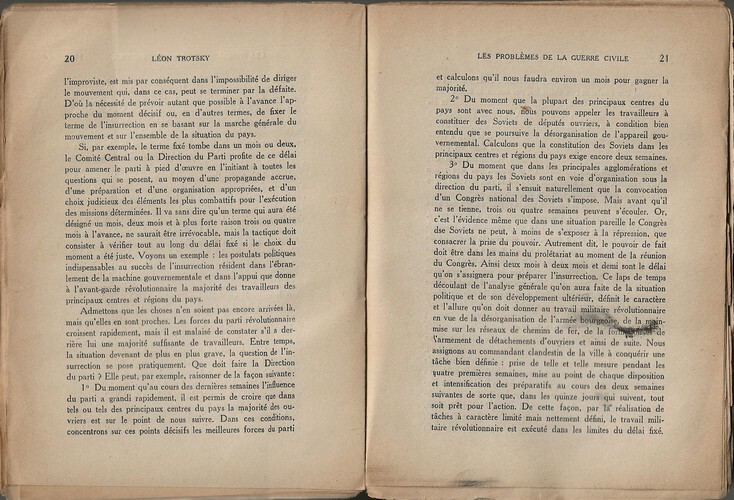
20068493Paris, Imprimerie Spéciale de la Librairie du Travail / Collection " Faits et Documents n° 5 ", 1926. In-12 broché de 38 pages au format 19,5 x 14,5 cm. Couverture avec titre imprimé. Dos carré, légèrement insolé, avec infimes frottis et minuscule manque au bas. Plats et intérieur assez parfaits malgré des bords un peu brunis, ainsi que d'infimes frottis et tassements aux coins. Brunissure horizontale en page 21. Exemplaire non coupé. Conférence donnée à la Société des sciences militaires de Moscou en juillet 1924, traduite du russe par Marcel Body. Tirage unique à 4000 exemplaires. Rarissime édition originale, en assez bel état général de cette fragile plaquette.
29287Suisse, Cahiers Indépendants, Témoins, VIème année. N° 21 de Février 1959. In-12 agrafé de 42 pages au format 21 x 13,5 cm. Couverture avec titre imprimé. Dos et bords des plats insolés. Intérieur frais. Photographie en noir de Victor Serge en frontispice. Préface de Jean. P. Samson. En fin d'ouvrage on trouve deux témoignages sur Victor Serge, avec photographie de ce dernier, par Rirette-Maîtrejean et Julian Gorkin. Liste avec l'œuvre de Victor Serge en dernière page. Rarissime édition originale, très fragile, en superbe état général de fraicheur.
29288Editions Spartacus / Cahiers Mensuels n° 26 d'Avril- Mai 1948. Plaquette In-16 brochée de 64 pages au format 18 x 13,5 cm. Couverture illustrée. Dos carré muet, légèrement insolé. Plats et intérieur frais. Textes de Alfred Rosmer, Hélène Modiano, Julian Coffinet, Victor Serg, etc, préfacéspar Marcel Martine. tEtat superbe proche du parfait. Rare édition originale.
193991921939 Moscou, 1939, Edition en lagues étrangères; in-4, pelin cartonnage de l' éditeur gris avec vignette en couleurs contre-colée au 1er plat ; 68,(2)pp. Texte imprimé en noir avec les têtes de chapitres en rouge; 8 illustrations hors texte en couleurs, sépia ou noir.
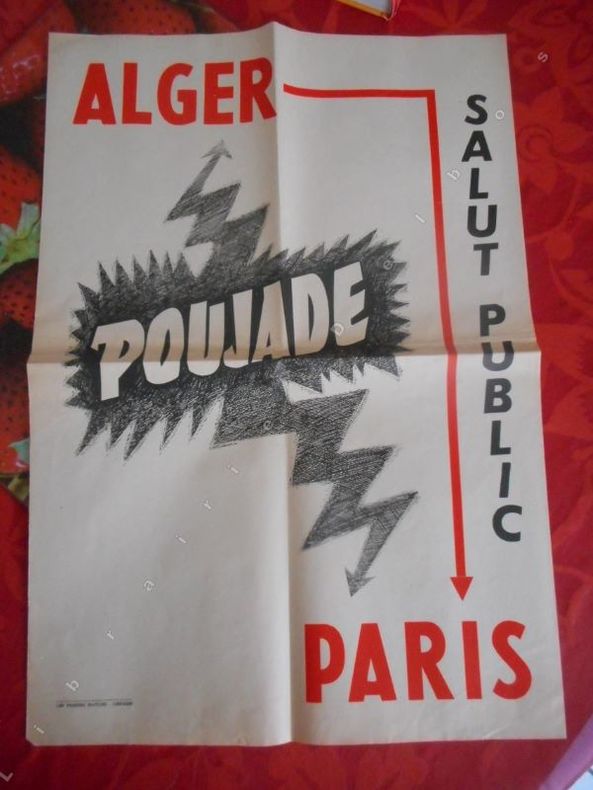
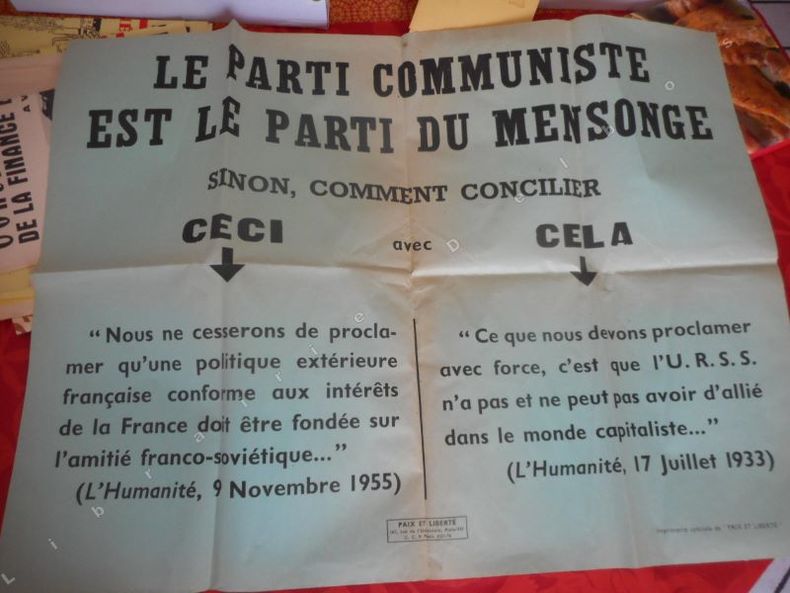
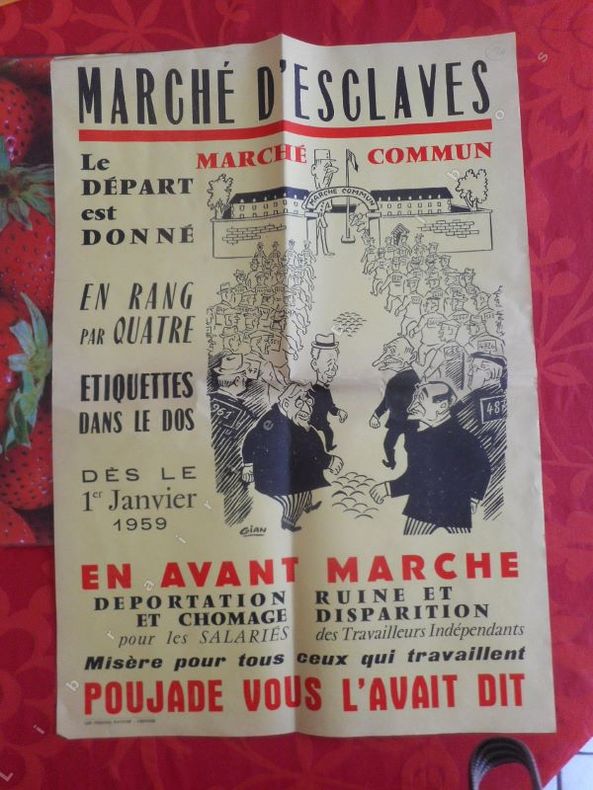
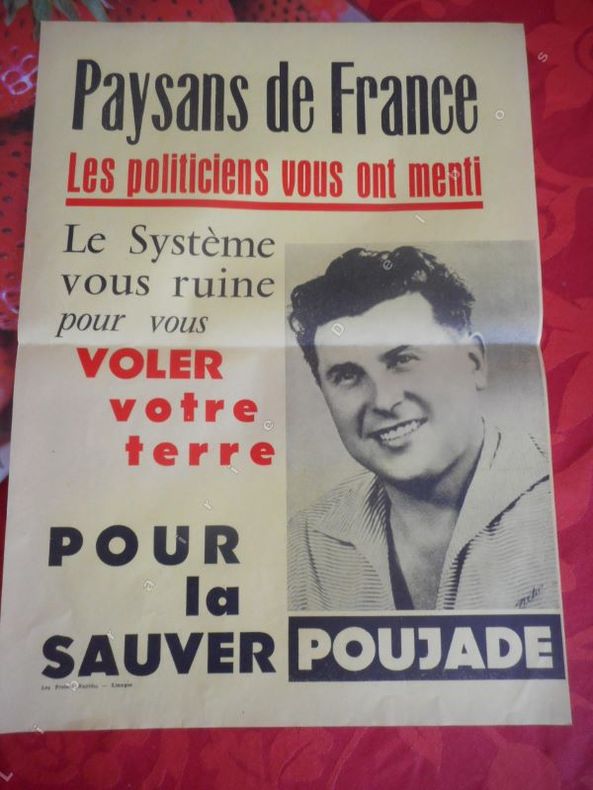
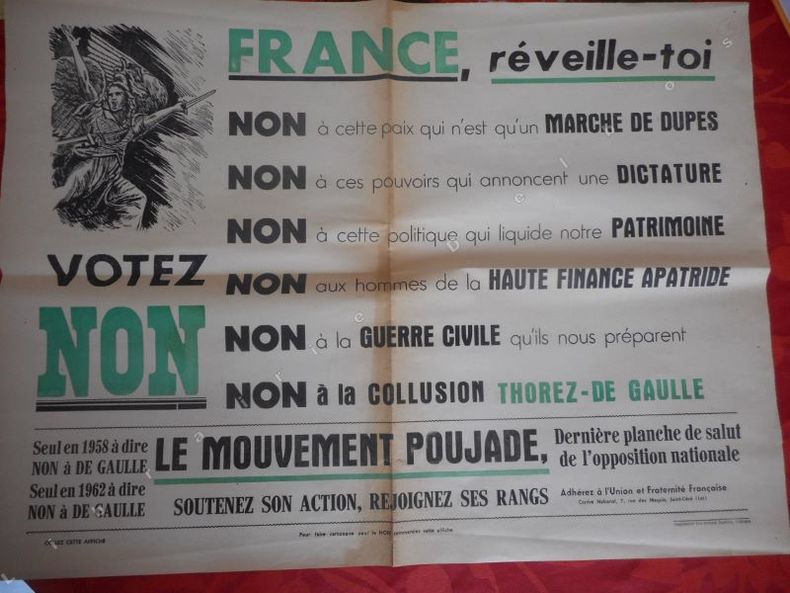
43063s.d.. Affiche politique au format 38x54 cm, non datee. Pliee. Tres bon etat.
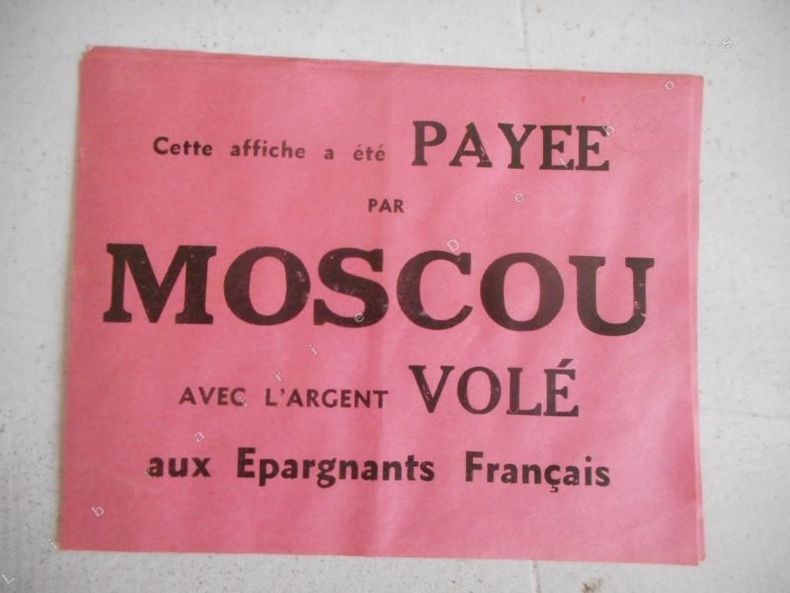
43066s.d.. Affiche politique au format 12,5x16 cm, non datee. Pliee. Tres bon etat.
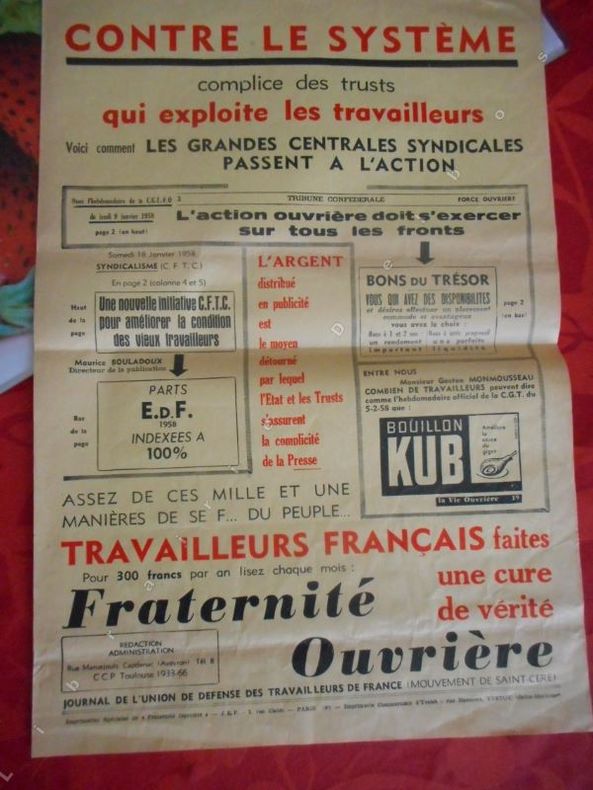
43062s.d.. Affiche politique au format 28x38 cm, non datee. Pliee. Tres bon etat.
43060s.d.. Affiche politique au format 80x76 cm, non datee. Pliee. Legere insolation. Tres bon etat.
43065s.d.. Affiche politique au format 38x56 cm, non datee. Pliee. Tres bon etat.
43061s.d.. Affiche politique au format 28x38 cm, non datee. Pliee. Tres bon etat.
43064s.d.. Affiche politique au format 60x40 cm, non datee. Pliee. Tres bon etat.
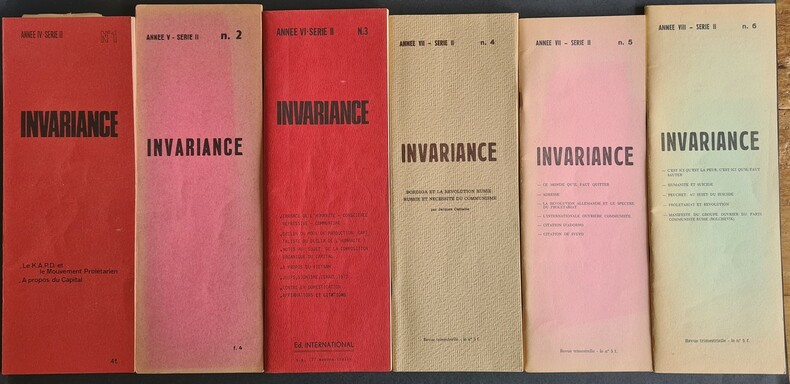
1619817Série complète Revue Invariance, Année IV - Série II, numéro 1 à 6 de 1971 à 1975. Six volumes in-8 oblong, brochés, puis agrafés de 76, 62, 124, 68, 64 pages, au format 29,5 ou 30,5 x 11 cm. Couvertures de différentes couleurs avec titres imprimés. Dos carrés ou pincés. Plats et intérieur frais, avec quelques passages en marges notés au crayon, et des notes sur fiches bristol. Complet des feuilles d'errata. Invariance est à la fois une revue française à la parution irrégulière et un groupe militant du même nom fondée par Jacques Camatte, en 1968, à la suite de sa rupture avec le Parti communiste international dont il jugeait les positions trop activistes. Cette revue fut d'abord consacrée à une ligne de stricte orthodoxie bordiguiste d’après les idées d’Amadeo Bordiga, puis s'éloigna de cette tradition pour finalement rompre avec le marxisme et développer des thèmes proches de l'anarcho-primitivisme. mondial. Cette revue de la " Radicalité Intellectuelle " post-1968 eut de nombreux collaborateurs : Philippe Leclerc, Gianni Collu, Nicola La Porta à Florence, Giorgio Cesarano, Henri et Claudie Bastelica, Jean-Louis Darlet, Saïa et Danièle Voldman ( articles « À propos du Vietnam » et « Juifs, sionisme, Israël »). La revue attira l’attention de tout un milieu à gauche du trotskysme, tant en France qu’en Italie. Toni Negri, en prison, lisait Invariance. Certains groupes marginaux italiens ( Ludd, Comontismo ) prétendirent même s’en inspirer dans des actions de « récupération ». Jacques Camatte, né en 1935 à Cannes, fut professeur de Sciences de la Vie et de la Terre (SVT), théoricien « Bordiguiste » de 1957 à 1967. Engagé dans la FEN jusqu’en 1967 il fut le créateur cette revue, qui pour lui était le produit du mouvement de 68 en lequel, Jacques Camatte voyait, la fin de la phase de contre-révolution…Il disait que Mai 68, ce n’est pas la révolution, c’est son émergence. Une émergence qui, toujours selon lui, avait été préparée par la guerre du Vietnam, la crise monétaire internationale,la lutte des guérilleros en Amérique latine, et surtout celle du mouvement ouvrier noir, provoquée par les conséquences de l’automation... Série complète en état superbe. Edition originale de toute rareté.
11214Paris, Le Centre d'Archives et de Documentation Politiques et Sociales, 1975. In-8 broché, 32 pp.
11021Paris, Editions du Fuseau, 1952. In-8 broché (dos bruni, papier jauni). 286 pp.
1984LFA-126736243Un ouvrage de 165 pages, format 150 x 205 mm, broché, publié en 1984, Université de Grenoble 3, bon état, peu courant
4359Paris, Plon-Terre Humaine, 1976. Fort volume petit in-8 reliure d'éditeur toile noire sous jaquette illustrée, 768 pp. 44 illustrations, 5 cartes dans le texte et 52 photographies hors texte.
2944Moscou, Editions en langues étrangères, s.d. Fort in-8 reliure tile bleue sous jaquette, 827 pp.
11022Paris, Les Iles d'Or, 1954. In-8 broché (couverture défraîchie), 306 pp. Exemplaire su Service de Presse.
4832Paris, François Maspero, Cahiers Libres n° 9-10, 1960. In-12 broché, 337 pp. (couverture défraichie). Pour la première fois, un communiste en tant que tel, avec l'appui et la garantie de son parti, donne une analyse marxiste lucide, sans rien cacher, de cette période.
5616Paris, Payot-Bibliothèque Historique, 1972. In-8 broché, 549 pp. Cartes.
6260Paris, François Maspero - Cahiers Libres n° 22, 1961. In-12 broché, 172 pp. Un des 250 exemplaires d'abonné (non numéroté).
1967LFA007f9N° 962 - 16 septembre 1967 - numéro complet - bon état
16934Par-tout (Holland), Chez le vrai sage, 1760. 2 works bound in 1 volume. 130 pp.; 211, (5) pp. 12mo. Contemporary marbled calf, spine gilt with raised bands, label with gilt lettering, front cover with repair. First work: Not in Camus; Weller, ii, 129; Conlon 51:635 (listing an edition printed in 'Francfort et Leipsic' in 62 pages only); Holzmann & Bohatta, 11995; INED 1907 & 1872 (for Formey's work). One of at least two editions printed in the year of its first publication.Rare and important treatise on legal reform in which Frederic collaborated with Cujacius. The work is both historical and political and discusses the origins of law in Greece, Rome, France, England and Germany, their structure and classification and how national culture influences the development and adaptation of laws. Formey's treatise covers the pp. 86-130. It argues in favour of interest as long as the interest is "honnête". - Small stamp in blank portion of half-title.Second work: Kress 5457; INED 3318; Goldsmiths 9074; Einaudi 4031 (all listing the first edition); Le Bucher bibliographique, 780; Weller, ii, p. 140. According to Lichtenberger in his Le Socialisme au XVIIIe siècle, this is, if not the most important socialist work of the 18th century, at least one of the most important works, and it is the theoretical foundation of his famous Naufrage des isles flottantes; ou Basiliade .......'Morelly argued that the code of nature was completely communistic. Starting out from the proposition that moral evil, the essence of which was avarice, could be explained by social conditions Morelly portrayed and advocated an ideal communistic society in which it would be 'impossible to be depraved.' (.....) In many respects Morelly's system anticipates the rationalistic utopianism of Fourier' (Kingsley Martin in ESS, vol. xi, pp. 10 ff).Morelly was 'tremendously influential in inspiring utopian socialism, for his theories are reflected in almost every one of the schemes of the Utopian socialists. In fact we must regard him, if not the founder, at least as the most conspicious forerunner of the Utopian Socialists. (.....) Of the writers of his time he was the one who saw most clearly the need of a new system to replace the old; he alone was truly constructive, for he actually outlined a new social structure which he thought would meet the needs should ancient society be overthrown. While others deserve merit as critics and analysts and destroyers, he alone deserves the name of utopianist at this early period' (Hertzler, J.O. The history of Utopian Thought, p. 186 ff). The work was severely prosecuted in France. This edition was apparently printed in Holland and destined for the French market. - A very nice volume with two important texts.
23026Norrkoeping, Eric Biornström, (below, on printed cover: En Commission - Londres, Trübner & Co), 1863. (2), iv, (2, blank), 96 pp. 8vo. Modern boards, original covers preserved. Anderson 302; Kilgour 436; Zaleski 197. First separate edition: Herzen's letters to Turgenev, which first appeared in My Past and Thoughts, published here with a new introduction. 'Herzen's renewed interest in Russia's past and future was closely linked to his bitter disappointment in the "old world". He was a discerning critic of bourgeois society, even if his strictures were not always fair. The modern reader is struck especially by certain far-sighted observations, that seem to anticipate criticism of a complex phenomenon we have come to refer to as "mass culture". Herzen's most interesting comments in this respect are to be found in a series of articles entitled Ends and Beginnings, in which he conducted a polemic with Ivan Turgenev, who had become the moral authority for liberal Westernizers in Russia' (Andrzej Walicki, A History of Russian Thought, Oxford, Clarendon Press, 1980, p. 170). Alexander Herzen (1812-70) was a prominent nineteenth-century Russian social thinker and is known as the 'father of Russian socialism.' Early in his intellectual development, Herzen was influenced by German idealist thinkers such as Schiller and Schelling. He believed in the autonomy and dignity of the individual and opposed forces, such as family and state, that oppressed the individual. Later, under the influence of French socialist thinkers such as Charles Fourier, Herzen's thought became more radical. Herzen projected his earlier concern for the oppressed individual onto society at large and he became a supporter of socialism. The socialism he envisioned was a loose federation of self-governing communes. Only in such a system could the ideal society be achieved- according to Herzen that society would be a free association of individuals which provided for the full flowering of each personality. Herzen initially placed his hopes for this future order in the European socialist movement. After the failure of the 1848 revolutions to achieve socialist principles, however, Herzen became disillusioned about European prospects and turned his attention to Russia. Herzen argued that socialist transformation would actually come first to Russia because communal institutions such as the peasant commune survived and bourgeois attitudes hadn't yet emerged. This sense of the advantages of Russian 'backwardness' was influential among the Populists in the 1870s. Herzen has been called a 'gentry revolutionary.' The illegitimate son of a wealthy landowner, Herzen viewed the gentry as a progressive class. The revolution he envisioned was for the people but not necessarily by them. Also, his socialism was a national destiny rather than a class one, and because he promoted the value of individualism in collectivist form--in other words, the full flowering of the individual could best be realized in a socialist order. Among Herzen's works are From the Other Shore (1848-50) and The Russian People and Socialism and his autobiography, My Past and Thoughts.He founded a periodical, the famous Kolokol, in whose pages the free word first appeared in the Russian language, unhampered by censor or police, exposing the government's secrets, criticizing bureaucratic abuses, approving the good intentions of the czar, the 'liberator', and trying to dictate to him a reform program.