COMMUNISMBiblio.com
96 résultats
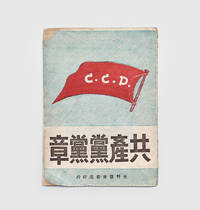
1947182588Shexian: Taihang qunzhing shudian "Taihang People's Bookstore" 1947. Maoism made official First edition thus. Passed at the party's seventh congress in 1945 the constitution for the first time formalized "Mao Zedong Thought" as the guiding ideology of Chinese communism. Following the historic congress the new constitution was disseminated by local printers in the rural base areas under party control. This example was issued in the foothills of the Taihang Mountains near the capital of the strategically important Shanxi-Hobei-Shandong-Henan "liberated zone." In 1948 Mao took up residence in nearby Xibaipo where he lived until his triumphant entry into Beijing in March 1949. This first printing dates to September 1947. Subsequent printings appeared in December 1947 and several times in 1948 but they did not have a frontispiece. Rural printers had access to only the most rudimentary facilities and the vast majority of base-area publications have now perished. Octavo pp. ii 27 1. Half-tone frontispiece portrait of Mao decoration above table of contents. Text in Chinese. Original illustrated wrappers front cover lettered in black. Tidemark at head of volume spine worn split at head of front joint chip to front cover several gatherings uncut: a very good copy typical of publications printed in the Chinese Communist Party's rural base areas. unknown
39London: Victor Gollancz 1935. Hard bound first edition. Very good with some spotting and chips to head of dust jacket spine. Scarce in dust jacket. 355 grams. All books in stock and available for immediate shipment from Winnipeg Manitoba. London: Victor Gollancz, 1935 unknown
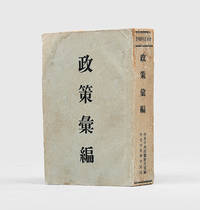
1949183227No stated place: Zhonggong zhongyang huajong ju "Middle China Bureau of the Chinese Communist Party" c.1949. First edition thus number 126 of an unknown internal distribution gathering together documents and speech transcripts issued by central party authorities in the decisive two years of the Chinese civil war. As the communist victory became inevitable the party's focus switched to preparing its burgeoning ranks of cadres for the many challenges of government. This anthology was printed for cadres in the Middle China Bureau which had been founded in 1941 under the leadership of Liu Shaoqi to oversee New Fourth Army operations. In May 1949 the leadership was transferred to Lin Biao Mao's superstar general and future heir apparent. Octavo. Text in Chinese. Original grey wrappers spine and front cover lettered in black. A few reader marks internally. Tidemarks spine worn in places front cover with simple old paper repair on verso foxing and staining internally: very good. unknown
197017547New York: G. P. Putnam' Sons. Very Good with no dust jacket. 1970. First Edition; First Printing. Hardcover. Black cloth cover with gilt lettering on spine and top cover. Lacking DJ. Cover is clean and unworn. Corners sharp Binding sound tight and straight. Previous owner's name on ffep. There is a short personal inscription signed by the editor Buckley on the half-title page. ; 8vo 8" - 9" tall; 303 pages; Signed by Editor . G. P. Putnam' Sons hardcover
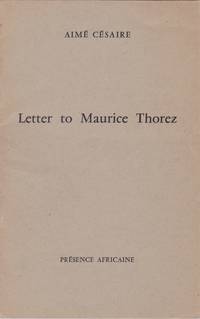
19572127<p>Paris: Editions Présence africaine 1957. <br /><br />A letter from the Martinique poet and politician Aimé Césaire to Maurice Thorez secretary general of the French Communist Party. Césaire announces his resignation from the party citing Stalin's crimes and the party's treatment of nonwhite people.</p><p>Césaire's letter is dated October 24 1956 one day after the start of the Hungarian Uprising against the Soviet Union and eight months following Nikita Khrushchev's "secret speech" documenting Stalin's crimes. <br /><br />"I think I have said enough to make it plain that it's neither Marxism nor Communism I repudiate; that the use certain people have made of Marxism and Communism is what I condemn" Césaire writes. "That what I want is that Marxism and Communism be harnessed into the service of colored peoples and not colored peoples into the service of Marxism and Communism." pages 11-12. Pamphlet entirely in English.<br /><br />While this pamphlet is widely held by institutions it's uncommon in commerce. SCARCE.</p><p>PHYSICAL DETAILS: 12mo 7 1/16 x 4 1/2 inches; 180 x 113 mm 15 1 pages in stapled green-gray wrappers with errata slip pasted to recto of lower wrapper soft cover.<br /><br />CONDITION: Light soiling to wrappers some light creasing to pages but clean and unmarked. A Very Good or better copy of a scarce publication.</p> Editions Présence africaine paperback
193756650Brussels: CILACC 1937. fair. 19 wraps footnotes bibliography text darkened small pieces missing to text and cover edges covers darkened. Cover edges reinforced with tape. Text is in French. Translation of French title: Anti-Communist Documentation: Comintern in "Peaceful" Action. Using data gleaned from Russian periodicals such as Pravda Bolshevik and Izvestia CILACC exposed the contradictions in Soviet propanda and used it to undermine official Stalinist rhetoric and the image of the "beloved leader." CILACC paperback
1957833Plain printed and staple bound wraps. 205pp. Crease to front wrap previous owner's initials. Ownership stamp on front wrap reads "Commonwealth of Massachusetts / Dept. of Public Safely / Div. of Subversive Activities / Boston Mass." An investigation and report on the case against Professor Dirk J Struik of MIT a Dutch Marxist and mathematician who was accused of being a Soviet spy. Commonwealth of Massachusetts paperback
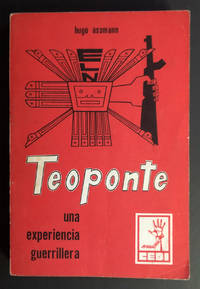
19713912<p>Oruro Bolivia: CEDI 1971. 1st edition. Soft cover. Very Good/No Jacket as issued. VG. 8vo 282pp printed wrappers. Rare original edition of this revolutionary memoir published in Bolivia. In Spanish. Unmarked copy a bit of reading wear.</p> Oruro, Bolivia: CEDI paperback
036559427X.Gpaperback. Good. Access codes and supplements are not guaranteed with used items. May be an ex-library book. paperback
19582004Washington D.C.: Press Office-German Embassy 1958. No Edition Stated. <br /><br />Octavo 8 1/2 x 5 1/2 inches; 215 x 140 mm 19 1 pages in stapled wrappers. With a compliments card laid in. <br /><br />Transcript of a speech by Ernst Lemmer a German government minister about the worsening refugee crisis. He notes that millions have fled the German Democratic Republic -- which he calls the Soviet Zone -- since 1949. <br /><br />He blames increasing "Sovietization" of the GDR and denies GDR assertions that West Germany is enticing people to leave. An interesting insight into West Germany's growing alarm about the tide of refugees from the GDR. The Communist regime of course would build the Wall less than three years later. SCARCE.<br /><br />OCLC shows about a dozen institutional holdings. Scarce in commerce. <br /><br />An interesting insight into West Germany's growing alarm about the tide of refugees from the GDR. The Communist regime of course would build the Wall less than three years later. SCARCE.<br /><br />CONDITION: Toning to edges a few light creases internally clean and unmarked. A Very Good copy. Press Office-German Embassy
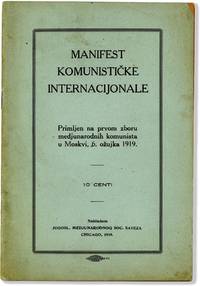
191983563Chicago: Jugosl. Medjunarodnog Soc. Saveza 1919. 12mo 17cm. Staple-bound printed pale blue wrappers; 28pp. Mild toning and soil to wrapper edges; expected tanning to text; Very Good. <br /> <br /> Scarce American Croat translation of Trotsky's Manifesto of the Communist International which had originally appeared in Issue no. 1 of The Communist International the Comintern's theoretical organ. The translator of this edition is unidentified; nor is there any mention of Trotsky as author. Hoover Institution only in OCLC. Jugosl. Medjunarodnog Soc. Saveza unknown
13603Heraklion Crete Greece. 12 January 1947. 4pp. 8vo. 96 lines of text. On paper ruled for accounts. On lightly-aged paper with loss to corners and at central edge affecting a few lines of text. Accompanying the letter is a translation 2pp. 8vo by Colin Jordan with the assistance of Dr Loukas Christodloulos. The letter is of great interest casting light on Leigh Fermor's activities in Crete in the period following the Second World War. The identity of 'Haris' is not immediately apparent: he does not appear to feature in George Psychoundakis's account of the Cretan resistance 'The Cretan Runner' 1955 which was translated by Leigh Fermor. Addressing 'Mr. Leigh Fermor' the author of the letter begins in reproachful terms: 'After my third letter you remain silent. I write now with a big question mark: why this is happening and why you are ignoring my thoughts and my offer in general' He asks Fermor 'for the sake of our friendship and co-operation and for our land of Crete' to guide him in his thoughts and to advise him in his actions 'and to help me in my efforts against the slanderers and the malevolent enemies of our union'. He desires Leigh Fermor's 'co-operation against the transformation of Crete and Greece my country into a Soviet protectorate.' He proceeds to report on 'the situation that exists': 'The Communist newspaper "Free Crete" has begun again a serious campaign against the English generally and in particular against us Major Fielding Major Alexander Wallace 'Xan' Fielding who like Leigh Fermor was in the SOE in Crete during the war and Kyrios Giorgos. They claim that the crimes of killing a villager from Potamiko Nikos Komi of another from Heraklion prior to the referendum others from Apokoronou and from Hania family murders for revenge and political party murders were done by you that you organized them that is and ordered their execution by your people.' A further claim is that 'from the time of the occupation' Leigh Fermor has been 'organizing here the ground for the occupation of Crete by the English and the creation of military bases since Alexandria is hostile towards Egypt and you are using that against her'. In his view it is easy to refute the Apokorona and Hania murder charges 'since it's commonly known that they were done by locals for revenge and due to political hatred and had nothing whatsoever to do with our work. The murder of the police officer from Heraklion happened before your arrival here in September. As for the killing of Komi at Potamiko the same man wrote a letter that he did it because of personal motives and not following orders from yourself.' He proposes to write 'to the newspapers of the Right-wing here that your visit to Crete was entirely a holiday trip to see your friends and that the villager's murder was done before you came. Also that the Hana murder had other purposes and that you and the English generally have never thought of occupying Crete and that you have always acted from friendship. I will also go to the prison and I will oblige Nikos Komis to sign a letter of protest against the writings of the "Free Crete" newspaper.' He will take responsibility for the publication 'as I did a few days ago when I published articles about English/Greek friendship in the <.>IDI and PATRIDA newspapers. Regarding 'the Communist nightmare that threatens all of us with destruction': 'Once again I give my life and for that thought I would gladly sacrifice. The communists know this and consider me their enemy like nobody else.' He ends with an enquiry regarding 'the Anglo-Greek Society at Heraklion that you had promised back in September'. Heraklion [Crete, Greece]. 12 January 1947. unknown
18771Heraklion Crete Greece. 12 January 1947. 4pp. 8vo. 96 lines of text. On paper ruled for accounts. On lightly-aged paper with loss to corners and at central edge affecting a few lines of text. Accompanying the letter is a translation 2pp. 8vo by Colin Jordan with the assistance of Dr Loukas Christodloulos. The letter is of great interest casting light on Leigh Fermor's activities in Crete in the period following the Second World War. The identity of 'Haris' is not immediately apparent: he does not appear to feature in George Psychoundakis's account of the Cretan resistance 'The Cretan Runner' 1955 which was translated by Leigh Fermor. Addressing 'Mr. Leigh Fermor' the author of the letter begins in reproachful terms: 'After my third letter you remain silent. I write now with a big question mark: why this is happening and why you are ignoring my thoughts and my offer in general' He asks Fermor 'for the sake of our friendship and co-operation and for our land of Crete' to guide him in his thoughts and to advise him in his actions 'and to help me in my efforts against the slanderers and the malevolent enemies of our union'. He desires Leigh Fermor's 'co-operation against the transformation of Crete and Greece my country into a Soviet protectorate.' He proceeds to report on 'the situation that exists': 'The Communist newspaper "Free Crete" has begun again a serious campaign against the English generally and in particular against us Major Fielding Major Alexander Wallace 'Xan' Fielding who like Leigh Fermor was in the SOE in Crete during the war and Kyrios Giorgos. They claim that the crimes of killing a villager from Potamiko Nikos Komi of another from Heraklion prior to the referendum others from Apokoronou and from Hania family murders for revenge and political party murders were done by you that you organized them that is and ordered their execution by your people.' A further claim is that 'from the time of the occupation' Leigh Fermor has been 'organizing here the ground for the occupation of Crete by the English and the creation of military bases since Alexandria is hostile towards Egypt and you are using that against her'. In his view it is easy to refute the Apokorona and Hania murder charges 'since it's commonly known that they were done by locals for revenge and due to political hatred and had nothing whatsoever to do with our work. The murder of the police officer from Heraklion happened before your arrival here in September. As for the killing of Komi at Potamiko the same man wrote a letter that he did it because of personal motives and not following orders from yourself.' He proposes to write 'to the newspapers of the Right-wing here that your visit to Crete was entirely a holiday trip to see your friends and that the villager's murder was done before you came. Also that the Hana murder had other purposes and that you and the English generally have never thought of occupying Crete and that you have always acted from friendship. I will also go to the prison and I will oblige Nikos Komis to sign a letter of protest against the writings of the "Free Crete" newspaper.' He will take responsibility for the publication 'as I did a few days ago when I published articles about English/Greek friendship in the <.>IDI and PATRIDA newspapers. Regarding 'the Communist nightmare that threatens all of us with destruction': 'Once again I give my life and for that thought I would gladly sacrifice. The communists know this and consider me their enemy like nobody else.' He ends with an enquiry regarding 'the Anglo-Greek Society at Heraklion that you had promised back in September'. Heraklion [Crete, Greece]. 12 January 1947. unknown
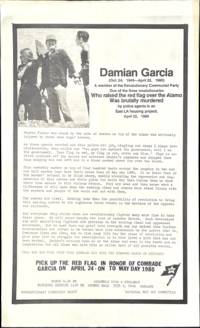
77437Small poster 8 1/2" x 14" photomechanically reproduced on white paper. Two-sided with the text in English on one side and Spanish on the other. Creased horizontally with some mild toning; else very good.<br /> <br /> This piece was intended to raise awareness of an April 24 1980 march and memorial meeting in Oakland California organized by the Revolutionary Communist Party in honor of Damian Garcia who was murdered two days earlier while distributing party literature at the Pico Gardens housing project in the Boyle Heights neighborhood of Los Angeles.<br /> <br /> Garcia a U.C. Santa Barbara graduate who served as executive director of La Casa de la Raza during the mid-1970s was a prominent RCP member who led one of the group's most notable actions: raising the red flag over the Alamo in San Antonio on March 20 1980. Throwing down the Texas flag Garcia declared "We've come to set the record straight about the Alamo. This is a symbol of the theft of Mexican land a symbol about the murder of Mexicans and Indians and a symbol of oppression of Chicanos and Mexicanos throughout the whole Southwest." He also called on people together with the proletariat worldwide to come out in struggle on May 1: International Workers Day.<br /> <br /> Following Garcia's death the RCP claimed that his murder was a result of this action and alleged Los Angeles Police Department involvement. The party also refused to cooperate in the investigation and organized demonstrations against both the LAPD and the City of Los Angeles including a May Day march in Los Angeles that was forcibly dispersed by riot clad police officers. As the RCP's first and only martyr Garcia remains an important propaganda symbol for the organization and frequently appears in the RCP newspaper The Revolutionary Worker. unknown
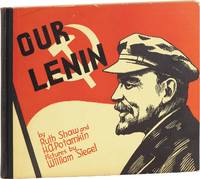
193481518New York: International Publishers 1934. First Edition. Oblong quarto 23cm x 27cm. Original cloth-backed pictorial boards; 62pp; illus. A remarkably bright unworn copy with minimal rubbing to board corners with the pictorial elements bright and unfaded. Internally clean and unmarked with joints and hinges tight; Near Fine. Lacking the scarce dustwrapper. There was also an issue in plain black bookcloth priority uncertain. <br /> <br /> A biographical encomium to Lenin for juvenile readers with illustrations by the New Masses cartoonist William Siegel. A great example of "party-approved" literature for children during the heyday of communism in America an unusually well-preserved copy. International Publishers unknown
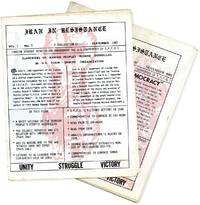
88373Philadelphia: Iran Student Association 1983. Two issues in original wrappers. Stapled paper self-wraps covers printed in two colors; 28pp 36pp; illus. Mild foxing at margins else Very Good. Text entirely in English.<br /> <br /> Organ of the American student arm of the Iranian People's Fedayee Fedai Guerrillas an Iranian guerrilla communist group that opposed both Western capitalism and the 1979 Islamic Revolution the latter chiefly from exile. This group is not to be confused with the Organization of Iranian People's Fedai Guerrillas from which the IPFG split in 1979 citing the former's lack of dedication to the principles of armed struggle. The magazine's contents are a combination of attacks on Iran's "imperialist" Islamic regime and on the foreign policy of the United States which the organization blames for laying the foundation for the Islamic revolution beginning with the CIA coup of 1953. A rare publication from a key period in modern Iranian history before the Islamic Republic had irrevocably consolidated power. This periodical rare; OCLC notes only about five locations for any holdings in the U.S. all for later issues. unknown
19501962<p>New York: Self-published ca. 1950. No Edition Stated. Oblong 48mo 3 7/8 x 5 1/2 inches; 100 x 140 mm 31 1 pages in stapled wrappers.</p><p>American journalist and professional curmudgeon John T. Flynn 1882-1964 responds to critics of his 1949 book "The Road Ahead: America's Creeping Revolution" in which he alleged America was being led down the road to socialism.</p><p>In this pamphlet he attacks Protestant church organizations saying they promote socialism. He also levels attacks at various people he considers socialists communists and fellow travelers. OCLC FirstSearch shows only six institutional holdings. SCARCE. <br /><br />CONDITION: Toning to wrappers rubber stamp of free-market economist Percy L. Greaves Jr. to upper wrapper. Internally clean bright and unmarked. Very Good.</p> Self-published paperback
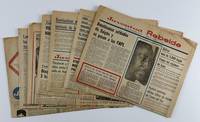
196912628Havana: Union de Jovenas Comunistas 1969. Seven newspapers each between 6 and 8pp. on newsprint. Illustrated. Modest toning some edge wear and closed tears some bumped or dog-eared corners. Overall very good. A small but instant collection of an informative newspaper from Communist Cuba published daily by the youth wing of the Party. The issues are all dated in January 1969 specifically from January 11 15 22 28 29 30 and 31. The issues contain domestic and international reporting along with topics relevant to revolutionary young people. Interestingly one issue contains a translated interview with Hollywood legend Marlon Brando. The paper also prints a legion of photographs cultural event listings classifieds baseball statistics and updates cartoons and more. Union de Jovenas Comunistas unknown
192658580Chicago: Charles H. Kerr & Co. 1926. 8vo. 152 2 pp. Blue cloth red lettering & ruling on covers red lettering on spine minor shelfwear w/ d.j. black lettering and hammer & sickle on red field minor chipping head & foot of spine VG/VG- copy. First edition of this travel memoir recounting this labor writer’s visit to the Soviet Union as she investigated music instruction in the new Russian schools. She describes labor conditions status of women child organization militarism a Volga journey along with theaters and the new sports movement. Charles H. Kerr & Co., hardcover
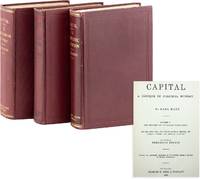
190688451Chicago Ill: Charles H. Kerr & Co. London: Swan Sonnenschein & Co. 1906 1907 1909. First Editions First Printings. Three Volumes. Octavo. 22.5cm. Publisher's deep maroon ribbed cloth titled in gilt to spines and ruled in blind to boards. 869pp.; 618pp.; 1048pp. Generally strong and tight; mild scuffing and to spine ends and corners and a few minor exterior stains. Spine gilt is significantly oxidized to Vol II as is usually seen on the first printing; internally clean and fresh some very light spotting in places mainly confined to the page edges. A very good handsome set of first printings. <br /> <br /> A full set of first printings of this bibliographically complex edition issued over the course of three years. Marx published the first volume of his epic analysis of capitalism in German in 1867. The first translation into English was of Volume 1 only and was accomplished by Edward Aveling and Samuel Moore in 1887 based on the revised 4th German edition as edited by Engels. The 1906 first American printing under the Charles Kerr impint as here largely follows this translation with the subsequent translation work for Volumes II and III being performed by Ernest Untermann. Thus the earliest printings of the Kerr edition comprise the first complete edition of Capital in the English language. The printing was done in Chicago by James Higgins Kerr's printer of choice making this also the first complete edition of Capital to be printed entirely by a union-run print shop. Untermann did most of his translation work from remote Florida beginning the effort in 1905 discovering in the process a number of indices footnotes and at least ten pages of text that Aveling and Moore had not included in their London edition - making the Kerr edition the most complete up to its time. <br /> <br /> Kerr burned through the first two-thousand copy print run of Volume I almost immediately and rushed to get Volume II out by July 1907. It's very possible that financial constraints were already making themselves known by Volume II as Kerr was selling the books at a loss to encourage sales; the almost ubiquitous oxidation of the gilt on Vol II is likely a result of experimental economy that swiftly failed. Vol III returns to the higher standards of the first volume. The bindings on the first printings also feature a triple blind rule to the ribbed cloth boards with subsequent printings having double rules. Kerr's reprint system seems to have incorporated dates on the title pages for some length of time with the dates on the copyright pages remaining unchanged; after a certain point around the early 1920's reprints were issued without dates to the title pages and any volume without a date can safely be deemed a post-1920s reprint. Issues of Kerr's International Socialist Review from the period of printing recount in detail some of his problems and concerns publishing and selling the work with detailed data on dates numbers of copies and the firm's hopes for the completed book. <br /> <br /> Genuine first printing sets of this important edition are tremendously scarce in commerce. The lack of any real bibliographical authority for the American edition combined with Kerr's generally lax approach to differentiating printings has over the years led to frequent errors and misjudgments on the part of cataloguers including in full disclosure ourselves. After a good deal of research most in the advertising pages of the International Socialist Review we're confident we've finally got it right. Charles H. Kerr & Co. [London: Swan Sonnenschein & Co.] unknown
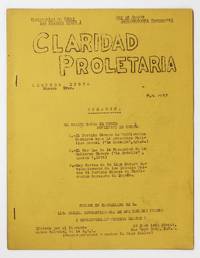
19376146New York: Revolutionary Workers League 1937. About very good. Two issues each 13pp. Folio. Mimeographed front wrapper stapled. One cover loosening. Moderate toning and dust soiling. Two issues of the scarce New York Spanish-language periodical Claridad Proletaria "El Organo en Castellano de la Liga Obrera Revolucionaria de los Estados Unidos." The Revolutionary Workers League was formed by American Trotskyist and Communist Party leader Hugo Oehler in 1935. The first issue present here dated September 1936 contains articles describing the revolutions in Spain and Latin America as well as pieces on the various internecine fights between the Trotskyist Stalinsist and other Communist factions during the 1930s. The second dated February 1937 is dedicated entirely to events in Spain and the role of Partido Obrero de Marxista Unificacion Workers' Party of Marxist Unification. OCLC locates a small smattering of individual issues. Revolutionary Workers League unknown
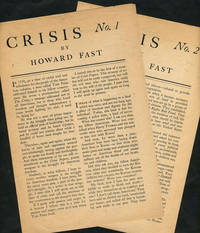
195123521New York: Civil Rights Congress 1951. Very good condition. Two pamphlets part of a series of articles by the American author and noted Communist. Fast modeled his pamphlets on Thomas Paine's "Crisis Papers" noting "I intend this to be the first of a number of Crisis Papers. This tyranny of today will not be easily conquered nor will the evil men who rule America easily bow to the will of the people. I state that I will speak up again and again so long as the need be present". <br /> <br /> Crisis No. 1 protests the American war in Korea the activities of the House Committee on Un-American Activities and attacks and threats on American Communists. Fast decries the threats against the leader of the Civil Rights Congress William L. Patterson to turn over all of his organization's records or be jailed. The Congress's goal was to fight racism & racial injustice in the US.<br /> <br /> Crisis No. 2 concerns the government's attacks on the Civil Rights Congress Bail Fund. 8vo 4pp each. Paper evenly toned. These are the first and second of three pamphlets titled Crisis. Fast wrote extensively on the Paul Robeson riots in Peekskill NY. OCLC: 30448136 Crisis No. 1 and OCLC: 71682230. Civil Rights Congress unknown
193243659Santiago de Chile: Union Social de Chile 1932. First Edition. 12mo 17.5cm.; publisher's blue-grey printed staplebound wrappers; 8pp. Textblock slightly toned else a Fine copy. Issued as "Folleto No. 21. [Union Social de Chile] unknown
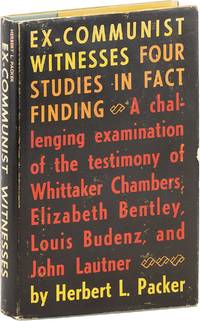
196282699Stanford: Stanford University Press 1962. First Edition. Octavo. 22.5cm. Publisher's pale slate grey cloth covered boards titled in black to spine. Dustjacket. viii; 279pp. Light scuffing and edgewear minor bumping to spine ends in a bright strong example of the dustjacket with some minor rubbing and chipping to extremities. some sunning and fraying to the spine panel and ends a very good handsome copy with some light wear. Internally clean. Bookplate of Phillip G. Fox to front pastedown clearly a home made design and almost certainly that of Professor Phillip G. Fox of the University of Wisconsin who was a professor of business administration with an almost obsessive interest in slot machines and the mathematics of gambling payouts. The bookplate has been composed as a piece of typewriter art centered on a complex mathematical equation; bookdealers aren't necessarily terribly mathematically adept so the solution will have to be found by the next owner of the book.<br /> <br /> Packer's preoccupation here is centred around which of the regularly used official methods for interrogating communists and building information on their activities is the most efficient and successful; court trials admisnitrative hearins or Congressional investigations. There is an interesting corollary in that he is compelled to analyze whether or not Communism is in fact subversive but the answer to that shouldn't probably shouldn't get in the way of a good system for governments to control their citizens. Stanford University Press unknown
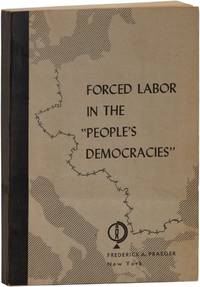
195584362New York: Frederick A. Praeger; For the Mid-European Studies Center of the Free Europe Committee 1955. Revised Edition. Octavo. 20cm. Original black cloth spine over illustrated card wraps. 247pp. Some light wear to the extremities and minor toning to the card wraps; internally clean. A very good strong copy.<br /> <br /> An analysis of the nature extent and appalling realities of Soviet forced labor camps in Hungary Czechoslovakia Romania Bulgaria and Poland. This revised edition was expanded in order to include data regarding forced labor camps in Communist China. Frederick A. Praeger; For the Mid-European Studies Center of the Free Europe Committee unknown