Kim Il SungMareMagnum

14 578 résultats
OTTIME CONDIZIONI
19586065Couverture souple. Broché. 268 pages.
195891917Couverture souple. Broché. 268 pages.
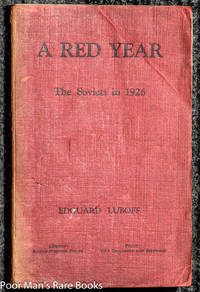
192735883London: Anglo-Russian Press. Good with no dust jacket. 1927. First Edition. Card Covers. 136 pages; Uncommon- Worldcat locates 12 copies in worldwide libraries and collectons. Red card covers. Illustrated with textual pics. Cartoons Red Press extracts etc. Anti-communist. Focuses on Anglo-Soviet relations. . Anglo-Russian Press unknown
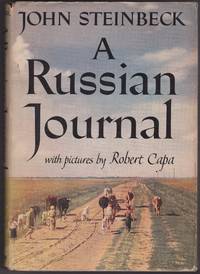
19482521New York: The Viking Press 1948. First Edition First Printing. <br /><br />Small Quarto 9 3/4 x 6 3/4 inches; 247 x 167 mm 220 pages in green and tan cloth in an unclipped illustrated dust jacket hard cover accompanied by four photographic prints. <br /><br />An account of a trip to the Soviet Union in 1947 by author John Steinbeck and photographer Robert Capa who visited while the country was attempting to recover from the devastation of World War II. They traveled to Moscow Stalingrad and other cities as well as to Ukraine and Georgia meeting numerous ordinary people while accompanied by a minder from the government. <br /><br />The New York Herald Tribune financed the trip and along with some other newspapers published articles by Steinbeck and photos by Capa. Indeed included here are three photographs that were used by one of the newspapers as indicated by layout instructions on the versos of the photos. There's also a later publicity photo of Steinbeck. One of the photos from the trip showing a Georgian restaurant in Moscow appears on page 47 of the book. Two of the trip photos are stamped on the versos with the notice that their reproduction could be used only with the "1948 Steinbeck-Capa articles on Russia" along with "Copyright 1948 by John Steinbeck." <br /><br />Our copy is a first printing of the first edition with "Printed by the Viking Press in April 1948" on the copyright page. The dust jacket carries a price of $3.75. <br /><br />A fascinating look at ordinary people in the Soviet Union as the country tried to rebuild following World War II accompanied by three photographs of scenes from the country and a publicity photo of Steinbeck. <br /><br />CONDITION: Book slightly cocked rear hinge loose corners rubbed spine ends bumped end papers slightly toned a couple of pages with vertical creases possibly a production error. Nearly Very Good in a Good dust jacket that has some loss to both spine ends as well as a few tears nicks toning foxing and stains. The four photographs have some nicks creases and soiling to the edges. The versos contain notes stamped instructions and captions pasted on the photo of Steinbeck has an article pasted to the verso. Some discoloration to two photos resulting from pasting of newspaper captions to the versos. The Viking Press hardcover
AA.VV A scuola di politica : il modello comunista di Frattocchie (1944-1993). Bari - Roma, Laterza 2017 italian, 265 CR.52 Brossura editoriale, volume come nuovo, copertina e interno in condizioni eccellenti, legatura salda 265 pagine circaCopertina come da foto
trad. di Luisa Zanoncelli bross. edit. ill., lieve gora al dorso, tracce d'uso
(Milano), A. Mondadori, (1970), in-16, br. editoriale, pp. 266, (4). In parte sciolto.
MAI SFOGLIATO; LIEVE BRUNITURA, LIEVI SEGNI DEL TEMPO; INTONSO. Informazioni bibliografiche Titolo: A sinistra di Mao Titolo originale dell'opera: Peking und die Neue Linke Note: In copertina: Documenti sui gruppi che in Cina e nel mondo contestano gli amministratori della rivoluzione culturale Collana: Volume 13 di L'Immagine del presente Autore: Klaus Mehnert Traduzione di: Luisa Zanoncelli Editore: Milano: Arnoldo Mondadori, 1970 Lunghezza: 266 pagine; 19 cm Soggetti: Comunismo, Partito comunista cinese, Rivoluzione culturale, Cina, Mao Tse-Tung, Repubblica popolare, URSS, Unione Sovietica, Lenin, Marxismo, Sviluppo, Critica, Saggi, Politica, Situazione politica, Sec. 20., Nuova sinistra, Società, Borghesia, Comune Parigi, Hunan, Anarchismo, Studenti, Movimenti politici, Operai, Maoismo, Debray, Che Guevara, Novecento, Internazionale, Socialismo, Documenti, Masse, Ideologie politiche, Storia contemporanea, '900, Classe operaia, Programma, Sheng-wu-lien, Burocrazia, Grande Balzo
19990008049Boulder CO: Westview Press 1999. First English language edition. Hardcover. As New/issued without. 8vos; xxxiv 562; ix 389 pages maroon cloth in original shrinkwrap. Not x-library. Scarce. O.P. <br/><br/>This English translation contains an autobiography by Mironov which was not in the Russian edition. It details his anti-Marxism philosophy while a student in Leningrad. "The author has assimilated a large body of foreign scholarship primarily "new social history" produced by Anglo-American authors along with a sprinkling of more broadly European economic and demographic history from the 1970s and 1980s which is effectively incorporated into his own very deep empirical knowledge. . The reader does not find in this extensively researched account the standard Soviet answers to specific historical questions. Mironov has abandoned most Soviet cliches though he still assumes that laws of Russian history can be identified based on social science theory and quantitative analysis Elise Kimerling Wirtschafter." "This is a massterful work that provides other scholars with a wealth of useful information while confrontimg them with an argument that compels a response - William G. Wagner." Maps. Westview Press hardcover
8vo, hardcover in dj, pp.336. For much of the twentieth century, Europe was haunted by a threat of its own imagining: Judeo-Bolshevism. This myth that Communism was a Jewish plot to destroy the nations of Europe?was a paranoid fantasy, and yet fears of a Jewish Bolshevik conspiracy took hold during the Russian Revolution and spread across Europe. During World War II, these fears sparked genocide. Paul Hanebrink?s history begins with the counterrevolutionary movements that roiled Europe at the end of World War I. Fascists, Nazis, conservative Christians, and other Europeans, terrified by Communism, imagined Jewish Bolsheviks as enemies who crossed borders to subvert order from within and bring destructive ideas from abroad. In the years that followed, Judeo-Bolshevism was an accessible and potent political weapon. After the Holocaust, the specter of Judeo-Bolshevism did not die. Instead, it adapted to, and became a part of, the Cold War world. Transformed yet again, it persists today on both sides of the Atlantic in the toxic politics of revitalized right-wing nationalism. Drawing a worrisome parallel across one hundred years, Hanebrink argues that Europeans and Americans continue to imagine a transnational ethno-religious threat to national ways of life, this time from Muslims rather than Jews.
8vo, hardcover, First edition, first impression. In 'as new' condition, not price clipped (no published price), no inscriptions, looks unopened, unread. 346pp, illustrated. In 1968 historian Sheila Fitzpatrick was 'outed' by the Soviet newspaper Sovetskaya Rossiya as the next thing to a spy for Western intelligence. A graduate student at Oxford, Fitzpatrick had spent time in Moscow to access several of its archives for her doctoral research on A V Lunacharsky, the first Soviet Commissar of Enlightenment after the 1917 Bolshevik Revolution. Moscow, the world capital of socialism, was renowned for its drabness. The buses were overcrowded; there were endemic shortages and endless queues. This was the era of Brezhnev, of a possible 'thaw' in the Cold War, when the Soviets couldn't decide either to thaw out properly or re-freeze. Yet, despite KGB attention, and the impossibility of finding a suitable winter coat, Sheila felt more at home in Moscow than anywhere else- a feeling cemented by her friendships with Lunacharsky's brother-in-law, Igor and daughter, Irina. Punctuated by letter to her mother in Australia and her diary entries from the time, and borne along by Fitzpatrick's wry insightful narrative, A Spy in the Archives captures the life and time of Cold War Russia and provides a unique insight into everyday life in the Soviet Union
125p. Illustrated with drawings. 8vo. Original full purple cloth binding. First edition. "The author was a Hungarian art student who was one of the organizers of the Budapest protest meetings which triggered the Hungarian Revolution. He published this diary pseudonymously after his flight to Canada. "The men, women, and children of Budapest began writing a diary in blood at 11 P.M., October 23, 1956, when the first bullets fired by Hungarian AVH secret police screamed through a crowd of thousands jammed in front of the Radio Budapest Building." Coldwar/Economics 3
pp. xi, 212. Illustrated with diagrams. Tall 8vo. Original full cloth binding. Original dust jacket. Fourth printing. Coldwar/Economics 1
193074539Librairie Valois | Paris 1930 | 13 x 20.50 cm | broché
br. Nella seconda metà dell'Ottocento nella sonnolenta e patriarcale Russia cominciarono a diffondersi i primi germi della rivoluzione sociale. Comunisti, socialisti ma anche tanti anarchici e nichilisti si spesero sull'altare delle idee rivoluzionarie, per innescare le condizioni necessarie alla sollevazione popolare. In questo volume, curato e tradotto dallo slavista Vittorio Strada, è raccolta la straordinaria corrispondenza tra due giganti del pensiero rivoluzionario, il comunista Herzen e l'anarchico Bakunin che si confrontano e scontrano - sempre sospesi sul sottile crinale dettato dalla loro amicizia e rivalità - sulle pratiche politiche rivoluzionarie, le sue finalità etiche, l'uso della violenza. Non solo. In queste lettere compare di continuo tra i due, quasi fosse uno spettro, la tragica figura di Necaev, vero e proprio mito politico "maledetto", nichilista, bombarolo e terrorista senza scrupoli, a lungo protetto e collaboratore dello stesso Bakunin, incubo dei potenti, sempre in fuga dalla polizia, e figura di ispirazione del grande romanzo dostoevskiano "I demoni". Un mito così longevo da far sì che il suo "Catechismo del rivoluzionario" 8riprodotto in questo libro) venga poi utilizzato da movimenti tra i più diversi, non ultimi addirittura i jihadisti. Gli eventi narrati non riguardano la sola Russia, ma toccano la Comune di Parigi e l'Europa intera. "Non ho mai incontrato un altro uomo con una così rara combinazione di scintillante brillantezza e profondità" (Tolstoj). Con scritti di Dostoevskij, Marx e Engels, Lopatin, Necaev, Ogarëv.
200786351Editions de L'aube Seuil | Paris 2007 | 14.50 x 22 cm | broché
Diario dell'inviato del Komintern nella "zona speciale" della Cina.
1957100147730ÉDITIONS PIERRE HORAY 1957 in8. 1957. Broché. Cet ouvrage d'Angelo Rossi propose une analyse rigoureuse du stalinisme incluant le texte intégral du rapport Khrouchtchev un document capital pour comprendre l'histoire de l'URSS et les tares du régime soviétique. L'analyse est complétée par une postface de Denis de Rougemont qui examine la nature les limites et l'avenir de la déstalinisation
A. Berrini - Noi siamo la Classe Operaia: I duemila di Monfalcone - ed. 2004 Testo in lingua italiana. Pagine 244 Copertina morbida. Condizioni molto buone.
A. Colombi - Vita di militante: Dalla Prima Guerra Mondiale alla Caduta del Fascismo - ed. 1975 Testo in lingua italiana. Pagine 290 Copertina morbida. Condizioni molto buone.
Antonio Graziadei - Le teorie sull'utilità, marginale e la lotta contro il marxismo - ed. 1943 Testo in lingua italiana, Pag. 308 Copertina rmorbida Condizioni molto buone
*** Documenti della rivoluzione nell' America Latina - A. Hart - Cuba: un Partito Comunista all' altezza di un popolo rivoluzionario - 1^ ed. Feltrinelli 1970 - pag. 67 Bella pubblicazione, fonte ricchissima di informazioni per appassionati , studiosi e collezionisti
A. Labriola - Giovanni Bovio e Giordano Bruno - ed. 1915 ca. Testo in lingua italiana. Pagine 82 Copertina morbida. Condizioni molto buone con piccoli segni del tempo.