3 418 résultats
161923330N. Y.: Camera Work 1916-1917. First only editions oftThe final two issues of Alfred Stieglitz's monumental photographic periodical Camera Work including in number 48 the earliest appearance in print of the work of Paul Strand and in number 50 an issue entirely dedicated to the work of Strand. Limited to 500 copies printed. "The work of Paul Strand was the first photography to excite Stieglitz in a long time. He saw Strand as practicing a truly photographic version of the kind of forceful representation he found in painters like Picasso and Matisse and he presented Strand's work as a clean break even changing the time-tested production methods of Camera Work Strand's photogravures were printed on thicker paper and with different inks." - Roth 101 pp. 42-43. Issue No. 48 includes six photographs by Strand six halftones by Steiglitz of installations at his gallery 291 and single photographs by Frank Eugene Arthur Allen Lewis and Francis Bruguiere. Issue No. 49/50 includes eleven original photogravures all after work by Strand among them "The White Fence" "Abstraction Porch Shadows" and "Abstraction Bowls". One cannot overestimate the importance of these two issues of Camera Work. As Milton Brown has noted the appearance of Strand's portrait series herein "was a revelation. Even today they are strikingly powerful images; they were then a new stage in photographic realism. The close-up views and cropping of negatives cut off the subjects from their environment sometimes even breaking the frame and riveting attention entirely on the physiognomic and psychological revelation of individuality character and social condition. . . . Strand's experiments with abstraction and the machine were his unwitting contribution to the history of photography: the portraits basic to the rest of his development are the first clear expression of his own aesthetic philosophy." - Milton W. Brown "The Three Roads" in Paul Strand: Essays on His Life and Work. Edited by Maren Stange. Aperture 1990 p. 29. Although not noted in the volumes these two issues of Camera Work came from the collection of James Johnson Sweeney at various times the Curator of Painting and Sculpture at MOMA the second Director of the Guggenheim Museum and the Director of the Museum of Fine Arts Houston. . Among the most sought-after issues of Camera Work these two numbers are complete and in remarkable condition. The plates are clean free of foxing and creasing. The text blocks are clean bright and sound largely unopened. A bit of offsetting from plates to the facing pages as usual somewhat more pronounced in No. 49/50 but not affecting the images themselves. Wrappers are clean with only very light wear; the hinges are firm and there is no creasing or darkening of the spines. Overall both issues are in near fine and extremely scarce thus. . 2 volumes small folio illustrated with 9 and 11 original photogravures respectively original printed wrappers. Among the most sought-after issues of Camera Work these two numbers are complete and in remarkable condition. The plates are clean free of foxing and creasing. The text blocks are clean bright and sound largely unopened. A bit of offsetting from plates to the facing pages as usual somewhat more pronounced in No. 49/50 but not affecting the images themselves. Wrappers are clean with only very light wear; the hinges are firm and there is no creasing or darkening of the spines. Overall both issues are in near fine and extremely scarce thus. . Camera Work unknown books
161923330N. Y.: Camera Work 1916-1917. First only editions of the final two issues of Alfred Stieglitz's monumental photographic periodical Camera Work including in number 48 the earliest appearance in print of the work of Paul Strand and in number 50 an issue entirely dedicated to the work of Strand. Limited to 500 copies printed. "The work of Paul Strand was the first photography to excite Stieglitz in a long time. He saw Strand as practicing a truly photographic version of the kind of forceful representation he found in painters like Picasso and Matisse and he presented Strand's work as a clean break even changing the time-tested production methods of Camera Work Strand's photogravures were printed on thicker paper and with different inks." - Roth 101 pp. 42-43. Issue No. 48 includes six photographs by Strand six halftones by Steiglitz of installations at his gallery 291 and single photographs by Frank Eugene Arthur Allen Lewis and Francis Bruguiere. Issue No. 49/50 includes eleven original photogravures all after work by Strand among them "The White Fence" "Abstraction Porch Shadows" and "Abstraction Bowls". One cannot overestimate the importance of these two issues of Camera Work. As Milton Brown has noted the appearance of Strand's portrait series herein "was a revelation. Even today they are strikingly powerful images; they were then a new stage in photographic realism. The close-up views and cropping of negatives cut off the subjects from their environment sometimes even breaking the frame and riveting attention entirely on the physiognomic and psychological revelation of individuality character and social condition. . . . Strand's experiments with abstraction and the machine were his unwitting contribution to the history of photography: the portraits basic to the rest of his development are the first clear expression of his own aesthetic philosophy." - Milton W. Brown "The Three Roads" in Paul Strand: Essays on His Life and Work. Edited by Maren Stange. Aperture 1990 p. 29. Although not noted in the volumes these two issues of Camera Work came from the collection of James Johnson Sweeney at various times the Curator of Painting and Sculpture at MOMA the second Director of the Guggenheim Museum and the Director of the Museum of Fine Arts Houston. . Among the most sought-after issues of Camera Work these two numbers are complete and in remarkable condition. The plates are clean free of foxing and creasing. The text blocks are clean bright and sound largely unopened. A bit of offsetting from plates to the facing pages as usual somewhat more pronounced in No. 49/50 but not affecting the images themselves. Wrappers are clean with only very light wear; the hinges are firm and there is no creasing or darkening of the spines. Overall both issues are in near fine and extremely scarce thus. . 2 volumes small folio illustrated with 9 and 11 original photogravures respectively original printed wrappers. Among the most sought-after issues of Camera Work these two numbers are complete and in remarkable condition. The plates are clean free of foxing and creasing. The text blocks are clean bright and sound largely unopened. A bit of offsetting from plates to the facing pages as usual somewhat more pronounced in No. 49/50 but not affecting the images themselves. Wrappers are clean with only very light wear; the hinges are firm and there is no creasing or darkening of the spines. Overall both issues are in near fine and extremely scarce thus. . Camera Work unknown
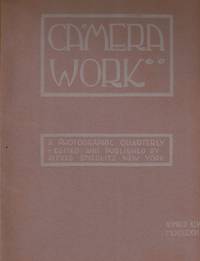
19161576New York: Alfred Stieglitz 1916. 1st Edition. Hardcover. Very Good. FIRST EDITION OF ONE OF THE MOST CELEBRATED ISSUES OF CAMERA WORK: Issue number 48 introducing the work of Paul Strand. Complete with 9 original photogravures including 1 by Frank Eugene 6 by Paul Strand 1 by Arthur Allen Lewis and 1 by Francis Bruguière as well as 6 half-tone reproductions after photographs of '291' by Alfred Stieglitz. With original texts by Marius De Zayas and Marsden Hartley. "When in 1915 Stieglitz saw Strand's radically new approach to photography which embraced the inherent characteristics of the medium and its materials together with the ideas of the artistic avant-garde he felt committed once again to communicate in Camera Work the importance of photography as a vital art form. Stieglitz had been striving for precisely this synthesis of formal abstraction and poetic expressiveness a synthesis which embodied an American aesthetic and syntax. In his October 1916 issue of Camera Work Stieglitz wrote of Strand: 'His work is rooted in the best traditions of photography. His vision is potential. His work is pure. It is direct. It does not rely upon tricks of process. In whatever he does there is applied intelligence. In the history of photography there are but few photographers who from the point of view of expression have really done work of any importance. And by importance we mean work that has some relatively lasting quality that element which gives all art its real significance'" Kaspar M. Fleischmann in American Photography: Local and Global Contexts. Photogravures entitled in the order they appear The Cat by Frank Eugene New York Wall Street Telegraph Poles New York Fifth Avenue and 42nd Street New York Rooftops New York Washington Heights New York and New York City Hall Park by Paul Strand; Winter by Arthur Allen Lewis; and A Portrait by Francis Bruguière. Containing original articles entitled "From '291'-July-August Number 1915" by Marius De Zayas and "Epitaph for Alfred Stieglitz" by Marsden Hartley. New York: Alfred Stieglitz October 1916. Quarto 23 cm x 35 cm approx. 9" x 12" original gray wrappers; custom box. General edgewear to fragile wrappers with upper hinge split. VERY RARE COMPLETE IN THE ORIGINAL WRAPPERS. Alfred Stieglitz hardcover books
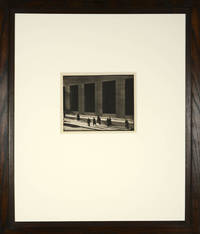
91270New York 1916. . Photogravure on japan paper from Camera Work No. 48 annotated on the reverse image size 13.4 x 16.6 cm. sheet 28.1 x 20 cm mounted and framed.<br /> An iconic image of Wall Street and a turning point in modern photography.<br /><br />Wall Street depicts a scene of everyday life in Manhattan's Financial District. Workers are seen walking past the J.P. Morgan building in New York City on the famous Wall Street of which the photograph takes its name. The photograph is famous for its reliance on the sharpness and contrast of the shapes and angles created by the building and the workers that lead to its abstraction. This photograph is considered to be one of Strand's most famous works and an example of his change from pictorialism to straight photography. Strand moved from the posed to portraying the purity of the subjects. There is no focal point with the lines converging off of the frame of the image. The financial building take majority of the frame. Emphasis is placed on the strong shapes created by the architecture of the building. The workers are included in the image but are faceless and are trumped in size by the massive square shapes from the building they walk past. Also the workers are captured in motion which on film makes them appear blurry. This aesthetic that Strand creates in Wall Street is his break toward the modern.<br /><br />Social change was important to Strand. With Wall Street he sought to portray a social message. He captured the faceless people next to the looming financial building in order to give a warning. Strand shows 'the recently built J.P. Morgan Co. building whose huge dark recesses dwarf the passers-by with the imposing powers of uniformity and anonymity' Ollman Art Review: Paul Strand: A Transition Caught on Film. The people cannot escape the overwhelming power that this modern establishment will have on their future and the future of America. He warns us to not be the small people that look almost ant-like next to this building that has a massive amount of control over the American economy.<br /><br />The photo now simply titled 'Wall Street' was one of six Paul Strand pictures Stieglitz published in Camera Work. In three of the six pictures humanity strides out from abstract ideas and each figure was a study in itself an irregular item complimented by modular formats that surround it. Another set of eleven Strand photos were published in the magazine's final issue in 1917 and those pictures overwhelmingly endorsed by Stieglitz as 'brutally direct' made Strand's reputation.<br /> New York, 1916. unknown
2004142475New York NY: Thornwillow Press Ltd 2004. full crushed light brown moroccan goatskin eight inlaid gems Opals Citrines and Carnelians in a circular pattern with the title in gilt on the front board marbled endsheets cloth clamshell box with leather spine title in gilt on spine. Thornwillow Press. small oblong 8vo. full crushed light brown moroccan goatskin eight inlaid gems Opals Citrines and Carnelians in a circular pattern with the title in gilt on the front board marbled endsheets cloth clamshell box with leather spine title in gilt on spine. 34 pages. Monotypes by Wendy Mark. Limited to 1000 copies of which this is one of 4 unique manuscript copies bound thus. Signed by Mark Strand and Wendy Mark on the half-title and title pages as well as the publisher Luke Ives Pontifell on the colophon. Fine in fine clamshell box.<BR> <br /> <BR> <br /> Produced under the direction of Luke Ives Pontifell at his Thornwillow Press on handmade paper. <BR> <br /> <BR> <br /> From the artist: "This whimsical and beautiful poem by former U.S. Poet Laureate Mark Strand celebrates the many virtues joys and challenges of candy. The monotypes by Wendy Mark were made especially for this edition and were reproduced from her originals using offset lithography."<BR> <br /> <BR> <br /> Having received her Masters of Fine Arts from Columbia University Wendy Mark has been producing wonderfully illustrative art primarily to coincide with poetical works. Not only has she worked with Mark Strand on this project but she has worked with other authors such as Charles Simic and Paul Muldoon among others. Thornwillow Press, Ltd unknown
Lucky Strike cigarette ad on back cover provides a truly classic and timeless example of a mis-timed advertisement. Consider that the great Wall St. stock market crash of 1929 occurred mere days before this issue hit the newsstands. Beneath the caption "An Ancient Prejudice has been removed" appears a clenched fist labeled as "American Intelligence" breaking a heavy chain. Top left a paranoid miser stacks his gold by candlelight. Top right a wealthy couple visits their palatial bank. Text beneath miser reads "Hoarding gold with the fanatical zeal of the miser has vanished. American Intelligence sponsors thousands of banking institutions to which the individual (i.e. the wealthy couple) safely entrusts his wealth." The message is clear. Readers should put their trust (and money) in the banks, and shun gold. This issue was likely printed just as the Great Crash occurred, causing countless financial institutions to go under - and destroying even more individual fortunes. (The ad goes on to claim that cigarettes have similarly overcome the prejudice against them.) A truly stunning work which deserves to be preserved and reflected upon in this age of limitless fiat currency printing. Average wear with three-inch crease to lower corner of back cover. Suitably framed and mounted, this ad will make a superlative office display for any precious metals executive. Magazine
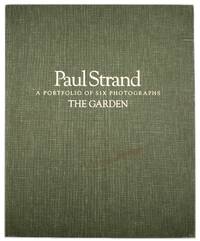
324487New York: Strand/Hoffman 1976. Limited to 50 copies #13 signed in the shaky hand of the photographer. Folio. Green cloth dropbox. Laid in loose. Limited to 50 copies #13 signed in the shaky hand of the photographer. Folio. Strand/Hoffman unknown
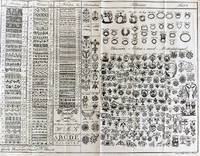
18222128Lithogr. front. portrait of Greve XVI 526 8 pages 1 large folded table "Giesser Zettel fuer Buchbinder" and 4 numbered large folded plates ; 2 16 16 with a foreword by the author to his fellow colleagues XX 2 388 pages and 7 numbered folded lithogr. plates. Cont. light blue boards gilt label to spine. All edges gilt top and lower corners of edges gauffered. 180 x 105 mm. Binding rubbed extremeties worn labels minimally chipped. <br /><br /><br />Mejer 1804 ; Pollard & Potter 36 ; Schmidt-Künsemüller 7261. First edition of arguably the most important German bookbinding manual of the first half of the 19th century. Ernst Wilhelm Greve born 1787 was originally from Copenhagen but worked most of his life in Berlin as a bookbinder. Volume I with a remarkable large plate 515 x 405 mm which according to an advert in volume II was also published separately depicting numerous examples of fillets borders signs vignettes and ornaments after designs by the Berlin based artist and engraver Thieme numbered 1 through 170 each design is priced individually and could be ordered directly from the artist and furthermore including a four-page publicity leaflet by Greve quoting tools papers and other bookbinding materials which could be purchased at his bookbindery. The four-page subscriber's list contains ca 100 subscribers with 32 of them being bookbinders or apprentice bookbinders. A fresh and clean copy quite unusual for such a manual and very rare thus. Maurer
196389275New York: Brooklyn College 1963. Presentation copy from one of America's most influential photographers First edition presentation copy inscribed by Paul Strand on the rear wrapper "To Cipe and Will with affection Paul" - a superb association linking one of the great photographers of the 20th century with two of the most influential figures in American graphic design. Cipe Pineles long associated with Condé Nast and later the first woman to serve as autonomous art director of a mass-market magazine transformed editorial visual culture in the 1930s and 40s championing the use of fine artists in commercial illustration and breaking multiple professional barriers. Her husband William "Bill" Golden rose to become the seminal art director of CBS before his early death in 1958. Accompanying the book is a group of three intimate ingeniously handmade cards sent by Paul Strand and his third wife the photographer Hazel Kingsbury Strand spanning more than two decades of friendship. Each combines personal news with visual elements assembled for the recipients - small affectionate constructions that verge on artists' books and speak directly to the Strands' shared creative life and to their long professional connection with CBS. One 1951 celebrates Pineles and Golden's adoption of their son with Hazel noting Strand's ongoing work; another 1958 sent from their home at La Briardière and decorated with Hazel's sampler discusses Strand's "Scotch book" project later published as Tir a'Mhurain 1962; and the last 1974 illustrated with a winter photograph of their house reflects on advancing age work in progress and mutual friends in London and New York. WorldCat lists copies of 16 Gravures at only four institutions Yale Currier Museum of Art New Hampshire Institute of Art Library and the Harry Ransom Center. Small quarto pp. 16. 16 black and white illustrations on 8 plates. Original moderate orange printed wrappers. Edges lightly rubbed couple of nicks to head of front wrapper. An excellent copy. unknown
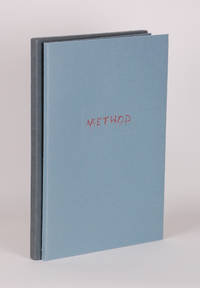
142478Brooklyn NY: Dieu Donné 2013. heavy illustrated handmade paper wrappers paper cardstock slipcase. Dieu Donné. oblong 4to. heavy illustrated handmade paper wrappers paper cardstock slipcase. 2 pages of prose with two full-page paper collages. With illustrations by the author and selections of poetry by nine of his friends. They are: Joseph Brodsky Louise Glück Jorie Graham William Merwin Vijay Seshadri Charles Simic Derek Walcott Rosanna Warren and Charles Wright. Privately printed in a limited edition of 15 copies of which this is one of 10 numbered copies signed by Mark Strand. A fine copy in fine slipcase.<BR> <br /> <BR> <br /> Method was written designed and illustrated by Mark Strand. The two prose pieces he wrote for this edition are partnered with two of his collages created from paper he produced with the help of Susan Gosin at Dieu Donné Papermill. Meredith Walker cut and assembled the collages for the edition. The type was designed and set by Russell Maret. The text set in 13 point Strand Serif was letterpress printed by Peter Krunty. Barbara Mauriello bound the edition using custom handmade paper designed by Mark Strand and produced by Paul Wong and Amy Jacobs. Dieu Donné unknown
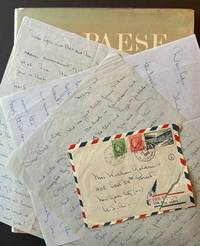
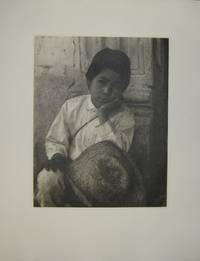
195525259Milano/Torino: Giulio Einaudi Editore 1955. Cloth. Near Fine/Near Fine. A lovely Paul Strand collection including 3 long warm letters to his good friend Cipe Pineles pioneering graphic designer and art director -- Seventeen Vogue Vanity Fair Glamour. In the handwritten letters which date from 1954 1955 and 1962 and are 3 4 and 3 pgs. long respectively Strand among other things reflects on the 1955 1st edition of Un Paese a very sharp copy of which we present here with the letters. The book and its dustjacket are very clean and each is solid and easily Near Fine. And the 3 letters are also bright clean and eminently legible. An uncommon look through these correspondences at the musings of a major photographer toward his own recently published work. The 3 letters and the book all being offered together as an archive. Giulio Einaudi Editore unknown
2013142504Brooklyn NY: Dieu Donné 2013. loose leaves laid into a folding chemise clamshell box. Dieu Donné. square 4to. loose leaves laid into a folding chemise clamshell box. unpaginated. Privately printed in a limited edition of 50 copies of which this is one of 15 'artist's proof' copies signed by Mark Strand. A near fine copy.<BR> <br /> <BR> <br /> A major collaborative effort of this fine press item being the writing of Mark Strand with the images by Frederic Amat and the calligraphic writing by theatrical designer Robert Wilson with the silk screen printed for this edition by Oriol Treserra and Xavier Todo of Taller Vallirana Barcelona. The paper was custom made by Paul Wong of Dieu Donne Papermill New York. Susan Gosin and Estela Robles assisted with the design while the letterpress of Peter Kruty printed the poem and colophon which was set in the typeface Strand Serif designed by Russell Maret. The box was designed and produced by Angels Arroyo. Dieu Donné unknown
2013142638Brooklyn NY: Dieu Donné 2013. loose leaves laid into a folding chemise clamshell box. Dieu Donné. square 4to. loose leaves laid into a folding chemise clamshell box. unpaginated. Privately printed in a limited edition of 50 copies of which this is one of 35 numbered copies signed by Mark Strand. A near fine copy.<BR> <br /> <BR> <br /> A major collaborative effort of this fine press item being the writing of Mark Strand with the images by Frederic Amat and the calligraphic writing by theatrical designer Robert Wilson with the silk screen printed for this edition by Oriol Treserra and Xavier Todo of Taller Vallirana Barcelona. The paper was custom made by Paul Wong of Dieu Donne Papermill New York. Susan Gosin and Estela Robles assisted with the design while the letterpress of Peter Kruty printed the poem and colophon which was set in the typeface Strand Serif designed by Russell Maret. The box was designed and produced by Angels Arroyo. Dieu Donné unknown
50258Strand Paul. Original vintage hand-colored platinum photograph of a dormitory at Bryn Mawr College 9 3/8 x 7 inches tipped to original mounting board. Framed and glazed. No date but circa 1908. Titled and SIGNED by Paul Strand in the lower margin. Fine condition. At the beginning of Paul Strand's career as a photographer he traveled to the Ivy League colleges and made hand-colored platinum photographs which he sold to the students and alumni. <br/><br/> unknown books
201312138SEVEN DAYS Dieu Donne Press 2013 first edition a very fine copy consisting of loose leaves laid into a clamshell box. A major collaborative effort of this fine press item being the writing of Mark Strand with the images by Frederic Amat and the calligraphic writing by theatrical designer Robert Wilson with the silk screen printed for this edition by Oriol Treserra and Xavier Todo of Taller Vallirana Barcelona. The paper was custom made by Paul Wong of Dieu Donne Papermill New York. Susan Gosin and Estela Robles assisted with the design while the letterpress of Peter Kruty printed the poem and colophon which was set in the typeface Strand Serif design by Russell Maret. The box was design and produced by Angels Arroyo. Of the 40 copies in this edition 25 numbered and 15 proofs all SIGNED by Mark Stand Frederic Amat and Robert Wilson on the colophon this is #5 of the artists proofs. Dieu Donne Press unknown
elala5097New York: Da Capo Press 1967. Second Edition Limited to 1000 numbered copies signed by Strand. A seminal work by a legendary figure in 20th century American photography. Based on photographs taken by the author on his travels through Mexico in 1932-33 the striking photogravures depict architecture landscape the indigenous people and religious folk sculpture. Strand's work first made its appearance as Photographs of Mexico in a limited edition of 250 copies in 1940 with the printing of the steel-faced gravure plates by master platemaker Otto Wackernagel being supervised by Strand himself and executed by Charles Furth and the Photogravure and Color Company. This second edition utilized the original Wackernagel plates but they were now printed by Albert Delong at the Andersen Lamb Company of Brooklyn. Strand was even more pleased with this version remarking: they have been able to get even more out of these twenty beautiful plates in printing the second edition.this work I think is superlative.Delong.has made these plates sing. "The images are a celebration of the subjects pride dignity and endurance and are a clear testament to Strands belief that the photogravure process is capable of yielding the finest results achievable in photographic printmaking." The Aperture Foundation 2012. folio. pp. 7. 20 photogravure plates with tissue guards. plates & text loose as issued in original paper wr. cloth & board chemise & paper slipcase. A fine copy [New York]: Da Capo Press, [1967] hardcover
198016001New York: Aperture 1980. First edition Deluxe issue. Hardcover. vg. 1/450. Tan cloth title stamped in gray and white on cover with matching slipcase in original publishers shipping box. Some tearing to tape on box abrasions on part of title on fore-edge of box. Illustrated with 94 reproductions of black and white photographs by Paul Strand. Includes original 7 1/2" x 9 1/2" hand-pulled dust-grain photogravure Iris 1928 mounted on heavy card stock 13 3/4" x 16 3/4". Photo protected by printed tissue guard signed by Hazel Strand all resting in paper- and original shipping sleeve. Blind-stamp of the estate in margin on paper sleeve. Preface by Paul Metcalf. Afterword by Beaumont Newhall. Shipping box and photogravure in very good book and slipcase in near fine condition. Paul Strand 1890-1976 was an American photographer and filmmaker who helped establish photography as an art form in the 20th century. Film credits include Manhatta 1921 Redes 1936 and Native Land 1942. Nancy Newhall 1908-1974 was a photography critic and founder of the influential photographic magazine 'Aperture'. Aperture hardcover
195424812Orgeval France: Not Published 1954. The letters give much background to the creative process of Strand and were written to the designer-artist couple William Golden & Cipe Pineles here addressed as 'Bill & Cipe' who were friends and professional colleagues extending back to their collaborations as participants in the Group Theater in New York in the 1930s. Paul Strand 1890 -1976 American photo-artist Strand and his fellow-photographer wife Hazel Kingsbury took up residence in Orgeval France after moving to Europe in 1950 "driven into self-exile Strand later would suggest by the repressive anti-Communist climate in America after publishing La France de Profil 1952 a portrait of postwar small-town French lifeStrand would spend the rest of his life assembling and completing similar book portraits celebrating primarily rural cultures" as Un Paese & others "Many established photographers from Walker Evans to Eliot Porter have admitted to having been strongly influenced by Strand's impeccably rich and detailed prints concern for formal relationships respect for his subjects and ability to distill the essence of his subjects. However through much of the 1950s and 1960s his reputation fell into eclipse. His dedication to view cameras and fine printing his largely frontal compositions and his devotion to creating politically motivated celebrations of traditional largely rural cultures did not fit an artistic world fascinated with the hand camera and the constant change of contemporary life. By the late 1960s however Strand received renewed acclaim first through European exhibitions and then by means of a retrospective exhibition sponsored by the Philadelphia Museum of Art 1971." John B. Rohrbach in the ANB Cipe Pineles 1908 - 1991 Austrian-born American graphic designer & art director associated with Conde Nast Vogue & others; William Golden 1911 - 1959 American graphic designer especially noted for his work at CBS. Letter 1: Four handwritten pages with very good content throughout; dated May 10 1954 just prior to the publishing of "Un Paese" the Italian-produced photograph & text collaboration between photographer Paul Strand and neo-realist screenwriter Cesare Zavattini. Written in blue ink on airmail paper: "just back from Milan with very good news. The book is finished and accepted by Einaudi one of the best and biggest publishers in Italy. Zavattini has written a fine and moving text very direct very simplethis outcome after months of nothing happening made us both feel pretty good. Printing is going to be done by Pizzi in Milanone of the best around for gravure. We had one conference and find that the nephew of the boss speaks English and seems both intelligent and cooperative. Won't be any problem of putting my finger in the pie I think. We have to be back in Milan on the 20th with the negatives and Pizzi offered to make a few quick tests for us to see. Einaudi is being very flexible as to size and format cover etc. They seem to want to do a good job and one that doesn't look like the present rash of photo book. I mentioned that my good friend Golden might take a crack at the cover and they were only too pleased. We decided on a slightly larger page size than La France de Profil both to get away from the standard thinking and also to give more space for text. Size we chose was 23 x 29 cms. Naturally the cover will be a little larger. I would say add about 3mm for the cover size length & width. The title so far chosen is "Un Paese." In Italian this has the double meaning of a village and the whole country. This is Zavattini's title and we think it is good - Simple and excites curiosity by not being too explicit. As for other printing on the cover - Cesare Zavattini and Paul Strand. He is a big name in Italy and I have the feeling that both names can be larger and more effective than in "La France de Profil." Lastly this publisher usually puts his own name Einaudi on the cover not too conspicuously. Now as to the photographs for the cover. The publishers are favorable to one of people and there are two which attracts them. One you have. It is the photograph of a family the mother in the doorway and five sons. For me it is one of the most important photographs and one that many people respond to. That is a horizontal. The other is a vertical portrait of a little girl which I will print this week and mail to you before we go back to Milan. I have the feeling that the impact of the cover should not rely entirely on the photograph itself but rather on a total layout in which the whole page is eye compelling. In short not like the French book. What do you think Last of all we thought the photograph of the white wall with all the iron things- sides etc. might do well for the back cover - no type. The photograph you mentioned of the people in front of the café is good but perhaps too sad - for most of those folks are from the old people's home across the street. Einaudi are not interested in bleed pages. If I wanted some they would agree. If you were around maybe there would be some. On my own I think to have none at least at this stage. But that doesn't mean I guess that the cover photos can't be bled if you see it that way on one or more sides. Guess that about covers the news. I think we will go to Scotland in June at least to have a look around and perhaps work if it looks good. It's awfully damn kind of you think about the cover of the new book and to let us have your ideas.As always signed Paul." The cover photograph discussed was used as planned on the finished "Un Paese" photo-volume; the Scotland trip mentioned eventually led to the publication of Strand's "Tir a'mhurain Outer Hebrides." Letter 2: Dated June 13 1955; three pages handwritten and also sent to Cipe Bill and Tom their son Golden. Strand inquires as to Bill Golden's opinion on the final version of 'Un Paese': "for I just received the first letters from America from very enthusiastic people. Everyone comments on the beauty of the cover such words as 'superb.' We think it is swell and a real 'Golden' job. The general feeling is that although the Swiss printing is a bit better that as a whole this is a better book more warm and human. I think that is so because it was much more planned and concentratedhoping there may be an edition in French and one American publisher has expressed interest. If this develops I may have to call on you Bill again for we must keep the cover intact" Also about half the letter is concerned with the purchase redesign and descriptions of the property & gardens of their home in Orgeval France which was eventually a subject of another Strand photo-book and was the haven from which much work originated. The letter signed by Paul and Hazel. The letter-sheets approx. 8 1/4" x 10 1/4" size; old fold lines little bit of edge-wrinkling; in very good condition. . Manuscript. Not Bound. Very Good. Not Published paperback books
196423321Iowa City: The Stone Wall Press 1964. First edition of Strand's scarce first book. One of 225 copies printed from Romanee type on Curtis Rag paper by Kim Merker at the Stone Wall Press. Berger Printing & the Mind of Merker 16. The printer's copy inscribed by Strand to Kim Merker on the first page of text: "For Kim with both eyes open . . . Mark Strand. Spine a touch faded although much less so than usual otherwise a fine copy in specially made matching slipcase. 8vo original bright red cloth publisher's matching slipcase. Spine a touch faded although much less so than usual otherwise a fine copy in specially made matching slipcase. The Stone Wall Press unknown books
1973593154New York: Atheneum 1973. Hardcover. Near Fine. First edition hardcover issue. Yellow cloth gilt. Slightest soiling on the spine near fine issued without dust jacket. Published as a paperback original this is one of approximately 10 copies prepared by the publisher in hardcovers for the use of the author. This copy Inscribed by Strand using most of the front fly to fellow poet Donald Justice and his wife Jean: "for Don and Jean with love and thanks and better story in the making Mark Strand. Iowa City. Sept. 1973. The Yewell Street Story is merely a diversion." Laid into the book are seven pages carbon typed manuscripts on rectos only of a long poem by Strand "The Untelling" and the final poem in the book not identified as being by Strand except for a small pencil note "Strand" on the first page likely in Justice's hand. The seven-page manuscript has one small hand-correction and has been neatly folded into thirds else fine. The hardcover issue is rare. The association is significant. The carbon typescript is a bonus. Atheneum hardcover
1967329383New York: Da Capo Press 1967. Second edition. Prefatory note by Leo Hurwitz new note for this edition by Strand and a statement of homage by David Alfaro Siqueiros. One of 1000 numbered copies signed by Strand. Twenty photogravures. 8pp. 1 vols. Folio. Folded signatures and loose sheets laid into stiff wrapper enclosed in folding cloth covered chemise and board slipcase minor wear to slipcase. Second edition. Prefatory note by Leo Hurwitz new note for this edition by Strand and a statement of homage by David Alfaro Siqueiros. One of 1000 numbered copies signed by Strand. Twenty photogravures. 8pp. 1 vols. Folio. A masterful reworking of the 1940 original prepared under the photographer's supervision with the photogravures hand printed from the original plates on BFK Rives by Albert Delong. Strand took the original photographs in 1932-33 as a prelude to his work on the film Los Redes and the 1940 edition under the title Photographs of Mexico was limited to 250 copies. Da Capo Press unknown
201093930Aperture/Fundacion Televisa. New. 2010. Hardcover. 1597111376 . FREE UPGRADE to Courier/Priority Shipping Upon Request - IN STOCK AND IMMEDIATELY AVAILABLE FOR SHIPMENT - Flawless copy brand new pristine never opened -- 356 pages; 429 illustrations including 100 in color. Catalogue Raisonne Catalog Raisonné Complete Works Catalogo Razonado Obra Completa Raisonnee Aperture/Fundacion Televisa hardcover
1967175452New York: Da Capo Press 1967. Hardcover. VG--plate 6 has crease to lower left corner; plate 15 has tiny copper-like marks to bottom left corner. slipcase covers have shelf-wear rubbing & numerous scratches & scuffs; top corner is bumped & rubbed; top bk cover edge has chip/dent; bottom back cover rubbed w/ 1.5 split to cover paper but no separation to boards; back cover has some fading to grey boards. 7 pg folder of text w/ 20 loose plates & tissue guard housed in a cloth covered oversized portfolio. edition includes grey black printed slipcase. 1000 Signed Copies By The Photographer. This Is Copy 364. A Very Nice Edition Of Strand's Work. Da Capo Press hardcover books
196251433London: MacGibbon & Kee 1962. First UK edition. Hardcover. Strand Paul. 4to. 151 pp. 145 b&w photographs. There is a slight leaning at the spine and light toning to the endpapers else near fine in the publisher's cloth. The photo-illustrated dust jacket shows light wear at the edges with a soft crease on the rear panel else very good. Laid-in is a printed complimentary slip from the author. Published under this title in England the U.S. and Germany with no priority. Bodly SIGNED and presented " To Louise and Mike photographer Louise Dahl-Wolfe and her husband Meyer With affection Paul Strand & Hazel. Frenchtown July 1963." Presentation copies by Strand are rare especially to another prominent photographer. <br/><br/> MacGibbon & Kee hardcover books
196722541New York: De Capo Press 1967. Second edition. Hardcover. Folio plates loose as issued in fine cream stiff wrappers in fine brown chemise and housed in near fine beige pebble grained cloth clam shell box backstrip slightly darkened. Strand Paul. 8 pages text. 40.5 x 31.5 cm. The twenty loose photogravure plates measure 25.4 x 20.3 cm: all contain tissue guards. Limited edition copy 532 of 1000 signed by Strand who in the limitation statement notes that he believes the plates herein superior to the original printing of 1940. Original photogravures made by Otto Wackernagel with an introduction by David Alfaro Siquieros and Introduction by Leo Hurwitz. Strand presents the people architecture and religious folk sculpture of Mexico. Interior contents crisp and clean. De Capo Press hardcover books