566 résultats
19702080202105302668Kadokawashoten 1970. Soft Cover. Fine. Size: 15cm Number of books: 6 Kadokawashoten paperback
19662080502106909324Not Available 1966. Soft Cover. Fine. The book is in fine condition. Not Available paperback
2091502133527124Chiku ma shobo N.A. Soft Cover. Fine. Number of books: 2 Chiku ma shobo paperback
19922081402109703430Omura shoten 1992. Soft Cover. Fine. The book is in fine condition. Omura shoten paperback
19712081402109703596Not Available 1971. Soft Cover. Fine. The book is in fine condition. Not Available paperback
190841523Voenniia Tinografiia S Peterburg' 1908. 1st edition. Hardback. Cloth G. xvi496pp3pp coloured insert 6 folding tables & charts one of which is rather torn at the first fold where the sheet is attached to the gutter many b/w line diagrams & tables cloth rather grubby & worn paper yellowed at the margins small tear to the title occasional neat pencil underlining to the text 2 ink signatures to the upper cover one dated March 25 1908 a reassonable copy of a fragile & uncommon book. CYRILLIC text. A Russian Officer's pocket field reference book giving information on Army manoeuvers field trips war games and tactical objectives. The book contains a wealth of information & many diagrams from Morse Code & Semaphore to loading artillery pieces onto rail wagons and digging trenches. Voenniia Tinografiia, S Peterburg' hardcover
1975Q-0465039421Basic Books 1975-01-01. Hardcover. New. New. In shrink wrap. Looks like an interesting title! Basic Books hardcover
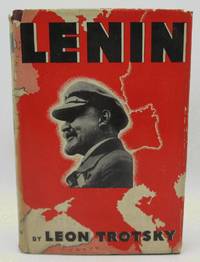
193509428Blue Ribbon Books 1935. Hardcover. Very Good/Very Good. Dust jacket with striking image of Lenin is worn at the edges spine sunned and chipped head/tail. Burgundy cloth boards are rubbed at the extremities. Pen name front endpaper. No publication date perhaps 1920s or 30s. All orders packed with care most dust jackets protected by Brodart sleeve independent bookseller since 2011 Blue Ribbon Books hardcover
1918010138New York: Boni and Liveright 1918. Book. Very Good. Hardcover. First American Edition. 12mo - over 6¾ - 7¾" tall. 238 pp previous owner's bookplate on fr pastedown Introduction by Lincoln Steffens author's preface b&w frontis photo 11 titled chapters no index. 5" x 7.5" blue-black cloth faded red letters in mylar glassine wraps. The author at the time of his writing the book was the minister of foreign affairs of revolutionary Russia. Steffens introduction parses Western interpretatons of Trotsky's message very nicely. Messages from Russia do not penetrate the Western facade run by the USA and the UK. But there were no thermonuclear weapons in 1918. There was only the carnage of the Western front in France. Boni and Liveright Hardcover
1940BB2120Mexico: Editorial América 1940. First Edition. Pictorial Wrappers. Fine-. First Printing of Leon Trotsky's fragile final book published one month after his assassination apparently at the behest of Joseph Stalin. In Spanish with a prologue by Adolfo Zamora. 8vo 194 x 125mm: 1911pp. Original Illustrated wrappers. fore-edge untrimmed. Wrappers lightly soiled with very minor edge wear; cheap wartime paper embrowned but not brittle. A superlative survival especially scarce in this condition. A compilation of writings representing Trotsky's final crusade against Stalinism and the propaganda campaign that Joseph Stalin launched to justify Trotsky's assassination. In January 1929 Trotsky was expelled from the Soviet Union for criticizing Stalin's suppression of democracy in the Communist Party and for failing to develop adequate economic planning. After four years in Turkey Trotsky lived briefly in France and then Norway and in 1936 was granted asylum in Mexico where he settled with his family in a suburb of Mexico City Three years later during Stalin’s purges of his political foes Trotsky was found guilty of treason in absentia. He survived a machine-gun attack on his home but on August 20 1940 fell prey to a Spanish Communist Ramon Mercader who fatally wounded him with an ice-pick. Trotsky died from his wounds the next day. N. B. With few exceptions always identified we only stock books in exceptional condition carefully preserved in archival removable mylar sleeves. All orders are packaged with care and posted promptly. Satisfaction guaranteed. Fine Editions Ltd is a member of the Independent Online Booksellers Association and we subscribe to its codes of ethics. Editorial América unknown
193048515Berlin: S. Fischer 1930. Erste bis fünfzehnte auflage. Octavo 22cm; original tan linen boards lettered in blue and red; portrait frontispiece; xvi1-5693pp. Very Good with slight dust-soiling to covers typical looseness to text block but hinges tight; text complete clean and unmarked - a solid respectable copy lacking dustwrapper. First published edition in any language of Trotsky's autobiography written following his exile from the Soviet Union in 1928; translated from the Russian manuscript by Alexandra Ramm. Text entirely in German. S. Fischer unknown
1931D2340Berlin: S. Fischer Verlag 1931. First Edition. Paperback. Very Good. Plain paper wraps. With publisher's printed presentation slip laid-in. Some light rubbing and very faint soiling on covers and along edges of text block. Internally nice and clean. An excellent copy. <br/><br/> S. Fischer Verlag paperback
19932110502150201156Iwanamishoten 1993. Soft Cover. Fine. Number of books: 2 Iwanamishoten paperback
19672091502134000756Godo shuppan 1967. Soft Cover. Fine. Number of books: 1 Godo shuppan paperback
19722111902158904150Kawade Shobo Shinsha 1972. Soft Cover. Fine. Volume: 1 Kawade Shobo Shinsha paperback
19302111902158904734Arusu 1930. Soft Cover. Fine. Volume: 1 Arusu paperback
19682081002108803872Hyundai Shichosha 1968. Soft Cover. Fine. Number of books: 1 Hyundai Shichosha paperback
1989x-0810319527Gale / Cengage Learning 1989. Hardcover. New. 500 pages. 11.25x8.00x1.25 inches. Gale / Cengage Learning hardcover
1990x-081031956XGale / Cengage Learning 1990. Hardcover. New. 350 pages. 11.50x8.75x1.50 inches. Gale / Cengage Learning hardcover
1989x-0810319519Gale / Cengage Learning 1989. Hardcover. New. 11.50x7.75x2.00 inches. Gale / Cengage Learning hardcover
Z1-F-043-00722Random House. Used - Good. Ships from UK in 48 hours or less usually same day. Your purchase helps support Sri Lankan Children's Charity 'The Rainbow Centre'. Ex-library so some stamps and wear but in good overall condition. 100% money back guarantee. We are a world class secondhand bookstore based in Hertfordshire United Kingdom and specialize in high quality textbooks across an enormous variety of subjects. We aim to provide a vast range of textbooks rare and collectible books at a great price. Our donations to The Rainbow Centre have helped provide an education and a safe haven to hundreds of children who live in appalling conditions. We provide a 100% money back guarantee and are dedicated to providing our customers with the highest standards of service in the bookselling industry. Random House unknown
1971ANAIS-0394471776Random House 1971-01-01. First Edition. hardcover. Good. 23.9x16x3.8. Buy with confidence. Excellent Customer Service & Return policy. Random House hardcover
0394471776.Ghardcover. Good. Access codes and supplements are not guaranteed with used items. May be an ex-library book. hardcover
SONG0394471776Random House 0000-00-00. First Edition. hardcover. Used: Good. 0.00x0.00x0.00. Buy with confidence. Excellent Customer Service & Return policy. Random House hardcover
192458185Berlin 1924. Original printed wrappers. A bit of browning to wrappers and a bit loose at the inner hinges. But overall in very nice condition. 59pp. <br/><br/><em>First edition in the extremely scarce separate off-print of this seminal essay which appeared in October 1924 as the preface to the third volume of Trotsky's collected works. The essay now counts as a work in its own and was subsequently reprinted numerous times on its own by the Trotskyist movement. This seminal essay came to play a defining role in the development of post-Lenin politics in Russia. It was extremely critical of the purported revolutionary failings of two key members of the collective leadership that ruled Soviet Russia in the months after Lenin's death Grigory Zinoviev and Lev Kamenev and Trotsky was seen as main threat to the accession of power. The publication of his foundational essay on the October Revolution was used as a pretext for the Soviet leadership to isolate and attack Trotsky. It now constitutes a cornerstone of post-Revolutionaly Russian politics. "When Lenin was stricken with his first cerebral hemorrhage in May 1922 the question of eventual succession to the leadership of Russia became urgent. Trotsky owing to his record and his charismatic qualities was the obvious candidate in the eyes of the party rank and file but jealousy among his colleagues on the Politburo prompted them to combine against him. As an alternative the Politburo supported the informal leadership of the troika composed of Grigory Zinovyev Lev Kamenev and Stalin.In the winter of 1922-23 Lenin recovered partially and turned to Trotsky for assistance in correcting the errors of the troika particularly in foreign trade policy the handling of the national minorities and reform of the bureaucracy. In December 1922 warning in his then secret "Testament" of the danger of a split between Trotsky and Stalin Lenin characterized Trotsky as a man of "exceptional abilities" but "too far-reaching self-confidence and a disposition to be too much attracted by the purely administrative side of affairs." Just before he was silenced by a final stroke in March 1923 Lenin invited Trotsky to open an attack on Stalin but Trotsky chose to bide his time possibly contemplating an alliance against Zinovyev. Stalin moved rapidly to consolidate his hold on the Central Committee at the 12th Party Congress in April 1923.By fall alarmed by inroads of the secret police among party members and efforts to weaken his control of the war commissariat Trotsky decided to strike out against the party leadership. In October he addressed a wide-ranging critique to the Central Committee stressing especially the violation of democracy in the party and the failure to develop adequate economic planning. Reforms were promised and Trotsky responded with an open letter detailing the direction they should take. This however served only as the signal for a massive propaganda counterattack against Trotsky and his supporters on grounds of factionalism and opportunism. At this critical moment Trotsky fell ill of an undiagnosed fever and could take no personal part in the struggle. Because of Stalin's organizational controls the party leadership easily won and the "New Course" controversy was terminated at the 13th Party Conference in January 1924 the first substantially stage-managed party assembly with the condemnation of the Trotskyist opposition as a Menshevik-like illegal factional deviation. Lenin's death a week later only confirmed Trotsky's isolation. Convalescing on the Black Sea coast Trotsky was deceived about the date of the funeral failed to return to Moscow and left the scene to Stalin. His eulogy for the late party leader was in effect delivered in a biography of Lenin that Trotsky wrote for the 13th edition 1926 of the Encyclopædia Britannica.Attacks on Trotsky did not cease. When the 13th Party Congress in May 1924 repeated the denunciations of his violations of party discipline Trotsky vainly professed his belief in the omnipotence of the party. The following fall he took a different tack in his essay "The Lessons of October 1917" linking the opposition of Zinovyev and Kamenev to the October Revolution with the failure of the Soviet-inspired German communist uprising in 1923. The party leadership replied with a wave of denunciation counterposing Trotskyism to Leninism denigrating Trotsky's role in the Revolution and denouncing the theory of permanent revolution as a Menshevik heresy. In January 1925 Trotsky was removed from the war commissariat." Encycl. Britt. </em> unknown