9 489 résultats
19105731910 Paris, Marcel Rivière (Bibliothèque du Mouvement Prolétarien, et Bibliothèque Sociologique), 1910 et 1924, 2 ouvrages reliés en un volume in 12, demi-percaline bleue amateur, dos lisse, étiquette basane rouge, couvertures conservées, 68 et XII-132 pages ; qq. rousseurs ; reliure fanée.
1956156691956 Paris, Le Seuil (Collection "Esprit"), 1956, fort in 8°, broché, 664 pages.
35014P., Julliard, 1970, in 8° broché, 155 pages ; illustrations ; jaquette illustrée.
1947398571947 P., Corrêa, 1947, in 12 broché, 283 pages.
12491P., Fayard, 1981, fort et grand in 8° broché, 735pp.
1953156671953 P. , PUF, 1953, in 8°, broché, XXXII-269 pages.
11317Paris, Christian Bourgois éditeur, (21 octobre) 1980. In-8 (207 x 132 mm), broché, 360 pages, couverture à rabats.
1950109901950 Moscou, Editions en Langues Etrangères, sans date (circa années 1950) ; in-8, pleine percaline havane, titre doré au dos et sur plat ; 381 pp. , 36 pp. , (2) pp. , 24 planches de portraits en noir et blanc à pleine page hors-texte, 15 illustrations in-texte. exemplaire en bon état.
711Light wear to paint; lacks metal stand at rear; remnants of box torn with loss. Very good. HFP-711. <p>Marx "Ring The Bell" Target w/ Partial Box The Boy Hunter Target with Trap Doors. New York: Louis Marx & Co. No date circa 1940.</p> <br /> <p>Tin lithograph "Ring The Bell" target with movable trap doors. Measures approximately 11 x 17 inches. In original partial cardboard box. Illustrated characters include Polecat Pete Bad Bill Bruin and Sly Jim Crow.</p> . unknown

1940147971N.p.: N.p. 1940. Vintage sheet of 35 Empress Brand collectible color transfer stickers made in a philatelic style featuring illustrations of six scenes from the 1932 pre-Code Marx Brothers comedy film. Noted on the top right corner as "Made in Japan." <br /> <br /> Very Good lightly toned with two rust marks and associated small tears from having been previously stapled at the top edge. N.p. unknown
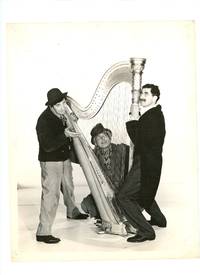
1938000012475n.p.: n.p. 1938. Photograph. Very Good. 61 cm x 48 cm. Glossy black and white photograph. The photograph depicts from left to right: Chico Harpo and Groucho Marx all gathered around a harp with cheeky expressions on their faces. The harp that is pictured is the one that was used in their 1939 film At the Circus. The Marx Brothers got their start in Vaudeville but would go on to make several motion pictures in the first days of the Silver Screen. Thirteen of their films have been rated in the AFI's top 100 comedic motion pictures: their impact on cinema cannot be overstated. The brothers were sons of German-Jewish immigrants and their mother Minnie acted as their manager until her passing in 1929. In this photograph going left to right the three oldest Marx brothers are shown Chico or Leonard Marx Adolph or Harpo and the youngest of the three Julius or Groucho Marx. A few pinholes and light wear to the corners of the photograph. n.p. unknown
63975Österreichische Staatsdruckerei. Wien. 1948. pp. 61 i. Portrait frontispiece. Original cloth spine faded and with a touch of wear to the ends inscription from Marx 1949 a very good copy. Joseph Marx - Honorary graduation and its resonance; Collected lectures on the occasion of Marx's appointment as honorary doctor at the philosophical faculty of Vienna University on 10 May 1947. Österreichische Staatsdruckerei. Wien. 1948. hardcover
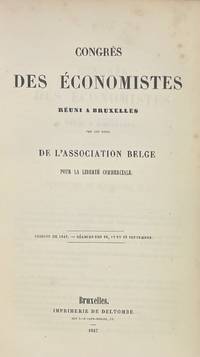
18473297Bruxelles: Imprimerie de Deltombe 1847. First edition. In later wrappers. Paper tanned occasional foxing. Otherwise in fine condition. First edition. In later wrappers. 5 2-211 1 p. <p><br /> Rare printed proceedings of the first international congress of economists in Brussels featuring Karl Marx's attendance and his early engagement in public economic debates.<br /> <p><p><br /> This volume documents the proceedings of the first-ever international conference of economists held in Brussels from September 16 to 18 1847 under the auspices of the Association belge pour la Liberté commerciale. Directed by Charles Joseph Marie Ghislain de Brouckere the conference was a landmark event gathering leading economists lawyers and businessmen to debate issues of free trade and economic policy.<br /> <p><p><br /> A significant aspect of this congress is the participation of Karl Marx whose presence is recorded on the official list of participants "Marx homme de lettres et économiste à Bruxelles" p. 7. At the time Marx was living in Brussels and his involvement in the congress marked a crucial moment in his engagement with economic theory and the broader socialist movement. Although Marx was prevented from speaking his attendance along with other members of the Communist League such as Friedrich Engels was notable for their intent to challenge bourgeois economics and advocate for working-class interests.<br /> <p><p><br /> The congress became a site of contention between the bourgeois majority and the Communist group particularly after Georg Weerth's speech which sharply criticized the benefits of free trade as espoused by the free traders. Engels later provided a detailed report of these events in the Deutsche-Brüsseler-Zeitung highlighting the tensions and the exclusion of Marx's voice from the official proceedings.<br /> <p><p><br /> This book is a rare primary source for the study of 19th-century economic thought and a crucial document for understanding the early public activities of Karl Marx just months before the publication of the Communist Manifesto. It offers invaluable insights into the ideological battles that shaped modern economic and political thought.<br /> <p>. Imprimerie de Deltombe unknown
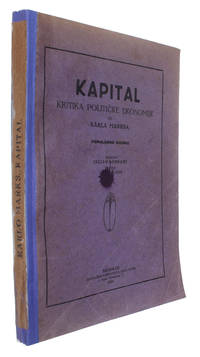
192456992Beograd Izdavacka Knjizarnica Gece Kona 1924. 8vo. In the original printed wrappers. Spine renewed preserving most of the original spine. Ink stain to front wrapper. Previous ower's name to top of title-page. First leaves with a few underlignings otherwise internally fine and clean. 198 4 pp. <br/><br/><em>Rare first Serbian translation of Marx's Das Kapital. Translator Mosa Pijade a Serbian Sephardic Jew were sentenced 20 years of prison in 1925 because of 'revolutionary activities' partly because of making the present translation. In prison he meet Josip Broz-Tito and Pijade became Tito s right hand one of the leaders of Tito s Partisans during WWII and after the war the President of the Yugoslavian Parliament.During WWII Pijade became one of the leaders of Tito s partisans and after the war the President of the Yugoslavian Parliament between 1954 and 1955. In 1948 Pijade convinced Tito to allow the Yugoslav Jews to immigrate to Israel. The book was issued by Geca Kon Géza Kohn a Jewish publisher born in Hungary who owned the biggest publishing house in Yugoslavia operating from 1901 until the occupation by Germany in 1941. After the Germans marched into Belgrade Kon was arrested and shot. Most of his family who were also active in the business were taken to a concentration camp in Vojvodina and shot in the same year. OCLC only list three copies: University of Pittsburgh Philosophical Faculty; Ljubljana and Zagreb City Library </em> unknown
196324641AB1963. München Beck 1963. 8°. VIII 348 Seiten. Softcover / Kartoniert. Sehr guter Zustand / KEINE Anstreichungen. Beck'sche schwarze Reihe ; Bd. 20. paperback
19632374BB1963. Third Edition. New York TIME Incorporated 1963. 13 x 20 cm. XIX 246 pages. Original Softcover. Parts of the cover cut off. Otherwise in very good condition. TIME Reading program Special Editions Includes for example the following chapters: The Philosophy of the Spirit; The Young Hegelians; Historical Materialism; Exile in London: The First Phase; The International; "The Red Terrorist Doctor" etc. paperback
198378243AB1983. London British Broadcasting Corporation 1983. 16 cm x 23.5 cm. 192 pages with illustrations. Original hardcover with dustjacket in protective mylar. Excellent condition with only minor signs of external wear. Includes for example the following contents:- The Point is to Change it / The English Connection / The Revolutionaries / Comrades and Citizens / One Goal Many Roads / Marx Comes Home / Conclusion etc. "In a speech delivered at Marx's funeral his collaborator Engels declared that 'his name will live on through the centuries and so will his work' In the century since Marx's death in 1883 his ideas have become the ruling ideology of almost half the world. Yet we are surprisingly ignorant of this the most influential doctrine of our age". Author. hardcover
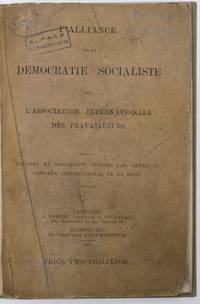
18731526Londres London; Hambourg Hamburg: A. Darson; Otto Meissner 1873. First edition. The original printed wrappers bound into later half cloth. Old faint collection stamps on wrappers and title page. The front wrapper and first leaf with traces of creasing. Wrappers and first and last two leaves dusted. A stain at the upper corner of the first four leaves one leaf with a whole due to the stain which only affects the margin. Overall in very good condition. First edition. The original printed wrappers bound into later half cloth. 4 137 1 p. <p><br /> A scarce copy of the renowned Alliance Pamphlet whose conclusion was written by Karl Marx.<br /> <p><br /> <p><br /> This report the so-called Alliance Pamphlet is a collection of documents and writings related to the International Alliance of Socialist Democracy written compiled and edited by Friedrich Engels Paul Lafargue and Karl Marx. <br /> <p><br /> <p><br /> The Alliance was a semi-secret subgroup of the International Workingmen's Association IWA; First International founded and led by Mikhail Bakunin the Russian revolutionary anarchist. The International sought to extrude the sectarian Alliance from the organization since its establishment in late 1868. Eventually at the Hague Congress 1872 the leaders of the International exposed the public and clandestine activities of the group and expelled its chief leaders Bakunin and James Guillaume from the IWA. The Congress appointed a committee which included Marx Engles and Lafargue to edit and publish the documents related to the Alliance. “The bulk of the work involved in the collection of additional material its comparison and analysis was carried out by Engels and Paul Lafargue. The concluding part of the pamphlet was written by Marx†see Collected Works 44. p. 665 note 623. In his letter dated on 26 July 1873 to Adolph Sorge Engels wrote: “Lafargue and I wrote it i.e. the Pamphlet together; only the conclusion is by Marx and myselfâ€. Collected Works 44. p. 521. The book appeared in French in the fall of 1873 and soon it was translated into German under a somewhat more tendentious title “Ein Complot gegen die Internationale Arbeiter-Associationâ€. <br /> <p><br /> <p><br /> Bibl.: The Collected Works of Karl Marx and Friedrich Engels. The Collected Works of Karl Marx and Frederick Engels. Letters 1844–1895. Volume 44. Charlottesville Va.: InteLex Corporation 2001. <br /> Rubel 726.; Stammhammer I 3.<br /> <p>. A. Darson; Otto Meissner unknown
19922372BB1992. New York Continuum 1992. 12 x 195 cm. XII263 Seiten. Original Softcover. Excellent condition with only minor signs of external wear. From the library of philosopher Graham Parkes. With his name on the front free endpaper and his clean markings and annotations in the text. Milestones of Thought Includes for example the following chapters: The Flasification of Marx's Concepts; Marx's Historical Materialism; The Problem of Consciousness Social Structure and the Use of Force etc. paperback
187158474High Holborn for the Council by Edward Truelove 1871. Small 8vo. Near contemporary quarter cloth with silver lettering to front board. Binding with signs of use but overall good. One closed marginal tear and title-page with a few brownspots otherwise very nice and clean. 35 pp. <br/><br/><em>Exceedingly rare first edition with the names of Lucraft and Odger still present under "The General Council" of one of Marx' most important works his seminal defense of the Paris Commune and exposition of the struggle of the Communards written for all proletarians of the world. While living in London Marx had joined the International Working Men's Association in 1864 - "a society founded largely by members of Britain's growing trade unions and designed to foster international working class solidarity and mutual assistance. Marx accepted the International's invitation to represent Germany and became the most active member of its governing General Council which met every Tuesday evening first at 18 Greek Street in Soho and later in Holborn. In this role Marx had his first sustained contact with the British working class and wrote some of his most memorable works notably "The Civil War in France". A polemical response to the destruction of the Paris Commune by the French government in 1871 it brought Marx notoriety in London as 'the red terror doctor' a reputation that helped ensure the rejection of his application for British citizenship several years later. Despite his considerable influence within the International it was never ideologically homogenous. homas C. Jones: "Karl Marx' London".The work was highly controversial but extremely influential. Even though most of the Council members of the International sanctioned the Address it caused a rift internally and some of the English members of the General Council were enraged to be seen to endorse it. Thus for the second printing of the work the names of Lucraft and Odger who had now withdrawn from the Council were removed from the list of members of "The General Council" at the end of the pamphlet. "Marx defended the Commune in a bitterly eloquent pamphlet "The Civil War in France" whose immediate effect was further to identify the International with the Commune by then in such wide disrepute that some of the English members of the General Council refused to endorse it." Saul K. Padover preface to Vol. II of the Karl Marx Library pp. XLVII-XLVIII."Written by Karl Marx as an address to the General Council of the International with the aim of distributing to workers of all countries a clear understanding of the character and world-wide significance of the heroic struggle of the Communards and their historical experience to learn from. The book was widely circulated by 1872 it was translated into several languages and published throughout Europe and the United States." The Karl Marx ArchiveMarx concluded "The Civil War in France" with these impassioned words which were to resound with workers all over the world: "Working men's Paris with its Commune will be forever celebrated as the glorious harbinger of a new society. Its martyrs are enshrined in the great heart of the working class. Its exterminators history has already nailed to that eternal pillory from which all the prayers of their priests will not avail to redeem them."The address which was delivered on May 30 1871 two days after the defeat of the Paris Commune was to have an astounding effect on working men all over the world and on the organization of power of the proletarians. It appeared in three editions in 1871 was almost immediately translated into numerous languages and is now considered one of the most important works that Marx ever wrote. " "The Civil War in France" one of Marx's most important works was written as an address by the General Council of the International to all Association members in Europe and the United States.From the earliest days of the Paris Commune Marx made a point of collecting and studying all available information about its activities. He made clippings from all available French English and German newspapers of the time. Newspapers from Paris reached London with great difficulty. Marx had at his disposal only individual issues of Paris newspapers that supported the Commune. He had to use English and French bourgeois newspapers published in London including ones of Bonapartist leanings but succeeded in giving an objective picture of the developments in Paris. .Marx also drew valuable information from the letters of active participants and prominent figures of the Paris Commune such as Leo Frankel Eugene Varlin Auguste Serraillier Yelisaveta Tornanovskaya as well as from the letters of Paul Lafargue Pyotr Lavrov and others.Originally he intended to write an address to the workers of Paris as he declared at the meeting of the General Council on March 28 1871. His motion was unanimously approved. The further developments in Paris led him however to the conclusion that an appeal should be addressed to proletarians of the world. At the General Council meeting on April 18 Marx suggested to issue "an address to the International generally about the general tendency of the struggle." Marx was entrusted with drafting the address. He started his work after April 18 and continued throughout May. Originally he wrote the First and Second drafts of "The Civil War in France" as preparatory variants for the work and then set about making up the final text of the address.He did most of the work on the First and Second drafts and the final version roughly between May 6 and 30. On May 30 1871 two days after the last barricade had fallen in Paris the General Council unanimously approved the text of "The Civil War in France" which Marx had read out."The Civil War in France" was first published in London on about June 13 1871 in English as a pamphlet of 35 pages in 1000 copies. Since the first edition quickly sold out the second English edition of 2000 copies was published at a lower price for sale to workers. In this edition i.e. MECW Marx corrected some of the misprints occurring in the first edition and the section "Notes" was supplemented with another document. Changes were made in the list of General Council members who signed the Address: the names of Lucraft and Odger were deleted as they had expressed disagreement with the Address in the bourgeois press and had withdrawn from the General Council and the names of the new members of the General Council were added. In August 1871 the third English edition of "The Civil War in France" came out in which Marx eliminated the inaccuracies of the previous editions.In 1871-72 "The Civil War" in France was translated into French German Russian Italian Spanish Dutch Flemish Serbo-Croat Danish and Polish and published in the periodical press and as separate pamphlets in various European countries and the USA. It was repeatedly published in subsequent years.In 1891 when preparing a jubilee German edition of "The Civil War in France" to mark the 20th anniversary of the Paris Commune Engels once again edited the text of his translation. He also wrote an introduction to this edition emphasising the historical significance of the experience of the Paris Commune and its theoretical generalisation by Marx in "The Civil War in France" and also giving additional information on the activities of the Communards from among the Blanquists and Proudhonists. Engels included in this edition the First and Second addresses of the General Council of the International Working Men's Association on the Franco-Prussian war which were published in subsequent editions in different languages also together with "The Civil War France". Notes on the Publication of "The Civil War in France" from MECW Volume 22. Only very few copies of the book from 1871 on OCLC are not explicitly stated to be 2nd or 3rd editions and we have not been able to find a single copy for sale at auctions within the last 50 years. </em> hardcover
1975219700Beijing.: 人民出版社.Renmin chubanshe. Reprint. 1975. Complete set of 4 paperback volumes in slipcase Volume I 803pp; Volume II 771pp; Volume III 677 pp; Volume IV 656pp; each volume measures 18.6 x 13cm slipcase measures 19.5 x 13 x 8.4cm text in simplified Chinese characters. Edges and endpapers foxed three volumes damp affected lower sections of leaves the fourth volume lightly stained in places with some creasing paper wrappers a little faded on spines. Slipcase worn and a stained lower section 3cm tear to lower corner. A fair to good set. . 人民出版社.[Renmin chubanshe]. paperback
193781932New York:: Farrar & Rinehart 1937. First edition of this Pulitzer Prize willing play. publisher's blue gilt-lettered cloth. Spine a little sunned; otherwise fine tight and sound. Small 8vo. Signed and inscribed "Moss" for Zeppo Marx "For being born on this day for being Zeppo and for many other things." February 25 1937. Farrar & Rinehart, hardcover
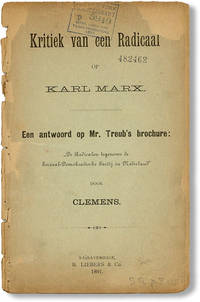
189143347's-Gravenhage: B. Liebers & Co 1891. First Edition. Octavo 20cm.; publisher's green wrappers; 53pp. Ex-NYPL with their usual markings wrappers and textblock exceedingly brittle and toned due to poor paper stock lacking rear cover. Good only. The Dutch syndicalist author's study of Marx published a year before his translation of The Communist Manifesto the first to appear in Dutch. Though this title is not institutionally uncommon in Europe OCLC locates no copies in North America as of January 2019. B. Liebers & Co unknown
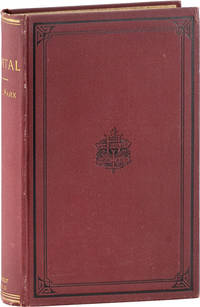
189059553New York: Humboldt Publishing Co N.d. 1890. First Humboldt Edition. First printing. Presumed later issue with ads undated but listing up to nos. 142-143 of the "Humboldt Library of Science" Wollstonecraft Vindication of the Rights of Woman issued in 1890. Octavo 24cm. Publisher's red cloth titled in gilt on spine with designs stamped in black on front cover in blind on rear cover; floral endpapers; xviii1-506pp;44pp ads. Bookplate to front pastedown of Jefferson D. Stewart Louisville Kentucky banker and financier whose pencil ownership signature dated 1895 also appears on the title page. An exceptional copy in the publisher's cloth binding minutely rubbed at joints and board corners; floral endpapers so prone to splitting at the hinges are fully intact and the text is fresh bright and unmarked. Very close to a fine copy and easily the best we have handled.<br /> <br /> The early publication history of this first volume of Marx's Capital in America is bibliographically complex at times stubbornly ambiguous and not seldom misrepresented. The earliest copies to appear for sale in America were imported sheets of the Swan Sonnenschein London edition of 1887 bound and distributed in America through two New York agents in one case identified on the pastedowns Julius Bordello in another Scribner & Welfored on a tipped-in slip see Philip Foner "Marx's 'Capital' in the United States" Science & Society Fall 1967. In 1889 Sonnenschein produced a stereotyped edition which was distributed in America through yet a third agent D. Appleton whose name appeared as co-publisher on the title page making this the first edition to carry any textual indication of an American publisher. Any of these three editions have some claim to being called the "First American Edition" notwithstanding the fact that none were printed in America. <br /> <br /> Beginning in January of 1890 Humboldt Publishing Co. a small New York radical publisher issued what it claimed to be "the only American edition - carefully Revised" of Capital. This was in fact an unauthorized reprinting of the Moore - Aveling translation issued without the permission of Marx's family the translators or the European publishers. To save on distribution costs Humboldt resorted to a standard 19th-century publishing ploy and issued the work as a four-part serial nos. 135-138 in its "Humboldt Library of Science" series at the time periodicals were subject to much lower postal rates than bound books. Around the same time - priority has never to our knowledge been established - Humboldt issued some of its printed sheets of Capital in the one-volume cloth edition we have here. This may be properly described as the first book edition of Capital to be printed in the United States. <br /> <br /> Unsurprisingly given the somewhat haphazard nature of 19th-century radical publishing some ambiguities remain. First it is clear from the dates of catalogued copies that Humboldt issued Capital at least twice in serial format - copies exist of issues 135-138 dated January to April 1890; other copies numbered identically exist dated October 1 to October 15 1890 see "Karl Marx Capital First American Editions" online resource . Second based on inspection of copies in our hands and other catalogued copies in commerce we note that the clothbound issue appeared with at least three different states of publisher's advertisements following the text - some with ads dated 1889 presumably the earliest issue; others as with our copy with undated ads but datable from contents to mid-to-late 1890; others with no ads at all. We suspect but cannot prove that the first two issues of the cloth edition correspond with the two known serial issues the first in January the second in October of 1890. Copies without ads were likely issued later to use up remaining sheets.<br /> <br /> Finally there is a question not previously commented upon in any of the scholarship we have consulted regarding Humboldt's claim that this "only American edition" was "carefully Revised." Some previous cataloguers have suggested that the Humboldt edition was a literal reprint of the Sonnenschein stereotype edition of 1889. But this makes little sense; Humboldt could not conceivably have had access to Sonnenschein's stereotype plates and besides the format and pagination of the two editions are entirely dissimilar. Was Moore & Aveling's translation in fact edited for American readers and if so to what degree This cataloguer has now spent sufficient time in a side-by-side comparison of the Humboldt and Sonnenschein via Hathi Trust editions to reach a preliminary conclusion that the only "revisions" consist in the alteration of British spellings to their American equivalents throughout the text e.g. "labor" for "labour"; "characterize" for "characterise" etc. No alterations to the substance of Moore and Aveling's translation appear to our eyes - though to be sure this is a lengthy work and we have performed only a random sampling of the text; an exhaustive comparison of the texts has never to our knowledge been carried out and this would seem to be a fruitful subject for research. <br /> <br /> 1. Foner Philip. "Marx's Capital in the United States." In Science & Society v. 31 no 4 Fall 1967 pp 461-66.<br /> 2. Amink Babak. "A Brief History of the Dissemination and Reception of Karl Marx's Capital in the United States and Britain." In World Review of Political Economy v.7 no. 3 Fall 2016 pp.334-349. <br /> 3. "Karl Marx Capital First American Editions" web article at Karl Marx Library Luxembourg <br /> <br /> NOTE: The second and third volumes had not yet been completed by Engels at this date and would not appear in the U.S. until the 1909 Kerr edition. Humboldt Publishing Co unknown
19651921Ukraine / Russia: by the artist 1965. original. watercolor on paper. Near Fine. Arkadi Soroka. Watercolor of Karl Mark on paper unframed 4.7" x 3.9" / 11.9 x 9.9 cm SIGNED in Cyrillic by Arkadi Soroka. Arkadi Soroka 1921-2010 Ukrainian/Russian artist is here working in a rather impressionistic Soviet Socialist Realist style. He worked mainly in Vinnitsa and participated in numerous exhibitions as a member of the Union of Ukrainian Artists. This is an appealing even friendly small watercolor of the great social-economist who sits invitingly on a park bench with hat beside him in what for this viewer is an unusual pose. Nice multi-tonal and impressionistic brushwork with a wee bit of pigment the artist has purposefully allowed to overlap into some of the margins. White matting tabs are present. by the artist unknown