212 résultats
18632091202133302158Otsukishoten 1863. Soft Cover. Fine. Number of pages: 372 16p Size: 20cm Otsukishoten paperback
1867120907Geneva: Verlag der Association 1867. First edition of Marx's announcements for Capital part of a complete run of Der Vorbote from the library of anarchist Johann Most First edition of Marx's formal announcements of the publication of the first volume of his magnum opus Das Kapital in the uncommon revolutionary socialist journal Der Vorbote with an exceptional provenance from the library of the German radical journalist and agitator Johann Most who played a part in Capital's publication history and with whom Marx had a turbulent relationship. When the first volume of Capital was finally published on 14 September 1867 Marx and Engels "set about breaking through the silence of the German press" Draper I 1867.1 by placing notices in various international papers with limited success. Marx had written to Johann Philipp Becker the founder and editor of Der Vorbote in April 1867 to pre-emptively ask for his help; as a result the first advance announcement appeared in Der Vorbote's issue of the same month with two further pre-publication announcements printed in the June and July issues. The official announcement of Capital's publication was printed in the September issue and successive notices printed in October and November. These were some of the earliest notices to be printed after Capital's publication and are all included in this volume along with other highly valuable contributions from most of the major figures of 19th-century international communism. Johann Most is best known for his later anarchist period in America but his reputation as an agitator was established in Germany as the editor of a series of social-democratic papers. Most was responsible for the first abridgement of Capital volume 1 published in 1873 under the title Kapital und Arbeit. Taking issue with some of Most's abbreviations Marx revised the abridgement but stipulated that his name not be used in connection with it because it remained imperfect. After being expelled from Berlin in 1878 Most emigrated to London where he repeatedly visited Marx but despite his attempts to sway Marx to his more radical opinions Most only succeeded in distancing himself further. Despite their disapproval when Marx and Engels were informed of Most's arrest in the wake of Alexander II's assassination they immediately sent a letter to the London Daily News in his defence and Marx even contributed to the fund against his prosecution. Most fled to America in 1882. On the news of Marx's death he gave a speech at the memorial meeting held in New York. Octavo 204 x 122 mm a complete run 72 monthly issues from 1866 to 1871. Recent purple half morocco and marbled paper boards new endpapers retaining the original front free endpaper see note. Spine lettered and dated in gilt with the title misspelled as "Der Verbote". Contemporary ownership inscription of "J. Most" - Johann Most 1846-1906 - in blue pencil a second inscription to title page of April 1869 issue and occasional annotation to the text. Contents generally clean with occasional spotting and dampmarks some stab-holes visible at gutters a few issues trimmed in the binding process those printed on inferior paper stock fragile at the margins and with a few short tears and more toning than others 1 full leaf April 1868 and 1 half-leaf January 1870 cut away and 4 other instances of excised portions clipped from the text by a previous owner; a rare survival. Andréas 55. See Draper The Marx-Engels Cyclopedia 1985. hardcover
1867RO50013563Journal des Demoiselles. 1867. In-4. En feuillets. Bon état, Couv. légèrement passée, Dos satisfaisant, Quelques rousseurs. 8 pages.. . . A l'italienne. Classification Dewey : 780.26-Partitions
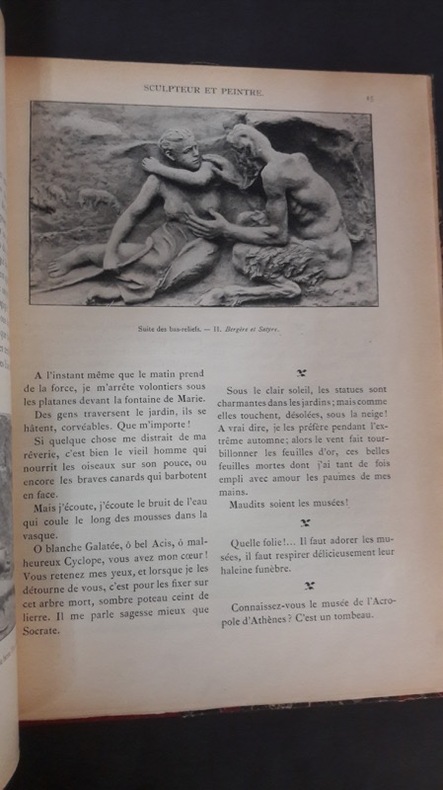
189898404Paris, Société Anonyme La Plume 1898 117 reproductions en noir et blanc de l’oeuvre de Falguière et un frontispice en couleur aquarelle de Eugène Grasset, In-8 25 cm sur 19 reliure demi-percaline rouge, dos orné d’un chardon doré. Tête dorée. Couvertures d’origine conservées. 104 pages. Pièce de titre décolorée avec petit manques. Coupes et coins de la reliures frottées. Bon état d’occasion.
184358875Zürich & Winterthur, Literarischen Comptoirs, 1843. 8vo. Bound in one nice later half calf binding in contemporary style with gilt title and blindstamped ornamentation to spine. Faded inscription of ""Eigenthus des Literar. Museum"" to both title-pages and last leaf of bot volumes. Stamps of the same Litarary Museum to volume 1, at both title-page, last leaf and a few leaves inbetween. Neat pencil annotations to a few leaves of volume 1. Neatly washed and with a few tiny closed tears to second gathering. A small spot to lower blank margin of pp. 195-8 of vol. 1. Contents generally clean and crisp. All in all a evry nice copy. IV, 320 + IV, 288 pp. [Marx' paper: Vol. I, pp. 56-88].
184358875Zürich & Winterthur Literarischen Comptoirs 1843. 8vo. Bound in one nice later half calf binding in contemporary style with gilt title and blindstamped ornamentation to spine. Faded inscription of "Eigenthus des Literar. Museum" to both title-pages and last leaf of bot volumes. Stamps of the same Litarary Museum to volume 1 at both title-page last leaf and a few leaves inbetween. Neat pencil annotations to a few leaves of volume 1. Neatly washed and with a few tiny closed tears to second gathering. A small spot to lower blank margin of pp. 195-8 of vol. 1. Contents generally clean and crisp. All in all a evry nice copy. IV 320 IV 288 pp. Marx' paper: Vol. I pp. 56-88. <br/><br/><em>Extremely scarce first edition of this two-volume periodical which contains the first printing of Marx' first newspaper article being the first political article written by Marx for publication namely his "Comments on the Latest Prussian Censorship Instruction". This important debut work which constitutes the foundation of Marxian dialectic and his formulation of Critical Hegelianism was written between January 15 and February 10 1842 but due to censorship restrictions it first appeared here in Ruge's "Anekdota" in Switzerland in 1843 to avoid German censorship. "The young Marx and the young Engels ridiculed the Prussian Censorship Law of 1841. The attack of the young Mark "Comments on the Latest Prussian Censorship Instruction" was written in 1842 but published a year later in Ruge's "Anekdota"."Comments on the Latest Prussian Censorship Instruction" is an early exercise by the young Marx in the application of the categories of Hegelian critique. In this essay the young Marx employed the Hegelian modalities of substance and essence to demonstrate the authoritarian nature of the Prussian Censorship Instruction. The young Marx utilized the concepts of substance and essence in the defence of free press. "Comments on the Latest Prussian Censorship Instruction" defines the essence of a free press as free mind or the essence of reason as freedom. The young Marx argues that it was impossible for reason to act in accordance with its essence unless it was totally free because without absolute freedom reason cannot follow its own insights to their logical conclusion. Consequently when the Prussian Censorship Instruction limits the freedom of reason when it sets boundaries beyond which reason cannot go the Prussian Government annihilates the essence of reason. The strategy of the young Marx is his essay is to adopt Hegelian logic in the cause of liberalism. He wished to show how Hegelian categories could be adjusted could be transformed into weapons in the cause of political reform. In this essay the young Marx proved two things that he interpreted Hegel as a critical Hegelian and that he himself continued this Critical Hegelian tradition. In 1842 the young Marx explored experimented with the use of Hegelian categories essence and appearance as devices by which to advance the cause of political progressivism and this was the meaning of Critical Hegelianism in the generation of Gans." Norman Levine: Divergent Paths: Hegel in Marxism and Engelsism pp. 142-43."Karl's i.e. Marx politics had closely followed those of Ruge ever since the end of the 1830s. In 1842 and 1843 their responses to immediate events not least the "frivolous diatribes of the "Free" had remained very close. An established author and in the possession of independent means "Papa Ruge" - as Jenny called him - was clearly the senior partner in this collaboration. The banning of the "Deutsche Jahrbücher" in January 1843 as the result of Prussian pressure together with the suppression of the "Rheinische Zeitung" meant the effective silencing of Young Hegelianism within Germany. The aim of the criticism as it was applied among Young Hegelians was to highlight the gap between the demands of reason and the behavior of the government but its failure to make any significant headway against the Prussia of Friedrich Wilhelm IV had also pushed them both towards an open criticism of Hegel's political philosophy. Gareth Steadman Jones: Karl Marx Greatness and Illusion p. 142.Although another anonymous essay "Luther als Schiedsrichter zwischen Strauß und Feuerbach" Vol. II pp. 206-208 has long been attributed to Marx the preface to MECW I now states that "recent research has proved that it was not written by Marx Draper register p. 58. The piece might be by Feuerbach himself. </em> unknown
189833534Berlin: Otto Janke 1898. Octavo. Full olive green cloth with titling within decorative border gilt titling to spine gilt patterned endpapers. 156 pp. With musical examples. Light uniform browning. Otto Janke unknown books
1876858331876. Marx Dr. K. F. H. AUSSPRUCHE EINES HEILKUNDIGEN UBER VERGANGENES GEGENWARTIGES UND KUNFTIGES. Gottingen: Dieterich'schen Verlags - Buchhandlung 1876. iv 143 pp. 8vo. quarter brown cloth unmarked with brown marbled paper covered boards. Presentation copy inscribed by Marx on front flyleaf no date. Boards and cloth worn. Pencil margin marks in a good portaion of the text. See Garrison Morton 2531 for another title by this author ORIGINES CONTAGII 1824. Scarce. unknown
1876858331876. Marx Dr. K. F. H. AUSSPRUCHE EINES HEILKUNDIGEN UBER VERGANGENES GEGENWARTIGES UND KUNFTIGES. Gottingen: Dieterich'schen Verlags - Buchhandlung 1876. iv 143 pp. 8vo. quarter brown cloth unmarked with brown marbled paper covered boards. Presentation copy inscribed by Marx on front flyleaf no date. Boards and cloth worn. Pencil margin marks in a good portaion of the text. See Garrison Morton 2531 for another title by this author ORIGINES CONTAGII 1824. Scarce. unknown books
1863757Berlin: Verlag von Otto Janke 1863. Fair. <p data-path-to-node="10">Second Edition. 378 pp. 8vo. Half brown cloth over marbled boards. An ex-library copy with the associated stamps labels and checkout pocket of the Columbus Ohio Public Library. Spine is heavily frayed and chipped with significant loss to the cloth. The hinges are cracked and the text block is fragile. Internally complete though the pages are toned consistent with age.</p> <br /> <p data-path-to-node="11">Adolf Bernhard Marx was one of the most influential music theorists of the 19th century and this biography remains a cornerstone of Beethoven studies. Despite the heavy wear and library markings it remains a vital primary source for those studying the evolution of music theory and the early reception of Beethoven's œuvre.</p> . Verlag von Otto Janke unknown
1875700471875. Göttingen Dieterichsche Verlags-Buchhandlung 1875 8° IV 141 1 pp. Halbleinenband mit aufkaschierter Titelbroschur. Erstdruck! Karl Friedrich Heinrich Marx 1796-1877 - "Nach dem Lyzeumsbesuch in Karlsruhe unter Lehrern wie J. P. Hebel und dem Botaniker C. C. Gmelin begann Marx 1813 sein Medizin- und Philosophiestudium in Heidelberg. 1817 beendete er es mit der prämiierten Arbeit über die Preisfrage der Fakultät: "Die Struktur und das Leben der Venen". Er kam mit Jean Paul in Berührung wurde durch Hegels Vorlesungen dessen Anhänger und beteiligte sich maßgeblich an der Gründung der Burschenschaften. 1818 bestand er mit Auszeichnung die ärztliche Staatsprüfung in Karlsruhe und begab sich zur Weiterbildung nach Wien. 1819 wurde er während der Unruhen nach dem Attentat auf A. v. Kotzebue neun Monate in Untersuchungshaft genommen. 1820 promovierte er in Jena zum Dr. med. war dann Accessist an der Bibliothek der Univ. Göttingen und habilitierte sich 1822 an deren Medizinischer Fakultät. 1826 wurde er ao. und 1831 o. Professor. Neben einer eigenen großen Praxis hat er in Göttingen durch 55 Jahre bis an sein Lebensende sämtliche theoretischen Fächer der klinischen Medizin gelehrt. Marx war kein unmittelbarer Wegbereiter seiner Wissenschaft immerhin bot er der Heilkunde in den Jahrzehnten romantischer Spekulationen einen sicheren Halt indem er ärztliches Denken therapeutisches Bemühen und die Nutzung naturwissenschaftlicher Methoden zu den "drei Pfeilern der Medizin" erklärte. In seiner "Allgemeinen Krankheitslehre" 1833 suchte er den Anschluß der Pathologie an die Naturwissenschaften zu gewinnen. So hat er sich auch für die Jennersche Pockenschutzimpfung Laennecs Auskultation und die Diagnostik Piorrys eingesetzt. Auch hat die Verwirklichung seiner Forderung für angehende Mediziner das Philosophikum durch eine naturwissenschaftliche Vorbildung unter Beibehaltung der humanistischen Schulerziehung zu ersetzen den Arzttyp der folgenden Generationen geprägt. Andererseits hielt er starr an manchen Thesen der antiken Autoren fest und blieb dem alten humoralen Denken verhaftet wenngleich er der neuen Solidarpathologie auf seine Art gerecht zu werden suchte. Nicht nur wegen solcher Widersprüche galt er auch nach seinem Tod vielen als Sonderling. Bleibende Bedeutung besitzt Marx durch seine Bemühungen um die ärztliche Ethik und seine Arbeiten zur Medizingeschichte. So zählte er zu den ersten die in moderner Zeit die theologische Seelsorge am Kranken klar von der psychischen Hinwendung und Betreuung durch den Arzt zu trennen suchten. Seine Morallehre hat er in Briefen an berühmte Kollegen wie Stieglitz Cheyne Thaer oder Gregory niedergelegt später u. d. T.: "Akesios Blicke in die ethischen Beziehungen der Medizin" 1844 engl. Übers. herausgegeben. Vor allem aber ist ihm - mit Francis Bacon als philosophischem Vordenker - der noch unverfälschte moderne Begriff der "Euthanasie" zu verdanken: Durch ihn erwächst dem Arzt die moralische Aufgabe dem aus dem Leben Scheidenden durch aufrichtenden Zuspruch und seelischen Beistand aber auch durch medikamentöse Milderung seiner Leiden das Sterben zu erleichtern. Eine solche "Todeslinderung" entsprach dem humanen Denken seiner Zeit doch wurde sie von ihm erstmals in den ärztlichen Pflichtenkanon aufgenommen. Überragend sind Marxs Verdienste um die Begründung der modernen Medizingeschichte: Um 1845 zählte er zu den wenigen deutschen und ausländischen Medizinern die sich in Breslau um Elias Henschel versammelten um den "Janus" die erste medizinhistorische Zeitschrift der Welt zu gründen. Noch in der Ära pragmatischer Geschichtsschreibung der Wissenschaften verknüpften seine Arbeiten die Medizin mit der Geistes- und Kulturgeschichte und deshalb bescherten auch seine Ärzte- und Forscherbiographien der Medizin eine neue historische Betrachtungsweise. Als erster forderte er die Geschichte der Wissenschaften als Unterrichtsgegenstand in den Schulen einzuführen und schon frühzeitig versuchte er auch die "Beziehungen zwischen der darstellenden und der Heilkunst" 1861 zu ergründen wobeidie Sorgfalt seiner Erhebungen diejenige Virchows übertraf. Grundlegend blieben seine Werke über die Geschichte des Kontagionismus und der Toxikologie; seine Arbeit über Herophilos 1838 regte die modernen Forschungen über alexandrinische und hellenistische Medizin an. Mit seinen Aphorismen die außerhalb der Medizin nach Form und Gehalt an Bacon die franz. Moralisten Goethe und Lichtenberg anknüpften verfeinerte er innerhalb der Heilkunde eine Literaturgattung die einst in ihr entstanden war. Diese sind bis heute weder von seinen Kollegen noch von der Literaturwissenschaft gewürdigt worden." Markwart Michler BDB XVI 1990 pp. 327 f. unknown
1834642601834. Notiz. Geb. Nat. Heilk. 1 859. - Hrsg. v. Ludwig Friedrich Froriep. - Weimar Landes-Industrie-Comptoir März 1834 4° 1-16 Sp. Tafel feine Broschur. Erstdruck! "Dupuytren legte mit Hülfe eines Troikarts und eines weissglüheden Cauteriums eine Harnröhre an. Offenerhaltung durch Katheter." "Dupytren created a urethra means of a trocar and white-hot cautery. Kept open by catheter." Zeis Nr.1629; Zeis No.2195 unknown
18982406Budapest: Gutenberg 1898. First Hungarian edition. In bit later paper. Cover rubbed. Small tears inside still in very good condition. First Hungarian edition. In bit later paper. 29 p. First Hungarian edition of Wage Labour and Capital. Gutenberg unknown
188360072London, The Modern Press, 1883. Royal8vo. Entire volume present, in the original olive green full cloth binding with gilt lettering to spine. Front board with black line-borders, black vignette, gilt lettering and gilt ornamentation depicting the sun. Spine with small mark and professional repairs to head and tail of spine. Light occassional brownspots to first leaves, otherwise a fine and clean copy. (Capital:) Pp. 57-68" 145-150. (Entire volume:) IV, 600 pp. Housed in a cloth clamshell box with gilt lettering to spine.
19001747226850ABSSwan Sonnenschein & Co. 1900. Hardcover. Acceptable. 1900. 6th Edition 1900. 816 pages. No dust jacket. Red cloth with gilt and black lettering. Translated by Samuel Moore and Edward Aveling. Edited by Frederick Engels. 2 volumes in 1. Pages are heavily tanned and foxed throughout. Occasional thumb marks to pages edges. Moderate dogearing to corners. Heavy cracking to gutters with a loose binding and pages. Boards have moderate shelf with bumping to corners. Spine ends are notably crushed with considerable tanning. Considerable water marks to boards and spine Slight forward lean to text block. Swan Sonnenschein & Co. hardcover
18892203008Humboldt 1889. 1st. hardcover. very good. First edition published and printed in the US. Very good condition gutters have tape first free end paper also has tape along inside to previous page as well as in back. Humboldt unknown
18912204033London: Sonneschein 1891. Fourth. hardcover. A very good fourth edition in the original cloth. The fourth edition. Very good in original cloth housed in a supplied slipcase. Sonneschein unknown
18892210110Appleton & Co 1889. first. hardcover. very good. First US edition in original cloth very good condition. Front and rear gutters have been repaired. Housed in a custom-made foldout case. Appleton & Co unknown
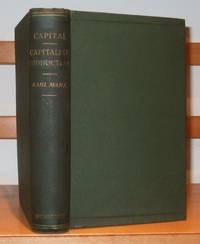
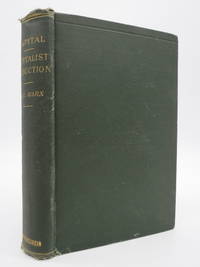
1890355490724647New York: Humboldt Publishing Co 1890. First Edition. Hard Cover. New York: The Humboldt Publishing Co. n.d. 1890. First US edition. First edition printed in America. Tall 8vo. xviii 506pp. This copy is bound without advertisements. Contemporary blue cloth binding with gilt lettering to the spine and with red speckled edges. Patterned end-papers. No inscriptions. No foxing. Firm hinges. Just a surface loss in a couple of places to the head and tail of of the spine and to the corners. Clean contents. A nice VG copy. NOT ex-library. Translated from the third German Edition by Samuel Moore and Edward Aveling. Edited by Frederick Engels. NB: In 1890 the Humboldt Publishing Company published this edition in English of Das Kapital in four separate parts bound in stapled wrappers. This copy appears to have bound contemporaneously from the individual wrappers as the stub holes are evident in the gutters in several places. NNB: The wrappered edition contained advertisements although this example does not have advertisements bound in as sometimes seen. A literary masterpiece and probably the greatest work of social theory. Photographs/scans available upon request. Humboldt Publishing Co hardcover
1896012738London: Swan Sonnenschein & Co 1896. Book measures 22.5x15.cm. Collation xxxi1816pp half title present. Bound in original publishers green cloth with gilt lettering marble endpapers. Cloth very lightly rubbed gilt lettering slightly faded some minor cloth repairs. Binding in very good firm condition. Internally name inscription on endpaper possibly written in crown faded name on title page hardly noticable some light spotting mainly to first 30 pages. Pages in good clean condition. A very nice copy. . Cloth. Very Good. 8vo. Swan Sonnenschein & Co Hardcover
18968387London: Swan Sonnenschein & Company. Good with no dust jacket. 1896. First English Edition; Fifth Printing. Hardcover. Original green cloth cover is frayed at corners and spine caps with light scuffing but clean and in good condition. Boards and spine are straight. Book is shaken. Page edges toned with very modest soiling. Split between patterned paste downs and end papers but hinges still strong. Former owner name and address on front patterned end sheet. Pages are lightly toned but clean and very good. . . Swan Sonnenschein & Company hardcover
189013889New York: Humboldt Publishing Co 1890. First Edition Thus; Later Printing. Hardcover. Book condition is Very Good sturdily rebound in 1/2 leather preserving original features. Weak stain to top page edges. A few small bumps and chips to exterior. Chip to bottom corner of pages 27-30 resulting in minor textual loss to footnotes. Text is clean and umarked. 494 printed pages plus index "Works and Authors quoted in 'Capital' " ending at page 506; no ads at rear. No date; one of the scarce later printings of the first edition of "Das Kapital" actually printed in the United States; though an earlier edition was released in 1889 by an American publisher Appleton that edition was printed in Scotland. ; 8vo 8" - 9" tall. Humboldt Publishing Co hardcover
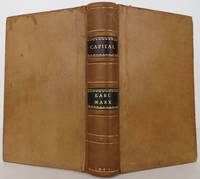
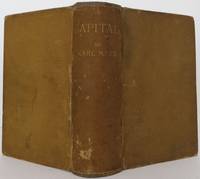
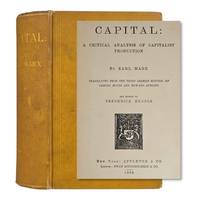
1889694 - 650 - 736<p><em>First American edition preceding the later Humboldt text in America by twenty months</em></p><p><strong>Publisher and Year</strong>: New York: Appleton & Co. 1889</p><p><strong>Edition</strong>: First American edition one of just 500 copies published in January 1889.1-4 Translated from the third German edition by Samuel Moore and Edward Aveling. The present work consists of the first and only volume to be fully written by Marx with the next two installments completed by Engels and published in English in 1907 and 1909.</p><p>Other than the title page the text of the 1889 Appleton edition is identical to the first British edition London: Swan Sonnenschein & Co. 1887 and was bound from sheets printed in the U.K. but was issued in one volume rather than two. For this edition the British firm printed and sold 500 sets of sheets to Appleton & Co. marking the first time that an American firm was listed as a publisher on the printed sheets. Note that in 1887 about half of the 500 copies of the first British edition were exported and bound in the United States but the sheets were not printed with credit to the two American distributors though both firms did make later alterations to advertise their involvement.1</p><p>The next appearance of the book in America came a full twenty months after the Appleton edition New York: The Humboldt Publishing Company 1890. Though the Humboldt edition was the earliest to be physically printed in the United States the text was an unauthorized piracy of the Moore-Aveling translation.1 The Humboldt edition was issued in serialized wrappers from September to October in 1890 and then in cloth by November of that year at the latest ~5000 copies were ultimately printed.15-8</p><p><strong>Condition and Description</strong>: Thick octavo publisher's ochre cloth stamped in gilt and blind pale-yellow endpapers 816 pp. Boards soiled with some rubbing and handling wear. Tips bumped and exposed. Gilt still legible. Some stains to the edges of the text block not intruding upon the text except for in one small instance on the upper part of the final blank. Hinges loose but holding with splits to the endpapers at the gutters but the webbing remains intact a common fault given the considerable weight and thickness of the text block. The text itself remains firmly bound with all pages attached. Tanning to the first two blanks from something that had been laid in. Previous owner's name in ink to the third blank page Louis Walldorf a member of the Socialist Labor Party in the 1890s. No other writing or underlining. A few scattered instances of light foxing and finger smudging. Without any restoration or repair. An 1899 card from The Labor Lyceum a socialist organization based in Rochester N.Y. is laid in. The card advertises an event "The 'People's Parliament'" consisting of a series of lectures and open debates concerning questions "vital.to the working people." The card in addition to ownership by a member of the Socialist Labor Party reflects the use of this copy in the American socialist movement in the late nineteenth century.</p><p><strong>Provenance: </strong>Louis Walldorf b. 1832 a German immigrant watchmaker and socialist political activist. In March of 1892 Walldorf was nominated by his ward to be an executive board member of The Socialist Labor SLP party in Rochester N.Y. where he resided. Later that year the SLP nominated their first candidates for president and vice president of the United States even though the official party platform was to abolish both offices. Walldorf remained a resident of Rochester throughout the 1890s and The Labor Lyceum card was plausibly his given where the advertised event was held.</p><p><strong>References:</strong></p><p>1. "Karl Marx Capital First American Editions." Article issued by the Karl Marx Library in Luxembourg.</p><p>2. The Publisher's Weekly 1888 Dec 29. Vol 34 Issue 26. Appleton's edition listed under "Will publish next week."</p><p>3. The Publisher's Weekly 1889 Jan 12. Vol 35 Issue 2. Appleton's edition listed under "Just published"</p><p>4. The Daily Inter Ocean 1889 Jan 12. Appleton's edition listed under "Books Received"</p><p>5. The Humboldt Library of Science issues of Marx's The Capital 135-138. Parts were dated Sep 1 Sep 15 Oct 1 and Oct 15 of 1890 on the front wrappers. Refer to the example sold by Swann Galleries on May 5th 2022.</p><p>6. Copies in wrappers were reprinted monthly from January 1891 to April 1891 with such copies bearing those dates on the front wrappers. Refer to the set listed by Antiquariat Inlibris.</p><p>7. The Nation 1890 November 6 Vol 51 Issue 1323. Humboldt edition advertised at $1.20 four parts in wrappers and $1.75 cloth</p><p>8. The Nation 1890 November 12 Vol 51 Issue 1324. Humboldt edition advertised at $1.20 four parts in wrappers and $1.75 cloth</p><p>-<br />Inventory ID: 694 - 650 - 736</p> Appleton & Co. hardcover
188360072London The Modern Press 1883. Royal8vo. Entire volume present in the original olive green full cloth binding with gilt lettering to spine. Front board with black line-borders black vignette gilt lettering and gilt ornamentation depicting the sun. Spine with small mark and professional repairs to head and tail of spine. Light occassional brownspots to first leaves otherwise a fine and clean copy. Capital: Pp. 57-68; 145-150. Entire volume: IV 600 pp. Housed in a cloth clamshell box with gilt lettering to spine. <br/><br/><em>The exceedingly rare first British translation of any part of ‘Das Kapital’ and the first English translation of any part of the work to be published in Britain. When Karl Marx was finalizing the first volume of “Das Kapital†he was already planning an English translation; British socialism was dominated by trade unionism and Marx wanted to propagate his ideas among the British working class. It would take 16 years however before the present translation was published and a full 20 years before the first full translation of the first volume of Das Kapital was published. The present work is of the utmost scarcity and we have not beeen able to find a single auction record of it. Marx' research for ‘Das Kapital’ was in large part carried out in the reading room of the British Library and the British working class during the industrial revolution in the late 18th century and early 19th century was highly important to Marx' class analysis. Consequently Marx was eager to have an English translation published and for years Marx and Engels tried to find an English translator and an editor for “Das Kapitalâ€. While several unauthorized translations were planned and even begun nothing came of it in Marx’s lifetime. The present book is the first volume of a journal edited by Ernest Belfort Bax & James Leigh Joynes which specialized in the publication of free-thinking and radical works. It was published from 1883 to 1889 and To-Day's guiding principle was to 'shake itself free from all fetters save those of truth and taste'. Its political stance is indeed bold and not entirely unfitting for a first translation of ‘Das Kapital’: 'the equal rights of every human being to health wealth wisdom and happiness shall be our watchword'. Two sections of ´Das Kapital´ namely: I. The Serfdom of Work; II. The Lordship of Wealth. According to the heading the second installment is being translated from the French edition of 1872 but a footnote states: “this chapter is translated from the second and third sections of chapter X of the original". The first complete English book edition appeared in 1887 under the title Capital: A Critical Analysis of Capitalist Production. It was translated by Samuel Moore and Edward Aveling the partner of Karl Marx's daughter Eleanor overseen by Engels. </em> hardcover
189059553New York: Humboldt Publishing Co N.d. 1890. First Humboldt Edition. First printing. Presumed later issue with ads undated but listing up to nos. 142-143 of the "Humboldt Library of Science" Wollstonecraft Vindication of the Rights of Woman issued in 1890. Octavo 24cm. Publisher's red cloth titled in gilt on spine with designs stamped in black on front cover in blind on rear cover; floral endpapers; xviii1-506pp;44pp ads. Bookplate to front pastedown of Jefferson D. Stewart Louisville Kentucky banker and financier whose pencil ownership signature dated 1895 also appears on the title page. An exceptional copy in the publisher's cloth binding minutely rubbed at joints and board corners; floral endpapers so prone to splitting at the hinges are fully intact and the text is fresh bright and unmarked. Very close to a fine copy and easily the best we have handled.<br /> <br /> The early publication history of this first volume of Marx's Capital in America is bibliographically complex at times stubbornly ambiguous and not seldom misrepresented. The earliest copies to appear for sale in America were imported sheets of the Swan Sonnenschein London edition of 1887 bound and distributed in America through two New York agents in one case identified on the pastedowns Julius Bordello in another Scribner & Welfored on a tipped-in slip see Philip Foner "Marx's 'Capital' in the United States" Science & Society Fall 1967. In 1889 Sonnenschein produced a stereotyped edition which was distributed in America through yet a third agent D. Appleton whose name appeared as co-publisher on the title page making this the first edition to carry any textual indication of an American publisher. Any of these three editions have some claim to being called the "First American Edition" notwithstanding the fact that none were printed in America. <br /> <br /> Beginning in January of 1890 Humboldt Publishing Co. a small New York radical publisher issued what it claimed to be "the only American edition - carefully Revised" of Capital. This was in fact an unauthorized reprinting of the Moore - Aveling translation issued without the permission of Marx's family the translators or the European publishers. To save on distribution costs Humboldt resorted to a standard 19th-century publishing ploy and issued the work as a four-part serial nos. 135-138 in its "Humboldt Library of Science" series at the time periodicals were subject to much lower postal rates than bound books. Around the same time - priority has never to our knowledge been established - Humboldt issued some of its printed sheets of Capital in the one-volume cloth edition we have here. This may be properly described as the first book edition of Capital to be printed in the United States. <br /> <br /> Unsurprisingly given the somewhat haphazard nature of 19th-century radical publishing some ambiguities remain. First it is clear from the dates of catalogued copies that Humboldt issued Capital at least twice in serial format - copies exist of issues 135-138 dated January to April 1890; other copies numbered identically exist dated October 1 to October 15 1890 see "Karl Marx Capital First American Editions" online resource . Second based on inspection of copies in our hands and other catalogued copies in commerce we note that the clothbound issue appeared with at least three different states of publisher's advertisements following the text - some with ads dated 1889 presumably the earliest issue; others as with our copy with undated ads but datable from contents to mid-to-late 1890; others with no ads at all. We suspect but cannot prove that the first two issues of the cloth edition correspond with the two known serial issues the first in January the second in October of 1890. Copies without ads were likely issued later to use up remaining sheets.<br /> <br /> Finally there is a question not previously commented upon in any of the scholarship we have consulted regarding Humboldt's claim that this "only American edition" was "carefully Revised." Some previous cataloguers have suggested that the Humboldt edition was a literal reprint of the Sonnenschein stereotype edition of 1889. But this makes little sense; Humboldt could not conceivably have had access to Sonnenschein's stereotype plates and besides the format and pagination of the two editions are entirely dissimilar. Was Moore & Aveling's translation in fact edited for American readers and if so to what degree This cataloguer has now spent sufficient time in a side-by-side comparison of the Humboldt and Sonnenschein via Hathi Trust editions to reach a preliminary conclusion that the only "revisions" consist in the alteration of British spellings to their American equivalents throughout the text e.g. "labor" for "labour"; "characterize" for "characterise" etc. No alterations to the substance of Moore and Aveling's translation appear to our eyes - though to be sure this is a lengthy work and we have performed only a random sampling of the text; an exhaustive comparison of the texts has never to our knowledge been carried out and this would seem to be a fruitful subject for research. <br /> <br /> 1. Foner Philip. "Marx's Capital in the United States." In Science & Society v. 31 no 4 Fall 1967 pp 461-66.<br /> 2. Amink Babak. "A Brief History of the Dissemination and Reception of Karl Marx's Capital in the United States and Britain." In World Review of Political Economy v.7 no. 3 Fall 2016 pp.334-349. <br /> 3. "Karl Marx Capital First American Editions" web article at Karl Marx Library Luxembourg <br /> <br /> NOTE: The second and third volumes had not yet been completed by Engels at this date and would not appear in the U.S. until the 1909 Kerr edition. Humboldt Publishing Co unknown