LA LANTERNE NOIRE (Revue de Critique Anarchiste)Livre Rare Book

2 065 résultats
15480Edité par Jean-Pierre Duteuil (Juillet 1978) - In-8 broché et agrafé de 52 pages - Exemplaire en très bon état
1979170866La Rue Paris, 1979. In-8 broché, couverture illustrée de 100 pages. Revue culturelle d'expression anarchiste. Sous la direction de Suzie Chevet. Daniel GUERIN ; Stirner père de l'anarchisme. Hn REGNELL : Les racines de la société violente. Serge LIVROZET : L'ordre et le désordre. Maurice JOYEUX : En Iran. Interview : HUBERT LE FEAL par F TRAVELET. Très bon état
1974171902Groupe Libertaire Louise-Michel Groupe Libertaire Louise-Michel, 1974. N°17. In-8 broché de 99 pages. Un numéro spécial, pour quoi faire ? La sexualité dans le passé. Ton corps est à toi, le sais-tu. La sexualité et les couches sociales. Les jeunes et le sexe. Le couple et ses problèmes. De l'éveil sexuel au mariage. Le ghetto. Érotisme, pornographie et anarchie. Le spectacle érotique. Obscénité et littérature contestataire en R.F.A. Philosophie et sexualité. Bon état
1971171906Groupe Libertaire Louise-Michel Groupe Libertaire Louise-Michel, 1971. N°10. La commune de Paris. In-8 broché de 100 pages. Bon état
1979185154Groupe Libertaire Louise-Michel Groupe Libertaire Louise-Michel, 1979. N°26. In-8 broché de 99 pages. Sommaire : En Iran. Parlement européen. Les joies du futur. Perspectives économiques L'ordre et le désordre. Le recours à la loi. La parole enchainée. Les racines de la société violente. Libres enfants de Jonas. Stirner "père de l'anarchisme". L'idolâtrie ouvrière. Bon état
4800Bourg, P.F. Bottier, 1838 - 1844 ; cinq volumes in-8 ; demi-percaline marron à coins, faux-nerfs, titre manuscrit en doré, plats conservés (reliure mi-XXe) ; XXIV, 224 ; XIV, 350 ; XXV, 404 ; XXXIII, 427 ; III, 304, 67, VIII pp.
193128841931. Paris éditions Anationalistes 1931 - Broché 11 cm x 17 cm 42 pages - Texte anonyme traduit de l'esperanto par L.G. Avid et G. Waringhien préface de L. Barbedette - Bon état
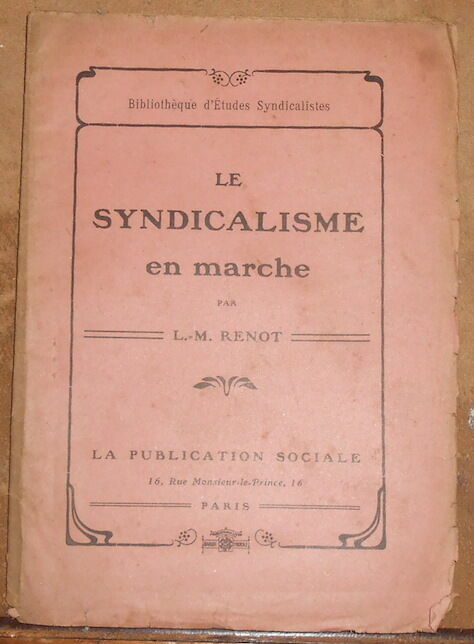
1909171751909. Paris La Publication Sociale Bibliothèque d'Etudes Syndicalistes s. d. (circa 1909) - Broché 14 cm x 19 5 cm 16 pages - Texte de L.-M. Renot - Bon état
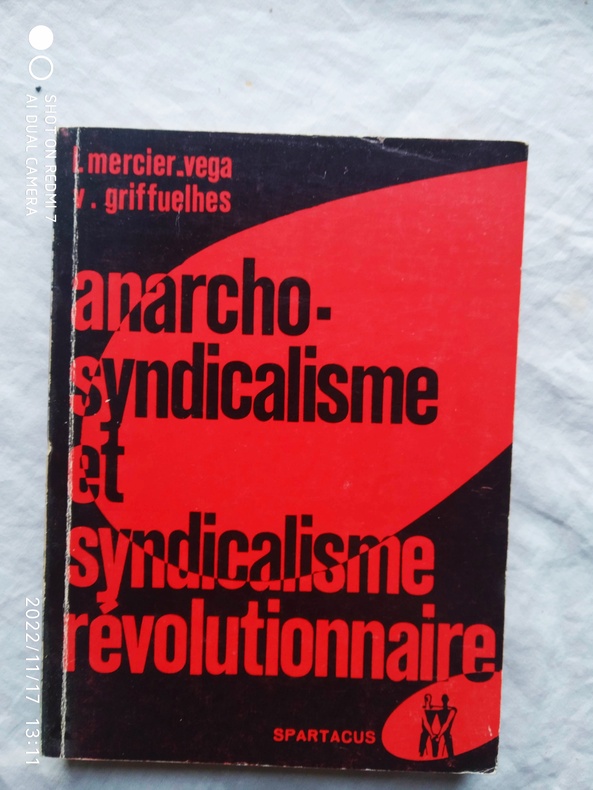
1978EB2567L. Mercier-Vega / V. Griffuelhes, Anarcho-syndicalisme et syndicalisme révolutionnaire, Spartacus, cahiers mensuels, René Lefeuvre, sept - oct 1978, 13,5 cm X 18,7 cm, 100 pp, couverture souple illustrée.
192822698Paris, La Brochure Mensuelle, Novembre 1928, sous couverture de relais « Contre le Courant », janvier 1959. Plié, 13 cm x 19 cm, 26 pages suivi de Le Militarisme de Lux (4 pages)+ VIII pages catalogue Contre Le Courant. Texte de L. Renard. Bon état.
in 16°, bross. edit. ill., lievi fioriture in seconda e terza di cop. - prima edizione it. - trad. di Filippo Frassati
1919107801919. Paris Librairies du Parti Socialiste et de l'Humanité réunies 1919 - Broché 12 cm x 19 cm 94 pages - Texte de Kurt Eisner préface de Jean Longuet - Tache sur la couv. sinon bon état intérieur
1914014687Paris Publications des "Temps Nouveaux" - n°2 1914 plaquette in-12 agrafé, couverture illustrée
in-8 - 312 pp. Brossura editoriale con copertina. Very good copy. [EN-4]
in 12 - pp.374 - Brossura editoriale con copertina illustrata. VG [CA31-7]
in-12, 545 pages, broche, jaquette illustrée. Accrocs à la jaquette sinon bel exemplaire. [CL-4]
plaq. in-16, 64 pages, agr., couv. Bel exemplaire [DV-SM]
fort volume in-16, 445 pages, broche. Bel exemplaire. [LP-6]
Editions du Sextan, 2012. In-8 broché de 469 pages. Très bon état
Stock, "Bibliothèque historique" n°3,1976. In-12 broché avec jaquette, 749 pp.
In-8, 434p. Exemplaire à l'état de neuf.
Covers show edgewear & are tape-repaired at spine. Internally Very Good & Solid. (R-1-1); 8vo; Zheneva [i.e. Geneva], Gruppa "Khlieb i volia," 1904. Paper Wrappers, 12mo, 75 pages. 17 cm. In Russian. This is the first separate appearance of Kropotkin's important essay on the state, and also its first appearance in his native Russian (The essay first appeared as a series of articles entitled "L'Etat: son rôle historique" in Les Temps nouveaux, December 19, 1896- July 3, 1897.) It was later translated and published in English as "The State: Its Historic Role" (London: Freedom Press, 1911). Kropotkin, in exile in Western Europe, "became the best-known propagandist in the international anarchist movement" and "participated in several attempts to direct anarchist propaganda into Russia ..Kropotkin was and remains the most widely read anarchist writer, and his version of anarchist theory was the most influential contribution to the anarchist movement in Russia and elsewhere " (Nicolas Walter in Shukman, 1988, pp. 334-335) OCLC lists 3 copies worldwide (Hoover, U of Kansas, Columbia). This is Alexander Granovsky's copy with his signature & bookplate. Granovsky was a leader of the Ukranian exile community in the US and was the founder, in 1941, of the Ukrainian Scientific Institute, which had a short life but was one of the forerunners of other efforts that followed World War II. He was a also a leader of the Organization for the Rebirth of Ukraine and a world famous entomologist, activist and poet as well. From the English Translation: "First of all, let us be agreed as to what we wish to include in the term the State. There is, of course, the German school which enjoys confusing "State" with "Society". The best German thinkers, and many among the French, are guilty of this confusion because they cannot conceive of society without a concentration of the State; and because of this anarchists are usually accused of wanting to ``destroy society'' and of advocating a return to ``the permanent war of each against all.'' Yet, to argue thus is to overlook altogether the advances made in the domain of history during the last thirty-odd years; it is to overlook the fact that humans lived in Societies for thousands of years before the State had been heard of; it is to forget that so far as Europe is concerned the State is of recent origin---it barely goes back to the sixteenth century; finally, it is to ignore that the most glorious periods in history are those in which civil liberties and communal life had not yet been destroyed by the State, and in which large numbers of people lived in communes and free federations. The State is only one of the forms adopted by society in the course of history. Why then make no distinction between what is permanent and what is accidental? Then again the "State" has also been confused with "Government". Since there can be no State without government, it has been sometimes said that what one must aim at is the absence of government and not the abolition of the State. However, it seems to me that in State and government we have two concepts of a different order. The State idea means something quite different from the idea of government. It not only includes the existence of a power situated above society, but also of a "territorial concentration" as well as the "concentration of many functions of the life of societies in the hands of a few". It carries with it some new relationships between members of society which did not exist before the establishment of the State. A whole mechanism of legislation and of policing has to be developed in order to subject some classes to the domination of others. This distinction, which at first sight might not be obvious, emerges especially when one studies the origins of the State. Indeed, there is only one way of really understanding the State, and that is to study its historic development, and this is what we will try to do." OCLC lists 3 copies worldwide (Hoover, Kansas, & Columbia). (RUS-10-1)
200140913ABFfm., Unrast (= Klassiker der Sozialrevolte, Band 4 und 5), 2001. 8°, insg. 549 S. mit 2 s/w-Porträts, illustr. original Kartonage (Paperback), Erstausgabe der Neuübersetzung sehr schöne, saubere und wohl auch unbenutzte Exemplare
19185774Zürich, Meyer, 1918. 211 S., 1 Bl. OBroschur. Kl.-8°.
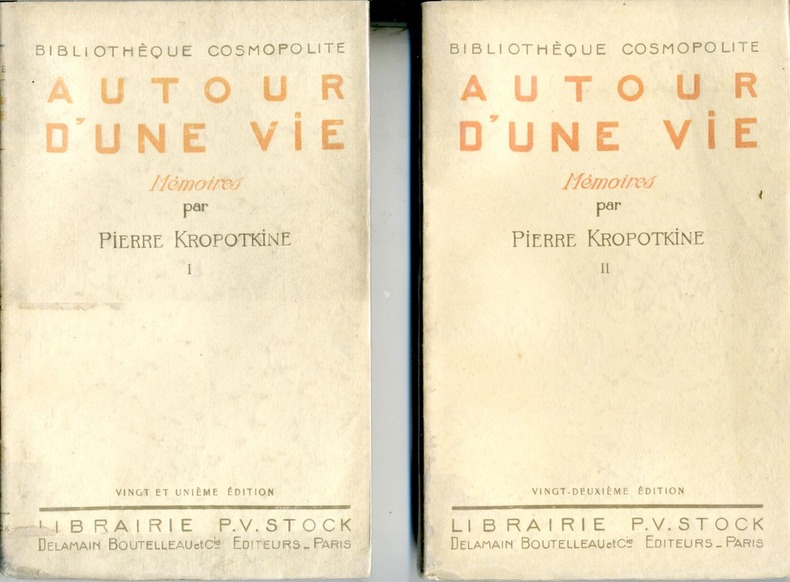
5239"Bibliothèque Cosmopolite" Stock (1921) - En 2 volumes brochés de 536 pages - Préface de Georges Brandes - Index des noms cités - Très bon état non coupé