KROPOTKINE PierreLivre Rare Book
KROPOTKINE PierreLivre Rare Book
Le salariat
5356Publications de la Révolte (1892) - 2° édition - Plaquette de 36 pages - Bon état

Marché Noir - Librairie Ultime Razzia · Gardanne, France50,00 €
2 065 résultats
5350"La Bonne Collection" n° 154 - La Brochure Mensuelle (1936) - Plaquette de 24 pages - Illustration de Jules HENAULT - Très bon état
Stock, "Bibliothèque historique" n°3,1976. In-12 broché avec jaquette, 749 pp.
5351La Brochure Mensuelle n° 2 (1923) - Editions du Groupe de propagande par la brochure - Plaquette de 32 pages - Bon état
5356Publications de la Révolte (1892) - 2° édition - Plaquette de 36 pages - Bon état
5358"Bibliothèque de propagande anarchiste" n° 3 - Editions de la " Librairie Sociale " (1921) - 3° édition - Plaquette de 16 pages - Très bon état
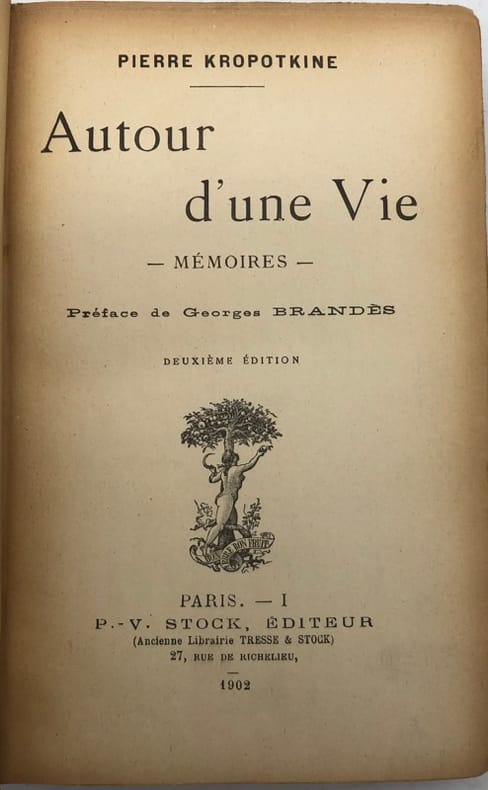
233768Paris, P.-V. Stock, 1902 in-12, XXI pp., 536 pp., demi-percaline verte, dos lisse orné de filets et fleuron dorés, pièce de titre havane, couverture conservée (reliure de l'époque). Essais de plume sur la seconde couverture.
229343Paris, P.-V. Stock, 1905 in-12, XXI pp., 536 pp., demi-basane cerise, dos à nerfs orné de filets et pointillés dorés, tranches mouchetées (reliure de l'époque). Dos insolé.
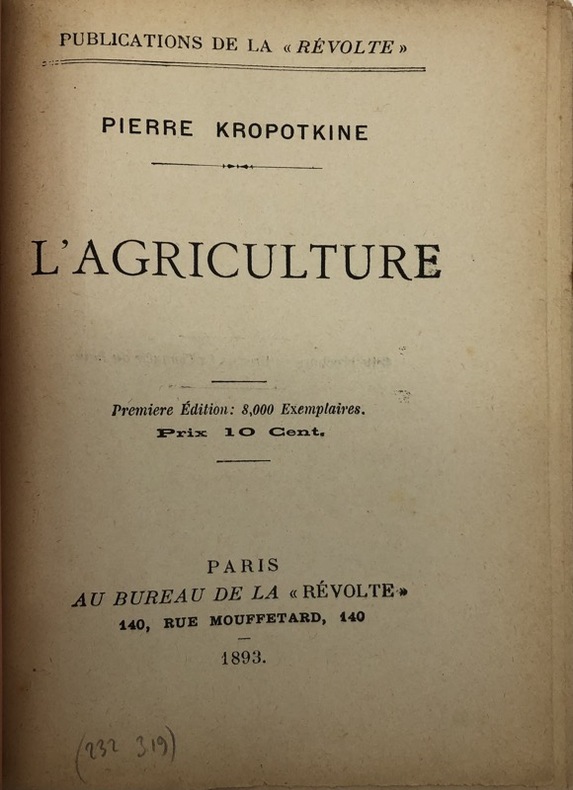
232319Paris, au bureau de la Révolte [Imprimerie Panvert], 1893 in-16, 32 pp., broché. Seconde couverture salie.
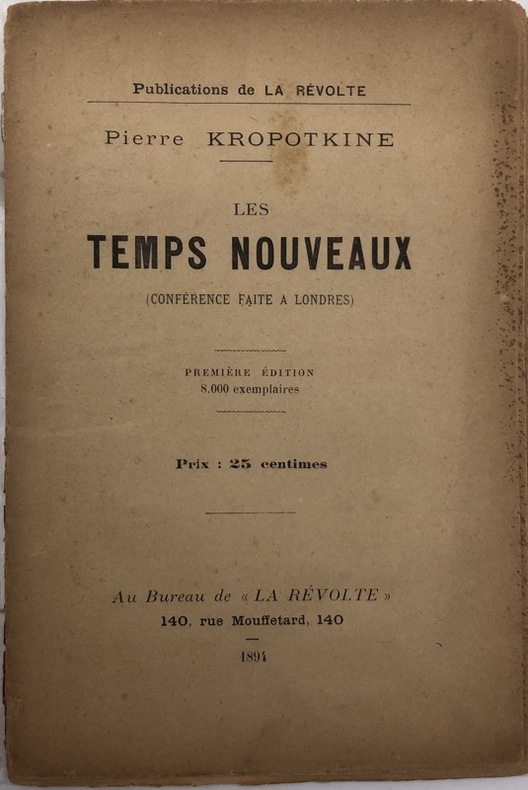
232320[Paris], au bureau de la Révolte , 1894 in-12, 63 pp., broché. Dos cassé.
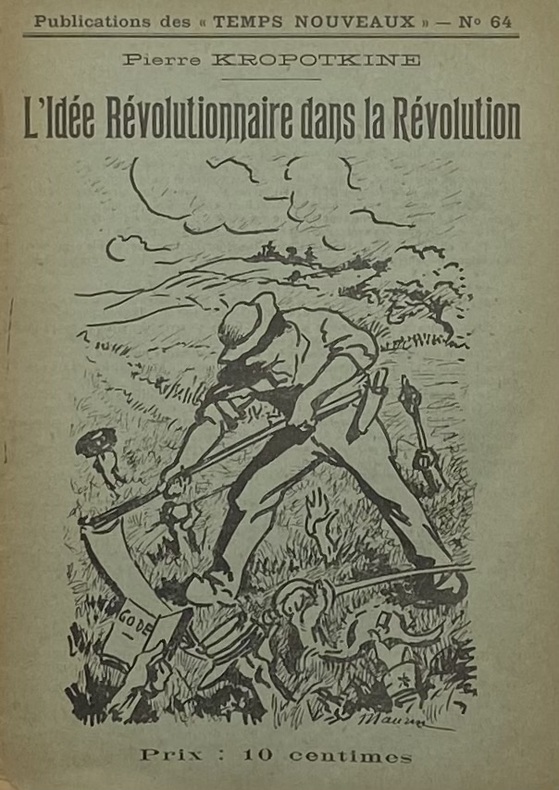
232750Paris, Les Temps nouveaux, 1913 in-16, 24 pp., broché sous couverture illustrée.
L15117Paris. P.-V. Stock, éditeur, 1903. Préface de Georges Brandès. In-12 reliure demi-maroquin rouge. Tête et titre dorés, dos 5 nerfs. Bel exemplaire.
1921114810P., Librairie P. V. Stock, 1921, 2 vol. in-12, xxi-536 pp, pagination continue, préface de Georges Brandès, mentions de 20e édition, index, reliures pleine toile noire, dos lisses avec titres dorés et filets à froid, encadrements à froid sur les plats (rel. de l'époque), reliures défraîchies, état correct (Coll. Bibliothèque cosmopolite)
38149Lausanne, La Guilde du Livre, 1972. In-8°, 434p. Reliure pleine toile d'éditeur.
In-8, 434p. Exemplaire à l'état de neuf.
114Ag0 Paris, la brochure mensuelle, sans date - fascicule in12 de 64pp, broché - 1er plat détaché, brochage un peu libertaire ... papier jauni. On ne présente plus le grand théoricien de l'Anarchie P. Kropotkine (1842-1921). On signalera simplement qu'il fut ami avec Elisée Reclus et collabora à sa Géographie Nouvelle. Il fut le plus grand philosophe de l'autogestion. A sa mort en Russie, le pouvoir soviétique ne put empêcher un rassemblement gigantesque pour ses funérailles
114Ag0 Paris, la brochure mensuelle, sans date - fascicule in12 de 64pp, broché - 1er plat détaché, brochage un peu libertaire ... papier jauni. On ne présente plus le grand théoricien de l'Anarchie P. Kropotkine (1842-1921). On signalera simplement qu'il fut ami avec Elisée Reclus et collabora à sa Géographie Nouvelle. Il fut le plus grand philosophe de l'autogestion. A sa mort en Russie, le pouvoir soviétique ne put empêcher un rassemblement gigantesque pour ses funérailles
189635504585Bruxelles, Bibliothèque des Temps Nouveaux, 1896 ; plaquette in-16, brochée, couv. imprimée. 35 pp.Qq. fentes sans manque de papier et pliures à la couv. Exemplaire en partie non coupé.
21070Valencia, F. Sempere, [vers 1910]. In-8, 233 pp., basane noire, dos long orné de filets dorés, intiales G.M. dorées en queue de dos, couverture originale imprimée (petites rousseurs et mouillures).
Covers show edgewear & are tape-repaired at spine. Internally Very Good & Solid. (R-1-1); 8vo; Zheneva [i.e. Geneva], Gruppa "Khlieb i volia," 1904. Paper Wrappers, 12mo, 75 pages. 17 cm. In Russian. This is the first separate appearance of Kropotkin's important essay on the state, and also its first appearance in his native Russian (The essay first appeared as a series of articles entitled "L'Etat: son rôle historique" in Les Temps nouveaux, December 19, 1896- July 3, 1897.) It was later translated and published in English as "The State: Its Historic Role" (London: Freedom Press, 1911). Kropotkin, in exile in Western Europe, "became the best-known propagandist in the international anarchist movement" and "participated in several attempts to direct anarchist propaganda into Russia ..Kropotkin was and remains the most widely read anarchist writer, and his version of anarchist theory was the most influential contribution to the anarchist movement in Russia and elsewhere " (Nicolas Walter in Shukman, 1988, pp. 334-335) OCLC lists 3 copies worldwide (Hoover, U of Kansas, Columbia). This is Alexander Granovsky's copy with his signature & bookplate. Granovsky was a leader of the Ukranian exile community in the US and was the founder, in 1941, of the Ukrainian Scientific Institute, which had a short life but was one of the forerunners of other efforts that followed World War II. He was a also a leader of the Organization for the Rebirth of Ukraine and a world famous entomologist, activist and poet as well. From the English Translation: "First of all, let us be agreed as to what we wish to include in the term the State. There is, of course, the German school which enjoys confusing "State" with "Society". The best German thinkers, and many among the French, are guilty of this confusion because they cannot conceive of society without a concentration of the State; and because of this anarchists are usually accused of wanting to ``destroy society'' and of advocating a return to ``the permanent war of each against all.'' Yet, to argue thus is to overlook altogether the advances made in the domain of history during the last thirty-odd years; it is to overlook the fact that humans lived in Societies for thousands of years before the State had been heard of; it is to forget that so far as Europe is concerned the State is of recent origin---it barely goes back to the sixteenth century; finally, it is to ignore that the most glorious periods in history are those in which civil liberties and communal life had not yet been destroyed by the State, and in which large numbers of people lived in communes and free federations. The State is only one of the forms adopted by society in the course of history. Why then make no distinction between what is permanent and what is accidental? Then again the "State" has also been confused with "Government". Since there can be no State without government, it has been sometimes said that what one must aim at is the absence of government and not the abolition of the State. However, it seems to me that in State and government we have two concepts of a different order. The State idea means something quite different from the idea of government. It not only includes the existence of a power situated above society, but also of a "territorial concentration" as well as the "concentration of many functions of the life of societies in the hands of a few". It carries with it some new relationships between members of society which did not exist before the establishment of the State. A whole mechanism of legislation and of policing has to be developed in order to subject some classes to the domination of others. This distinction, which at first sight might not be obvious, emerges especially when one studies the origins of the State. Indeed, there is only one way of really understanding the State, and that is to study its historic development, and this is what we will try to do." OCLC lists 3 copies worldwide (Hoover, Kansas, & Columbia). (RUS-10-1)
200140913ABFfm., Unrast (= Klassiker der Sozialrevolte, Band 4 und 5), 2001. 8°, insg. 549 S. mit 2 s/w-Porträts, illustr. original Kartonage (Paperback), Erstausgabe der Neuübersetzung sehr schöne, saubere und wohl auch unbenutzte Exemplare
19185774Zürich, Meyer, 1918. 211 S., 1 Bl. OBroschur. Kl.-8°.
bross. edit., gore in cop., tracce d'uso al dorso, rare sottolineature a matita
198373636Frankfurt am Main : Syndikat (Taschenbücher Syndikat / EVA ; Bd. 6), 1983. 282 S. Taschenbuch
in inglese bross. edit., fascicolo di 35 pp.
19772456Basel, Eigenverlag, 1977. 40 Seiten. OBroschur.