Arms, Goodsil FilleyBiblio.com

3 526 résultats
1436875471.Gpaperback. Good. Access codes and supplements are not guaranteed with used items. May be an ex-library book. paperback
3642543618.Ghardcover. Good. Access codes and supplements are not guaranteed with used items. May be an ex-library book. hardcover
1162221925.Ghardcover. Good. Access codes and supplements are not guaranteed with used items. May be an ex-library book. hardcover
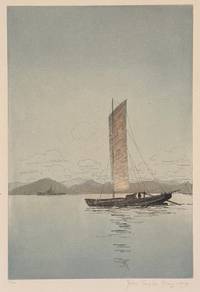
19199281919. Aquatint with hand coloring in watercolor on watermarked laid Arches paper 8 1/16 x 5 9/16 inches 206 x 142 mm full margins. Signed titled dated and numbered 22/40 in pencil lower margin. From the fourth state of 4 consisting of a total of 80 impressions only 40 of which have hand coloring in watercolor. In superb condition with light toning and archival tape tabs at the top right and left corners and lower right corner on the verso well outside of the image area. Printed by Frederick Reynolds. <br /> <br /> Fletcher 23. Paper: Arms was typical of the artists of this period - he was obsessed with paper a mania for collecting paper that could/would improve an edition. The quantity he left after his death distributed by his wife to fellow artists witnesses his love for finely made paper -paper interesting because of texture color distinctive weave. The earliest paper known to have been used by Arms came from a Baptismal Register Kirchen Ordnung The Reformed Church Middletown Dauphin County Pennsylvania 1708 bought in a bookshop in Philadelphia. His early prints 1915-1919 evidence paper taken from old books with gilded edges. Some prints appear on stationary from the Cisalpine Napoleonic Italy still bearing the estampe of the office or department; others carry penned ink page numbers taken from old ledgers of the Eighteenth Century-all beautiful shades of grey blue and green handmade ribbed and otherwise. Some of his color aquatints were printed on full sheets of heavy chine or Japanese vellum giving a sense of luxury in the richness of the stock and the width of the margins. There was a myriad of modern papers gleaned in England France Italy and the United States. William Dolan Fletcher John Taylor Arms a Man for All Time: The Artist and His Work. Sign of the Arrow Eastern Press 1982. p. 15. unknown
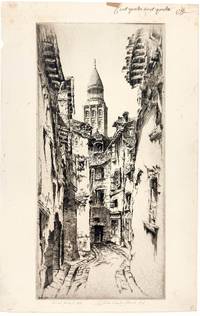
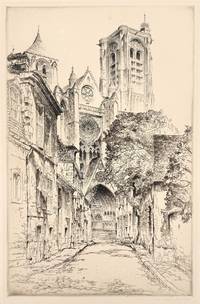
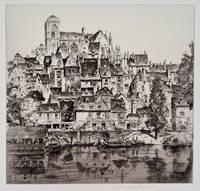
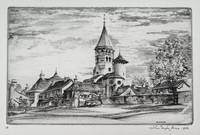
192823171928. Etching with drypoint on antique cream laid paper 12 x 5 9/16 305 x 142 mm; sheet 13 1/4 x 8 1/2 inches 337 x 216 mm. Signed dated and inscribed in the lower margin in pencil. Although Fletcher specifies only 2 trial proofs Arms himself has inscribed "Trial Proof VII" in pencil in the lower margin. An impression aside from the regular edition of 100 printed on 18th century paper with a contemporary inscription in ink in the upper right corner which reads "Cent quatre vingt quatre" one hundred twenty four. There are some areas of light discoloration in the margins that date to the origin of the paper. Printed by Frederick Reynolds assisted by Henry Carling. A magnificently detailed impression in excellent condition. <br /> <br /> Fletcher 212. Périgueux has one of the most extensive old towns in the Dordogne department in France. The Périgueux Cathedral was originally built in the 12th century but it was rebuilt by the architect Paul Abadie between 1852 and 1895. The base of the bell tower was part of the original church. Today the square bell tower has three tiers pierced with arches that support a tall dome. In Arms' etching the bell tower looms above a narrow cobblestone alley lined with ancient stone buildings. In perhaps a tribute to Whistler Arms left building surfaces unmarked by his etching needle. Light vertical passages draw the viewer's eye toward the darker more detailed center of the image. One's eyes move upward with the play of shadow texture and light toward the imposing domed bell tower.<br /> <br /> Born in 1887 in Washington DC John Taylor Arms studied at Princeton University and ultimately earned a degree in architecture at the Massachusetts Institute of Technology in 1912. With the outbreak of W.W.I Arms served as an officer in the United States Navy and it was during this time that he turned his focus to printmaking having published his first etching in 1919. His first subjects were the Brooklyn Bridge near the Navy Yard and it was during his wartime travel that Arms created a series of extraordinarily detailed etchings based on gothic cathedrals and churches he visited in France and Italy the plate for Guardians of the Spire was created in 1921. He used what was available to him namely sewing needles and a magnifying glass to create the incredibly rich and fine detail that his etchings are known for. Upon his return to New York after the war Arms enjoyed a successful career as a graphic artist created a series of etchings of American cities and published Handbook of Print Making and Print Makers Macmillan 1934. He served as President of the Society of American Graphic Artists and in 1933 was made a full member of the National Academy of Design. Arms died in Fairfield Connecticut in 1953. unknown
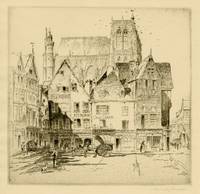
192510381925. Etching on cream wove Japon paper 7 3/8 x 7 3/4 inches 188 x 197 mm full margins. Signed and dated in pencil lower margin. In excellent condition with some minor surface soiling on the recto as well as inscriptions in pencil at the left and right corners verso. One of 150 impressions printed by Frederick Reynolds. French Church Series No. 5; Illustrated in Dorothy Noyes Arms Churches of France p. 16. Born in 1887 in Washington DC John Taylor Arms studied at Princeton University and ultimately earned a degree in architecture at the Massachusetts Institute of Technology in 1912. With the outbreak of W.W.I Arms served as an officer in the United States Navy and it was during this time that he turned his focus to printmaking having published his first etching in 1919. His first subjects were the Brooklyn Bridge near the Navy Yard and it was during his wartime travel that Arms created a series of extraordinarily detailed etchings based on gothic cathedrals and churches he visited in France and Italy the plate for Guardians of the Spire was created in 1921. He used what was available to him namely sewing needles and a magnifying glass to create the incredibly rich and fine detail that his etchings are known for. Upon his return to New York after the war Arms enjoyed a successful career as a graphic artist created a series of etchings of American cities and published Handbook of Print Making and Print Makers Macmillan 1934. He served as President of the Society of American Graphic Artists and in 1933 was made a full member of the National Academy of Design. Arms died in Fairfield Connecticut in 1953. unknown
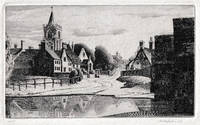
19388271938. Etching on antique Emberlin 1846 cream laid paper with a parial watermark of Britannia or Seated Victory set in a cartouche surmounted by the Crown of England 3 1/4 x 5 1/2 inches 83 x 140 mm full margins. Signed dated and inscribed "Ed. 150 II" in pencil lower margin. Non-archival tape tabs at the top corners recto well outside of the image area otherwise in excellent condition. Fletcher states an unknown number of first state proof impressions and 13 second state proof impressions; he also states a regular edition of 231 second state impressions. Arms's hand inscription regarding the numbering on this print remains slightly mysterious although Fletcher does descibe other instances in which recorded edition numbers appeared to be incomplete or incorrect so not an anomoly in this instance. The very special paper hand chosen for this impression would indicate that this is a proof impression perhaps a presentation proof of the second state aside from an unrealized run of 150. <br /> <br /> Fletcher 315. Paper: Arms was typical of the artists of this period - he was obsessed with paper a mania for collecting paper that could/would improve an edition. The quantity he left after his death distributed by his wife to fellow artists witnesses his love for finely made paper -paper interesting because of texture color distinctive weave.<br /> <br /> The earliest paper known to have been used by Arms came from a Baptismal Register Kirchen Ordnung The Reformed Church Middletown Dauphin County Pennsylvania 1708 bought in a bookshop in Philadelphia.<br /> <br /> His early prints 1915-1919 evidence paper taken from old books with gilded edges. Some prints appear on stationary from the Cisalpine Napoleonic Italy still bearing the estampe of the office or department; others carry penned ink page numbers taken from old ledgers of the Eighteenth Century-all beautiful shades of grey blue and green handmade ribbed and otherwise. Some of his color aquatints were printed on full sheets of heavy chine or Japanese vellum giving a sense of luxury in the richness of the stock and the width of the margins. There was a myriad of modern papers gleaned in England France Italy and the United States. -William Dolan Fletcher A Man For All Times p. 15. unknown
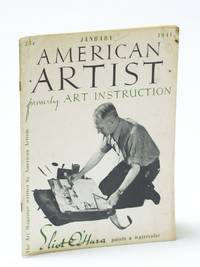
1941651H2643USA: Watson-Guptill Publications Inc. Good. 1941. First Edition. Single Issue Magazine. 36 pages. Features: Eliot O'Hara Paints a Watercolor - article with illustrations; John Taylor Arms - how he makes an etching part 2 of 3; The Technic of the Airbrush; Interview with Stevan Dohanos; Tempera; Pencil Drawing; When an artist goes gunning with a camera; and more. Average wear. A sound copy.; 4to - over 9¾" - 12" tall; American Artist Magazine January Jan. 1941 - Eliot O'Hara Cover Photo Eliot O'Hara Paints a Watercolor - article with illustrations; John Taylor Arms - how he makes an etching part 2 of 3; The Technic of the Airbrush; Interview with Stevan Dohanos; . Watson-Guptill Publications, Inc. unknown
1930mon0000033191Crafton Collection 1930. Hardcover. Very Good. in x in x in. 2nd printing. Tipped in plates. Lightly read if read at all. No markings in book. Binding is fine. DJ with shelf wear to edges. Crafton Collection hardcover
192623181926. Etching with drypoint on watermarked FJ Head & Co. handmade laid paper 10 3/4 x 9 7/8 inches 272 x 252 mm; sheet 18 1/8 x 14 1/8 inches 461 x 360 mm full margins. A trial proof aside from the regular edition of 100. Signed dated inscribed "I" in pencil in the lower margin. From the small batch of impressions printed by Frederick Reynolds. With both the artist's moniker ink stamp and the Collection John Taylor Arms ink stamp both in black ink in the lower margin. There is also a New York Public Library accession number in the lower right as well as a pencil inscription indicating that the print was once in the Eddie Welch Estate collection 1975. Small loss at the top-left sheet edge well outside of the image area otherwise in excellent condition. <br /> <br /> Fletcher 181. Born in 1887 in Washington DC John Taylor Arms studied at Princeton University and ultimately earned a degree in architecture at the Massachusetts Institute of Technology in 1912. With the outbreak of W.W.I Arms served as an officer in the United States Navy and it was during this time that he turned his focus to printmaking having published his first etching in 1919. His first subjects were the Brooklyn Bridge near the Navy Yard and it was during his wartime travel that Arms created a series of extraordinarily detailed etchings based on gothic cathedrals and churches he visited in France and Italy the plate for Guardians of the Spire was created in 1921. He used what was available to him namely sewing needles and a magnifying glass to create the incredibly rich and fine detail that his etchings are known for. Upon his return to New York after the war Arms enjoyed a successful career as a graphic artist created a series of etchings of American cities and published Handbook of Print Making and Print Makers Macmillan 1934. He served as President of the Society of American Graphic Artists and in 1933 was made a full member of the National Academy of Design. Arms died in Fairfield Connecticut in 1953. unknown
1926138861926. Arms John Taylor. Arms John Taylor. ARCH OF THE CONCA PERUGIA. Etching 1926. 10 1/4" x 14 5/8 plus margins. Framed to 18 x 22 inches. Signed in pencil and annotated "Trial Proof No. 6"; only state. Fletcher 175. There were 12 trial proofs and an edition of 100. Printed by Frederick Reynolds. In excellent condition. Number 4 of the Italian Series and one of Arms' "Preferred" plates. Dorothy Noyes Arms Hill Towns of Northern Italy Macmillan 1930 P. 70. unknown
19273672New York: Minton Balch 1927. Hardcover. Very good. Paper over boards with a paper spine label on the front cover. The frontispiece is an original etching numbered and signed by Heintzelman. The interior is bright and clean the covers are lightly soiled and the paper over the spine is chipped in a few places. Overall a very good copy. The untitled etching numbered 85 is a fine specimen and is still very bright and clean. A nice copy in very good condition. <br/><br/> Minton Balch hardcover
192782598MINTON BALCH & CO. As New. 1927. Hardcover. FREE UPGRADE to Courier/Priority Shipping Upon Request - IN STOCK AND IMMEDIATELY AVAILABLE FOR SHIPMENT - AS NEW THE TEXT BLOCK IS PRISTINE CLEAN UNMARKED AND IN EXCELLENT CONDITION - - 31 pages 12 plates chronological list of etchings done from 1915 -1926 "Modern American Etchers" Series 4to. -- with a bonus offer-- . MINTON BALCH & CO hardcover
192955151929. Arms John Taylor. Arms John Taylor. BASILICA OF THE MADELEINE VEZELAY THE ABBEY CHURCH OF STE. MADELEINE. F.223 3rd state of 3. "French Churches" series Arms Churches of France p. 146. Edition of 130 printed on blue laid paper by Peter Platt. 12 3/4 x 7 3/8 inches; 324 x 188 mm. Inscribed "3rd State" and signed in pencil. unknown
13975Arms John Taylor. BATTLE WAGON - U.S.S. ALABAMA OUTFITTING AT NORFOLK NAVY YARD CRANE SHIP KEARSARGE ALONGSIDE - 1942 . F.376. Etching and drypoint 1943. Sixth State Inscribed "VI" lower left and signed and dated 1943 lower right. This is a proof printed by Charles White aside from the edition of 872. In excellent condition. unknown
13104Arms John Taylor. BEAVER HOUSE AU NORD. Fletcher 88. Etching 1920. An Artist's Proof printed by Fredrick Reynolds. Signed and dated in pencil by Arms lower right and incscribed "Artist's Proof" lower left. The edition was 75 of which 10 impressions were titled "Au Nord."5 7/8 x 7 7/8 inches 150 x 201 mm. framed to 17 x 18 inches. In excellent condition. This print is scarce. unknown
192523321925. Etching on watermarked handmade F J Head & Co cream laid paper with a deckle edge 14 1/8 x 9 1/8 inches 358 x 232 mm; sheet 18 1/8 x 11 inches 461 x 280 mm full margins. Signed and dated in pencil in the lower margin. Although the work is not identified by the artist given the special nature of the paper it is likely one of a very limited number of trial proof impressions. Minor mat tone otherwise in superb condition. <br /> <br /> Fletcher 166. unknown
192920511929. Etching on cream laid paper 12 7/8 x 5 1/2 inches 328 x 140 mm; sheet 14 7/8 X 8 3/8 inches 389 x 217 mm full margins. Signed and dated in pencil in the lower right margin. From the edition of 100 impressions printed by Frederick Reynolds in 1929. In good condition with one pea-sized spot of discoloration with an associated pinpoint sized spot of foxing in the left margin well outside of the image area as well as some light and unobtrusive toning in the margins. Inking is dark and rich with all of the fine details printing clearly. No. 27 from the French Church Series; illustrated on p. 140 in Dorothy Noyes Arms Churches of France. <br /> <br /> Fletcher 221. Born in 1887 in Washington DC John Taylor Arms studied at Princeton University and ultimately earned a degree in architecture at the Massachusetts Institute of Technology in 1912. With the outbreak of W.W.I Arms served as an officer in the United States Navy and it was during this time that he turned his focus to printmaking having published his first etching in 1919. His first subjects were the Brooklyn Bridge near the Navy Yard and it was during his wartime travel that Arms created a series of extraordinarily detailed etchings based on gothic cathedrals and churches he visited in France and Italy the plate for Guardians of the Spire was created in 1921. He used what was available to him namely sewing needles and a magnifying glass to create the incredibly rich and fine detail that his etchings are known for. Upon his return to New York after the war Arms enjoyed a successful career as a graphic artist created a series of etchings of American cities and published Handbook of Print Making and Print Makers Macmillan 1934. He served as President of the Society of American Graphic Artists and in 1933 was made a full member of the National Academy of Design. Arms died in Fairfield Connecticut in 1953. unknown
2035Etching on antique cream laid paper with a deckle edge 9 1/8 x 9 3/4 inches 232 x 248 mm; sheet 12 1/8 x 12 3/4 inches 307 x 323 mm full margins. Signed and dated in pencil in the lower right margin. In excellent condition with some extremely minor uniform toning a light pencil notation "56" in the lower margin perhaps in the artist's hand and with the upper-right extreme corner loosely dog-eared well outside of the image area. Paper tape tabs at the top right and left corner verso. A magnificently detailed image with excellent inking and rich burr. <br /> <br /> <br /> Fletcher 206. Born in 1887 in Washington DC John Taylor Arms studied at Princeton University and ultimately earned a degree in architecture at the Massachusetts Institute of Technology in 1912. With the outbreak of W.W.I Arms served as an officer in the United States Navy and it was during this time that he turned his focus to printmaking having published his first etching in 1919. His first subjects were the Brooklyn Bridge near the Navy Yard and it was during his wartime travel that Arms created a series of extraordinarily detailed etchings based on gothic cathedrals and churches he visited in France and Italy the plate for Guardians of the Spire was created in 1921. He used what was available to him namely sewing needles and a magnifying glass to create the incredibly rich and fine detail that his etchings are known for. Upon his return to New York after the war Arms enjoyed a successful career as a graphic artist created a series of etchings of American cities and published Handbook of Print Making and Print Makers Macmillan 1934. He served as President of the Society of American Graphic Artists and in 1933 was made a full member of the National Academy of Design. Arms died in Fairfield Connecticut in 1953. unknown
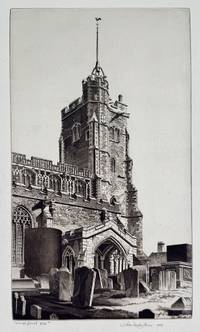
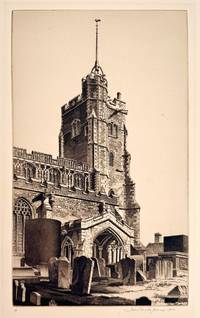
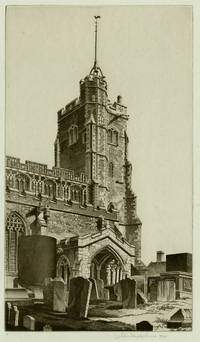
194420461944. Etching on antique grayish-blue laid paper 9 1/2 x 5 1/2 inches 242 x 140 mm; sheet 12 5/8 x 7 5/9 inches 325 x 198 mm full margins. Signed titled dated and inscribed Trial Proof XIII II Cavendish Church. Trial Proof XIII; second published state an old English early 19th. To my dearest sister with deepest devotion John Taylor Arms 1944. A trial proof aside from 155 impressions from the second state of 2. Printed by David Strang. English Series No. 11. In superb condition with excellent inking rich tonality and magnificent detail. <br /> <br /> On an impression owned by Arms biographer William Dolan Fletcher Arms notes that he spent 236 hours etching the first state and an additional 53 3/4 hours on the second state. <br /> <br /> Fletcher 381. Born in 1887 in Washington DC John Taylor Arms studied at Princeton University and ultimately earned a degree in architecture at the Massachusetts Institute of Technology in 1912. With the outbreak of W.W.I Arms served as an officer in the United States Navy and it was during this time that he turned his focus to printmaking having published his first etching in 1919. His first subjects were the Brooklyn Bridge near the Navy Yard and it was during his wartime travel that Arms created a series of extraordinarily detailed etchings based on gothic cathedrals and churches he visited in France and Italy the plate for Guardians of the Spire was created in 1921. He used what was available to him namely sewing needles and a magnifying glass to create the incredibly rich and fine detail that his etchings are known for. Upon his return to New York after the war Arms enjoyed a successful career as a graphic artist created a series of etchings of American cities and published Handbook of Print Making and Print Makers Macmillan 1934. He served as President of the Society of American Graphic Artists and in 1933 was made a full member of the National Academy of Design. Arms died in Fairfield Connecticut in 1953. unknown
194420411944. Etching on cream laid paper with a deckle edge and with an unidentified watermark with an "AL" inside an ovoid cartouche with a garter and buckle likely English 19th century 9 1/2 x 5 1/2 inches 242 x 140 mm; sheet 13 x 7 1/2 330 x 190 mm full margins. Signed titled dated and numbered "II" in pencil in the lower margin. In very good condition with some minor mat tone and uniform age tone with paper tape at the top and bottom corners at the right sheet edge verso. A trial proof from a total of 13 proof impressions. A good impression on antique paper.<br /> <br /> English Series No. 11.<br /> <br /> Fletcher 181. On an impression of this work belonging to William Dolan Fletcher Arms mentions that he spent 236 hours on the first state and an additional 53 1/2 hours on the second state.<br /> <br /> Awards:<br /> 1945: Annual Exhibition of the Royal Academy London<br /> 1945: Best Print in Exhibition 22nd Annual Exhibition Arts & Crafts Assoc. Meriden CT.<br /> 1947: Honorable Mention for Excellence 30th Annual Exhibition Chicago Society of Etchers Chicago IL.<br /> 1948: Special Mention for Excellence 30th Annual Exhibition Palm Beach Art League West Palm Beach FL.<br /> <br /> Born in 1887 in Washington DC John Taylor Arms studied at Princeton University and ultimately earned a degree in architecture at the Massachusetts Institute of Technology in 1912. With the outbreak of W.W.I Arms served as an officer in the United States Navy and it was during this time that he turned his focus to printmaking having published his first etching in 1919. His first subjects were the Brooklyn Bridge near the Navy Yard and it was during his wartime travel that Arms created a series of extraordinarily detailed etchings based on gothic cathedrals and churches he visited in France and Italy the plate for Guardians of the Spire was created in 1921. He used what was available to him namely sewing needles and a magnifying glass to create the incredibly rich and fine detail that his etchings are known for. Upon his return to New York after the war Arms enjoyed a successful career as a graphic artist created a series of etchings of American cities and published Handbook of Print Making and Print Makers Macmillan 1934. He served as President of the Society of American Graphic Artists and in 1933 was made a full member of the National Academy of Design. Arms died in Fairfield Connecticut in 1953. unknown
194412671944. Etching on bluish-grey thin laid paper 9 1/2 x 5 1/2 inches 242 x 140 mm full margins. Signed dated and numbered "II." In very good condition with three pin-point sized dots of brown discoloration in the left margin well outside of the image area and paper tape at the top and botton corners at the right sheet edge verso. A trial proof from a total of 13 proof impressions. A luminous impression on unusual paper.<br /> <br /> English Series No. 11.<br /> <br /> Fletcher 381. On an impression of this work belonging to William Dolan Fletcher Arms mentions that he spent 236 hours on the first state and an additional 53 1/2 hours on the second state.<br /> <br /> Awards:<br /> 1945: Annual Exhibition of the Royal Academy London<br /> 1945: Best Print in Exhibition 22nd Annual Exhibition Arts & Crafts Assoc. Meriden CT.<br /> 1947: Honorable Mention for Excellence 30th Annual Exhibition Chicago Society of Etchers Chicago IL.<br /> 1948: Special Mention for Excellence 30th Annual Exhibition Palm Beach Art League West Palm Beach FL. unknown
195020531950. Etching on antique cream laid paper with a deckle edge and an unidentified round watermark with an arm holding a torch 3 1/2 x 5 5/8 inches 89 x 144 mm; sheet 5 3/4 x 8 3/8 inches 146 x 212 mm full margins. Signed titled and inscribed "II" in pencil in the lower margin. One of 6 six proof impressions of the 2nd state of 2 aside from the regular edition of 300. Printed by Charles S. White. In good condition with minor mat tone and some inscriptions in pencil in the lower margin on ther verso. Ex-collection Atlantic Gallery Washington DC with the label on the mat-back. <br /> <br /> Fletcher 422. Born in 1887 in Washington DC John Taylor Arms studied at Princeton University and ultimately earned a degree in architecture at the Massachusetts Institute of Technology in 1912. With the outbreak of W.W.I Arms served as an officer in the United States Navy and it was during this time that he turned his focus to printmaking having published his first etching in 1919. His first subjects were the Brooklyn Bridge near the Navy Yard and it was during his wartime travel that Arms created a series of extraordinarily detailed etchings based on gothic cathedrals and churches he visited in France and Italy the plate for Guardians of the Spire was created in 1921. He used what was available to him namely sewing needles and a magnifying glass to create the incredibly rich and fine detail that his etchings are known for. Upon his return to New York after the war Arms enjoyed a successful career as a graphic artist created a series of etchings of American cities and published Handbook of Print Making and Print Makers Macmillan 1934. He served as President of the Society of American Graphic Artists and in 1933 was made a full member of the National Academy of Design. Arms died in Fairfield Connecticut in 1953. unknown
19398151939. Etching on fine laid antique Head & Co. paper with a partial watermark. 1/2 x 13/16 13 x 21 mm full margins. Signed dated and inscribed "II" in pencil lower margin. A trial proof impression from the second state of two printed by the artist aside from the regular edition of 519. In superb condition with excellent inking and inky plate edges. <br /> <br /> Fletcher 330. Fletcher states a discrepency in the number of impressions in the regular edition of this plate. Arms in two different places lists the edition size as 471; yet his notes indicate an additional 48 impressions.<br /> <br /> French Church Series No. 42<br /> Christmas Card Series No. 20<br /> Miniature Series No. 23<br /> Brooch Series No. 4<br /> <br /> Paper: Arms was typical of the artists of this period - he was obsessed with paper a mania for collecting paper that could/would improve an edition. The quantity he left after his death distributed by his wife to fellow artists witnesses his love for finely made paper -paper interesting because of texture color distinctive weave.<br /> <br /> The earliest paper known to have been used by Arms came from a Baptismal Register Kirchen Ordnung The Reformed Church Middletown Dauphin County Pennsylvania 1708 bought in a bookshop in Philadelphia.<br /> <br /> His early prints 1915-1919 evidence paper taken from old books with gilded edges. Some prints appear on stationary from the Cisalpine Napoleonic Italy still bearing the estampe of the office or department; others carry penned ink page numbers taken from old ledgers of the Eighteenth Century-all beautiful shades of grey blue and green handmade ribbed and otherwise. Some of his color aquatints were printed on full sheets of heavy chine or Japanese vellum giving a sense of luxury in the richness of the stock and the width of the margins. There was a myriad of modern papers gleaned in England France Italy and the United States. -William Dolan Fletcher A Man For All Times p. 15. unknown
19486981948. Etching on handmade cream laid paper 3 1/2 x 4 1/4 inches 890 x 108 mm full margins. Signed dated and inscribed "III" in pencil lower margin. Edition of 150 third state of three. No. 49 from the French Church Series. A beautiful bright inky impression in excellent condition with astonishing detail.<br /> <br /> Fletcher 411 iii/III. Born in 1887 in Washington DC John Taylor Arms studied at Princeton University and ultimately earned a degree in architecture at the Massachusetts Institute of Technology in 1912. With the outbreak of W.W.I Arms served as an officer in the United States Navy and it was during this time that he turned his focus to printmaking having published his first etching in 1919. His first subjects were the Brooklyn Bridge near the Navy Yard and it was during his wartime travel that Arms created a series of extraordinarily detailed etchings based on gothic cathedrals and churches he visited in France and Italy the plate for Guardians of the Spire was created in 1921. He used what was available to him namely sewing needles and a magnifying glass to create the incredibly rich and fine detail that his etchings are known for. Upon his return to New York after the war Arms enjoyed a successful career as a graphic artist created a series of etchings of American cities and published Handbook of Print Making and Print Makers Macmillan 1934. He served as President of the Society of American Graphic Artists and in 1933 was made a full member of the National Academy of Design. Arms died in Fairfield Connecticut in 1953. unknown