542 résultats
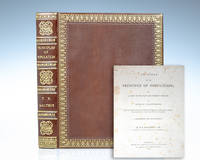
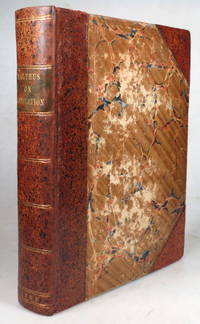
18208125London: John Murray 1820. 1820 vi 601 1 p. First edition. It has a good quality mid-twentieth century binding with a polished morocco spine marbled boards and vellum corners. The spine with gold lines and a contrasting label. Minor rubs to the spine ends otherwise in very good condition. There is an undated pencil note on the title page '£45 Repair'. The text with a few signs of use and some pale paper toning. IMPORTANT COOPERATIVE MOVEMENT PROVENANCE: The title page is inscribed at the head 'Society for promoting Working Men's Assocns / 34 Castle Place -- Oxford Street with a shelfmark R31'. The Society was founded in 1849 by the Christian Socialists in an attempt to found self governing workshops. Lower down the title page is the oval stamp of Ormond Street Working Mens College which still exists in Camden. Founded in 1854 by Frederick Denison Maurice Wiki describes it as 'The Working Men's College is among the earliest adult education institutions established in the United Kingdom and Europe's oldest extant centre for adult education. Founded by Christian socialists at its inception it was at the forefront of liberal education philosophy.' At different times its teachers included Thomas Hughes whose latin lectures were apparently not so popular as his boxing club F.J. Furnival and E.M. Forster. London: John Murray, hardcover
1821040304Boston MA: Wells and Lilly 1821. Book. Very Good. Full-Leather. First American Edition. 8vo - over 7¾" - 9¾" tall. Original full tree calf gilt on burgundy title label mounted on upper spine. Rubbed along edges some surface cracking/crazing rubbed joints and spine extremities. Foxed endpapers some toning and scattered foxing to interior but otherwise intact with firm binding. Former owner's signature on front flyleaf. viii472 pp. Exceptionally scarce first American edition issued a year after the first British edition of 1820. Wells and Lilly Hardcover
18363620869William Pickering 1836. Spine in poor conidition. Browning of pages.This book has hardback covers. Ex-library With usual stamps and markings In poor condition suitable as a reading copy. No dust jacket. Please note the Image in this listing is a stock photo and may not match the covers of the actual item750grams ISBN: William Pickering hardcover
1820884511London: 1820. Some light foxing to the title page otherwise a superior copy in the original papercovered boards with paper spine label. Malthus' Principles of Political Economy did not have its full impact on economic theory until it was revived by J.M. Keynes and P. Sraffa in the twentieth century. Math and technology aside Malthus argues not that society tends toward cannibalistic starvation but that either society will "preventatively" control its population or nature will "correctively" reduce population"Several philosophers and speculatists had supposed that a certain state of society very different from any that has hitherto existed was in itself practicable; and that if it were realised it would be productive of a far greater degree of human happiness than is compatible with the present institutions of society."21 Malthus' argument as stated by Hazlitt is that if man were to give up his existing social institutions then there would be as much bad as good come of it. "For says Mr Malthus though this improved state of society were actually realized it could not possibly continue but must soon terminate in a state of things pregnant with evils for more insupportable than any we at present endure.". First Edition. Contemporary Blue Cloth. Excellent. 8vo. Hardcover
1946758Albin Michel , Principes d'Action Démographique Malicorne sur Sarthe, 72, Pays de la Loire, France 1946 Book condition, Etat : Bon broché In-8 1 vol. - 171 pages
1161846840.Ghardcover. Good. Access codes and supplements are not guaranteed with used items. May be an ex-library book. hardcover
1144840031.Gpaperback. Good. Access codes and supplements are not guaranteed with used items. May be an ex-library book. paperback
1340652064.Ghardcover. Good. Access codes and supplements are not guaranteed with used items. May be an ex-library book. hardcover
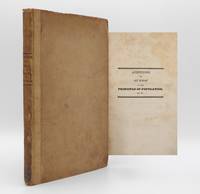
1831376545Georgetown D. C.: Published by Charles Cruikshank Rind's Press 1831. First American edition first published in London in 1817. 8vo. Original cloth backed tan boards printed paper label reading "Additions / to an / Essay /on / Population / by T.B. Malthus" uncut partially unopened. Some spotting and browning of binding rubbing with some wear to extremities some foxing and spotting of leaves insect trail along lower inner hinge marginal tears on R4 and Cc4 not affecting text. A very good copy in brown cloth clamshell box with leather spine label. First American edition first published in London in 1817. 8vo. Very scarce. This work contains new chapters additions and corrections included in the fifth edition separately published with a new title page and pagination for those who already had the earlier editions. <br /> <br /> The Contents leaf lists: Book II Chapters I Checks to Population in France and VII Checks to Population in England; Book III Chapters II Of Systems of Equality IV Of Emigration VI Of Poor Laws VIII-XIV the Agricultural and Commercial Systems Corn Laws Exportation and Importation and "Of increasing Wealth as it affects the Condition of the Poor; Book IV Chapters VI "Effects of the Knowledge of the Principal Cause of Poverty on Civil Liberty" XII "Different Plans of Improving the Condition of the Poor considered" and the Appendix. There are new chapters on the Poor and Corn Laws. A revised chapter on rent and especially the change in Chapter III which formely dealt with Godwin and his "Systems of Equality" now relate to Robert Owen his Utopian systems and his "New View of Society". <br /> <br /> In 1817 at the height of his success Robert Owen addressed the House of Commons speaking on his methods and ideas. Owen had disagreed with Malthus' theories of population. In 1824 Owen had come to America and purchased what became New Harmony a communal society experiment. It was not successful and Owen returned to England in 1828. The Appendix contains Malthus' responses to the publication of Principles of Population and Production by Mr. Wayland and An Inquiry into the Principle of Population by James Grahame. Each chapter notes where the additions should be placed referring to the English edition of 1807 and American edition of 1809. Goldsmiths' Kress Library 26723.2; Kress C2883; Kress B6973 Goldsmiths' 21762 Einaudi 3664 last three for London ed. Published by Charles Cruikshank, Rind's Press unknown
0530645386.Ghardcover. Good. Access codes and supplements are not guaranteed with used items. May be an ex-library book. hardcover
1817231696London : John Murray 1817. 1st edition. Hardcover. Contemporary aniline calf over marble boards. Front hinge loose with wear to the spine bands and panel edges. A good copy. Physical description; iv 327 1 p. ; 22 cm. Includes bibliographical references.Subjects; Population.Malthusianism. Population control. Population growth.Referenced by: Kress Lib B.6973. London : John Murray hardcover
181722733London: John Murray 1817. First edition. 1 vols. 8vo. Rebound in later buckram. Title a little foxed contents generally clean. First edition. 1 vols. 8vo. Issued in conformity with but separately from the fifth edition - the penultimate edition before the sixth and final one in his lifetime. Kress B.6973; Goldsmith 21762 John Murray unknown
180755024London: Printed for J. Johnson in St Paul's Church-Yard by T. Bensley 1807. Fourth edition. Octavo 22cm in two volumes. In contemporary brown calf seven sets of double gilt rules to spine titled in gilt on red leather spine label numbered on black leather spine labels blind tool to board edges all edges sprinkled grey; plain endpapers; vol. I: i-xvi 1-580pp; vol. II: i-viii 1-484 60pp. Sturdy copies much rubbed vol. I slightly cocked lower front joint of vol. I and upper front joint of vol. II cracking vol. II lacking spine label scratch to upper board of vol. II endleaves and some prelims foxed but otherwise internally free from soil: Good or better. <br /> <br /> The fourth edition of Malthus' widely influential discussion of overpopulation. Malthus 1766-1834 argued that population "increases geometrically while food supplies increase only arithmetically" and that some misery was inevitable unless population growth could be restrained. He proposed "moral restraint" as a solution. Many of his theories have now been largely rejected but "the Essay was highly influential in the progress of thought in early nineteenth-century Europe" and "his influence on social policy whether for good or evil was considerable." The first edition was shorter; "later editions were considerably altered and grew bulkier as Malthus defended his views against a host of critics" Printing and the Mind of Man. KRESS B.5219. GOLDSMITHS 19373. PMM 251 1st edn. Printed for J. Johnson in St Paul's Church-Yard, by T. Bensley unknown
180775775hLondon: Printed for R. Johnson in St. Paul's Church-Yard by T. Bensley Bolt Court Fleet Street 1807. Book. Very Good. Hardcover. 8vo - over 7¾ - 9¾" tall. Two-volume set in full tree-calf with gilt spines. Professionally re-backed with original spines relaid. Moderate handling and bumping to covers. Edges and endpapers toned. Armorial bookplate of Sir Edward Strachey Baronet Sutton Court Somerset inside front covers; early owner's name in ink to free endpapers. Otherwise clean tight and unmarked -- no foxing or staining to text. Very neat -- a sound and handsome set. Half-titles present; extensive index. xvi580viii48460indexpp. Printed for R. Johnson in St. Paul's Church-Yard, by T. Bensley, Bolt Court, Fleet Street Hardcover
1020321849.Ghardcover. Good. Access codes and supplements are not guaranteed with used items. May be an ex-library book. hardcover
1021167355.Gpaperback. Good. Access codes and supplements are not guaranteed with used items. May be an ex-library book. paperback
1021681350.Gpaperback. Good. Access codes and supplements are not guaranteed with used items. May be an ex-library book. paperback
1019370831.Ghardcover. Good. Access codes and supplements are not guaranteed with used items. May be an ex-library book. hardcover
1803143843London: T. Bensley 1803. Rare second edition of this cornerstone text of modern economics. Quarto bound in full diced morocco raised bands gilt titles and tooling to the spine front and rear panels marbled endpapers. In very good condition. An exceptional presentation. “Malthus was one of the founders of modern economics. His Essay was originally the product of a discussion on the perfectibility of society with his father who urged him to publish. Thus the first edition published anonymously was essentially a fighting tract but later editions were considerably altered and grew bulkier as Malthus defended his views against a host of critics… The Essay was highly influential in the progress of thought in early 19th-century Europe and his influence on social policy was considerable… Both Darwin and Wallace clearly acknowledged Malthus as a source of the idea of ‘the struggle for existence†PMM 251. T. Bensley hardcover
180345423London: Printed for J. Johnson. by T. Bensley. 1803. Second edition or "A New Edition Very Much Enlarged". 4to. viii iv 610 pp. 19th century half speckled calf over marbled boards gilt rules to the spine gilt lettered green label all edges marbled. Binding expertly resewn and the joints neatly repaired occasional foxing mostly mild an attractive copy. First published anonymously in 1798 Malthus drew upon the works of Hume and Smith amongst others to explain his conservative conception of population control. "The central idea of the essay. was a simple one. The population of a community. increases geometrically while food supplies increase only arithmetically. The 'Essay' was highly influential in the progress of thought in early 19th century Europe. it came at the right time to harden the existing feeling against the Poor Laws" - Printing and the Mind of Man 251. Citing examples from other societies and sources not hitherto known to him Malthus rewrote and extended his essay significantly enough for him to consider this an entirely "new work" in his introduction to this edition. He expanded and refined his theory of positive checks on population growth those that increase the death rate and negative ones those that inhibit birth rates slightly softening his tone by arguing for greater moral restraint as opposed to the bleaker and cruder mechanisms of hunger disease and war to keep population numbers down and therefore keep overall prosperity up. Despite being hugely influential in economic and philosophical terms Malthus has always been a divisive figure and his arguments remain controversial to this day. London: Printed for J. Johnson... by T. Bensley... unknown
1298468272.Gpaperback. Good. Access codes and supplements are not guaranteed with used items. May be an ex-library book. paperback
0678008388.Ghardcover. Good. Access codes and supplements are not guaranteed with used items. May be an ex-library book. hardcover
133386633X.Gpaperback. Good. Access codes and supplements are not guaranteed with used items. May be an ex-library book. paperback
1333566506.Gpaperback. Good. Access codes and supplements are not guaranteed with used items. May be an ex-library book. paperback
180940999Washington City: Roger Chew Weightman 1809. 2 volumes 8vo. 8 1/4 x 5 inches. Vol. 1 xvi 510 xxxiv pp.; Vol. 2 vii 542 pp. Contemporary tree calf skilfully rebacked. Spines gilt ruled forming six compartments lettering pieces in the second compartmenrs<br/> <br/> Provenance: Possibly John Barclay 1749-1824 former Mayor of Philadelphia from 1791 to 1793<br/> <br/> First American edition of a fundamental text of Modern Economics.<br/> <br/> Thomas Robert Malthus was an English economist cleric and scholar influential in the fields of political economy and demography. Malthus came to prominence for his publication of the present work first published in 1798. Between 1798 and 1826 Malthus published six versions of the essay updating each edition to incorporate new material to address criticism and to convey changes in his own perspectives on the subject. Writing in response to Jean-Jacques Rousseau and William Godwin specifically their approaches to the improvement of society Malthus opposed the optimistic view in 18th-century Europe that saw society as improving and in principle as perfectible. Malthus saw population growth as inevitable whenever conditions improved thereby precluding real progress towards a utopian society: "The power of population is indefinitely greater than the power in the earth to produce subsistence for man." Malthus laid the "theoretical foundation of the conventional wisdom that has dominated the debate both scientifically and ideologically on global hunger and famines for almost two centuries" Daoud. He remains a much-debated writer.<br/> <br/> Shaw 17975; Daoud Ade "Robbins and Malthus on scarcity abundance and sufficiency: The missing sociocultural element" in American Journal of Economics and Sociology 69.4: 1206-1229; Harvey David "Population Resources and the Ideology of Science"in Economic Geography 503: 256277. Roger Chew Weightman unknown