539 résultats
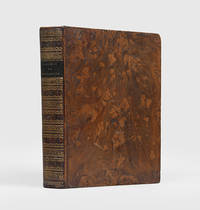
1798116955London: J. Johnson 1798. First edition of this cornerstone text of modern economics. Octavo bound in three quarters calf. Laid in is a clipping from an original manuscript signed by Malthus and entirely in his hand which reads in part "If at one time such a given product would make an effectual demand for certain commodities the conditions of the supply of which are supposed to remain the same it would immediately cease to make such effectual." Signed by Malthus in the lower right corner "Malthus." The verso features two further partial lines of text relating to supply and demand. In near fine condition. First editions of Malthus' magnum opus are exceptionally scarce. Malthus was one of the founders of modern economics. His Essay was originally the product of a discussion on the perfectibility of society with his father who urged him to publish. Thus the first edition published anonymously was essentially a fighting tract but later editions were considerably altered and grew bulkier as Malthus defended his views against a host of critics. The Essay was highly influential in the progress of thought in early 19th-century Europe and his influence on social policy was considerable. Both Darwin and Wallace clearly acknowledged Malthus as a source of the idea of 'the struggle for existence" PMM 251. J. Johnson unknown books
1798116955London: J. Johnson 1798. First edition of this cornerstone text of modern economics. Octavo bound in three quarters calf. Laid in is a clipping from an original manuscript signed by Malthus and entirely in his hand which reads in part "If at one time such a given product would make an effectual demand for certain commodities the conditions of the supply of which are supposed to remain the same it would immediately cease to make such effectual." Signed by Malthus in the lower right corner "Malthus." The verso features two further partial lines of text relating to supply and demand. In near fine condition. First editions of Malthus' magnum opus are exceptionally scarce. “Malthus was one of the founders of modern economics. His Essay was originally the product of a discussion on the perfectibility of society with his father who urged him to publish. Thus the first edition published anonymously was essentially a fighting tract but later editions were considerably altered and grew bulkier as Malthus defended his views against a host of critics… The Essay was highly influential in the progress of thought in early 19th-century Europe and his influence on social policy was considerable… Both Darwin and Wallace clearly acknowledged Malthus as a source of the idea of ‘the struggle for existence†PMM 251. J. Johnson unknown
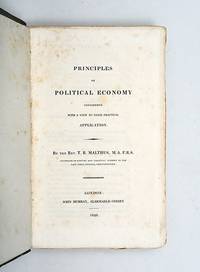
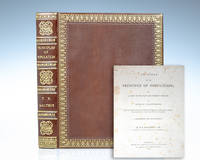
1820151433London: John Murray 1820. First edition. The book was conceived as a series of tracts rather than a comprehensive and systematic treatise though Malthus published it to establish his own position against that of Ricardo with whom he had been having an ongoing debate about the nature of labour demand and profit. "In his 'Principles of Political Economy' Malthus was proposing investment in public work and private luxury as a means of increasing effective demand and hence as a palliative to economic distress. The nation he thought must balance the power to produce and the will to consume" DSB. "The Principles had only a limited impact at the time and was severely criticized by J. R. McCulloch and Ricardo; the latter prepared extensive critical notes. But more recently it has received greater recognition largely as a result of the comments by J. M. Keynes in the 1930s. Keynes argued that Malthus's theory of effective demand provided a scientific explanation of unemployment and that the hundred-year domination of Ricardo over Malthus had been a disaster for the progress of economics. Keynes believed that if economics had followed Malthus instead of being constrained by Ricardo in an artificial groove the world would be a much wiser and richer place" ODNB. Octavo. Uncut and unopened in the original drab paper-backed blue boards printed paper spine label. Housed in a dark blue quarter morocco solander box by the Chelsea Bindery. Engraved book plate "Bibliothèque de Mr de Barante" to front pastedown paper library shelf label to foot of spine. Head of spine chipped front joint cracked rear joint cracked at head spine label a little chipped all still very strong; a very good copy. Goldsmiths' 22767; Kress C.577. hardcover
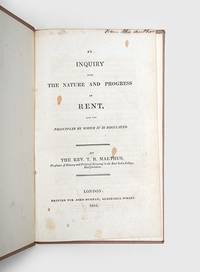
1815168217London: for John Murray; 1815. A major contribution to rent theory First edition first issue presentation copy inscribed in a secretarial hand "from the author" on the title page. The pamphlet is the first expression of Malthus's view for which he is credited as among the founders of the classical theory of rent. "Together with the population principle the theory of rent was one of the chief ideas contributed by Malthus to the re-evaluation of Smith's political economy which took place during the first decades of the nineteenth century" Winch p. 349. Malthus developed the idea from his lectures while professor of history and political economy at the East India College. Its publication grew out of a private debate between Malthus and Ricardo. In response Ricardo expounded on Malthus's ideas and their synthesis was the basis of English thought on rent for the rest of the century. The second issue names J. Johnson and Co. in the imprint. Provenance: with the bookplate of the Dutch economist Arnold Heertje 1934-2020. Octavo 207 x 127 mm pp. iv 62. Twentieth-century pink paper boards red morocco label to spine. Superficial split to front joint contents spotted. A good copy. Black 2877; Einaudi 3673; Goldsmiths' 21130; Hollander 2323; Kress B.6536; McCulloch p. 32. Donal Winch Riches and Poverty 1996. hardcover
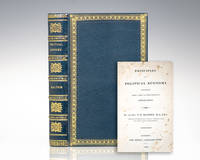
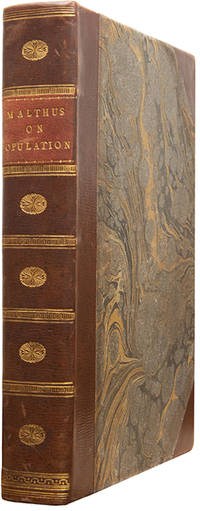
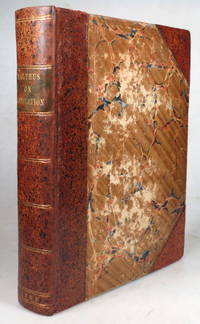
1820143844London: John Murray 1820. Rare first edition of Malthus' classic work. Octavo bound in full diced morocco raised bands gilt titles and tooling to the spine front and rear panels marbled endpapers. In near fine condition. An exceptional presentation. Thomas Malthus was an English economist known for his work in the fields of political economics and demography. His theory that prosperity and production lead not to utopia but to population growth and thereby back to social imbalance known as the "Malthusian trap" was expounded in his Essay on the Principle of Population 1789 one of his most notable and debated works. His Principles of Political Economy was written as a polemic against David Ricardo's On the Principles of Political Economy and Taxation and Say's Law arguing that demand did not grow simultaneously with supply but that they should be analyzed independent of each other expounding ideas which became influential on Keynsian economics. Both these works were divisive incurring backlash and support amongst notable economists. The bleak message of his Principle of Population rendered Malthus a notorious figure: Ebenezer Scrooge from A Christmas Carol for example justifies his refusal to give charity as a Malthusian attempt to control the population. John Murray hardcover
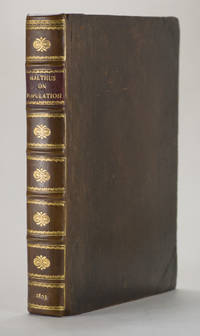
1803156812London: printed for J. Johnson by T. Bensley 1803. A classic of economic thought significantly expanded The Great Quarto edition notionally the second edition of the Essay on Population published in 1798 but so substantially enlarged rewritten and re-titled as to be a new book. "In 1803 Malthus published a greatly expanded second edition of the Essay incorporating details of the population checks that had been in operation in many different countries and periods. Although nominally a second edition it was regarded by Malthus as a substantially new work. He did not claim originality for the idea that population tends to outrun the food supply. In the preface to the second edition he stated that in writing the first edition he had deduced the principle of population from the writings of David Hume Robert Wallace Adam Smith and Richard Price but that in the intervening period he had become aware that much more had been published on the subject. He nevertheless believed that even more remained to be done especially in describing the means by which populations are checked and in drawing out the practical implications of the principle of population. In the second edition he made clear what was only implicit in the first that prudential restraint should if humanly possible be 'moral restraint' - that is delayed marriage accompanied by strictly moral pre-marital behaviour although he admitted that moral restraint would not be easy and that there would be occasional failures. Whereas in the first edition he had said that all the checks to population would involve either misery or vice in the second edition he attempted to lighten this 'melancholy hue' Essay on the Principle of Population 1st edition 1798 p. iv and 'to soften some of the harshest conclusions of the first essay' 2nd edition 1803 p. vii by arguing that moral restraint if supported by an education emphasizing the immorality of bringing children into the world without the means of supporting them would tend to increase rather than diminish individual happiness" ODNB. Quarto. Uncut in the original boards manuscript lettering to spine. Housed in a custom solander box with red label. Neat 20th-century ownership label to front pastedown. Joints and corners worn some expert reconsolidation to binding horizontal tear to head of title neatly repaired without loss and short vertical tear to lower margin of the same; a very good copy. Einaudi 3668; Goldsmiths' 18640; Kress B.4701. hardcover
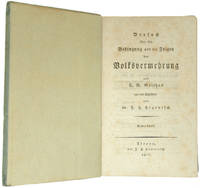
180731326Altona, J.F. Hammerich, 1807. 8vo. Bound in the two orig. blue cardboardbindings. The backs have been professionally restored, preserving the orig. printed paper title-labels and cont. paper library-labels at lower backs. Occasional brownspotting due to the paper-quality, but all in all a very nice and attractive copy. XVI, (4), 368" VIII, 358, (1) pp. Some of the first leaves of the ""Erstes Buch"" in the first volume have been misbound, but are all present.
180731326Altona J.F. Hammerich 1807. 8vo. Bound in the two orig. blue cardboardbindings. The backs have been professionally restored preserving the orig. printed paper title-labels and cont. paper library-labels at lower backs. Occasional brownspotting due to the paper-quality but all in all a very nice and attractive copy. XVI 4 368; VIII 358 1 pp. Some of the first leaves of the "Erstes Buch" in the first volume have been misbound but are all present. <br/><br/><em>Rare first German edition of this political and economic classic which constitutes Malthus' first major publication and his main work because of which he is considered the father of demography and one of the main sources of inspiration for Darwin and Wallace. It is the first translation of the "Principle on Population" into any language and it influenced German politics tremendously.The first edition was printed anonymously in London in 1798 and in 1803 the second edition which also according to Malthus himself can be said to constitute a new work appeared; -the great quarto edition from 1803 is thoroughly revised and much enlarged the title has been changed and Malthus' name appears on the title-page for the first time it is on this edition that all the preceding editions are based and in consequence also the early translations. All the later editions were minor revisions of the second one. In 1806 the third edition appeared and as soon as 1807 the first German one which is translated from the revised third edition "Die gegenwärtige Uebersetzung ist nach der dritten Ausgabe Oktav London 1806. Die Quartausgabe ist minder vollständig" Vorwort p. V. New revisions of the text kept appearing till the sixth edition in 1826. The book then as now is considered highly controversial and it has influenced all demographers ever since as well as being of immense importance to the study of economic theory and genetic inheritance. "The "Essay" was highly influential in the progress of thought in the early nineteenth-century Europe. "Parson" Malthus as Cobbett dubbed him was for many a monster and his views were often grossly misinterpreted. But his influence on social policy whether for good or evil was considerable. The Malthusian theory of population came at the right time to harden the existing feeling against the Poor Laws and Malthus was a leading spirit behind the Poor Law Amendment Act of 1834." PMM 251.Thomas Robert Malthus 1766-1834 called the "enfant terrible" of the economists was an English demographer statistician and political economist who is best known for his groundbreaking views on population growth presented in his "Essays on the Principle of Population" which is based on his own prediction that population would outrun food supply causing poverty and starvation. Among other things this caused the legislation which lowered the population of the poor in England. Malthus actually turned political economic and social thought upside down with this work which has caused him to be considered one of the 100 most influential persons in history Hart The 100: A Ranking of the most Influential Persons in History 1978. Of course he was condemned by Marx and Engels and opposed by the socialists universally but the work was of immense impact on not only politics economics social sciences etc but also on natural sciences. "Later in the "Origin of Species" he Darwin wrote that the struggle for existence "is the doctrine of Malthus applied with manifold force to the whole animal and vegetable kingdoms; for in this case there can be no artificial increase of food and no prudential restraint from marriage" p. 63. Alfred Russel Wallace who arrived at a worked-out formulation of the theory of evolution at almost precisely the same time as Darwin acknowledged that "perhaps the most important book I read was Malthus's "Principles of Population" My Life p. 232. Although there were four decennial censuses before Malthus' death he did not himself analyze the data although he did influence Lambert Quetelet and Pierre Verhulst who made precise statistical studies on growth of populations in developed countries and showed how the early exponential growth changed to an S curve." DSB IX p. 69. As Malthus realized that his theories were not satisfactorily presented or sufficiently demonstrated in the first edition from 1798 he travelled for three years through Europe gleaning statistics and then published the second edition in 1803. Among other places he travelled through Northern Germany and his detailed diaries of these journeys provided him with some of the evidence necessary for the development of his theory on population growth. The observational information that he gathered on his travels in Europe were crucial to the development of his theories which also means that the work is of great interest for other European countries and not only Britain. "In 1819 the Royal Society elected Malthus to a fellowship. He was also a member of the French Institute and the Berlin Academy and a founding member of the Statistical Society 1834." DSB IX p. 67. Printing and the Mind of Man 251 first edition. </em> unknown
1820884511London: 1820. Some light foxing to the title page otherwise a superior copy in the original papercovered boards with paper spine label. Malthus' Principles of Political Economy did not have its full impact on economic theory until it was revived by J.M. Keynes and P. Sraffa in the twentieth century. Math and technology aside Malthus argues not that society tends toward cannibalistic starvation but that either society will "preventatively" control its population or nature will "correctively" reduce population"Several philosophers and speculatists had supposed that a certain state of society very different from any that has hitherto existed was in itself practicable; and that if it were realised it would be productive of a far greater degree of human happiness than is compatible with the present institutions of society."21 Malthus' argument as stated by Hazlitt is that if man were to give up his existing social institutions then there would be as much bad as good come of it. "For says Mr Malthus though this improved state of society were actually realized it could not possibly continue but must soon terminate in a state of things pregnant with evils for more insupportable than any we at present endure.". First Edition. Contemporary Blue Cloth. Excellent. 8vo. Hardcover
182066825"If Only Malthus Instead of Ricardo Had Been the Parent Stem From Which Nineteenth-Century Economics Proceeded What a Much Wiser and Richer Place the World Would be Today" MALTHUS Thomas Robert. Principles of Political Economy. Considered with a View to Their Practical Application. London: John Murray 1820. First edition. Octavo. vi 12-601602. Original boards uncut. With original paper label on spine. Hinges expertly and almost invisibly repaired. Old bookplate from "The Library of Victoria" with no other library markings. A very clean copy internally fine. Very scarce in original boards. Housed in a custom quarter black morocco clamshell gilt-stamped. First edition of Malthus' principal contribution to economic theory. Schumpeter describes Malthus' work in relation to that of his predecessors Adam Smith and Ricardo as follows: "Ricardo's work.started with the Wealth of Nations and recoined the latter's theoretical contents by a method that centered in the concept of value. Exactly the same thing is evidently true of the work of Malthus.except for his theory of saving and investment which on the face of it seems to be Malthus's own all the elements that enter into the analytic apparatus of that work and even its terminological arrangements point to the First book of the Wealth of Nations. Only whereas Ricardo recoined the doctrine of Wealth by means of the labor-quantity theory of value Malthus recoined it by the means of the theory of value that A. Smith actually used namely the theory of supply and demand.whereas Ricardo's analytic apparatus is geared to the problem of distribution.Malthus. geared his apparatus to the analysis of the whole economic process.Therefore Malthus should.stand in the history of analysis not only as the author of a valid alternative to Ricardo's theory but as the sponsor or rather as one of the sponsors of the victorious one." "Although Malthus is best known for the views on population contained in his Essay on Population.there can be no doubt that his importance for economists today rests mainly on his Principles of Political Economy 1820. It was because of the latter work that J. M. Keynes reinstated Malthus as a major figure in modern economic thought". New Palgrave. Cress C577. HBS 66825. $7500 John Murray hardcover books
1803143843London: T. Bensley 1803. Rare second edition of this cornerstone text of modern economics. Quarto bound in full diced morocco raised bands gilt titles and tooling to the spine front and rear panels marbled endpapers. In very good condition. An exceptional presentation. “Malthus was one of the founders of modern economics. His Essay was originally the product of a discussion on the perfectibility of society with his father who urged him to publish. Thus the first edition published anonymously was essentially a fighting tract but later editions were considerably altered and grew bulkier as Malthus defended his views against a host of critics… The Essay was highly influential in the progress of thought in early 19th-century Europe and his influence on social policy was considerable… Both Darwin and Wallace clearly acknowledged Malthus as a source of the idea of ‘the struggle for existence†PMM 251. T. Bensley hardcover
182734205London: John Murray 1827. First edition 8vo pp. viii 261 2; original blue paper-covered boards printed paper label on spine; a little cracking of the paper along the front joint else a very good copy in a quarter green morocco slipcase. This is Malthus's last major work. In it he criticises a number of classical economists including Smith Say Ricardo and McCulloch. Say is given particular attention over the idea of value. Malthus then offers his own definitions of 70 economic concepts. "A valiant attempt to resolve differences of opinion in political economy by codifying its terminology and establishing rules for the definition of terms. It could be regarded as one of the earliest works on the methodology of economics" ODNB. The Vander Poel copy; engraved amorial bookplate of Theodore L. Harrison on rear pastedown. Kress C. 1924. NCBEL III 1294. Palgrave II p.677. <br/><br/> John Murray hardcover books
112135London T. Bensley for J. Johnson 1803. . Second edition substantially revised; 4to 27.5 x 22 cm; a few pencil annotations C4 cancelled and signed C3 title neatly tipped on to following leaf small chip lower edge b2 occasional spotting; modern half brown morocco gilt spine in 6 compartments contrasting red morocco lettering-piece very good; viii 4 610pp.<br /> The second edition substantially revised and in essence a 'new work' in which Malthus defends his views against a host of critics Preface.<br /><br />'The central idea of the essay and the hub of Malthusian theory was a simple one. The population of a community Malthus suggested increases geometrically while food supplies increased only arithmetically. If the natural increase in population occurs the food supply becomes insufficient and the size of the population is checked by 'misery' that is the poorest sections of the community suffer disease and famine. The Essay was highly influential in the progress of thought in early nineteenth-century Europe' PMM.<br /><br />In this enlarged edition Malthus made clear what was only implicit in the first that prudential restraint should if humanly possible be 'moral restraint' that is delayed marriage accompanied by strictly moral pre-marital behaviour although he admitted that moral restraint would not be easy and that there would be occasional failures. Whereas in the first edition he had said that all the checks to population would involve either misery or vice in the second edition he attempted to lighten this 'melancholy hue' first edition p.iv and 'to soften some of the harshest conclusions of the first essay' second edition p.vii by arguing that moral restraint if supported by an education emphasising the immorality of bringing children into the world without the means of supporting them would tend to increase rather than diminish individual happiness.<br /><br />'His work was an important influence on both Darwin and Wallace in their formulation of the concept of natural selection. It also had a profound influence on the decrease in size of families down to the present time' Garrison-Morton.<br /> Cf.PMM 251; Garrison-Morton 1693; Goldsmiths 18640; Kress B.4701. London, T. Bensley for J. Johnson, 1803. unknown
180345495London: Printed for J. Johnson by T. Bensley 1803. Second enlarged edition. Large 4to pp. viii 3contents 1errata 610. Bound in contemporary full calf rebacked at an early time with the original spine laid down. Ownership signature on the endpaper of "N.W. Ridley Colborne" on the endpaper and "Horace W. Baddle 1859" on the top of the title page. Some light intermittant spotting and staining but a nice clean copy with wide margins. Garrison-Morton 1693; Carpenter XXXII 2; Einaudi 3668; Goldsmiths' 18640; Kress B.4701; Mattioli 2207 See Printing and the Mind of Man # 251. The great quarto edition of Malthus' masterpiece a very important work in the field of economics and a source of Darwin's "idea of 'the struggle for existence'" PMM The ReverendThomas Robert Malthus FRS 1766 - 1834 was a British scholar influential in political economy and demography. He has become widely known for his theories concerning population and its increase or decrease in response to various factors. The six editions of his Principles of Population published from 1798 to 1826 observed that sooner or later population gets checked by famine disease and widespread mortality. The central idea is a simple one: that population expands geometrically while food production grows arithmetically. This edition though being the second may be considered as a new work which Malthus himself also claimed; -it is thoroughly revised and much enlarged nearly four times the length of the original essay the title has been changed the title of the first is merely: "An Essay on the Principle of Population as it Affects the Future Improvement of Society with Remarks on the Speculation of Mr. Godwin M. Condorcet and Other Writers" He notes: "In the course of this inquiry I found that much more had been done than I had been aware of when I first published the essay. The poverty and misery arising from a too rapid increase of population had been distinctly seen and the most violent remedies proposed so long ago as the times of Plato and Aristotle. And of late years the subject had been treated in such a manner by some of the French economists occasionally by Montesquieu and among our own writers by Dr. Franklin Sir James Steuart Mr. Arthur Young and Mr. Townsend as to create a natural surprise that it had not excited more of the publick attention" Preface to the second edition p. IV. "The "Essay" was highly influential in the progress of thought in the early nineteenth-century Europe. "Parson" Malthus as Cobbett dubbed him was for many a monster and his views were often grossly misinterpreted. But his influence on social policy whether for good or evil was considerable. The Malthusian theory of population came at the right time to harden the existing feeling against the Poor Laws and Malthus was a leading spirit behind the Poor Law Amendment Act of 1834." PMM 251. Printed for J. Johnson, by T. Bensley unknown books
180365276The Economics of Population MALTHUS Thomas Robert. An Essay on the Principle of Population; Or a view of its past and present effects on Human Happiness; With an Inquiry into our prospects respecting the future removal or mitigation of the evils which it occasions. A new edition very much enlarged. London: Printed for J. Johnson. by T. Bensley 1803. Second edition enlarged and revised. Quarto. viii 4 610 pp. Contemporary calf skillfully rebacked to style and with corners renewed. Spine decoratively tooled in gilt compartments with burgundy morocco gilt lettering label. Endpapers renewed. Occasional light foxing. Title-page with publisher's diagonal paper flaw crease. Overall very good. A completely revised and greatly expanded edition of the most influential work on population ever written. Malthus published the first edition of his Essay in 1798 and was apparently unprepared for the torrent of controversy that his ideas provoked. His response to the public outcry was to spend the next five years refining and expanding his theories for this second edition so much so that "in its present shape it may be considered a new work and I should probably have published it as such omitting the few parts of the former which I have retained but that I wished it to form a whole of itself and not to need a continual reference to the other." preface Malthus' basic argument--that population increases geometrically at a greater rate than does the means of subsistence which increases arithmetically--was one of the earliest modern economic and social theories and his contention that it would eventually become necessary for society to impose some form of restraint on over-population provided the premise for heated socio-economic debate for almost two centuries. Kress B4701. See Printing and the Mind of Man 251. HBS 65276. $6500 Printed for J. Johnson...by T. Bensley unknown books
180321446London: Printed for J. Johnson by T. Bensley 1803. Book. Very Good. Full Leather. Second Edition. Large Quarto. 26.5 cm x 21 cm. Pp. viii 3 contents 1 errata 610. Bound in contemporary diced calf bordered by double gilt rules artfully rebacked to style with corners restored spine divided into 6 compartments with central blind-stamped ornaments flanked by narrow gilts rules dog tooth rolls and dotted lines between raised bands gilt titled direct marbled endpapers speckled edges. Endpapers and title a bit foxed title and facing blank with brown spotting to inner margin almost certainly caused by pressed foliage but otherwise a very clean copy internally with only an occasional hint of marginal foxing in a handsome and well-preserved binding. The Second Edition known as the Great Quarto Edition of Malthus's famous treatise on population. This edition was so substantially revised and enlarged from the anonymously published essay of 1798 that the author himself considered it almost a new work. The original essay was essentially a polemical tract designed as a corrective to the utopian views of Condorcet and Godwin regarding the perfectibity of society. Malthus argued that progress of society will always be hindered by the tendency of the population to increase faster than the means of subsistence. While populations increase geometrically food production only increases arithmetically resulting in hardship and starvation for the lowest ranks of society. In the vastly enlarged 1803 edition the product of five years of research and travel on the European continent Malthus addresses the many misconceptions and criticisms of his original essay by presenting a far more thorough and balanced statement of his views. He begins the work with a lengthy historical analysis of the working out of his theory in many different types of societies throughout the world from ancient times to the present. By fleshing out his ideas with factual examples he claims to give his work in his own words "a more practical and permanent interest". As the extended title of the second edition indicates the last half of Malthus's work is devoted to an issue barely touched upon in the earlier essay namely the measures and expedients that may be taken by society to mitigate or eliminate the suffering resulting from population pressures. Here he softens the harshness of his original conclusion that the only checks on population consist in "misery or vice" i.e. famine and disease or homosexuality and abortion by proposing a number of preventive measures that should be taken in the form of education for the lower classes reform of the poor laws and "moral restraint" i.e. abstinence and delayed childbearing in order to avoid the ruinous consequences of over-population. Malthus's theory of population though later qualified by technological advances in food production and birth control remains one of the most influential works in the history of social and economic thought. Most importantly it served to call public attention to population as a major factor in the progress of civilisation and through its emphasis on social competition for scarce resources "the struggle for existence" provided the critical impetus for Darwin and Wallace's theory of natural selection. PMM 25 1 cf. 1st edition. Printed for J. Johnson, by T. Bensley Hardcover
180365276London: Printed for J. Johnson.by T. Bensley 1803. The Economics of Population<br> <br> MALTHUS Thomas Robert. An Essay on the Principle of Population; Or a view of its past and present effects on Human Happiness; With an Inquiry into our prospects respecting the future removal or mitigation of the evils which it occasions. A new edition very much enlarged. London: Printed for J. Johnson. by T. Bensley 1803.<br> <br> Second edition enlarged and revised. Quarto. viii 4 610 pp.<br> <br> Contemporary calf skillfully rebacked to style and with corners renewed. Spine decoratively tooled in gilt compartments with burgundy morocco gilt lettering label. Endpapers renewed. Occasional light foxing. Title-page with publisher's diagonal paper flaw crease. Overall very good.<br> <br> A completely revised and greatly expanded edition of the most influential work on population ever written. Malthus published the first edition of his Essay in 1798 and was apparently unprepared for the torrent of controversy that his ideas provoked. His response to the public outcry was to spend the next five years refining and expanding his theories for this second edition so much so that "in its present shape it may be considered a new work and I should probably have published it as such omitting the few parts of the former which I have retained but that I wished it to form a whole of itself and not to need a continual reference to the other." preface<br> <br> Malthus' basic argument--that population increases geometrically at a greater rate than does the means of subsistence which increases arithmetically--was one of the earliest modern economic and social theories and his contention that it would eventually become necessary for society to impose some form of restraint on over-population provided the premise for heated socio-economic debate for almost two centuries.<br> <br> Kress B4701. See Printing and the Mind of Man 251.<br> <br> HBS 65276.<br> <br> $6500. Printed for J. Johnson...by T. Bensley unknown
182066825London: John Murray 1820. If Only Malthus Instead of Ricardo Had Been the Parent Stem From Which<br> <br> Nineteenth-Century Economics Proceeded What a Much Wiser<br> <br> and Richer Place the World Would be Today"<br> <br> MALTHUS Thomas Robert. Principles of Political Economy. Considered with a View to Their Practical Application. London: John Murray 1820.<br> <br> First edition. Octavo. vi 12-601602.<br> <br> Original boards uncut. With original paper label on spine. Hinges expertly and almost invisibly repaired. Old bookplate from "The Library of Victoria" with no other library markings. A very clean copy internally fine. Very scarce in original boards. Housed in a custom quarter black morocco clamshell gilt-stamped.<br> <br> First edition of Malthus' principal contribution to economic theory. Schumpeter describes Malthus' work in relation to that of his predecessors Adam Smith and Ricardo as follows: "Ricardo's work.started with the Wealth of Nations and recoined the latter's theoretical contents by a method that centered in the concept of value. Exactly the same thing is evidently true of the work of Malthus.except for his theory of saving and investment which on the face of it seems to be Malthus's own all the elements that enter into the analytic apparatus of that work and even its terminological arrangements point to the First book of the Wealth of Nations. Only whereas Ricardo recoined the doctrine of Wealth by means of the labor-quantity theory of value Malthus recoined it by the means of the theory of value that A. Smith actually used namely the theory of supply and demand.whereas Ricardo's analytic apparatus is geared to the problem of distribution.Malthus. geared his apparatus to the analysis of the whole economic process.Therefore Malthus should.stand in the history of analysis not only as the author of a valid alternative to Ricardo's theory but as the sponsor or rather as one of the sponsors of the victorious one."<br> <br> "Although Malthus is best known for the views on population contained in his Essay on Population.there can be no doubt that his importance for economists today rests mainly on his Principles of Political Economy 1820. It was because of the latter work that J. M. Keynes reinstated Malthus as a major figure in modern economic thought". New Palgrave. Cress C577.<br> <br> HBS 66825.<br> <br> $6500. John Murray unknown
1803924F45DLondon: J. Johnson by T. Bensley 1803. Leather. Very Good. 11" by 9". None. The important and heavily revised second edition of Thomas Robert Malthus's discussion of the problems of a growing human population. First published in 1798 this is the substantially revised enlarged and re-written second edition of Malthus's important work.Malthus's work - which posits that the human population will outgrow the supply of food and resources - fuelled the debate on the size of the British population and contributed to the passion of the Census Act of 1800.A key argument within the book was dedicated to what is now known as the Malthusian Law of Population theorising that growing population rates will lead to a rising supply of labour inevitably lowering wages and leading to poverty.With the armorial bookplate of James Frampton to the front pastedown along side the former owner's ink inscription of N.B. Hobbs. Hobbs's inscription is also present to the recto of a front blank.This second edition incorporated details of population controls that had been used in various countries and periods. In a contemporary calf binding with light rubbing to boards. Minor loss to tail of spine label. Hinges neatly repaired. Retaining the original endpapers. Bookplate and inscription to front pastedown with further inscription to a front blank. Internally firmly bound. Significant spotting to endpapers and to first and final leaves. Pages bright with scattered further areas of concentrated spotting throughout. Very Good J. Johnson, by T. Bensley hardcover
1803182784London: printed for J. Johnson by T. Bensley 1803. Malthus softens his conclusions The Great Quarto edition notionally the second edition following the first of 1798 but so substantially enlarged rewritten and re-titled as to be effectively a new book. The Essay was one of the most influential works in the history of economic thought arguing the link between food supply and population size and the inevitability of famine and suffering once population exceeded its limits. "For today's readers living in a post-Malthus era the world's population problems are well known and serious but no longer sensational. It is difficult therefore to appreciate the radical and controversial impact made by the Essay at the time of publication. It challenged the conventional notion that population growth is an unmixed blessing. It discussed prostitution contraception and other sexual matters. And it gave vivid descriptions of the horrendous consequences of overpopulation and of the brutal means by which populations are checked" ODNB. In the second edition Malthus "made clear what was only implicit in the first that prudential restraint should if humanly possible be 'moral restraint' - that is delayed marriage accompanied by strictly moral pre-marital behaviour although he admitted that moral restraint would not be easy and that there would be occasional failures. Whereas in the first edition he had said that all the checks to population would involve either misery or vice in the second edition he attempted to lighten this 'melancholy hue' and 'to soften some of the harshest conclusions of the first essay' by arguing that moral restraint if supported by an education emphasizing the immorality of bringing children into the world without the means of supporting them would tend to increase rather than diminish individual happiness" ODNB. Quarto 269 x 205 mm pp. viii 4 610. Contemporary tree calf rebacked and recornered with original spine laid down spine gilt in compartments with black morocco label. Twentieth-century bookplate of Virginia bibliophile and historian Christopher Clark Geest. Scattered light foxing else a very good copy. Einaudi 3668; Goldsmiths' 18640; Kress B.4701. unknown
180345423London: Printed for J. Johnson. by T. Bensley. 1803. Second edition or "A New Edition Very Much Enlarged". 4to. viii iv 610 pp. 19th century half speckled calf over marbled boards gilt rules to the spine gilt lettered green label all edges marbled. Binding expertly resewn and the joints neatly repaired occasional foxing mostly mild an attractive copy. First published anonymously in 1798 Malthus drew upon the works of Hume and Smith amongst others to explain his conservative conception of population control. "The central idea of the essay. was a simple one. The population of a community. increases geometrically while food supplies increase only arithmetically. The 'Essay' was highly influential in the progress of thought in early 19th century Europe. it came at the right time to harden the existing feeling against the Poor Laws" - Printing and the Mind of Man 251. Citing examples from other societies and sources not hitherto known to him Malthus rewrote and extended his essay significantly enough for him to consider this an entirely "new work" in his introduction to this edition. He expanded and refined his theory of positive checks on population growth those that increase the death rate and negative ones those that inhibit birth rates slightly softening his tone by arguing for greater moral restraint as opposed to the bleaker and cruder mechanisms of hunger disease and war to keep population numbers down and therefore keep overall prosperity up. Despite being hugely influential in economic and philosophical terms Malthus has always been a divisive figure and his arguments remain controversial to this day. London: Printed for J. Johnson... by T. Bensley... unknown
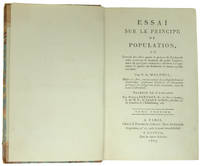
180931327Paris & Genève, Chez J.J. Paschoud, 1809. 8vo. Bound in three nice uniform cont. hcalfbdgs. w. gilt backs, red leather title-labels w. gilt lettering and gilt round green tome-labels on backs. Capitals w. a bit of wear. Internally nice and clean. W. half-titles in all three volumes and advertisement-leaf in vol. one. XIII, (1), 424, (5) (6), 395, (1) (4), 392 pp.
180931327Paris & Genève Chez J.J. Paschoud 1809. 8vo. Bound in three nice uniform cont. hcalfbdgs. w. gilt backs red leather title-labels w. gilt lettering and gilt round green tome-labels on backs. Capitals w. a bit of wear. Internally nice and clean. W. half-titles in all three volumes and advertisement-leaf in vol. one. XIII 1 424 5; 6 395 1; 4 392 pp. <br/><br/><em>First French edition of this political and economic classic which constitutes Malthus' first major publication and his main work because of which he is considered the father of demography and the main source of inspiration of Darwin and Wallace.The first edition was printed anonymously in London in 1798 and in 1803 the second edition which also according to Malthus himself can be said to constitute a new work appeared; -the great quarto edition from 1803 is thoroughly revised and much enlarged the title has been changed and Malthus' name appears on the title-page it is on this edition that all the preceding editions are based and in consequence also the early translations. All the later editions were minor revisions of the second one. In 1807 the fourth edition appeared and in 1809 the first French one which is translated from the revised fourth edition "A la suite de cette préface on trouve dans la 4.e édition sur laquelle je traduis une notice de tous les changements que la 3.e édition a apportés à la 2.e. Le plus considérable est celui qui a rapport à l'estimation de la fécondité des mariages. Il est absolument inutile pour les lecteurs francois de connoître le détail minutieux des autres changemens qui ne peuvent intéresser que les acquéreurs des précédentes éditions. P.P.p" Préface p. xxiij. New revisions of the text kept appearing till the sixth edition in 1826.The book then as now is considered highly controversial and it has influenced all demographers ever since as well as being of immense importance to the study of economic theory and genetic inheritance. "The "Essay" was highly influential in the progress of thought in the early nineteenth-century Europe. "Parson" Malthus as Cobbett dubbed him was for many a monster and his views were often grossly misinterpreted. But his influence on social policy whether for good or evil was considerable. The Malthusian theory of population came at the right time to harden the existing feeling against the Poor Laws and Malthus was a leading spirit behind the Poor Law Amendment Act of 1834." PMM 251.Thomas Robert Malthus 1766-1834 called the "enfant terrible" of the economists was an English demographer statistician and political economist who is best known for his groundbreaking views on population growth presented in his "Essays on the Principle of Population" which is based on his own prediction that population would outrun food supply causing poverty and starvation. Among other things this caused the legislation which lowered the population of the poor in England. Malthus actually turned political economic and social thought upside down with this work which has caused him to be considered one of the 100 most influential persons in history Hart The 100: A Ranking of the most Influential Persons in History 1978. Of course he was condemned by Marx and Engels and opposed by the socialists universally but the work was of immense impact on not only politics economics social sciences etc but also on natural sciences. "Later in the "Origin of Species" he Darwin wrote that the struggle for existence "is the doctrine of Malthus applied with manifold force to the whole animal and vegetable kingdoms; for in this case there can be no artificial increase of food and no prudential restraint from marriage" p. 63. Alfred Russel Wallace who arrived at a worked-out formulation of the theory of evolution at almost precisely the same time as Darwin acknowledged that "perhaps the most important book I read was Malthus's "Principles of Population" My Life p. 232. Although there were four decennial censuses before Malthus' death he did not himself analyze the data although he did influence Lambert Quetelet and Pierre Verhulst who made precise statistical studies on growth of populations in developed countries and showed how the early exponential growth changed to an S curve." DSB IX p. 69.As Malthus realized that his theories were not satisfactorily presented or sufficiently demonstrated in the first edition from 1798 he travelled for three years through Europe gleaning statistics and then published the second edition in 1803. Among other places he travelled through France and Switzerland in 1802 and his detailed diaries of these journeys provided him with some of the evidence necessary for the development of his theory on population growth. The observational information that he gathered on his travels in Europe were crucial to the development of his theories which also means that the work is of great interest for other European countries and not only Britain. "In 1819 the Royal Society elected Malthus to a fellowship. He was also a member of the French Institute and the Berlin Academy and a founding member of the Statistical Society 1834." DSB IX p. 67. Printing and the Mind of Man 251 </em> hardcover
180736928Altona, J.F. Hammerich, 1807. 8vo. Bound in the two nice cont. uniform cardboardbindings w. marbled paper. Gilt lines and gilt title-labels to spines. Some wear w. minor loss of paper to capitals, hinges and corners. Small hole to paper as well as to leather title-label of spine of volume two. Some brownspotting, but overall a nice and atrractive copy. Lacking the half-tilte for the first book (merely stating ""Erstes Buch""). XVI, 368"" VIII, 358, (1) pp.
180736928Altona J.F. Hammerich 1807. 8vo. Bound in the two nice cont. uniform cardboardbindings w. marbled paper. Gilt lines and gilt title-labels to spines. Some wear w. minor loss of paper to capitals hinges and corners. Small hole to paper as well as to leather title-label of spine of volume two. Some brownspotting but overall a nice and atrractive copy. Lacking the half-tilte for the first book merely stating "Erstes Buch". XVI 368; VIII 358 1 pp. <br/><br/><em>Rare first German edition of this political and economic classic which constitutes Malthus' first major publication and his main work because of which he is considered the father of demography and one of the main sources of inspiration for Darwin and Wallace. It is the first translation of the "Principle on Population" into any language and it influenced German politics tremendously.The first edition was printed anonymously in London in 1798 and in 1803 the second edition which also according to Malthus himself can be said to constitute a new work appeared; -the great quarto edition from 1803 is thoroughly revised and much enlarged the title has been changed and Malthus' name appears on the title-page for the first time it is on this edition that all the preceding editions are based and in consequence also the early translations. All the later editions were minor revisions of the second one. In 1806 the third edition appeared and as soon as 1807 the first German one which is translated from the revised third edition "Die gegenwärtige Uebersetzung ist nach der dritten Ausgabe Oktav London 1806. Die Quartausgabe ist minder vollständig" Vorwort p. V. New revisions of the text kept appearing till the sixth edition in 1826. The book then as now is considered highly controversial and it has influenced all demographers ever since as well as being of immense importance to the study of economic theory and genetic inheritance. "The "Essay" was highly influential in the progress of thought in the early nineteenth-century Europe. "Parson" Malthus as Cobbett dubbed him was for many a monster and his views were often grossly misinterpreted. But his influence on social policy whether for good or evil was considerable. The Malthusian theory of population came at the right time to harden the existing feeling against the Poor Laws and Malthus was a leading spirit behind the Poor Law Amendment Act of 1834." PMM 251.Thomas Robert Malthus 1766-1834 called the "enfant terrible" of the economists was an English demographer statistician and political economist who is best known for his groundbreaking views on population growth presented in his "Essays on the Principle of Population" which is based on his own prediction that population would outrun food supply causing poverty and starvation. Among other things this caused the legislation which lowered the population of the poor in England. Malthus actually turned political economic and social thought upside down with this work which has caused him to be considered one of the 100 most influential persons in history Hart The 100: A Ranking of the most Influential Persons in History 1978. Of course he was condemned by Marx and Engels and opposed by the socialists universally but the work was of immense impact on not only politics economics social sciences etc but also on natural sciences. "Later in the "Origin of Species" he Darwin wrote that the struggle for existence "is the doctrine of Malthus applied with manifold force to the whole animal and vegetable kingdoms; for in this case there can be no artificial increase of food and no prudential restraint from marriage" p. 63. Alfred Russel Wallace who arrived at a worked-out formulation of the theory of evolution at almost precisely the same time as Darwin acknowledged that "perhaps the most important book I read was Malthus's "Principles of Population" My Life p. 232. Although there were four decennial censuses before Malthus' death he did not himself analyze the data although he did influence Lambert Quetelet and Pierre Verhulst who made precise statistical studies on growth of populations in developed countries and showed how the early exponential growth changed to an S curve." DSB IX p. 69. As Malthus realized that his theories were not satisfactorily presented or sufficiently demonstrated in the first edition from 1798 he travelled for three years through Europe gleaning statistics and then published the second edition in 1803. Among other places he travelled through Northern Germany and his detailed diaries of these journeys provided him with some of the evidence necessary for the development of his theory on population growth. The observational information that he gathered on his travels in Europe were crucial to the development of his theories which also means that the work is of great interest for other European countries and not only Britain. "In 1819 the Royal Society elected Malthus to a fellowship. He was also a member of the French Institute and the Berlin Academy and a founding member of the Statistical Society 1834." DSB IX p. 67. Printing and the Mind of Man 251 first edition. </em> hardcover