Farolfi BernardinoMareMagnum
Capitalismo europeo e rivoluzione borghese 1798/1815
In 8 (21x14) Legatura in tela con sovracopertina illustrata; pp. XV-413; Molto buono

Booklovers.It · Novara, IT20,00 €
542 résultats
19070His Majesty's Receipt of Exchequer London. 9 February no year . 1p. 8vo. In poor condition aged and worn with loss to edges and holing around the signature. Begins with manuscript text in square brackets: 'The -9 Day of ffebry <.> Received by me Daniel Malthus Execd as P Margin Of the Right Honourable Robert Earl of Northampton One of the Four Tellers of His Majesty's Receipt of Exchequer the Sum of Fifty Pounds .'. The annuity has been raised on 'Rates and Duties upon all Wines imported into Great Britain and for raising a certain Sum of Money for the Service of the year 1745'. According to T. R. Malthus's entry in the Oxford DNB his father 'being an only son of seven children appears to have inherited considerable wealth and property and these independent means enabled him to travel and to cultivate his literary artistic theatrical and scientific interests. He entered Queen's College Oxford in 1747 but did not graduate. He was an admirer of Rousseau who once visited The Rookery when Malthus was an infant. He was said to have published some literary pieces anonymously but the statement by an obituarist that he had translated works from French and German was firmly contradicted by Malthus. He supported the views of the marquis de Condorcet and William Godwin on the perfectibility of mankind but also encouraged his son's publication of opposing views. Aspects of his behaviour—for example the unconventional education he chose for Malthus and his refusal to allow his wife to wear her wedding ring—were regarded as eccentric and perhaps show the influence of Rousseau. He married on 6 May 1752 Henrietta Catherine Graham 1733–1800 his second cousin the daughter of Daniel Graham 1695–1778 apothecary to George II and George III. She can be seen as a young girl with her brother and two sisters in Hogarth's painting The Graham Children 1742 now in the National Gallery London. Malthus was the sixth of their seven children two boys and five girls. His Majesty's Receipt of Exchequer, London. 9 February [ no year ]. unknown
1769Extrait de la revue "ancienne revue des revue" du 1er décembre 1904. Paris, 1904, Aux bureau de la revue. cousu, 26p, 17x26cm, couv bleue, titre typo noir, non massicoté, e.a.s.
In 8 (21x14) Legatura in tela con sovracopertina illustrata; pp. XV-413; Molto buono
1390024601.Ghardcover. Good. Access codes and supplements are not guaranteed with used items. May be an ex-library book. hardcover
1390024547.Gpaperback. Good. Access codes and supplements are not guaranteed with used items. May be an ex-library book. paperback
In 8, pp. 55 + (1). Timbretto di possesso al p. ant. Mancanza del lembo sup. est. del p. ant. D. rifatto. Qualche alone ai margg. delle cc. Br. ed. Nel saggio l'A. ripercorre le posizioni degli economisti che precedettero Malthus sulla questione demografica connessa allo sviluppo delle risorse produttive (Quesnay, Richetti, Genovesi, Beccaria, Verri, Ortes, Filangieri) per poi soffermarsi sulla dottrina dell'economista inglese.
J. M. Poursin, G. Dupuy Malthus. Bari, Laterza 1974, Copertina cartonata. Tagli sporchi di polvere, pagine leggermente ingiallite. Collana:"Universale Laterza 291". Mediocre (Poor) . <br> <br> <br> 169<br>
126979 May 1827. 'L. I. Fields' i.e. Lincolns Inn Fields London. 2pp. 12mo. 40 lines. Bifolium. Good on aged paper. The reverse of the second leaf carries half of a red wax seal as well as the address to 'James Loch Esqr Bloomsbury Square'. The letter begins: 'My dear Loch Some friends of mine from the Country are desirous of seeing Lord Stafford's & Lord Grosvenor's pictures some time next week; & they understand that the obtaining of Tickets is not a matter of course but that some little interest is necessary.' He asks for assistance 'with regard to Cleveland House . for Mrs Johnston & party about 5 or 6 persons'. He is going 'to the Cambridge Election' on the following day and thinks that it will be 'very keenly contested'. On his return he hopes 'to attend the Council of the London University' when he hopes 'that Horner's business will be finally & satisfactorily settled'. He has heard 'nothing more about Silk Gowns' but 'Willy Brougham . persists in retaining his appointment and will not be scared into resignation like Plunkett by the Chancery Lawyers.' In the last paragraph he deprecates the news that 'Lord Exeter is to have one of the blue Ribbands though he is no friend of Canning's & indeed closely connected with the high Tory opposition'. This is in his view 'one among many instances of C's weakness & entire dependence upon the higher power.' There is no mention of Loch in Lady Seymour's 'The "Pope" of Holland House Selections from the Correspondence of John Whishaw and his Friends 1813-1840' 1906 and the year 1827 is skirted over. 9 May [1827]. 'L. I. Fields' [i.e. Lincolns Inn Fields, London]. unknown
2 works, large 8vo, [4], 39, [1]; 4pp., at the head of the title page of the first work is the contemporary inscription "I paid for 500 for these with the addition of the Malthusian Doctrines", disbound pamphlets. Goldsmiths'-Kress no. 29829 & 30337.
1968B369Berlin, Akademie-Verlag, 1968. Kartoniert, 8°, 288 S., Heft Nr. 27 der »Schriften des Instituts für Wirtschaftswissenschaften«, Inhalt: Die Bevölkerungsbewegung in Geschichte und Theorie - Bürgeliche Theorien - Marxistische Betrachtung der Bevölkerungsentwicklung - Die Überbevölkerung in den Entwickliungsstaaten - Probleme der Bevölkerungsstabilisierung
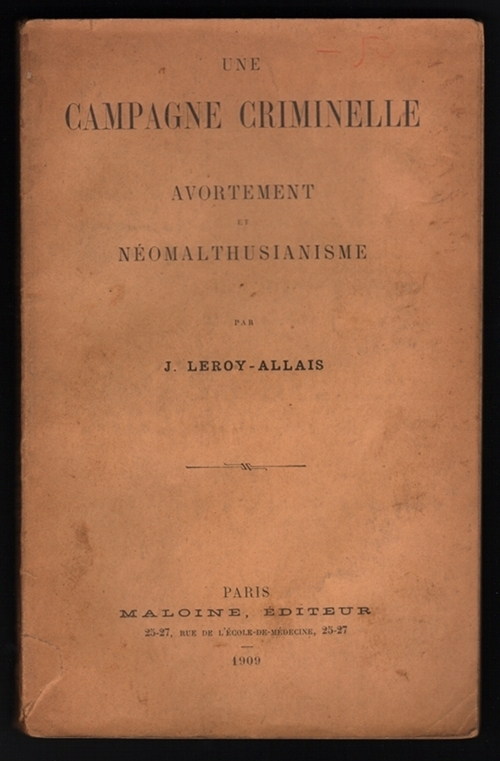
621MALOINE, éditeurs, Paris 1909
Mm 125x195 Brossura cucita di pp. 439, in buono stato. SPEDIZIONE IN 24 ORE DALLA CONFERMA DELL'ORDINE.
In-16 (Cm 17 x 10,5), pp. 78, brossura editoriale, sovracoperta editoriale con titolo entro cornice. Una tavola in antiporta. Collana "Profili, 6 ". Quarta edizione. Qualche lieve ingiallitura sparsa. INTONSO - BUONO
br. Un saggio biografico ricco di spunti su Thomas Robert Malthus. Economista, filosofo, demografo, Malthus è stata una delle figure più importanti vissute a cavallo fra il Settecento e l'Ottocento. Considerato il precursore della moderna sociologia, l'accademico inglese è ricordato per aver individuato come causa della povertà una crescita della popolazione molto più rapida di quella delle risorse.
1820RO30109165J. P. AILLAU. 1820. In-8. Broché. Etat passable, Couv. défraîchie, Dos abîmé, Quelques rousseurs. 501+452 pages. Tome premier : Charnières fendues, Manques coiffes. Tome second : Charnières fendues, coiffes abîmées, couverture défraichie.. . . . Classification Dewey : 330-Economie
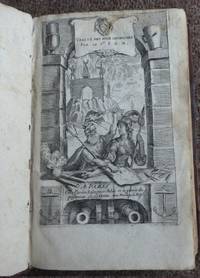
53104<p>Paris Cardin Besogne 1640. TITLE CONTINUED: De nouveau reveu corrige & augmente par l'autheur. 1640 first published in 1629 8vo approximately 170 x 100mm 6¾ x 4 inches French text added engraved pictorial title page of Neptune and Mars fireworks in the background dated 1629 6 full page illustrations 38 text engravings both illustrations and diagrams some decorated initials and headpieces pages: 10 1-277 5 pages 136 and 139 misnumbered 116 and 137 collation: A-S8 T4 T4 a blank bound in contemporary speckled calf raised bands to spine gilt decoration to spine pale red speckling to edges. Binding slightly worn small neat repair to top of spine gilt slightly worn pitting to sides small water stain to top of engraved title a larger one to top of letterpress title see image a very faint small intermittent stain to upper margin throughout very faint half page water stain on S8 - T3 small closed tear to margin of 2 pages neatly repaired very small blank corner missing on S2 verso T3 lightly browned. A very good sturdy copy. Francis Malthus d.1658 of English origin was an engineer in the royal French army and a captain general of mines and sapping. He was responsible for the French use of the mortar beginning in 1634. See: Chris Philip A Bibliography of Firework Books page 91 M 040.5; Spaulding and Karpinski Early Military Books in the University of Michigan Libraries page 19; John Eliot Hodgkin Rariora Volume 3 Books on Fireworks section page 15; Maurice Cockle A Bibliography of Military Books to 1642 page 93 No.118 referring to the English edition of 1629: "This work though in advance of anything so far written on the subject in English does not attain to the standard of Thibourel and Appier. Yet it is with foreign treatises it must be weighed for Malthus received his training in pyrotechnics abroad. It was Malthus who about the year 1634 introduced the mortar into the French service." 4 copies of our 1640 edition listed in Library Hub Discover. MORE IMAGES ATTACHED TO THIS LISTING ALL ZOOMABLE FURTHER IMAGES ON REQUEST. POSTAGE AT COST AND ALL PARCELS SENT FULLY TRACKED AND FULLY INSURED.</p> Paris, Cardin Besogne, 1640. hardcover
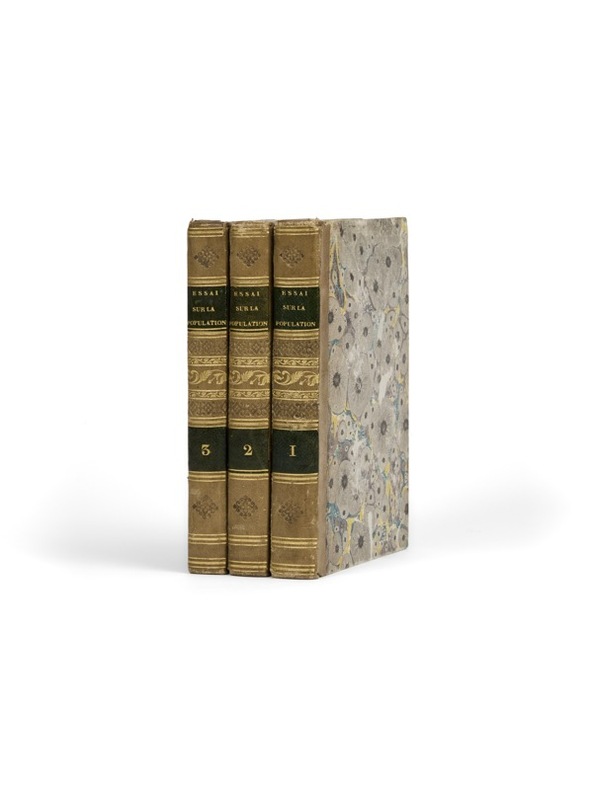
30964Paris & Genève J. J. Paschoud 1809. 3 vol. 120 x 195 mm de 424 395 et 392 p. Demi-veau brun dos ornés de fleurons à froid et roulettes dorées pièces de titre et de tomaison tranches jaunes mouchetées reliure légèrement postérieure. . Édition originale de la traduction française. . Au début des années 1790 le philosophe anglais William Godwin expose un « principe de population ». Réagissant principalement à la thèse alors développée par Godwin Malthus fait alors paraître la première édition de son Essai sur le principe de population un pamphlet qui paraît - anonymement - en 1798. Il y substitue en 1803 ce qui se veut un traité plus scientifique dans lequel il se réfère aussi à quatre autres sources importantes : Of the Populousness of Ancient Nations de David Hume A Dissertation on the Numbers of Mankind de Robert Wallace Observations on Reversionary Payments de Richard Price et An Inquiry into the Nature and Causes of the Wealth of Nations d'Adam Smith. Deux ans après cette parution l'Essai fait l'objet d'une traduction partielle par le Suisse Pierre Prévost qui fut professeur de physique et de philosophie à l'Université de Genève. Certains chapitres sont intégralement traduits tandis que d'autres ne le sont que partiellement. Prévost accompagne sa traduction de notes et commentaires personnels ; encouragé par Malthus il fait paraître en 1809 à Paris et à Genève cette nouvelle édition la première complète donnée d'après la dernière établie par Malthus en 1807 la quatrième édition anglaise. « Malthus m'a même autorisé en conséquence à y faire les changements que j'estimerais nécessaires. Je n'ai pas abusé de cette permission. Je me suis prescrit au contraire de faire connaître l'ouvrage de M. Malthus tel qu'il l'a lui-même publié. L'appendice est la seule partie où j'ai fait des retranchements et quelques modifications sans les indiquer en détail ; parce que les objections que l'auteur y discute m'ont paru quelquefois trop faibles ou trop particulières pour mériter d'être exposées et réfutées dans une traduction avec autant d'étendue qu'elles le sont dans l'original. Mais j'ai supprimé certains morceaux et même des chapitres entiers qui s'écartent un peu du sujet principal ou qui sont trop immédiatement relatifs à l'Angleterre. » « L'Essai du révérend Malthus causa en 1798 un véritable choc idéologique dans une Angleterre en crise traumatisée par la Révolution française. Ce texte contient la première formulation - inchangée dans les cinq éditions suivantes - du principe de population. Avancée fondamentale ce principe affirme que les vitesses de croissance de la population et des subsistances sont très différents la première augmentant plus rapidement que la seconde .» INED préface à l'édition critique de 2017. Son analyse des crises de surproduction l'oppose à Jean-Baptiste Say et en fait un précurseur de Keynes - par l'accent qu'il met sur l'insuffisance de la demande - ce dernier soulignant qu'il est « le premier des économistes de Cambridge ». Rare première traduction française de cette référence majeure dans l'histoire des idées. Bon exemplaire. De la bibliothèque Antoine Larue avec ex-libris. Dirigeant de plusieurs entreprises de l'industrie chimique dans la deuxième partie du XXe siècle sa bibliothèque sera dispersée en 1985 puis 1993 à l'Hôtel Drouot par Claude Guérin. Printing and the Mind of Man n° 251 pour l'édition originale anglaise de 1798 ; Kress B 5591. Paris & Genève, J. J. Paschoud, 1809. 3 vol. (120 x 195 mm) de 424, 395 et 392 p. Demi-veau brun, dos ornés de fleurons à fro unknown
1964RO40084321Mediations. 1964. In-12. Broché. Etat d'usage, Couv. légèrement passée, Dos satisfaisant, Intérieur bon état. 236 pages. Page de titre manquante. Petite tache d'encre sur la tranche.. . . . Classification Dewey : 304.6-Démographie
2010RO30314370Flammarion. 2010. In-8. Broché. Bon état, Couv. convenable, Dos satisfaisant, Intérieur frais. 284 pages.. . . . Classification Dewey : 301-Sociologie
180930964Un des ouvrages les plus influents de l'histoire de la pensée économique Paris & Genève, J. J. Paschoud, 1809. 3 vol. (120 x 195 mm) de 424, 395 et 392 p. Demi-veau brun, dos ornés de fleurons à froid et roulettes dorées, pièces de titre et de tomaison, tranches jaunes mouchetées (reliure légèrement postérieure). Édition originale de la traduction française.
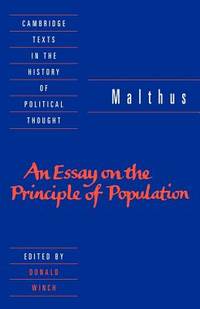
1992Cambridge-9780521429726Cambridge University Press 1992. PAPERBACK. New. Cambridge University Press paperback
1992Cambridge-9780521429726Cambridge University Press 1992. PAPERBACK. New. Cambridge University Press paperback
1969R240009490CALMANN LEVY EDITEUR. 1969. In-12. Broché. Bon état, Couv. convenable, Dos satisfaisant, Intérieur frais. 306 pages. Couverture rempliée.. . . . Classification Dewey : 330-Economie
332181969. Calmann-Lévy. Coll : Perspectives Economiques. Petit In-8. Br. Couv. à rabats. 366 p. BE. Notes en page de garde.
196946734Calmann Levy Paris, Calmann Levy 1969. In-8 broché de 366 pages. Très bon état