Malthus, Thomas Robert (1766-1834)Biblio.com

542 résultats
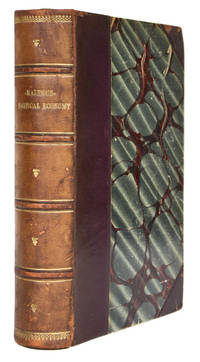
1815181657London : Printed for John Murray Albemarle Street; and J. Johnson and Co. St. Paul's Church Yard 1815. First Edition. Hardback. Good copy in the original wrappers bound in later 19th century aniline calf over marble boards. Gilt-blocked black leather label to the spine. Spine bands and panels edges somewhat dust-dulled and rubbed as with age. Previous owner's notes/annotations attached to back of title page. Scattered marginal foxing. Remains particularly well-preserved overall; tight bright clean and strong. ; 8vo 8"" - 9"" tall; 48 pages; Description: 48p. 23cm. Subjects: Malthus T. R. Thomas Robert 1766-1834. - Observations on the corn laws. Corn laws Great Britain. Grain trade - Great Britain. Corn - Prices - Great Britain. Agriculture - Economic aspects - Great Britain. Publisher's 8 page catalogue to the rear and dated February 1815. Spine title reads: Malthus - Import of Corn - 1815. London : Printed for John Murray, Albemarle Street; and J. Johnson and Co. St. Paul's Church Yard hardcover
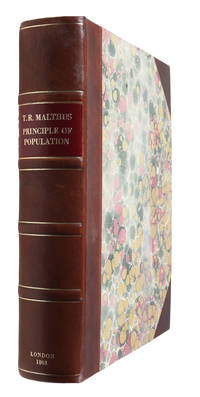
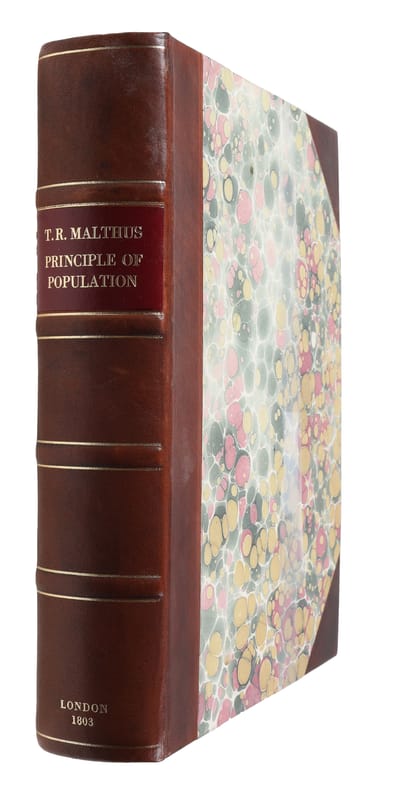
180362792London Printed for J. Johnson by T. Bensley 1803. Large 4to. Later brown hcalf with four raised bands single gilt lines and red leather title-label to spine. First three and last 14 leaves a bit brownspotted title-page and last two leaves marginally repaired at hinge otherwise a very nice clean and solid copy. VIII 4 610 pp. <br/><br/><em>The Great Quarto-edition of Malthus' milestone work the first and most influential book on population. Although being the second edition after the anonymously printed first of 1798 it is so significantly altered revised and expanded that it is considered a new work rather than a new edition. Malthus himself also thought of it as such. It is nearly four times the length of the 1798 essay the title has been changed the title of the first: "An Essay on the Principle of Population as it Affects the Future Improvement of Society with Remarks on the Speculation of Mr. Godwin M. Condorcet and Other Writers" and it is published with Mathus' name as the author not anonymously. All later editions were minor revisions of this heavily expanded and altered second one. "In the course of this inquiry I found that much more had been done than I had been aware of when I first published the essay. The poverty and misery arising from a too rapid increase of population had been distinctly seen and the most violent remedies proposed so long ago as the times of Plato and Aristotle. And of late years the subject had been treated in such a manner by some of the French economists occasionally by Montesquieu and among our own writers by Dr. Franklin Sir James Steuart Mr. Arthur Young and Mr. Townsend as to create a natural surprise that it had not excited more of the publick attention" Preface to the second edition p. IV. The controversial views because of which the work became so influential are most provocative and eyeopening in the second edition in which Malthus for instance for the first time advocates moral restraint meaning sexual abstinence and late marriage and elaborately explains his comparison between the increase of population and food. "The "Essay" was highly influential in the progress of thought in the early nineteenth-century Europe. "Parson" Malthus as Cobbett dubbed him was for many a monster and his views were often grossly misinterpreted. But his influence on social policy whether for good or evil was considerable. The Malthusian theory of population came at the right time to harden the existing feeling against the Poor Laws and Malthus was a leading spirit behind the Poor Law Amendment Act of 1834." PMM 251. Thomas Robert Malthus 1766-1834 called the "enfant terrible" of the economists was an English demographer statistician and political economist who is best known for his groundbreaking views on population growth presented in his "Essays on the Principle of Population" which is based on his own prediction that population would outrun food supply causing poverty and starvation. Among other things this caused the legislation which lowered the population of the poor in England. Malthus actually turned political economic and social thought upside down with this work which has caused him to be considered one of the 100 most influential persons in history Hart The 100: A Ranking of the most Influential Persons in History 1978. Malthus was naturally condemned by Marx and Engels and opposed by the socialists universally but the work had an enormous impact on not only politics economics and social sciences but also on natural sciences. For instance both Darwin and Wallace considered Malthus a main source in their development of the theory of natural selection considering him a great philosopher and his Essay on Population one of the most important books ever. "Malthus’s idea of man’s "Struggle for existence" had decisive influence on Charles Darwin and the theory of evolution. Other scientists related this idea to plants and animals which helped to define a piece of the evolutionary puzzle. This struggle for existence of all creatures is the catalyst by which natural selection produces the "survival of the fittest". Thanks to Malthus Darwin recognised the significance of intraspecies competition between populations of the same species e.g. the lamb and the lamb not just interspecies competition between species e.g. the lion and the lamb. Malthusian population thinking also explained how an incipient species could become a full-blown species in a very short timeframe." The second edition must be considered the most important of all the editions. This is far more a work on the problems of over-population than it is a response to Godwin and Condorcet on their works whic is the main concern of the first edition. "Not so much shocked by his own conclusions in his "Essay on Population" first ed. 1798 as driven by a naturally inquiring mind he travelled for three years through Europe gleaning statistics and then published a second edition 1803." Catlin A History of the Political Philosophers 1939 p. 377. PMM 251 first edition. </em> hardcover
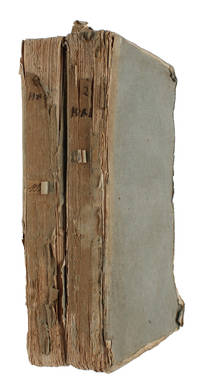
180760615Altona J.F. Hammerich 1807. 8vo. 2 volumes both uncut in the original blank wrappers. Wear to extremities front wrapper on vol. 1 detached and with tear. Missing ab. half of the paper on spines. Internally fine and clean. XVI 368; VIII 358 1 pp. <br/><br/><em>Rare first German edition of this political and economic classic which constitutes Malthus' first major publication and his main work because of which he is considered the father of demography and one of the main sources of inspiration for Darwin and Wallace. It is the first translation of the "Principle on Population" into any language and it influenced German politics tremendously.The first edition was printed anonymously in London in 1798 and in 1803 the second edition which also according to Malthus himself can be said to constitute a new work appeared; -the great quarto edition from 1803 is thoroughly revised and much enlarged the title has been changed and Malthus' name appears on the title-page for the first time it is on this edition that all the preceding editions are based and in consequence also the early translations. All the later editions were minor revisions of the second one. In 1806 the third edition appeared and as soon as 1807 the first German one which is translated from the revised third edition "Die gegenwärtige Uebersetzung ist nach der dritten Ausgabe Oktav London 1806. Die Quartausgabe ist minder vollständig" Vorwort p. V. New revisions of the text kept appearing till the sixth edition in 1826. The book then as now is considered highly controversial and it has influenced all demographers ever since as well as being of immense importance to the study of economic theory and genetic inheritance. "The "Essay" was highly influential in the progress of thought in the early nineteenth-century Europe. "Parson" Malthus as Cobbett dubbed him was for many a monster and his views were often grossly misinterpreted. But his influence on social policy whether for good or evil was considerable. The Malthusian theory of population came at the right time to harden the existing feeling against the Poor Laws and Malthus was a leading spirit behind the Poor Law Amendment Act of 1834." PMM 251.Thomas Robert Malthus 1766-1834 called the "enfant terrible" of the economists was an English demographer statistician and political economist who is best known for his groundbreaking views on population growth presented in his "Essays on the Principle of Population" which is based on his own prediction that population would outrun food supply causing poverty and starvation. Among other things this caused the legislation which lowered the population of the poor in England. Malthus actually turned political economic and social thought upside down with this work which has caused him to be considered one of the 100 most influential persons in history Hart The 100: A Ranking of the most Influential Persons in History 1978. Of course he was condemned by Marx and Engels and opposed by the socialists universally but the work was of immense impact on not only politics economics social sciences etc but also on natural sciences. "Later in the "Origin of Species" he Darwin wrote that the struggle for existence "is the doctrine of Malthus applied with manifold force to the whole animal and vegetable kingdoms; for in this case there can be no artificial increase of food and no prudential restraint from marriage" p. 63. Alfred Russel Wallace who arrived at a worked-out formulation of the theory of evolution at almost precisely the same time as Darwin acknowledged that "perhaps the most important book I read was Malthus's "Principles of Population" My Life p. 232. Although there were four decennial censuses before Malthus' death he did not himself analyze the data although he did influence Lambert Quetelet and Pierre Verhulst who made precise statistical studies on growth of populations in developed countries and showed how the early exponential growth changed to an S curve." DSB IX p. 69. As Malthus realized that his theories were not satisfactorily presented or sufficiently demonstrated in the first edition from 1798 he travelled for three years through Europe gleaning statistics and then published the second edition in 1803. Among other places he travelled through Northern Germany and his detailed diaries of these journeys provided him with some of the evidence necessary for the development of his theory on population growth. The observational information that he gathered on his travels in Europe were crucial to the development of his theories which also means that the work is of great interest for other European countries and not only Britain. "In 1819 the Royal Society elected Malthus to a fellowship. He was also a member of the French Institute and the Berlin Academy and a founding member of the Statistical Society 1834." DSB IX p. 67. Printing and the Mind of Man 251 first edition. </em> unknown
180362792London, Printed for J. Johnson, by T. Bensley, 1803. Large 4to. Later brown hcalf with four raised bands, single gilt lines and red leather title-label to spine. First three and last 14 leaves a bit brownspotted, title-page and last two leaves marginally repaired at hinge, otherwise a very nice, clean, and solid copy. VIII, (4), 610 pp.
180760615Altona, J.F. Hammerich, 1807. 8vo. 2 volumes both uncut in the original blank wrappers. Wear to extremities, front wrapper on vol. 1 detached and with tear. Missing ab. half of the paper on spines. Internally fine and clean. XVI, 368" VIII, 358, (1) pp.
104064London T. Bensley for J. Johnson 1806. . Third edition 2 vols 8vo xvi 501 63; vii 559 pp. contemporary tree calf gilt red morocco labels some pale foxing a very good set.<br /> The first two-volume edition. Contains important additions and corrections to the earlier editions including replies to his critics.<br /><br />'The central idea of the essay -- and the hub of Malthusian theory -- was a simple one. The population of a community Malthus suggested increases geometrically while food supplies increased only arithmetically. If the natural increase in population occurs the food supply becomes insufficient and the size of the population is checked by 'misery' -- that is the poorest sections of the community suffer disease and famine. The Essay was highly influential in the progress of thought in early nineteenth-century Europe' PMM.<br /><br />'His work was an important influence on both Darwin and Wallace in their formulation of the concept of natural selection. It also had a profound influence on the decrease in size of families down to the present time' Garrison-Morton.<br /> Garrison-Morton 1693; Goldsmiths' 19210; Kress B5067; Cf. PMM 251. London, T. Bensley for J. Johnson, 1806. unknown
1807185282London: Printed for Longman Hurst Rees and Orme 1807. Though his theories were so cruel his heart and manners were most kindly and courteous Second edition presented and inscribed by Thomas Malthus: "East India College Awarded to Mr John Trotter at the Public Examination of December 1817 as the first of his Class in Political Economy T. Rob. Malthus". Malthus taught as professor of history and political economy at the East India Company College at Haileybury from 1805 to his death in 1834 training generations of EIC management. Writing many years later a former student recalled "We called him Pop; not in derision for we had a great but rather distant respect for him. Though his theories were so cruel his heart and manners were most kindly and courteous" quoted in Maureen Alexander Turner p. 54. John Trotter 1800-1825 entered the college in 1816 and subsequently joined the EIC; he died seven years later aboard the Royal George just off Penang in Malaya which was then an EIC port. Trotter was the son of Alexander Trotter d. 1842 the financially imaginative paymaster of the Royal Navy. His engraved armorial bookplate is in both volumes; Malthus's ink inscription is on the front free endpaper verso. The History of the Anglo-Saxons by Sharon Turner 1768-1847 was originally published from 1799 to 1805. It quickly became "a powerful influence on historical thought for the succeeding half-century" ODNB and remains acknowledged as a turning point in Anglo-Saxon studies and a benchmark in historiography. Writing with a clear eye on the British Empire of his own day - in which Trotter's East India Company played so prominent a role - Turner presents the Anglo-Saxons as central to the historical development that set England on its imperial course. 2 vols quarto 271 x 213 mm pp. x 499 1; viii 472 8. Large hand-coloured engraved folding map by Neele showing "Territory inhabited by the Ancient Saxons north of the Elbe" as frontispiece of vol. I. Contemporary calf rebacked spines ruled and lettered in gilt covers with double-rule panel in gilt crest of the East India Company College blocked in gilt to centre turn-ins in blind marbled endpapers edges sprinkled in brown and red. Light rubbing extremities neatly restored infrequent damp staining to otherwise clean contents short closed tear to inner margin of folding map: just about a very good copy. Maureen Alexander Turner The Educational Ideas and Influence of Thomas Robert Malthus 1766-1834 University of Glasgow Department of Education PhD thesis 1991. unknown
180752195Altona J.F. Hammerich 1807. Contemp. hcalf. Gilt spine titlelabel in leather letters worn. Light wear to top of spine and corners. Spine rubbed. Some wear to edges of covers. A stamp on title-page. XVI 368; VIII 358 2 pp. A few leaves in the first quire disbound. Scattered brownspots and a few marginal underlinings on the first 20 leaves. <br/><br/><em>Rare first German edition of this political and economic classic which constitutes Malthus' first major publication and his main work because of which he is considered the father of demography and one of the main sources of inspiration for Darwin and Wallace. It is the first translation of the "Principle on Population" into any language and it influenced German politics tremendously.The first edition was printed anonymously in London in 1798 and in 1803 the second edition which also according to Malthus himself can be said to constitute a new work appeared; -the great quarto edition from 1803 is thoroughly revised and much enlarged the title has been changed and Malthus' name appears on the title-page for the first time it is on this edition that all the preceding editions are based and in consequence also the early translations. All the later editions were minor revisions of the second one. In 1806 the third edition appeared and as soon as 1807 the first German one which is translated from the revised third edition "Die gegenwärtige Uebersetzung ist nach der dritten Ausgabe Oktav London 1806. Die Quartausgabe ist minder vollständig" Vorwort p. V. New revisions of the text kept appearing till the sixth edition in 1826. The book then as now is considered highly controversial and it has influenced all demographers ever since as well as being of immense importance to the study of economic theory and genetic inheritance. "The "Essay" was highly influential in the progress of thought in the early nineteenth-century Europe. "Parson" Malthus as Cobbett dubbed him was for many a monster and his views were often grossly misinterpreted. But his influence on social policy whether for good or evil was considerable. The Malthusian theory of population came at the right time to harden the existing feeling against the Poor Laws and Malthus was a leading spirit behind the Poor Law Amendment Act of 1834." PMM 251.Thomas Robert Malthus 1766-1834 called the "enfant terrible" of the economists was an English demographer statistician and political economist who is best known for his groundbreaking views on population growth presented in his "Essays on the Principle of Population" which is based on his own prediction that population would outrun food supply causing poverty and starvation. Among other things this caused the legislation which lowered the population of the poor in England. Malthus actually turned political economic and social thought upside down with this work which has caused him to be considered one of the 100 most influential persons in history Hart The 100: A Ranking of the most Influential Persons in History 1978. Of course he was condemned by Marx and Engels and opposed by the socialists universally but the work was of immense impact on not only politics economics social sciences etc but also on natural sciences. "Later in the "Origin of Species" he Darwin wrote that the struggle for existence "is the doctrine of Malthus applied with manifold force to the whole animal and vegetable kingdoms; for in this case there can be no artificial increase of food and no prudential restraint from marriage" p. 63. Alfred Russel Wallace who arrived at a worked-out formulation of the theory of evolution at almost precisely the same time as Darwin acknowledged that "perhaps the most important book I read was Malthus's "Principles of Population" My Life p. 232. Although there were four decennial censuses before Malthus' death he did not himself analyze the data although he did influence Lambert Quetelet and Pierre Verhulst who made precise statistical studies on growth of populations in developed countries and showed how the early exponential growth changed to an S curve." DSB IX p. 69. As Malthus realized that his theories were not satisfactorily presented or sufficiently demonstrated in the first edition from 1798 he travelled for three years through Europe gleaning statistics and then published the second edition in 1803. Among other places he travelled through Northern Germany and his detailed diaries of these journeys provided him with some of the evidence necessary for the development of his theory on population growth. The observational information that he gathered on his travels in Europe were crucial to the development of his theories which also means that the work is of great interest for other European countries and not only Britain. "In 1819 the Royal Society elected Malthus to a fellowship. He was also a member of the French Institute and the Berlin Academy and a founding member of the Statistical Society 1834." DSB IX p. 67. Printing and the Mind of Man 251 first edition. </em> hardcover
180752195Altona, J.F. Hammerich, 1807. Contemp. hcalf. Gilt spine, titlelabel in leather (letters worn). Light wear to top of spine and corners. Spine rubbed. Some wear to edges of covers. A stamp on title-page. XVI, 368" VIII, 358, (2) pp. A few leaves in the first quire disbound. Scattered brownspots and a few marginal underlinings on the first 20 leaves.
1820119668London: John Murray 1820. First edition of this classic work regarding nature of labor demand and profit. Octavo original boards retaining the original paper spine label. In very good condition. Ownership inscription from the African Society and stamp to the title page. Rare in the original boards. "There can be no doubt that Malthus' importance for economists today rests mainly on his Principles of Political Economy. It was because of this latter work that J. M. Keynes 1933 reinstated Malthus as a major figure in modern economic thought" New Palgrave. "In his 'Principles of Political Economy' Malthus was proposing investment in public work and private luxury as a means of increasing effective demand and hence as a palliative to economic distress. The nation he thought must balance the power to produce and the will to consume" DSB. "The Principles had only a limited impact at the time and was severely criticized by J. R. McCulloch and Ricardo; the latter prepared extensive critical notes. But more recently it has received greater recognition largely as a result of the comments by J. M. Keynes in the 1930s. Keynes argued that Malthus's theory of effective demand provided a scientific explanation of unemployment and that the hundred-year domination of Ricardo over Malthus had been a disaster for the progress of economics. Keynes believed that if economics had followed Malthus instead of being constrained by Ricardo in an artificial groove the world would be a much wiser and richer place" ODNB. John Murray hardcover books
1820119668London: John Murray 1820. First edition of this classic work regarding nature of labor demand and profit. Octavo original boards retaining the original paper spine label. In very good condition. Ownership inscription from the African Society and stamp to the title page. Rare in the original boards. There can be no doubt that Malthus’ importance for economists today rests mainly on his Principles of Political Economy. It was because of this latter work that J. M. Keynes 1933 reinstated Malthus as a major figure in modern economic thought" New Palgrave. "In his 'Principles of Political Economy' Malthus was proposing investment in public work and private luxury as a means of increasing effective demand and hence as a palliative to economic distress. The nation he thought must balance the power to produce and the will to consume" DSB. "The Principles had only a limited impact at the time and was severely criticized by J. R. McCulloch and Ricardo; the latter prepared extensive critical notes. But more recently it has received greater recognition largely as a result of the comments by J. M. Keynes in the 1930s. Keynes argued that Malthus's theory of effective demand provided a scientific explanation of unemployment and that the hundred-year domination of Ricardo over Malthus had been a disaster for the progress of economics. Keynes believed that if economics had followed Malthus instead of being constrained by Ricardo in an artificial groove the world would be a much wiser and richer place" ODNB. John Murray hardcover
180912840Paris and Geneva: Chez J.J. Paschoud 1809. 3 volumes. First Edition in French. Provenance: With the contemporary engraved bookplate of H. Trouchin and that of the subsequent owner Pierre Sciclounoff. 8vo very handsomely bound in a fine French binding of contemporary half calf over speckled boards spines with gilt ruled bands red morocco title label and green morocco volume label lettered in gilt. xxiii 424 3 ad; 395 3; 392. A very fine and handsome set very clean and sturdy in absolutely period state. The first French edition of Malthus’ landmark work. The translation from the English is by Pierre Prevost probably from the third English edition which was corrected and expanded by Malthus. French editions of Malthus are uncommon and this set is in exceptional condition in its original and contemporary state.<br> Originally written in response to a discussion with the author's father on the perfectibility of society the book was reprinted several times with many alterations and additions as Malthus defended his views against a host of critics.<br> "The central idea of the essay--and the hub of Malthusian theory--was a simple one. The population of a community Malthus suggested increases geometrically while food supplies increase only arithmetically. If the natural increase in population occurs the food supply becomes insufficient and the size of the population is checked by 'misery'--that is the poorest sections of the community suffer disease and famine. Malthus recognized two other possible checks to population expansion: first 'vice'--that is homosexuality prostitution and abortion all totally unacceptable to Malthus; and second 'moral restraint'--the voluntary limitation of the production of children by the postponement of marriage. This was the solution to the population problem that Malthus advocated. The 'Essay' was highly influential in the progress of thought in early nineteenth-century Europe" PMM. Marx Engels Paley Darwin Wallace Keynes and Ricardo were all influenced by Malthus--either working off his ideas or reacting against them. Chez J.J. Paschoud hardcover
95378London John Murray 1820. . First edition; 8vo; small ownership stamp to lower outside corner of title-page small early 20th century bookseller's label to lower outside corner of verso of upper free endpaper a little age-toning and small ink smudge to title nineteenth century half calf over marbled boards rubbed at extremities spine faded a very good copy; vi 601 pp.<br /> The book was conceived as a series of tracts rather than a comprehensive and systematic treatise though Malthus published it to establish his own position against that of Ricardo with whom he had been having an ongoing debate about the nature of labour demand and profit. 'In his 'Principles of Political Economy' Malthus was proposing investment in public work and private luxury as a means of increasing effective demand and hence as a palliative to economic distress. The nation he thought must balance the power to produce and the will to consume' DSB.<br /><br />'The Principles had only a limited impact at the time and was severely criticized by J. R. McCulloch and Ricardo; the latter prepared extensive critical notes. More recently it has received greater recognition largely as a result of the comments by J. M. Keynes in the 1930s. Keynes argued that Malthus's theory of effective demand provided a scientific explanation of unemployment and that the hundred-year domination of Ricardo over Malthus had been a disaster for the progress of economics. Keynes believed that if economics had followed Malthus instead of being constrained by Ricardo in an artificial groove the world would be a much wiser and richer place.' ODNB.<br /> Goldsmiths' 22767; Kress C.577. London, John Murray, 1820. hardcover
1820948P11London: John Murray 1820. First edition. Cloth. Very Good. 9" by 6". None. The first edition of this important economic work by the influential writer Thomas Robert Malthus. The first edition.'Principles of Political Economy' is now regarded as a very influential study on economics in which the author explains the historical economic depression in Europe and why they occur. The work rejects the idea of Say's law and Ricardo's 1817 Principles of Political Economy and Taxation generally. Malthus argued that any rise in wages above the subsistence level would encourage population growth which in turn would drive wages back down to subsistencea dynamic often referred to as the "Malthusian trap." By the economist scholar and cleric Thomas Robert Malthus. He published this work to rival David Ricardo's 1817 work 'Principles of Political Economy and Taxation'."The Principles had only a limited impact at the time and was severely criticized by J. R. McCulloch and Ricardo; the latter prepared extensive critical notes. But more recently it has received greater recognition largely as a result of the comments by J. M. Keynes in the 1930s. Keynes argued that Malthus's theory of effective demand provided a scientific explanation of unemployment and that the hundred-year domination of Ricardo over Malthus had been a disaster for the progress of economics. Keynes believed that if economics had followed Malthus instead of being constrained by Ricardo in an artificial groove the world would be a much wiser and richer place" DNBVery rarely seen eight pages of adverts to the rear dated April 1820. In a rebacked cloth binding. Externally generally smart. Spine label is rubbed with light marks and a small amount of loss. Minor bumping to the extremities. Light marks and a small amount of rubbing to the cloth. Internally firmly bound. Pages are lightly age-toned and generally clean with scattered spots. Tidemark to pages 159 to 194. Very Good John Murray hardcover
1827170223003London: John Murray 1827. First Edition. Hardcover. Very Good. First edition first printing. Finely bound in brown leather with raised bands and gilt stamping. Contents lightly toned light restoration to several pages evident. Title page and text of last chapter show light evidence of erased pencil markings. Previous owner name on half title page. An important and early work on economic methodology. John Murray hardcover books
1809101490Washington: Printed and Published by Roger Chew Weightman 1809. First American edition of this cornerstone text of modern economics. Octavo 2 volumes bound in contemporary calf rebacked red and black morocco spine labels gilt titles. Previous owner's inscription to front free endpaper "An application was made to Bishop Watson to answer this book on the grounds that it discouraged benevolence. He declined excusing himself however unfavorably saying that he saw its object was to prove that population could not increase beyond the level of rules of self-evident truth. A much better employment would have been to discover means of resistance that might supply the increasing wants of the population." Bishop Richard Watson served as the Bishop of Llandaff from 1782 to 1816 and published a number of political pamphlets contributing to the Revolution Controversy regarding the fundamental politics of the French Revolution. Watson corresponded with and published several counterarguments to the works of Thomas Paine and Thomas Robert Malthus among others. In very good condition with some browning to the text as usual sporadic foxing. Rare and desirable. Malthus was one of the founders of modern economics. His Essay was originally the product of a discussion on the perfectibility of society with his father who urged him to publish. Thus the first edition published anonymously was essentially a fighting tract but later editions were considerably altered and grew bulkier as Malthus defended his views against a host of critics. The Essay was highly influential in the progress of thought in early 19th-century Europe and his influence on social policy was considerable. Both Darwin and Wallace clearly acknowledged Malthus as a source of the idea of 'the struggle for existence" PMM 251. Printed and Published by Roger Chew Weightman unknown books
1827170223003London: John Murray 1827. First Edition. Hardcover. Very Good. First edition first printing. Finely bound in brown leather with raised bands and gilt stamping. Contents lightly toned light restoration to several pages evident. Title page and text of last chapter show light evidence of erased pencil markings. Previous owner name on half title page. An important and early work on economic methodology. John Murray hardcover
180993446Paris: J. J. Paschoud 1809. The most influential work of its era on population in a contemporary binding First French edition translated by Pierre Prévost. First published in English in 1798 it was perhaps the most influential work of its era on population arguing that the growth of a population would always outrun its ability to feed itself. The first edition was so successful that Malthus soon elaborated on it under his real name culminating in the sixth edition of 1826 which was a scholarly expansion of the first. A political economist who occupies a hallowed place in the history of biology Malthus was acknowledged by both Charles Darwin and Alfred Russel Wallace as a key influence in developing the theory of natural selection. 3 vols octavo. Contemporary quarter calf marbled boards brown morocco labels spines lettered in gilt with gilt and black motifs edges uncut. Board edges slightly faded and a little scuffed joints tender tips bumped and lightly rubbed. A very good set. Carpenter XXXII 7; Kress B.5591. hardcover
1820242928London: John Murray 1820. First edition. vi 601 pp. 1 vols. 8vo 219 x 132 mm. Bound in later half cloth and marbled boards paper label. Very good. First edition. vi 601 pp. 1 vols. 8vo 219 x 132 mm. First edition of this important classic of economic theory. "There can be no doubt that Malthus' importance for economists today rests mainly on his Principles of Political Economy. It was because of this latter work that J. M. Keynes 1933 reinstated Malthus as a major figure in modern economic thought" New Palgrave. "One of the founders of modern economics" Malthus was credited by Keynes with framing the theory "that a lack of effective demand can cause economic crises" PMM 251. "In his Principles of Political Economy Malthus was proposing investment in public works and private luxury as a means of increasing effective demand and hence as a palliative to economic distress. The nation he thought must balance the power to produce and the will to consume" DSB IX:70. Goldsmith 22767; Lowndes 1459; Kress C577 John Murray unknown books
18208125London: John Murray 1820. 1820 vi 601 1 p. First edition. It has a good quality mid-twentieth century binding with a polished morocco spine marbled boards and vellum corners. The spine with gold lines and a contrasting label. Minor rubs to the spine ends otherwise in very good condition. There is an undated pencil note on the title page '£45 Repair'. The text with a few signs of use and some pale paper toning. IMPORTANT COOPERATIVE MOVEMENT PROVENANCE: The title page is inscribed at the head 'Society for promoting Working Men's Assocns / 34 Castle Place -- Oxford Street with a shelfmark R31'. The Society was founded in 1849 by the Christian Socialists in an attempt to found self governing workshops. Lower down the title page is the oval stamp of Ormond Street Working Mens College which still exists in Camden. Founded in 1854 by Frederick Denison Maurice Wiki describes it as 'The Working Men's College is among the earliest adult education institutions established in the United Kingdom and Europe's oldest extant centre for adult education. Founded by Christian socialists at its inception it was at the forefront of liberal education philosophy.' At different times its teachers included Thomas Hughes whose latin lectures were apparently not so popular as his boxing club F.J. Furnival and E.M. Forster. London: John Murray, hardcover
1718149970London: John Murray Eden: London J. Wright 1817 Eden: 1800. An excellent copy in contemporary calf Fourth edition of Malthus's Essay first published in 1798 one of the most important and influential works in the history of economic thought and the foundation text of modern demography. The second volume is appended with the first edition of Frederick Morton Eden's An Estimate of the Number of Inhabitants in Great Britain an appropriate pairing by the contemporary owner - Eden's population census preceded the first national decennial population census by a year but undershot the official figure by five million. It nonetheless marks like Malthus's Essay an important milestone in the study of population. Two works bound in 2 vols octavo 210 x 128 mm. Bound without half-titles. Contemporary sprinkled calf orange and dark green morocco labels gilt in compartments gilt roll border to covers blind serrated turn-ins marbled endpapers brown speckled edges. Contemporary ownership signature of Thomas Entwisle to title pages later small ink notation to front free endpapers versos. Minor patch of abrasion to rear cover of vol. I joints just beginning to split but holding firm light browning to Eden else contents fresh. An excellent copy. unknown
123522London John Murray 1820. . First edition; 8vo 21 x 13.5 cm; moderate spotting front free endpaper just starting to become loose at head of gutter margin remains of a library label to front pastedown; contemporary half calf marbled paper boards spine lettered in gilt dulled; vi 601 1pp.<br /> The first edition of Malthus' treatise on political economy.<br /><br />The book was conceived as a series of tracts rather than a comprehensive and systematic treatise though Malthus published it to establish his own position against that of Ricardo with whom he had been having an ongoing debate about the nature of labour demand and profit. 'In his 'Principles of Political Economy' Malthus was proposing investment in public work and private luxury as a means of increasing effective demand and hence as a palliative to economic distress. The nation he thought must balance the power to produce and the will to consume' DSB.<br /><br />'The Principles had only a limited impact at the time and was severely criticized by J. R. McCulloch and Ricardo; the latter prepared extensive critical notes. More recently it has received greater recognition largely as a result of the comments by J. M. Keynes in the 1930s. Keynes argued that Malthus's theory of effective demand provided a scientific explanation of unemployment and that the hundred-year domination of Ricardo over Malthus had been a disaster for the progress of economics. Keynes believed that if economics had followed Malthus instead of being constrained by Ricardo in an artificial groove the world would be a much wiser and richer place.' ODNB.<br /> Goldsmiths' 22767; Kress C.577. London, John Murray, 1820. hardcover
1817157003London: John Murray 1817. The foundation text of modern demography Fourth edition of Malthus's Essay first published in 1798 one of the most important and influential works in the history of economic thought and the foundation text of modern demography. 2 vols octavo 203 x 126 mm. With half-titles. Contemporary calf spines lettered in gilt. Contemporary ownership signature to title pages bookplate of one C. W. Clementine dated 1901 to front pastedowns. Slight scratch to rear cover of vol. I endpapers toned and a little soiled slight worming in fore margin of vol. II not affecting text an excellent copy in a well-preserved contemporary binding. unknown
1827122073London: John Murray 1827. First Edition. hardcover. near fine. viii 261pp. 8vo rebound in 3/4 red leather gilt-lettered spine; half-title expertly repaired otherwise fine. London: John Murray 1827. First Edition. Near fine.<br/><br/> A critique of the terms used by French economists Adam Smith Jean-Baptiste Say James Mill David Ricardo J.R. McCulloch and Samuel Bailey followed by the author's classification. Kress C. 1924. NCBEL III 1294. Palgrave II p.677.<br/><br/> John Murray unknown books
1650WB15505Paris 1650. Hardcover. Near Fine. Second edition. 4to. Engraved title 2 plates 28 illustrations 27 of which are full page. Bound in contemporary mottled calf. A very nice copy. Malthus was an Englishman employed in France. This work similar to others he published consists of five treatises: the first on artillery in general; the second on bombs and mortars; the third on "artificial fire"; the fourth on the mining and undermining of walls; the fifth concerns fireworks. <br/><br/> hardcover