112 résultats
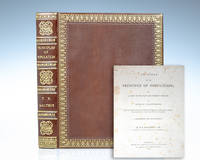
18262411260086London: John Murray 1826. Hardcover. Acceptable. Malthus' Classic Work on the Economics of Population Growth Sold with all faults. Vol. 1 only. xviii 535 pages Important note: lacking pages 531-534. Good candidate for rebind. Binding broken boards detached lacking half of spine leather. Marbled boards. Clean unmarked pages. Vol. 1 of the 6th expanded edition of Essay on the Principle of Population. In this work Malthus argues that there is a disparity between the rate of growth of population which increases geometrically and the rate of growth of agriculture which increases only arithmetically. He then explores how populations have historically been kept in check. The final edition in Malthus' lifetime. Goldsmiths' 24893; Kress C1724 John Murray hardcover
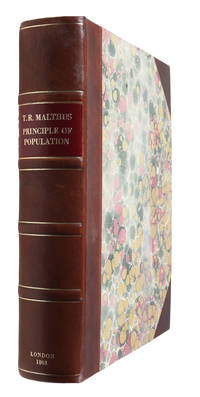
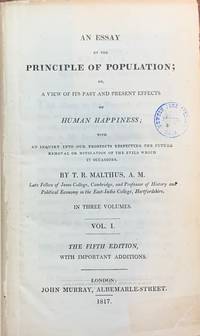
18177080<p><em>An Essay on the Principle of Population or A View of its Past and Present Effects on Human Happiness; With An Inquiry into our Prospects Respecting the Future Removal or Mitigation of the Evils which it Occasions.</em><br /><br />8vo. Modern ½-brown calf leather binding over marbled boards gilt decorated spine with 5 raised bands two black and red gilt lettered morocco labels; new endpapers added. London: Printed for John Murray 1817. <strong>Fifth Edition with Important Additions.</strong> <strong>3 volumes. </strong><br /><br /><em>An Essay on the Principle of Population </em>was first published anonymously in 1798 through J. Johnson London. The author was soon identified as The Reverend Thomas Robert Malthus. In 1803 a second and much enlarged edition was published with the author acknowledged. Later editions were taken from the second edition and there are additional changes throughout the sixth edition. It has been acknowledged as one of the most influential economic works in history. Library stamps on the title pages; some numbers in pencil on the copyright pages; title page of volume 1 worn with a small tape repair; o/w Fine. Rare.</p> Printed for John Murray hardcover
1809013706Washington City: Chew Weightman 1809. First american from the third London edition. Due volumi 13x22 cm di XVI-510-XXXIII pp e VI-542 pagine. Scritta di proprietà datata 5 march 1834 sulle pagine di titolo. Una gora alla metà inferiore del volume nelle prime ed ultime 30 pp del volume 1. Qualche altra brunitura sparsa. Legatura coeva in tutta pelle marmorizzata dorsi lisci con tassello di titolo; qualche usura e abrasioni ai piatti del volume 2 ma nel complesso bell'esemplare di questa prima edizione americana dell'opera di Malthus. Chew Weightman unknown
1841018705Bruxelles: Société Typographique Belge Wahlen 1841. .suivi de quelques recherches relatives à l'espérance de guérir ou d'adoucir les maux qu'elle entraine. Traduit de l'anglais sur la 5me édition par P. Prevost et G. Prevost de Génève. Nouvelle édition revue corrigee et augmentee . d'apres MM. Balbi et d'Omalius d'Halloy. Due volumi 19 cm di 4-422 e 4-448 pagine. Qualche fioritura. Timbro di possesso Polesini alle pagine di titolo; ex libris al retro della copertina. In lingua francese. Brossura editoriale una gora e dorsi restaurati muti. Société Typographique Belge, Wahlen unknown
18211512140034Boston: Wells and Lilly 1821-01-01. First Edition. Hardcover. Very Good. First American edition. Bound in marbled boards spine rebacked in modern leather. Burgundy Moroccan leather spine label. Clean unmarked pages. Marginal browning to pages. Internally very good. <br> The first English edition was printed by John Murray in 1820 this is the 1st American edition printed in 1821 in Boston.J.M. Keynes "argued that Malthus's theory of effective demand provided a scientific explanation of unemployment and that the hundred-year domination of Ricardo over Malthus had been a disaster for the progress of economics. Keynes believed that if economics had followed Malthus . the world would be a much wiser and richer place" ODNB. The last chapter of the book was devoted to rebutting Say's law and argued that the economy could stagnate with a lack of "effectual demand". In other words wages if less than the total costs of production cannot purchase the total output of industry causing prices to fall; price falls decrease incentives to invest creating a downward spiral. Refs for 1st English ed: Goldsmiths 22767; Kress C577. <br><br>Early signature of E.W. Paige Schenectady NY and his book plate on front paste down. Eugene W. Paige 1852-1919 served in the New York legislature in the 19th century. Boston: Wells and Lilly hardcover
18079380London: J Johnson 1807. The Fourth Edition of Volume 1 only comprising books 1 & 2. By T R Malthus A.M. late fellow of Jesus College Cambridge and Professor of History and Political Economy in the East India College Hertfordshire. Tree calf boards pleasingly worn a little bumped to corners. Six panelled spine lettered 'Volume 1' in gilt over black a little chipped to tail. Endpapers clean front and rear. Original owner's bookplate to front pastedown features the Clan Carmichael coat of arms in the name of Richard Carmichael. A later handwritten ownership inscription to top of bookplate reads Mo Holroyd above a date of July 26 1865. To recto of title page is an additional original handwritten ownership inscription again in the name of Richard Carmichael dated November 25th 1809. Text block very sound and in very good condition. Loss noted on collation to bottom corner of pp.1 resulting in lack of final word; similar loss to pp.7 resulting in lack of bottom 2 lines of text. Otherwise complete and a very pleasing volume. Please contact Christian White Rare Books Ltd for more information or images of this item 1807 J Johnson hardcover
1817720P18London: John Murray 1817. First edition. Hardback. Very Good. 9" by 5.5". None. The first edition of this additions volume to Thomas Robert Malthus' immensely influential essay on the issue of growing population. The first edition of this work.This work is Malthus' additions to his influential book 'An Essay on the Principle of Population' added to the fourth and earlier editions.'An Essay on the Principle of Population' is a treatise warning of the future difficulties with a growing population on Earth.The essay was not the first work to be published on population but it was incredibly influential as contributed to the passing of the 1800 Census Act.This addition volume highlights key issues in the original work and expands upon them giving the reader a wider understanding of the issue of population.Written by Thomas Robert Malthus a scholar who is best known for this work and for his influential economics.Bound without publisher's adverts. In the original publisher's marbled paper boards. Externally smart. A small amount of bumping to the head and tail of the spine and to the extremities. A little rubbing to the boards and spine resulting in fading of the marble pattern. Internally firmly bound. Pages are lightly age-toned and generally clean with some scattered spotting. Very Good John Murray hardcover
1803924F45DLondon: J. Johnson by T. Bensley 1803. Leather. Very Good. 11" by 9". None. The important and heavily revised second edition of Thomas Robert Malthus's discussion of the problems of a growing human population. First published in 1798 this is the substantially revised enlarged and re-written second edition of Malthus's important work.Malthus's work - which posits that the human population will outgrow the supply of food and resources - fuelled the debate on the size of the British population and contributed to the passion of the Census Act of 1800.A key argument within the book was dedicated to what is now known as the Malthusian Law of Population theorising that growing population rates will lead to a rising supply of labour inevitably lowering wages and leading to poverty.With the armorial bookplate of James Frampton to the front pastedown along side the former owner's ink inscription of N.B. Hobbs. Hobbs's inscription is also present to the recto of a front blank.This second edition incorporated details of population controls that had been used in various countries and periods. In a contemporary calf binding with light rubbing to boards. Minor loss to tail of spine label. Hinges neatly repaired. Retaining the original endpapers. Bookplate and inscription to front pastedown with further inscription to a front blank. Internally firmly bound. Significant spotting to endpapers and to first and final leaves. Pages bright with scattered further areas of concentrated spotting throughout. Very Good J. Johnson, by T. Bensley hardcover
1806ZB1325657London: J. Johnson 1806. Price HAS BEEN REDUCED by 10% until Monday June 29 SALE item 2 vols. xvi 505 58 index vii 559 pp. contemporary full leather bindings now dry and worn a few areas of the spine of the first volume now lacking the leather covering masonic library and private book plate to the front paste down of each volume scant foxing else internally clean and tight. - If you are reading this this item is actually physically in our stock and ready for shipment once ordered. We are not bookjackers. Buyer is responsible for any additional duties taxes or fees required by recipient's country. Photos available upon request. London: J. Johnson hardcover
1820948P11London: John Murray 1820. First edition. Cloth. Very Good. 9" by 6". None. The first edition of this important economic work by the influential writer Thomas Robert Malthus. The first edition.'Principles of Political Economy' is now regarded as a very influential study on economics in which the author explains the historical economic depression in Europe and why they occur. The work rejects the idea of Say's law and Ricardo's 1817 Principles of Political Economy and Taxation generally. Malthus argued that any rise in wages above the subsistence level would encourage population growth which in turn would drive wages back down to subsistencea dynamic often referred to as the "Malthusian trap." By the economist scholar and cleric Thomas Robert Malthus. He published this work to rival David Ricardo's 1817 work 'Principles of Political Economy and Taxation'."The Principles had only a limited impact at the time and was severely criticized by J. R. McCulloch and Ricardo; the latter prepared extensive critical notes. But more recently it has received greater recognition largely as a result of the comments by J. M. Keynes in the 1930s. Keynes argued that Malthus's theory of effective demand provided a scientific explanation of unemployment and that the hundred-year domination of Ricardo over Malthus had been a disaster for the progress of economics. Keynes believed that if economics had followed Malthus instead of being constrained by Ricardo in an artificial groove the world would be a much wiser and richer place" DNBVery rarely seen eight pages of adverts to the rear dated April 1820. In a rebacked cloth binding. Externally generally smart. Spine label is rubbed with light marks and a small amount of loss. Minor bumping to the extremities. Light marks and a small amount of rubbing to the cloth. Internally firmly bound. Pages are lightly age-toned and generally clean with scattered spots. Tidemark to pages 159 to 194. Very Good John Murray hardcover
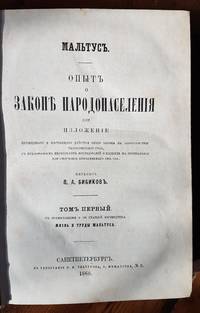
1868178<p><strong>Scarce first Russian edition of a major landmark of economic literature the <em>Essay on the Principle of Population</em></strong> first published in English in 1798.</p><p><strong>With much added material.</strong> The translator P. A. Bibikov was a historian philosopher and literary critic who had already translated Smith's Wealth of Nations in 1866. With this background he added a wealth of material to this edition making it more than just a translation but also an a posteriori analysis. Next to the 80 pages on Malthus' life and works Bibikov added in a rich appendix translations of foreign commentators as well as his own footnotes relating to Russia. Very interestingly he updated and commented the many pages Malthus had already devoted to the Russian case. The appendix includes texts by Townsend Garnier Chernyshevskiy and Prudhon as well as a convenient 20-pp. alphabetical index.</p><p>"The central idea of the essay - and hub of the Malthusian theory - was a simple one. If the natural increase in population occurs the food supply becomes insufficient and the size of the population is checked by 'misery' - that is the poorest sections of the community suffer disease and famine. Malthus recognises two other possible checks to population expansion: first 'vice' - that is homosexuality prostitution and abortion all totally unacceptable to Malthus; and second 'moral restraint' - the voluntary limitation of the product of children by the postponement of marriage." PMM.</p><p>Provenance: Unidentified symbolistic booklabel to upper endpapers; small Baltic bookseller's stamps to lower endpapers.</p><p>Physical description:Two volumes 8vo. 476 pp. incl. half-title title and table of contents at end; 468 pp. incl. table of contents. Later plain brown cloth author titled in ink on the spines.</p><p>Condition:Very occasional light spotting.</p> Glazunov, Skt. Peterburg, hardcover
1831376545Georgetown D. C.: Published by Charles Cruikshank Rind's Press 1831. First American edition first published in London in 1817. 8vo. Original cloth backed tan boards printed paper label reading "Additions / to an / Essay /on / Population / by T.B. Malthus" uncut partially unopened. Some spotting and browning of binding rubbing with some wear to extremities some foxing and spotting of leaves insect trail along lower inner hinge marginal tears on R4 and Cc4 not affecting text. A very good copy in brown cloth clamshell box with leather spine label. First American edition first published in London in 1817. 8vo. Very scarce. This work contains new chapters additions and corrections included in the fifth edition separately published with a new title page and pagination for those who already had the earlier editions. <br /> <br /> The Contents leaf lists: Book II Chapters I Checks to Population in France and VII Checks to Population in England; Book III Chapters II Of Systems of Equality IV Of Emigration VI Of Poor Laws VIII-XIV the Agricultural and Commercial Systems Corn Laws Exportation and Importation and "Of increasing Wealth as it affects the Condition of the Poor; Book IV Chapters VI "Effects of the Knowledge of the Principal Cause of Poverty on Civil Liberty" XII "Different Plans of Improving the Condition of the Poor considered" and the Appendix. There are new chapters on the Poor and Corn Laws. A revised chapter on rent and especially the change in Chapter III which formely dealt with Godwin and his "Systems of Equality" now relate to Robert Owen his Utopian systems and his "New View of Society". <br /> <br /> In 1817 at the height of his success Robert Owen addressed the House of Commons speaking on his methods and ideas. Owen had disagreed with Malthus' theories of population. In 1824 Owen had come to America and purchased what became New Harmony a communal society experiment. It was not successful and Owen returned to England in 1828. The Appendix contains Malthus' responses to the publication of Principles of Population and Production by Mr. Wayland and An Inquiry into the Principle of Population by James Grahame. Each chapter notes where the additions should be placed referring to the English edition of 1807 and American edition of 1809. Goldsmiths' Kress Library 26723.2; Kress C2883; Kress B6973 Goldsmiths' 21762 Einaudi 3664 last three for London ed. Published by Charles Cruikshank, Rind's Press unknown
1817231696London : John Murray 1817. 1st edition. Hardcover. Contemporary aniline calf over marble boards. Front hinge loose with wear to the spine bands and panel edges. A good copy. Physical description; iv 327 1 p. ; 22 cm. Includes bibliographical references.Subjects; Population.Malthusianism. Population control. Population growth.Referenced by: Kress Lib B.6973. London : John Murray hardcover
181722733London: John Murray 1817. First edition. 1 vols. 8vo. Rebound in later buckram. Title a little foxed contents generally clean. First edition. 1 vols. 8vo. Issued in conformity with but separately from the fifth edition - the penultimate edition before the sixth and final one in his lifetime. Kress B.6973; Goldsmith 21762 John Murray unknown
180755024London: Printed for J. Johnson in St Paul's Church-Yard by T. Bensley 1807. Fourth edition. Octavo 22cm in two volumes. In contemporary brown calf seven sets of double gilt rules to spine titled in gilt on red leather spine label numbered on black leather spine labels blind tool to board edges all edges sprinkled grey; plain endpapers; vol. I: i-xvi 1-580pp; vol. II: i-viii 1-484 60pp. Sturdy copies much rubbed vol. I slightly cocked lower front joint of vol. I and upper front joint of vol. II cracking vol. II lacking spine label scratch to upper board of vol. II endleaves and some prelims foxed but otherwise internally free from soil: Good or better. <br /> <br /> The fourth edition of Malthus' widely influential discussion of overpopulation. Malthus 1766-1834 argued that population "increases geometrically while food supplies increase only arithmetically" and that some misery was inevitable unless population growth could be restrained. He proposed "moral restraint" as a solution. Many of his theories have now been largely rejected but "the Essay was highly influential in the progress of thought in early nineteenth-century Europe" and "his influence on social policy whether for good or evil was considerable." The first edition was shorter; "later editions were considerably altered and grew bulkier as Malthus defended his views against a host of critics" Printing and the Mind of Man. KRESS B.5219. GOLDSMITHS 19373. PMM 251 1st edn. Printed for J. Johnson in St Paul's Church-Yard, by T. Bensley unknown
180775775hLondon: Printed for R. Johnson in St. Paul's Church-Yard by T. Bensley Bolt Court Fleet Street 1807. Book. Very Good. Hardcover. 8vo - over 7¾ - 9¾" tall. Two-volume set in full tree-calf with gilt spines. Professionally re-backed with original spines relaid. Moderate handling and bumping to covers. Edges and endpapers toned. Armorial bookplate of Sir Edward Strachey Baronet Sutton Court Somerset inside front covers; early owner's name in ink to free endpapers. Otherwise clean tight and unmarked -- no foxing or staining to text. Very neat -- a sound and handsome set. Half-titles present; extensive index. xvi580viii48460indexpp. Printed for R. Johnson in St. Paul's Church-Yard, by T. Bensley, Bolt Court, Fleet Street Hardcover
1803143843London: T. Bensley 1803. Rare second edition of this cornerstone text of modern economics. Quarto bound in full diced morocco raised bands gilt titles and tooling to the spine front and rear panels marbled endpapers. In very good condition. An exceptional presentation. “Malthus was one of the founders of modern economics. His Essay was originally the product of a discussion on the perfectibility of society with his father who urged him to publish. Thus the first edition published anonymously was essentially a fighting tract but later editions were considerably altered and grew bulkier as Malthus defended his views against a host of critics… The Essay was highly influential in the progress of thought in early 19th-century Europe and his influence on social policy was considerable… Both Darwin and Wallace clearly acknowledged Malthus as a source of the idea of ‘the struggle for existence†PMM 251. T. Bensley hardcover
180345423London: Printed for J. Johnson. by T. Bensley. 1803. Second edition or "A New Edition Very Much Enlarged". 4to. viii iv 610 pp. 19th century half speckled calf over marbled boards gilt rules to the spine gilt lettered green label all edges marbled. Binding expertly resewn and the joints neatly repaired occasional foxing mostly mild an attractive copy. First published anonymously in 1798 Malthus drew upon the works of Hume and Smith amongst others to explain his conservative conception of population control. "The central idea of the essay. was a simple one. The population of a community. increases geometrically while food supplies increase only arithmetically. The 'Essay' was highly influential in the progress of thought in early 19th century Europe. it came at the right time to harden the existing feeling against the Poor Laws" - Printing and the Mind of Man 251. Citing examples from other societies and sources not hitherto known to him Malthus rewrote and extended his essay significantly enough for him to consider this an entirely "new work" in his introduction to this edition. He expanded and refined his theory of positive checks on population growth those that increase the death rate and negative ones those that inhibit birth rates slightly softening his tone by arguing for greater moral restraint as opposed to the bleaker and cruder mechanisms of hunger disease and war to keep population numbers down and therefore keep overall prosperity up. Despite being hugely influential in economic and philosophical terms Malthus has always been a divisive figure and his arguments remain controversial to this day. London: Printed for J. Johnson... by T. Bensley... unknown
180940999Washington City: Roger Chew Weightman 1809. 2 volumes 8vo. 8 1/4 x 5 inches. Vol. 1 xvi 510 xxxiv pp.; Vol. 2 vii 542 pp. Contemporary tree calf skilfully rebacked. Spines gilt ruled forming six compartments lettering pieces in the second compartmenrs<br/> <br/> Provenance: Possibly John Barclay 1749-1824 former Mayor of Philadelphia from 1791 to 1793<br/> <br/> First American edition of a fundamental text of Modern Economics.<br/> <br/> Thomas Robert Malthus was an English economist cleric and scholar influential in the fields of political economy and demography. Malthus came to prominence for his publication of the present work first published in 1798. Between 1798 and 1826 Malthus published six versions of the essay updating each edition to incorporate new material to address criticism and to convey changes in his own perspectives on the subject. Writing in response to Jean-Jacques Rousseau and William Godwin specifically their approaches to the improvement of society Malthus opposed the optimistic view in 18th-century Europe that saw society as improving and in principle as perfectible. Malthus saw population growth as inevitable whenever conditions improved thereby precluding real progress towards a utopian society: "The power of population is indefinitely greater than the power in the earth to produce subsistence for man." Malthus laid the "theoretical foundation of the conventional wisdom that has dominated the debate both scientifically and ideologically on global hunger and famines for almost two centuries" Daoud. He remains a much-debated writer.<br/> <br/> Shaw 17975; Daoud Ade "Robbins and Malthus on scarcity abundance and sufficiency: The missing sociocultural element" in American Journal of Economics and Sociology 69.4: 1206-1229; Harvey David "Population Resources and the Ideology of Science"in Economic Geography 503: 256277. Roger Chew Weightman unknown
1826015875London: John Murray 1826 Book. Fair. Hardcover. 5th or later Edition. 1826 Sixth edition 2 volume set published 1826 The final revised text Good/Reasonable Condition: see notes Vol I: xviii 535pp. Vol 2: iv 528pp CONDITION Set Needs Rebinding Vol I Original Buckram Top of Spine is Loose; see photo Contents tight and clean Viol II No Binding Slight Browning on Title-Page Pencil Scribbles on the back of the last flyleaf Contents tight and clean. John Murray hardcover
1803182784London: printed for J. Johnson by T. Bensley 1803. Malthus softens his conclusions The Great Quarto edition notionally the second edition following the first of 1798 but so substantially enlarged rewritten and re-titled as to be effectively a new book. The Essay was one of the most influential works in the history of economic thought arguing the link between food supply and population size and the inevitability of famine and suffering once population exceeded its limits. "For today's readers living in a post-Malthus era the world's population problems are well known and serious but no longer sensational. It is difficult therefore to appreciate the radical and controversial impact made by the Essay at the time of publication. It challenged the conventional notion that population growth is an unmixed blessing. It discussed prostitution contraception and other sexual matters. And it gave vivid descriptions of the horrendous consequences of overpopulation and of the brutal means by which populations are checked" ODNB. In the second edition Malthus "made clear what was only implicit in the first that prudential restraint should if humanly possible be 'moral restraint' - that is delayed marriage accompanied by strictly moral pre-marital behaviour although he admitted that moral restraint would not be easy and that there would be occasional failures. Whereas in the first edition he had said that all the checks to population would involve either misery or vice in the second edition he attempted to lighten this 'melancholy hue' and 'to soften some of the harshest conclusions of the first essay' by arguing that moral restraint if supported by an education emphasizing the immorality of bringing children into the world without the means of supporting them would tend to increase rather than diminish individual happiness" ODNB. Quarto 269 x 205 mm pp. viii 4 610. Contemporary tree calf rebacked and recornered with original spine laid down spine gilt in compartments with black morocco label. Twentieth-century bookplate of Virginia bibliophile and historian Christopher Clark Geest. Scattered light foxing else a very good copy. Einaudi 3668; Goldsmiths' 18640; Kress B.4701. unknown
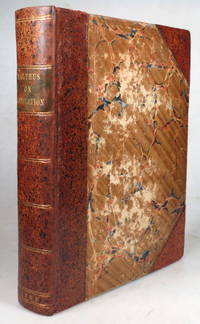
18265784691John Murray 1826. Volume 1. This is an ex-library book and may have the usual library/used-book markings inside.This book has hardback covers. In good all round condition. Sixth edition. Medium 8vo with marbled boards and black leather half binding. Raised bands gilt lettering and gilt borders on backstrip. Bumped corners and some minor chipping and general wear. Interior is secure clean and clear save for some foxing. Trimmed. Please note the Image in this listing is a stock photo and may not match the covers of the actual item850grams ISBN: John Murray hardcover
180362792London Printed for J. Johnson by T. Bensley 1803. Large 4to. Later brown hcalf with four raised bands single gilt lines and red leather title-label to spine. First three and last 14 leaves a bit brownspotted title-page and last two leaves marginally repaired at hinge otherwise a very nice clean and solid copy. VIII 4 610 pp. <br/><br/><em>The Great Quarto-edition of Malthus' milestone work the first and most influential book on population. Although being the second edition after the anonymously printed first of 1798 it is so significantly altered revised and expanded that it is considered a new work rather than a new edition. Malthus himself also thought of it as such. It is nearly four times the length of the 1798 essay the title has been changed the title of the first: "An Essay on the Principle of Population as it Affects the Future Improvement of Society with Remarks on the Speculation of Mr. Godwin M. Condorcet and Other Writers" and it is published with Mathus' name as the author not anonymously. All later editions were minor revisions of this heavily expanded and altered second one. "In the course of this inquiry I found that much more had been done than I had been aware of when I first published the essay. The poverty and misery arising from a too rapid increase of population had been distinctly seen and the most violent remedies proposed so long ago as the times of Plato and Aristotle. And of late years the subject had been treated in such a manner by some of the French economists occasionally by Montesquieu and among our own writers by Dr. Franklin Sir James Steuart Mr. Arthur Young and Mr. Townsend as to create a natural surprise that it had not excited more of the publick attention" Preface to the second edition p. IV. The controversial views because of which the work became so influential are most provocative and eyeopening in the second edition in which Malthus for instance for the first time advocates moral restraint meaning sexual abstinence and late marriage and elaborately explains his comparison between the increase of population and food. "The "Essay" was highly influential in the progress of thought in the early nineteenth-century Europe. "Parson" Malthus as Cobbett dubbed him was for many a monster and his views were often grossly misinterpreted. But his influence on social policy whether for good or evil was considerable. The Malthusian theory of population came at the right time to harden the existing feeling against the Poor Laws and Malthus was a leading spirit behind the Poor Law Amendment Act of 1834." PMM 251. Thomas Robert Malthus 1766-1834 called the "enfant terrible" of the economists was an English demographer statistician and political economist who is best known for his groundbreaking views on population growth presented in his "Essays on the Principle of Population" which is based on his own prediction that population would outrun food supply causing poverty and starvation. Among other things this caused the legislation which lowered the population of the poor in England. Malthus actually turned political economic and social thought upside down with this work which has caused him to be considered one of the 100 most influential persons in history Hart The 100: A Ranking of the most Influential Persons in History 1978. Malthus was naturally condemned by Marx and Engels and opposed by the socialists universally but the work had an enormous impact on not only politics economics and social sciences but also on natural sciences. For instance both Darwin and Wallace considered Malthus a main source in their development of the theory of natural selection considering him a great philosopher and his Essay on Population one of the most important books ever. "Malthus’s idea of man’s "Struggle for existence" had decisive influence on Charles Darwin and the theory of evolution. Other scientists related this idea to plants and animals which helped to define a piece of the evolutionary puzzle. This struggle for existence of all creatures is the catalyst by which natural selection produces the "survival of the fittest". Thanks to Malthus Darwin recognised the significance of intraspecies competition between populations of the same species e.g. the lamb and the lamb not just interspecies competition between species e.g. the lion and the lamb. Malthusian population thinking also explained how an incipient species could become a full-blown species in a very short timeframe." The second edition must be considered the most important of all the editions. This is far more a work on the problems of over-population than it is a response to Godwin and Condorcet on their works whic is the main concern of the first edition. "Not so much shocked by his own conclusions in his "Essay on Population" first ed. 1798 as driven by a naturally inquiring mind he travelled for three years through Europe gleaning statistics and then published a second edition 1803." Catlin A History of the Political Philosophers 1939 p. 377. PMM 251 first edition. </em> hardcover
1807AQ28409London: Printed for J. Johnson.by T. Bensley 1807. In two volumes. xvi 580; vii 484pp 60. With half-titles. Contemporary gilt-ruled half-calf marbled paper boards contrasting green and tan calf lettering-pieces marbled edges. Lightly rubbed corners exposed. Hinges exposed later inked ownership inscription of Arthur Johnson to recto of front blank fly-leaf of Vol. I very occasional light spotting. The fourth edition greatly extended from the anonymous first of 1798 of this cornerstone of early studies of demography and an influential work in the history of political economy. Contrary to the prevailing Whig theory of history English cleric and scholar Thomas Robert Malthus 1766-1834 argued that the agricultural output of modern Britain would not be able to support the rapid population growth witnessed in the eighteenth-century and thus that society would return to earlier subsistence levels following catastrophic outbreaks of disease and famine. The second edition of 1803 was substantially revised and extended to include observations made from European data and most notably the recognition that human agency and especially moral restraint could alleviate the plight of the poorest elements of society. The third edition of 1806 added an appendix in which Malthus replied to his many contemporary critics. This fourth edition incorporates all of the previous revisions and additions. Provenance: Arthur Henry Johnson 1845-1927 historian and chaplain of All Souls College Oxford; author of inter alia The history of the Worshipful Company of the Drapers of London Oxford 1914-22 and The disappearance of the small landowner Oxford 1909. . Fourth edition. 8vo. Printed for J. Johnson...by T. Bensley hardcover
1826149989London: John Murray 1826. The definitive text in original boards Sixth edition the final lifetime edition and the definitive text with Malthus's final revisions marking a significantly expanded and amended text from the first edition of 1798. The Essay is one of the most important and influential works in the history of economic thought and the foundation text of modern demography. 2 vols octavo. Original purple cloth-backed drab grey paper boards printed spine labels. Ownership signature dated 1882 to front free endpaper old price label to front cover of vol. II. Spines lightly sunned label of vol. II chipped with loss paper covering on front cover of vol. II peeling around front joint tips a little worn light foxing partly unopened. A very good copy. hardcover