112 résultats
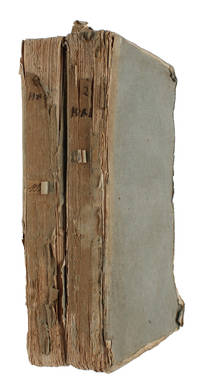
18079380London: J Johnson 1807. The Fourth Edition of Volume 1 only comprising books 1 & 2. By T R Malthus A.M. late fellow of Jesus College Cambridge and Professor of History and Political Economy in the East India College Hertfordshire. Tree calf boards pleasingly worn a little bumped to corners. Six panelled spine lettered 'Volume 1' in gilt over black a little chipped to tail. Endpapers clean front and rear. Original owner's bookplate to front pastedown features the Clan Carmichael coat of arms in the name of Richard Carmichael. A later handwritten ownership inscription to top of bookplate reads Mo Holroyd above a date of July 26 1865. To recto of title page is an additional original handwritten ownership inscription again in the name of Richard Carmichael dated November 25th 1809. Text block very sound and in very good condition. Loss noted on collation to bottom corner of pp.1 resulting in lack of final word; similar loss to pp.7 resulting in lack of bottom 2 lines of text. Otherwise complete and a very pleasing volume. Please contact Christian White Rare Books Ltd for more information or images of this item 1807 J Johnson hardcover
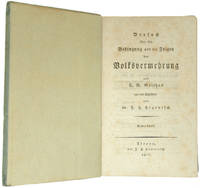
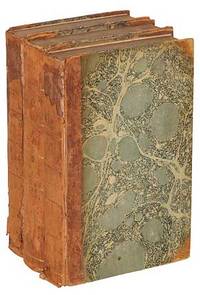
180736928Altona, J.F. Hammerich, 1807. 8vo. Bound in the two nice cont. uniform cardboardbindings w. marbled paper. Gilt lines and gilt title-labels to spines. Some wear w. minor loss of paper to capitals, hinges and corners. Small hole to paper as well as to leather title-label of spine of volume two. Some brownspotting, but overall a nice and atrractive copy. Lacking the half-tilte for the first book (merely stating ""Erstes Buch""). XVI, 368"" VIII, 358, (1) pp.
180731326Altona, J.F. Hammerich, 1807. 8vo. Bound in the two orig. blue cardboardbindings. The backs have been professionally restored, preserving the orig. printed paper title-labels and cont. paper library-labels at lower backs. Occasional brownspotting due to the paper-quality, but all in all a very nice and attractive copy. XVI, (4), 368" VIII, 358, (1) pp. Some of the first leaves of the ""Erstes Buch"" in the first volume have been misbound, but are all present.
180760615Altona, J.F. Hammerich, 1807. 8vo. 2 volumes both uncut in the original blank wrappers. Wear to extremities, front wrapper on vol. 1 detached and with tear. Missing ab. half of the paper on spines. Internally fine and clean. XVI, 368" VIII, 358, (1) pp.
180752195Altona, J.F. Hammerich, 1807. Contemp. hcalf. Gilt spine, titlelabel in leather (letters worn). Light wear to top of spine and corners. Spine rubbed. Some wear to edges of covers. A stamp on title-page. XVI, 368" VIII, 358, (2) pp. A few leaves in the first quire disbound. Scattered brownspots and a few marginal underlinings on the first 20 leaves.
180760615Altona J.F. Hammerich 1807. 8vo. 2 volumes both uncut in the original blank wrappers. Wear to extremities front wrapper on vol. 1 detached and with tear. Missing ab. half of the paper on spines. Internally fine and clean. XVI 368; VIII 358 1 pp. <br/><br/><em>Rare first German edition of this political and economic classic which constitutes Malthus' first major publication and his main work because of which he is considered the father of demography and one of the main sources of inspiration for Darwin and Wallace. It is the first translation of the "Principle on Population" into any language and it influenced German politics tremendously.The first edition was printed anonymously in London in 1798 and in 1803 the second edition which also according to Malthus himself can be said to constitute a new work appeared; -the great quarto edition from 1803 is thoroughly revised and much enlarged the title has been changed and Malthus' name appears on the title-page for the first time it is on this edition that all the preceding editions are based and in consequence also the early translations. All the later editions were minor revisions of the second one. In 1806 the third edition appeared and as soon as 1807 the first German one which is translated from the revised third edition "Die gegenwärtige Uebersetzung ist nach der dritten Ausgabe Oktav London 1806. Die Quartausgabe ist minder vollständig" Vorwort p. V. New revisions of the text kept appearing till the sixth edition in 1826. The book then as now is considered highly controversial and it has influenced all demographers ever since as well as being of immense importance to the study of economic theory and genetic inheritance. "The "Essay" was highly influential in the progress of thought in the early nineteenth-century Europe. "Parson" Malthus as Cobbett dubbed him was for many a monster and his views were often grossly misinterpreted. But his influence on social policy whether for good or evil was considerable. The Malthusian theory of population came at the right time to harden the existing feeling against the Poor Laws and Malthus was a leading spirit behind the Poor Law Amendment Act of 1834." PMM 251.Thomas Robert Malthus 1766-1834 called the "enfant terrible" of the economists was an English demographer statistician and political economist who is best known for his groundbreaking views on population growth presented in his "Essays on the Principle of Population" which is based on his own prediction that population would outrun food supply causing poverty and starvation. Among other things this caused the legislation which lowered the population of the poor in England. Malthus actually turned political economic and social thought upside down with this work which has caused him to be considered one of the 100 most influential persons in history Hart The 100: A Ranking of the most Influential Persons in History 1978. Of course he was condemned by Marx and Engels and opposed by the socialists universally but the work was of immense impact on not only politics economics social sciences etc but also on natural sciences. "Later in the "Origin of Species" he Darwin wrote that the struggle for existence "is the doctrine of Malthus applied with manifold force to the whole animal and vegetable kingdoms; for in this case there can be no artificial increase of food and no prudential restraint from marriage" p. 63. Alfred Russel Wallace who arrived at a worked-out formulation of the theory of evolution at almost precisely the same time as Darwin acknowledged that "perhaps the most important book I read was Malthus's "Principles of Population" My Life p. 232. Although there were four decennial censuses before Malthus' death he did not himself analyze the data although he did influence Lambert Quetelet and Pierre Verhulst who made precise statistical studies on growth of populations in developed countries and showed how the early exponential growth changed to an S curve." DSB IX p. 69. As Malthus realized that his theories were not satisfactorily presented or sufficiently demonstrated in the first edition from 1798 he travelled for three years through Europe gleaning statistics and then published the second edition in 1803. Among other places he travelled through Northern Germany and his detailed diaries of these journeys provided him with some of the evidence necessary for the development of his theory on population growth. The observational information that he gathered on his travels in Europe were crucial to the development of his theories which also means that the work is of great interest for other European countries and not only Britain. "In 1819 the Royal Society elected Malthus to a fellowship. He was also a member of the French Institute and the Berlin Academy and a founding member of the Statistical Society 1834." DSB IX p. 67. Printing and the Mind of Man 251 first edition. </em> unknown
180752195Altona J.F. Hammerich 1807. Contemp. hcalf. Gilt spine titlelabel in leather letters worn. Light wear to top of spine and corners. Spine rubbed. Some wear to edges of covers. A stamp on title-page. XVI 368; VIII 358 2 pp. A few leaves in the first quire disbound. Scattered brownspots and a few marginal underlinings on the first 20 leaves. <br/><br/><em>Rare first German edition of this political and economic classic which constitutes Malthus' first major publication and his main work because of which he is considered the father of demography and one of the main sources of inspiration for Darwin and Wallace. It is the first translation of the "Principle on Population" into any language and it influenced German politics tremendously.The first edition was printed anonymously in London in 1798 and in 1803 the second edition which also according to Malthus himself can be said to constitute a new work appeared; -the great quarto edition from 1803 is thoroughly revised and much enlarged the title has been changed and Malthus' name appears on the title-page for the first time it is on this edition that all the preceding editions are based and in consequence also the early translations. All the later editions were minor revisions of the second one. In 1806 the third edition appeared and as soon as 1807 the first German one which is translated from the revised third edition "Die gegenwärtige Uebersetzung ist nach der dritten Ausgabe Oktav London 1806. Die Quartausgabe ist minder vollständig" Vorwort p. V. New revisions of the text kept appearing till the sixth edition in 1826. The book then as now is considered highly controversial and it has influenced all demographers ever since as well as being of immense importance to the study of economic theory and genetic inheritance. "The "Essay" was highly influential in the progress of thought in the early nineteenth-century Europe. "Parson" Malthus as Cobbett dubbed him was for many a monster and his views were often grossly misinterpreted. But his influence on social policy whether for good or evil was considerable. The Malthusian theory of population came at the right time to harden the existing feeling against the Poor Laws and Malthus was a leading spirit behind the Poor Law Amendment Act of 1834." PMM 251.Thomas Robert Malthus 1766-1834 called the "enfant terrible" of the economists was an English demographer statistician and political economist who is best known for his groundbreaking views on population growth presented in his "Essays on the Principle of Population" which is based on his own prediction that population would outrun food supply causing poverty and starvation. Among other things this caused the legislation which lowered the population of the poor in England. Malthus actually turned political economic and social thought upside down with this work which has caused him to be considered one of the 100 most influential persons in history Hart The 100: A Ranking of the most Influential Persons in History 1978. Of course he was condemned by Marx and Engels and opposed by the socialists universally but the work was of immense impact on not only politics economics social sciences etc but also on natural sciences. "Later in the "Origin of Species" he Darwin wrote that the struggle for existence "is the doctrine of Malthus applied with manifold force to the whole animal and vegetable kingdoms; for in this case there can be no artificial increase of food and no prudential restraint from marriage" p. 63. Alfred Russel Wallace who arrived at a worked-out formulation of the theory of evolution at almost precisely the same time as Darwin acknowledged that "perhaps the most important book I read was Malthus's "Principles of Population" My Life p. 232. Although there were four decennial censuses before Malthus' death he did not himself analyze the data although he did influence Lambert Quetelet and Pierre Verhulst who made precise statistical studies on growth of populations in developed countries and showed how the early exponential growth changed to an S curve." DSB IX p. 69. As Malthus realized that his theories were not satisfactorily presented or sufficiently demonstrated in the first edition from 1798 he travelled for three years through Europe gleaning statistics and then published the second edition in 1803. Among other places he travelled through Northern Germany and his detailed diaries of these journeys provided him with some of the evidence necessary for the development of his theory on population growth. The observational information that he gathered on his travels in Europe were crucial to the development of his theories which also means that the work is of great interest for other European countries and not only Britain. "In 1819 the Royal Society elected Malthus to a fellowship. He was also a member of the French Institute and the Berlin Academy and a founding member of the Statistical Society 1834." DSB IX p. 67. Printing and the Mind of Man 251 first edition. </em> hardcover
180731326Altona J.F. Hammerich 1807. 8vo. Bound in the two orig. blue cardboardbindings. The backs have been professionally restored preserving the orig. printed paper title-labels and cont. paper library-labels at lower backs. Occasional brownspotting due to the paper-quality but all in all a very nice and attractive copy. XVI 4 368; VIII 358 1 pp. Some of the first leaves of the "Erstes Buch" in the first volume have been misbound but are all present. <br/><br/><em>Rare first German edition of this political and economic classic which constitutes Malthus' first major publication and his main work because of which he is considered the father of demography and one of the main sources of inspiration for Darwin and Wallace. It is the first translation of the "Principle on Population" into any language and it influenced German politics tremendously.The first edition was printed anonymously in London in 1798 and in 1803 the second edition which also according to Malthus himself can be said to constitute a new work appeared; -the great quarto edition from 1803 is thoroughly revised and much enlarged the title has been changed and Malthus' name appears on the title-page for the first time it is on this edition that all the preceding editions are based and in consequence also the early translations. All the later editions were minor revisions of the second one. In 1806 the third edition appeared and as soon as 1807 the first German one which is translated from the revised third edition "Die gegenwärtige Uebersetzung ist nach der dritten Ausgabe Oktav London 1806. Die Quartausgabe ist minder vollständig" Vorwort p. V. New revisions of the text kept appearing till the sixth edition in 1826. The book then as now is considered highly controversial and it has influenced all demographers ever since as well as being of immense importance to the study of economic theory and genetic inheritance. "The "Essay" was highly influential in the progress of thought in the early nineteenth-century Europe. "Parson" Malthus as Cobbett dubbed him was for many a monster and his views were often grossly misinterpreted. But his influence on social policy whether for good or evil was considerable. The Malthusian theory of population came at the right time to harden the existing feeling against the Poor Laws and Malthus was a leading spirit behind the Poor Law Amendment Act of 1834." PMM 251.Thomas Robert Malthus 1766-1834 called the "enfant terrible" of the economists was an English demographer statistician and political economist who is best known for his groundbreaking views on population growth presented in his "Essays on the Principle of Population" which is based on his own prediction that population would outrun food supply causing poverty and starvation. Among other things this caused the legislation which lowered the population of the poor in England. Malthus actually turned political economic and social thought upside down with this work which has caused him to be considered one of the 100 most influential persons in history Hart The 100: A Ranking of the most Influential Persons in History 1978. Of course he was condemned by Marx and Engels and opposed by the socialists universally but the work was of immense impact on not only politics economics social sciences etc but also on natural sciences. "Later in the "Origin of Species" he Darwin wrote that the struggle for existence "is the doctrine of Malthus applied with manifold force to the whole animal and vegetable kingdoms; for in this case there can be no artificial increase of food and no prudential restraint from marriage" p. 63. Alfred Russel Wallace who arrived at a worked-out formulation of the theory of evolution at almost precisely the same time as Darwin acknowledged that "perhaps the most important book I read was Malthus's "Principles of Population" My Life p. 232. Although there were four decennial censuses before Malthus' death he did not himself analyze the data although he did influence Lambert Quetelet and Pierre Verhulst who made precise statistical studies on growth of populations in developed countries and showed how the early exponential growth changed to an S curve." DSB IX p. 69. As Malthus realized that his theories were not satisfactorily presented or sufficiently demonstrated in the first edition from 1798 he travelled for three years through Europe gleaning statistics and then published the second edition in 1803. Among other places he travelled through Northern Germany and his detailed diaries of these journeys provided him with some of the evidence necessary for the development of his theory on population growth. The observational information that he gathered on his travels in Europe were crucial to the development of his theories which also means that the work is of great interest for other European countries and not only Britain. "In 1819 the Royal Society elected Malthus to a fellowship. He was also a member of the French Institute and the Berlin Academy and a founding member of the Statistical Society 1834." DSB IX p. 67. Printing and the Mind of Man 251 first edition. </em> unknown
180736928Altona J.F. Hammerich 1807. 8vo. Bound in the two nice cont. uniform cardboardbindings w. marbled paper. Gilt lines and gilt title-labels to spines. Some wear w. minor loss of paper to capitals hinges and corners. Small hole to paper as well as to leather title-label of spine of volume two. Some brownspotting but overall a nice and atrractive copy. Lacking the half-tilte for the first book merely stating "Erstes Buch". XVI 368; VIII 358 1 pp. <br/><br/><em>Rare first German edition of this political and economic classic which constitutes Malthus' first major publication and his main work because of which he is considered the father of demography and one of the main sources of inspiration for Darwin and Wallace. It is the first translation of the "Principle on Population" into any language and it influenced German politics tremendously.The first edition was printed anonymously in London in 1798 and in 1803 the second edition which also according to Malthus himself can be said to constitute a new work appeared; -the great quarto edition from 1803 is thoroughly revised and much enlarged the title has been changed and Malthus' name appears on the title-page for the first time it is on this edition that all the preceding editions are based and in consequence also the early translations. All the later editions were minor revisions of the second one. In 1806 the third edition appeared and as soon as 1807 the first German one which is translated from the revised third edition "Die gegenwärtige Uebersetzung ist nach der dritten Ausgabe Oktav London 1806. Die Quartausgabe ist minder vollständig" Vorwort p. V. New revisions of the text kept appearing till the sixth edition in 1826. The book then as now is considered highly controversial and it has influenced all demographers ever since as well as being of immense importance to the study of economic theory and genetic inheritance. "The "Essay" was highly influential in the progress of thought in the early nineteenth-century Europe. "Parson" Malthus as Cobbett dubbed him was for many a monster and his views were often grossly misinterpreted. But his influence on social policy whether for good or evil was considerable. The Malthusian theory of population came at the right time to harden the existing feeling against the Poor Laws and Malthus was a leading spirit behind the Poor Law Amendment Act of 1834." PMM 251.Thomas Robert Malthus 1766-1834 called the "enfant terrible" of the economists was an English demographer statistician and political economist who is best known for his groundbreaking views on population growth presented in his "Essays on the Principle of Population" which is based on his own prediction that population would outrun food supply causing poverty and starvation. Among other things this caused the legislation which lowered the population of the poor in England. Malthus actually turned political economic and social thought upside down with this work which has caused him to be considered one of the 100 most influential persons in history Hart The 100: A Ranking of the most Influential Persons in History 1978. Of course he was condemned by Marx and Engels and opposed by the socialists universally but the work was of immense impact on not only politics economics social sciences etc but also on natural sciences. "Later in the "Origin of Species" he Darwin wrote that the struggle for existence "is the doctrine of Malthus applied with manifold force to the whole animal and vegetable kingdoms; for in this case there can be no artificial increase of food and no prudential restraint from marriage" p. 63. Alfred Russel Wallace who arrived at a worked-out formulation of the theory of evolution at almost precisely the same time as Darwin acknowledged that "perhaps the most important book I read was Malthus's "Principles of Population" My Life p. 232. Although there were four decennial censuses before Malthus' death he did not himself analyze the data although he did influence Lambert Quetelet and Pierre Verhulst who made precise statistical studies on growth of populations in developed countries and showed how the early exponential growth changed to an S curve." DSB IX p. 69. As Malthus realized that his theories were not satisfactorily presented or sufficiently demonstrated in the first edition from 1798 he travelled for three years through Europe gleaning statistics and then published the second edition in 1803. Among other places he travelled through Northern Germany and his detailed diaries of these journeys provided him with some of the evidence necessary for the development of his theory on population growth. The observational information that he gathered on his travels in Europe were crucial to the development of his theories which also means that the work is of great interest for other European countries and not only Britain. "In 1819 the Royal Society elected Malthus to a fellowship. He was also a member of the French Institute and the Berlin Academy and a founding member of the Statistical Society 1834." DSB IX p. 67. Printing and the Mind of Man 251 first edition. </em> hardcover
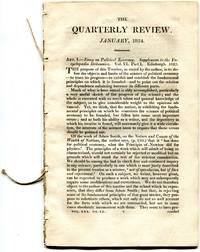
1824000011084London: John Murray 1824. Disbound. Good. 8vo. 24 cm x 13.5 cm. 1 298-334 pp. Pamphlet. The Quarterly Review was a British periodical that began in 1809. This is a review of Thomas Malthus' Principles of Political Economy and the writers of this review frequently compare Malthus' work to Adam Smith's The Wealth of Nations. A fascinating look at what Malthus' contemporaries thought of his work a work which would later be praised by J.M. Keynes the twentieth-century economist. This article was once bound in a compendium of the Quarterly review but now lacks boards and wraps. The stitching is present on the side and the final leaf is starting from the stitching. John Murray unknown
1808385225London: Sold by T. Becket 1808. Hardcover. Fair. First edition. Volume 56 May to August 1808. Octavo. Contemporary half calf and marbled paper over boards red morocco spine label. The leather is dry and worn front joint is split else a good sound copy. Armorial bookplate of Margaret Smith Burges on the front pastedown. Contains reviews of George Crabbe's "Poems" Jarrold's "Answer" to Malthus's "Essay on the Principle of Population" Malthus's "A Reply to the Essay on Population" and much more. Sold by T. Becket hardcover
1821267479London: J. Porter 1821. Hardcover. Fair. First edition. Volumes 94-96 Complete three volume set for 1821. Octavos. Contemporary half calf and marbled paper boards. Overall scuffing to the spine and boards chipping to the spine backs else a good sound set. Contains reviews of Shelley's "The Cenci A Tragedy" and "Prometheus Unbound" William Edward Parry's two "Journals" of a Voyage for the Discovery of a North-West Passage and a Voyage of Discovery to the Arctic Regions the "Principles of Political Economy" by Malthus "The History of British India" by James Mill and much more. J. Porter hardcover
1807185282London: Printed for Longman Hurst Rees and Orme 1807. Though his theories were so cruel his heart and manners were most kindly and courteous Second edition presented and inscribed by Thomas Malthus: "East India College Awarded to Mr John Trotter at the Public Examination of December 1817 as the first of his Class in Political Economy T. Rob. Malthus". Malthus taught as professor of history and political economy at the East India Company College at Haileybury from 1805 to his death in 1834 training generations of EIC management. Writing many years later a former student recalled "We called him Pop; not in derision for we had a great but rather distant respect for him. Though his theories were so cruel his heart and manners were most kindly and courteous" quoted in Maureen Alexander Turner p. 54. John Trotter 1800-1825 entered the college in 1816 and subsequently joined the EIC; he died seven years later aboard the Royal George just off Penang in Malaya which was then an EIC port. Trotter was the son of Alexander Trotter d. 1842 the financially imaginative paymaster of the Royal Navy. His engraved armorial bookplate is in both volumes; Malthus's ink inscription is on the front free endpaper verso. The History of the Anglo-Saxons by Sharon Turner 1768-1847 was originally published from 1799 to 1805. It quickly became "a powerful influence on historical thought for the succeeding half-century" ODNB and remains acknowledged as a turning point in Anglo-Saxon studies and a benchmark in historiography. Writing with a clear eye on the British Empire of his own day - in which Trotter's East India Company played so prominent a role - Turner presents the Anglo-Saxons as central to the historical development that set England on its imperial course. 2 vols quarto 271 x 213 mm pp. x 499 1; viii 472 8. Large hand-coloured engraved folding map by Neele showing "Territory inhabited by the Ancient Saxons north of the Elbe" as frontispiece of vol. I. Contemporary calf rebacked spines ruled and lettered in gilt covers with double-rule panel in gilt crest of the East India Company College blocked in gilt to centre turn-ins in blind marbled endpapers edges sprinkled in brown and red. Light rubbing extremities neatly restored infrequent damp staining to otherwise clean contents short closed tear to inner margin of folding map: just about a very good copy. Maureen Alexander Turner The Educational Ideas and Influence of Thomas Robert Malthus 1766-1834 University of Glasgow Department of Education PhD thesis 1991. unknown
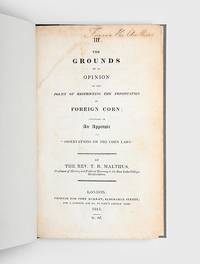
1815172737London: Printed for John Murray and J. Johnson and Co. 1815. Malthusian economics stress-tested First edition presentation copy inscribed in a secretarial hand "From the Author" at the head of the title page. The Grounds of an Opinion is a rare Malthusian argument in favour of economic interventionism supporting the restrictions imposed by the Corn Laws on foreign grain. In his wider work on population and poverty Malthus promoted an essentially laissez-faire approach to political economy. In the Essay on the Principles of Population 1798 for example he rejected poor relief and centralized intervention as fatally detrimental to the work ethic of the poor. The Grounds of an Opinion therefore shocked his circle of Whiggish friends but Malthus justified his deviation on grounds of national security: encouraging domestic production was the only way to ensure self-sufficiency in food within a fickle and changeable continent. Malthus's presentation may have been less effective than he hoped. A leaf of contemporary manuscript notes tipped in after p. 4 records considerable dissatisfaction with Malthus's "most extraordinary assertion". Octavo 208 x 128 mm pp. ii 48; lacking terminal advertisement leaf. Recent brown quarter calf grey paper-covered boards. Infrequent 20th-century pencil annotations to contents. Light foxing vertical tear to title page neatly repaired and upper inner corner replaced: a very good copy. Einaudi 3672; Goldsmiths' 2177; Kress B6535; Mattioli 2214; Sraffa 3690. hardcover
1820119668London: John Murray 1820. First edition of this classic work regarding nature of labor demand and profit. Octavo original boards retaining the original paper spine label. In very good condition. Ownership inscription from the African Society and stamp to the title page. Rare in the original boards. "There can be no doubt that Malthus' importance for economists today rests mainly on his Principles of Political Economy. It was because of this latter work that J. M. Keynes 1933 reinstated Malthus as a major figure in modern economic thought" New Palgrave. "In his 'Principles of Political Economy' Malthus was proposing investment in public work and private luxury as a means of increasing effective demand and hence as a palliative to economic distress. The nation he thought must balance the power to produce and the will to consume" DSB. "The Principles had only a limited impact at the time and was severely criticized by J. R. McCulloch and Ricardo; the latter prepared extensive critical notes. But more recently it has received greater recognition largely as a result of the comments by J. M. Keynes in the 1930s. Keynes argued that Malthus's theory of effective demand provided a scientific explanation of unemployment and that the hundred-year domination of Ricardo over Malthus had been a disaster for the progress of economics. Keynes believed that if economics had followed Malthus instead of being constrained by Ricardo in an artificial groove the world would be a much wiser and richer place" ODNB. John Murray hardcover books
1820242928London: John Murray 1820. First edition. vi 601 pp. 1 vols. 8vo 219 x 132 mm. Bound in later half cloth and marbled boards paper label. Very good. First edition. vi 601 pp. 1 vols. 8vo 219 x 132 mm. First edition of this important classic of economic theory. "There can be no doubt that Malthus' importance for economists today rests mainly on his Principles of Political Economy. It was because of this latter work that J. M. Keynes 1933 reinstated Malthus as a major figure in modern economic thought" New Palgrave. "One of the founders of modern economics" Malthus was credited by Keynes with framing the theory "that a lack of effective demand can cause economic crises" PMM 251. "In his Principles of Political Economy Malthus was proposing investment in public works and private luxury as a means of increasing effective demand and hence as a palliative to economic distress. The nation he thought must balance the power to produce and the will to consume" DSB IX:70. Goldsmith 22767; Lowndes 1459; Kress C577 John Murray unknown books
182123029Boston: Wells and Lilly 1821. First American edition of this landmark work in political economy. Octavo bound in three quarters leather over marbled boards black leather morocco spine label. In near fine condition. In his Principle of Political Economy Malthus was proposing investment in public works and private luxury as a means of increasing effective demand and hence as a palliative to economic distress. The nation he thought must balance the power to produce and the will to consume" DSB. Wells and Lilly hardcover books
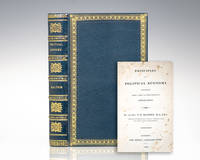
182066825"If Only Malthus Instead of Ricardo Had Been the Parent Stem From Which Nineteenth-Century Economics Proceeded What a Much Wiser and Richer Place the World Would be Today" MALTHUS Thomas Robert. Principles of Political Economy. Considered with a View to Their Practical Application. London: John Murray 1820. First edition. Octavo. vi 12-601602. Original boards uncut. With original paper label on spine. Hinges expertly and almost invisibly repaired. Old bookplate from "The Library of Victoria" with no other library markings. A very clean copy internally fine. Very scarce in original boards. Housed in a custom quarter black morocco clamshell gilt-stamped. First edition of Malthus' principal contribution to economic theory. Schumpeter describes Malthus' work in relation to that of his predecessors Adam Smith and Ricardo as follows: "Ricardo's work.started with the Wealth of Nations and recoined the latter's theoretical contents by a method that centered in the concept of value. Exactly the same thing is evidently true of the work of Malthus.except for his theory of saving and investment which on the face of it seems to be Malthus's own all the elements that enter into the analytic apparatus of that work and even its terminological arrangements point to the First book of the Wealth of Nations. Only whereas Ricardo recoined the doctrine of Wealth by means of the labor-quantity theory of value Malthus recoined it by the means of the theory of value that A. Smith actually used namely the theory of supply and demand.whereas Ricardo's analytic apparatus is geared to the problem of distribution.Malthus. geared his apparatus to the analysis of the whole economic process.Therefore Malthus should.stand in the history of analysis not only as the author of a valid alternative to Ricardo's theory but as the sponsor or rather as one of the sponsors of the victorious one." "Although Malthus is best known for the views on population contained in his Essay on Population.there can be no doubt that his importance for economists today rests mainly on his Principles of Political Economy 1820. It was because of the latter work that J. M. Keynes reinstated Malthus as a major figure in modern economic thought". New Palgrave. Cress C577. HBS 66825. $7500 John Murray hardcover books
182046619London: John Murray 1820. First edition 8vo vi 601 1 pp. Contemporary black half calf a little rubbed covers very slightly damp stained and bowed gilt spine and red label. "The Principles had only a limited impact at the time. more recently it has received greater recognition largely as a result of the comments by J. M. Keynes in the 1930s. Keynes argued that Malthus's theory of effective demand provided a scientific explanation of unemployment and that the hundred-year domination of Ricardo over Malthus had been a disaster for the progress of economics. Keynes believed that if economics had followed Malthus instead of being constrained by Ricardo in an artificial groove the world would be a much wiser and richer place." ODNB. Goldsmiths 22767. Kress C577. London: John Murray unknown
18208125London: John Murray 1820. 1820 vi 601 1 p. First edition. It has a good quality mid-twentieth century binding with a polished morocco spine marbled boards and vellum corners. The spine with gold lines and a contrasting label. Minor rubs to the spine ends otherwise in very good condition. There is an undated pencil note on the title page '£45 Repair'. The text with a few signs of use and some pale paper toning. IMPORTANT COOPERATIVE MOVEMENT PROVENANCE: The title page is inscribed at the head 'Society for promoting Working Men's Assocns / 34 Castle Place -- Oxford Street with a shelfmark R31'. The Society was founded in 1849 by the Christian Socialists in an attempt to found self governing workshops. Lower down the title page is the oval stamp of Ormond Street Working Mens College which still exists in Camden. Founded in 1854 by Frederick Denison Maurice Wiki describes it as 'The Working Men's College is among the earliest adult education institutions established in the United Kingdom and Europe's oldest extant centre for adult education. Founded by Christian socialists at its inception it was at the forefront of liberal education philosophy.' At different times its teachers included Thomas Hughes whose latin lectures were apparently not so popular as his boxing club F.J. Furnival and E.M. Forster. London: John Murray, hardcover
1821040304Boston MA: Wells and Lilly 1821. Book. Very Good. Full-Leather. First American Edition. 8vo - over 7¾" - 9¾" tall. Original full tree calf gilt on burgundy title label mounted on upper spine. Rubbed along edges some surface cracking/crazing rubbed joints and spine extremities. Foxed endpapers some toning and scattered foxing to interior but otherwise intact with firm binding. Former owner's signature on front flyleaf. viii472 pp. Exceptionally scarce first American edition issued a year after the first British edition of 1820. Wells and Lilly Hardcover
18363620869William Pickering 1836. Spine in poor conidition. Browning of pages.This book has hardback covers. Ex-library With usual stamps and markings In poor condition suitable as a reading copy. No dust jacket. Please note the Image in this listing is a stock photo and may not match the covers of the actual item750grams ISBN: William Pickering hardcover
1820884511London: 1820. Some light foxing to the title page otherwise a superior copy in the original papercovered boards with paper spine label. Malthus' Principles of Political Economy did not have its full impact on economic theory until it was revived by J.M. Keynes and P. Sraffa in the twentieth century. Math and technology aside Malthus argues not that society tends toward cannibalistic starvation but that either society will "preventatively" control its population or nature will "correctively" reduce population"Several philosophers and speculatists had supposed that a certain state of society very different from any that has hitherto existed was in itself practicable; and that if it were realised it would be productive of a far greater degree of human happiness than is compatible with the present institutions of society."21 Malthus' argument as stated by Hazlitt is that if man were to give up his existing social institutions then there would be as much bad as good come of it. "For says Mr Malthus though this improved state of society were actually realized it could not possibly continue but must soon terminate in a state of things pregnant with evils for more insupportable than any we at present endure.". First Edition. Contemporary Blue Cloth. Excellent. 8vo. Hardcover
1820143844London: John Murray 1820. Rare first edition of Malthus' classic work. Octavo bound in full diced morocco raised bands gilt titles and tooling to the spine front and rear panels marbled endpapers. In near fine condition. An exceptional presentation. Thomas Malthus was an English economist known for his work in the fields of political economics and demography. His theory that prosperity and production lead not to utopia but to population growth and thereby back to social imbalance known as the "Malthusian trap" was expounded in his Essay on the Principle of Population 1789 one of his most notable and debated works. His Principles of Political Economy was written as a polemic against David Ricardo's On the Principles of Political Economy and Taxation and Say's Law arguing that demand did not grow simultaneously with supply but that they should be analyzed independent of each other expounding ideas which became influential on Keynsian economics. Both these works were divisive incurring backlash and support amongst notable economists. The bleak message of his Principle of Population rendered Malthus a notorious figure: Ebenezer Scrooge from A Christmas Carol for example justifies his refusal to give charity as a Malthusian attempt to control the population. John Murray hardcover
1820002253London England: John Murray 1820. 1st Edition . Half-Leather. Fair. Contemporary calf with hand marbled covers; leather spine dry flaking and rubbed with small piece missing and gold stamped title barely visiible; covers detached; front paste down with previous owner's book plate and name neatly in black ink; foxing throughout text otherwise very good without markings; 8vo; with 601 pages. <br/> <br/> John Murray hardcover