443 résultats
2090502130400197Kobun do shobo N.A. Soft Cover. Fine. Number of pages: Taisho 13 4th edition Size: 46 size 397 pages Kobun do shobo paperback
1019175761.Ghardcover. Good. Access codes and supplements are not guaranteed with used items. May be an ex-library book. hardcover
1019180617.Gpaperback. Good. Access codes and supplements are not guaranteed with used items. May be an ex-library book. paperback
ria9781019175767_inpHardcover. New. New Book; Fast Shipping from UK; Not signed; Not First Edition; This work has been selected by scholars as being culturally important and is part of the knowledge base of civilization as we know it.This work is in the "public domain in the United States of America and possibly other nations. Withi hardcover
1992Cambridge-9780521429726Cambridge University Press 1992. PAPERBACK. New. Cambridge University Press paperback
1992Q-0521429722Cambridge University Press 1992-08-28. Paperback. New. New. In shrink wrap. Looks like an interesting title! Cambridge University Press paperback
0521419549.Ghardcover. Good. Access codes and supplements are not guaranteed with used items. May be an ex-library book. hardcover
1992Q-0521419549Cambridge University Press 1992-08-28. Hardcover. New. New. In shrink wrap. Looks like an interesting title! Cambridge University Press hardcover
1992SONG0521419549Cambridge University Press 1992-08-28. hardcover. Used: Good. 5.75x1.00x9.00. Buy with confidence. Excellent Customer Service & Return policy. Cambridge University Press hardcover
1992DADAX0521419549Cambridge University Press 1992-08-28. hardcover. New. 5.75x1.00x9.00. Buy with confidence. Excellent Customer Service & Return policy. Cambridge University Press hardcover
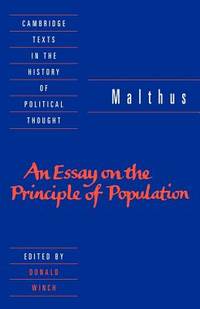
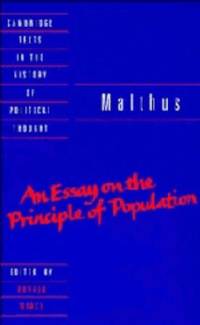
B9780521419543Hardback. New. This 1992 book provides a student audience with the best scholarly edition of Malthus' Essay on the Principle of Population. Written in 1798 as a polite attack on post-French-revolutionary speculations on the theme of social and human perfectibility it remains one of the most powerful statements of the limits to human hopes set by the tension between population growth and natural resources. hardcover
ria9780521419543_inpHardcover. New. New Book; Fast Shipping from UK; Not signed; Not First Edition; This 1992 book provides a student audience with the best scholarly edition of Malthus' Essay on the Principle of Population. Written in 1798 as a polite attack on post-French-revolutionary speculations on the theme of social and human p hardcover
1996JE-GYNI-TGYWRoutledge 1996. Hardcover. Very Good. Very faint small pink mark to long page edge. No other marks to book or cover. Clean bright pages tight binding pristine cover. Looks like new. An excellent copy of this rare volume. Items are dispatched the following or the same day. Please note our excellent customer feedback. <br/> <br/> Routledge hardcover
1020573007.Ghardcover. Good. Access codes and supplements are not guaranteed with used items. May be an ex-library book. hardcover
94302London Academic Press 1983. 8° XIX 416 S. OLwd. Stemp. a Vors. sonst tadell. 010 London, Academic Press, 1983 unknown
19682080502107000631Iwanamishoten 1968. Soft Cover. Fine. Size: 15cm Number of books: 2 Iwanamishoten paperback
91296Winterthur Keller 1957. 8° XXIV 200 S. Brosch. Min. beschienen u. gebrauchsspurig Stempel a. Schmutztitel innen sonst tadellos. EA. Dissertation Universität Zèrich. 010 Winterthur, Keller, 1957 unknown
838244-nnew. unknown
838244like new. unknown
45013685like new. unknown
45578558like new. unknown
6380363Cambridge University Press CUP pp. 430 Index. Hardback. New. Cambridge University Press CUP hardcover
126979 May 1827. 'L. I. Fields' i.e. Lincolns Inn Fields London. 2pp. 12mo. 40 lines. Bifolium. Good on aged paper. The reverse of the second leaf carries half of a red wax seal as well as the address to 'James Loch Esqr Bloomsbury Square'. The letter begins: 'My dear Loch Some friends of mine from the Country are desirous of seeing Lord Stafford's & Lord Grosvenor's pictures some time next week; & they understand that the obtaining of Tickets is not a matter of course but that some little interest is necessary.' He asks for assistance 'with regard to Cleveland House . for Mrs Johnston & party about 5 or 6 persons'. He is going 'to the Cambridge Election' on the following day and thinks that it will be 'very keenly contested'. On his return he hopes 'to attend the Council of the London University' when he hopes 'that Horner's business will be finally & satisfactorily settled'. He has heard 'nothing more about Silk Gowns' but 'Willy Brougham . persists in retaining his appointment and will not be scared into resignation like Plunkett by the Chancery Lawyers.' In the last paragraph he deprecates the news that 'Lord Exeter is to have one of the blue Ribbands though he is no friend of Canning's & indeed closely connected with the high Tory opposition'. This is in his view 'one among many instances of C's weakness & entire dependence upon the higher power.' There is no mention of Loch in Lady Seymour's 'The "Pope" of Holland House Selections from the Correspondence of John Whishaw and his Friends 1813-1840' 1906 and the year 1827 is skirted over. 9 May [1827]. 'L. I. Fields' [i.e. Lincolns Inn Fields, London]. unknown
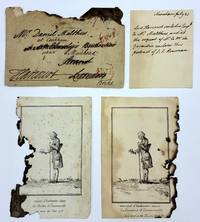
17791748Original manuscript / ink drawing. c.1779-1788. Pen and ink portrait of Jean Jacques Rousseau in the garden at Ermenonville titled beneath "venant d'herboriser dans les Jardins d'Ermenonville au mois de Juin 1778" along with a printed version of the image signed Mayer Georg Friedrich Meyer engraved by J. M. Moreau in 1779. Each 15 x 10cm. Accompanied by an ink manuscript letter 10.5 x 8cm headed "Nuneham July 21" presenting the images: "Lord Harcourt sends his compts. to Mr. Malthus and at the request of Mr. le Mqs. de Girardin encloses this portrait of J: J: Rousseau". Contained within the original postal cover addressed to Mr. Daniel Malthus redirected from his London address to Cookham signed at the foot by Harcourt under the parliamentary privilege franking system with additional "free" handstamps to the front panel and further postal markings to the reverse the specific types of postal markings on the cover indicate a date range of 1779-1788. The ink portrait engraved portrait and postal cover all have historical burn marks and associated loss as well as toning and light foxing; the letter remains in good order. A fascinating and intimate gift linking several late eighteenth-century intellectuals all connected to the French philosopher Jean Jacques Rousseau in the form of two portraits of the philosopher one ink one engraved sent from Rousseau's last pupil René de Girardin Marquis of Vauvray 1735-1808 via the radically-inclined politician and gardener George Harcourt 2nd Earl Harcourt 1736-1809 to the father of the famous economist Thomas Malthus Daniel Malthus 1730-1800 himself a friend of Rousseau.</p><p>The present portrait depicts Rousseau in the final weeks of his life 'botanizing' in the garden at Ermenonville the first French landscape garden created by his pupil René de Girardin who here sends the portrait. Ermenonville was itself inspired by Rousseau's ideas created by Girardin as an illustration of his philosophical and social beliefs regarding the place of man in nature. Within the garden Girardin began construction of a house for Rousseau modelled after the "Élysée" of Julie in Rousseau's novel <em>La Nouvelle Héloïse</em>. Rousseau himself visited the garden in May 1778 staying in a small thatched cottage where he remained until his death in July that year. Girardin subsequently made a tomb for Rousseau at Ermenonville which became a destination of pilgrimage for his admirers until his body was re-interred at the Pantheon in Paris in October 1794. Following Rousseau's death Girardin and two other of his friends of prepared a complete edition of his works using the manuscripts of some of his most important writings including <em>Les Confessions </em>and <em>Les Rêveries du promeneur solitaire</em> which he had left behind at Ermenonville. This new edition was published in Geneva between 1780 and 1782 and contributed greatly to the spread of Rousseau's ideas throughout France and beyond in the years leading up to the French Revolution.</p><p>The original drawing of Rousseau at Ermenonville was executed by the German artist Georg Friedrich Meyer 1733-1779 who also resided with Girardin at Eremenonville during his final years and where he became well acquainted with Rousseau. Other similar versions of this drawing by Meyer exist one being in the collection of the Fine Art Museum of San Francisco and it is unclear as to whether the present pen and ink drawing is an original work by Meyer or a contemporary copy of the engraving - either way its origin from the hands of Girardin himself provide it with sufficient interest. </p><p>The present two portraits subsequently made their way to the politician George Harcourt 2nd Earl Harcourt previously Viscount Nuneham a supporter of John Wilkes friend of Catherine Macaulay opponent of the war against the American colonies and pioneering garden designer. Here he apparently acted as an intermediary in this distinguished friendship circle sending the pictures on to Daniel Malthus - enlightened gentlemen friend of David Hume and Rousseau and father to Thomas Malthus.</p><p>Daniel Malthus had first become acquainted with Rousseau when he visited him at Môtiers in May 1764. He later invited Rousseau and his wife Thérèse to stay at his estate "The Rookery" near Dorking Surrey during the couple's visit to England in 1766 with Malthus hoping to find them a place to settle nearby. They visited the Malthus home for a day with Hume about three weeks after Thomas's birth but ultimately settled in Derbyshire for the remainder of their visit. Daniel and several family members subsequently went north to visit Rousseau joining him on botanical expeditions - a shared passion. Rousseau and Malthus maintained a lifelong correspondence and botanical exchange with the pair enthusiastically swapping English and French literature botanical specimens and philosophical musings. Later in life Rousseau would divide his personal herbarium among his friends sending parts of it to Daniel who also ultimately purchased his botanical library.</p><p>Daniel Malthus was - like Girardin - a dedicated Rousseauist using like many enlightened families of the period Rousseau's <em>Émile</em> as a guide to the education of his children; as he described in a letter to Rousseau of 1768 his children botanized in their local area went on nature walks carried out farm work and conducted their own little experiments. Indeed in his last known letter to Rousseau he declared "if I am ever known it will be as the friend of Rousseau". He would however ultimately be best known by his progeny Thomas who would go on to famously argue against the writings of the thinkers who proclaimed humanity's perfectibility preferred by his father including Rousseau William Godwin and the Marquis de Condorcet. Regardless of this Daniel keenly supported his adult son's endeavours with Thomas's earlier unorthodox education itself also having played a key role in shaping his knowledge of natural law and mathematics. MacDonald J. Marc "Malthus and the Philanthropists 1764–1859: The Cultural Circulation of Political Economy Botany and Natural Knowledge" Social Sciences 2017 61 4. [Original manuscript / ink drawing]. unknown