Louis XVILivre Rare Book
1 043 résultats
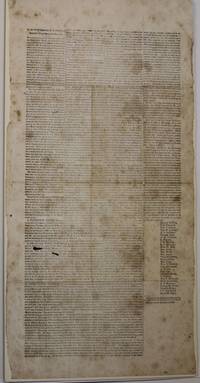
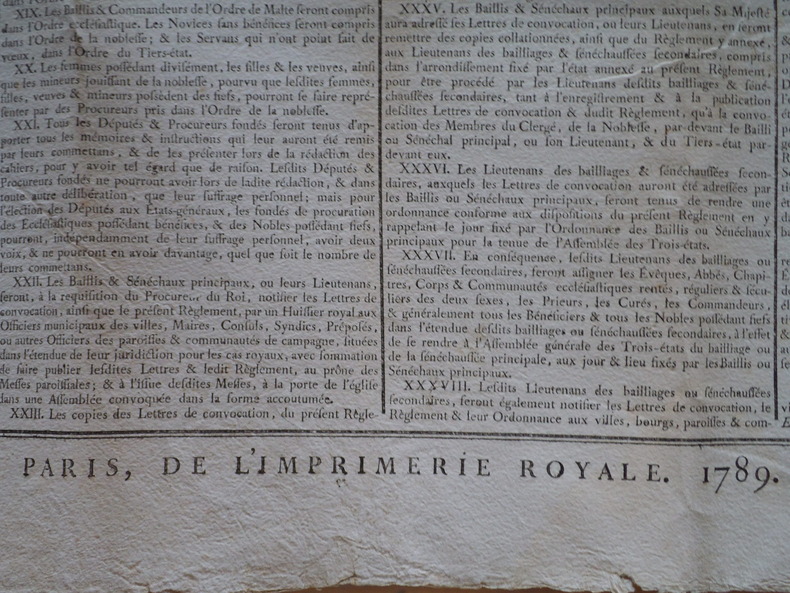
8525Paris, de l’imprimerie Royale, le 24 janvier 1789. Placard in folio, 565x860mm.Sur papier fort. Texte sur 4 colonnes séparées par un filet noir. Pliures, ainsi qu’une mouillure (sans gravité). Il s’agit de l’acte initial de la Révolution Française. La détresse financière à la veille de la Révolution. Il ne se trouve plus personne qui veuille prêter au ROI et les privilèges résistent opiniâtrement à toute création d’impôt les atteignant dans leur privilège ; le gouvernement de Louis XVI se trouve ainsi acculé à la nécessité de s’adresser à la Nation pour en obtenir de l’argent et convoquer pour cela, les Etats-Généraux. Cette convocation, aboutissement d’un conflit d’ordre fiscal entre le ROI et les privilégiés, est l’acte décisif qui ouvre l’ère Révolutionnaire. Les privilégiés, en la réclamant, le ROI en l’accordant, fournissent à la Nation l’instrument nécessaire avec lequel elle va faire la REVOLUTION. Cette grande affiche règle les modalités d'élection des députés aux Etas-Généraux et la confection des cahiers de doléances. Rare et précieux document
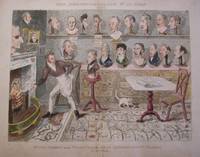
elala2053Alnwick: 1826-32. An album containing 36 engraved and etched caricatures including at least 25 dealing with the Alnwick Northumberland election of 1826 some additional dealing with the Northumberland election of 1832 and 3 broadsides 2 illustrated. various sized sheets 25 hand-coloured most mounted on larger uniform sheets. bound as an oblong folio in later half morocco extremities worn short splits in lower joints scattered soiling & foxing several sheets folded & some torn but with no loss of image. ownership entry of William Graham Richardson North Shields. The 1826 Alnwick election for two parliamentary representatives for Northumberland was a hotly contested one marked by much rancour and animosity among the candidates and the voters. Some voters engaged in the practice of plumping or voting for only a single candidate rather than two. Of the four contestants Henry Thomas Liddell Liddle Tory Matthew Bell Tory Thomas Wentworth Beaumont at the time an Independent Reformer and Henry George Grey Viscount Howick Whig Liddell and Bell emerged victorious. Another figure appearing in some of the caricatures is John George Lambton later first Earl of Durham Governor General of Canada 1837 and author of the celebrated Durham Report 1839. While supporting the candidature of his brother-in-law Lord Howick Lambton fought a bloodless duel with T.W.Beaumont. A full listing of the broadsides and caricatures some of which carry the imprint of W.Stephenson or W.Davison is available upon request. [Alnwick]: 1826-32. unknown
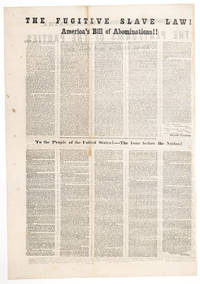
185227980<p><strong>Boston Fugitive Slave Law Printing on Free Soil Party Broadsheet</strong></p><p>"<em>a vote for either of the former candidates is as truly a vote in favor of the sustenance defence and encouragement of American slavery in all its hideousness as a vote for the devil were a vote in favor of sin…</em>"</p><p>This broadsheet prints a summary of the three major party platforms—the "Compromise Democratic" Party the Whig Party and the Free Democratic Free Soil Party—headed with the injunction to "<em>Read Reflect and then Act!</em>" The second page includes the text of the Fugitive Slave Law or "<em>America's Bill of Abominations!!</em>" passed in September 1850 and an editorial by "Alexander" that explains the benefits of the Free Soil Party over the other two parties.</p><p><strong>ELECTION OF 1852. FUGITIVE SLAVE LAW.</strong> Printed Broadsheet <em>Boston Commonwealth</em> Extra July 1852. 2 pp. 25½ x 22 in.</p><p><strong>Excerpts</strong><br />"<em>The Platforms of the Parties. Read Reflect and then Act!</em>" p1</p><p>"<em>The Fugitive Slave Law! America's Bill of Abominations!!</em>" p2</p><p><em>"…Section 6</em></p><p><em>And be it further enacted That when a person held to service or labor in any State or Territory of the United States has heretofore or shall hereafter escape into another State or Territory of the United States the person or persons to whom such service or labor may be due or his her or their agent or attorney duly authorized by power of attorney in writing acknowledged and certified under the seal of some legal officer or court of the State or Territory in which the same may be executed may pursue and reclaim such fugitive person either by procuring a warrant from some one of the courts judges or commissioners aforesaid of the proper circuit district or county for the apprehension of such fugitive from service or labor or by seizing and arresting such fugitive where the same can be done without process and by taking or causing such person to be taken forthwith before such court judge or commissioner whose duty it shall be to hear and determine the case of such claimant in a summary manner; and upon satisfactory proof being made by deposition or affidavit in writing to be taken and certified by such court judge or commissioner or by other satisfactory testimony duly taken and certified by some court magistrate justice of the peace or other legal officer authorized to administer an oath and take depositions under the laws of the State or Territory from which such person owing service or labor may have escaped with a certificate of such magistracy or other authority as aforesaid with the seal of the proper court or officer thereto attached which seal shall be sufficient to establish the competency of the proof and with proof also by affidavit of the identity of the person whose service or labor is claimed to be due as aforesaid that the person so arrested does in fact owe service or labor to the person or persons claiming him or her in the State or Territory from which such fugitive may have escaped as aforesaid and that said person escaped to make out and deliver to such claimant his or her agent or attorney a certificate setting forth the substantial facts as to the service or labor due from such fugitive to the claimant and of his or her escape from the State or Territory in which he or she was arrested with authority to such claimant or his or her agent or attorney to use such reasonable force and restraint as may be necessary under the circumstances of the case to take and remove such fugitive person back to the State or Territory whence he or she may have escaped as aforesaid. In no trial or hearing under this act shall the testimony of such alleged fugitive be admitted in evidence; and the certificates in this and the first fourth section mentioned shall be conclusive of the right of the person or persons in whose favor granted to remove such fugitive to the State or Territory from which he escaped and shall prevent all molestation of such person or persons by any process issued by any court judge magistrate or other person whomsoever.</em></p><p><em>Section 7</em></p><p><em>And be it further enacted That any person who shall knowingly and willingly obstruct hinder or prevent such claimant his agent or attorney or any person or persons lawfully assisting him her or them from arresting such a fugitive from service or labor either with or without process as aforesaid or shall rescue or attempt to rescue such fugitive from service or labor from the custody of such claimant his or her agent or attorney or other person or persons lawfully assisting as aforesaid when so arrested pursuant to the authority herein given and declared; or shall aid abet or assist such person so owing service or labor as aforesaid directly or indirectly to escape from such claimant his agent or attorney or other person or persons legally authorized as aforesaid; or shall harbor or conceal such fugitive so as to prevent the discovery and arrest of such person after notice or knowledge of the fact that such person was a fugitive from service or labor as aforesaid shall for either of said offences be subject to a fine not exceeding one thousand dollars and imprisonment not exceeding six months by indictment and conviction before the District Court of the United States for the district in which such offence may have been committed or before the proper court of criminal jurisdiction if committed within any one of the organized Territories of the United States; and shall moreover forfeit and pay by way of civil damages to the party injured by such illegal conduct the sum of one thousand dollars for each fugitive so lost as aforesaid to be recovered by action of debt in any of the District or Territorial Courts aforesaid within whose jurisdiction the said offence may have been committed…"</em></p><p>"<em>To the People of the United States!—The Issue Before the Nation!</em>" p2</p><p>"<em>We present you this Document for the Campaign in order that its doctrines may be scanned before the minds of men become steeled against the power of just reasoning by the intense zeal and party prejudice of an exciting election. It is a simple and earnest appeal to reason.</em>" p2/c1</p><p>"<em>The Free Democracy will favor the early policy of the country to limit localize and discourage slavery—the separation of national funds from banking institutions cheap postage a moderate revenue—the election of civil officers by the people—such internal improvements as are national and constitutional—the cordial reception of emigrants and exiles from the old world—the grant of the Public Lands free of cost to landless settlers—the immediate repeal of the Fugitive Slave Law—the recognition of the independence of Hayti—an arrangement in future treaties…</em></p><p>"<em>And the said party will oppose the exercise of doubtful constitutional powers—the demand for more slave States new slave territories and the nationalization of slavery—foreign interference with the right of a nation to govern itself.</em>" p2/c2</p><p>"<em>The intrepid Free Democracy have sought the arena of political strife with a determination to oppose each of these powerful clock-work organizations. They publish a platform which presents a point-blank contrast to either and both the others. They claim the support of the people because their policy is founded in Right and Justice; and because the application of that policy to governmental affairs cannot be secured by the triumph of any other party.</em>" p2/c3-4</p><p>"<em>While the attitude of the Free Democracy is that of a general championship of the rights of the humbler classes … its position upon the slavery question affords the great contrast and entitles it to the support of the lovers of Freedom and Right.</em>" p2/c4</p><p>"<em>Whigs and Democrats would sanction slavery by law. The Free Democracy forbid the high-handed endeavor.</em>" p2/c4</p><p>"<em>It follows that a vote for either of the former candidates is as truly a vote in favor of the sustenance defence and encouragement of American slavery in all its hideousness as a vote for the devil were a vote in favor of sin.</em>" p2/c4-5</p><p><strong>Historical Background</strong><br />The author of the editorial may have been Alexander De Witt 1798-1879 a former Democrat who joined the Free Soil Party and was one of the six signatories of the "Appeal of the Independent Democrats" in January 1854 in opposition to the Kansas-Nebraska Act.</p><p>President Zachary Taylor a Whig died in July 1850. His successor Millard Fillmore supported the Compromise of 1850 and enforcement of its stronger Fugitive Slave Law which made him unpopular in the North. At the Whig National Convention in Baltimore the delegates took 53 ballots to choose General Winfield Scott of New Jersey as their presidential candidate.</p><p>At the Democratic convention also in Baltimore it took 48 ballots to select dark-horse choice Senator Franklin Pierce of New Hampshire as their presidential candidate.</p><p>The Free Soil Party which opposed the extension of slavery chose Senator John P. Hale of New Hampshire as their presidential candidate. After the Compromise of 1850 many Barnburner Democrats and Conscience Whigs returned to their parties at the expense of the Free Soil Party.</p><p>With no major policy differences between the Democrats and Whigs the election became a contest of personalities between Scott the anti-slavery war hero of the Mexican War and the pro-slavery Pierce who though eighteen years younger had also served in the war.</p><p>In the election on November 2 1852 Pierce won 50.8 percent of the popular vote carrying 27 states with 254 electoral votes. Scott's 43.9 percent carried only 4 states with 42 electoral votes. Hale attracted 4.9 percent of the popular vote taking no electoral votes.</p><p><strong><em>The Commonwealth</em></strong> 1851-1853 was a newspaper published in Boston daily with occasional supplements under the motto "Circulate the documents<em>.</em>" In 1852 it became the official newspaper of the Free Soil Party in Massachusetts.</p><p>Condition: Very good overall.</p> Boston Commonwealth
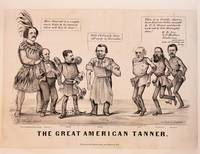
186836501New York: Currier & Ives 1868. Lithograph illustrated broadside by Currier & Ives oblong 11" x 15-1/2". Matted. Light dusting Near Fine. Cartoon characters identified by name; in lower right corner "on Stone by Cameron." John Cameron was a talented artist employed at Currier & Ives. In lower left corner "Thos. Worth. Sketch." Worth designed many cartoon broadsides for Currier & Ives. <br /> <br /> "An election-year cartoon invoking both Grant's humble beginnings as a tanner and his successful Civil War military career. Popular New York governor John Thompson Hoffman dressed as an Indian the 'Great Sachem of Tammany' presents Democratic candidates Horatio Seymour and Francis P. Blair Jr. to Grant. He addresses Grant 'Here General is a couple more hides to be tanned when will they be done' Grant smokes a cigar and wears the leather apron of a tanner rolled-up sleeves exposing his muscular arms. He replies 'Well I'll finish them off early in November.' <br /> "At right corner former Confederate generals Robert E. Lee Simon Bolivar Buckner and John C. Pemberton hold their rumps and hop about in pain. They announce 'This is to Certify that we have had our hides tanned and that the work was by him thoroughly done." Reilly AAS's entry asserts "Issued well before 1868 election." <br /> Reilly 1868-11. Weitenkampf 159. OCLC 191119896 1- Villanova 1136555720 1- AAS as of October 2024. Currier & Ives unknown
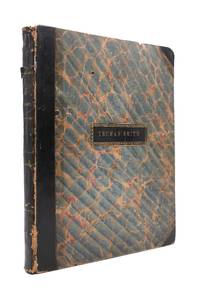
1848346068Washington D.C.: George S. Gideon 1848. Vol. 1 Numbers 1-18 plus a November 16 extra all published. 312pp. 4to. Contemporary half black morocco and marbled paper boards worn at joints and edges. Provenance: Truman Smith morocco label on the upper cover. Vol. 1 Numbers 1-18 plus a November 16 extra all published. 312pp. 4to. Scarce complete run of the weekly political newspaper "devoted to the support of Taylor and Fillmore" published during their campaign in the Election of 1848 which pitted the Whig Zachary Taylor against the Democrat Lewis Cass. The masthead features a woodcut of a horseback Taylor with his Mexican War troops firing a canon at Cass. In the final post-election Extra which includes the news of Taylor's victory the masthead has changed to the canon blowing Cass to pieces. The final page of the Extra comprises a prospectus for a New Series of the Battery.<br /> <br /> This example with provenance to ardent Taylor supporter Senator Truman Smith of Connecticut who served on the Whig Executive Committee of Congress and who contributed within the pages of the campaign newspaper. George S. Gideon unknown
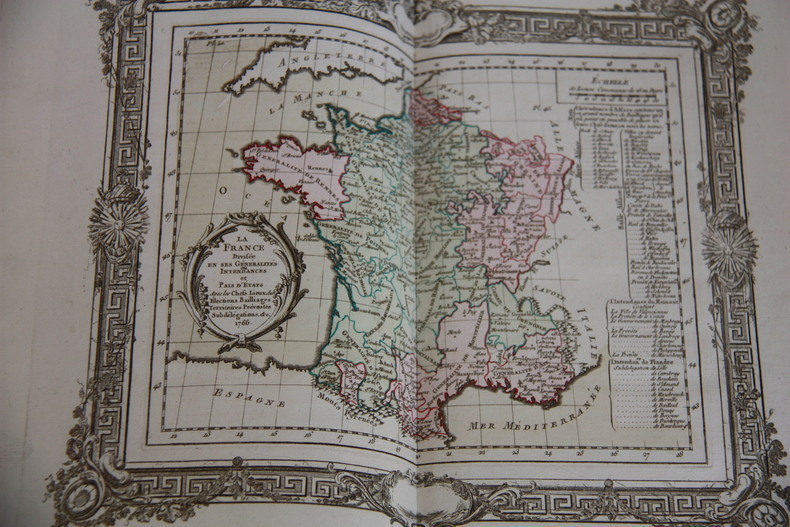
LB9in-4° demi veau à nerfs, caissons ornés de fleurons, pièce de titre. Garde blanche, Frontispice double page représentant la statue équestre de Louis XV inaugurée le 20 juin 1763 sur ce qui deviendra la place de la Concorde, Titre double page, Discours préléminaire i à viij , carte des généralités et intendances double page en couleur, carte générale des 22 élections de la généralité de Paris, double page, couleur , Description de la Généralité de Paris i à xxxiv [contient les principales foires avec leur durée] , Election de Beauvais carte couleur double page , description de l'élection de Beauvais 1 à 4 , Election de Compiègne carte couleur double page , description de l'élection de Compiègne 5 à 8 , Election de Mantes carte couleur double page , description de l'élection de Mantes 9 à 12 , Election de Pontoise carte couleur double page , description de l'élection de Pontoise 13 à 16 , Election de Senlis carte couleur double page , description de l'élection de Senlis 17 à 20 , Election de Dreux carte couleur double page , description de l'élection de Dreux 21 à 24 , Election de Monfort-l'Amaury carte couleur double page , description de l'élection de Montfort-l'Amaury 25 à 28 , Plan général de la ville et faubourgs de Paris , double page couleur , nouvelle élection et environs de Paris , double page couleur , description de l'élection de Paris 29 à 52 , Election de Meaux carte couleur double page , description de l'élection de Meaux 53 à 60 , Election de Coulommiers carte couleur double page , description de l'élection de Coulommiers , 61 à 64 , Election de Rosoy carte couleur double page , description de l'élection de Rosoy, 65 à 68 , Election d'Etampes carte couleur double page , description de l'élection d'Etampes , 69 à 71 , Election de Melun carte couleur double page , description de l'élection de Melun , 73 à 80 , Election de Provins carte couleur double page , description de l'élection de Provins , 81 à 84 , Election de Nemours carte couleur double page , description de l'élection de Nemours 85 à 88 , Election de Montereau-Fault-Yonne carte couleur double page , description de l'élection de Montereau-Fault-Yonne 89 à 92 , Election de Sens carte couleur double page , description de l'élection de Sens, 93 à 100 , Election de Nogent carte couleur double page , description de l'élection de Nogent 97 à 100 [sic] , Election de Joigny carte couleur double page , description de l'élection de Joigny, 101 à 104 , Election de Saint-Florentin carte couleur double page , description de l'élection de Saint-Florentin 109 [mauviase pagination, sans manque comme le prouve la remarque en p. 104] à 112 , Election de Tonnerre carte couleur double page , description de l'élection de Tonnerre , 113 à 118 , Election de Vézelay carte couleur double page , description de l'élection de Vézelay , 119 à 122 , Avis et errata, 2 p. non foliotées, Table générale des matières j à xj , garde blanche.
012954Paris Plon 0 4 volumes in-8 brochés, couvertures illustrée
186440557New York: Bromley & Company 1864. 19" x 24" lithograph broadside cartoon. Old tears repaired with tape on verso. Long horizontal tear at center has been reinforced by tape on verso. Light wrinkling and toning. The cartoon remains bold solid and intact. Good.<br /> <br /> "The first in a series of four harsh anti-Lincoln satires published by Bromley & Co. in New York. An imaginary dream of Jack Downing a comic Yankee character created in the 1830s by Seba Smith has Lincoln and some of his supporters and cabinet members as a band of undertakers about to inter the Constitution. <br /> "In 1862 displeased by Attorney General Edward Bates's slowness in enforcing the Conspiracies Act the President took matters into his own hands and issued a proclamation 'directing trial by court martial or military commissions of all persons who impeded the draft discouraged enlistments or committed other disloyal acts.' Around thirty-eight thousand people were arrested denied the right of habeas corpus and held in jail until brought to trial. This heavy-handed act provides the fuel for the artist's attack here. <br /> "Secretary Stanton is shown driving a hearse 'War Democracy' drawn by four horses with the heads of War Democrats left to right: John Cochrane Benjamin F. Butler Thomas Francis Meagher and Daniel S. Dickinson. Secretary Stanton says 'My jackasses had a load but they pull'd it through bravely. Cochrane: 'I pull for the side that pays the best always.' Butler: 'A million of dollars from New-Orleans'. . . <br /> "At right journalist Horace Greeley and Massachusetts senator Charles Sumner bury a casket labeled 'Constitution. Three other caskets 'Union' 'Habeas Corpus' and 'Free Speech Charge Express' wait nearby. Greeley: 'I guess we'll bury it so deep that it will never get up again.' Sumner: 'Be still you old fool. Let us first be sure that it is all under.' <br /> "A sober Lincoln watches with folded arms asking 'Chase will it stay down" Beside him treasury secretary Salmon P. Chase responds '. . . It must stay down. Or we shall all go up!' . . . <br /> "Abolitionist clergyman Henry Ward Beecher presides over the ceremony with a black child in his arms praying 'Not thy will oh Lord! But mine be done.' Above them Secretary of War Edwin M. Stanton who has the legs and tail of a demon and holds a dagger flies off crying 'If it were done when 'tis done'." Reilly<br /> Reilly 1864-37. Weitenkampf 141. OCLC 647912979 2- AAS Clements 299947771 1- DLC as of December 2024. Bromley & Company unknown
193624942<p>This sheet contains five rough sketches of graphics calling on the workers and voters of America to support Franklin D. Roosevelt's reelection in 1936. They did in record numbers.</p><p><strong>PRESIDENTIAL ELECTION OF 1936.</strong> Typed Document Signed. Artwork by Franz Felix and Ideas and Copy by Richard Barron "Set of Rough Sketches Containing Some Suggested Promotion Ideas to be Used in the 1936 Democratic Presidential Campaign" July 2 1936. 1 p. 12 x 10½ in.</p><p><strong>Excerpts:</strong></p><p>"<em>1. Sounding the call against 'economic royalists' in the spirit of 1776.</em>"</p><p>"<em>2. Appropriating the well-known symbol of violence</em> upraised fist<em> diverting it to peaceful democratic use. To include the farmer phrase the appeal: TOILERS OF AMERICA – UNITE FOR ROOSEVELT.</em>"</p><p>"<em>3. The statue of 'The Thinker' as a symbol of the man today who thinks the toiler with brawn and brain.everyman.</em>"</p><p>"<em>4. Direct appeal to radical labor and leftists in general.</em>"</p><p>"<em>5. Another way of appealing to the working class men and women.</em>"</p><p>"<em>This collaborative effort respectfully submitted for consideration to the Chairman of the Democratic National Committee Mr. James A. Farley.</em>"</p><p><strong>Historical Background</strong></p><p>After unseating incumbent Republican President Herbert Hoover in 1932 President Franklin D. Roosevelt ran for reelection in 1936. His Republican opponent was Governor Alf Landon of Kansas. Although the Great Depression had entered its eighth year Roosevelt's New Deal policies were broadly popular. He won the highest share of the popular and electoral vote since the uncontested 1820 election. Roosevelt attracted more than 60 percent of the popular vote and won the electoral votes of 46 states; Landon won the electoral votes of only Maine and Vermont.</p><p>Democratic Party chairman James Farley had predicted that Roosevelt would lose only Maine and Vermont. After the results of the 1936 election Farley quipped that the nation needed to revise the conventional political wisdom of "As Maine goes so goes the nation" to "As Maine goes so goes Vermont."</p><p>These ideas for campaign imagery employed or modified common images to support Roosevelt's campaign. One drew on the imagery of artist Archibald Willard's 1875 painting <em>The Spirit of '76</em> and employed three figures of workers to match the subjects of Willard's image. Another appropriated the upraised fist as a symbol of violence and repurposed it as a symbol of defiant unity against "<em>economic royalists</em>." A third used an image of <em>The Thinker</em> by French sculptor Auguste Rodin 1840-1917 to appeal to thinking voters. Another image appeals to the fears of radicals that the alternative to Roosevelt is "<em>Reaction</em>."</p><p>Richard Barron and artist Franz Felix submitted these ideas to Democratic National Committee chairman James A. Farley on July 2 1936 three weeks before the Democratic Party held its convention in Philadelphia. There is no evidence that these images were used in the campaign and it is possible that Farley rejected them. At the end of the campaign the Democratic National Committee had a campaign deficit of approximately $850000. To help offset those expenses the treasurer convinced President Roosevelt to sign 2500 brief Forewords which were bound into <em>The Democratic Book 1936</em> and sent to donors of $250. Purchases brought in more than $400000 for the party and led Republicans to charge corrupt practices for allowing corporations to contribute to the campaign by buying copies.</p><p><strong>Franz Felix</strong> 1892-1967 was born in Vienna Austria and developed an ability as a child to draw portraits in charcoal. He studied portraiture in Vienna and immigrated to the United States shortly after World War I. He settled in San Francisco where he established himself as a portrait artist and commercial illustrator. In the late 1920s he moved to New York and established a studio in the suburb of Spring Valley where he produced book and magazine illustrations. During World War II he painted a series of murals of wartime activities of Spring Valley residents.</p><p><strong>James A. Farley</strong> 1888-1976 was born in New York into an Irish Catholic family. After his father died he helped his mother with a small business to support the family. After graduating from Packard Business College in New York City where he studied bookkeeping and other business skills Farley got a job with the U.S. Gypsum Corporation. He served as a Democratic town clerk in Stony Point New York and became chairman of the county's Democratic Party in 1918. He organized upstate Democrats and helped elect Alfred E. Smith as Governor that year. He served in the New York State Assembly in 1923 but was defeated at the next election for supporting the repeal of Prohibition. As chair of the state Athletic Commission Farley fought for the civil rights of African American athletes. Farley founded he General Builders Corporation from smaller firms to become New York City's largest building supply company. Farley directed Franklin D. Roosevelt's narrowly successful New York gubernatorial campaign in 1928 and his reelection in 1930. Farley served as chairman of the New York State Democratic Committee from 1930 to 1944 and helped build the national New Deal coalition that elected Roosevelt to the Presidency four times. In 1932 Farley became the chairman of the Democratic National Committee and in 1933 U.S. Postmaster General. He held both positions until 1940. Farley and Roosevelt broke on the two-term tradition of the Presidency in 1940 and he later helped propose the 22nd Amendment to the U.S. Constitution limiting a person to two elections as president approved by Congress in 1947 and ratified in 1951. Farley became chairman of the board of the Coca-Cola Export Corporation in 1940 and held that position for more than thirty years.</p>
184838376Augusta GA: Printed at the Office of the Chronicle and Sentinel 1848. 32pp. Light toning and foxing. Frontis portrait of Taylor with facsimile inscription "Your obt Servt Z. Taylor." Good or better in later quarter morocco and modern marbled paper over boards. <br /> <br /> No consulted source records this Georgia printing among the several issues of this item with several variations in title. The Chronicle & Sentinel published at Augusta during the years 1837-1876. <br /> This Whig campaign document presents Taylor a Louisiana planter as the hero of the Mexican War. He surely had no other qualifications for the Presidency having never even previously voted. But it was enough for the Whigs to capture the Presidency for the second and last time. <br /> Not in Wise & Cronin Taylor Miles De Renne Sabin Eberstadt Decker. <br /> bound with SPEECH OF JOHN M. CLAYTON OR DELAWARE IN DEFENCE OF ZACHARY TAYLOR. Washington: 1848. 16pp. Caption title as issued. A few fox marks Very Good.<br /> bound with Botts John Minor: TO THE WHOLE WHIG PARTY OF THE UNITED STATES. Washington: Gideon. 1848. 16pp. Caption title as issued. Light wear and fox Good. <br /> The Virginia Whig argues that Henry Clay not the Mexican War hero Zachary Taylor should be the Whigs' presidential nominee in 1848. Botts argues that Clay is the embodiment of Whig principles; Taylor stands for nothing discernible. <br /> Sabin 6832n. Not in Haynes Tutorow Haferkorn.<br /> bound with Botts John Minor: TO THE WHIGS OF VIRGINIA. Washington: Gideon. 1848. 15 1 blank pp. Caption title as issued. Foxed Good. <br /> Botts supports Henry Clay the Party's candidate in 1844. Botts analyzes the vote in the 1844 election "when the largest Whig vote ever cast in the State was given for Mr. Clay." Taylor has made it clear that if nominated he will not be bound by Whig doctrines. <br /> Sabin 6832n.<br /> bound with GREAT WHIG DEMONSTRATION IN FAVOR OF THE NOMINATION OF GEN. TAYLOR TO THE PRESIDENCY. THE BUENA VISTA FESTIVAL AT PHILADELPHIA FEBRUARY 22 1848. Washington: Gideon. 1848. Caption title as issued 32pp. Printed in double columns. Very Good.<br /> "Nothing superior in the way of a Political Festival has occurred in this city for many years. All point to ZACHARY TAYLOR AS AN UNDOUBTED WHIG as THE MAN OF THE PEOPLE and capable to bear the Whig standard- as he bore the National Flag at Buena Vista." A lineup of distinguished Whigs gets on the Taylor bandwagon all showcased in this rare campaign pamphlet.<br /> Not in Eberstadt Decker Sabin Miles. OCLC 32271765 1- DLC as of May 2022. Printed at the Office of the Chronicle and Sentinel unknown
183838949New York: H.R. Robinson 1838. Oblong lithograph broadside 13-1/4" x 20." Shallow blank left margin chips from a prior mounting. Light outer margin darkening. A clean image signed 'Blanks fecit' perhaps Edward Williams Clay. Very Good.<br /> <br /> A satiric commentary on thwarted Democratic hopes to control New York City. Whigs dashed Democratic expectations in the New York municipal elections of spring 1838. Successful Whig mayoral candidate Aaron Clark holds and restrains two horses by their tails: 'Stop my good fellows you are going on a fools errand you are counting your chickens before they are hatched'." His victory has delayed if not destroyed Loco Foco hopes of political dominance. <br /> On the right a Loco Foco supporter in the garb of a carman or driver sits on a horse and tries to ride toward Albany to fulfill his ambitions: 'Marcy must resign in my favor and I'll be next Governor myself for this job!' Reilly suggests the man is either Isaac Varian the Loco Foco mayoral candidate or Democratic Congressman C.C. Cambreling.<br /> On the left a uniformed Jacksonian Democrat sits on his horse. He wants to go to Washington: 'I shall insist on Matty's making me next Collector.' He is probably Tammany leader Jesse Hoyt who indeed was successful in his quest to be Collector of the Port of New York.<br /> Reilly 1838-11. Weitenkampf 52. OCLC 299944597 1- DLC 1136565725 1- AAS as of December 2025. Not at NYPL or NYHS web sites. H.R. Robinson unknown
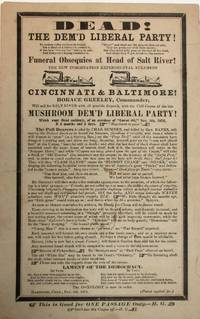
187238915Hartford 1872. Broadside 6" x 9-1/2" text surrounded by mourning border. A few spots Very Good. Illustrations of two steamers. At the bottom: "This is Good for ONE PASSAGE Only. - H.G." Dated at Hartford November 5 1872.<br /> <br /> "Salt River" is 19th century American slang: a losing candidate for office was taking a trip "up Salt River." Tickets for passage "up Salt River" were frequently printed to mock supporters of losing candidates. <br /> This humorous scarce broadside taunts Horace Greeley and other defectors from the Republican Party for their support of Greeley in 1872. "On the overwhelming defeat of the Liberal Republican Party and its candidate Horace Greeley in the presidential election of 1872. Greeley had been nominated at a Liberal Republican convention at Cincinnati in May and at the Democratic National Convention at Baltimore in July 1872" AAS description.<br /> Pall bearers include Charles Sumner and General Banks prominent Republican supporters of Greeley.<br /> OCLC 191231113 2- AAS Middlebury 47090036 1- CT Hist. Soc. as of August 2025. unknown
182334261Raleigh 1823. 15 1 blank pp. Caption title as issued. Disbound. Scattered light and moderate foxing. Good. <br /> <br /> Signed at the end in type: "November 1823. CAROLINA." A scarce pro-Calhoun anti-Crawford piece for the 1824 presidential election. <br /> When Calhoun decided to seek the presidency in 1824 "both Crawford and Adams the acknowledged front-runners felt betrayed" Crawford because Calhoun had reportedly assured him that he would defer to the older man and wait his turn; and Adams because Calhoun had said that "for the good of the country.the next President should come from the North." Peterson THE GREAT TRIUMVIRATE 116. <br /> Miles 3. Thornton 1750. AI 12071 1- DLC. OCLC 42212191 3- NYHS Duke UNC as of December 2024. unknown
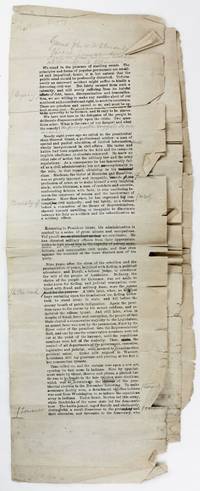
18775770N.p. likely Springfield Il: ca. January 8 1877. Good. Three long galley leaves each approximately 6.5 x 19 inches and printed on rectos only with numerous pencil emendations. Old folds and creases numerous chips and tears to margins pervasive wrinkling making reading a bit challenging at times but with no loss to text. Small portion of third leaf containing the last eight lines of text detached but present. Not in great shape but seemingly unique. A galley proof of a speech by General John A. McClernand in the midst of the contentious Election of 1876 which was so far as we can determine neither delivered nor published. A pencil note at top reveals his authorship and notes the speech was intended to be delivered January 8 at the “Great Citizens Convention†in Springfield Illinois almost certainly in 1877 following the recent election in the Fall of 1876. McClernand was an Illinois contemporary of Lincoln's a Democratic Congressman and War Democrat. He was also an ally of another Illinois politician and Lincoln adversary Stephen A. Douglas. He was appointed a general during the Civil War largely through political maneuvering and was generally considered incompetent. McClernand greatly resented the authority of Grant who finally relieved him of command in June 1863. Following the war McClernand became a leading critic of Congressional Reconstruction as well as the Grant Administration in general. He also chaired the 1876 Democratic National Convention which nominated Tilden for the presidency.<br /> <br /> Here McClernand bitterly attacks Grant his presidential Administration and Reconstruction. According to McClernand Grant's "tastes and habits had been acquired in the field and the camp -- in implicit obedience or absolute command. He knew no other rule of action but the military law and army regulations. As a consequence he has lamentably failed as a civil administrator." As President fraudulently and illegally Grant "joined with Kellog a political adventurer and Durell a federal judge to overthrow the will of the people of Louisiana." Law and order says McClernand "lay prostrate and panting at the feet of her remorseless tyrants." McClernand also assails Grant's highhanded tactics in the other Southern States.<br /> <br /> Now says McClernand "the president and his accomplices have now applied themselves to defeat the will of the people by a parliamentary device. They claimed for the President of the Senate the right and power to count the electoral votes and to declare the result and by implication that that right and power would be so exercised as to count Tilden out of his election and to count Hayes into one." He wasn't wrong. In one of the closest most hotly-contested and highly-controversial elections in American history to put it simply Hayes effectively stole the election by agreeing to remove northern soldiers from the South and end Reconstruction. It would be interesting to know what McClernand thought of the ultimate result -- he didn't get Tilden but he did get the end of Reconstruction.<br /> <br /> "Yet another prominent Illinoian who played a role in the Civil War John Alexander McClernand was born in Breckinridge County Kentucky before moving to Shawneetown Illinois at a young age. Similar to fellow Illinoian Abraham Lincoln McClernand was a largely self-taught lawyer who began practicing in Shawneetown in 1835. Also like Lincoln McClernand served in the Black Hawk War. However McClernand was a staunch Democrat. In 1835 he established the newspaper Shawneetown Democrat. He was active in Democratic politics at both the state and federal level serving in the Illinois House of Representatives and eventually Congress. In Congress McClernand was a stalwart Jacksonian Democrat who strongly disliked abolitionists. He strongly opposed the Wilmot Proviso which banned slavery in the territory gained after the Mexican-American War. He became a key ally of fellow Democrat and Illinoian Stephen A. Douglas helping him pass the Compromise of 1850. As tensions rose approaching the election of 1860 McClernand campaigned for Douglas’s presidency and became a Unionist. After war broke out in the following April McClernand helped raise volunteers for the Union Army. Because Lincoln needed to retain a wide base of support and retain connections with Democrats in Illinois he appointed McClernand a brigadier general on May 17 1861. McClernand’s military career would be defined by an ongoing clash with fellow Illinoian General Ulysses S. Grant. Grant a seasoned West Pointer who served in Mexico was irritated by McClernand a political general with little military experience. Further exacerbating relations was McClernand’s tendency to boast about his exploits and diminish the achievements of other commanders" - American Battlefield Trust's entry on John A. McClernand. ca. January 8 unknown
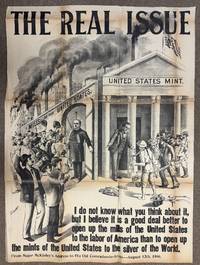
189641421Chicago: Edwards Deutsch & Heitmann 1896. Elephant folio broadside 36" x 48" mounted on linen at time of manufacture. A graphic black-and-white campaign broadside for Republican William McKinley's 1896 presidential contest against Democrat William Jennings Bryan. Early folds with significant wear and splitting along folds including the backing several archival cloth tape repairs on verso. Moderate toning at the fold lines. Good only. <br /> <br /> "McKinley welcomes workers to U.S. mills W.J. Bryan welcomes foreign silver." Library of Congress copy of this print but reprinted in 1900 with the addition of large red type "McKinley was Right in 1896." <br /> Democrat Bryan favoring free coinage of silver and elimination of tariffs welcomes foreigners bringing to the Mint silver from India Germany England Mexico Japan China and elsewhere. Republican McKinley favoring the gold standard and tariffs to protect American industries welcomes prosperous American workers to American mills.<br /> "From Major McKinley's Address to His Old Comrades = In = Arms. - August 12th 1896."<br /> OCLC 20499606 1- Detroit Pub. Lib. as of April 2026. Edwards, Deutsch & Heitmann unknown
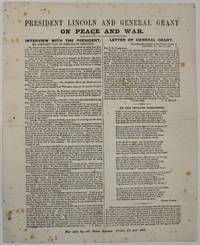
186440032New York: For sale by all News Agents. Price $1 per 100. 1864. Broadside 9 1/2" x 11 1/4". Printed in two columns. Light foxing Old white tape remnants at upper margin of blank verso. Very Good.<br /> <br /> The broadside prints Judge Mills's report of his interview with President Lincoln who strongly defends the use of black troops in the war effort. General Grant's letter to E.B. Washbourne sic reports "The Rebels have now in their ranks their last man. The little boys and old men are guarding prisoners guarding railroad bridges and forming a good part of their garrisons for entrenched positions." Bayard Taylor's poem on the Democrats' presidential nominating convention 'On the Chicago Surrender' is also printed. <br /> "Judge Mills" was Joseph T. Mills of Wisconsin an attorney and judge who had also been a State Assemblyman.<br /> Bartlett 2725. Sabin 41157. Weinstein Against the Tide 141. Not in Monaghan. For sale by all News Agents. Price, $1 per 100. unknown
Original Progressive Conservative Party of Canada Speakers' Handbook for use in the run-up to the Canadian federal election of 1945. Printing date not stated but was most likely 1944, possibly 1945. Unpaginated. Two inches thick. Provides the full spectrum of PC policies and points with which to attack the Liberal and C.C.F. parties. Contents divided into the following sections: Table of Contents; Leadership - with considerable biographical information on PC leader John Bracken; War Policy and Veterans; Agriculture; Labour; Reconstruction and Natural Resources; Transportation; International Problems; Liberal Policy; C.C.F. Policy. The sections on Liberal and C.C.F. policies extensively document the perceived weaknesses of these parties and were no-doubt intended to serve as the arsenal of attack ads and talking points to be used against these parties. Unmarked. Average wear and soiling. Due to wartime restrictions these handbooks were string-bound. Provides a comprehensive snapshot of the Canadian federal political scene prior to the election of 1945, as seen from the PC perspective. A unique and highly-informative WWII-era Canadian federal political memento. Book
184439908Towanda PA 1844. Folio broadside 10-1/8" x 21." Printed in four columns each column separated by a rule. Light to moderate foxing light wear. Good. Signed in type at the bottom by thirty disillusioned local Democrats. <br /> <br /> Towanda is the county seat of Bradford County the residence of many of the signers including Judge Edward Herrick the first signer. This evidently unrecorded broadside illustrates the impending split in the Democratic Party along sectional lines over the issue of slavery. <br /> The signers are "steadfast" Democrats distraught that their Party has nominated James K. Polk of Tennessee as its 1844 presidential candidate. Polk known as the "Dark Horse" candidate "was thrust upon the party as the candidate by the intrigues and management of the NULLIFIERS! italics in original. The instructions and pledges of the delegates were disregarded and Mr. V. Buren and the Democratic party betrayed!"<br /> Clay "a statesman of the first order" has always sought to advance the national interest as opposed to parochial concerns. The signers defend his support of protective tariffs and the American System. They applaud his opposition to the annexation of Texas and his warnings that a war with Mexico would result in an expansion of the "odious" system of slavery. <br /> Not in Sabin or American Imprints. Not located on OCLC or the online sites of AAS U Penn U TN as of March 2025. unknown
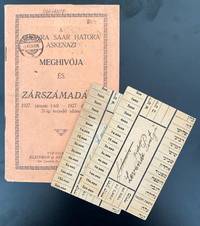
192843241Satu-Mare Szatmar/Satmar Romania: No Publisher The Chevra Sa’ar HaTorah Ashkenazi; printed by Tipográfia Kleinman si Heimlich 1928. 1st edition. Original orange printed paper wrappers 8vo 10 pages. Primarily in Hungarian with 2-page statement & closing speech also in Yiddish. <br> <br> WITH LAID IN: Two aliyah to the Torah Ark pledge cards one for Ephraim Lavii and one for Levende Pinty<br> <br> Title translates roughly as “The Saar Hatora Ashkenazi Society Financial Statement and Closing Speech. For The Period From January 1 1927 To December 31 1927.â€<br> <br> From the strife-ridden year of 1928 in Satu Mare see below a budget report including tables and lists for the Chevra Sa’ar HaTorah Ashkenazi with heartfelt call to action by the President Yosef Chaim Mayer asking the community to support its efforts to raise funds to build a new Beit HaMidrash. The plea is also undersigned by Eli Mandelbaum and by the two gabbais David Spiegel and Yona Weiss. <br> <br> A total of 11 names of leaders of the society are named. <br> <br> Society members are asked for their support in the upcoming election; presumably this is the controversial election of a new chief rabbi which famously split the community and resulted in the appointment of Hasidic Joel Teitelbaum and the creation of the Satmar Dynasty under him. <br> <br> In 1715 when Sathmar became a royal town the Jews were expelled but they began to resettle in the 1820s."In 1841 several Jews obtained the permission to settle permanently in Sathmar; the first Jewish community was formally established in 1849 and in 1857 a synagogue was built. After a great number of traditional Ashkenazic Jews had settled in the town the Jewish community split in 1898 when a supporter of the Hasidic movement was elected chief rabbi into an Orthodox and a Status Quo community led by a Zionist rabbi which erected a synagogue in 1904.<br> <br> In the 1920s there were several Zionist organizations in Satu Mare and the yeshiva one of the largest in the region was attended by 400 students. In 1930 the city had five large synagogues and about 20 shtiebels. In 1928 a conflict within the Orthodox community broke out over the election of a new chief rabbi lasting six years and ending in 1934 with the appointment of the Hasidic rabbi Joel Teitelbaum a traditionalist and anti-Zionist who later re-founded the Satmar Hasidic dynasty in Williamsburg New York. Another Hasidic rabbi Aharon Roth the founder of the Shomrei Emunim and Toldot Aharon communities in Jerusalem was also active in Satu Mare†Wikipedia.<br> <br> We could not locate another copy of this publication anywhere not in OCLC not in KVK not in the Hungarian National Library not in the Romanian National Library and not with a google search. Perhaps a unique surviving copy.<br> <br> Adressee’s name and “Satu Mare†penned on rear cover for mailing stamp clipped out of corner of blank rear wrapper no text loss. Postal cancellation stamp “Satu Mare 5. Feb 1928†on front cover as well as some other ink notations. Paper remains bright and strong about Very Good Condition. Exceedingly Rare with important connection to Satmar Hasidism. B Holo2-163-11-'LG. Satu-Mare [Szatmar/Satmar, Romania]: No Publisher [The Chevra Sa’ar HaTorah Ashkenazi; printed by Tipográfia Kleinman si Heim unknown
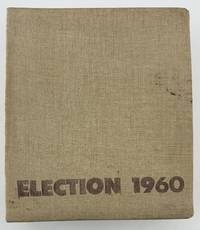
19604337Various locations in and around Chicago Il: likely early November 1960. Very good plus. Title leaf plus 25 leaves illustrated with forty-seven silver gelatin photographs pasted one per leaf or page all about 5.5 x 7.5 inches plus five loose images two duplicates and three other images not pasted in. Square quarto. Contemporary tan cloth custom photograph album metal-hinged spine front cover printed with title reading "ELECTION 1960." Minor wear and soiling to album. Light occasional thumb-soiling to album leaves ownership signature reading "G. Robert Hillman" on title leaf. Photographs in excellent condition. An utterly charming vernacular photograph album assembled during the seminal Presidential Election of 1960 one of the closest presidential elections in United States history which pitted Vice President Richard Nixon against the junior Senator from Massachusetts John F. Kennedy. The album features about fifty original photographs on the campaign trail in Illinois beginning with about a dozen-and-a-half images of Richard Nixon and his local supporters. The photographs capture various angles of Nixon during his stump speech a young boy waving an "I'm for Nixon" handmade sign another young boy with a Nixon button on his coat crowd scenes a large campaign sign for Nixon-Lodge outside a local store and more. One image featuring a mixed crowd of Nixon and Kennedy supporters transitions into the next section of photographs which concentrates on JFK's campaign. The first image in this section is a closeup of a "Kennedy for President" hat followed by four images of JFK's campaign manager Robert Kennedy making a speech three images of Eleanor Roosevelt stumping for Kennedy five images of Lyndon Johnson and his airplane numerous shots of Kennedy supporters and crowd shots outside Chicago Blackhawks stadium. The photographs then feature the inside of Chicago Auditorium where the first three images depict John F. Kennedy - the first shaking hands with Chicago's longtime Mayor Richard Daley and two during his speech likely his speech of November 4 1960 - just four days before Election Day. The final three images show supporters of both candidates.<br /> <br /> The 1960 United States Presidential Election was a watershed moment for the campaign politics of the country. Senator Kennedy won the election with a clear Electoral College margin of 303 to 219. However Vice President Nixon won three more states than Kennedy and lost the popular vote only by about 110000 votes out of more than 68 million votes cast. The election set the course for most of the remainder of the 1960s but left Nixon soured and suspicious that the election had been stolen from him - a feeling he never let go and one with ominous echoes today. As indicated in the present album the 1960 presidential election was passionate on both sides with each candidate drawing large enthusiastic crowds for their appearances.<br /> <br /> The signature on the title leaf of the present album likely identifies the compiler. G. Robert Hillman is a Senior Editor for Politico. Hillman was born in Peoria and grew up on a farm near Flanagan Illinois about a hundred miles from Chicago. He went to college at the University of Illinois at Urbana-Champaign and began his career at Chicago Today and the Chicago Sun-Times. Hillman would have been in middle school during the 1960 election campaign not too precocious for a young man obsessed with politics especially during one of the most heated and media-intensive campaigns of the 20th century. likely early November unknown
Contents: Seattle will build 15,000 fine new homes (ad); Schlitz beer ad - in color with lovely model; New York Central Railroad ad - "Black Magic" - 95,000,000 tons of coal per year; Block votes tipped teh balance in closest election since 1916 - photo of FDR with Harry Truman; Photos of voting shenanigans in Chicago; V-2 weapons may win next war but come too late for this one - detailed article with air photo; Ignorant men and modern weapons - the inside story of the Chinese Army - with photos of refugees fleeing the Japanese; White trucks - color ad; France given more say in Europe in prelude to Big Three Meeting; Reprieve for the Canadian Zombies; Doukhobor mass disrobing; Cuban housecleaning - Grau purges Batista henchmen; Long-suffering victims of sinus problems can be cured; Nikola Tesla - prophet of tomorrow; Very military ad by Bankers Trust Company shows a soldier pulling the pin from a grenade with his teeth; Color Sheaffer's pen ad inside back cover. Average wear. Address label atop front cover. Unmarked. A sound copy. Book
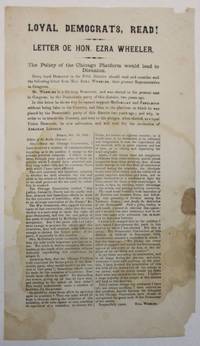
186439322np. Milwaukee Berlin WI 1864. Broadside 6-1/8" x 11." Spotted small chip to blank upper corner. Good.<br /> <br /> Ezra Wheeler Wisconsin Democrat was serving his only term in Congress when he wrote this October 15 letter to his constituents in the Berlin Courant. He retired from Congress at the end of his term.<br /> Lincoln supporters reprinted the letter in this broadside for the edification of voters in Wheeler's Fifth Wisconsin District. Wheeler "cannot support McClellan and Pendleton without being false to his Country and false to the platform on which he was placed by the Democratic party of this district two years ago. . . As a loyal Union Democrat he now advocates and vote for the re-election of Abraham Lincoln." Wheeler explains that a Democratic victory "would inevitably be the separation of the Northern and Southern States and following that probably a division among the Northern States; and finally the destruction of our Government."<br /> We have not located a record of this broadside. <br /> Not located in Sabin Bartlett or on OCLC or the online sites of U WI Libraries AAS LCP Newberry Harvard Yale as of January 2024. unknown
182835196Bangor 1828. Folio broadside 9-1/4" x 20". Matted hinged at upper edge. Printed in three full columns. A few old folds Very Good.<br /> <br /> The Convention met in Bangor on July 9 1828. After endorsing candidates for various State offices the Convention issued and printed its 'Address. to the Electors of the Counties of Somerset and Penobscot' focusing on the upcoming presidential contest. Praising the incumbent John Quincy Adams the Address proclaims "It is sufficient to say of him that talents of the highest order are joined to uncommon attainments. We would ask you to turn from the rantings of demagogues the bold fictions of an irresponsible press. Is not our country moving on peacefully and prosperously in the great march of improvement" <br /> Adams's opponent General Jackson is unsuited for the presidency: "His character has been formed as a military chieftain. He is rash headstrong impetuous and unreflecting-- that he knows no law but his own will." Example after example demonstrates Jackson's unfitness<br /> Not in American Imprints Sabin Wise & Cronin Jackson Adams or on the online sites of OCLC AAS Harvard Boston Athenaeum Bowdoin U Maine as of October 2023. unknown
57846. The UK General Election of 1865 was won by Lord Palmerston for the Liberals increasing their large majority over the Earl of Derby's Conservatives to more than 80. The Liberal Party were the transformed Whigs having changed their name since the previous election in 1859. Palmerston holding the Devon constituency of Tiverton died later in the same year and was succeeded as Prime Minister by Lord John Russell. Robert Jardine above standing for the Liberal Party was elected in Ashburton in 1865 but the constituency was abolished in 1868. unknown
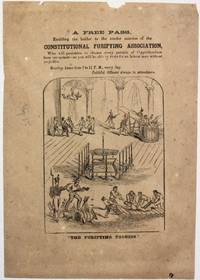
186440035np 1864. Broadside 6.25" x 9" with two-thirds of the sheet consisting of a wood engraving entitled "The Purifying Process." Toned with a few short blank edge chips. Good.<br /> <br /> This scarce political broadside mocks the Copperheads who opposed the Lincoln Administration and the Civil War. The broadside depicts humorous rituals imposed on the Copperheads designed to purge Copperhead-ism from their natures. Weitenkampf and OCLC call this an 1864 broadside with the Lincoln-McClellan election the subject of this piece. <br /> Weitenkampf page 140. OCLC 14137917 4- Lincoln Presidential Library Brown U IL Princeton 1360327631 1- DLC 1085916488 1- AAS as of May 2024. unknown