[Election of 1844]Biblio.com
1 159 résultats
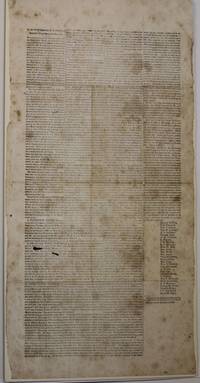
184439908Towanda PA 1844. Folio broadside 10-1/8" x 21." Printed in four columns each column separated by a rule. Light to moderate foxing light wear. Good. Signed in type at the bottom by thirty disillusioned local Democrats. <br /> <br /> Towanda is the county seat of Bradford County the residence of many of the signers including Judge Edward Herrick the first signer. This evidently unrecorded broadside illustrates the impending split in the Democratic Party along sectional lines over the issue of slavery. <br /> The signers are "steadfast" Democrats distraught that their Party has nominated James K. Polk of Tennessee as its 1844 presidential candidate. Polk known as the "Dark Horse" candidate "was thrust upon the party as the candidate by the intrigues and management of the NULLIFIERS! italics in original. The instructions and pledges of the delegates were disregarded and Mr. V. Buren and the Democratic party betrayed!"<br /> Clay "a statesman of the first order" has always sought to advance the national interest as opposed to parochial concerns. The signers defend his support of protective tariffs and the American System. They applaud his opposition to the annexation of Texas and his warnings that a war with Mexico would result in an expansion of the "odious" system of slavery. <br /> Not in Sabin or American Imprints. Not located on OCLC or the online sites of AAS U Penn U TN as of March 2025. unknown
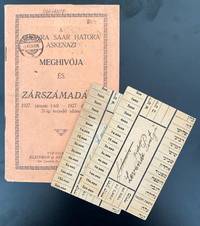
192843241Satu-Mare Szatmar/Satmar Romania: No Publisher The Chevra Sa’ar HaTorah Ashkenazi; printed by Tipográfia Kleinman si Heimlich 1928. 1st edition. Original orange printed paper wrappers 8vo 10 pages. Primarily in Hungarian with 2-page statement & closing speech also in Yiddish. <br> <br> WITH LAID IN: Two aliyah to the Torah Ark pledge cards one for Ephraim Lavii and one for Levende Pinty<br> <br> Title translates roughly as “The Saar Hatora Ashkenazi Society Financial Statement and Closing Speech. For The Period From January 1 1927 To December 31 1927.â€<br> <br> From the strife-ridden year of 1928 in Satu Mare see below a budget report including tables and lists for the Chevra Sa’ar HaTorah Ashkenazi with heartfelt call to action by the President Yosef Chaim Mayer asking the community to support its efforts to raise funds to build a new Beit HaMidrash. The plea is also undersigned by Eli Mandelbaum and by the two gabbais David Spiegel and Yona Weiss. <br> <br> A total of 11 names of leaders of the society are named. <br> <br> Society members are asked for their support in the upcoming election; presumably this is the controversial election of a new chief rabbi which famously split the community and resulted in the appointment of Hasidic Joel Teitelbaum and the creation of the Satmar Dynasty under him. <br> <br> In 1715 when Sathmar became a royal town the Jews were expelled but they began to resettle in the 1820s."In 1841 several Jews obtained the permission to settle permanently in Sathmar; the first Jewish community was formally established in 1849 and in 1857 a synagogue was built. After a great number of traditional Ashkenazic Jews had settled in the town the Jewish community split in 1898 when a supporter of the Hasidic movement was elected chief rabbi into an Orthodox and a Status Quo community led by a Zionist rabbi which erected a synagogue in 1904.<br> <br> In the 1920s there were several Zionist organizations in Satu Mare and the yeshiva one of the largest in the region was attended by 400 students. In 1930 the city had five large synagogues and about 20 shtiebels. In 1928 a conflict within the Orthodox community broke out over the election of a new chief rabbi lasting six years and ending in 1934 with the appointment of the Hasidic rabbi Joel Teitelbaum a traditionalist and anti-Zionist who later re-founded the Satmar Hasidic dynasty in Williamsburg New York. Another Hasidic rabbi Aharon Roth the founder of the Shomrei Emunim and Toldot Aharon communities in Jerusalem was also active in Satu Mare†Wikipedia.<br> <br> We could not locate another copy of this publication anywhere not in OCLC not in KVK not in the Hungarian National Library not in the Romanian National Library and not with a google search. Perhaps a unique surviving copy.<br> <br> Adressee’s name and “Satu Mare†penned on rear cover for mailing stamp clipped out of corner of blank rear wrapper no text loss. Postal cancellation stamp “Satu Mare 5. Feb 1928†on front cover as well as some other ink notations. Paper remains bright and strong about Very Good Condition. Exceedingly Rare with important connection to Satmar Hasidism. B Holo2-163-11-'LG. Satu-Mare [Szatmar/Satmar, Romania]: No Publisher [The Chevra Sa’ar HaTorah Ashkenazi; printed by Tipográfia Kleinman si Heim unknown
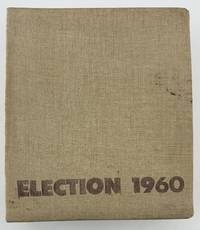
19604337Various locations in and around Chicago Il: likely early November 1960. Very good plus. Title leaf plus 25 leaves illustrated with forty-seven silver gelatin photographs pasted one per leaf or page all about 5.5 x 7.5 inches plus five loose images two duplicates and three other images not pasted in. Square quarto. Contemporary tan cloth custom photograph album metal-hinged spine front cover printed with title reading "ELECTION 1960." Minor wear and soiling to album. Light occasional thumb-soiling to album leaves ownership signature reading "G. Robert Hillman" on title leaf. Photographs in excellent condition. An utterly charming vernacular photograph album assembled during the seminal Presidential Election of 1960 one of the closest presidential elections in United States history which pitted Vice President Richard Nixon against the junior Senator from Massachusetts John F. Kennedy. The album features about fifty original photographs on the campaign trail in Illinois beginning with about a dozen-and-a-half images of Richard Nixon and his local supporters. The photographs capture various angles of Nixon during his stump speech a young boy waving an "I'm for Nixon" handmade sign another young boy with a Nixon button on his coat crowd scenes a large campaign sign for Nixon-Lodge outside a local store and more. One image featuring a mixed crowd of Nixon and Kennedy supporters transitions into the next section of photographs which concentrates on JFK's campaign. The first image in this section is a closeup of a "Kennedy for President" hat followed by four images of JFK's campaign manager Robert Kennedy making a speech three images of Eleanor Roosevelt stumping for Kennedy five images of Lyndon Johnson and his airplane numerous shots of Kennedy supporters and crowd shots outside Chicago Blackhawks stadium. The photographs then feature the inside of Chicago Auditorium where the first three images depict John F. Kennedy - the first shaking hands with Chicago's longtime Mayor Richard Daley and two during his speech likely his speech of November 4 1960 - just four days before Election Day. The final three images show supporters of both candidates.<br /> <br /> The 1960 United States Presidential Election was a watershed moment for the campaign politics of the country. Senator Kennedy won the election with a clear Electoral College margin of 303 to 219. However Vice President Nixon won three more states than Kennedy and lost the popular vote only by about 110000 votes out of more than 68 million votes cast. The election set the course for most of the remainder of the 1960s but left Nixon soured and suspicious that the election had been stolen from him - a feeling he never let go and one with ominous echoes today. As indicated in the present album the 1960 presidential election was passionate on both sides with each candidate drawing large enthusiastic crowds for their appearances.<br /> <br /> The signature on the title leaf of the present album likely identifies the compiler. G. Robert Hillman is a Senior Editor for Politico. Hillman was born in Peoria and grew up on a farm near Flanagan Illinois about a hundred miles from Chicago. He went to college at the University of Illinois at Urbana-Champaign and began his career at Chicago Today and the Chicago Sun-Times. Hillman would have been in middle school during the 1960 election campaign not too precocious for a young man obsessed with politics especially during one of the most heated and media-intensive campaigns of the 20th century. likely early November unknown
Contents: Seattle will build 15,000 fine new homes (ad); Schlitz beer ad - in color with lovely model; New York Central Railroad ad - "Black Magic" - 95,000,000 tons of coal per year; Block votes tipped teh balance in closest election since 1916 - photo of FDR with Harry Truman; Photos of voting shenanigans in Chicago; V-2 weapons may win next war but come too late for this one - detailed article with air photo; Ignorant men and modern weapons - the inside story of the Chinese Army - with photos of refugees fleeing the Japanese; White trucks - color ad; France given more say in Europe in prelude to Big Three Meeting; Reprieve for the Canadian Zombies; Doukhobor mass disrobing; Cuban housecleaning - Grau purges Batista henchmen; Long-suffering victims of sinus problems can be cured; Nikola Tesla - prophet of tomorrow; Very military ad by Bankers Trust Company shows a soldier pulling the pin from a grenade with his teeth; Color Sheaffer's pen ad inside back cover. Average wear. Address label atop front cover. Unmarked. A sound copy. Book
182334261Raleigh 1823. 15 1 blank pp. Caption title as issued. Disbound. Scattered light and moderate foxing. Good. <br/><br/> Signed at the end in type: "November 1823. CAROLINA." An extremely scarce pro-Calhoun anti-Crawford piece for the 1824 presidential election. When Calhoun decided to seek the presidency in 1824 "both Crawford and Adams the acknowledged front-runners felt betrayed" Crawford because Calhoun had reportedly assured him that he would defer to the older man and wait his turn; and Adams because Calhoun had said that "for the good of the country.the next President should come from the North." Peterson THE GREAT TRIUMVIRATE 116. <br/>Miles 3. Thornton 1750. AI 12071 1- DLC. OCLC 42212191 3- NYHS Duke UNC as of February 2021. unknown books
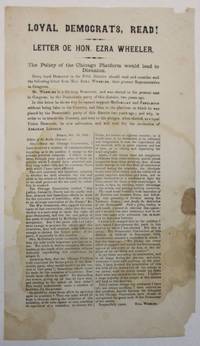
186439322np. Milwaukee Berlin WI 1864. Broadside 6-1/8" x 11." Spotted small chip to blank upper corner. Good.<br /> <br /> Ezra Wheeler Wisconsin Democrat was serving his only term in Congress when he wrote this October 15 letter to his constituents in the Berlin Courant. He retired from Congress at the end of his term.<br /> Lincoln supporters reprinted the letter in this broadside for the edification of voters in Wheeler's Fifth Wisconsin District. Wheeler "cannot support McClellan and Pendleton without being false to his Country and false to the platform on which he was placed by the Democratic party of this district two years ago. . . As a loyal Union Democrat he now advocates and vote for the re-election of Abraham Lincoln." Wheeler explains that a Democratic victory "would inevitably be the separation of the Northern and Southern States and following that probably a division among the Northern States; and finally the destruction of our Government."<br /> We have not located a record of this broadside. <br /> Not located in Sabin Bartlett or on OCLC or the online sites of U WI Libraries AAS LCP Newberry Harvard Yale as of January 2024. unknown
182835196Bangor 1828. Folio broadside 9-1/4" x 20". Matted hinged at upper edge. Printed in three full columns. A few old folds Very Good.<br /> <br /> The Convention met in Bangor on July 9 1828. After endorsing candidates for various State offices the Convention issued and printed its 'Address. to the Electors of the Counties of Somerset and Penobscot' focusing on the upcoming presidential contest. Praising the incumbent John Quincy Adams the Address proclaims "It is sufficient to say of him that talents of the highest order are joined to uncommon attainments. We would ask you to turn from the rantings of demagogues the bold fictions of an irresponsible press. Is not our country moving on peacefully and prosperously in the great march of improvement" <br /> Adams's opponent General Jackson is unsuited for the presidency: "His character has been formed as a military chieftain. He is rash headstrong impetuous and unreflecting-- that he knows no law but his own will." Example after example demonstrates Jackson's unfitness<br /> Not in American Imprints Sabin Wise & Cronin Jackson Adams or on the online sites of OCLC AAS Harvard Boston Athenaeum Bowdoin U Maine as of October 2023. unknown
182835196Bangor 1828. Folio broadside 9-1/4" x 20". Matted hinged at upper edge. Printed in three full columns. A few old folds Very Good.<br/><br/> The Convention met in Bangor on July 9 1828. After endorsing candidates for various State offices the Convention issued and printed its 'Address. to the Electors of the Counties of Somerset and Penobscot' focusing on the upcoming presidential contest. Praising the incumbent John Quincy Adams the Address proclaims "It is sufficient to say of him that talents of the highest order are joined to uncommon attainments. We would ask you to turn from the rantings of demagogues the bold fictions of an irresponsible press. Is not our country moving on peacefully and prosperously in the great march of improvement" <br/> Adams's opponent General Jackson is unsuited for the presidency: "His character has been formed as a military chieftain. He is rash headstrong impetuous and unreflecting-- that he knows no law but his own will." Example after example demonstrates Jackson's unfitness<br/>Not in American Imprints Sabin Wise & Cronin Jackson Adams or on the online sites of OCLC AAS Harvard Boston Athenaeum Bowdoin U Maine as of July 2018. unknown books
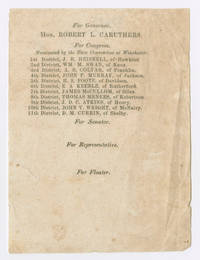
1863WRCAM53688Winchester 1863. Broadside 5 x 3 3/4 inches. Toned minor soiling and wrinkling. Very good. An exceedingly rare Confederate Tennessee state election ticket from 1863 nominating Robert L. Caruthers for governor and eleven others as state senators. In 1863 state elections were due in Tennessee. The state was fractured by war and secession and both Unionists and Confederates expressed the desire to hold elections for state government. Confederate supporters held a convention in Winchester and nominated a governor the State Legislature and members for the Confederate Congress. It was a bit of a fool's errand. <br> <br> Isham G. Harris who still considered himself the governor of Tennessee issued a proclamation calling for the election to be held on the first Thursday in August. Just who voted and how many or how few will probably never be known. According to historians the State Archives in Nashville are scant and inconclusive; returns from only thirty-two counties are found some of which reported the vote of only one civil district. Not a single report was from West Tennessee counties and only eight Middle Tennessee counties made returns. Robert L. Caruthers was elected governor on the face of returns but he was never inaugurated and thus never served a day as governor of Tennessee. No Confederate State Legislature ever convened either. The Confederate Congressmen were the only lucky ones. Those who were elected in 1863 took their seats in Richmond however briefly. <br> <br> George Webb notes this copy in his NOT IN ALLEN bibliography in 2013. Not in Parrish & Willingham. The only other copy or shall we say copies resides at the Library of Virginia in an uncut sheet of six tickets. This will likely be the only copy ever available in the marketplace. WEBB NOT IN ALLEN 199 this copy. unknown books
57846. The UK General Election of 1865 was won by Lord Palmerston for the Liberals increasing their large majority over the Earl of Derby's Conservatives to more than 80. The Liberal Party were the transformed Whigs having changed their name since the previous election in 1859. Palmerston holding the Devon constituency of Tiverton died later in the same year and was succeeded as Prime Minister by Lord John Russell. Robert Jardine above standing for the Liberal Party was elected in Ashburton in 1865 but the constituency was abolished in 1868. unknown
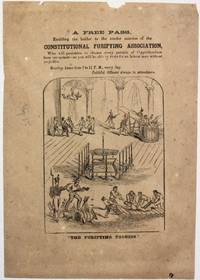
186440035np 1864. Broadside 6.25" x 9" with two-thirds of the sheet consisting of a wood engraving entitled "The Purifying Process." Toned with a few short blank edge chips. Good.<br /> <br /> This scarce political broadside mocks the Copperheads who opposed the Lincoln Administration and the Civil War. The broadside depicts humorous rituals imposed on the Copperheads designed to purge Copperhead-ism from their natures. Weitenkampf and OCLC call this an 1864 broadside with the Lincoln-McClellan election the subject of this piece. <br /> Weitenkampf page 140. OCLC 14137917 4- Lincoln Presidential Library Brown U IL Princeton 1360327631 1- DLC 1085916488 1- AAS as of May 2024. unknown
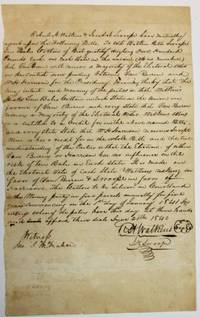
184039023Courtland Lawrence Cty. Alabama 1840. Single page 7-3/4" x 12-3/4." Entirely in ink manuscript. Dated June 20 1840 and signed at the end by Watkins and Swoope with Jno. J. McMahon as witness. Inner edge is irregular. Closed tear no loss repaired expertly at blank bottom margin. Very Good.<br /> <br /> This documents records the terms of a wager on the outcome of the 1840 presidential election. "Watkins betts Swoope Ten Bales Cotton of Best quality weighing Five Hundred Pounds Each on each State in the union 26 in number that Van Buren will receive a majority of the Electoral votes in the contest now pending between Van Buren and Wm. H. Harrison for the Presidency." <br /> In case that's not entirely clear "The true intent and meaning of the parties is that Watkins risks Ten Bales Cotton in each State in the Union in favour of Van Buren and every state that Van Buren receives a majority of the Electoral votes." The bet is made on the electoral vote of each State. Watkins risking in favor of Van Buren & Swoope in favor of Harrison. . . The cotton to be delivered in Courtland to the winning party in five parcels annually for five years commencing on the 1st day of January 1841." <br /> A calculation of States and bales can be seen at the bottom left corner in pencil. <br /> Robert Herndon Watkins 1782-1855 was a farmer in Courtland. Jacob Kuhn Swoope 1800-1841 partnered with his two brothers in the successful Courtland mercantile firm of J & J Swoope in Courtland. John T. McMahon c.1805-1857 was a Courtland commission merchant in the firm of Bierne & McMahon for many years. Saunders Col. James E.: EARLY SETTLERS OF ALABAMA WITH NOTES AND GENEALOGIES New Orleans:1899 accessed online. unknown
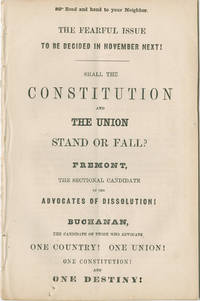
185624482<p>"<i>What a Combination! Seward Greeley Bennet Watson Webb H. Ward Beecher &c. There can be no doubt that this goodly company will speedily be increased by the addition of Fred. Douglass and his black republicans… The only candidate to arrest this tide of demoralization and sectionalism is James Buchanan.</i>"</p><p>This pro-Buchanan election of 1856 pamphlet attacks the first Republican presidential candidate John C. Frémont. Quoting from the speeches and writings of William Lloyd Garrison Horace Greeley Wendell Phillips Salmon P. Chase Henry Ward Beecher William H. Seward Joshua R. Giddings this pamphlet ignores distinctions between abolitionists racial egalitarians more limited opponents just of the expansion of slavery into the territories or those who fought the kidnapping of free African Americans under the Fugitive Slave Law. It paints all with the same broad brush as "Black Republican" extreme abolitionists who were willing to destroy the Union rather than remain in it with slaveholders.</p> <b>ELECTION OF 1856.</b>Printed Document. <i>The Fearful Issue to Be Decided in November Next! Shall the Constitution and the Union Stand or Fall Fremont The Sectional Candidate of the Advocates of Dissolution! Buchanan The Candidate of Those Who Advocate One Country! One Union! One Constitution! and One Destiny!</i> 1856. 24 pp. 5 x 8½ in.<p><b><br /></b></p><p><b>Excerpts:</b></p><p>Before Title: "<i>Read and hand to your Neighbor.</i>"</p><p>"<i>We propose showing by indubitable testimony that John C. Fremont's leading friends are now the open enemies of the Federal Constitution… the enemies of one-half of the States of the Union; the enemies of the laws of Congress; and the enemies to equality of the States.</i>" 3</p><p>"<i>In a speech delivered at the New England Anti-Slavery Convention on the 29th of May 1856 by Wm. Lloyd Garrison we have a flood of light shed on the relation between abolitionism and republicanism which divests the subject of all doubt or uncertainty.</i>" 4</p><p>"<i>William H. Seward was known at the Abolition Convention at Philadelphia… as one of Fremont's warmest supporters. Indeed it is well known that to Chase Seward and Greeley Fremont is mainly indebted for his nomination: they defeated McLean.</i>" 7</p><p>"<i>Nathaniel P. Banks Abolitionist and Disunionist was elected Speaker of the House by a solid sectional vote: he did not get one vote from the South.No man has exhibited such ferocious hostility to the fugitive slave law to the compromise measures and to the Federal Constitution. His speeches full of treason and of war would fill a volume.</i>" 8 and 9</p><p>"<i>Every leading committee has an Abolition Disunionist for chairman and a Disunion majority! There some thirty-five committees in the House… Black Republicans monopolized all the great committees. Thus was the work of Disunion formally begun in the Congress of the United States! This monstrous act unprecedented in all our history was the deliberate work of the men who now surround Fremont.</i>" 10</p><p>"<i>The reverend agitator Ward Beecher is out for Fremont in the last number of his 'Independent.' He is probably next to Garrison and Phillips the most profligate calumniator of the Constitution and the Union.</i>" 19</p><p>"<i>What a Combination! Seward Greeley Bennet Watson Webb H. Ward Beecher &c. There can be no doubt that this goodly company will speedily be increased by the addition of Fred. Douglass and his black republicans. Every Black Republican in Congress from New York is now the earnest advocate of Fremont.</i>" 20</p><p>"<i>We aver that there is not an Abolitionist or Disunionist in Pennsylvania who is not an active and open friend of John C. Fremont for the Presidency. David Wilmot and William F. Johnston lead the motley crew both recreants from the Democratic party because the Democratic party respected the Constitution of the United States and would not desert its injunctions… The only candidate to arrest this tide of demoralization and sectionalism is James Buchanan. It is against him and against the Constitution that this combination has been formed.</i>" 23</p><p>"<i>in the South every vote thrown for Mr. Fillmore is more or less an aid to John C. Fremont to the extent that it may weaken James Buchanan.</i>" 24</p><p>"<i>We would speak of Mr. Fillmore with entire respect. His speech at Albany was patriotic and forcible but it cannot be denied that out of New York in the North all those who pretend to support him will be called upon in the State elections to unite against the Democratic party with the friends of Fremont otherwise known as the Black Republicans.</i>" 24</p><p><b>Historical Background</b></p><p>James Buchanan won with 1.8 million votes and 174 electoral votes from 19 states. Fremont received 1.3 million votes winning 11 northern states with 114 electoral votes. American Party "Know Nothing" candidate and former President Millard Fillmore received 873000 votes winning Maryland's 8 electoral votes. Frémont received no votes at all in 10 of the 14 slave states and fewer than 1200 votes total in the other 4 slave states.</p><p><b>John C. Frémont</b> 1813-1890 "the Pathfinder" was a legendary explorer who achieved military victories in California during the Mexican War. He entered politics as California's first senator and then became the first Republican presidential candidate in 1856. During the Civil War Lincoln removed Frémont from command in Missouri after he unilaterally declared martial law and threatened to confiscate all property including slaves of Southern sympathizers. Lincoln gave Frémont command of an army in western Virginia where he was defeated by Stonewall Jackson in the Battle of Cross Keys. After Frémont refused to serve under General John Pope Lincoln never again gave him a field command contributing to a personal grudge. In 1864 Frémont abandoned his third-party campaign for the presidency in September after Lincoln agreed to remove U.S. Postmaster General Montgomery Blair from office.</p><p><b>Condition</b></p><p>Disbound minor pin holes very good.</p>
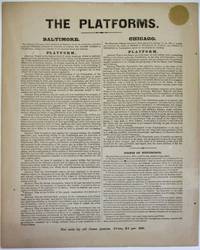
186438115New York: For sale by all News Agents. Price $1 per 100 1864. Broadside 9" x 11 1/2". One margin spot from removal of a gum label light uniform toning. Very Good. Printed in two columns separated by a rule. The Column on the left is headed "Baltimore Platform" for the National Union Republican Party; the right hand column is headed "Chicago Platform" for the Democrat-Copperhead Party. <br /> <br /> A Republican recitation of the Democrats' Platform and the Republicans' Platform in 1864 and an analysis of their 'Points of Difference.' "The Union platform looks to the ending of the war through the defeat and overthrow of the Rebellion while the Democratic contemplates peace through the virtual triumph of the traitors." The broadside exhorts "Freemen of the United States! read mark weigh resolve and VOTE! This is preeminently a contest regarding important principles and measures compared with which personal considerations are of small account." <br /> We conclude that this broadside was printed in New York as the legend "For sale by all News Agents. Price $1 per 100" appears in similar broadside material with a New York imprint.<br /> Sabin 63348. Not in Bartlett. For sale by all News Agents. Price, $1 per 100 unknown
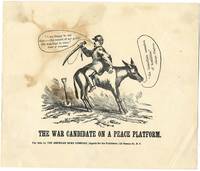
186440123New York: For Sale by the AMERICAN NEWS COMPANY Agents for the Publishers. 121 Nassau St. 1864. Oblong broadside 8" x 9-3/8." Couple of light fox spots not affecting illustration. Very Good.<br /> <br /> The broadside mocks the dissonance in the Democrats' 1864 presidential campaign. Candidate McClellan's acceptance speech supported a continued War Effort; but his Party's platform called for an end to the War. <br /> McClellan sitting backward on a jackass says "I am happy to say that -- the record of my public life was kept in view". The jackass however facing the other direction says quoting from the Chicago Platform "An immediate cessation of hostilities." <br /> Weitenkampf 145. Not in Reilly. OCLC 57744783 2- Boston Ath. NYHS as of June 2024. AAS also owns a copy For Sale by the AMERICAN NEWS COMPANY, (Agents for the Publishers.) 121 Nassau St. unknown
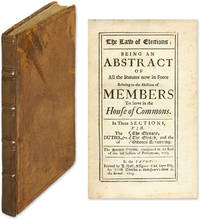
1713539311713. London 1713. 2d ed. London 1713. 2d ed. Scarce Eighteenth-Century English Treatise on Election Law Election Law. Great Britain. The Law of Elections: Being an Abstract of All the Statutes Now in Force Relating to the Election of Members to Serve in the House of Commons: In Three Sections Viz. The Duties &c. of the Electors The Elected And the Officers Returning. London: Printed for J. Nutt Assignee of Ed. Sayer Esq. for Jacob Tonson 1713. vi 126 6 21 3 pp. Half-title lacking. Octavo 6-1/2" x 4". Contemporary sheep blind frames and fillets to boards raised bands to spine rebacked retaining original backstrip hinges mended. Some rubbing with wear to corners a few large scuffs to boards. Toning to portions of text light foxing to a few leaves internally clean. $650. Second edition "continued to the end of the last session of Parliament 1713" which adds an addenda to the first edition of 1708. It was one of the earliest books on the subject. According to Sweet & Maxwell the first studies were Freedom of Elections to Parliament 1680 and Observations Concerning the Regulation of Elections for Parliament 1689 a work attributed to the Earl of Shaftsbury. OCLC locates 6 copies 3 in North America at the Library of Congress Harvard Law School and Stanford University. The ESTC locates 9 copies 8 in Great Britain 1 in North America at the University of Indiana. Sweet & Maxwell A Legal Bibliography of the British Commonwealth 1:151 20. English Short-Title Catalogue T108633. unknown books
185624482<p>"<i>What a Combination! Seward Greeley Bennet Watson Webb H. Ward Beecher &c. There can be no doubt that this goodly company will speedily be increased by the addition of Fred. Douglass and his black republicans… The only candidate to arrest this tide of demoralization and sectionalism is James Buchanan.</i>"</p><p>This pro-Buchanan election of 1856 pamphlet attacks the first Republican presidential candidate John C. Frémont. Quoting from the speeches and writings of William Lloyd Garrison Horace Greeley Wendell Phillips Salmon P. Chase Henry Ward Beecher William H. Seward Joshua R. Giddings this pamphlet ignores distinctions between abolitionists racial egalitarians more limited opponents just of the expansion of slavery into the territories or those who fought the kidnapping of free African Americans under the Fugitive Slave Law. It paints all with the same broad brush as "Black Republican" extreme abolitionists who were willing to destroy the Union rather than remain in it with slaveholders.</p> <b>ELECTION OF 1856.</b>Printed Document. <i>The Fearful Issue to Be Decided in November Next! Shall the Constitution and the Union Stand or Fall Fremont The Sectional Candidate of the Advocates of Dissolution! Buchanan The Candidate of Those Who Advocate One Country! One Union! One Constitution! and One Destiny!</i> 1856. 24 pp. 5 x 8½ in.<p><b><br /></b></p><p><b>Excerpts:</b></p><p>Before Title: "<i>Read and hand to your Neighbor.</i>"</p><p>"<i>We propose showing by indubitable testimony that John C. Fremont's leading friends are now the open enemies of the Federal Constitution… the enemies of one-half of the States of the Union; the enemies of the laws of Congress; and the enemies to equality of the States.</i>" 3</p><p>"<i>In a speech delivered at the New England Anti-Slavery Convention on the 29th of May 1856 by Wm. Lloyd Garrison we have a flood of light shed on the relation between abolitionism and republicanism which divests the subject of all doubt or uncertainty.</i>" 4</p><p>"<i>William H. Seward was known at the Abolition Convention at Philadelphia… as one of Fremont's warmest supporters. Indeed it is well known that to Chase Seward and Greeley Fremont is mainly indebted for his nomination: they defeated McLean.</i>" 7</p><p>"<i>Nathaniel P. Banks Abolitionist and Disunionist was elected Speaker of the House by a solid sectional vote: he did not get one vote from the South.No man has exhibited such ferocious hostility to the fugitive slave law to the compromise measures and to the Federal Constitution. His speeches full of treason and of war would fill a volume.</i>" 8 and 9</p><p>"<i>Every leading committee has an Abolition Disunionist for chairman and a Disunion majority! There some thirty-five committees in the House… Black Republicans monopolized all the great committees. Thus was the work of Disunion formally begun in the Congress of the United States! This monstrous act unprecedented in all our history was the deliberate work of the men who now surround Fremont.</i>" 10</p><p>"<i>The reverend agitator Ward Beecher is out for Fremont in the last number of his 'Independent.' He is probably next to Garrison and Phillips the most profligate calumniator of the Constitution and the Union.</i>" 19</p><p>"<i>What a Combination! Seward Greeley Bennet Watson Webb H. Ward Beecher &c. There can be no doubt that this goodly company will speedily be increased by the addition of Fred. Douglass and his black republicans. Every Black Republican in Congress from New York is now the earnest advocate of Fremont.</i>" 20</p><p>"<i>We aver that there is not an Abolitionist or Disunionist in Pennsylvania who is not an active and open friend of John C. Fremont for the Presidency. David Wilmot and William F. Johnston lead the motley crew both recreants from the Democratic party because the Democratic party respected the Constitution of the United States and would not desert its injunctions… The only candidate to arrest this tide of demoralization and sectionalism is James Buchanan. It is against him and against the Constitution that this combination has been formed.</i>" 23</p><p>"<i>in the South every vote thrown for Mr. Fillmore is more or less an aid to John C. Fremont to the extent that it may weaken James Buchanan.</i>" 24</p><p>"<i>We would speak of Mr. Fillmore with entire respect. His speech at Albany was patriotic and forcible but it cannot be denied that out of New York in the North all those who pretend to support him will be called upon in the State elections to unite against the Democratic party with the friends of Fremont otherwise known as the Black Republicans.</i>" 24</p><p><b>Historical Background</b></p><p>James Buchanan won with 1.8 million votes and 174 electoral votes from 19 states. Fremont received 1.3 million votes winning 11 northern states with 114 electoral votes. American Party "Know Nothing" candidate and former President Millard Fillmore received 873000 votes winning Maryland's 8 electoral votes. Frémont received no votes at all in 10 of the 14 slave states and fewer than 1200 votes total in the other 4 slave states.</p><p><b>John C. Frémont</b> 1813-1890 "the Pathfinder" was a legendary explorer who achieved military victories in California during the Mexican War. He entered politics as California's first senator and then became the first Republican presidential candidate in 1856. During the Civil War Lincoln removed Frémont from command in Missouri after he unilaterally declared martial law and threatened to confiscate all property including slaves of Southern sympathizers. Lincoln gave Frémont command of an army in western Virginia where he was defeated by Stonewall Jackson in the Battle of Cross Keys. After Frémont refused to serve under General John Pope Lincoln never again gave him a field command contributing to a personal grudge. In 1864 Frémont abandoned his third-party campaign for the presidency in September after Lincoln agreed to remove U.S. Postmaster General Montgomery Blair from office.</p><p><b>Condition</b></p><p>Disbound minor pin holes very good.</p> books
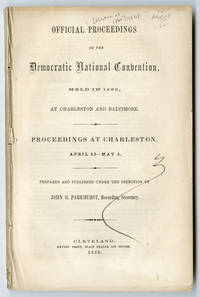
1860WRCAM45168Cleveland: Nevins' Print Plain Dealer Job Office 1860. 188pp. Dbd. Ink pen trial on titlepage. Light wear in fore-edge of titlepage and upper margin of final text leaf. Two text leaves printed on slightly folded paper resulting in obscuration of some text. Good. The official record of a crucially important moment in American politics the 1860 Democratic Conventions at which Stephen A. Douglas won the nomination and faced Republican nominee Abraham Lincoln in the general election. The first convention was held in Charleston in late April and early May and was a rancorous affair. Douglas led the field of nine total candidates at Charleston over the opposition of militant Southern Democrats so-called "Fire Eaters". Despite the fact that fifty-seven separate ballots were held Douglas could not secure the necessary two-thirds majority of delegates. The delegates therefore adjourned and reconvened in Baltimore in June where the committee voted to exclude certain delegates from Louisiana and Alabama who had been disruptive in Charleston. Douglas finally secured the nomination on the second ballot in Baltimore and went on to lose the general election to Lincoln. The present text prints all the proceedings of the Charleston and Baltimore conventions offering a detailed picture of American politics at their most fractious. Nevins' Print, Plain Dealer Job Office unknown books
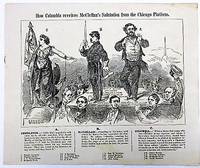
186434855New York 1864. Broadside wood engraving oblong 9-5/8" x 7-7/8". Blank verso uniformly toned Very Good.<br/><br/> "Columbia repudiates Democratic presidential candidate George Brinton McClellan's endorsement of the platform devised at the August 1864 Democratic convention in Chicago. The text below the picture provides the dialogue descriptive notes and identification of the main characters. Columbia: 'What a shame that a man who was educated at my expense and whom I have since honored and petted should have allowed himself to be allured by ambition into such company and upon such a Platform! His Letter cannot conceal his real position nor hide those odious 'planks;' neither can it reconcile me to his traitorous companions. I DISCARD BOTH HIM AND THEM FOREVER'." Reilly <br/> Onlookers include the discredited James Buchanan Fernando Wood Horatio Seymour Clement Vallandigham Franklin Pierce and other Copperheads. <br/>Reilly 1864-22. Weitenkampf 144. OCLC 299946973 2- Lib. Cong. W. Res. Hist. Soc. 881054411 1- UCSB 81099323 1- Am. Phil. Soc. as of April 2018. unknown books
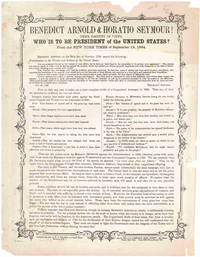
1868WRCAM48472Brooklyn: D.S. Holmes 1868. Broadside 13 x 10 inches. Some small tears chipping and loss at top and right edges. Minor foxing. Very good. Broadside printed for the U.S. Presidential Campaign of 1868 which pitted former New York governor Horatio Seymour against Gen. Ulysses S. Grant. This broadside points out Seymour's Copperhead tendencies and statements made by him in 1864 linking him to similar sentiments made by the notorious traitor Benedict Arnold. Seymour's Copperhead utterances during the war haunted his campaign and he lost decisively to Grant. The text printed here strives to demonstrate: <br> <br> ".the points made by Horatio Seymour against the Administration in 1864 are identical point by point with those made by Benedict Arnold against Washington and the Continental Congress in 1780.The Copperhead chiefs of these times who draw so lavishly upon the sophistries and fallacies of 1780 for the furtherance of their factious designs cannot too well understand that the sequel to all this is endless disgrace. They must not expect to fight the Government with weapons of the Tories and of the blue-light Federalists without sharing the same fate." D.S. Holmes unknown books
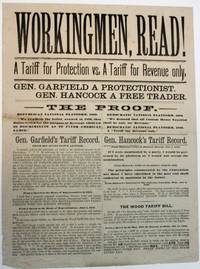
188036539Concord NH 1880. Broadside 11-3/8" x 15-1/4". Printed in a variety of type sizes and fonts. Bit of wrinkling else Very Good. <br/><br/> General James Garfield was the Republicans' 1880 presidential candidate; General Winfield Scott Hancock ran for the Democrats. Garfield's supporters claim here that protective tariffs "favor American labor." Garfield's laudable support for tariffs is contrasted with the views of Hancock and his party. Reduction or elimination of tariffs would "be a movement to equalize wages here with the lowest prevailing in the Old World."<br/> We suggest a New Hampshire imprint because that State's Democratic candidate for Governor Frank Jones is pilloried here for opposing protective legislation.<br/>Not located on OCLC or the online sites of AAS New Hampshire Historical Society or Rauner Library as of April 2020. unknown books
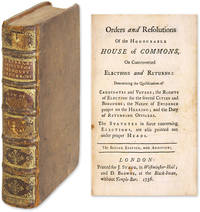
1736633391736. Maryland Colonal Period;. Maryland Colonal Period;. Three Eighteenth-Century Works on English Election Law With an Interesting Maryland Association Great Britain. Election Law. Maryland Colonial Period. Orders and Resolutions of the Honourable House of Commons On Controverted Elections and Returns: Determining the Qualifications of Candidates and Voters; The Rights of Election for the Several Cities and Boroughs; The Nature of Evidence Proper on the Hearing; And the Duty of Returning Officers. The Statutes in Force Concerning Elections Are Also Pointed Out Under Proper Heads. With Additions. London: Printed for J. Stagg 1736. ix i 3-48-48 49-209 8 pp. Bound With The Statutes at Large Concerning Elections of Members to Serve in the House of Commons; Containing A Compleat Collection of All the Acts of Parliament Now in Force Which Relate Thereto Continued to the End of the Last Session of Parliament 1734. London: Printed by John Baskett Printer to the King's Most Excellent Majesty And Sold by Him Robert Gosling in Fleetstteet sic and John Stagg in Westminster-Hall 1734. vi 73 64-109 17 10 pp. The text is continuous despite pagination. And Cowley John Attributed. The Candidates Guide: Or The Electors Rights Decided. Shewing the Determination of the Rights of Elections By the Hon'ble the Commons of Great Britain in Parliament In All Contraverted Elections for the Counties and Boroughs in South Britain From the Year 1624 to 1730. Corrected and Improved. To Which is Added The Like Determinations in Contraverted Elections for North Britain Since the Union. With Several Resolutions and Standing Orders Relating to Elections Qualifications Returns Petitions and Proceedings in General. Together with the Head of the Statutes Now in Force Concerning the Same; And Several Adjusted Cases in Disputed Points of Admitting of Evidence on Hearings at the Bar of the House. The Whole Digested into Alphabetical Order With Proper References and Genuine Quotations. London: Printed for J. Brindley in New Bond-Street And Sold by Mrs. Dodd Without Temple-Bar And by the Booksellers of London and Westminster: Likewise in Most Great Towns in England 1735. 64 pp. 12mo. 6" x 4". Contemporary calf gilt spine with raised bands and lettering pieces. Moderate rubbing to extremities with some wear to spine ends unknown books
172416349Roma, Typis Reu. Cam. Apostolicae (Stamperia della reveranda Camera apostolica), 1724 ; in-4 ; vélin ivoire de l’époque, titre manuscrit au dos ; (2) ff. d’Index. Suivi par : Compendio delle cose principali Contenute nel Ceremoniale di Gregorio XV. De electione Romani Pontificis. Per facilitare alli Signori Cardinali il nuovo modo di elegere il Papa, e per istruttione delli Maestri di Ceremonie. Roma, nella Stamperia della Reu. Cam. Apost., 1724 ; (6) ff. y compris le titre séparé, 11 pp., (1 bl.) ; (10) ff.: Riforma delle Spese solite farsi in tempo di Sede Vacante, e per il Conclave. Vignette sur bois identique aux deux titres, aux armes du Vatican.
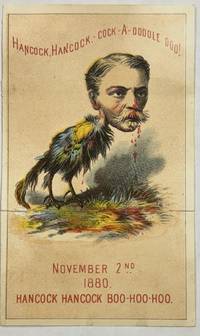
188040342New York: Copyright by Geo. H. Hanks 1880. Metamorphic card 3-1/4" x 5-3/8" fully opened. Richly colored light wear Very Good.<br /> <br /> The unopened illustration depicts a dignified serious Hancock as a rooster in elaborate feathers. But when opened Hancock has lost his feathers is emaciated and bleeding from the mouth. The caption reads "November 2nd. 1880 Hancock Hancock Boo-Hoo-Hoo." Winfield Scott Hancock a decorated Civil War general and a hero of Gettysburg was the losing Democrats' presidential candidate in 1880 opposing Republican James A. Garfield. <br /> The verso entitled 'Rhymes for Young Democrats' brilliantly skewers the overt racism of the Democratic Party. It begins: <br /> "Sing a song of shotguns Pocket full of knives Four-and- twenty black men Running for their lives; When the polls are open Shut the nigger's mouth Isn't that a bully way To make a solid South" <br /> OCLC 32320004 1- Brown as of August 2024. Copyright by Geo. H. Hanks unknown
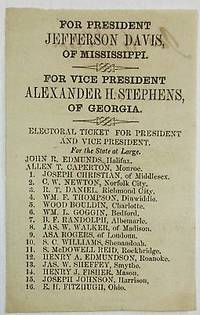
186133882Richmond 1861. Small broadside ticket 3" x 4-3/4". Very Good. <br /> <br /> A rare Virginia Confederate electoral ticket for the Confederacy's first and only national election: Jefferson Davis for President Alexander Stephens for Vice President. Also listed are two at-large electors and sixteen others by District. <br /> Variant of Parrish & Willingham 5367 5368; Crandall 2744 noting "four variant printings and sizes"; and Hummel 4667-4669. unknown