114 résultats
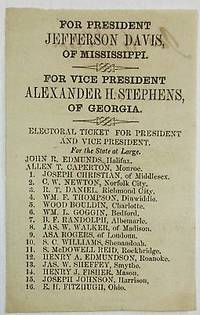
186133882Richmond 1861. Small broadside ticket 3" x 4-3/4". Very good. <br/><br/> A rare Virginia Confederate electoral ticket for the Confederacy's first and only national election: Jefferson Davis for President Alexander Stephens for Vice President. Also listed are two at-large electors and sixteen others by District. <br/>Variant of Parrish & Willingham 5367 5368; Crandall 2744 noting "four variant printings and sizes"; and Hummel 4667-4669. OCLC 58833485 2- U GA Boston Ath. 702707722 1- Yale as of June 2017 different dimensions. unknown books
18811336103Washington: U.S. G.P.O. 1881. Hardcover. Octavo xii 281 pages; VG-; 3/4 bound in black leather red marbled boards gilt lettering to spine; marbled endpapers; moderate rubbing to hinges edges of boards head and tail of spine; 26 folding plates in rear; "March 3 1881.--Laid on the table and ordered to be printed."; name written on second free endpaper; Shelved in case 8 1/2. 1336103. Shelved Dupont Bookstore. [U.S. G.P.O.] hardcover books
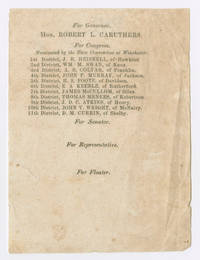
1863WRCAM53688Winchester 1863. Broadside 5 x 3 3/4 inches. Toned minor soiling and wrinkling. Very good. An exceedingly rare Confederate Tennessee state election ticket from 1863 nominating Robert L. Caruthers for governor and eleven others as state senators. In 1863 state elections were due in Tennessee. The state was fractured by war and secession and both Unionists and Confederates expressed the desire to hold elections for state government. Confederate supporters held a convention in Winchester and nominated a governor the State Legislature and members for the Confederate Congress. It was a bit of a fool's errand. <br> <br> Isham G. Harris who still considered himself the governor of Tennessee issued a proclamation calling for the election to be held on the first Thursday in August. Just who voted and how many or how few will probably never be known. According to historians the State Archives in Nashville are scant and inconclusive; returns from only thirty-two counties are found some of which reported the vote of only one civil district. Not a single report was from West Tennessee counties and only eight Middle Tennessee counties made returns. Robert L. Caruthers was elected governor on the face of returns but he was never inaugurated and thus never served a day as governor of Tennessee. No Confederate State Legislature ever convened either. The Confederate Congressmen were the only lucky ones. Those who were elected in 1863 took their seats in Richmond however briefly. <br> <br> George Webb notes this copy in his NOT IN ALLEN bibliography in 2013. Not in Parrish & Willingham. The only other copy or shall we say copies resides at the Library of Virginia in an uncut sheet of six tickets. This will likely be the only copy ever available in the marketplace. WEBB NOT IN ALLEN 199 this copy. unknown books
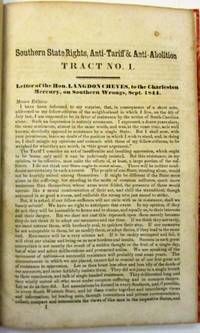
184425849Charleston 1844. 40 pp. Bound in modern quarter red morocco and marbled paper over boards. Minor scattered foxing Very Good plus.<br/><br/> A rare Southern Nationalist tract opposing the election of Henry Clay in 1844 warning of the imminent threat to the South's cherished institution of slavery supporting the Texas annexation and denouncing the North's imposition of protective tariffs. <br/> It begins with Langdon Cheves's Letter opposing separate State secession by South Carolina. Though Northern aggressions-- including the recent rejection of the Treaty to Annex Texas-- and the Tariff are an "insufferable and insulting oppression.I do not think one State ought to resist alone." He urges grass-roots organization to ready the South for mass secession. For this stance Cheves was harshly criticized by Carolinians who urged a go-it-alone policy. His Letter is followed by an early Daniel Webster speech embracing the South's opposition to protective tariffs and support of free trade. John Quincy Adams's Letter illustrates northern "fanaticism" on the slavery issue; Andrew Jackson's Letter of August 1844 supports the annexation of Texas; and James Towles's tract 'The South in Danger' warns against the election of Henry Clay who opposes annexation. <br/>Howes S790 AI 44-5791 and Streeter 1535 each recording a variant issue only. unknown books
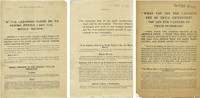
189443553n.p.: Hartman & Cadick 1894. First editions. Self wrappers. Good to very good. 8 pp. 8 pp. 8 pp. 8vo. The mid-term elections of 1884 were a disaster for the Democrats led by Grover Cleveland. Republicans and Populists in large part due to the efforts of Joseph Weeks Babcock 1850-1909 a Republican Congressman from Wisconsin who helped organize the Republican Congressional Campaign Committee in 1893 and was a major force in routing the Democrats in the 1894 House elections which cost the Democrats 113 of their 218 seats. They are most likely printed by Hartman & Cadick Republican printers. All follow the same format of quoting leading figures and using bold face type. 1: Caption title "If the Laboring Class be to Perish I Say the Whole Nation." A the head of the title: No. 1 - From the Congressional Record. The caption title is from the English Reformer William Cobbett followed by "You cannot reduce the laborer to a state of starvation and degradation without also destroying national prosperity" a quote from Joseph Norton Dolph 1835-1897 Senator from Oregon from one of his many speeches quoted here. OCLC locates only a single copy at the Rutherford B. Hayes Presidential Center. A very good copy docketed on front wrapper mail fold. 2: Caption title "The industrial side of the tariff controversy must not be overlooked. The four millions of people who work in our factory system are the most potent factors outside of agriculture in our civilization." - Hon. J. W. Babcock Wisconsin. A the head of the title: Record No. 3. Apparently unrecorded. We could find no copies in OCLC NUC or other reference sources. Chip to front wrapper else very good with docketing stamp. 3: Caption title "When you Rob the Laboring Men of their Employment you Rob the Farmers of their Customers." The quote from the caption title belongs to Charles Curtis 1860-1936 Republican from Kansas who would go on to become Hoover's Vice President. OCLC locates one copy at the Western Reserve Historical Society Library. A good copy browned some minor chipping docketing stamp on front wrapper. [Hartman & Cadick?] unknown books
193624942<p>This sheet contains five rough sketches of graphics calling on the workers and voters of America to support Franklin D. Roosevelt's reelection in 1936. They did in record numbers.</p> <b>PRESIDENTIAL ELECTION OF 1936.</b>Typed Document Signed. Artwork by Franz Felix and Ideas and Copy by Richard Barron "Set of Rough Sketches Containing Some Suggested Promotion Ideas to be Used in the 1936 Democratic Presidential Campaign" July 2 1936. 1 p. 12 x 10½ in.<p><b><br /></b></p><p><b>Excerpts:</b></p><p>"<i>1. Sounding the call against 'economic royalists' in the spirit of 1776.</i>"</p><p>"<i>2. Appropriating the well-known symbol of violence</i> upraised fist<i> diverting it to peaceful democratic use. To include the farmer phrase the appeal: TOILERS OF AMERICA – UNITE FOR ROOSEVELT.</i>"</p><p>"<i>3. The statue of 'The Thinker' as a symbol of the man today who thinks the toiler with brawn and brain.everyman.</i>"</p><p>"<i>4. Direct appeal to radical labor and leftists in general.</i>"</p><p>"<i>5. Another way of appealing to the working class men and women.</i>"</p><p>"<i>This collaborative effort respectfully submitted for consideration to the Chairman of the Democratic National Committee Mr. James A. Farley.</i>"</p><p><b>Historical Background</b></p><p>After unseating incumbent Republican President Herbert Hoover in 1932 President Franklin D. Roosevelt ran for reelection in 1936. His Republican opponent was Governor Alf Landon of Kansas. Although the Great Depression had entered its eighth year Roosevelt's New Deal policies were broadly popular. He won the highest share of the popular and electoral vote since the uncontested 1820 election. Roosevelt attracted more than 60 percent of the popular vote and won the electoral votes of 46 states; Landon won the electoral votes of only Maine and Vermont.</p><p>Democratic Party chairman James Farley had predicted that Roosevelt would lose only Maine and Vermont. After the results of the 1936 election Farley quipped that the nation needed to revise the conventional political wisdom of "As Maine goes so goes the nation" to "As Maine goes so goes Vermont."</p><p>These ideas for campaign imagery employed or modified common images to support Roosevelt's campaign. One drew on the imagery of artist Archibald Willard's 1875 painting <i>The Spirit of '76</i> and employed three figures of workers to match the subjects of Willard's image. Another appropriated the upraised fist as a symbol of violence and repurposed it as a symbol of defiant unity against "<i>economic royalists</i>." A third used an image of <i>The Thinker</i>by French sculptor Auguste Rodin 1840-1917 to appeal to thinking voters. Another image appeals to the fears of radicals that the alternative to Roosevelt is "<i>Reaction</i>."</p><p>Richard Barron and artist Franz Felix submitted these ideas to Democratic National Committee chairman James A. Farley on July 2 1936 three weeks before the Democratic Party held its convention in Philadelphia. There is no evidence that these images were used in the campaign and it is possible that Farley rejected them. At the end of the campaign the Democratic National Committee had a campaign deficit of approximately $850000. To help offset those expenses the treasurer convinced President Roosevelt to sign 2500 brief Forewords which were bound into <i>The Democratic Book 1936</i> and sent to donors of $250. Purchases brought in more than $400000 for the party and led Republicans to charge corrupt practices for allowing corporations to contribute to the campaign by buying copies.</p><p><b>Franz Felix</b> 1892-1967 was born in Vienna Austria and developed an ability as a child to draw portraits in charcoal. He studied portraiture in Vienna and immigrated to the United States shortly after World War I. He settled in San Francisco where he established himself as a portrait artist and commercial illustrator. In the late 1920s he moved to New York and established a studio in the suburb of Spring Valley where he produced book and magazine illustrations. During World War II he painted a series of murals of wartime activities of Spring Valley residents.</p><p><b>James A. Farley</b> 1888-1976 was born in New York into an Irish Catholic family. After his father died he helped his mother with a small business to support the family. After graduating from Packard Business College in New York City where he studied bookkeeping and other business skills Farley got a job with the U.S. Gypsum Corporation. He served as a Democratic town clerk in Stony Point New York and became chairman of the county's Democratic Party in 1918. He organized upstate Democrats and helped elect Alfred E. Smith as Governor that year. He served in the New York State Assembly in 1923 but was defeated at the next election for supporting the repeal of Prohibition. As chair of the state Athletic Commission Farley fought for the civil rights of African American athletes. Farley founded he General Builders Corporation from smaller firms to become New York City's largest building supply company. Farley directed Franklin D. Roosevelt's narrowly successful New York gubernatorial campaign in 1928 and his reelection in 1930. Farley served as chairman of the New York State Democratic Committee from 1930 to 1944 and helped build the national New Deal coalition that elected Roosevelt to the Presidency four times. In 1932 Farley became the chairman of the Democratic National Committee and in 1933 U.S. Postmaster General. He held both positions until 1940. Farley and Roosevelt broke on the two-term tradition of the Presidency in 1940 and he later helped propose the 22nd Amendment to the U.S. Constitution limiting a person to two elections as president approved by Congress in 1947 and ratified in 1951. Farley became chairman of the board of the Coca-Cola Export Corporation in 1940 and held that position for more than thirty years.</p> books
205133unbound. very good. Below are printed the names of the Presidential Electors and Republican statewide candidates from Connecticut for the election of 1884. Included are the successfully elected candidates for Governor and Lieutenant Governor Henry B. Harrison and Lorrin A. Cooke. N.p. 1884. Very good<br/><br/> unknown books
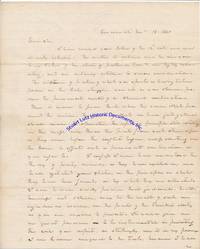
5149PRESIDENTIAL ELECTION OF 1840. ALS. 2pgs. November 18 1840. Cincinnati Ohio. An autograph letter signed “J Burnet†by Ohio lawyer and politician Jacob Burnet 1770-1853. It is addressed to James Dunlap of Pittsburg. Burnet replies to Dunlap’s letter stating his concerns about Pennsylvania politics in light of the recent 1840 Presidential election in which William Henry Harrison defeated Martin Van Buren. Harrison would die only a month into his Presidency. Mentioning a “schism†at one point Burnet seems to anticipate the national divide that would eventually lead to the American Civil War although this may have referred to economic issues rather than the question of slavery: “Dear Sir I have received your letter of the 12th inst and read it with interest. The matter it contains…the view you have taken of the state of parties in Penna are highly interesting and are certainly entitled to serious consideration. The mixture of parties of which you speak as having taken place in the late struggle can not as you observe…There is reason to fear that when the cause which…the union the fruits of which we have just gathered shall warn so often at the repelling principle…will throw the parts from each other as far as they win before the conflict began unless something can be done to effect such a permanent combination as you refer to. I confess I now have understood the theory of party…as they have existed in and have agitated your state or the principles on which they have been found or by which they are…I can however easily…schism may be the result of such an injudicious course on the part of the…you are anxious to prevent. It would give mow me great pleasure to be instrumental in preventing the wit you depict so strikingly were it in my power. I was known unequal to the task because I have no claims to the confidence of the General beyond those of his friends generally not because in addition to this I could not point him to the parties or the persons as to whom he ought to be on his guard. A frank communication from a confidential friend in Penna who understands the whole subject would receive the attention it deserves. An intelligent Penna…can communicate the specific information necessary to show him the danger and the mode of avoiding it. Advice or caution in a care like this to have its proper influence should come from the power of information. Your views on the subject of claims founded on services rendered in the late political contest are precisely those I entertain and express on all occasions and I have reason to believe the General looks on the subject though the same medium and views it in the same light. If our motives have been patriotic our labor has been done for the country and success is our only legitimate reward. If they have been personal they are not praiseworthy and ought not to be rewarded. I am confident that president elect views the matter in that light and that he does not feel personal obligations to any body on account of no part taken in the contest. If this be not so I have very much misunderstood his character. Yours very respectfully J Burnetâ€. The letter is in very good condition with a loss to the back page that does not affect any content. A reminder of the eternal contention and controversy in American political elections. unknown books
179321First Edition. 20pp. 8vo disbound; browning to text. Philadelphia: John Binns 1812.<br/><br/> The Committee of Correspondence consisted of Republican Pennsylvanian state legislators. Address is for the re-election of James Madison and against the candidacy of De Witt Clinton. Last page lists the names of the Pennsylvania Electoral Ticket. S&S 25254.<br/><br/> unknown books
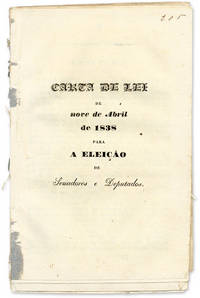
1838609821838. Portugal Election Law. Carta De Lei De Nove De Abril De 1838 Para E Eleicao de Senadores E Deputados Half-title. Porto: Imprensa Constitucional 1838. 33 pp. Folding table. Disbound stab-stitched pamphlet. Light toning foxing to a few leaves early hand-lettered page numbers to upper corners of leaves. $75. The Portuguese law of 1838 governing national elections containing 92 articles with numerous statistical tables relating to district representation. unknown books
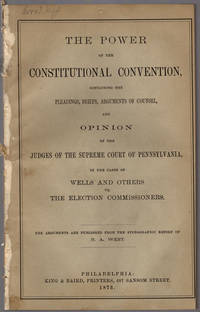
187339109Philadelphia: King & Baird 1873. 8vo 8.75". 206 pp. <br><br>Wrangling over a special election and the power of the conitituional convention. "The arguments are published from the stenographic report of R.A. West. Disbound retains front wrapper. King & Baird unknown books
184427407New York 1844. 6.5" x 8" one leaf. Three light vertical folds. Very Good.<br/><br/> In the 1844 election New York City's voters cast 35% more votes than there were people. Charles P. Brown to whom this letter was addressed was on the Board of Assistant Aldermen for New York City from 1843-44 and was foreman of the grand jury investigating the anomaly. He was also assessor and town supervisor of Alabama New York; and a representative from Genesee County in the General Assembly. unknown books
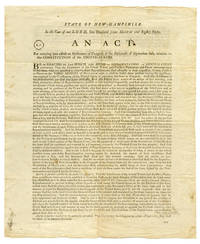
1788WRCAM52937Portsmouth N.H. 1788. Broadsheet approximately 14 1/4 x 11 3/4 inches. Previously folded with one small hole at lower central fold line. Slight curling at edges very light tanning and foxing. Very good. A rare broadsheet calling for New Hampshire representatives to be appointed to the Electoral College for the first presidential election under the Constitution in 1788. On Sept. 13 1788 Congress passed a resolution that electors should be appointed and in response this November 12 act of the New Hampshire legislature declared December 15 as the date to elect the state's representatives to both houses of Congress and to determine its electors for the Electoral College. New Hampshire was the first of the ten states that had ratified the Constitution at this point to hold its federal elections. We locate only two other copies at the American Antiquarian Society and Dartmouth. BRISTOL B6753. WHITTEMORE NEW HAMPSHIRE 458. unknown books
18801406246th Cong. 2d Sess.: SR497. 1880. 28 469pp. Disbound. Very Good. The Democrat Wallace and his committee seek to demonstrate that Massachusetts Republicans "dismissed or threatened with dismissal from employment or deprivation of any right or privilege" anyone who didn't vote Republican in the fall elections. SR497. unknown books
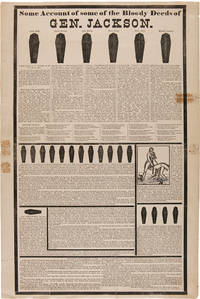
1828WRCAM56438N.p. 1828. Broadside 20 3/4 x 14 inches. Old folds small closed tears along most folds some separation at center fold. Residue and mild staining from previous tape repairs one older tape repair still in place. Minor edge wear and a few small chips even tanning. About very good. One version of the infamous "Coffin Broadsides" attacking Andrew Jackson in the presidential campaign of 1828. There was considerable mud-slinging between the Jackson and Adams camps during that campaign which eventually saw the defeat of incumbent John Quincy Adams and the election of Andrew Jackson. Across the top of the present broadside are six woodcut coffins bearing the names of six militiamen shot for mutiny on Jackson's orders during the War of 1812; an account of their wrongful execution follows. Below that there are more accounts of Jackson's evil and murderous deeds including twelve regular soldiers shot for desertion despite their "not guilty" pleas complete with twelve more coffin woodcuts; Jackson assaulting another man Samuel Jackson in the streets of Nashville and running him through with a sword while Samuel bent over to pick up a rock for defense with a woodcut of a demonic Jackson committing the murderous act; the tale of another soldier unfairly executed another woodcut coffin; and a brief account of some Indian prisoners executed on Jackson's orders four more coffins. The bottom portion includes a testimonial by Thomas Hart Benton who himself had fought a duel with Jackson. <br> <br> The "Coffin Handbill" was printed and reprinted in several sizes and formats. Sabin quotes John Spencer Bassett in his LIFE OF ANDREW JACKSON who notes that the "execution of mutinous militiamen in the campaigns of 1813 and 1814 was recalled to show Jackson's ferocious temper; and when a Philadelphia editor published a hand-bill showing a coffin with the victims standing by its side the idea was caught up eagerly and repeated in all parts of the country." SABIN 86569. OCLC 18042341 45888498. unknown books
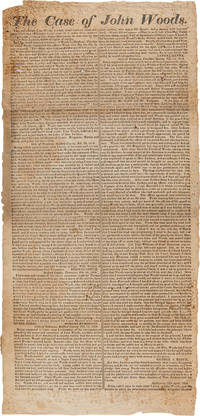
1828WRCAM56513N.p. 1828. Broadsheet 19 x 9 inches text printed in two columns on both sides. Old folds some chips to edges minor loss to upper left corner and closed tear to bottom edge no text affected. Two small holes affecting just one word a few areas of soiling light foxing even tanning. Manuscript annotations to verso. About very good. A rare broadside recounting Andrew Jackson's infamous execution of Private John Woods published in 1828 by Jackson's opponents during the 1828 election. There was considerable mud-slinging between the Jackson and Adams camps during that campaign which eventually saw the defeat of incumbent John Quincy Adams and the election of Andrew Jackson. This dense broadside recounts the events of March 1814 at Fort Strother during the Creek Campaign when Jackson charged John Woods an eighteen year-old militiaman with disobedience disrespect and mutiny. According to the text the trial itself only occurred because Jackson's soldiers would not shoot Woods' at the moment of the offense despite Jackson's cries to "Shoot the damned rascal!.blow ten balls through the damned rascal!" The court martial followed soon after; Woods was found guilty and sentenced to die. Some testimonies here state that Jackson offered to spare Woods' life if he would enlist in the regular army but Woods refused; others disagree. He was executed thirty-six hours later. <br> <br> Then follows the sworn testimony of several witnesses: Thomas Couch Robert Ferguson Samuel Hanna George A. Brock Isaac Roberts James Harris William Stewart Joseph Alexander Isaac Anderson Abm. Whitney and John Williams all fellow-soldiers of Woods who witnessed or had personal knowledge of the facts in the case. Their accounts of Woods' supposed mutiny substantially downplay the severity of Woods' disobedience suggesting that it was likely a misunderstanding; they also emphasize the draconian nature of the punishment and make several mentions of Woods' aging and infirm parents. Williams' account closes: "It is not true that Woods on the ground of Execution with oaths and defiance refused to promise obedience. On the contrary he wept loud and bitterly." All of the testimonies are datelined in Tennessee in the first few months of 1828. The nature of the printing lends itself to the possibility of a Tennessee press. <br> <br> Though not as famous as the "Coffin Handbills" that appeared at the same time listing Woods' execution among many other crimes by Jackson this was definitely addressed to the same audiences. John Spencer Bassett in his LIFE OF ANDREW JACKSON notes that the "execution of mutinous militiamen in the campaigns of 1813 and 1814 was recalled to show Jackson's ferocious temper; and when a Philadelphia editor published a hand-bill showing a coffin with the victims standing by its side the idea was caught up eagerly and repeated in all parts of the country." <br> <br> Not in Wise & Cronin and we could find no listing for this broadside in OCLC or in American Imprints. It has only appeared at auction twice and then not since 1925 when Anderson Galleries offered a copy as part of the sale of the Henry De Puy collection which was strong in Andrew Jackson material. The only copy in the trade seems to be one offered by the Eberstadts in 1939. unknown books
186433879Indianapolis 1864. Folio 8 ½" x 14". 16 pp folded. Poll Book preprinted with introduction columns and headings names of candidates etc. First 5 pages and final 4 pages completed in neat ink manuscript. The first page contains an introduction at the top half followed by names of voters up through #279 on page 5. At page 13 is the pre-printed certification filled in and signed by three officers followed by a list of both preprinted and added names of those on the election ticket and the offices they seek with number of votes received by each in manuscript. The final page contains the docketing information. Signed by Andrew Griffin David McKee and John D. Dource and filed on October 13 1864. Quite clean. Very Good. <br/> with Tally Paper. 17" x 28". Preprinted with heading columns and names of candidates and offices they seek. Some additional candidates added in manuscript with manuscript tallies and calculations. Old folds with a few short splits at corner folds a few splits repaired with archival tape on verso some soiling of verso. At the head of the document are the signatures of Andrew Griffin David McKee and John D. Dource judges; and Benjamin F. Reeve and J.R. Hunt clerks. Tally sheet docketed on verso as filed October 13 1864 by B.F. Tingley Clerk. Very Good. <br/><br/> During Indiana's 1864 gubernatorial election Oliver P. Morton ran on the Union ticket against Democrat Joseph McDonald. Morton had been elected Lt. Governor under Gov. Henry Lane in 1860. Lane resigned two days after being confirmed in January 1861 so that he could take a seat in the U.S. Senate; Morton succeeded to his office. Morton won the election by more than 20000 votes. <br/> Names of the 279 who voted include: Lewis Smith Bradford Z. Norris John B. Reeve Owen Reynolds John W.N. Hunt William Carney Henry Long Hiram Smith Henry Armstrong John Ryan Thomas N. Smith George W. Brown David Johnson Alexander FitzJarrell William Quail Francis M. Patterson George Gray Lorenso D. Richardson Richard W. McKee. <br/> Benjamin F. Tingley 1823-1904 served as the Clerk of Rush County from 1864 to 1872 and he was a member of the local Freemason lodge where he held the position of treasurer for a time. Others who signed off on these documents as judges and clerks were primarily farmers by occupation. unknown books
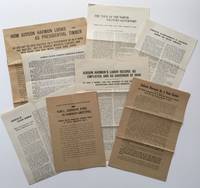
1912371Columbus Oh 1912. About very good. Eight pieces including one 12pp. pamphlet and seven broadsides and bifolia. Old folds light wear. Several items evenly tanned. An informative group of eight extremely scarce or unrecorded pieces promoting the presidential campaign of Ohio Governor and former U.S. Attorney General Judson Harmon in 1912. Harmon eventually lost out to Woodrow Wilson at the Democratic National Convention. The most substantial piece a twelve-page pamphlet concerning Harmon's "presidential timber" located only at the Ohio History Center lavishes praise upon his character and provides a lengthy discussion and defense of his legislative record as Governor. The remaining pieces are not recorded by OCLC and include an endorsement from the late mayor of Cleveland Tom L. Johnson a broadside comparing Harmon's record with Wilson's a four-page endorsement by Charles H. Wirmel leader of the Ohio Steam Engineers Union a broadside printing of endorsements from Progressive leaders in the Democratic Party and two printings of remarks made by Harmon before Democratic Party gatherings. Scarce and ephemeral material on the Democratic contest for the presidential nomination in 1912. unknown books
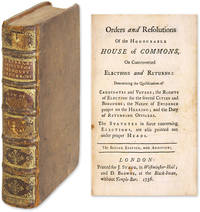
1736633391736. Maryland Colonal Period;. Maryland Colonal Period;. Three Eighteenth-Century Works on English Election Law With an Interesting Maryland Association Great Britain. Election Law. Maryland Colonial Period. Orders and Resolutions of the Honourable House of Commons On Controverted Elections and Returns: Determining the Qualifications of Candidates and Voters; The Rights of Election for the Several Cities and Boroughs; The Nature of Evidence Proper on the Hearing; And the Duty of Returning Officers. The Statutes in Force Concerning Elections Are Also Pointed Out Under Proper Heads. With Additions. London: Printed for J. Stagg 1736. ix i 3-48-48 49-209 8 pp. Bound With The Statutes at Large Concerning Elections of Members to Serve in the House of Commons; Containing A Compleat Collection of All the Acts of Parliament Now in Force Which Relate Thereto Continued to the End of the Last Session of Parliament 1734. London: Printed by John Baskett Printer to the King's Most Excellent Majesty And Sold by Him Robert Gosling in Fleetstteet sic and John Stagg in Westminster-Hall 1734. vi 73 64-109 17 10 pp. The text is continuous despite pagination. And Cowley John Attributed. The Candidates Guide: Or The Electors Rights Decided. Shewing the Determination of the Rights of Elections By the Hon'ble the Commons of Great Britain in Parliament In All Contraverted Elections for the Counties and Boroughs in South Britain From the Year 1624 to 1730. Corrected and Improved. To Which is Added The Like Determinations in Contraverted Elections for North Britain Since the Union. With Several Resolutions and Standing Orders Relating to Elections Qualifications Returns Petitions and Proceedings in General. Together with the Head of the Statutes Now in Force Concerning the Same; And Several Adjusted Cases in Disputed Points of Admitting of Evidence on Hearings at the Bar of the House. The Whole Digested into Alphabetical Order With Proper References and Genuine Quotations. London: Printed for J. Brindley in New Bond-Street And Sold by Mrs. Dodd Without Temple-Bar And by the Booksellers of London and Westminster: Likewise in Most Great Towns in England 1735. 64 pp. 12mo. 6" x 4". Contemporary calf gilt spine with raised bands and lettering pieces. Moderate rubbing to extremities with some wear to spine ends unknown books
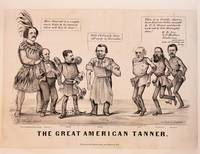
186836501New York: Currier & Ives 1868. Lithograph illustrated broadside by Currier & Ives oblong 11" x 15-1/2". Matted. Light dusting Near Fine. Cartoon characters identified by name; in lower right corner "on Stone by Cameron." John Cameron was a talented artist employed at Currier & Ives. In lower left corner "Thos. Worth. Sketch." Worth designed many cartoon broadsides for Currier & Ives. <br/><br/> "An election-year cartoon invoking both Grant's humble beginnings as a tanner and his successful Civil War military career. Popular New York governor John Thompson Hoffman dressed as an Indian the 'Great Sachem of Tammany' presents Democratic candidates Horatio Seymour and Francis P. Blair Jr. to Grant. He addresses Grant 'Here General is a couple more hides to be tanned when will they be done' Grant smokes a cigar and wears the leather apron of a tanner rolled-up sleeves exposing his muscular arms. He replies 'Well I'll finish them off early in November.' <br/> "At right corner former Confederate generals Robert E. Lee Simon Bolivar Buckner and John C. Pemberton hold their rumps and hop about in pain. They announce 'This is to Certify that we have had our hides tanned and that the work was by him thoroughly done." Reilly AAS's entry asserts "Issued well before 1868 election." <br/>Reilly 1868-11. Weitenkampf 159. OCLC 191119896 2- AAS Villanova as of January 2020. Currier & Ives unknown books
1896200371896. n.p. 1896. 4 pp folded. Caption title as issued. Chipped at blank foremargin Good. A Republican campaign leaflet supporting the Republicans' gold standard against the free silver policy of William Jennings Bryan and the Democrats. Not located on OCLC. unknown books
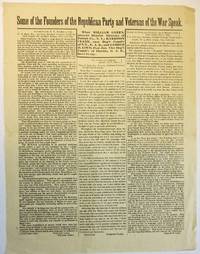
189236912New York 1892. Folio broadside 10" x 13" printed in three columns beneath caption title. Minor wear at blank upper edge Very Good plus.<br/><br/> "The Republican party of 1860 was the exponent of the grandest ideas and the most ennobling sentiments but to what abysmal depths has it fallen in these times. It now stands for nothing more than a corrupting combination between plutocrats and politicians to plunder the people." <br/> Three former Republicans express their dismay at their Party's moral collapse in the Gilded Age and their indignation at Republican mistreatment of Union Civil War veterans. They announce their plans to vote for Grover Cleveland the Democratic candidate in the upcoming presidential election. They are confident "that the interests of the old soldiers are safe with the Democratic party and Grover Cleveland who has always been sincere who has always kept his promises." <br/> The three are William Green District Attorney of Fulton County NY; Harrison Clark "once Dep't Comd'r of N.Y. G.A.R. and George B. Loud Past Jun. Vice Dep't Comd'r of Florida G.A.R." They express their disappointment and anger in these printed letters dated in early October 1892 to Theodore F. Reed Secretary of the National Veterans' Tariff Reform League.<br/>Not located on OCLC as of June 2020 or the online sites of NYPL or NYHS. unknown books
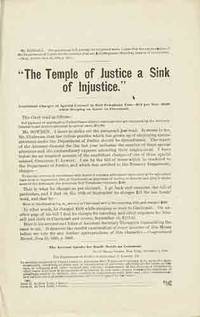
188837352n.p.: n.p. 1888. First edition. Self wrappers. A very good copy. 4 pp. 8vo. First section title reads "Exorbitant Charge of Special Counsel in Bell Telephone Case - $75 per day - $100 while Sleeping en Route to Cincinnati." Goes on to accuse the Department of Justice of rights violations and cronyism. "The Citizen and his rights trampled upon in every direction through processes of law." Extensively quotes Samuel Jackson Randall 1828-1890 Democratic member of the United States House of Representatives from Pennsylvania whose power was waning at the time. OCLC locates only two copies: Library of Michigan and the Wisconsin Historical Society. n.p. unknown books
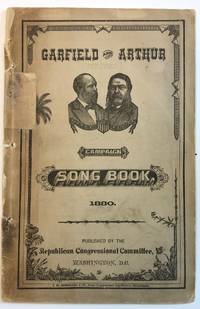
188028864Philadelphia: J.M. Armstrong & Co. Music Typographers and Printers 1880. 24pp stitched in original printed and illustrated wrappers worn at inner margin of wrappers with wrapper title as issued. Good.<br/><br/> Lots of songs with music celebrating the Republicans' Civil War achievements the life of 'Jim Garfield of the West' condemning 'The Bourbon Democracee' etc. The rear wrapper lists the number of each State's electoral votes. J.M. Armstrong & Co., Music Typographers and Printers unknown books
188013357np 1880. 4pp folded caption title as issued. A couple of closed margin tears expert inconspicuous repairs no loss and a few fox blotches. Good or so. <br/><br/> "Document No. 9" of the Democratic Party's 1880 campaign pieces. Hancock hero of Gettysburg accepts his Party's presidential nomination. Also printed is his 1876 letter to General Sherman demonstrating his obedience to civil authorities and constitutional processes as the chaotic election of 1876 worked itself out. unknown books